|
시장보고서
상품코드
2119857
대체 금융 : 시장 점유율 분석, 업계 동향 및 통계, 성장 예측(2026-2031년)Alternative Financing - Market Share Analysis, Industry Trends & Statistics, Growth Forecasts (2026 - 2031) |
||||||
 Mordor Intelligence
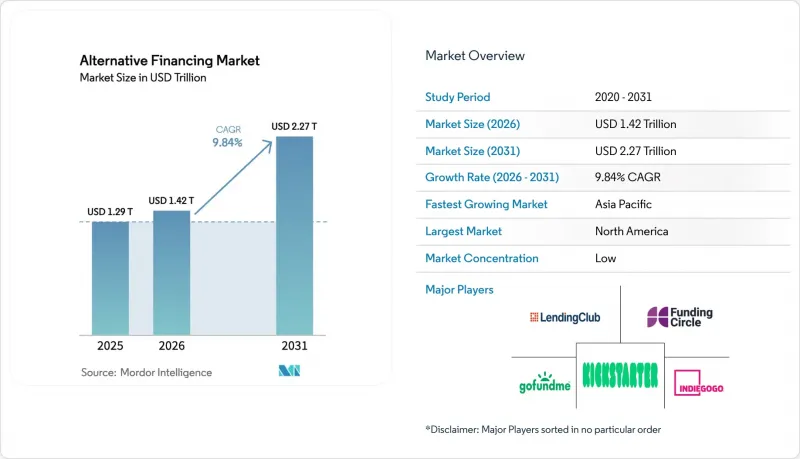
Mordor Intelligence에 의하면, 대체 금융 시장 규모는 2025년에 1조 2,900억 달러로 평가되었습니다. 2026년 1조 4,200억 달러에서 2031년까지 2조 2,700억 달러에 이를 것으로 예상되며, 예측 기간(2026-2031년) CAGR은 9.84%를 나타낼 전망입니다.
본 보고서는 자금 조달 형태(P2P 렌딩, 크라우드펀딩(주식형, 보상형·기부형)), 최종 사용자(개인 소비자, 중소기업(SME), 대기업, 기타), 지역(북미, 남미, 유럽, 기타)별로 분류되어 있습니다. 시장 전망은 금액(미 달러) 기준으로 제시되어 있습니다.
세계의 대체 금융 시장 동향 및 인사이트
디지털 퍼스트를 지향하는 중소기업의 신용 격차 확대
OECD 회원국 기업의 99%를 중소기업이 차지하고 있습니다. 그러나 중소기업은 전 세계적으로 큰 자금 조달 격차에 직면해 있으며, 기존 은행은 엄격한 담보 요건과 수작업 심사 절차에 따른 높은 비용으로 인해 이 격차를 메우는 데 어려움을 겪고 있습니다. 핀테크 대출 업체들은 클라우드 기반 대출 관리 시스템과 AI 신용 평가 모델을 활용하여 신청 절차의 대부분을 자동화하고, 승인 시간을 몇 분으로 단축하는 동시에 대출 1달러당 한계 비용을 절감하고 있습니다. 임베디드 파이낸스(Embedded Finance) 제공업체는 대출 기능을 회계, 전자상거래, 급여 계산 플랫폼에 직접 통합함으로써 지속적인 데이터 루프를 구축하고, 신용 평가의 가시성과 고객 유지율을 높이고 있습니다. 또한, 디지털을 통한 대출 실행으로 대출 기관은 시장에서 ABS(자산담보증권)나 대출 전체를 매각함으로써 노출 위험을 신속하게 신디케이트화할 수 있게 됩니다. 이를 통해 운전자금 대출을 높은 수익률을 추구하는 기관 투자자의 요구를 충족시키는 거래 가능한 자산으로 전환할 수 있습니다. 이러한 요인들이 복합적으로 작용하여 대상 차주 기반이 확대되고 플랫폼의 처리 능력이 향상됨에 따라, 전체 연평균 성장률(CAGR)이 예측치 기준 +2.8% 상승할 것으로 전망됩니다.
개인 투자자의 ‘수익률 추구’ 열기
장기간 지속된 저금리 정책의 여파로, 개인 투자자와 인증 투자자는 더 높은 수익률을 제공하는 사모 신용 상품으로 눈을 돌리고 있으며, 2025년에는 전 세계 사모 신용 자산 풀이 1조 7,000억 달러에 달했습니다. 주식형 및 보상형 크라우드펀딩 캠페인에서는 두 자릿수의 순수익률이 보고되고 있어, 창업자의 벤처 사업에 대한 개인 투자자 수요가 뒷받침되고 있습니다. 각 플랫폼은 단기 소비자 채권을 규제 대상 증권으로 포장하여, 투자 적격 채권과 맞먹는 예측 가능한 상환 일정을 제공하면서도 그 이상의 스프레드를 창출하고 있습니다. 기관 투자자들도 유사한 움직임을 보이며, 시장·대출 ABS 및 담보부 펀드 채무(CFO)를 임베디드함으로써 2차 시장의 유동성을 확대하고, 수익률 추구형 투자자들을 더욱 끌어들이고 있습니다. 이러한 모멘텀에 힘입어 2027년까지 해당 부문의 연평균 성장률(CAGR)은 2퍼센트 포인트 가까이 상승할 것으로 예측됩니다.
전 세계 각국의 제각각인 규제 체계와 라이선스 발급 상한선
국가별 대출 면허, 주별 공시법, 바젤 IV 도입 일정의 불일치로 인해, 특히 국경을 넘어 사업을 확장하는 기업의 경우 컴플라이언스 예산이 증가하고 있습니다. 미국에서는 현재 절반 이상의 주에서 상업 대출에 대해 APR(연간 이자율) 형태의 비용 공시를 의무화하고 있어, 소규모 플랫폼의 경우 대응하기 어려운 맞춤형 워크플로가 생성되고 있습니다. 유럽은행감독청(EBA)의 ‘중대한 위험 이전’에 관한 지침에 따라, 핀테크 기업이 구성한 포트폴리오를 임베디드하는 은행에는 건별 승인 절차가 추가되어 자금 조달 주기가 지연되고 있습니다. 한편, 신흥 시장의 자금 송금 관련 법규에서는 현지 법인 설립이나 최소 자본금 납입이 의무화되는 경우가 많아, 지역 진출이 지연되고 있습니다. 규제 조화가 이루어지지 않은 점은 향후 10년간 총 성장률을 1.8퍼센트 포인트 낮출 것으로 예측됩니다.
부문 분석
수익 기반 금융은 2025년 대출 조성액에서 차지하는 비중이 미미했지만, SaaS(Software-as-a-Service) 제공업체나 소비자 브랜드가 고정 상환 일정보다 월별 매출액에 연동된 상환을 선호하기 때문에 연평균 성장률(CAGR) 27.26%로 다른 모든 카테고리를 앞지르는 속도로 성장하고 있습니다. 이러한 움직임은 벤처 캐피털 기업인 제너럴 카탈리스트가 고객의 마케팅 예산 최대 80%를 보장하기 위해 지속적인 자본을 배정함으로써 신뢰성을 높였으며, 기관 투자자들의 수용을 시사했습니다. 2025년에도 P2P 대출은 여전히 총 대출액의 44.12%라는 최대 점유율을 차지했지만, 이 부문은 기관 투자자로부터 자금을 조달받는 시장형 대출로 변모하고 있습니다. LendingClub만 해도 2025년 1분기에 20억 달러 규모의 대출을 취급했으며, 그 대부분은 검증된 소비자 신용을 추구하는 자산운용사에 의해 임베디드되었습니다. 증권화를 통해 P2P 플랫폼은 45일 이내에 자본을 재투자할 수 있게 되었으며, 새로운 비즈니스 모델이 등장해도 시장 점유율을 유지하고 있습니다.
각 부문의 차별화 요인은 업무 효율성에 있습니다. Upstart에서는 AI를 활용한 의사결정을 통해 개인 대출 승인 프로세스의 92%가 자동화되어 있습니다. ‘지금 구매, 나중에 결제(BNPL)’의 거래액은 계속해서 급증하고 있습니다. Affirm이 최근 설정한 40억 달러 규모의 대출 한도 덕분에 3년 동안 200억 달러 이상의 대출을 취급할 여력이 확대되고 있으며, 이는 민간 신용 시장의 유동성이 매우 높음을 보여줍니다. 매출채권 금융 및 공급망 금융 플랫폼에서는 위조가 불가능한 감사 추적을 확보하기 위해 블록체인을 도입하고 있으며, 이를 통해 지급 주기를 수주에서 수일로 단축하고 부정행위를 줄이고 있습니다. 한편, 머천트 캐시 어드밴스(MCA) 제공업체는 판결 승인서 악용 의혹으로 인해 주 차원의 상한선 규제가 강화되고 있으며, 이 부문은 투명성이 높은 수익 배분형 상환 조건으로 전환되고 있습니다. 환경·사회·지배구조(ESG) 기준이 상품 설계에 점점 더 큰 영향을 미치고 있으며, 대출 기관은 지속가능성 인증을 받은 차입자에게 금리 할인을 제공함으로써 신용 평가에 정성적 요소를 반영하고 있습니다.
지역별 분석
2025년 북미 매출의 34.20%는 오픈 데이터 규제와 증권화의 높은 유동성이 결합되어 창출된 것입니다. 연방 정부가 특정 주에 대한 이자 제한을 우선적으로 적용함으로써 고수익 할부 대출 시장을 전국적으로 통합하는 데 기여하고 있지만, 캘리포니아주와 미주리주 등에서 제정된 새로운 상업 금융 공개법은 소규모 플랫폼에 규정 준수 부담을 안겨주고 있습니다. 2026년에 시행될 캐나다의 연방 소매 결제 감독 체계는 비은행 결제 서비스 제공업체(PSP)에도 라이선스 의무를 확대하여, 국경을 넘는 플랫폼에 대해 위험 관리의 통일을 촉진하게 될 것입니다. 멕시코의 핀테크법은 라틴아메리카에서 두 번째로 큰 경제 규모를 자랑하는 이 나라에서 규제 체계를 구축하려는 결제 및 대출 스타트업들을 지속적으로 유치하고 있으며, 이 지역의 입지를 더욱 확대되고 있습니다.
아시아태평양은 디지털 결제 처리액의 폭발적인 증가와 정부 주도의 오픈 뱅킹 정책에 힘입어, 2026년부터 2031년까지 연평균 성장률(CAGR) 14.23%로 가장 빠르게 성장하는 지역이 될 전망입니다. 핀테크 매출은 2021년 2,450억 달러에서 2030년까지 1조 5,000억 달러로 증가할 것으로 예측되며, 인도와 인도네시아가 가장 큰 증가분을 차지할 것으로 전망됩니다. 싱가포르 MAS(금융관리청)가 제정한 ‘결제 서비스법’은 타국에서 유효한 전자화폐 라이선스를 인정하고 있어, 지역 금융기관의 다중 시장 진출을 용이하게 하고 있습니다. 중국 본토의 앤트 그룹(Ant Group)은 국내 건전성 규제 요건을 준수하기 위해 독립된 사업 단위로 분할되는 동시에, 알리페이+(Alipay+)를 활용해 15억 명의 소비자의 지갑과 57개국 8,800만 개의 가맹점을 기술적으로 연결함으로써, 이를 통해 국경을 넘는 자금 흐름이 촉진되고 있습니다. 아시아의 선진국(호주, 뉴질랜드, 일본)에서는 은행의 사업 축소로 인해 발생한 중견 기업 시장의 자금 조달 공백을 사모 신용 펀드가 메우고 있습니다. 호주에서는 2024년 말까지 600억 달러 규모의 약정 완료된 사모 신용 유동 자금이 확보될 전망입니다.
유럽에서는 PSD3(제3차 결제 서비스 지침), 즉시 결제 지침, 유럽은행감독청(EBA)에 따라 은행이 기관 투자자와 대출 위험을 분담할 수 있는 대규모 위험 이전형 증권화의 추진에 힘입어 균형 잡힌 기회가 제공되고 있습니다. 영국의 ‘소비자 신용법’ 개정은 소액 할부 계획에 관한 규제를 합리화하는 것을 목적으로 하고 있으며, BNPL(후불)의 보급을 가속화할 가능성이 있습니다. 유럽 대륙의 사업자들은 브렉시트 이후 라이선스 ‘여권 제도’의 불확실성에 직면해 있으며, EU에 대한 접근성을 유지하기 위해 일부 플랫폼은 더블린이나 암스테르담에 병행 사업체를 설립하고 있습니다. 중동 및 아프리카에서는 아랍에미리트와 사우디아라비아의 자유무역지대 규제 당국이 90일 이내에 디지털 은행 영업 허가를 부여하게 됨에 따라, 결제를 주축으로 하는 대출 기관의 국경 간 사업 확대가 촉진되고 있습니다. 라틴아메리카에서는 여전히 벤처 캐피털 투자가 활발합니다. 2024년의 경기 침체에도 불구하고 핀테크 기업들은 해당 지역 벤처 캐피털 투자액의 40% 이상을 차지하고 있으며, 브라질과 콜롬비아에서 임베디드 크레딧의 보급이 자금 조달 주기의 변동을 상쇄하고 있습니다.
기타 혜택
- 엑셀 형식 시장 예측(ME) 시트
- 3개월간 애널리스트 지원
자주 묻는 질문
목차
제1장 서론
제2장 조사 방법
제3장 주요 요약
제4장 시장 구도
제5장 시장 규모 및 성장 예측
제6장 경쟁 구도
제7장 시장 기회 및 향후 전망
KTH 26.09.10According to Mordor Intelligence, the alternative financing market size was valued at USD 1.29 trillion in 2025 and estimated to grow from USD 1.42 trillion in 2026 to reach USD 2.27 trillion by 2031, at a CAGR of 9.84% during the forecast period (2026-2031).
This report is Segmented by Financing Type (Peer-To-Peer Lending, Crowdfunding (Equity, Reward/Donation)), by End User (Individual Consumers, Small & Medium Enterprises (SMEs), Large Enterprises, and More), and by Geography (North America, South America, Europe, and More). The Market Forecasts are Provided in Terms of Value (USD).
Global Alternative Financing Market Trends and Insights
Digital-first SME credit-gap expansion
SMEs constitute 99% of enterprises across OECD economies. However, they face a significant global financing gap, which traditional banks struggle to bridge due to restrictive collateral requirements and the high costs associated with manual onboarding processes. Fintech lenders use cloud-based loan-management systems and AI scoring to automate most of the applications, shrinking approval times to minutes while lowering the marginal cost per dollar originated. Embedded-finance providers integrate lending directly into accounting, e-commerce, and payroll platforms, creating a continuous data loop that enhances credit visibility and customer stickiness. Digital origination also allows lenders to syndicate exposures rapidly through marketplace ABS or whole-loan sales, turning working-capital loans into tradable assets that satisfy yield-hungry institutions. Collectively, these forces enlarge the addressable borrower base and raise platform throughput, contributing a forecast +2.8% uplift to the overall CAGR.
Retail-investor 'search-for-yield' momentum
After successive years of low policy rates, retail and accredited investors migrated toward higher-yielding private-credit instruments, fuelling a global private-credit asset pool of USD 1.7 trillion in 2025. Equity and reward-based crowdfunding campaigns have reported double-digit net returns, validating retail demand for direct exposure to entrepreneurial ventures. Platforms package short-duration consumer receivables into regulated notes, providing predictable amortization schedules that rival investment-grade bonds yet generate superior spreads. Institutional allocators mirror that behavior, purchasing marketplace-loan ABS and collateralized fund obligations, enlarging secondary-market liquidity that further attracts yield seekers. Momentum is expected to add almost two percentage points to the sector's CAGR through 2027.
Patch-work global regulatory regimes & licensing caps
Country-specific lending licenses, state-by-state disclosure laws, and diverging Basel IV adoption timelines increase compliance budgets, especially for cross-border scale-ups. In the U.S., more than half the states now require APR-style cost disclosures for commercial loans, creating customized workflows that smaller platforms find difficult to handle. The European Banking Authority's guidelines on significant risk transfer add deal-by-deal approval layers for banks purchasing fintech-originated portfolios, delaying funding cycles. Meanwhile, money transmission statutes in emerging markets often oblige local entity formation and minimum capital deposits, slowing geographic rollouts. Lack of regulatory harmonization is projected to shave 1.8 percentage points off headline growth over the decade.
Other drivers and restraints analyzed in the detailed report include:
- Open-banking legislation & JOBS Act provisions
- Institutional securitization of marketplace loans
- Rising default and fraud risk amid economic slowdown
For complete list of drivers and restraints, kindly check the Table Of Contents.
Segment Analysis
Revenue-based finance, though holding a modest slice of 2025 originations, is outpacing every peer class with a 27.26% CAGR as sellers of software-as-a-service and consumer brands prefer repayment linked to monthly sales rather than fixed amortisation schedules. The movement gained credibility when venture firm General Catalyst allocated recurring capital to underwrite up to 80% of clients' marketing budgets, signalling institutional acceptance. Peer-to-peer lending still commands the largest 44.12% slice of overall volumes in 2025, but the category has morphed into institutionally funded marketplace origination; LendingClub alone handled USD 2 billion in Q1 2025 loans, most purchased by asset managers seeking seasoned consumer credit. Securitisation now allows P2P platforms to recycle capital within 45 days, maintaining shares even as newer models arise.
Operational efficiency differentiates segments: AI-powered decision-making at Upstart automates 92% of personal-loan approvals. Buy-now-pay-later volumes continue to surge; Affirm's latest USD 4 billion warehouse expands its lending headroom to underwrite more than USD 20 billion in three years, evidencing deep private-credit liquidity. Invoice-finance and supply-chain-finance platforms incorporate blockchain for immutable audit trails, shortening pay-out cycles from weeks to days and cutting fraud. Merchant cash-advance providers, on the other hand, face stricter state-level caps after allegations of confessions-of-judgment abuse, nudging the segment toward transparent, revenue-share repayment terms. Environmental, social and governance (ESG) filters increasingly influence product design, with lenders offering rate discounts for certified sustainable-practice borrowers, adding a qualitative layer to credit scoring.
Complete Report Scope:
- By Financing Type
- Peer-to-Peer Lending
- Crowdfunding (Equity, Reward/Donation)
- Revenue-Based Financing
- Merchant Cash Advance
- Invoice & Supply-Chain Finance
- Others (BNPL,Micro-Lending,Equipment Finance)
- By End User
- Individual Consumers
- Small & Medium Enterprises (SMEs)
- Large Enterprises
- Non-profit & Social-impact Organizations
- By Geography
- North America
- Canada
- United States
- Mexico
- South America
- Brazil
- Peru
- Chile
- Argentina
- Rest of South America
- Europe
- United Kingdom
- Germany
- France
- Spain
- Italy
- BENELUX (Belgium, Netherlands, Luxembourg)
- NORDICS (Denmark, Finland, Iceland, Norway, Sweden)
- Rest of Europe
- Asia-Pacific
- India
- China
- Japan
- Australia
- South Korea
- South East Asia
- Rest of Asia-Pacific
- Middle East and Africa
- United Arab Emirates
- Saudi Arabia
- South Africa
- Nigeria
- Rest of Middle East and Africa
- North America
Geography Analysis
North America's 34.20% revenue in 2025 stems from a confluence of open-data regulation and deep securitisation liquidity. Federal pre-emption of certain state usury limits has fostered a uniform national market for high-yield instalment loans, though new commercial-finance disclosure statutes in states like California and Missouri create compliance overhead for smaller platforms. Canada's federal retail-payment supervision framework, coming into force in 2026, will extend licence obligations to non-bank PSPs, nudging cross-border platforms to unify risk controls. Mexico's fintech law continues to attract payments and lending start-ups seeking a regulated foothold in Latin America's second-largest economy, further enlarging the region's footprint.
Asia-Pacific is the fastest-growing block at 14.23% CAGR between 2026 and 2031, driven by an explosion in digital-payment volume and government-backed open-banking agendas. Fintech revenue is projected to rise from USD 245 billion in 2021 to USD 1.5 trillion by 2030, with India and Indonesia delivering the largest incremental volumes. Singapore's MAS Payment Services Act offers passportable e-money licences, simplifying multi-market expansion for regional lenders. Mainland China's Ant Group has split into independent units to align with domestic prudential requirements while using Alipay+ to export technology-connecting 1.5 billion consumer wallets to 88 million merchants across 57 countries-thereby funnelling cross-border lending flows. Developed Asia (Australia, New Zealand, Japan) is seeing private-credit funds fill middle-market funding gaps left by bank retrenchment, with Australia hosting USD 60 billion in committed private-credit dry powder by end-2024.
Europe offers a balanced opportunity, underpinned by PSD3, the instant-payment directive and the European Banking Authority's push for significant risk-transfer securitisations that allow banks to share loan risk with institutional investors. The UK's Consumer Credit Act overhaul aims to streamline rules for small-sum instalment plans, potentially accelerating BNPL penetration. Continental players face licence 'passporting' uncertainty post-Brexit, causing some platforms to establish parallel entities in Dublin and Amsterdam to retain EU access. In the Middle East and Africa, UAE and Saudi Arabia free-zone regulators now grant digital-bank charters within 90 days, spurring cross-border expansion among payments-first lenders. Latin America remains venture-capital heavy: fintechs received over 40% of regional VC dollars despite a 2024 downturn, with embedded-credit adoption in Brazil and Colombia offsetting funding-cycle volatility.
- LendingClub
- Funding Circle
- GoFundMe
- Kickstarter
- Indiegogo
- Prosper
- Kiva
- OnDeck
- CAN Capital
- LendingTree
- Fundbox
- Avant
- Upstart
- Lendio
- Mercado Credito (MercadoLibre)
- Ant Group
- WeBank
- Auxmoney
- RateSetter
- Zopa
- Klarna
Additional Benefits:
- The market estimate (ME) sheet in Excel format
- 3 months of analyst support
TABLE OF CONTENTS
1 Introduction
- 1.1 Study Assumptions & Market Definition
- 1.2 Scope of the Study
2 Research Methodology
3 Executive Summary
4 Market Landscape
- 4.1 Market Overview
- 4.2 Market Drivers
- 4.2.1 Digital-first SME credit-gap expansion
- 4.2.2 Retail-investor "search-for-yield" momentum
- 4.2.3 Open-banking & JOBS-Act-style regulations
- 4.2.4 Institutional securitization of marketplace loans
- 4.2.5 Tokenization of real-world assets (fractional funding)
- 4.2.6 Bank capital-rule tightening pushing borrowers to fintech lenders
- 4.3 Market Restraints
- 4.3.1 Patch-work global regulatory regimes & licensing caps
- 4.3.2 Rising default / fraud risk amid economic slowdown
- 4.3.3 High cost of capital versus deposit-funded banks
- 4.3.4 ABS warehouse liquidity crunch for non-bank lenders
- 4.4 Value / Supply-Chain Analysis
- 4.5 Regulatory Landscape
- 4.6 Technological Outlook
- 4.7 Porter's Five Forces
- 4.7.1 Threat of New Entrants
- 4.7.2 Bargaining Power of Buyers
- 4.7.3 Bargaining Power of Suppliers
- 4.7.4 Threat of Substitutes
- 4.7.5 Competitive Rivalry
5 Market Size & Growth Forecasts
- 5.1 By Financing Type
- 5.1.1 Peer-to-Peer Lending
- 5.1.2 Crowdfunding (Equity, Reward/Donation)
- 5.1.3 Revenue-Based Financing
- 5.1.4 Merchant Cash Advance
- 5.1.5 Invoice & Supply-Chain Finance
- 5.1.6 Others (BNPL,Micro-Lending,Equipment Finance)
- 5.2 By End User
- 5.2.1 Individual Consumers
- 5.2.2 Small & Medium Enterprises (SMEs)
- 5.2.3 Large Enterprises
- 5.2.4 Non-profit & Social-impact Organizations
- 5.3 By Geography
- 5.3.1 North America
- 5.3.1.1 Canada
- 5.3.1.2 United States
- 5.3.1.3 Mexico
- 5.3.2 South America
- 5.3.2.1 Brazil
- 5.3.2.2 Peru
- 5.3.2.3 Chile
- 5.3.2.4 Argentina
- 5.3.2.5 Rest of South America
- 5.3.3 Europe
- 5.3.3.1 United Kingdom
- 5.3.3.2 Germany
- 5.3.3.3 France
- 5.3.3.4 Spain
- 5.3.3.5 Italy
- 5.3.3.6 BENELUX (Belgium, Netherlands, Luxembourg)
- 5.3.3.7 NORDICS (Denmark, Finland, Iceland, Norway, Sweden)
- 5.3.3.8 Rest of Europe
- 5.3.4 Asia-Pacific
- 5.3.4.1 India
- 5.3.4.2 China
- 5.3.4.3 Japan
- 5.3.4.4 Australia
- 5.3.4.5 South Korea
- 5.3.4.6 South East Asia
- 5.3.4.7 Rest of Asia-Pacific
- 5.3.5 Middle East and Africa
- 5.3.5.1 United Arab Emirates
- 5.3.5.2 Saudi Arabia
- 5.3.5.3 South Africa
- 5.3.5.4 Nigeria
- 5.3.5.5 Rest of Middle East and Africa
- 5.3.1 North America
6 Competitive Landscape
- 6.1 Market Concentration
- 6.2 Strategic Moves
- 6.3 Market Share Analysis
- 6.4 Company Profiles (includes Global-level Overview, Market-level overview, Core Segments, Financials as available, Strategic Information, Market Rank/Share for key companies, Products & Services, Recent Developments)
- 6.4.1 LendingClub
- 6.4.2 Funding Circle
- 6.4.3 GoFundMe
- 6.4.4 Kickstarter
- 6.4.5 Indiegogo
- 6.4.6 Prosper
- 6.4.7 Kiva
- 6.4.8 OnDeck
- 6.4.9 CAN Capital
- 6.4.10 LendingTree
- 6.4.11 Fundbox
- 6.4.12 Avant
- 6.4.13 Upstart
- 6.4.14 Lendio
- 6.4.15 Mercado Credito (MercadoLibre)
- 6.4.16 Ant Group
- 6.4.17 WeBank
- 6.4.18 Auxmoney
- 6.4.19 RateSetter
- 6.4.20 Zopa
- 6.4.21 Klarna
7 Market Opportunities & Future Outlook
- 7.1 White-space & Unmet-need Assessment