|
시장보고서
상품코드
2124271
크라우드펀딩 시장 : 시장 점유율 분석, 업계 동향 및 통계, 성장 예측(2026-2031년)Crowdfunding - Market Share Analysis, Industry Trends & Statistics, Growth Forecasts (2026 - 2031) |
||||||
 Mordor Intelligence
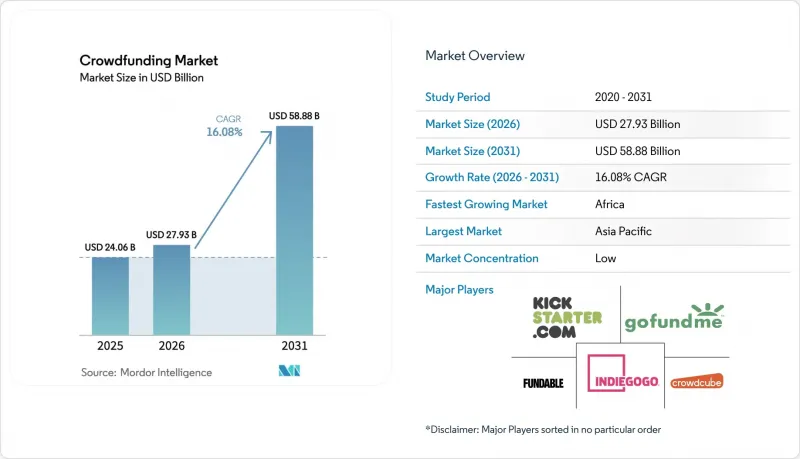
Mordor Intelligence에 의하면, 크라우드펀딩 시장 규모는 2025년에 240억 6,000만 달러로 평가되었고, 2026년에 279억 3,000만 달러로 추정되고,, 2031년까지 588억 8,000만 달러에 이를 것으로 예측되며, 2026-2031년 CAGR 16.08%로 성장할 전망입니다.
본 보고서는 자금 조달 모델별(리워드형, 주식형, 기타), 투자 규모별(마이크로(1만 달러 이하), 소규모(1만-25만 달러), 기타), 플랫폼 도입 방식별(클라우드 기반, 온프레미스형), 투자자 유형별(개인 투자자, 기타), 용도 분야별(기술 및 혁신, 식음료, 기타), 지역별로 분류되어 있습니다. 시장 전망은 금액(달러) 기준으로 제시되어 있습니다.
세계의 크라우드펀딩 시장 동향 및 인사이트
EU 전역을 대상으로 한 ECSP 규제가 국경을 넘는 주식형 크라우드펀딩의 가능성을 넓히고 있습니다.
유럽의 크라우드펀딩 서비스 제공업체 규정(2020/1503)은 플랫폼이 현지 법인을 설립하지 않고도 모든 회원국의 투자자에게 접근할 수 있는 ‘싱글 패스포트’ 제도를 도입하고 있습니다. 이를 통해 법적 비용이 절감되고, 유동성이 집중되며, 발행사의 접근성이 확대됩니다. 반면, 모집 규모는 500만 유로(424만 달러)로 상한선이 설정되어 있으며, 표준화된 공시가 의무화되어 있습니다. Seedrs와 Crowdcube는 현재 남유럽 및 동유럽 시장에 진출해 있는 반면, 걸프 국가와 아프리카의 규제 당국은 규제 조화를 가속화하기 위해 이 프레임워크를 벤치마크로 삼고 있습니다. 자금 세탁 방지(AML)에 관한 해석 차이가 여전히 남아 있어 규정 준수상의 중복이 발생하기 쉬우며, 대규모 법무 팀을 보유한 플랫폼이 유리한 입장에 있습니다.
AI를 활용한 캠페인 분석이 전 세계적으로 성공률을 향상
머신러닝 엔진은 과거 투자 약정 데이터와 실시간 참여 지표를 분석하여 가격 책정, 보상 체계, 캠페인 시작 시기를 최적화합니다. 동료 심사를 거친 연구에 따르면, AI를 활용한 캠페인의 성공률은 15-20% 상승하는 것으로 나타났습니다. 자연어 처리 모델은 피치(pitch)의 질을 향상시키고, 이상 감지 기능은 가짜 지지자나 중복된 지갑을 차단합니다. 이러한 이중 기능 덕분에 투자자의 신뢰가 높아지고, 그동안 사기로 인해 발목이 잡혀 있던 시장의 확산이 촉진되고 있습니다.
아시아태평양 플랫폼의 막대한 부정 손실이 투자자의 신뢰를 훼손하고 있습니다.
감독 체계가 거래량을 따라가지 못하는 지역에서는 부정 캠페인이나 자금 횡령이 여전히 만연하고 있습니다. 일부 운영자는 분리 관리 계좌나 감사 요건을 회피하고 있어, 재구매자 후원자들의 신뢰를 훼손하고 있습니다. 일본 증권거래등감시위원회는 감독을 강화하고 있지만, 집행은 여전히 불균일하여 악질적인 플랫폼이 규제가 느슨한 관할 구역을 악용할 여지가 남아 있습니다.
부문 분석
2025년, 보상형 캠페인은 크라우드펀딩 시장 점유율의 34.44%를 차지했으나, 스마트 계약을 통해 보상과 지분권이 융합됨에 따라 하이브리드형 토큰은 연평균 성장률(CAGR) 16.22%로 확대되고 있습니다. 주식 조달 라운드는 500만 달러까지의 자금 조달을 허용하는 SEC의 2021년 규정 개정의 혜택을 받아 크라우드펀딩 시장의 확대에 기여하고 있습니다. 부채 기반 모델은 신흥 경제국에서 금융 서비스가 미치지 못하는 차입자의 요구를 충족시키는 한편, 건강 위기 시에는 기부 캠페인이 급증하고 있습니다.
하이브리드형 제공 제품은 투자자들이 원하는 상승 여력과 유동성을 모두 충족시키고 있습니다. Republic은 현재 롤링 펀드를 통해 혜택을 주식으로 전환하고 있으며, 일본의 새로운 소규모 공모 제도에서는 토큰 제공 제품이 명시적으로 허용되고 있습니다. 세제 명확화 및 유통 시장에 관한 규정은 여전히 정비 중이며, 도입이 가속화되는 한편 운영상의 복잡성도 증가하고 있습니다.
2025년에도 1만 달러 이하의 소액 투자는 여전히 50.24%의 점유율을 차지했지만, 연금 기금과 패밀리 오피스가 크라우드펀딩 시장에 진입함에 따라 100만 달러를 초과하는 고액 자금 조달 라운드는 연평균 성장률(CAGR) 17.06%로 성장을 지속하고 있습니다. 인증 투자자에 대한 상한선을 철폐하는 SEC의 개혁에 따라 7자리 수의 투자액도 촉진되고 있습니다. 1만 달러에서 25만 달러 규모의 소액 투자는 플랫폼이 엄선한 투자 대상에 접근하기 위해 자금을 모은 인증 엔젤 투자자나 신디케이트를 위한 것이며,반면, 25만 달러에서 100만 달러 규모의 중규모 투자는 엔젤 라운드와 기관 투자자에 의한 시리즈 A 자금 조달 사이의 격차를 메우는 역할을 하고 있습니다.
각 플랫폼은 경험 많은 투자자층이 수용될 수 있도록 단계적인 KYC(신원 확인), 사이드 레터, 캡 테이블 연계 등의 조치를 취하고 있습니다. AngelList의 보고서에 따르면, 해당 기업의 시드 라운드 프로젝트 중 3분의 1이 AI 스타트업이며, 기관 투자자의 자금이 성장성이 높은 분야에 집중되고 있는 실태가 드러나고 있습니다. 반면, 금전적 수익보다 커뮤니티를 중시하는 개인 투자자가 시장에서 배제될 위험도 우려됩니다.
지역별 분석
아시아태평양은 모바일 지갑, 지원적인 샌드박스 규제, 소규모 공모 한도를 4배로 상향 조정한 2024년 일본의 개혁에 힘입어 전 세계 거래량의 절반을 차지하고 있습니다. 이 지역의 블록체인 허브인 싱가포르, 홍콩, 도쿄에는 유동성을 높이고 크라우드펀딩 시장을 뒷받침하는 보안 토큰 거래소가 자리 잡고 있습니다. 중국과 동남아시아 일부 지역에서는 여전히 사기 우려가 두드러지지만, AI를 활용한 모니터링을 통해 신뢰 격차는 점차 좁혀지고 있습니다.
아프리카의 연평균 성장률(CAGR) 17.54%는 모바일 머니의 보급과 기업의 ESG 관련 자금 유입에 기인합니다. 각 플랫폼은 M-Pesa의 결제 네트워크를 통합하고, 은행 계좌가 없는 사용자의 투자도 수용함으로써 서비스 범위를 확대되고 있습니다. 그러나 서아프리카에서는 높은 네트워크 수수료와 카드 결제 게이트웨이 제한으로 인해 운영 비용이 상승하고 있어, 프랑스어권 국가로의 확장이 지연되고 있습니다.
북미는 인증 투자자의 탄탄한 기반과 SEC의 상한선 규제 완화 혜택을 누리고 있으며, 벤처 캐피털과의 경계를 모호하게 만드는 거액의 자금 조달 라운드를 뒷받침하고 있습니다. 유럽은 ECSP 패스포트를 활용해 분산된 시장을 연결하고 있지만, AML(자금 세탁 방지) 규제의 차이로 인해 컴플라이언스 비용이 높은 수준을 유지하고 있어, 대형 사업자에 의한 시장 점유율 집중이 진행되고 있습니다.
남미에서는 통화 변동이 과제로 대두되고 있으며, 브라질과 아르헨티나의 플랫폼에서는 인플레이션 헤지를 목적으로 스테이블코인 기반의 캠페인을 제공합니다. 중동에서는 샤리아(이슬람 법)에 부합하는 구조가 주목받고 있으며, 특히 걸프 지역에서는 자산 담보형 이익 분배가 이슬람 금융의 원칙에 부합하는 것으로 지지받고 있습니다.
기타 혜택
- 엑셀 형식 시장 예측(ME) 시트
- 3개월간 애널리스트 지원
자주 묻는 질문
목차
제1장 서론
제2장 조사 방법
제3장 주요 요약
제4장 시장 구도
제5장 시장 규모 및 성장 예측
제6장 경쟁 구도
제7장 시장 기회 및 향후 전망
AJYAccording to Mordor Intelligence, the crowdfunding market size is projected to be USD 24.06 billion in 2025, USD 27.93 billion in 2026, and reach USD 58.88 billion by 2031, growing at a CAGR of 16.08% from 2026 to 2031.
This report is Segmented by Funding Model (Reward-Based, Equity-Based, and More), Investment Size (Micro (Less Than USD 10, 000), Small (USD 10, 000 - 25, 000), and More), Platform Deployment (Cloud-Based, and On-Premises), Investor Type (Individual Retail, and More), Application Sector (Technology and Innovation, Food and Beverage, and More), and Geography. The Market Forecasts are Provided in Terms of Value (USD).
Global Crowdfunding Market Trends and Insights
EU-Wide ECSP Regulation Unlocking Cross-Border Equity Crowdfunding
The European Crowdfunding Service Providers Regulation 2020/1503 offers a single passport that lets platforms reach investors across all member states without opening local entities. This lowers legal overhead, aggregates liquidity, and expands issuer reach, all while capping offering size at EUR 5 million (USD 4.24 million) and mandating standardized disclosures. Seedrs and Crowdcube now penetrate Southern and Eastern Europe, while regulators in the Gulf and Africa benchmark the framework to accelerate convergence. Persistent divergence in AML interpretations still raises compliance duplication, favoring platforms with large legal teams.
AI-Powered Campaign Analytics Increasing Success Rates Globally
Machine-learning engines parse historical pledge data and real-time engagement metrics to optimize pricing, reward tiers, and launch timing. Peer-reviewed studies show a 15-20-percentage-point lift in success rates for AI-enhanced campaigns. Natural-language models refine pitch quality, while anomaly detection blocks fake backers and duplicate wallets. These dual functions enhance investor trust and drive adoption in markets previously hamstrung by fraud.
High Platform Fraud Losses Undermining Investor Trust in Asia Pacific
Fraudulent campaigns and misappropriation of funds persist where supervision lags transaction volumes. Some operators bypass requirements for segregated accounts and audits, eroding confidence among repeat backers. Japan's Securities and Exchange Surveillance Commission has tightened oversight, yet enforcement remains uneven, allowing rogue platforms to arbitrage weak jurisdictions.
Other drivers and restraints analyzed in the detailed report include:
- Emergence of Blockchain Tokenization Enabling Fractional Real Estate in Asia Pacific
- Corporate ESG Commitments Channeling Funds Into Social-Impact Campaigns
- Fragmented KYC/AML Rules Elevating Compliance Costs
For complete list of drivers and restraints, kindly check the Table Of Contents.
Segment Analysis
Reward campaigns accounted for a 34.44% crowdfunding market share in 2025, yet hybrid tokens are advancing at a 16.22% CAGR as smart contracts blend perks with equity rights. Equity rounds benefit from the SEC's 2021 rule change allowing raises up to USD 5 million, broadening the crowdfunding market. Debt-based models meet underserved borrowers in emerging economies, while donation drives surge during health crises.
Hybrid offerings satisfy investor hunger for upside and liquidity. Republic now converts perks into equity through rolling funds, and Japan's new small-offering regime expressly accommodates token offerings. Tax clarity and secondary-market rules remain works in progress, adding operational complexity even as adoption accelerates.
Micro pledges below USD 10,000 still account for 50.24% share in 2025, but large-ticket rounds over USD 1 million show a 17.06% CAGR as pension funds and family offices embrace the crowdfunding market. SEC reforms that drop caps for accredited investors encourage seven-figure checks. Small investments between USD 10,000 and USD 250,000 serve accredited angels and syndicates that pool capital to access deal flow curated by platforms, while medium-sized investments between USD 250,000 and USD 1 million bridge the gap between angel rounds and institutional Series A financings.
Platforms respond with tiered KYC, side letters, and cap-table integrations acceptable to sophisticated allocators. AngelList reports that one-third of its seed deals involve AI startups, illustrating how institutional flows favor high-growth themes. The risk is crowding out retail backers who value community over financial returns.
Complete Report Scope:
- By Funding Model
- Reward-Based
- Equity-Based
- Debt / P2P Lending
- Donation-Based
- Hybrid / Blockchain-Based
- Real-Estate-Specific Crowdfunding
- By Investment Size
- Micro (Less Than USD 10 k)
- Small (USD 10 k - 250 k)
- Medium (USD 250 k - 1 m)
- Large (Greater Than USD 1 m)
- By Platform Deployment
- Cloud-Based
- On-Premise
- By Investor Type
- Individual Retail
- Accredited / High-Net-Worth
- Institutional
- Corporate Strategic
- By Application Sector
- Technology and Innovation
- Food and Beverage
- Media and Entertainment
- Real Estate and Construction
- Healthcare and Life Sciences
- Social Impact and Non-Profit
- Consumer Products and Fashion
- Other Application Sectors
- By Geography
- North America
- United States
- Canada
- Mexico
- South America
- Brazil
- Argentina
- Rest of South America
- Europe
- Germany
- United Kingdom
- France
- Italy
- Spain
- Russia
- Rest of Europe
- Asia Pacific
- China
- Japan
- India
- South Korea
- Australia and New Zealand
- Southeast Asia
- Rest of Asia Pacific
- Middle East
- Saudi Arabia
- United Arab Emirates
- Turkey
- Rest of Middle East
- Africa
- South Africa
- Nigeria
- Kenya
- Rest of Africa
- North America
Geography Analysis
Asia Pacific commands half of global volume, driven by mobile wallets, supportive sandbox regulations, and the 2024 Japanese reforms that quadrupled small-offering limits. The region's blockchain hubs Singapore, Hong Kong, and Tokyo host security-token exchanges that deepen liquidity and anchor the crowdfunding market. Fraud concerns remain pronounced in China and parts of Southeast Asia, yet AI-powered monitoring is narrowing the trust gap.
Africa's 17.54% CAGR stems from mobile-money ubiquity and corporate ESG inflows. Platforms integrate M-Pesa rails to accept pledges without bank accounts, broadening reach. However, high network fees and restricted card gateways in West Africa raise operating costs, delaying expansion into francophone countries.
North America benefits from a deep base of accredited investors and the SEC's relaxed caps, fueling mega rounds that blur lines with venture capital. Europe leverages the ECSP passport to knit fragmented markets, but divergent AML rules keep compliance costs high, consolidating share among larger operators.
South America faces currency volatility, so Brazilian and Argentine platforms now offer stablecoin-denominated campaigns to hedge inflation. The Middle East's Shariah-compliant structures are gaining traction, especially in the Gulf, where asset-backed profit-sharing aligns with Islamic finance principles.
- Kickstarter PBC
- Indiegogo Inc.
- GoFundMe Inc.
- Crowdcube Limited
- Fundable LLC
- Wefunder Inc.
- CircleUp Network Inc.
- SeedInvest Technology Inc.
- Patreon Inc.
- Fundrise LLC
- Crowdfunder Inc.
- StartEngine Crowdfunding Inc.
- AngelList Holdings LLC
- GoGetFunding
- RealCrowd Inc.
- MicroVentures
- LendingClub Corporation
- Seedrs Limited
- Ulule SAS
- Campfire Inc.
- Milaap Social Ventures India Private Limited
- Makestar Co., Ltd.
- Mightycause Corporation
Additional Benefits:
- The market estimate (ME) sheet in Excel format
- 3 months of analyst support
TABLE OF CONTENTS
1 INTRODUCTION
- 1.1 Study Assumptions and Market Definition
- 1.2 Scope of the Study
2 RESEARCH METHODOLOGY
3 EXECUTIVE SUMMARY
4 MARKET LANDSCAPE
- 4.1 Market Overview
- 4.2 Market Drivers
- 4.2.1 Social-Media-Driven Virality Boosting Reward Campaigns in North America and Europe
- 4.2.2 EU-Wide ECSP Regulation Unlocking Cross-Border Equity Crowdfunding
- 4.2.3 AI-Powered Campaign Analytics Increasing Success Rates Globally
- 4.2.4 Emergence of Blockchain-Based Tokenization Enabling Fractional Real-Estate Deals in Asia Pacific
- 4.2.5 Corporate ESG Commitments Channelling Funds into Social-Impact Campaigns in Africa and South America
- 4.2.6 Rising Adoption of Shariah-Compliant Crowdfunding Platforms in Middle East
- 4.3 Market Restraints
- 4.3.1 High Platform Fraud Losses Undermining Investor Trust in Asia Pacific
- 4.3.2 Fragmented KYC/AML Rules Elevating Compliance Costs in Europe and United States
- 4.3.3 Crowdfunding Fatigue Amid Campaign Proliferation Lowering Donation Conversion Rates
- 4.3.4 Restricted Payment Gateway Access Limiting Crowdfunding Platform Launches in Emerging African Markets
- 4.4 Industry Value Chain Analysis
- 4.5 Regulatory Outlook
- 4.6 Technological Outlook
- 4.7 Impact of Macroeconomic Factors on the Market
- 4.8 Porter's Five Forces Analysis
- 4.8.1 Threat of New Entrants
- 4.8.2 Bargaining Power of Buyers/Consumers
- 4.8.3 Bargaining Power of Suppliers
- 4.8.4 Threat of Substitute Products
- 4.8.5 Intensity of Competitive Rivalry
5 MARKET SIZE AND GROWTH FORECASTS (VALUE)
- 5.1 By Funding Model
- 5.1.1 Reward-Based
- 5.1.2 Equity-Based
- 5.1.3 Debt / P2P Lending
- 5.1.4 Donation-Based
- 5.1.5 Hybrid / Blockchain-Based
- 5.1.6 Real-Estate-Specific Crowdfunding
- 5.2 By Investment Size
- 5.2.1 Micro (Less Than USD 10 k)
- 5.2.2 Small (USD 10 k - 250 k)
- 5.2.3 Medium (USD 250 k - 1 m)
- 5.2.4 Large (Greater Than USD 1 m)
- 5.3 By Platform Deployment
- 5.3.1 Cloud-Based
- 5.3.2 On-Premise
- 5.4 By Investor Type
- 5.4.1 Individual Retail
- 5.4.2 Accredited / High-Net-Worth
- 5.4.3 Institutional
- 5.4.4 Corporate Strategic
- 5.5 By Application Sector
- 5.5.1 Technology and Innovation
- 5.5.2 Food and Beverage
- 5.5.3 Media and Entertainment
- 5.5.4 Real Estate and Construction
- 5.5.5 Healthcare and Life Sciences
- 5.5.6 Social Impact and Non-Profit
- 5.5.7 Consumer Products and Fashion
- 5.5.8 Other Application Sectors
- 5.6 By Geography
- 5.6.1 North America
- 5.6.1.1 United States
- 5.6.1.2 Canada
- 5.6.1.3 Mexico
- 5.6.2 South America
- 5.6.2.1 Brazil
- 5.6.2.2 Argentina
- 5.6.2.3 Rest of South America
- 5.6.3 Europe
- 5.6.3.1 Germany
- 5.6.3.2 United Kingdom
- 5.6.3.3 France
- 5.6.3.4 Italy
- 5.6.3.5 Spain
- 5.6.3.6 Russia
- 5.6.3.7 Rest of Europe
- 5.6.4 Asia Pacific
- 5.6.4.1 China
- 5.6.4.2 Japan
- 5.6.4.3 India
- 5.6.4.4 South Korea
- 5.6.4.5 Australia and New Zealand
- 5.6.4.6 Southeast Asia
- 5.6.4.7 Rest of Asia Pacific
- 5.6.5 Middle East
- 5.6.5.1 Saudi Arabia
- 5.6.5.2 United Arab Emirates
- 5.6.5.3 Turkey
- 5.6.5.4 Rest of Middle East
- 5.6.6 Africa
- 5.6.6.1 South Africa
- 5.6.6.2 Nigeria
- 5.6.6.3 Kenya
- 5.6.6.4 Rest of Africa
- 5.6.1 North America
6 COMPETITIVE LANDSCAPE
- 6.1 Market Concentration
- 6.2 Strategic Moves
- 6.3 Market Share Analysis
- 6.4 Company Profiles (Includes Global Level Overview, Market Level Overview, Core Segments, Financials as Available, Strategic Information, Market Rank/Share for Key Companies, Products and Services, and Recent Developments)
- 6.4.1 Kickstarter PBC
- 6.4.2 Indiegogo Inc.
- 6.4.3 GoFundMe Inc.
- 6.4.4 Crowdcube Limited
- 6.4.5 Fundable LLC
- 6.4.6 Wefunder Inc.
- 6.4.7 CircleUp Network Inc.
- 6.4.8 SeedInvest Technology Inc.
- 6.4.9 Patreon Inc.
- 6.4.10 Fundrise LLC
- 6.4.11 Crowdfunder Inc.
- 6.4.12 StartEngine Crowdfunding Inc.
- 6.4.13 AngelList Holdings LLC
- 6.4.14 GoGetFunding
- 6.4.15 RealCrowd Inc.
- 6.4.16 MicroVentures
- 6.4.17 LendingClub Corporation
- 6.4.18 Seedrs Limited
- 6.4.19 Ulule SAS
- 6.4.20 Campfire Inc.
- 6.4.21 Milaap Social Ventures India Private Limited
- 6.4.22 Makestar Co., Ltd.
- 6.4.23 Mightycause Corporation
7 MARKET OPPORTUNITIES AND FUTURE OUTLOOK
- 7.1 White-Space and Unmet-Need Assessment