

|
시장보고서
상품코드
2119881
그린 빌딩 시장 : 점유율 분석, 업계 동향과 통계, 성장 예측(2026-2031년)Green Buildings - Market Share Analysis, Industry Trends & Statistics, Growth Forecasts (2026 - 2031) |
||||||
 Mordor Intelligence
Mordor Intelligence에 의하면, 그린 빌딩 시장 규모는 2025년에 4,170억 5,000만 달러, 2026년에 4,612억 3,000만 달러, 2031년까지 7,631억 2,000만 달러에 이를 것으로 예측되며, 2026년부터 2031년까지 CAGR 10.59%로 성장할 전망입니다.
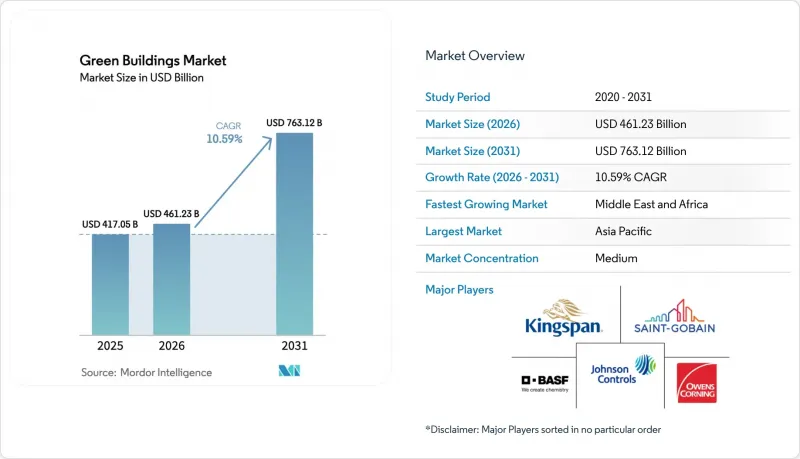
본 보고서는 제품 유형(외장 제품, 내장 제품, 건축 시스템, 기타), 최종 사용자(주택, 상업시설), 건설 단계(신축, 리모델링), 지역(북미, 남미, 유럽, 중동 및 아프리카, 아시아태평양)별로 분류되어 있습니다. 시장 예측은 금액(달러) 기준으로 제시되어 있습니다.
세계 그린 빌딩 시장 동향 및 인사이트
엄격한 그린 빌딩 규정 및 인증 요건
현재 제로 배출 건축 규정이 프로젝트의 자금 조달 심사를 좌우하고 있습니다. 2024년에 개정된 EU 지침에서는 2030년 이후 준공되는 모든 신축 건축물에 대해 운영 시 탄소 중립을 달성할 것을 의무화하고 있으며, 기존 비주거용 자산에 대해서도 2027년까지 최소 기준을 충족할 것을 요구하고 있습니다. 캘리포니아주의 ‘타이틀 24’에서는 태양광 발전 대응 지붕 및 배터리 저장 장치용 배선을 기본 설계에 포함하도록 의무화하고 있어, 재생에너지 도입을 미룰 여지가 없어졌습니다. LEED나 BREEAM 등의 인증 기관은 금융 기관이 계약 체결 전에 성능 증명을 요구하게 됨에 따라, 그린 파이낸스의 ‘게이트키퍼’ 역할을 수행하게 되었습니다. 이러한 정책들은 초기 단계에서 규정 준수 비용을 부담하게 하는 한편, 더 저렴한 자금 조달을 가능하게 하여 그린 빌딩 시장 전반에 걸친 보급을 가속화하고 있습니다. 기준을 충족하지 못하는 개발업자는 ‘좌초 자산’의 위험에 직면하게 되므로, 규제가 계속해서 수요를 견인할 것으로 확실시되고 있습니다.
에너지 가격 급등이 고성능 건축 외피에 대한 수요를 부추기고 있다.
2023년 이후 지속된 연료 가격 변동으로 인해 에너지 효율은 임차인의 요구 사항 목록 최상위에 올랐습니다. 현재 상업시설의 임차인들은 HVAC 부하를 최대 40%까지 줄여주는 삼중 유리, 단열 파사드, 반사형 지붕을 갖춘 건물에 대해 더 높은 임대료를 지불할 의향이 있습니다. 온화한 기후의 데이터센터나 물류 허브에서는 추운 지역의 사무실과 마찬가지로 기밀성이 높은 외피가 요구되고 있습니다. 이는 냉방비가 난방비를 초과하는 경우가 많기 때문입니다. 투자 회수 기간이 7년 이하로 단축됨에 따라, 소유주는 2차 시장이라 하더라도 고급 외장재나 창호 패키지의 도입을 정당화할 수 있게 되었습니다. 따라서 고성능 외피는 그린 빌딩 시장 전체의 리모델링 투자 성장을 뒷받침하는 기반이 되고 있습니다.
초기 투자 및 인증 취득 비용의 높음
LEED 골드 인증을 취득하려면 여전히 건설 예산의 8-12%에 해당하는 추가 비용이 소요되며, 중규모 프로젝트의 경우 모델링 및 검증에 드는 컨설팅 비용이 5만 달러를 초과하기도 합니다. 저가형 주택 개발업체들은 이러한 추가 비용을 회수하는 데 어려움을 겪고 있으며, 그린 빌딩 시장의 저소득층 부문에서의 도입이 둔화되고 있습니다. 일부 전력 회사는 에너지 효율 개보수를 위한 공동 자금 조달을 실시하고 있지만, 프로그램이 여전히 불충분하고 자금 조달 격차가 남아 있어 단기적인 성장이 제약받고 있습니다.
부문 분석
2025년 매출 중 건축 시스템이 42.3%를 차지하며, 그린 빌딩 시장에서 가장 큰 점유율을 기록하고 있습니다. HVAC 개조, 가변 냉매 유량(VRF) 히트 펌프 및 첨단 칠러는 화석 연료 의존도를 낮추고 새로운 냉매 규제를 준수함으로써 이 부문의 주력 제품이 되고 있습니다. 스마트 빌딩 관리 플랫폼은 HVAC, 조명,출입 제어를 통합한 대시보드를 제공하며, 소유주는 이를 활용하여 금융 기관에 효율성 향상 실적을 입증하고 있습니다. 건물 외피 개보수가 물리적 한계에 다다르고 있는 가운데, 시스템에서 도출된 성능 데이터는 두 자릿수 성장을 유지하기 위한 가장 명확한 ROI(투자 수익률) 경로를 제시하고 있습니다.
외장 제품(단열 패널, 고성능 유리, 반사형 지붕)은 여전히 필수적이지만, 건축 기준에 따른 도입이 포화 상태에 이르러 성장이 완만해지고 있습니다. 저VOC 도료나 재활용 바닥재 등의 내장 제품은 특히 고급 사무실에서 웰니스 인증의 호재를 타고 있습니다. 신흥 제품 라인(상변화 건식 벽체, 일렉트로크로믹 유리)에는 성장 여지가 있으나, 비용 절감이 기대됩니다. 중요한 점은 IoT 허브와의 ‘플러그 앤 플레이’ 방식의 상호 운용성을 확보한 공급업체는 프리미엄 가격을 책정할 수 있는 반면, 기존의 독립형 제품은 상품화(commoditization) 위험에 노출되어 있다는 것입니다. 그 결과, 외장 제품은 2031년까지 연평균 성장률(CAGR) 11.21%로 다른 카테고리를 상회하는 성장을 보일 것으로 예상되며, 그린 빌딩 시장에서 건축 시스템과의 격차를 좁힐 것으로 전망됩니다.
지역별 분석
아시아태평양은 중국의 ‘이산화탄소 배출 정점 및 탄소 중립’ 정책과 인도가 도시 인프라 자금 조달을 위해 그린본드를 급속히 도입한 것을 배경으로, 2025년 그린 빌딩 시장 매출의 37.6%를 차지했습니다. 중국은 2024년에 인증 연면적 100억 m²를 돌파했으며, 인도의 IGBC(인도 그린 빌딩 협의회) 등록 건수는 2025년에 25% 증가했습니다. 일본과 한국에서는 1990년대에 지어진 사무실을 엄격한 신규 규정에 맞추어 개보수하고 있는 반면, 호주에서는 주 정부의 보조금을 통해 교외 주택의 옥상 태양광 발전 및 전력 저장 시스템 도입이 가속화되고 있습니다. 이러한 동향에 따라 규제가 성숙해짐에 따라 성장세는 둔화될 것, 아시아태평양은 계속해서 시장 규모에서 선두를 유지할 전망입니다.
중동 및 아프리카는 가장 빠르게 성장하고 있으며, 사우디아라비아의 5,000억 달러 규모 ‘비전 2030’ 프로젝트와 UAE의 넷제로 도시 구상을 배경으로 2031년까지 연평균 성장률(CAGR) 12.23%를 나타낼 것으로 예측됩니다. NEOM의 기가스케일 조달에는 초기부터 재생에너지, 지역 냉방, 재이용수 시스템이 포함되어 있어, 건축 외피 및 시스템 공급업체에 막대한 수주 기회를 창출하고 있습니다. UAE에서는 2030년까지 건물의 75%가 그린 인증을 취득해야 하는 의무가 부과되어, 기존 건물 전체에 걸쳐 리모델링 열풍이 일고 있습니다. 남아프리카공화국은 송전망의 불안정성을 해소하기 위해 현장 태양광 발전 및 에너지 저장 장치에 투자하고 있으며, 라고스에서는 공공주택을 대상으로 건축 기준의 시범 도입이 이루어지고 있어 아프리카 대륙 전체로의 확산이 예상됩니다.
북미와 유럽은 성숙한 시장이지만 여전히 매우 중요한 역할을 하고 있습니다. 미국은 2024년에 450억 달러 규모의 부동산 그린본드를 발행하여 주요 대도시권의 LEED 인증 취득을 위한 개보수 공사에 자금을 공급했습니다. 캐나다는 2030년까지 연방 정부 건물을 넷제로로 전환할 것을 의무화하여, 이를 각 주의 정책 지침으로 삼고 있습니다. 유럽에서는 ‘Fit-for-55’ 패키지 하에서 개보수 작업이 가속화되고 있으며, 독일과 프랑스는 철저한 에너지 효율 개선을 위해 보조금을 투입하고 있습니다. 영국에서는 에너지 효율 지표를 건축물 안전 기준과 연계하여 외벽 교체 및 새로운 공조 설비 도입을 추진하고 있습니다. 라틴아메리카에서는 선택적인 성장이 나타나고 있으며, 브라질은 상파울루의 LEED 인증 건물 보유에서 주도적인 역할을 수행하는 한편, 멕시코는 미국 내 니어쇼어링을 진행하는 임차인의 요구를 충족하기 위해 친환경 기준을 채택하고 있습니다. 이러한 지역 전반에 걸쳐 리모델링 규모는 견조한 추세를 보이며, 전 세계 그린 빌딩 시장을 지탱하고 있습니다.
기타 혜택:
- 엑셀 형식 시장 예측(ME) 시트
- 3개월간의 애널리스트 지원
자주 묻는 질문
목차
제1장 서론
제2장 조사 방법
제3장 개요
제4장 시장 동향과 분석
제5장 시장 규모와 성장 예측
제6장 경쟁 구도
제7장 시장 기회와 향후 전망
JHS 26.09.03According to Mordor Intelligence, the green buildings market size is projected to be USD 417.05 billion in 2025, USD 461.23 billion in 2026, and reach USD 763.12 billion by 2031, growing at a CAGR of 10.59% from 2026 to 2031.
This report is Segmented by Product Type (Exterior Products, Interior Products, Building Systems, Others), by End User (Residential, Commercial), by Construction Stage (New Construction, Renovation), and by Geography (North America, South America, Europe, Middle East and Africa, Asia-Pacific). The Market Forecasts are Provided in Terms of Value (USD).
Global Green Buildings Market Trends and Insights
Stringent Green-Construction Regulations & Certification Mandates
Zero-emission building rules now dictate project underwriting. The EU directive, revised in 2024, compels all new structures delivered after 2030 to achieve zero-operational carbon and forces existing non-residential assets to meet minimum ratings by 2027. California's Title 24 adds solar-ready roofs and battery-storage wiring to baseline design, eliminating the ability to defer renewable integration. Certification bodies such as LEED and BREEAM have become gatekeepers to green finance because lenders demand proof of performance before closing. These policies front-load compliance expenses but simultaneously unlock cheaper debt, accelerating uptake across the green building market. Developers unable to meet benchmarks face stranded-asset risk, ensuring regulations continue to steer demand.
Rising Energy Prices Boosting Demand for High-Performance Envelopes
Persistent fuel-price volatility since 2023 has moved energy efficiency to the top of tenant wish lists. Commercial occupiers are now willing to pay higher rents for buildings with triple glazing, thermally broken facades, and reflective roofs that cut HVAC loads by up to 40%. Warm-climate data centers and logistics hubs join cold-weather offices in specifying airtight envelopes because cooling costs often eclipse heating bills. With payback periods narrowing to seven years or less, owners can justify premium claddings and window packages even in secondary markets. High-performing envelopes, therefore, anchor growth in retrofit spending across the wider green building market.
High Upfront Capital & Certification Costs
LEED Gold still adds 8-12% to construction budgets, with consultant fees for modeling and verification topping USD 50,000 on mid-size projects. Affordable-housing developers struggle to monetize that premium, slowing adoption in lower-income segments of the green building market. Some utilities co-finance efficiency upgrades, but programs remain patchy, leaving a financing gap that constrains near-term growth.
Other drivers and restraints analyzed in the detailed report include:
- Corporate ESG Targets Opening Green-Bond & Sustainability-Linked Financing
- Rapid Urbanization Programs with Green-Building Codes in APAC
- Fragmented Supply Chains for Low-Carbon Materials
For complete list of drivers and restraints, kindly check the Table Of Contents.
Segment Analysis
Building systems accounted for 42.3% of 2025 revenue, making them the largest slice of the green building market. HVAC retrofits, variable-refrigerant-flow heat pumps, and advanced chillers anchor this category by reducing fossil-fuel dependence and complying with new refrigerant rules. Smart building-management platforms integrate HVAC, lighting, and access controls into a unified dashboard that owners use to prove efficiency gains to lenders. With envelope upgrades nearing physical limits, performance data from systems provides the clearest ROI pathway to sustain double-digit growth.
Exterior products-insulated panels, high-performance glazing, reflective roofs-remain essential but grow more modestly as code-driven adoption saturates. Interior items such as low-VOC paint and recycled flooring ride the wellness-certification tailwind, especially in premium offices. Emerging lines-phase-change drywall, electrochromic glass offer upside but await cost reductions. Crucially, suppliers that ensure plug-and-play interoperability with IoT hubs can price at a premium, while legacy stand-alone products risk commoditization. As a result, exterior products are forecast to outpace other categories at an 11.21% CAGR through 2031, narrowing the gap with building systems in the green building market.
Complete Report Scope:
- By Product Type
- Exterior Products
- Interior Products
- Building Systems
- Others
- By End User
- Residential
- Apartments & Condominiums
- Villas & Landed Houses
- Commercial
- Office
- Retail
- Logistics
- Institutional
- Others (industrial real estate, hospitality real estate, etc.)
- Residential
- By Construction Stage
- New Construction
- Renovation
- By Geography
- North America
- United States
- Canada
- Mexico
- South America
- Brazil
- Argentina
- Chile
- Rest of South America
- Europe
- United Kingdom
- Germany
- France
- Italy
- Spain
- Netherlands
- Rest of Europe
- Middle East and Africa
- Saudi Arabia
- United Arab Emirates
- South Africa
- Nigeria
- Rest of Middle East and Africa
- Asia-Pacific
- China
- India
- Japan
- South Korea
- Australia
- Indonesia
- Rest of Asia-Pacific
- North America
Geography Analysis
Asia-Pacific accounted for 37.6% of the 2025 green building market revenue, underpinned by China's dual-carbon policy and India's quick uptake of green bonds funding urban infrastructure. China surpassed 10 billion m2 of certified floor area in 2024, and India's IGBC listings grew 25% in 2025. Japan and South Korea retrofit 1990-era offices to stringent new codes, while Australia's state subsidies accelerate rooftop solar-plus-storage in suburban housing. These dynamics ensure Asia-Pacific remains the volume leader, although growth moderates as regulations mature.
The Middle East & Africa region is the fastest climber, expected to record a 12.23% CAGR through 2031 on the back of Saudi Arabia's USD 500 billion Vision 2030 projects and the UAE's net-zero-city mandates. NEOM's giga-scale procurement embeds renewable power, district cooling, and recycled-water systems from the outset, creating mega-orders for envelope and system suppliers. The UAE requires 75% of buildings to hold green certification by 2030, spawning a retrofit wave across existing stock. South Africa invests in on-site solar and batteries to escape grid instability, and Lagos pilots codes for public housing, hinting at broader continental adoption.
North America and Europe, though mature, remain pivotal. The United States issued USD 45 billion in real-estate green bonds in 2024, funding LEED upgrades in major metros. Canada mandates net-zero federal buildings by 2030, anchoring provincial policy. European renovation accelerates under the Fit-for-55 package, with Germany and France channeling subsidies toward deep-energy retrofits. The UK ties energy-efficiency metrics to building-safety rules, driving facade recladding and new HVAC. Latin America grows selectively; Brazil leads with LEED stock in Sao Paulo, while Mexico adopts green standards to satisfy U.S. nearshoring tenants. Collectively, these regions keep renovation volumes strong, sustaining the global green building market.
- Kingspan Group PLC
- Saint-Gobain SA
- BASF SE
- Johnson Controls International plc
- Owens Corning
- Schneider Electric SE
- Holcim Ltd (LafargeHolcim)
- Skanska AB
- CEMEX S.A.B. de C.V.
- Interface Inc.
- Alumasc Group PLC
- Amvik Systems
- Binderholz GmbH
- Bauder Limited
- Kingspan Insulation LLC
- Armstrong World Industries
- RedBuilt LLC
- Homasote Company
- Carrier Global Corporation
- Panasonic Corporation (BIPV)
Additional Benefits:
- The market estimate (ME) sheet in Excel format
- 3 months of analyst support
TABLE OF CONTENTS
1 Introduction
- 1.1 Study Assumptions & Market Definition
- 1.2 Scope of the Study
2 Research Methodology
3 Executive Summary
4 Market Insights and Dynamics
- 4.1 Market Overview
- 4.2 Market Drivers
- 4.2.1 Stringent green-construction regulations & certification mandates
- 4.2.2 Rising energy prices driving demand for high-performance envelopes
- 4.2.3 Corporate ESG targets unlocking green-bond & sustainability-linked financing
- 4.2.4 Rapid urbanisation programs with green-building codes in APAC
- 4.2.5 Mandatory embodied-carbon disclosure in public procurement
- 4.3 Market Restraints
- 4.3.1 High upfront capital & certification costs vs. conventional builds
- 4.3.2 Fragmented regional supply chains for low-carbon materials
- 4.3.3 Skilled-labour shortage in advanced sustainable-construction methods
- 4.4 Value / Supply-Chain Analysis
- 4.5 Regulatory Landscape
- 4.6 Technological Outlook
- 4.7 Porter's Five Forces
- 4.7.1 Bargaining Power of Suppliers
- 4.7.2 Bargaining Power of Buyers
- 4.7.3 Threat of New Entrants
- 4.7.4 Threat of Substitutes
- 4.7.5 Competitive Rivalry
5 Market Size & Growth Forecasts
- 5.1 By Product Type
- 5.1.1 Exterior Products
- 5.1.2 Interior Products
- 5.1.3 Building Systems
- 5.1.4 Others
- 5.2 By End User
- 5.2.1 Residential
- 5.2.1.1 Apartments & Condominiums
- 5.2.1.2 Villas & Landed Houses
- 5.2.2 Commercial
- 5.2.2.1 Office
- 5.2.2.2 Retail
- 5.2.2.3 Logistics
- 5.2.2.4 Institutional
- 5.2.2.5 Others (industrial real estate, hospitality real estate, etc.)
- 5.2.1 Residential
- 5.3 By Construction Stage
- 5.3.1 New Construction
- 5.3.2 Renovation
- 5.4 By Geography
- 5.4.1 North America
- 5.4.1.1 United States
- 5.4.1.2 Canada
- 5.4.1.3 Mexico
- 5.4.2 South America
- 5.4.2.1 Brazil
- 5.4.2.2 Argentina
- 5.4.2.3 Chile
- 5.4.2.4 Rest of South America
- 5.4.3 Europe
- 5.4.3.1 United Kingdom
- 5.4.3.2 Germany
- 5.4.3.3 France
- 5.4.3.4 Italy
- 5.4.3.5 Spain
- 5.4.3.6 Netherlands
- 5.4.3.7 Rest of Europe
- 5.4.4 Middle East and Africa
- 5.4.4.1 Saudi Arabia
- 5.4.4.2 United Arab Emirates
- 5.4.4.3 South Africa
- 5.4.4.4 Nigeria
- 5.4.4.5 Rest of Middle East and Africa
- 5.4.5 Asia-Pacific
- 5.4.5.1 China
- 5.4.5.2 India
- 5.4.5.3 Japan
- 5.4.5.4 South Korea
- 5.4.5.5 Australia
- 5.4.5.6 Indonesia
- 5.4.5.7 Rest of Asia-Pacific
- 5.4.1 North America
6 Competitive Landscape
- 6.1 Market Concentration
- 6.2 Strategic Moves
- 6.3 Market Share Analysis
- 6.4 Company Profiles (includes Global level Overview, Market level overview, Core Segments, Financials as available, Strategic Information, Products & Services, and Recent Developments)
- 6.4.1 Kingspan Group PLC
- 6.4.2 Saint-Gobain SA
- 6.4.3 BASF SE
- 6.4.4 Johnson Controls International plc
- 6.4.5 Owens Corning
- 6.4.6 Schneider Electric SE
- 6.4.7 Holcim Ltd (LafargeHolcim)
- 6.4.8 Skanska AB
- 6.4.9 CEMEX S.A.B. de C.V.
- 6.4.10 Interface Inc.
- 6.4.11 Alumasc Group PLC
- 6.4.12 Amvik Systems
- 6.4.13 Binderholz GmbH
- 6.4.14 Bauder Limited
- 6.4.15 Kingspan Insulation LLC
- 6.4.16 Armstrong World Industries
- 6.4.17 RedBuilt LLC
- 6.4.18 Homasote Company
- 6.4.19 Carrier Global Corporation
- 6.4.20 Panasonic Corporation (BIPV)


