

|
시장보고서
상품코드
2119897
DevSecOps : 시장 점유율 분석, 업계 동향과 통계, 성장 예측(2026-2031년)DevSecOps - Market Share Analysis, Industry Trends & Statistics, Growth Forecasts (2026 - 2031) |
||||||
 Mordor Intelligence
Mordor Intelligence에 따르면 DevSecOps 시장 규모는 2025년 89억 1,000만 달러에서 2026년에는 108억 8,000만 달러로 확대하며, 2026-2031년에 CAGR 22.10%로 추이하며, 2031년에는 295억 2,000만 달러에 달할 것으로 예측됩니다.
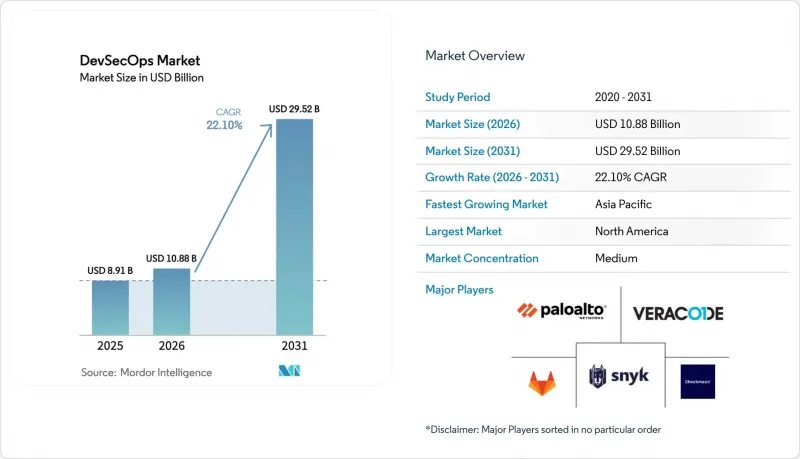
이 보고서는 제공 분야(솔루션, 서비스[전문 서비스 등]), 배포 모델(클라우드, 온프레미스, 하이브리드), 최종사용자 기업의 규모(중소기업, 대기업), 최종사용자 산업(IT·통신, BFSI, 제조업 등) 및 지역별로 분류되어 있습니다. 시장 예측은 금액(달러) 기준으로 제시되어 있습니다.
글로벌 DevSecOps 시장의 동향 및 인사이트
보안 및 규제 준수에 대한 관심이 높아지고 있습니다.
대통령령 제14028호는 미국 연방 기관 및 공급업체에 2025년 2월까지 소프트웨어 부품 리스트(SBOM) 작성을 의무화하고 있습니다. 한편, 유럽의 NIS2 지침 및 향후 시행될 사이버 복원력 법은 중요 부문에 걸쳐 있는 약 35만 개의 사업체에 유사한 ‘보안 설계(Security by Design)’ 원칙을 적용하고 있습니다. 현재 조직들은 규정 준수를 단순한 비용 부담이 아닌 경쟁 우위로 인식하고 있으며, 지속적인 통제 모니터링을 통해 감사 업무의 부담을 줄이고 조달 주기를 단축하고 있습니다. 관할 구역을 초월한 표준화된 요구 사항이 DevSecOps 시장을 주도하고 있습니다. 이는 통합 플랫폼이 기술적 통제 사항을 여러 규제에 동시에 대조할 수 있으며, 중복되는 툴 도입 비용을 절감할 수 있기 때문입니다.
지속적이고 자동화된 애플리케이션 배포의 필요성
마이크로서비스, 컨테이너, 서버리스 프레임워크 덕분에 하루에 수백 번의 코드 푸시가 가능해졌지만, 수동 침투 테스트로는 이러한 속도에 대응할 수 없습니다. 지속적 통합/지속적 배포(CI/CD) 파이프라인에는 실시간 정적 및 동적 스캔과 종속성 스캔이 통합되어 있으며, 프로덕션 환경으로 배포되기 전에 취약점이 있는 빌드를 차단합니다. 자동화된 보안 게이트가 개발 흐름과 병행되어 가동 중단 시간이 줄어들고 기능 개발 속도가 향상됨에 따라 기업은 측정 가능한 성과를 거두고 있습니다. 통합 개발 환경 내의 AI 코파일럿은 코딩 중에 보안 문제가 있는 코드를 감지하고 조기에 시정 조치를 취함으로써 릴리스 주기를 단축하고 있습니다.
‘보안 설계(Secure by Design)’ 실천에 있으며, 문화와 기술의 격차
코드 전달 속도와 보안의 미묘한 뉘앙스를 모두 이해하는 전문가에 대한 수요는 공급을 훨씬 초과하고 있습니다. 유럽 기업에 따르면 NIS2로 인해 인력 요건이 엄격해졌음에도 불구하고 사이버 보안 관련 채용 공고의 32%가 여전히 채워지지 않은 상태입니다. 많은 엔지니어링 팀 내에서는 여전히 성과 지표가 취약점 수정보다는 기능 처리량에 중점을 두고 있으며, DevOps 부서와 보안 부서 사이에 마찰이 발생하고 있습니다. 교육을 통해 취약점 수정 작업의 생산성은 3배까지 향상될 수 있지만, 분산된 직원 전체에 이러한 프로그램을 확대 적용하려면 지속적인 예산과 경영진의 지지가 필요합니다. 중소기업은 대형 클라우드 제공업체와 인재 확보 경쟁을 벌이고 있으므로 이러한 제약을 가장 절실히 느끼고 있습니다.
부문 분석
솔루션은 2025년 매출의 71.68%를 차지했습니다. 이는 구매자들이 단일 인터페이스에서 코드, 컨테이너, 클라우드 상태를 포괄하는 통합 대시보드를 선호하기 때문입니다. 이러한 제품군은 정적 분석, 소프트웨어 구성 분석, 런타임 보호를 동일한 워크플로우에 통합하여 학습 곡선을 완화합니다. 대조적으로, 서비스는 연평균 성장률(CAGR) 25.4%를 기록하며, 사내에 전문가를 보유하지 않은 조직을 끌어들이고 있습니다. 전문 서비스 제공업체는 거버넌스 모델 설계, 파이프라인 통합, 레드팀 평가를 수행하는 반면, 관리형 서비스 팀은 고객을 대신하여 지속적인 스캔 및 패치 적용을 수행합니다. AI 기능은 지속적인 조정이 필요하므로 관리형 서비스 분야의 DevSecOps 시장 규모는 꾸준히 확대될 것으로 예측됩니다. 기업은 대개 먼저 패키지 제품을 도입한 후, 설정 최적화, 정책 팩 맞춤화, 티켓 관리 시스템과의 연동을 위해 컨설팅 지원을 요청합니다. 파이프라인이 안정되면, 응답 시간 보장(SLA)을 약속하는 서비스 파트너에게 일상적인 모니터링 업무를 위탁합니다. 이러한 단계적 패턴은 라이선스 공급업체와 서비스 공급업체 모두에게 수익을 가져다주고 있지만, 선견지명이 있는 공급업체들은 판매 주기를 단축하기 위해 소프트웨어 구독에 자문 시간을 묶어 제공하는 경향이 강해지고 있습니다.
2025년에는 온프레미스가 49.95%의 점유율을 차지했습니다. 그러나 최고정보책임자(CIO)가 모놀리식 시스템을 컨테이너 서비스나 서버리스 런타임으로 전환함에 따라 클라우드 파이프라인은 연평균 성장률(CAGR) 26.6%로 성장하고 있습니다. 클라우드 호스팅형 보안 엔진은 빌드 기간 중 발생하는 버스트 테스트에 유연하게 대응하며, 결과를 몇 초 만에 개발자에게 피드백합니다. 또한 네이티브 클라우드 로그 및 ID 서비스를 활용하여 정책 상속을 간소화합니다. 하이브리드 배포는 기밀 데이터가 온프레미스에 남아 있고, 규제가 덜 엄격한 워크로드가 클라우드로 이전되는 과도기적 상태로 기능합니다. 시간이 지남에 따라 기업은 대개 두 형태 중 하나로 통합되며, 클라우드 퍼스트를 지향하는 기업은 여러 가용성 영역에 걸쳐 제어를 확대하고, 로컬 컴퓨팅을 유지하는 기업은 퍼블릭 클라우드 경험을 모방한 프라이빗 클라우드 툴 체인에 투자합니다. 벤더는 고객 유지율을 높이기 위해 이러한 모든 조합에서 대칭적인 정책 적용 범위를 입증해야 합니다.
지역별 분석
북미는 2025년에 전 세계 매출의 35.88%를 차지하며, 연방 정부의 조달 규정에 따라 공공 기관에 제품을 공급하는 공급업체는 SBOM 제출이 의무화되어 있으며, 선도적인 위치를 유지하고 있습니다. 실리콘밸리, 시애틀, 오스틴의 기술 생태계는 툴 벤더, 통합업체, 오픈소스 커뮤니티가 밀접하게 공존하는 환경을 조성하여 베스트 프랙티스의 확산을 가속화하고 있습니다. 캐나다는 ‘국가 사이버 보안 전략’을 통해 도입을 지원하고 있는 반면, 멕시코의 핀테크 규제는 은행이 국경을 넘는 결제 경로에 접근하기 위해 지속적인 규정 준수를 의무화하고 있습니다. 아시아태평양은 클라우드 네이티브 스타트업이 레거시 아키텍처를 비약적으로 추월하는 가운데 22.45%라는 가장 높은 연평균 성장률(CAGR)을 기록하고 있습니다. 중국의 ‘사이버 보안법’, 일본 디지털청의 지침, 그리고 인도의 컴퓨터 비상 대응팀(CERT-In)이 정한 취약점 공개 일정은 모두 통합적인 보안 테스트를 촉진하고 있습니다. 싱가포르 금융당국(MAS)과 호주의 프루덴셜 규제 당국은 디지털 뱅킹에 대한 규제를 강화하고 있으며, 벤더들에게 CI/CD에 암호화 스캔을 통합할 것을 촉구하고 있습니다. 현지 하이퍼스케일러인 알리바바 클라우드, 텐센트 클라우드, 그리고 AWS 아시아태평양 리전은 플랫폼 제공업체와 제휴하여 지역 규정 준수 체제에 맞춘 DevSecOps 청사진을 미리 패키지화하고 있습니다. 유럽은 ‘규제 우선’의 길을 걷고 있습니다. NIS2 지침은 에너지, 운송, 의료 분야의 사고 보고 의무 범위를 확대하고 있는 반면, 디지털 운영 복원력법(Digital Operational Resilience Act)은 금융 기관에 대한 지속적인 통제 테스트를 규정하고 있습니다. 이에 따라 조직들은 ENISA의 지침을 준수하고, 감사인을 위해 기계 판독 가능한 증거를 출력할 수 있는 통합 보안 포털을 도입하고 있습니다. 독일, 프랑스, 영국이 지출의 대부분을 차지하고 있지만, 동유럽의 소프트웨어 아웃소싱 거점들도 고객의 기대에 부응하기 위해 파이프라인을 업그레이드하고 있습니다. 그 밖의 지역에서는 브라질의 LGPD 개인정보 보호법과 아랍에미리트(UAE)의 국가 사이버 보안 전략이 라틴아메리카 및 중동 전역의 지출을 견인하고 있습니다.
기타 혜택:
- 엑셀 형식의 시장 예측(ME) 시트
- 3개월간의 애널리스트 지원
자주 묻는 질문
목차
제1장 서론
제2장 조사 방법
제3장 개요
제4장 시장 구도
제5장 시장 규모와 성장 예측
제6장 경쟁 구도
제7장 시장 기회와 향후 동향
KSA 26.09.02According to Mordor Intelligence, the DevSecOps market size is expected to grow from USD 8.91 billion in 2025 to USD 10.88 billion in 2026 and is forecast to reach USD 29.52 billion by 2031 at 22.10% CAGR over 2026-2031.
This report is Segmented by Offering (Solution, Services [Professional Services, and More]), Deployment Model (Cloud, On-Premise, and Hybrid), by End-User Enterprise Size (Small and Medium Enterprise, Large Enterprises), End-User Industry ( IT and Telecom, BFSI, Manufacturing, and More), and Geography. The Market Forecasts are Provided in Terms of Value (USD).
Global DevSecOps Market Trends and Insights
Rising focus on security and regulatory compliance
Executive Order 14028 obliges United States federal agencies and suppliers to produce Software Bills of Materials by February 2025, while Europe's NIS2 directive and forthcoming Cyber Resilience Act apply similar security-by-design principles to roughly 350,000 entities across critical sectors . Organizations now treat compliance as competitive advantage rather than overhead, with continuous controls monitoring reducing audit workloads and accelerating procurement cycles. Standardized expectations across jurisdictions propel the DevSecOps market because unified platforms can map technical controls to multiple regulations simultaneously, cutting redundant tooling costs.
Need for continuous and automated application delivery
Microservices, containers, and serverless frameworks enable hundreds of daily code pushes, but manual penetration tests cannot scale to that cadence. Continuous integration / continuous delivery (CI/CD) pipelines embed real-time static, dynamic, and dependency scans that block vulnerable builds before production. Enterprises cite measurable returns when automated security gating parallels development flow, as downtime drops and feature velocity rises. AI copilots inside integrated development environments now flag insecure code during authoring, shifting remediation left and compressing release cycles.
Cultural and skills gap in secure-by-design practices
Demand for professionals who grasp both code delivery speed and security nuance far exceeds supply. European companies report that 32% of open cybersecurity roles remain vacant even as NIS2 heightens staffing requirements. Inside many engineering teams, performance metrics still reward feature throughput rather than vulnerability closure, fostering friction between DevOps and security units. Training can triple remediation productivity, yet rolling such programs across distributed workforces requires sustained budget and leadership endorsement. SMEs feel the constraint most acutely because they compete for talent against large cloud providers.
Other drivers and restraints analyzed in the detailed report include:
- Shift to cloud-native and micro-service architectures
- AI-generated code expanding attack surface
- Toolchain sprawl and integration complexity
For complete list of drivers and restraints, kindly check the Table Of Contents.
Segment Analysis
Solutions held 71.68% of 2025 revenue because buyers prefer centralized dashboards that cover code, container, and cloud posture from a single interface. These suites fold static analysis, software composition analysis, and runtime protection into identical workflows, reducing the learning curve. In contrast, services recorded a 25.4% CAGR and attract organizations lacking internal specialists. Professional service providers design governance models, integrate pipelines, and conduct red-team assessments, while managed services teams run ongoing scans and patching on behalf of clients. The DevSecOps market size for managed services is projected to climb steadily as AI features require continuous tuning. Enterprises often begin with shrink-wrapped products before seeking consulting help to optimize configuration, customize policy packs, and link ticketing systems. Once pipelines stabilize, they outsource day-to-day monitoring to service partners that guarantee response-time agreements. This sequential pattern sustains revenue for both license and service vendors, though forward-looking suppliers increasingly bundle advisory hours into software subscriptions to shorten sales cycles.
On-premise held 49.95% share in 2025. Yet cloud pipelines grow at a 26.6% CAGR as chief information officers migrate monoliths into container services and serverless runtimes. Cloud-hosted security engines elastically handle burst testing during build windows and stream results back to developers in seconds. They also tap native cloud logs and identity services, simplifying policy inheritance. Hybrid deployments serve as transitional states where sensitive data remains on-premise while less regulated workloads shift to cloud. Over time, firms often consolidate either way; those leaning cloud-first expand controls across multiple availability zones, while those retaining local compute invest in private-cloud toolchains that mimic public-cloud experience. Vendors must demonstrate symmetric policy coverage across these permutations to preserve account stickiness.
Complete Report Scope:
- By Offering
- Solutions
- Services
- Professional Services
- Managed Services
- By Deployment Model
- Cloud
- On-Premise
- Hybrid
- By End-user Enterprise Size
- Small and Medium Enterprises
- Large Enterprises
- By End-User Industry
- IT and Telecom
- BFSI
- Healthcare and Life Sciences
- Government and Public Sector
- Manufacturing
- Retail and E-commerce
- Others (Energy, Education, etc.)
- By Geography
- North America
- United States
- Canada
- Mexico
- South America
- Brazil
- Argentina
- Rest of South America
- Europe
- Germany
- United Kingdom
- France
- Italy
- Spain
- Russia
- Rest of Europe
- Asia-Pacific
- China
- Japan
- India
- South Korea
- Australia and New Zealand
- Rest of Asia-Pacific
- Middle East and Africa
- Middle East
- Saudi Arabia
- United Arab Emirates
- Turkey
- Rest of Middle East
- Africa
- South Africa
- Nigeria
- Egypt
- Rest of Africa
- Middle East
- North America
Geography Analysis
North America generated 35.88% of global revenue in 2025 and preserves leadership because federal procurement rules mandate SBOM submission for any supplier to public agencies. Technology ecosystems in Silicon Valley, Seattle, and Austin foster a dense mix of tool vendors, integrators, and open-source communities that accelerate best-practice diffusion. Canada supports adoption through its National Cyber Security Strategy, whereas Mexico's fintech regulations drive banks toward continuous compliance to access cross-border payment corridors. Asia-Pacific registers the highest 22.45% CAGR as cloud-native startups leapfrog legacy architectures. China's Cybersecurity Law, Japan's Digital Agency guidelines, and India's Computer Emergency Response Team (CERT-In) vulnerability disclosure timelines all encourage integrated security testing. Singapore's financial authority (MAS) and Australia's Prudential Regulation Authority tighten controls for digital banking, nudging vendors to embed encryption scanning into CI/CD. Local hyperscalers-Alibaba Cloud, Tencent Cloud, and AWS Asia Pacific Regions-partner with platform providers to pre-package DevSecOps blueprints for regional compliance regimes. Europe follows a regulation-first path. The NIS2 directive widens mandatory incident reporting across energy, transport, and healthcare, while the Digital Operational Resilience Act stipulates continuous controls testing for financial entities. Organizations therefore adopt unified security portals that align to ENISA guidance and emit machine-readable evidence for auditors. Germany, France, and the United Kingdom contribute the bulk of spending, but Eastern European software outsourcing hubs also upgrade pipelines to meet customer expectations. Elsewhere, Brazil's LGPD privacy law and the United Arab Emirates' National Cybersecurity Strategy catalyze spending across Latin America and the Middle East.
- Aqua Security Software Ltd.
- Amazon Web Services, Inc.
- Black Duck Software (by Synopsys, Inc.)
- Checkmarx Ltd.
- Cisco Systems, Inc.
- Contrast Security, Inc.
- Dynatrace, Inc.
- Fortinet, Inc.
- GitLab Inc.
- IBM Corporation
- Imperva, Inc.
- Invicti Security Corp.
- JFrog Ltd.
- Microsoft Corporation
- Datadog, Inc.
- Palo Alto Networks, Inc.
- Qualys, Inc.
- Rapid7, Inc.
- Snyk Limited
- SonarSource SA
- Synopsys, Inc.
- Veracode, Inc.
Additional Benefits:
- The market estimate (ME) sheet in Excel format
- 3 months of analyst support
TABLE OF CONTENTS
1 INTRODUCTION
- 1.1 Market Definition and Study Assumptions
- 1.2 Scope of the Study
2 RESEARCH METHODOLOGY
3 EXECUTIVE SUMMARY
4 MARKET LANDSCAPE
- 4.1 Market Overview
- 4.2 Market Drivers
- 4.2.1 Rising focus on security and regulatory compliance
- 4.2.2 Need for continuous and automated application delivery
- 4.2.3 Shift to cloud-native and micro-service architectures
- 4.2.4 AI-generated code expanding attack surface
- 4.2.5 Mandates for Software Bills of Materials (SBOMs)
- 4.2.6 GenAI-powered security automation advantages
- 4.3 Market Restraints
- 4.3.1 Cultural and skills gap in secure-by-design practices
- 4.3.2 Toolchain sprawl and integration complexity
- 4.3.3 Budget compression amid platform consolidation
- 4.3.4 Legacy process inertia in heavily regulated sectors
- 4.4 Value / Supply-Chain Analysis
- 4.5 Evaluation of Critical Regulatory Framework
- 4.6 Impact Assessment of Key Stakeholders
- 4.7 Technological Outlook
- 4.8 Porter's Five Forces Analysis
- 4.8.1 Bargaining Power of Suppliers
- 4.8.2 Bargaining Power of Consumers
- 4.8.3 Threat of New Entrants
- 4.8.4 Threat of Substitutes
- 4.8.5 Intensity of Competitive Rivalry
- 4.9 Impact of Macro-economic Factors
5 MARKET SIZE AND GROWTH FORECASTS (VALUE)
- 5.1 By Offering
- 5.1.1 Solutions
- 5.1.2 Services
- 5.1.2.1 Professional Services
- 5.1.2.2 Managed Services
- 5.2 By Deployment Model
- 5.2.1 Cloud
- 5.2.2 On-Premise
- 5.2.3 Hybrid
- 5.3 By End-user Enterprise Size
- 5.3.1 Small and Medium Enterprises
- 5.3.2 Large Enterprises
- 5.4 By End-User Industry
- 5.4.1 IT and Telecom
- 5.4.2 BFSI
- 5.4.3 Healthcare and Life Sciences
- 5.4.4 Government and Public Sector
- 5.4.5 Manufacturing
- 5.4.6 Retail and E-commerce
- 5.4.7 Others (Energy, Education, etc.)
- 5.5 By Geography
- 5.5.1 North America
- 5.5.1.1 United States
- 5.5.1.2 Canada
- 5.5.1.3 Mexico
- 5.5.2 South America
- 5.5.2.1 Brazil
- 5.5.2.2 Argentina
- 5.5.2.3 Rest of South America
- 5.5.3 Europe
- 5.5.3.1 Germany
- 5.5.3.2 United Kingdom
- 5.5.3.3 France
- 5.5.3.4 Italy
- 5.5.3.5 Spain
- 5.5.3.6 Russia
- 5.5.3.7 Rest of Europe
- 5.5.4 Asia-Pacific
- 5.5.4.1 China
- 5.5.4.2 Japan
- 5.5.4.3 India
- 5.5.4.4 South Korea
- 5.5.4.5 Australia and New Zealand
- 5.5.4.6 Rest of Asia-Pacific
- 5.5.5 Middle East and Africa
- 5.5.5.1 Middle East
- 5.5.5.1.1 Saudi Arabia
- 5.5.5.1.2 United Arab Emirates
- 5.5.5.1.3 Turkey
- 5.5.5.1.4 Rest of Middle East
- 5.5.5.2 Africa
- 5.5.5.2.1 South Africa
- 5.5.5.2.2 Nigeria
- 5.5.5.2.3 Egypt
- 5.5.5.2.4 Rest of Africa
- 5.5.5.1 Middle East
- 5.5.1 North America
6 COMPETITIVE LANDSCAPE
- 6.1 Market Concentration
- 6.2 Strategic Moves
- 6.3 Market Share Analysis
- 6.4 Company Profiles (includes Global level Overview, Market level overview, Core Segments, Financials as available, Strategic Information, Market Rank/Share for key companies, Products and Services, and Recent Developments)
- 6.4.1 Aqua Security Software Ltd.
- 6.4.2 Amazon Web Services, Inc.
- 6.4.3 Black Duck Software (by Synopsys, Inc.)
- 6.4.4 Checkmarx Ltd.
- 6.4.5 Cisco Systems, Inc.
- 6.4.6 Contrast Security, Inc.
- 6.4.7 Dynatrace, Inc.
- 6.4.8 Fortinet, Inc.
- 6.4.9 GitLab Inc.
- 6.4.10 IBM Corporation
- 6.4.11 Imperva, Inc.
- 6.4.12 Invicti Security Corp.
- 6.4.13 JFrog Ltd.
- 6.4.14 Microsoft Corporation
- 6.4.15 Datadog, Inc.
- 6.4.16 Palo Alto Networks, Inc.
- 6.4.17 Qualys, Inc.
- 6.4.18 Rapid7, Inc.
- 6.4.19 Snyk Limited
- 6.4.20 SonarSource SA
- 6.4.21 Synopsys, Inc.
- 6.4.22 Veracode, Inc.
7 MARKET OPPORTUNITIES AND FUTURE TRENDS
- 7.1 White-space and Unmet-need Assessment


