|
시장보고서
상품코드
2120255
위생용품용 접착제 시장 : 점유율 분석, 업계 동향과 통계, 성장 예측(2026-2031년)Hygiene Adhesives - Market Share Analysis, Industry Trends & Statistics, Growth Forecasts (2026 - 2031) |
||||||
 Mordor Intelligence
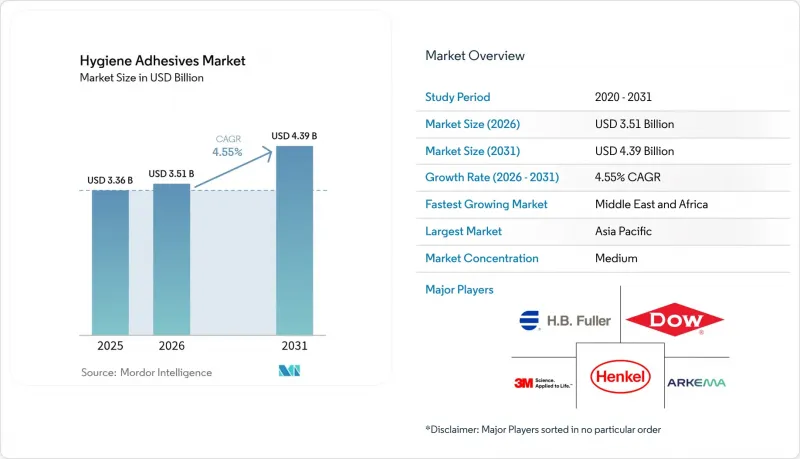
Mordor Intelligence에 의하면, 2026년 위생용품용 접착제 시장 규모는 35억 1,000만 달러로 추정되고 있어 2025년 33억 6,000만 달러에서 확대해, 2031년에는 43억 9,000만 달러에 이를 것으로 예측됩니다.
2026년부터 2031년까지의 연평균 성장률(CAGR)은 4.55%가 될 것으로 전망됩니다.
본 보고서는 수지 유형(에틸렌-비닐 아세테이트, 스티렌-에틸렌-부타디엔-스티렌, 스티렌-이소프렌-스티렌, 스티렌-부타디엔-스티렌 등), 제품 유형(직물 및 부직포),최종 용도 제품(유아용, 성인용 등), 지역(아시아태평양, 북미, 유럽, 남미, 중동 및 아프리카)별로 분류되어 있습니다. 시장 예측은 금액(달러) 기준으로 제시되어 있습니다.
전 세계 위생용품용 접착제 시장 동향 및 인사이트
전 세계 일회용 유아 기저귀 소비 증가
중국의 기저귀 보급률은 2021년 81.5%에서 2023년 89%로 상승했으며, 보호자들 사이에서는 첨단 SEBS 기반 탄성 접착제를 채택한 더 얇고 저자극성 디자인으로의 전환이 진행되고 있습니다. 기저귀 1장당 접착제 사용량은 2020년 디자인에 비해 약 30% 감소했으나, 프리미엄 탄성 시스템에는 15%-20%의 가격 상승이 수반되므로 단위당 가치는 상승하고 있습니다. 프록터 앤 갬블(P&G)이나 유니참(Unicharm)과 같은 다국적 기업들은 관세와 운송 시간을 줄이기 위해 생산의 현지화를 추진하고 있으며, 이를 통해 지역 배합 제조업체들은 수요에 맞는 등급을 공동 개발할 수 있게 되었습니다. 장시간 착용형 및 야간용 제품은 액체에 장시간 노출되어도 접착 강도를 유지하는 내습성 구조용 접착제에 대한 수요를 더욱 부추기고 있습니다. 따라서 동아시아의 출산율 둔화에도 불구하고, 유아용품 부문은 위생용품용 접착제 시장에서 여전히 가장 큰 판매량을 차지하는 분야로 남아 있습니다.
신흥 아시아 국가에서의 여성 위생용품용품 보급 가속화
인도의 생리대 매출액은 2018년에 12%의 상품·서비스세가 철폐된 점과,생리대 사용률이 불과 33.5%에 그치던 농촌 지역에서 공공 부문의 배포가 뒷받침되면서, 2024년 15억 달러에서 2030년까지 30억 달러로 확대될 것으로 예측됩니다. 수요 증가에 따라 고흡수성 코어를 접착하기 위한 건설용 접착제 사용량이 늘어나는 한편, 윙용 감압 접착제에 대한 수요도 높아지고 있습니다. 각 공급업체들은 피부 자극에 대한 불만을 줄이고, 처음 사용하는 소비자층 시장 점유율을 확보하기 위해 저취성이며 ISO 10993을 준수하는 화학 성분을 우선적으로 채택하고 있습니다. 인도, 인도네시아, 필리핀의 일부 지역에서는 주 정부에 의해 퇴비화 가능한 생리대 사용이 의무화됨에 따라, 셀룰로오스 기질과 함께 분해되는 식물성 기름이나 전분을 원료로 한 바이오 핫멜트 접착제에 대한 연구 개발이 촉진되고 있습니다.
석유계 수지의 가격 변동이 생산자의 이익률을 압박
에틸렌 및 프로파일렌의 원가는 원유 가격 변동 및 정유시설의 가동률과 연동됩니다. 2024년 하반기, 중국의 재고 과잉을 배경으로 EVA 가격은 하락했으나, 2020년 이후 크래커 설비에 대한 투자 부족으로 인해 2026년까지 공급 부족이 발생할 가능성이 높은 것으로 보입니다. 위생용품용 접착제 배합 제조업체의 EBITDA 마진은 평균 8%-12%이며, 원자재 가격 상승분을 전액 전가하는 경우는 드물기 때문에 경화 속도를 저해하지 않으면서 비용 리스크를 완화하는 EVA와 SEBS의 하이브리드 블렌드 실험이 진행되고 있습니다. 대형 기저귀 제조업체들은 수지 공급을 확보하고 부가가치를 창출하기 위해 후방 통합을 검토하고 있습니다.
부문 분석
2025년, 에틸렌-비닐아세테이트 공중합체(EVA)는 비용 경쟁력과 폭넓은 설비 호환성을 반영하여 위생용품용 접착제 시장에서 40.92%의 점유율을 차지했습니다. 그러나 SEBS는 2031년까지 연평균 성장률(CAGR) 6.12%를 나타낼 것으로 예측되며, 위생용품용 접착제 시장 전체를 상회하는 속도로 확대될 것으로 전망됩니다. 이는 가공업체들이 장시간 착용 시에도 체온 하에서 접착 강도를 유지하는 내열성을 우선시하기 때문입니다. SIS는 속건성 덕분에 고흡수성 코어를 고정하는 건설용 접착제 분야에서 계속해서 주도적인 위치를 차지하고 있지만, SBS는 감압 접착제 분야에서는 여전히 틈새 시장으로 남아 있습니다. 2024년에 H.B. 풀러사의 ‘Full-Hook’ 시리즈로 상품화된 EVA-SEBS 하이브리드 시스템은 배합 설계자가 비용과 내열성의 균형을 어떻게 맞추고 있는지를 보여줍니다.
지역별 선호도의 차이가 이러한 분화를 더욱 확대시키고 있습니다. 중국 제조업체들은 공급망이 안정되어 있고 배합 조정도 최소한으로 충분하기 때문에 EVA를 계속 사용하고 있습니다. 대조적으로, 일본과 유럽의 컨버터들은 REACH의 배출 상한 기준을 충족하기 위해 SEBS 채택을 가속화하고 있습니다. 2024년에 출원된, 오픈 타임이 긴 개질 스티렌 블록 공중합체에 관한 특허는 분당 1,000개를 넘는 라인 속도를 목표로 하는 지속적인 혁신을 보여줍니다.
지역별 분석
아시아태평양은 2025년에 46.10%의 시장 점유율을 차지하며 위생용품용 접착제 시장을 주도했습니다. 이는 2026년 중국에서 16만 톤의 핫멜트 접착제 수요가 예상된다는 점과 인도에서 생리대의 급속한 보급에 힘입은 결과입니다. 중국 소비자들은 고성능 탄성 접착제가 필요한 고급 기저귀로 계속해서 전환하고 있는 반면, 인도에서는 농촌 지역의 생리대 보급률 향상을 위한 노력이 진행되고 있습니다. 일본에서는 성인용 기저귀 판매량이 유아용 기저귀 판매량을 앞지르는 인구 구조의 역전 현상이 나타나고 있으며, 이는 체온에서도 접착 강도를 유지하는 높은 박리 강도의 SEBS계 접착제 수요를 뒷받침하고 있습니다. 급속한 도시화가 진행되고 있는 아세안(ASEAN) 국가들은 새로운 성장 기회를 제공하고 있지만, 유통망의 세분화로 인해 공급업체 입장에서는 서비스 제공에 대한 부담이 여전히 높은 상황입니다.
북미와 유럽은 성숙한 시장이지만, 프리미엄화와 엄격한 환경 규제에 힘입어 수익성이 높은 시장으로 자리 잡고 있습니다. 다우 케미칼은 2024년 매출 성장이 주춤했다고 보고했으나, 특수 수지에 대한 투자를 지속하고 있으며, 헨켈의 미국 내 자동화 설비 업그레이드는 기계적 적합성이 높은 화학 기술에 대한 지속적인 노력을 보여주고 있습니다. 유럽의 확대 생산자 책임(EPR) 법에 따라 바이오 및 수성 접착제로의 전환이 가속화되고 있으며, 에보닉은 특수 첨가제 개발 자금을 확보하기 위해 범용 사업을 매각하고 있습니다.
중동 및 아프리카는 현재 중규모 시장에 불과하지만, ‘사우디 비전 2030’에 따른 의료 인프라 확충과,UAE의 의료 지출이 2023년 208억 달러에서 2028년까지 267억 달러로 증가할 것으로 예상되는 점을 배경으로, 2031년까지 연평균 성장률(CAGR) 5.74%로 성장할 것으로 전망됩니다. 소매 인프라 확대와 콜드체인 개선으로 인해 위생용품용품의 유통 범위가 넓어지고 있습니다. 브라질은 남미 시장의 핵심을 담당하고 있지만, 환율의 불확실성에 직면해 있습니다. 그러나 인플레이션율이 안정적으로 유지된다면, 2020년대 후반에는 잠재적 수요가 유발될 가능성이 있습니다.
기타 혜택:
- 엑셀 형식 시장 예측(ME) 시트
- 3개월간의 애널리스트 지원
자주 묻는 질문
목차
제1장 서론
제2장 조사 방법
제3장 개요
제4장 시장 구도
제5장 시장 규모와 성장 예측
제6장 경쟁 구도
제7장 시장 기회와 향후 전망
JHS 26.09.03According to Mordor Intelligence, hygiene adhesives market size in 2026 is estimated at USD 3.51 billion, growing from 2025 value of USD 3.36 billion with 2031 projections showing USD 4.39 billion, growing at 4.55% CAGR over 2026-2031.
This report is Segmented by Resin Type (Ethylene-Vinyl Acetate, Styrene-Ethylene-Butadiene-Styrene, Styrene-Isoprene-Styrene, Styrene-Butadiene-Styrene, and More), Product Type (Woven and Non-Woven), End-Use Product (Baby Care, Adult Care, and More), and Geography (Asia-Pacific, North America, Europe, South America, and Middle East and Africa). The Market Forecasts are Provided in Terms of Value (USD).
Global Hygiene Adhesives Market Trends and Insights
Rising Consumption of Disposable Baby Diapers Worldwide
China's diaper penetration climbed from 81.5% in 2021 to 89% in 2023, and parents are trading up to thinner, hypoallergenic designs that rely on advanced SEBS-based elastic adhesives. Although the adhesive weight per diaper is falling by roughly 30% compared to 2020 designs, the value per unit is rising because premium elastic systems carry 15%-20% price increases. Multinationals such as Procter & Gamble and Unicharm have localized production to reduce tariffs and freight time, which allows regional formulators to co-develop tailored grades. Extended-wear and overnight products further drive demand for moisture-resistant construction adhesives that retain bond strength under sustained exposure to liquids. The baby segment, therefore, remains the single largest volume outlet for the hygiene adhesives market despite slower birth rates in East Asia.
Accelerating Feminine Hygiene Adoption in Emerging Asia
India's sanitary-pad sales are expected to expand from USD 1.5 billion in 2024 to USD 3.0 billion by 2030, driven by the 2018 removal of a 12% goods and services tax and public-sector distribution in rural districts, where pad usage stood at only 33.5%. Rising demand translates into higher construction-adhesive volumes to bond super-absorbent cores and into pressure-sensitive grades for wings. Suppliers are prioritizing low-odor, ISO 10993-compliant chemistries to mitigate skin-irritation complaints and capture market share among first-time users. State mandates for compostable pads in parts of India, Indonesia, and the Philippines are stimulating R&D in bio-based hot-melts derived from plant oils and starches that disintegrate alongside cellulose substrates.
Petro-Resin Price Volatility Eroding Producer Margins
Ethylene and propylene costs track crude swings and refinery run rates. EVA prices softened in late 2024 amid inventory overhang in China, yet underinvestment in cracker capacity since 2020 signals a likely deficit by 2026. Hygiene adhesive formulators average 8%-12% EBITDA margins and seldom pass through feedstock spikes in full, prompting experiments with hybrid EVA-SEBS blends that temper cost risk without compromising cure speed. Larger diaper converters are studying backward integration to secure resin supply and capture added value.
Other drivers and restraints analyzed in the detailed report include:
- Aging Populations Boosting Adult-Incontinence Demand
- Sustainability Push Toward Low-VOC and Bio-Based Chemistries
- Adhesive Bleed and Odor; Emerging Ultrasonic Bonding
For complete list of drivers and restraints, kindly check the Table Of Contents.
Segment Analysis
Ethylene-vinyl acetate controlled 40.92% hygiene adhesives market share in 2025, reflecting its competitive cost and broad equipment compatibility. SEBS, however, is forecasted to grow at a 6.12% CAGR through 2031, outstripping the overall hygiene adhesives market as converters prioritize heat resistance that maintains bond integrity at body temperature over extended wear. SIS continues to lead in construction adhesives that anchor super-absorbent cores thanks to its fast-tack nature, while SBS remains a niche in pressure-sensitive tapes. Hybrid EVA-SEBS systems, commercialized in H.B. Fuller's Full-Hook line during 2024, demonstrate how formulators balance cost with thermal durability.
Regional preferences amplify divergence. Chinese producers stay with EVA because supply chains are entrenched and formulation tweaks are minimal. In contrast, Japanese and European converters are accelerating the adoption of SEBS to meet REACH emission ceilings. Patent filings in 2024 covering modified styrene block copolymers with longer open time indicate sustained innovation aimed at line speeds above 1,000 pieces per minute.
Complete Report Scope:
- By Resin Type
- Ethylene-vinyl acetate (EVA)
- Styrene-ethylene-butadiene-styrene (SEBS)
- Styrene-isoprene-styrene (SIS)
- Styrene-butadiene-styrene (SBS)
- Other Resin Types
- By Product Type
- Woven
- Non-woven
- By End-use Product
- Baby Care
- Adult Care
- Feminine Care
- Other Applications
- By Geography
- Asia-Pacific
- China
- India
- Japan
- South Korea
- ASEAN Countries
- Rest of Asia-Pacific
- North America
- United States
- Canada
- Mexico
- Europe
- Germany
- United Kingdom
- Italy
- France
- Spain
- Russia
- Rest of Europe
- South America
- Brazil
- Argentina
- Rest of South America
- Middle-East and Africa
- Saudi Arabia
- South Africa
- Rest of Middle-East and Africa
- Asia-Pacific
Geography Analysis
The Asia-Pacific region dominated the hygiene adhesives market with a 46.10% market share in 2025, underpinned by China's forecasted demand of 160,000 tonnes of hot-melt adhesives in 2026 and India's rapid uptake of sanitary pads. Chinese consumers continue to shift toward premium diaper formats that require high-performance elastic adhesives, while Indian initiatives aim to increase pad penetration in rural villages. Japan exemplifies demographic inversion as adult diapers overtake baby volumes, spurring demand for high-peel SEBS adhesives that maintain bond integrity at body temperature. Quickly urbanizing ASEAN economies supply greenfield growth, although distribution fragmentation keeps service intensity high for suppliers.
North America and Europe are mature but lucrative markets, driven by premiumization and stringent environmental regulations. Dow reported softer 2024 sales yet continues to invest in specialty resins, and Henkel's US automation upgrades demonstrate a continued commitment to machine-friendly chemistries. Extended producer responsibility statutes in Europe are accelerating the switch to bio-based and waterborne adhesives, with Evonik divesting its commodity business to fund specialty additive development.
The Middle East and Africa, while only a midsize base today, are expected to grow at 5.74% CAGR to 2031 on the back of Saudi Vision 2030 healthcare build-outs and a projected UAE health spend rise from USD 20.8 billion in 2023 to USD 26.7 billion by 2028. Expanding retail infrastructure and improved cold chains widen distribution for hygiene products. Brazil anchors South America yet faces currency uncertainty; however, stable inflation paths could unleash latent demand in the latter half of the decade.
- 3M
- Abifor AG
- ADTEK Malaysia Sdn Bhd
- Arkema
- Avery Dennison Corporation
- Colquimica Adhesives
- Dow
- Evonik Industries AG
- Exxon Mobil Corporation
- Focus Hotmelt Company
- H.B. Fuller Company
- Henkel AG & Co. KGaA
- Huntsman Corporation
- ICHEMCO s.r.l.
- Jowat AG
- Lohmann GmbH & Co. KG
- NANPAO RESINS CHEMICAL GROUP
- OMNOVA Solutions Inc.
- Palmetto Adhesives
- Savare Specialty Adhesives LLC
- Sika AG
- TEX YEAR INDUSTRIES INC.
Additional Benefits:
- The market estimate (ME) sheet in Excel format
- 3 months of analyst support
TABLE OF CONTENTS
1 Introduction
- 1.1 Study Assumptions & Market Definition
- 1.2 Scope of the Study
2 Research Methodology
3 Executive Summary
4 Market Landscape
- 4.1 Market Overview
- 4.2 Market Drivers
- 4.2.1 Rising consumption of disposable baby diapers worldwide
- 4.2.2 Accelerating feminine hygiene adoption in emerging Asia
- 4.2.3 Aging populations boosting adult-incontinence demand
- 4.2.4 Sustainability push toward low-VOC and bio-based chemistries
- 4.2.5 Automation need for ultra-fast-setting hot-melt systems
- 4.3 Market Restraints
- 4.3.1 Petro-resin price volatility eroding producer margins
- 4.3.2 Adhesive bleed and odour raising consumer complaints
- 4.3.3 Emerging ultrasonic bonding reducing adhesive usage
- 4.4 Value Chain Analysis
- 4.5 Porter's Five Forces
- 4.5.1 Bargaining Power of Suppliers
- 4.5.2 Bargaining Power of Buyers
- 4.5.3 Threat of New Entrants
- 4.5.4 Threat of Substitutes
- 4.5.5 Degree of Competition
5 Market Size & Growth Forecasts (Value)
- 5.1 By Resin Type
- 5.1.1 Ethylene-vinyl acetate (EVA)
- 5.1.2 Styrene-ethylene-butadiene-styrene (SEBS)
- 5.1.3 Styrene-isoprene-styrene (SIS)
- 5.1.4 Styrene-butadiene-styrene (SBS)
- 5.1.5 Other Resin Types
- 5.2 By Product Type
- 5.2.1 Woven
- 5.2.2 Non-woven
- 5.3 By End-use Product
- 5.3.1 Baby Care
- 5.3.2 Adult Care
- 5.3.3 Feminine Care
- 5.3.4 Other Applications
- 5.4 By Geography
- 5.4.1 Asia-Pacific
- 5.4.1.1 China
- 5.4.1.2 India
- 5.4.1.3 Japan
- 5.4.1.4 South Korea
- 5.4.1.5 ASEAN Countries
- 5.4.1.6 Rest of Asia-Pacific
- 5.4.2 North America
- 5.4.2.1 United States
- 5.4.2.2 Canada
- 5.4.2.3 Mexico
- 5.4.3 Europe
- 5.4.3.1 Germany
- 5.4.3.2 United Kingdom
- 5.4.3.3 Italy
- 5.4.3.4 France
- 5.4.3.5 Spain
- 5.4.3.6 Russia
- 5.4.3.7 Rest of Europe
- 5.4.4 South America
- 5.4.4.1 Brazil
- 5.4.4.2 Argentina
- 5.4.4.3 Rest of South America
- 5.4.5 Middle-East and Africa
- 5.4.5.1 Saudi Arabia
- 5.4.5.2 South Africa
- 5.4.5.3 Rest of Middle-East and Africa
- 5.4.1 Asia-Pacific
6 Competitive Landscape
- 6.1 Market Concentration
- 6.2 Strategic Moves
- 6.3 Market Share (%)/ Ranking Analysis
- 6.4 Company Profiles (includes Global level Overview, Market level overview, Core Segments, Financials as available, Strategic Information, Market Rank/Share for key companies, Products & Services, and Recent Developments)
- 6.4.1 3M
- 6.4.2 Abifor AG
- 6.4.3 ADTEK Malaysia Sdn Bhd
- 6.4.4 Arkema
- 6.4.5 Avery Dennison Corporation
- 6.4.6 Colquimica Adhesives
- 6.4.7 Dow
- 6.4.8 Evonik Industries AG
- 6.4.9 Exxon Mobil Corporation
- 6.4.10 Focus Hotmelt Company
- 6.4.11 H.B. Fuller Company
- 6.4.12 Henkel AG & Co. KGaA
- 6.4.13 Huntsman Corporation
- 6.4.14 ICHEMCO s.r.l.
- 6.4.15 Jowat AG
- 6.4.16 Lohmann GmbH & Co. KG
- 6.4.17 NANPAO RESINS CHEMICAL GROUP
- 6.4.18 OMNOVA Solutions Inc.
- 6.4.19 Palmetto Adhesives
- 6.4.20 Savare Specialty Adhesives LLC
- 6.4.21 Sika AG
- 6.4.22 TEX YEAR INDUSTRIES INC.
7 Market Opportunities and Future Outlook
- 7.1 White-space and Unmet-Need Assessment