|
시장보고서
상품코드
2120306
민간 항공기용 착륙장치 : 시장 점유율 분석, 업계 동향과 통계, 성장 예측(2026-2031년)Commercial Aircraft Landing Gear - Market Share Analysis, Industry Trends & Statistics, Growth Forecasts (2026 - 2031) |
||||||
 Mordor Intelligence
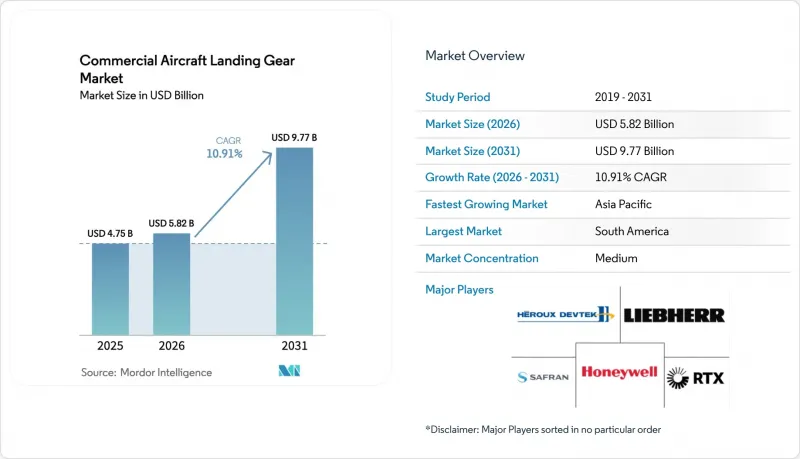
Mordor Intelligence에 따르면 민간 항공기용 착륙장치 시장 규모는 2025년 47억 5,000만 달러에서 2026년에는 58억 2,000만 달러로 확대하며, 2026-2031년에 CAGR 10.91%로 추이하며, 2031년에는 97억 7,000만 달러에 달할 것으로 예측됩니다.
이 보고서는 랜딩 기구의 유형(주착륙장치 및 앞바퀴), 항공기 유형(나로우드, 와이드바디, 리저널 제트), 최종사용자(OEM 및 애프터마켓), 하위 시스템(작동 시스템, 조향 시스템 등), 그리고 지역(북미, 유럽, 아시아태평양 등)별로 분류되어 있습니다. 시장 전망은 금액(달러) 기준으로 제시되어 있습니다.
전 세계 민간 항공기용 랜딩 기어 시장의 동향 및 인사이트
경량 복합재료 및 티타늄 매트릭스 재료로의 전환
탄소 상쇄 비용의 급등과 배출 규제의 강화로 인해 항공사들은 불필요한 탄소 배출량을 1kg이라도 줄이려고 노력하고 있습니다. TISICS는 30%-70%의 경량화가 예상되는 티타늄 매트릭스 스트럿 개발에 대해 영국 정부로부터 250만 파운드(336만 달러)의 자금 지원을 확보했습니다. 크랜필드 대학의 추산에 따르면 현재의 교통량 예측을 바탕으로 할 때 질량을 30% 줄임으로써 2050년까지 960만 톤의 CO₂를 감축할 수 있을 것으로 보입니다. 사프란(Safran)사의 와이어 아크 적층 성형 기술을 통해 A350의 티타늄 착륙 장치 부품 리드 타임이 피로 수명을 저하시키지 않으면서 40% 단축되었습니다. EASA 및 FAA가 복합재료의 피로 시험을 10만 사이클 시뮬레이션까지 시행하고 있으므로 인증은 여전히 병목 현상으로 남아 있지만, 플랫폼 간 데이터 공유가 승인 절차의 신속화에 기여하고 있습니다. 항공사들은 금속과 복합재료를 결합한 하이브리드 설계를 숙지한 공급업체를 높이 평가하고 있습니다. 이는 수명 주기 동안의 연료비 절감 효과가 초기 비용 증가분을 상회하기 때문이며, 측정 가능한 운영 비용 절감을 입증할 수 있는 혁신적인 기업을 우선시하는 방식으로 조달 결정 방식이 변화하고 있습니다.
안전성과 유지보수성을 높이는 전동 브레이크 아키텍처의 OEM 도입
전동 브레이크는 유압 배관을 제거하여 화재 위험을 줄일 뿐만 아니라, 항공기의 버스 전원에 공급되는 회생 에너지를 회수할 수 있게 합니다. 콜린스 에어로스페이스(Collins Aerospace)의 보고에 따르면 DURACARB 사의 카본 브레이크는 B737NG에서 318kg의 경량화를 실현했으며, 전동식 브레이크는 정밀한 토크 제어를 통해 디스크 수명을 25% 연장했습니다. B787은 2011년에 완전 전동식 브레이크를 탑재하여 도입되었으며, 사프란(Safran)사도 이에 이어 A350 및 현재 A320neo용 계약을 수주했습니다. 이 회사는 디스크 교체 및 상태 모니터링 분석을 PBH(부품 수명 보증) 체계에 통합함으로써 지속적인 수익 증대를 도모하고 있습니다. 공압 및 유압 부하가 보다 단순한 전기 서브시스템으로 전환됨에 따라 전동 아키텍처는 ‘더욱 전동화된’ 항공기 객실과 시너지 효과를 발휘하고 있습니다. 리프헬(Leupheld)사는 브레이크 제어 장치를 플라이-바이-와이어 방식의 항공 전자 장비와 결합하여, 활주로의 마찰 계수에 따라 토크를 실시간으로 조정하고 있습니다. 이는 규제 당국이 ‘연기 항목 리스트’의 합리화를 통해 지지하는 안전 기능입니다. 전동 브레이크에 대한 형식 인증을 획득한 공급업체는 규제상 우위를 누리고 있습니다. 신규 진입 기업은 비대칭 추력이나 오염된 활주로와 같은 극한 조건에서의 신뢰성을 입증해야 하기 때문입니다. 이 과정은 시험 데이터를 공유하는 경우에도 2년 이상 소요됩니다.
티타늄 및 복합재료의 공급 병목 현상
러시아산 티타늄에 대한 서방 국가들의 제재로 인해 2022년에는 공급량의 약 3분의 1이 감소했고, 2024년에는 항공우주 등급 티타늄 가격이 1킬로그램당 35달러까지 치솟았으며, 신규 제련소 인증까지 소요되는 기간이 18개월로 늘어났습니다. 킬로그램당 20-150달러 가격대의 탄소섬유 프리프레그는 자동차 및 풍력발전 분야의 수요로 인해 생산 능력이 재배정된 결과, 2025년에는 9개월의 리드타임이 발생했습니다. 스피릿 에어로시스템즈의 기체 품질 문제는 보잉의 제조 계획에 연쇄적인 영향을 미쳤으며, 랜딩 기어 공급업체는 변동하는 납기 일정에 맞춰 재고를 조정할 수밖에 없었습니다. 사프란(Safran)의 프랑스 티타늄 단조 공장에 대한 투자와 콜린스 에어로스페이스(Collins Aerospace)와 도레이(Toray) 간의 프리프레그에 관한 장기 계약은 예측 가능한 비용으로 핵심 소재를 확보하기 위한 수직 통합 전략의 한 예입니다. 후방 통합을 수행할 규모의 규모나 자본이 부족한 중소 공급업체들은 장기 OEM 계약으로 인해 가격 전가 유연성이 제한되어 이익률 압박에 직면해 있습니다.
부문별 분석
주요 조립품은 2025년 민간 항공기용 랜딩 기어 시장의 매출의 75.24%를 차지하며, 단가가 높은 통합형 카본 브레이크와 전동 액추에이터에 힘입어 2031년까지 꾸준히 성장할 것으로 전망됩니다. 쇽업소버, 휠 페어 및 하중 지지 트러니언이 포함되므로 각 메인 기어의 선적 세트는 복잡하고 자본 집약적입니다. 콜린스 에어로스페이스(Collins Aerospace)의 전동식 DURACARB 패키지 하나만으로도 318kg의 경량화를 실현하고 디스크 수명을 4분의 1 연장함으로써, 2,000-3,000회 착륙마다 정기적인 오버홀 수요를 창출하고 있습니다. 반면, 전륜 기어 시장은 2031년까지 연평균 성장률(CAGR) 11.21%로 확대될 것으로 예상되며, 조향 및 지상 취급 하중에 중점을 두고 있습니다. A350용으로 Leupheld가 제공하는 전기유압식 스티어링은 택싱의 정밀도를 높이는 한편, 수익 창출 수단은 제한적입니다.
전동 브레이크 아키텍처로의 전환에 따라 가치 창출의 중심은 주착륙장치 공급업체로 이동하고 있습니다. 이러한 공급업체들은 PBH 계약 하에 구동, 제동, 디지털 헬스 모듈을 번들로 제공할 수 있으므로, OEM의 조달을 간소화하고 제품 수명 주기 전반에 걸쳐 안정적인 수익을 확보할 수 있습니다. 전륜의 혁신은 시야 불량시 활주로 이탈 위험을 줄여주는 소형 카메라와 스마트 스티어링 액추에이터에 중점을 두고 있지만, 가격 프리미엄은 여전히 미미한 수준입니다. 두 가지 기어 유형을 단독으로 공급하는 수직 통합 기업은 인터페이스 위험을 줄이고, 일반적으로 플랫폼당 15년간의 독점권을 확보함으로써 중견 경쟁사들에 대한 시장 지위를 공고히 하고 있습니다.
2025년, 협동체기(narrow-body)는 민간 항공기용 랜딩 기어 시장 점유율의 65.90%를 차지했습니다. 에어버스와 보잉이 합쳐서 월 110대 이상의 단일 통로 항공기 납품을 목표로 하고 있는 만큼, 2031년까지 연평균 성장률(CAGR) 12.00%라는 견고한 성장세를 보일 것으로 전망됩니다. 이 항공기들은 활주 거리가 짧기 때문에 이착륙 주기가 빈번해져 스트럿, 부시, 브레이크의 마모가 가속화됩니다. 결과적으로 이는 애프터마켓 수요를 견인하고 있습니다. 와이드바디 항공기의 착륙 장치는 생산 대수는 적지만, 하중 수용 능력이 높습니다. B777X의 메인 트랙은 약 3,000킬로그램인 반면, B737 MAX는 1,200킬로그램으로, 이것이 프리미엄 가격 책정의 근거가 되고 있습니다. 엠브라에르 E2나 A220으로 대표되는 리저널 제트는 중량 및 사이클 수 요건이 Heroux-Devtek과 같은 공급업체로 하여금 더 짧은 활주로와 높은 운용률에 맞춘 착륙장치 개발을 촉진하도록 하는 중간적인 위치를 차지하고 있습니다.
와이드바디 항공기의 회복은 나로우바디 항공기보다 뒤처지고 있는데, 이는 특히 아시아와 유럽의 장거리 노선 수요가 완전히 정상화되기까지 시간이 걸리고, 각 항공사가 B787이나 A350의 주문을 연기하고 있기 때문입니다. 지역 제트기는 500km 미만의 노선에서는 터보프롭기와 경쟁하고 있지만, 속도와 객실의 쾌적함 덕분에 더 긴 통근 노선에서는 여전히 선호되고 있습니다. 따라서 각 공급업체는 OEM 구성이 변동하더라도 각 기어 생산 세트 간에 유연하게 전환할 수 있도록 유연한 생산 라인과 다기능 인력 양성에 투자하고 있습니다. 이러한 기동성을 통해 자본의 유휴를 최소화하면서, 2027년 이후 광동체 항공기 수요 회복에 대비한 준비 태세를 유지하고 있습니다.
지역별 분석
아시아태평양은 중국과 인도의 주문 급증에 힘입어 2025년 민간 항공기용 랜딩 기어 시장 매출의 32.78%를 차지했습니다. 도시화, 항공 여행 정책의 자유화, 가처분 소득의 증가로 인해 좌석 수요가 확대될 것으로 예상되므로, 2031년까지 그 우위를 유지할 것으로 전망됩니다. 중국의 COMAC C919는 단계적인 현지화를 도모하고 있지만 여전히 유럽과 미국의 랜딩 기어 공급업체에 의존하고 있으며, 이로 인해 기존 제조사들은 기술 이전의 압박을 받고 있습니다. 인도의 인디고 항공과 에어 인디아는 2024년에 총 970대 이상의 수주를 기록했으며, 이에 따라 랜딩 기어 제조사들은 오프셋 조항을 충족하기 위해 현지 조립을 검토하고 있습니다. 일본의 스미토모 정밀공업은 보잉 및 에어버스용 액추에이터를 공급하고 있으며, 이 지역이 글로벌 밸류체인에서 수행하는 역할을 공고히 하고 있습니다. 에어아시아나 베트젯 등 저비용 항공사(LCC)는 카본 브레이크 및 예측 유지보수용 센서 채택을 촉진하는 높은 운용 횟수의 수요 패턴을 유지하고 있습니다.
남미는 LATAM 및 아줄의 기체 갱신, 그리고 엠브라에르의 E2가 나로우바디 항공기보다 경제성이 뛰어난 지방 도시 간 노선에 침투하고 있는 것을 배경으로, 2026-2031년에 연평균 성장률(CAGR) 14.95%라는 가장 높은 성장세가 예상됩니다. 2025년에는 국내 여행이 급속히 회복되면서, 항공기 이착륙 빈도 증가를 지원하는 공항 인프라 투자가 유도되었습니다. 엠브라에르의 E2용 착륙 장치와 관련된 Heroux-Devtek의 다년 계약을 통해 해당 공급업체는 이러한 추세를 타고 성장할 준비가 되어 있습니다. 2025년 매출의 45%는 북미와 유럽이 합쳐서 차지했습니다. 하지만 항공사들이 수명 주기 비용 관리를 위해 PBH 계약을 활용하고 있으므로 이 지역의 성숙한 기체군에서는 신규 납품보다 개조에 중점이 옮겨가고 있습니다. EU 배출권 거래 제도(EU ETS)와 같은 규제 체계로 인해 배출량을 감축하고 검증된 탄소 크레딧의 감축 효과를 더 많이 확보할 수 있는 전동 브레이크 및 센서 도입에 대한 인센티브가 강화되고 있습니다.
중동 지역은 에미레이트 항공, 카타르 항공, 그리고 신규 진입자인 리야드 에어 등이 간헐적으로 거액의 주문을 하고 있으며, 큰 성장 잠재력을 지니고 있습니다. 그러나 와이드바디 항공기의 인증 지연과 원유 가격 변동이 예측에 불확실성을 초래하고 있습니다. 아프리카는 항공사의 낮은 수익성과 미비한 MRO 인프라로 인해 여전히 뒤처져 있습니다. 그러나 에티오피아 항공 등 국영 항공사들이 기체 현대화에 신중하게 투자하고 있으며, 성능이 최적화된 기어에 대한 수요가 싹트고 있음을 시사합니다. 각 공급업체들은 신흥 지역에 판매 자원을 배분할 때, 단기적인 판매량과 지정학적 리스크 및 지급 리스크 상황을 신중하게 비교 검토하고 있습니다.
기타 혜택:
- 엑셀 형식의 시장 예측(ME) 시트
- 3개월간의 애널리스트 지원
자주 묻는 질문
목차
제1장 서론
제2장 조사 방법
제3장 개요
제4장 시장 구도
제5장 시장 규모와 성장 예측
제6장 경쟁 구도
제7장 시장의 기회와 향후 전망
KSA 26.09.02According to Mordor Intelligence, the commercial aircraft landing gear market size is expected to grow from USD 4.75 billion in 2025 to USD 5.82 billion in 2026 and is forecasted to reach USD 9.77 billion by 2031 at a 10.91% CAGR over 2026-2031.
This report is Segmented by Landing Gear Type (Main Landing Gear and Nose Landing Gear), Aircraft Type (Narrowbody, Widebody, and Regional Jet), End User (Original Equipment Manufacturer and Aftermarket), Sub-Systems (Actuation System, Steering System, and More), and Geography (North America, Europe, Asia-Pacific, and More). The Market Forecasts are Provided in Terms of Value (USD).
Global Commercial Aircraft Landing Gear Market Trends and Insights
Shift Toward Lightweight Composite and Titanium-Matrix Materials
Escalating carbon-offset fees and tightening emissions regulations motivate airlines to shed every unnecessary kilogram of carbon. TISICS won GBP 2.5 million (USD 3.36 million) in UK funding for titanium-matrix struts that promise 30%-70% weight savings. Cranfield University calculated that a 30% mass cut could eliminate 9.6 million tons of CO2 by 2050, based on current traffic projections. Safran's wire-arc additive manufacturing reduced lead times by 40% for titanium landing-gear parts on the A350, without compromising fatigue life. Certification remains the chokepoint because EASA and FAA fatigue-test composites to 100,000 simulated cycles, but cross-platform data sharing helps accelerate approvals. Airlines reward suppliers that master hybrid metal-composite designs because life-cycle fuel savings outweigh upfront premiums, reshaping sourcing decisions in favor of innovators that can document measurable operating-cost reductions.
OEM Adoption of Electric Brake Architectures Enhancing Safety and Maintainability
Electric brakes eliminate hydraulic lines, reduce fire risk, and enable regenerative energy capture that powers aircraft buses. Collins Aerospace reports that DURACARB carbon brakes reduce weight by 318 kilograms on the B737NG and, in their electric form, extend disk life by 25% through precise torque control. The B787 was introduced with fully electric brakes in 2011, and Safran followed with contracts for the A350 and now the A320neo, bundling disk replacements and health-monitoring analytics under PBH frameworks that boost recurring revenue. Electric architectures dovetail with more-electric aircraft cabins as pneumatic and hydraulic loads migrate to simpler electrical subsystems. Liebherr pairs brake-control units with fly-by-wire avionics to adjust torque in real-time based on runway friction, a safety feature that regulators endorse by streamlining deferred-item lists. Suppliers holding type-certificate approvals for electric brakes enjoy regulatory moats because new entrants must prove reliability under edge-case conditions, such as asymmetric thrust or contaminated runways, a process that extends beyond two years, even with shared test data.
Titanium and Composite Material Supply Bottlenecks
Western sanctions on Russian titanium removed roughly one-third of the supply in 2022, pushing aerospace-grade prices as high as USD 35 per kilogram in 2024 and stretching qualification timelines for new mills to 18 months. Carbon-fiber prepreg, priced from USD 20 to USD 150 per kilogram, experienced a nine-month lead time in 2025 due to automotive and wind-energy demand diverting capacity. Spirit AeroSystems' fuselage quality issues cascaded through Boeing build plans, forcing landing-gear suppliers to juggle inventory against shifting delivery slots. Safran's investment in a French titanium-forging plant and Collins Aerospace's long-term pact with Toray for prepreg illustrate vertical integration strategies that secure critical materials at predictable costs. Smaller suppliers, lacking scale or capital for backward integration, face a margin squeeze, as long-term OEM contracts limit price-pass-through flexibility.
Other drivers and restraints analyzed in the detailed report include:
- Growth in Global Commercial Aircraft Production Requirements
- Integration of Smart Sensors for Landing-Gear Health Monitoring
- Certification Delays for Advanced Actuation and Composite Structures
For complete list of drivers and restraints, kindly check the Table Of Contents.
Segment Analysis
Main assemblies seized 75.24% of the commercial aircraft landing gear market revenue in 2025 and are projected to grow steadily through 2031, buoyed by integrated carbon brakes and electric actuators that command higher unit prices. The inclusion of shock absorbers, wheel pairs, and load-bearing trunnions makes each main-gear shipset complex and capital-intensive. Collins Aerospace's electric DURACARB package alone delivers 318-kilogram weight savings and extends disk life by a quarter, generating recurring overhaul demand every 2,000-3,000 landings. In comparison, nose gear is projected to expand at an 11.21% CAGR through 2031 and focuses on steering and ground-handling loads; Liebherr's electro-hydraulic steering for the A350 enhances taxi precision but offers fewer monetization levers.
The transition toward electric brake architectures skews value creation toward main-gear suppliers who can bundle actuation, braking, and digital-health modules under PBH contracts, thereby simplifying OEM sourcing and ensuring consistent revenue throughout the product lifecycle. Nose-gear innovation centers on compact cameras and smart steering actuators that trim runway excursion risk in low-visibility conditions, but the price premium remains modest. Vertically integrated players that deliver both gear types on a sole-source basis reduce interface risk and typically secure 15-year exclusivity per platform, fortifying market positions against mid-tier challengers.
Narrowbody jets accounted for 65.90% of the commercial aircraft landing gear market share in 2025. They will expand at a robust 12.00% CAGR through 2031 as Airbus and Boeing together target more than 110 monthly single-aisle deliveries. Their shorter stage lengths yield higher takeoff-and-landing cycles, accelerating wear on struts, bushings, and brakes, which in turn powers aftermarket demand. Widebody gear, although representing lower volumes, carries heavier load ratings; a B777X main truck weighs around 3,000 kilograms compared with 1,200 kilograms for the B737 MAX, supporting premium pricing. Regional jets, led by the Embraer E2 and A220, occupy a middle ground where weight and cycle requirements spur suppliers like Heroux-Devtek to tailor gear for shorter runways and higher sortie rates.
Widebody recovery trails narrowbody because long-haul traffic, particularly in Asia and Europe, has to fully normalize, prompting airlines to defer B787 and A350 orders. Regional jets face turboprop competition on routes under 500 kilometers, but retain a preference on longer commuter routes due to their speed and cabin comfort. Suppliers therefore invest in flexible production lines and cross-trained workers who are able to pivot between gear shipsets as the OEM mix fluctuates. This agility minimizes capital under-utilization while preserving readiness for any widebody rebound post-2027.
Complete Report Scope:
- By Landing Gear Type
- Main Landing Gear
- Nose Landing Gear
- By Aircraft Type
- Narrowbody
- Widebody
- Regional Jet
- By End User
- Original Equipment Manufacturer (OEM)
- Aftermarket
- By Sub-Systems
- Actuation System
- Steering System
- Braking System
- Strutural System
- Other Sub-Systems
- By Geography
- North America
- United States
- Canada
- Mexico
- Europe
- United Kingdom
- France
- Germany
- Italy
- Spain
- Russia
- Rest of Europe
- Asia-Pacific
- China
- India
- Japan
- South Korea
- Australia
- Rest of Asia-Pacific
- South America
- Brazil
- Rest of South America
- Middle East and Africa
- Middle East
- Saudi Arabia
- United Arab Emirates
- Rest of Middle East
- Africa
- South Africa
- Rest of Africa
- Middle East
- North America
Geography Analysis
The Asia-Pacific secured 32.78% of the commercial aircraft landing gear market revenue in 2025, driven by a surge in orders from China and India. It is expected to retain its primacy through 2031, as urbanization, liberalized air travel policies, and rising disposable incomes are expected to boost seat demand. China's COMAC C919 relies on Western gear suppliers while seeking progressive localization, placing technology-transfer pressure on incumbents. India's IndiGo and Air India surpassed 970 combined orders in 2024, prompting gear makers to consider local assembly to meet offset clauses. Japan's Sumitomo Precision Products delivers actuators for Boeing and Airbus programs, cementing the region's role in the global value chain. Low-cost carriers, such as AirAsia and Vietjet, sustain high-cycle demand profiles that favor carbon brakes and predictive maintenance sensors.
South America is primed for the fastest 14.95% CAGR from 2026 to 2031, anchored by LATAM and Azul fleet renewals and by Embraer's E2 penetration into secondary city pairs where regional jets outperform narrowbody economics. Domestic travel rebounded swiftly in 2025, drawing investment into airport infrastructure that supports higher movement frequencies. Heroux-Devtek's multi-year contract for Embraer E2 gear positions the supplier to ride this momentum. North America and Europe combined for 45% of the revenue in 2025. Still, their mature fleets are shifting emphasis toward retrofit rather than new deliveries as airlines leverage PBH agreements to manage lifecycle costs. Regulatory frameworks, such as the EU ETS, intensify incentives to adopt electric brakes and sensors that reduce emissions and capture more verified carbon-credit savings.
The Middle East offers a meaningful upside because Emirates, Qatar Airways, and newcomer Riyadh Air have placed episodic mega-orders. However, wide-body certification slippages and oil-price volatility inject uncertainty into forecasting. Africa continues to trail, hindered by limited airline profitability and underdeveloped MRO infrastructure; however, flag carriers such as Ethiopian Airlines invest cautiously in fleet modernization, signaling a nascent demand for performance-optimized gear. Suppliers weigh near-term volume against geopolitical and payment-risk profiles when allocating sales resources across emerging geographies.
- Safran SA
- RTX Corporation
- Liebherr-International Deutschland GmbH
- Parker-Hannifin Corporation
- Heroux-Devtek Inc.
- Triumph Group, Inc.
- Sumitomo Precision Products Co., Ltd.
- CIRCOR International, Inc.
- Magellan Aerospace Corporation
- REVIMA Group
- Crane Company
- GKN Aerospace Services Limited
- Eaton Corporation plc
- Moog Inc.
- Honeywell International Inc.
- Sika Interplant Systems Limited
Additional Benefits:
- The market estimate (ME) sheet in Excel format
- 3 months of analyst support
TABLE OF CONTENTS
1 INTRODUCTION
- 1.1 Study Assumptions and Market Definition
- 1.2 Scope of the Study
2 RESEARCH METHODOLOGY
3 EXECUTIVE SUMMARY
4 MARKET LANDSCAPE
- 4.1 Market Overview
- 4.2 Market Drivers
- 4.2.1 Shift toward lightweight composite and titanium-matrix materials for fuel-efficient aircraft
- 4.2.2 OEM adoption of electric brake architectures enhancing safety and maintainability
- 4.2.3 Growth in global commercial aircraft production requirements
- 4.2.4 Integration of smart sensors for landing gear health monitoring
- 4.2.5 Replacement of aging fleets with next-generation fuel-efficient aircraft
- 4.2.6 Adoption of Industry 4.0 and 5.0 technologies enhancing landing gear design and assembly
- 4.3 Market Restraints
- 4.3.1 Titanium and composite material supply bottlenecks
- 4.3.2 Certification delays for advanced actuation and composite structures
- 4.3.3 High cost of advanced materials and manufacturing processes
- 4.3.4 Expansion of OEM PBH agreements by reducing independent service opportunities
- 4.4 Value Chain Analysis
- 4.5 Regulatory Landscape
- 4.6 Technological Outlook
- 4.7 Porter's Five Forces Analysis
- 4.7.1 Bargaining Power of Suppliers
- 4.7.2 Bargaining Power of Buyers/Consumers
- 4.7.3 Threat of New Entrants
- 4.7.4 Threat of Substitute Products
- 4.7.5 Intensity of Competitive Rivalry
5 MARKET SIZE AND GROWTH FORECASTS (VALUE)
- 5.1 By Landing Gear Type
- 5.1.1 Main Landing Gear
- 5.1.2 Nose Landing Gear
- 5.2 By Aircraft Type
- 5.2.1 Narrowbody
- 5.2.2 Widebody
- 5.2.3 Regional Jet
- 5.3 By End User
- 5.3.1 Original Equipment Manufacturer (OEM)
- 5.3.2 Aftermarket
- 5.4 By Sub-Systems
- 5.4.1 Actuation System
- 5.4.2 Steering System
- 5.4.3 Braking System
- 5.4.4 Strutural System
- 5.4.5 Other Sub-Systems
- 5.5 By Geography
- 5.5.1 North America
- 5.5.1.1 United States
- 5.5.1.2 Canada
- 5.5.1.3 Mexico
- 5.5.2 Europe
- 5.5.2.1 United Kingdom
- 5.5.2.2 France
- 5.5.2.3 Germany
- 5.5.2.4 Italy
- 5.5.2.5 Spain
- 5.5.2.6 Russia
- 5.5.2.7 Rest of Europe
- 5.5.3 Asia-Pacific
- 5.5.3.1 China
- 5.5.3.2 India
- 5.5.3.3 Japan
- 5.5.3.4 South Korea
- 5.5.3.5 Australia
- 5.5.3.6 Rest of Asia-Pacific
- 5.5.4 South America
- 5.5.4.1 Brazil
- 5.5.4.2 Rest of South America
- 5.5.5 Middle East and Africa
- 5.5.5.1 Middle East
- 5.5.5.1.1 Saudi Arabia
- 5.5.5.1.2 United Arab Emirates
- 5.5.5.1.3 Rest of Middle East
- 5.5.5.2 Africa
- 5.5.5.2.1 South Africa
- 5.5.5.2.2 Rest of Africa
- 5.5.5.1 Middle East
- 5.5.1 North America
6 COMPETITIVE LANDSCAPE
- 6.1 Market Concentration
- 6.2 Strategic Moves
- 6.3 Market Share Analysis
- 6.4 Company Profiles (includes Global level Overview, Market level overview, Core Segments, Financials as available, Strategic Information, Market Rank/Share for key companies, Products and Services, and Recent Developments)
- 6.4.1 Safran SA
- 6.4.2 RTX Corporation
- 6.4.3 Liebherr-International Deutschland GmbH
- 6.4.4 Parker-Hannifin Corporation
- 6.4.5 Heroux-Devtek Inc.
- 6.4.6 Triumph Group, Inc.
- 6.4.7 Sumitomo Precision Products Co., Ltd.
- 6.4.8 CIRCOR International, Inc.
- 6.4.9 Magellan Aerospace Corporation
- 6.4.10 REVIMA Group
- 6.4.11 Crane Company
- 6.4.12 GKN Aerospace Services Limited
- 6.4.13 Eaton Corporation plc
- 6.4.14 Moog Inc.
- 6.4.15 Honeywell International Inc.
- 6.4.16 Sika Interplant Systems Limited
7 MARKET OPPORTUNITIES ANDFUTURE OUTLOOK
- 7.1 White-space and Unmet-Need Assessment