

|
시장보고서
상품코드
2120345
멤리스터 : 시장 점유율 분석, 업계 동향 및 통계, 성장 예측(2026-2031년)Memristor - Market Share Analysis, Industry Trends & Statistics, Growth Forecasts (2026 - 2031) |
||||||
 Mordor Intelligence
Mordor Intelligence에 의하면, 멤리스터 시장 규모는 2026년에 286억 달러에 이르고, 2031년까지 1,550억 9,000만 달러까지 확대되고 동기 사이에 CAGR 28.6%로 성장할 전망입니다.
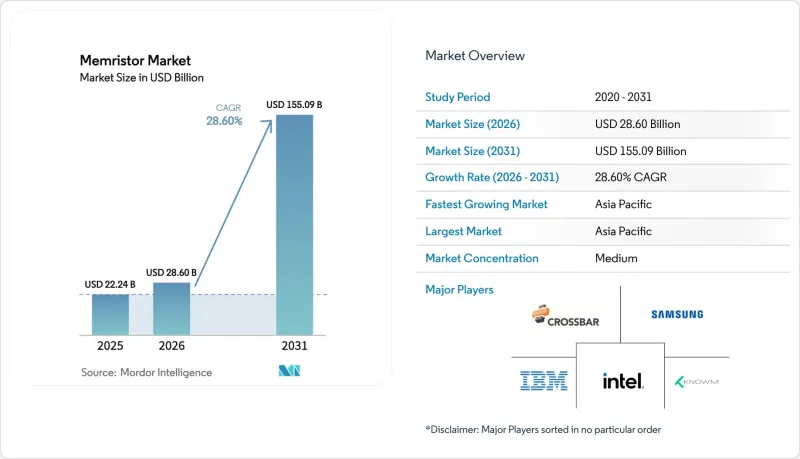
본 보고서는 용도별(비휘발성 메모리, 뉴로모픽 및 생물학적 시스템, 프로그래머블 로직 및 신호 처리 등), 최종 사용자 산업별(소비자 가전, IT 및 통신,자동차, 헬스케어 등), 기술별(분자 및 이온 박막 등), 소재별(금속 산화물, 칼코겐화물 등), 그리고 지역별로 분류되어 있습니다. 시장 전망은 금액(미 달러) 기준으로 제시되어 있습니다.
세계의 멤리스터 시장 동향 및 인사이트
IoT, 클라우드 컴퓨팅, 빅데이터에 대한 수요 증가
각 하이퍼스케일러 기업들은 폰 노이만형 코어에서 데이터 마이그레이션에 수반되는 80%의 에너지 오버헤드를 억제하기 위해, 멤리스터형 ‘Compute-in-Memory’ 어레이를 도입하고 있습니다. 칭화대학교가 개발한 완전 통합형 칩은 ASIC의 기준치에 비해 전력 소비가 3%에 불과하여, 웨어러블 단말기나 자율주행차에서 실시간 학습을 가능하게 하고 있습니다. 2025년 6월, 소프트뱅크, 인텔, 도쿄대학은 대용량·저전력 메모리의 상용화를 목표로 30억 엔(2,220만 달러)의 시드 자금을 투자하여 SAIMEMORY를 설립했습니다. 엣지 디바이스는 대기 시 누설 전류가 제로라는 이점을 누리고 있으며, 아시아태평양의 가전 업체들은 이러한 어레이를 가장 먼저 탑재하고 있습니다. 북미의 각 하이퍼스케일러 기업들은 추천 엔진을 위한 뉴로모픽 가속기의 시범 운영을 진행하고 있으며, 이는 즉시 개척 가능한 멤리스터 시장의 확대로 이어지고 있습니다.
자율형 로봇의 도입이 급증
창고나 공장의 로봇에는 기존의 DRAM-GPU 스택으로는 충족할 수 없는 결정론적 지연 시간이 요구됩니다. KAIST는 기존 설계에 비해 에너지 소비량을 92.9% 줄이면서 예측 정확도를 향상시킨, 곤충을 모방한 동작 감지기를 시연했습니다. 메모리스틱 시냅스를 탑재한 BrainChip사의 ‘Akida’ 프로세서는 밀리초 단위의 응답이 필요한 OEM 제조업체들의 주목을 받고 있습니다. 동아시아 공장의 협업 로봇이 초기 대량 도입 고객이 되고 있으며, 유럽의 산업 자동화 분야도 중기적인 조달 주기로 이에 뒤따르고 있습니다. 이러한 도입으로 인해 높은 내구성과 저온 드리프트를 갖춘 견고한 멤리스터에 대한 단위 수요가 증가하고 있습니다.
기술 적용의 복잡성
시스템 온 칩(SoC) 설계자는 재료, 아날로그 회로, 네트워크 알고리즘을 통합적으로 최적화해야 하지만, 이러한 다분야에 걸친 인재는 부족합니다. 도쿄대학의 다계층 TaOx 테스트 칩은 표준 프레임워크에서는 인식되지 않는 새로운 활성화 함수를 사용함으로써, 10년간의 유지 성능과 고밀도화의 균형을 실현했습니다. 이러한 격차로 인해 맞춤형 툴체인이 필요하게 되었고, 시장 출시까지의 기간이 장기화되며 비반복적 엔지니어링 비용(NRE)이 증가하고 있습니다. 생태계가 아직 확립 단계에 있는 지역에서는 그 영향을 가장 크게 받고 있지만, 2026년 이후 제품에 기대되는 공통 레퍼런스 디자인을 통해 장벽은 점차 낮아질 전망입니다.
부문 분석
2025년에는 마이크로컨트롤러의 임베디드 플래시 메모리 대체를 주축으로, 비휘발성 메모리가 매출의 45.22%를 차지했습니다. 뉴로모픽 및 생물학적 시스템과 관련된 멤리스터 시장 규모는 연구 기관들이 시뮬레이션에서 실용적인 실리콘으로의 전환을 진행함에 따라 연평균 성장률(CAGR) 36.22%로 성장할 전망입니다. KAIST가 개발한 셀렉터리스 어레이는 보안 카메라용 실시간 학습을 입증하며 상업적 실현 가능성을 보여주었습니다. 5G 무선 분야의 적응형 필터 등 프로그래머블 로직에 대한 활용도 증가하고 있습니다. 연산 중심 아키텍처가 순수한 스토리지를 능가함에 따라, 멤리스터 시장에서는 곱셈 및 누적 연산의 정밀도에 최적화된 디바이스로 가치가 이동할 것입니다.
이러한 전환은 ASIC의 3%에 해당하는 에너지로 작동하는 칭화대학교의 통합형 ‘Compute-in-Memory’ 칩에 의해 뒷받침되고 있습니다. 하이퍼스케일러의 스토리지 클래스 메모리 시범 프로젝트는 메모리와 로직의 경계를 더욱 모호하게 만들고 있습니다. 난수 생성이나 물리적으로 복제 불가능한 기능(PUF)과 같은 2차적인 역할이 수요를 서서히 끌어올리며, 멤리스터 시장의 다양화를 뒷받침하고 있습니다.
2025년에는 음성 및 카메라 처리를 위한 온디바이스 AI를 활용하는 소비자용 전자 기기가 매출의 31.55%를 차지했습니다. 자동차 분야 수요는 서브 밀리초 단위의 추론이 필요한 첨단 운전자 지원 시스템이 전기차에 탑재됨에 따라 연평균 성장률(CAGR) 27.53%로 가속화되고 있습니다. BrainChip사의 ‘Akida’ 프로세서는 이미 보행자 감지 모듈에 탑재되어 있습니다. 엣지 통신 및 IT 분야의 구매자들은 백홀 지연을 단축하기 위해 5G 기지국에 멤리스터 가속기를 도입하고 있으며, 이로 인해 통신 사업자 인프라 내에서 멤리스터 시장 점유율이 확대되고 있습니다.
의료기기 분야에서는 누설 전류가 없어 장수명 배터리가 실현되고 있으며, 산업용 자동화 분야에서는 적응형 로봇 컨트롤러에 멤리스터가 활용되고 있습니다. DARPA의 REMIND 프로젝트 선정 등 방위 관련 계약을 통해 방사선 내성 멤리스터 제품에 대한 안정적인 수익원이 확보되고 있습니다. 농업 및 소매업을 비롯한 신흥 분야에서도 센서 노드의 실증 실험이 진행 중이며, 이는 멤리스터 시장의 잠재적인 비즈니스 기회가 확대되고 있음을 시사합니다.
지역별 분석
아시아태평양은 2025년에 매출의 53.33%를 차지하며 메모리스트 시장을 주도했으며, 2031년까지 연평균 성장률(CAGR) 21.90%를 나타낼 것으로 예측됩니다. 일본은 반도체 프로그램에 10조 엔(670억 달러)을 배정하여 SAIMEMORY와 같은 벤처 기업을 지원하고 있습니다. 중국의 칭화대학교는 ASIC 기준 전력 소비량의 3%로 작동하는 ‘컴퓨트 인 메모리(Compute-in-Memory)’ 칩을 개발한 반면, 한국의 KAIST는 2024년부터 2025년에 걸쳐 상변화 메모리 및 뉴로모픽 기술 분야에서 획기적인 성과를 발표했습니다. 대만의 TSMC는 메모리스트 집적에 관한 『Nature』지 논문을 여러 편 공동 집필하며 파운드리 분야의 규모 확대를 시사하고 있습니다. 인도와 동남아시아 국가들은 설계 교육 강화에 주력하고 있지만, 메모리스트 생태계는 여전히 초기 단계에 머물러 있습니다.
북미는 국방 수요와 하이퍼스케일러의 AI 투자에 힘입어 2025년에는 2위를 차지했습니다. DARPA의 1,160만 달러 규모의 REMIND 보조금은 우주용 ReRAM 개발에 사용되고 있으며, 개정된 미국의 마이크로전자공학 전략에서는 메모리스트 소재가 국가적 우선 과제로 꼽히고 있습니다. IBM과 인텔은 상변화 및 뉴로모픽 아키텍처에 대한 연구를 계속하고 있으며, 캐나다와 멕시코는 패키징 및 설계 분야의 인재를 공급하고 있습니다.
이어 유럽에서는 독일, 프랑스, 영국이 첨단 운전자 지원 시스템 및 예측 유지보수 가속기 시범 프로젝트를 추진하고 있습니다. 유럽 우주국(ESA)은 심우주 탐사선용 멤리스터의 내방사선성을 평가했습니다. 남미, 중동 및 아프리카에서는 특히 스마트 시티 도입 측면에서 아직 초기 단계이긴 하지만 관심이 높아지고 있습니다. 그러나 공급망의 제약으로 인해 급속한 확장은 제한되고 있습니다. 따라서 아시아태평양과 북미는 2031년까지 멤리스터 시장에서 지배적인 위치를 유지할 전망입니다.
기타 혜택 :
- 엑셀 형식 시장 예측(ME) 시트
- 3개월간의 애널리스트 지원
자주 묻는 질문
목차
제1장 서론
제2장 조사 방법
제3장 주요 요약
제4장 시장 구도
제5장 시장 규모 및 성장 예측
제6장 경쟁 구도
제7장 시장 기회 및 향후 전망
KTH 26.09.10According to Mordor Intelligence, the memristor market size reached USD 28.6 billion in 2026 and is forecast to climb to USD 155.09 billion by 2031, advancing at a 28.6% CAGR over the period.
This report is Segmented by Application (Non-Volatile Memory, Neuromorphic and Biological System, Programmable Logic and Signal Processing, and More), End-User Industry (Consumer Electronics, IT and Telecom, Automotive, Healthcare, and More), Technology (Molecular and Ionic Thin Film, and More), Material (Metal Oxide, Chalcogenide, and More), and Geography. The Market Forecasts are Provided in Terms of Value (USD).
Global Memristor Market Trends and Insights
Increasing Demand for IoT, Cloud Computing, and Big Data
Hyperscalers are deploying memristive compute-in-memory arrays to curb the 80% energy overhead linked to data movement in von Neumann cores. A fully integrated chip from Tsinghua consumes 3% of ASIC baselines, enabling real-time learning on wearables and autonomous vehicles. In June 2025, SoftBank, Intel, and the University of Tokyo formed SAIMEMORY with JPY 3 billion (USD 22.2 million) seed capital to commercialize high-capacity low-power memory. Edge devices profit from zero standby leakage, and Asia-Pacific consumer-electronics vendors are quick to integrate such arrays. North American hyperscalers are piloting neuromorphic accelerators for recommendation engines, expanding the immediate addressable memristor market.
Surging Adoption of Autonomous Robots
Warehouse and factory robots demand deterministic latency that legacy DRAM-GPU stacks cannot meet. KAIST demonstrated an insect-mimicking motion detector consuming 92.9% less energy than existing designs while raising prediction accuracy. BrainChip's Akida processor, embedding memristive synapses, has attracted OEMs that require millisecond responses. Collaborative robots across East Asian factories have become early volume customers, and Europe's industrial automation sector is following in medium-term procurement cycles. These deployments push up unit demand for ruggedized memristors with high endurance and low-temperature drift.
Complexity in Technological Application
System-on-chip designers must co-optimize materials, analog circuits, and network algorithms, yet such multidisciplinary talent is scarce. The University of Tokyo's multilevel TaOx test chip balanced 10-year retention with higher density using new activation functions unrecognized by standard frameworks. This gap forces bespoke toolchains, extends time-to-market, and raises non-recurring engineering cost. Regions with nascent ecosystems feel the pinch most, but shared reference designs expected from 2026 products should gradually reduce barriers.
Other drivers and restraints analyzed in the detailed report include:
- Rising Adoption of Edge AI Accelerators Requiring In-Memory Computing
- Semiconductor Scaling Limits Pushing Beyond CMOS Memory Designs
- High Switching Variability and Endurance Issues
For complete list of drivers and restraints, kindly check the Table Of Contents.
Segment Analysis
In 2025, non-volatile memory represented 45.22% revenue, anchored by embedded flash replacements in microcontrollers. The memristor market size tied to neuromorphic and biological systems is set to grow at 36.22% CAGR as laboratories transition from simulation to production silicon. KAIST's selector-less array demonstrated real-time learning for security cameras, proving commercial viability. Programmable logic uses, such as adaptive filters in 5G radio, are also increasing. As compute-centric architectures outpace pure storage, the memristor market will witness value shifting toward devices optimized for multiply-accumulate precision.
The pivot is underscored by Tsinghua's integrated compute-in-memory chip, which operates at 3% of ASIC energy. Storage-class memory pilots by hyperscalers further blend the boundary between memory and logic. Secondary roles like random-number generation and physically unclonable functions add incremental demand, reinforcing the memristor market's diversification.
Consumer electronics held 31.55% revenue in 2025, leveraging on-device AI for voice and camera tasks. Automotive demand is accelerating at a 27.53% CAGR as electric vehicles embed advanced driver assistance requiring sub-millisecond inference. BrainChip's Akida processor is already integrated into pedestrian-detection modules. Edge telecom and IT buyers deploy memristive accelerators in 5G base stations to trim backhaul latency, boosting the memristor market share inside carrier infrastructure.
Healthcare devices enjoy long battery life thanks to zero leakage, while industrial automation uses memristors for adaptive robot controllers. Defense contracts, such as DARPA's REMIND award, secure revenue streams for radiation-hardened variants. Emerging sectors, agriculture and retail among them, experiment with sensor nodes, signaling broadening addressable opportunities for the memristor market.
Complete Report Scope:
- By Application
- Non-volatile Memory
- Neuromorphic and Biological System
- Programmable Logic and Signal Processing
- Emerging Data Storage
- Other Applications
- By End-user Industry
- Consumer Electronics
- IT and Telecom
- Automotive
- Healthcare
- Industrial Automation
- Defense and Aerospace
- Other End-user Industries
- By Technology
- Molecular and Ionic Thin Film
- Spin-based and Magnetic Memristor
- Hybrid CMOS-Memristor
- 3D Crosspoint
- Other Technologies
- By Material
- Metal Oxide
- Chalcogenide
- Spintronic
- Organic Polymer
- Ferroelectric
- Other Materials
- By Geography
- North America
- United States
- Canada
- Mexico
- Rest of North America
- Europe
- Germany
- France
- United Kingdom
- Italy
- Spain
- Russia
- Rest of Europe
- Asia-Pacific
- China
- Japan
- India
- South Korea
- Australia
- Rest of Asia-Pacific
- South America
- Brazil
- Argentina
- Rest of South America
- Middle East
- Saudi Arabia
- United Arab Emirates
- Turkey
- Rest of Middle East
- Africa
- South Africa
- Nigeria
- Rest of Africa
- North America
Geography Analysis
Asia-Pacific led the memristor market with 53.33% revenue in 2025 and is projected to grow at 21.90% CAGR through 2031. Japan earmarked JPY 10 trillion (USD 67 billion) for semiconductor programs, underpinning ventures like SAIMEMORY. China's Tsinghua University delivered a compute-in-memory chip consuming 3% of ASIC baselines, while South Korea's KAIST unveiled phase-change and neuromorphic breakthroughs during 2024-2025. Taiwan's TSMC co-authored multiple Nature papers on memristive integration, signaling foundry scale-up. India and Southeast Asian states are enhancing design education, yet their memristor ecosystems remain early-stage.
North America ranked second in 2025, propelled by defense needs and hyperscaler AI investment. DARPA's USD 11.6 million REMIND grant funds space-grade ReRAM, and amended U.S. microelectronics strategy lists memristive materials as national priorities. IBM and Intel continue research on phase-change and neuromorphic architectures, while Canada and Mexico contribute packaging and design talent.
Europe followed, with Germany, France, and the United Kingdom piloting advanced driver assistance and predictive-maintenance accelerators. The European Space Agency evaluates memristor radiation tolerance for deep-space probes. South America, the Middle East, and Africa show nascent but rising interest, especially in smart-city deployments, yet supply-chain constraints limit rapid scaling. Asia-Pacific and North America are therefore set to maintain dominant memristor market positions through 2031.
- Crossbar Inc.
- Panasonic Corporation
- 4DS Memory Limited
- Adesto Technology Inc.
- Micron Technology Inc.
- Samsung Electronics Co. Ltd.
- Sony Group Corporation
- Western Digital Corporation
- Knowm Inc.
- Intel Corporation
- IBM Corporation
- SK hynix Inc.
- Weebit Nano Ltd.
- Fujitsu Limited
- Toshiba Corporation
- Honeywell International Inc.
- Everspin Technologies Inc.
- STMicroelectronics N.V.
- Avalanche Technology Inc.
- HP Inc.
- Taiwan Semiconductor Manufacturing Company Limited
Additional Benefits:
- The market estimate (ME) sheet in Excel format
- 3 months of analyst support
TABLE OF CONTENTS
1 INTRODUCTION
- 1.1 Study Assumptions and Market Definition
- 1.2 Scope of the Study
2 RESEARCH METHODOLOGY
3 EXECUTIVE SUMMARY
4 MARKET LANDSCAPE
- 4.1 Market Overview
- 4.2 Market Drivers
- 4.2.1 Increasing Demand for IoT, Cloud Computing, and Big Data
- 4.2.2 Surging Adoption of Autonomous Robots
- 4.2.3 Rising Adoption of Edge AI Accelerators Requiring In-Memory Computing
- 4.2.4 Semiconductor Scaling Limits Pushing Beyond CMOS Memory Designs
- 4.2.5 Defense Funding for Radiation-Hardened Space Memory
- 4.2.6 Growing Focus on Carbon-Neutral Data Centers
- 4.3 Market Restraints
- 4.3.1 Complexity in Technological Application
- 4.3.2 High Switching Variability and Endurance Issues
- 4.3.3 Immature Design Automation Toolchains
- 4.3.4 Supply-Chain Dependence on Rare-Earth Materials
- 4.4 Industry Value / Supply-Chain Analysis
- 4.5 Regulatory Landscape
- 4.6 Technological Outlook
- 4.7 Industry Impact of Macroeconomic Factors on the Market
- 4.8 Porter's Five Forces Analysis
- 4.8.1 Threat of New Entrants
- 4.8.2 Bargaining Power of Buyers
- 4.8.3 Bargaining Power of Suppliers
- 4.8.4 Threat of Substitute Products
- 4.8.5 Intensity of Competitive Rivalry
5 MARKET SIZE AND GROWTH FORECASTS (VALUES)
- 5.1 By Application
- 5.1.1 Non-volatile Memory
- 5.1.2 Neuromorphic and Biological System
- 5.1.3 Programmable Logic and Signal Processing
- 5.1.4 Emerging Data Storage
- 5.1.5 Other Applications
- 5.2 By End-user Industry
- 5.2.1 Consumer Electronics
- 5.2.2 IT and Telecom
- 5.2.3 Automotive
- 5.2.4 Healthcare
- 5.2.5 Industrial Automation
- 5.2.6 Defense and Aerospace
- 5.2.7 Other End-user Industries
- 5.3 By Technology
- 5.3.1 Molecular and Ionic Thin Film
- 5.3.2 Spin-based and Magnetic Memristor
- 5.3.3 Hybrid CMOS-Memristor
- 5.3.4 3D Crosspoint
- 5.3.5 Other Technologies
- 5.4 By Material
- 5.4.1 Metal Oxide
- 5.4.2 Chalcogenide
- 5.4.3 Spintronic
- 5.4.4 Organic Polymer
- 5.4.5 Ferroelectric
- 5.4.6 Other Materials
- 5.5 By Geography
- 5.5.1 North America
- 5.5.1.1 United States
- 5.5.1.2 Canada
- 5.5.1.3 Mexico
- 5.5.1.4 Rest of North America
- 5.5.2 Europe
- 5.5.2.1 Germany
- 5.5.2.2 France
- 5.5.2.3 United Kingdom
- 5.5.2.4 Italy
- 5.5.2.5 Spain
- 5.5.2.6 Russia
- 5.5.2.7 Rest of Europe
- 5.5.3 Asia-Pacific
- 5.5.3.1 China
- 5.5.3.2 Japan
- 5.5.3.3 India
- 5.5.3.4 South Korea
- 5.5.3.5 Australia
- 5.5.3.6 Rest of Asia-Pacific
- 5.5.4 South America
- 5.5.4.1 Brazil
- 5.5.4.2 Argentina
- 5.5.4.3 Rest of South America
- 5.5.5 Middle East
- 5.5.5.1 Saudi Arabia
- 5.5.5.2 United Arab Emirates
- 5.5.5.3 Turkey
- 5.5.5.4 Rest of Middle East
- 5.5.6 Africa
- 5.5.6.1 South Africa
- 5.5.6.2 Nigeria
- 5.5.6.3 Rest of Africa
- 5.5.1 North America
6 COMPETITIVE LANDSCAPE
- 6.1 Market Concentration
- 6.2 Strategic Moves
- 6.3 Market Share Analysis
- 6.4 Company Profiles (includes Global Level Overview, Market Level Overview, Core Segments, Financials as Available, Strategic Information, Market Rank/Share for Key Companies, Products and Services, and Recent Developments)
- 6.4.1 Crossbar Inc.
- 6.4.2 Panasonic Corporation
- 6.4.3 4DS Memory Limited
- 6.4.4 Adesto Technology Inc.
- 6.4.5 Micron Technology Inc.
- 6.4.6 Samsung Electronics Co. Ltd.
- 6.4.7 Sony Group Corporation
- 6.4.8 Western Digital Corporation
- 6.4.9 Knowm Inc.
- 6.4.10 Intel Corporation
- 6.4.11 IBM Corporation
- 6.4.12 SK hynix Inc.
- 6.4.13 Weebit Nano Ltd.
- 6.4.14 Fujitsu Limited
- 6.4.15 Toshiba Corporation
- 6.4.16 Honeywell International Inc.
- 6.4.17 Everspin Technologies Inc.
- 6.4.18 STMicroelectronics N.V.
- 6.4.19 Avalanche Technology Inc.
- 6.4.20 HP Inc.
- 6.4.21 Taiwan Semiconductor Manufacturing Company Limited
7 MARKET OPPORTUNITIES AND FUTURE OUTLOOK
- 7.1 White-space and Unmet-need Assessment


