

|
시장보고서
상품코드
2120384
유럽의 열병합발전(CHP) : 시장 점유율 분석, 업계 동향 및 통계, 성장 예측(2026-2031년)Europe Combined Heat And Power (CHP) - Market Share Analysis, Industry Trends & Statistics, Growth Forecasts (2026 - 2031) |
||||||
 Mordor Intelligence
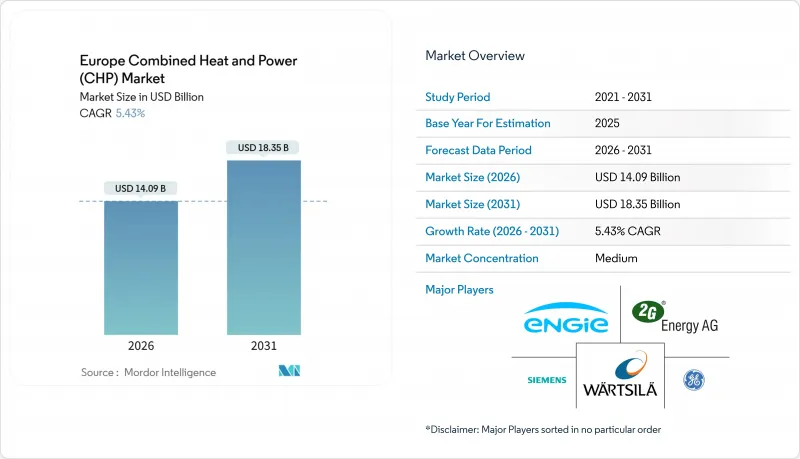
Mordor Intelligence에 의하면, 유럽의 열병합발전(CHP) 시장 규모는 2026년에 140억 9,000만 달러로 추정되고 예측 기간(2026-2031년) CAGR 5.43%로 확대되어 2031년에는 183억 5,000만 달러에 이를 전망입니다.
본 보고서는 연료(천연가스, 석탄, 바이오매스/바이오가스, 디젤, 원자력 및 신흥 연료), 원동기(복합 사이클, 가스 터빈, 증기 터빈,연료전지 등), 출력(10 MW 이하, 10-150 MW, 150-300 MW 및 300 MW 이상), 최종 사용자(유틸리티, 상업, 산업, 주택) 및 지역(독일, 영국, 프랑스, 북유럽 국가 등)별로 분류되어 있습니다.
유럽의 열병합발전(CHP) 시장 동향 및 인사이트
EU 그린딜과 관련된 에너지 효율화 및 CHP에 대한 보조금
REPowerEU 패키지는 2027년까지 3,000억 유로를 투입하는 것으로, 그중 약 15%가 고효율 열병합발전 및 지역 난방 시설 개보수에 배정되어 있어, 이는 단기적으로 수 GW 규모의 입찰 프로젝트로 이어질 것입니다. 독일의 BEG 프로그램에서는 바이오가스 또는 수소 대응 설비의 대상 비용 중 최대 40%가 보조되며, 2025년에는 5MW 미만의 왕복동 엔진 수주가 전년 대비 22% 증가했습니다. 네덜란드의 SDE++ 제도에서는 바이오메탄을 연료로 하는 CHP에 대해 1MWh당 95유로의 15년간 고정가격 임베디드이 보장되어, 낙농 분야의 신규 설비 용량 확대를 촉진하고 있습니다(RVO.NL). 벨기에 플란더스 지방은 열병합발전 인증서의 최저 가격을 28유로로 인상하여 제약 시설에서의 마이크로 CHP 도입 가능성을 높였습니다. 에너지 효율 지침 제14조는 폐열에 관한 비용 대비 효과 조사를 의무화하고 있으며, 이를 통해 화학, 펄프·제지, 식품 가공 업계의 CHP 전환을 위해 지자체 예산이 배정되고 있습니다.
재생 가능 가스에 대한 인센티브가 CHP 전환을 뒷받침
많은 회원국이 바이오가스, 바이오메탄 및 수소 대응 열병합발전 설비에 직접 보조금을 지원하는 넉넉한 고정가격 임베디드 제도, 투자 보조금 및 탄소 강도 보너스를 도입하고 있습니다. 독일의 BEG 프로그램에서는 재생 가능 가스를 연료로 사용하는 엔진의 설비 투자액의 최대 40%가 상환되는 반면, 네덜란드의 SDE++ 제도에서는 바이오메탄을 연료로 사용하는 CHP에 대해 15년 동안 1MWh당 95유로의 프리미엄이 보장됩니다. 이러한 인센티브 덕분에 5MW 미만 발전 플랜트의 투자 회수 기간은 5년 미만으로 단축되었으며, 왕복동력 엔진 제조업체에 대한 수주량이 두 자릿수 성장세를 보이고 있습니다. 또한, 전력 회사는 용량 시장의 수익을 유지하고 ETS(배출권 거래 제도) 비용 상승을 피하기 위해 기존 가스 터빈을 수소 혼합 가스 대응형으로 전환하고 있습니다. 이러한 정책의 확실성 덕분에 혐기성 소화 개발업체와 산업용 열 수요자 간의 장기 공급 계약이 촉진되어 연료 공급이 안정화되고 자금 조달 리스크가 완화되고 있습니다. 그 결과, 2031년에 이르기까지 재생 가능 가스는 신규 CHP 설비 증설에서 점점 더 큰 비중을 차지할 전망입니다.
화석 가스의 단계적 감축과 탄소 가격에 따른 압박
2025년 EU 배출권 거래 제도(ETS) 가격은 1tCO2당 평균 82유로가 되어, 가스 연소 CHP의 변동비에 1MWh당 35유로가 가산되어 스파크 스프레드가 축소되었습니다. 독일은 가스 자산에 대한 병행 지원책을 마련하지 않은 채 석탄에서 완전히 탈피했기 때문에 사업자들은 좌초 자산 위험에 노출되게 되었습니다. 영국에서는 ETS 과세에 더해 ‘탄소 가격 지원(CPS)’이 추가되어, 총 부담액이 tCO2당 40파운드를 초과함으로써 시장 거래의 수익성이 저하되었습니다. 프랑스의 국가 저탄소 전략은 2030년까지 산업용 가스 사용량을 40% 감축하는 것을 목표로 하고 있으며, 유리 및 철강 제조업체들이 전기 난방으로 전환하도록 압박하고 있습니다. 스페인의 기후 계획안에는 2027년까지 CHP 용량 지급을 단계적으로 폐지하고, 자금을 그린 수소로 전환하는 내용이 포함되어 있습니다.
부문별 분석
2025년, 유럽의 열병합발전 시장에서 천연가스의 점유율은 58.8%를 유지했습니다. 이는 기존 터빈 설비 및 지역 열 공급 루프에 힘입은 결과입니다. 스칸디나비아의 풍부한 임업 잔여물과 중부 유럽의 농업 폐기물 덕분에 바이오매스와 바이오가스를 합친 공급량은 총 발전량의 18%를 차지했습니다. 석탄의 점유율은 9%이지만, EU 택소노미에 따른 단계적 폐지 기한으로 인해 축소 추세를 보이고 있으며, 디젤 및 틈새 액체 연료는 실질적인 성장 요인이 없어 4% 미만에 그쳤습니다. 신흥 연료인 수소 혼합 연료, 바이오메탄, 첨단 바이오연료는 연평균 성장률(CAGR) 13.5%라는 급격한 성장세를 보이며, 2031년까지 천연가스의 우위를 서서히 잠식해 나갈 전망입니다. 이러한 동향은 원료 구성의 다양화를 보여주며, 유럽의 열병합발전 시장 전체에 걸친 자본 배분을 재조정하게 될 것입니다.
이러한 전환을 뒷받침하는 것은 정책적 인센티브입니다. 독일의 90억 유로 규모의 ‘국가 수소 전략’, 이탈리아의 바이오메탄 도입 의무, 그리고 네덜란드의 15년에 걸친 SDE++ 요금 제도는 연료 전환을 직접적으로 지원하고 있습니다. 사업자들은 기존 엔진을 부피 비율 기준으로 최대 30%까지 수소 대응형으로 개조하는 한편, 신규 피스톤 엔진 패키지는 100% 재생 가능 가스 대응형으로 공장 인증을 받아 출하되고 있습니다. 그 결과, 신흥 연료와 관련된 유럽의 열병합발전 시장 규모는 2031년까지 다른 모든 카테고리를 앞지르는 속도로 확대될 것으로 예측되며, 지방 자치단체 및 산업 시설 운영자에게 기술적 선택의 폭이 넓어지게 됩니다.
2025년에는 복합 사이클 발전 설비가 설치 용량의 30.3%를 차지하며, 대규모 지역 난방 사업자와 석유화학 단지의 열 공급을 확보했습니다. 이에 이어 왕복동 엔진이 26%를 차지하며, 병원, 데이터센터, 중규모 제조업체를 대상으로 하는 10MW 미만 부문을 주도했습니다. 연료전지는 절대 수치상으로는 여전히 소규모이지만, 주택용 마이크로 CHP에 대한 보조금과 기준 배출량이 거의 제로라는 점을 중시하는 전력 사업 규모의 수주를 배경으로 연평균 성장률(CAGR) 14.8%를 기록했습니다.
각 OEM사의 로드맵에서는 현재 수소 대응 인증, 부하 추종 능력, 그리고 배터리와의 하이브리드화가 중시되고 있으며, 이를 통해 원동기는 용량 시장 및 부대 서비스를 통한 수익 확보를 목표로 자리매김하고 있습니다. 독일의 KfW 433과 같은 보조금 프로그램에서는 연료전지 1기 설치당 최대 1만 1,200유로가 지급되는 반면, 영국의 용량 시장에서는 고체 산화물 스택이 신뢰성 높은 예비 전원으로 인정받고 있습니다. 이러한 구조를 통해 열 수요가 높은 도시에서는 복합 사이클 발전소가 규모의 경제성을 유지하고 있는 반면, 유럽의 열병합발전 시장에서 연료전지 및 첨단 엔진 솔루션의 점유율은 확대되고 있습니다.
기타 혜택 :
- 엑셀 형식 시장 예측(ME) 시트
- 3개월간의 애널리스트 지원
자주 묻는 질문
목차
제1장 서론
제2장 조사 방법
제3장 주요 요약
제4장 시장 구도
제5장 시장 규모 및 성장 예측
제6장 경쟁 구도
제7장 시장 기회 및 향후 전망
KTH 26.09.10According to Mordor Intelligence, the Europe combined heat and power market size is estimated at USD 14.09 billion in 2026, and is expected to reach USD 18.35 billion by 2031, at a CAGR of 5.43% during the forecast period (2026-2031).
This report is Segmented by Fuel (Natural Gas, Coal, Biomass/Biogas, Diesel, Nuclear, and Emerging Fuels), Prime Mover (Combined Cycle, Gas Turbine, Steam Turbine, Fuel Cells, and More), Capacity (Up To 10 MW, 10-150 MW, 150-300 MW, and Above 300 MW), End-User (Utilities, Commercial, Industrial, and Residential), and Geography (Germany, United Kingdom, France, NORDIC Countries, and More).
Europe Combined Heat And Power (CHP) Market Trends and Insights
EU Green Deal-Linked Energy-Efficiency & CHP Subsidies
The REPowerEU package channels EUR 300 billion through 2027, with roughly 15% reserved for high-efficiency cogeneration and district-heating upgrades, translating into a multi-GW near-term tender pipeline. Germany's BEG program reimburses up to 40% of eligible costs for biogas or hydrogen-ready units, lifting sub-5 MW reciprocating-engine orders by 22% year-on-year in 2025. The Netherlands' SDE++ scheme guarantees a 15-year tariff of EUR 95 per MWh for biomethane-fueled CHP, stimulating new dairy-sector capacity RVO.NL. Belgium's Flanders raised its cogeneration certificate floor to EUR 28, boosting micro-CHP viability in pharmaceutical campuses. Article 14 of the Energy Efficiency Directive mandates waste-heat cost-benefit studies, sending municipal budgets toward CHP retrofits in chemicals, pulp and paper, and food processing.
Renewable-Gas Incentives Fueling CHP Conversions
Multiple member states deploy generous feed-in tariffs, investment grants, and carbon-intensity bonuses that directly subsidize biogas, biomethane, and hydrogen-ready cogeneration units. Germany's BEG program reimburses up to 40% of capital outlays for engines firing renewable gases, while the Netherlands' SDE++ scheme locks in a 15-year premium of EUR 95 per MWh for biomethane-based CHP. These incentives shorten payback to fewer than five years for sub-5 MW plants and underpin a double-digit order surge among reciprocating-engine manufacturers. Utilities also pivot legacy gas turbines toward hydrogen blends to retain capacity-market revenues and avoid rising ETS costs. The policy certainty encourages long-term offtake contracts between anaerobic-digestion developers and industrial heat users, anchoring fuel supply and de-risking financing. As a result, renewable gases are positioned to claim a growing share of incremental CHP additions through 2031.
Fossil-Gas Phase-Down & Carbon-Pricing Squeeze
EU ETS prices averaged EUR 82 per tCO2 in 2025, adding EUR 35 per MWh to variable costs for gas-fired CHP and tightening spark spreads. Germany finalized its coal exit without parallel support for gas assets, leaving operators exposed to stranded-asset risk. The UK stacked its Carbon Price Support atop ETS levies, driving combined charges above GBP 40 per tCO2 and eroding merchant economics. France's national low-carbon strategy aims to cut industrial gas use by 40% by 2030, pushing glass and steel producers toward electrified heat. Spain's draft climate plan phases out CHP capacity payments by 2027, redirecting funds to green hydrogen.
Other drivers and restraints analyzed in the detailed report include:
- District-Heating Decarbonization Mandates in Nordics and CEE
- Industrial Resilience and Energy-Price Volatility Hedge
- Capital-Cost Competitiveness of High-Temperature Heat Pumps
For complete list of drivers and restraints, kindly check the Table Of Contents.
Segment Analysis
Natural gas retained 58.8% of the European combined heat and power market share in 2025, anchored in legacy turbine fleets and district-heating loops. Biomass and biogas together supplied 18% of output, thanks to abundant forestry residues in Scandinavia and agricultural waste in Central Europe. Coal's 9% footprint is shrinking under EU Taxonomy retirement deadlines, and diesel plus niche liquids remained below 4% without material growth levers. Emerging fuels, hydrogen blends, biomethane, and advanced biofuels expanded at a brisk 13.5% CAGR and are set to erode natural-gas dominance through 2031. These dynamics indicate a diversifying feedstock mix that will recalibrate capital allocation across the European combined heat and power market.
Policy incentives underpin the pivot. Germany's EUR 9 billion National Hydrogen Strategy, Italy's biomethane mandates, and the Netherlands' 15-year SDE++ tariff directly subsidize fuel switching. Operators retrofit existing engines for up to 30% hydrogen by volume, while new reciprocating packages arrive factory-certified for 100% renewable gas. As a result, the Europe combined heat and power market size attached to emerging fuels is projected to outpace every other category to 2031, widening technology choice for municipal utilities and industrial hosts.
Combined-cycle units delivered 30.3% of installed capacity in 2025, safeguarding heat supply for large district-heating operators and petrochemical complexes. Reciprocating engines followed at 26%, dominating the sub-10 MW class that addresses hospitals, data centers, and mid-sized manufacturers. Fuel cells, while still small in absolute numbers, posted a 14.8% CAGR on the back of residential micro-CHP subsidies and utility-scale orders that value near-zero criteria emissions.
OEM roadmaps now emphasize hydrogen-ready certificates, load-following capability, and hybridization with batteries, positioning prime movers for capacity-market and ancillary-service revenue. Subsidy programs such as Germany's KfW 433 grant up to EUR 11,200 per fuel-cell installation, while the UK's capacity market recognizes solid-oxide stacks as a reliable reserve. These mechanisms channel a rising share of the European combined heat and power market toward fuel-cell and advanced engine solutions, even as combined-cycle plants preserve scale advantages in cities with high heat demand.
Complete Report Scope:
- By Fuel
- Natural Gas
- Coal
- Biomass/Biogas
- Diesel and Other Liquid Fuels
- Nuclear
- Emerging fuels
- By Prime Mover
- Combined Cycle
- Gas Turbine
- Steam Turbine
- Reciprocating Engine
- Fuel Cells
- Microturbines and Others
- By Capacity
- Up to 10 MW
- 10 to 150 MW
- 150 to 300 MW
- Above 300 MW
- By End-User Sector
- Utilities
- Commercial
- Industrial
- Residential
- By Geography
- Germany
- United Kingdom
- France
- Italy
- Spain
- NORDIC Countries
- Russia
- Rest of Europe
List of Companies Covered in this Report:
- Engie SA
- General Electric Company
- Siemens AG
- Mitsubishi Power Europe
- UPM
- 2G Energy AG
- Wartsila Corp.
- Fleetsolve
- Vattenfall AB
- E.ON SE
- Veolia Environnement
- Capstone Green Energy
- Bosch Thermotechnology
- Caterpillar Energy Solutions
- MAN Energy Solutions
- Rolls-Royce (MTU)
- INNIO (Jenbacher)
- Clarke Energy
- Viessmann Group
- FuelCell Energy
- Ballard Power Systems
- Bloom Energy
- Dantherm Power
Additional Benefits:
- The market estimate (ME) sheet in Excel format
- 3 months of analyst support
TABLE OF CONTENTS
1 Introduction
- 1.1 Study Assumptions & Market Definition
- 1.2 Scope of the Study
2 Research Methodology
3 Executive Summary
4 Market Landscape
- 4.1 Market Overview
- 4.2 Market Drivers
- 4.2.1 EU Green Deal-linked energy-efficiency & CHP subsidies
- 4.2.2 Rapid district-heating network expansions in CEE & Nordics
- 4.2.3 Price-volatility hedging via on-site generation/resilience
- 4.2.4 Biogas/biomethane scale-up unlocking renewable-gas CHP
- 4.2.5 Hybrid CHP + high-temp heat-pump retrofits in energy-intensive industry
- 4.2.6 Hydrogen-ready peaking CHP for grid-balancing & "dark doldrums"
- 4.3 Market Restraints
- 4.3.1 Fossil-gas phase-down & carbon-pricing squeeze
- 4.3.2 High CAPEX vs heat-pumps & electrification alternatives
- 4.3.3 Large-scale heat-pump substitution of low-/mid-temp heat
- 4.3.4 Shrinking run-hours from negative-price events & must-run limits
- 4.4 Supply-Chain Analysis
- 4.5 Regulatory Landscape
- 4.6 Technological Outlook
- 4.7 Porter's Five Forces
- 4.7.1 Bargaining Power of Suppliers
- 4.7.2 Bargaining Power of Consumers
- 4.7.3 Threat of New Entrants
- 4.7.4 Threat of Substitute Products & Services
- 4.7.5 Degree of Competition
5 Market Size & Growth Forecasts
- 5.1 By Fuel
- 5.1.1 Natural Gas
- 5.1.2 Coal
- 5.1.3 Biomass/Biogas
- 5.1.4 Diesel and Other Liquid Fuels
- 5.1.5 Nuclear
- 5.1.6 Emerging fuels
- 5.2 By Prime Mover
- 5.2.1 Combined Cycle
- 5.2.2 Gas Turbine
- 5.2.3 Steam Turbine
- 5.2.4 Reciprocating Engine
- 5.2.5 Fuel Cells
- 5.2.6 Microturbines and Others
- 5.3 By Capacity
- 5.3.1 Up to 10 MW
- 5.3.2 10 to 150 MW
- 5.3.3 150 to 300 MW
- 5.3.4 Above 300 MW
- 5.4 By End-User Sector
- 5.4.1 Utilities
- 5.4.2 Commercial
- 5.4.3 Industrial
- 5.4.4 Residential
- 5.5 By Geography
- 5.5.1 Germany
- 5.5.2 United Kingdom
- 5.5.3 France
- 5.5.4 Italy
- 5.5.5 Spain
- 5.5.6 NORDIC Countries
- 5.5.7 Russia
- 5.5.8 Rest of Europe
6 Competitive Landscape
- 6.1 Market Concentration
- 6.2 Strategic Moves (M&A, Partnerships, PPAs)
- 6.3 Market Share Analysis (Market Rank/Share for key companies)
- 6.4 Company Profiles (includes Global level Overview, Market level overview, Core Segments, Financials as available, Strategic Information, Products & Services, and Recent Developments)
- 6.4.1 Engie SA
- 6.4.2 General Electric Company
- 6.4.3 Siemens AG
- 6.4.4 Mitsubishi Power Europe
- 6.4.5 UPM
- 6.4.6 2G Energy AG
- 6.4.7 Wartsila Corp.
- 6.4.8 Fleetsolve
- 6.4.9 Vattenfall AB
- 6.4.10 E.ON SE
- 6.4.11 Veolia Environnement
- 6.4.12 Capstone Green Energy
- 6.4.13 Bosch Thermotechnology
- 6.4.14 Caterpillar Energy Solutions
- 6.4.15 MAN Energy Solutions
- 6.4.16 Rolls-Royce (MTU)
- 6.4.17 INNIO (Jenbacher)
- 6.4.18 Clarke Energy
- 6.4.19 Viessmann Group
- 6.4.20 FuelCell Energy
- 6.4.21 Ballard Power Systems
- 6.4.22 Bloom Energy
- 6.4.23 Dantherm Power
7 Market Opportunities & Future Outlook
- 7.1 White-space & Unmet-Need Assessment


