|
시장보고서
상품코드
2120386
북미의 무균 포장 : 시장 점유율 분석, 업계 동향 및 통계, 성장 예측(2026-2031년)North America Aseptic Packaging - Market Share Analysis, Industry Trends & Statistics, Growth Forecasts (2026 - 2031) |
||||||
 Mordor Intelligence
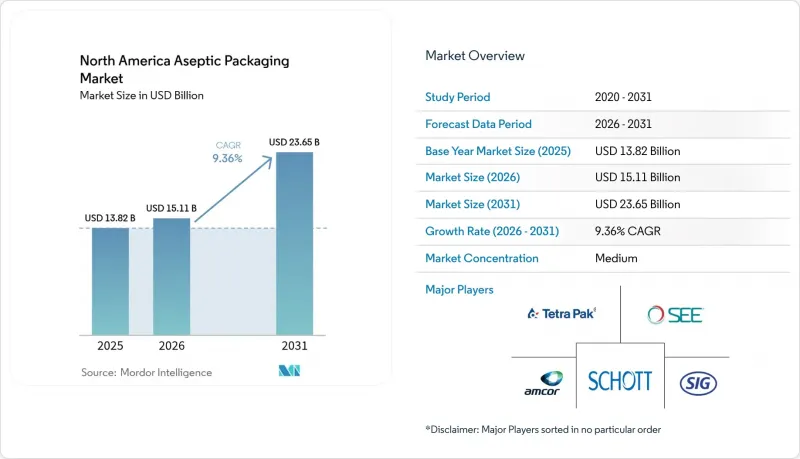
Mordor Intelligence에 의하면, 북미의 무균 포장 시장 규모는 2025년 138억 2,000만 달러로 평가되었습니다. 2026년에는 151억 1,000만 달러로 확대되어 2026년부터 2031년에 걸쳐 CAGR 9.36%로 성장을 지속하여, 2031년에는 236억 5,000만 달러에 이를 것으로 예측됩니다.
본 보고서는 포장 재료(종이 및 판지, 플라스틱, 유리, 알루미늄 포일·금속, 다층 복합재), 제품 유형(병, 카톤, 봉지·파우치 등), 최종 사용자 산업(의약품, 음료, 식품, 기타),기술(무균 액체 포장, 블로우-필-씰, 기타), 국가별로 분류되어 있습니다. 시장 예측은 금액(미 달러) 기준으로 제시되어 있습니다.
북미의 무균 포장 시장 동향 및 인사이트
콜드체인 물류 비용 절감에 대한 수요 증가
온도 관리 운송은 유통 예산의 15-25%를 차지하므로, 냉장을 배제함으로써 이익률은 급속히 개선됩니다. 예를 들어, 멕시코산 우유 수입의 경우 상온으로 출하함으로써 1리터당 0.15-0.30달러의 운송비 할증금을 피할 수 있습니다. 네슬레는 이러한 비용 절감 효과를 활용하기 위해 2025년부터 2027년까지 멕시코의 무균 포장 라인에 10억 달러를 투자할 계획입니다. 냉장 창고가 제한적인 미국의 지방 카운티에서도 유사한 계산이 성립하는 반면, 캐나다의 유제품 제조업체들은 물류 비용이 제품 가격을 초과하는 경우가 많은 북부 오지 지역 사회에 제품을 공급하기 위해 상온 보관이 가능한 포장에 의존하고 있습니다. 디젤 가격 급등과 운전기사 부족이 장기화되는 가운데, 북미의 무균 포장 시장은 냉장 운송 거리 단축 측면에서 지속적인 우위를 점하고 있습니다.
보관 기간 12개월 이상의 제품에 대한 선호
팬데믹 당시 식량 비축에 따른 대량 구매가 확대되면서, 현재 도시 지역 시장에서는 상온 보관이 가능한 상품에 20-30%의 가격 할증이 적용되고 있습니다. 테트라팩의 조사에 따르면, 67%의 가구가 브랜드 충성도보다 유통기한을 더 중요하게 여깁니다. 제약 업계에서는 SCHOTT Pharma사가 노스캐롤라이나주에 3억 7,100만 달러를 투자해 건설한 공장에서 상온에서 36개월간 안정성을 유지하는 주사기의 생산량을 3배로 늘리고 있습니다. 도시 지역의 소비자들은 긴 유통기한을 편의성이나 비상시 대비와 연결 지어 생각하고 있으며, 상온 보관이 가능한 음료의 재처방이 진행되고 있습니다. 그 결과, 북미의 무균 포장 시장은 식료품점 매대와 병원 재고 모두에서 성장 동력을 얻고 있습니다.
무균 충전 라인의 고액 설비 투자와 긴 투자 회수 기간
턴키 시스템 비용은 1,000만-5,000만 달러에 달하고, 제약 업계용 검증 비용으로 200만-500만 달러가 추가되므로 투자 회수 기간은 7-10년에 이릅니다. 소규모 가공업체들은 특히 기술 인력의 임금이 25-30% 높은 상황에서 이러한 지출에 필요한 자금을 조달하는 데 어려움을 겪고 있습니다. 리스 모델은 맞춤형 무균 충전 설비에는 거의 적합하지 않기 때문에 사업 확장은 합병이나 사모펀드를 통한 자금 조달이 주류를 이루고 있습니다. 그 결과, 수요가 급증하고 있음에도 불구하고 업계 재편이 진행되고 있어 북미의 무균 포장 시장의 성장 곡선은 둔화되고 있습니다.
부문별 분석
2025년에는 판지가 매출의 61.78%를 차지했습니다. 이는 확립된 공급망과 재생 가능한 섬유에 대한 소비자의 신뢰를 여실히 보여줍니다. 또한, 이 부문은 각 주의 재활용 소재 함유율에 관한 법규에도 부합하여, 북미의 무균 포장 시장에 규제 측면의 호재를 가져오고 있습니다. 한편, 유리는 제약 업계의 화학적 비활성 요구에 힘입어 2031년까지 연평균 성장률(CAGR) 10.24%로 성장을 지속하고 있습니다. 코닝(Corning)사의 ‘Valor Glass’와 같은 혁신 기술은 오랫동안 지속되어 온 층간 박리 문제를 해결하고 있으며, 한편 샷(Schott)사의 사전 멸균 바이알은 충전 및 밀봉 공정을 단축시키고 있습니다. 플라스틱은 연포장 분야에서 일정한 입지를 유지하고 있지만, 일회용 제품에 대한 엄격한 규제가 성장을 저해하고 있습니다. 알루미늄 포일은 민감한 생물학적 제제에서 초저산소 투과성을 확보하는 데 필수적인 소재로 남아 있습니다. 다층 복합재는 이러한 특성을 모두 갖추고 있지만, 앞서 언급한 재활용 관련 과제에 직면해 있습니다. 전반적으로 북미의 무균 포장 업계에서 소재 선택은 무균성, 지속가능성, 그리고 비용 목표 간의 균형을 어떻게 잡느냐에 달려 있습니다.
향후 전망으로는 유리가 틈새 시장의 지위에서 벗어나고 있는 것으로 나타납니다. 제약사는 동결 건조된 바이오의약품과의 호환성 및 추출물에 대한 내성을 높이 평가하고 있으며, 이로 인해 무게 증가라는 단점도 정당화되고 있습니다. 한편, 음료 브랜드들은 상온 보관이 가능한 주스, 식물성 우유, 수프 등에서 ‘섬유 유래’라는 마케팅 메시지가 소비자들에게 호응을 얻고 있어 종이 카톤을 계속 채택하고 있습니다. 규제 압력이 높아짐에 따라 폴리머 용기는 완전히 폐지되는 것이 아니라, 바이오 코팅으로의 단계적 전환이 진행되고 있습니다. 이러한 동향이 맞물려 기재의 다양화가 진행되며, 북미의 무균 포장 시장을 원자재 가격 변동으로부터 보호하고 있습니다.
종이 카톤은 수십 년에 걸친 상온 보관 가능한 음료 라인과 효율적인 팔레트 활용을 통해 2025년 총 출하량의 41.95%를 차지했습니다. 그럼에도 불구하고, 바이알과 앰플은 무균 1차 포장이 필요한 생물학적 제제 주사제의 확대에 힘입어 연평균 성장률(CAGR) 10.79%를 기록하며 다른 모든 형태를 앞질렀습니다. 이 부문은 세척 및 열처리된 상태로 납품되는 ‘사용 준비 완료’ 구성의 혜택을 받아 제약 회사의 사이클 타임을 단축하고 있습니다. 또한, 블로우-필-씰 방식의 단회 투여용 패키지는 바늘을 사용하지 않는 작업 공정이 필요한 백신 프로그램에서도 주목을 받고 있습니다. 그 결과, 의약품 분야가 북미의 무균 포장 시장을 용기의 소형화와 단위당 가치 향상으로 이끌고 있습니다.
병은 무거운 유리나 PET의 사용이 정당화되는 프리미엄 콜드 브루 커피나 영양 쉐이크에 사용되고 있습니다. 파우치는 가볍으면서도 유연한 형태가 요구되는 수프나 소스 브랜드에 적합합니다. 한편, 새로운 충전 헤드에 통합된 인라인 AI 검사는 무균성 부적합률을 대폭 낮춤으로써 또 다른 차별화 요소로 작용하고 있습니다. 따라서 모든 제품군이 편의성이나 규정 준수를 무기로 시장 점유율 경쟁을 벌이고 있으며, 컨버터에게 있어 적응성이 높은 생산 플랫폼은 전략적으로 필수적인 요소가 되었습니다.
기타 혜택 :
- 엑셀 형식 시장 예측(ME) 시트
- 3개월간의 애널리스트 지원
자주 묻는 질문
목차
제1장 서론
제2장 조사 방법
제3장 주요 요약
제4장 시장 구도
제5장 시장 규모 및 성장 예측
제6장 경쟁 구도
제7장 시장 기회 및 향후 전망
KTH 26.09.10According to Mordor Intelligence, the North America aseptic packaging market size is expected to grow from USD 13.82 billion in 2025 to USD 15.11 billion in 2026 and is forecast to reach USD 23.65 billion by 2031 at 9.36% CAGR over 2026-2031.
This report is Segmented by Packaging Material (Paper and Paperboard, Plastics, Glass, Aluminum Foil/Metal, and Multilayer Composites), Product Type (Bottles, Cartons, Bags and Pouches, and More), End-User Industry (Pharmaceutical, Beverage, Food, and More), Technology (Aseptic Liquid Packaging, Blow-Fill-Seal, and More), and Country. The Market Forecasts are Provided in Terms of Value (USD).
North America Aseptic Packaging Market Trends and Insights
Growing Demand to Cut Cold-Chain Logistics Costs
Temperature-controlled transport absorbs 15-25% of distribution budgets, so eliminating refrigeration quickly improves margins. Mexican milk imports, for instance, avoid USD 0.15-0.30 per liter in freight premiums when shipped ambient. Nestle has earmarked USD 1 billion for aseptic lines in Mexico between 2025 and 2027 to exploit the savings. Rural U.S. counties with limited cold storage echo the calculus, while Canadian dairies rely on shelf-stable packs to reach remote northern communities where logistics costs often exceed product value. As diesel prices and driver shortages linger, the North America aseptic packaging market finds a durable advantage in cutting refrigerated miles.
Preference for Products with >=12-Month Shelf Life
Bulk buying expanded during pandemic pantry stocking, and ambient-stable items now fetch 20-30% mark-ups in city markets. Tetra Pak surveys show 67% of households rank shelf life above brand loyalty. In pharma, SCHOTT Pharma's USD 371 million North Carolina plant triples syringe output that holds room-temperature stability for 36 months. Urban shoppers equate longer life with convenience and emergency readiness, prompting beverage reformulations that withstand ambient warehousing. As a result, the North America aseptic packaging market gains momentum from both grocery aisles and hospital inventories.
High Cap-Ex and Long ROI for Aseptic Filling Lines
Turnkey systems cost USD 10-50 million, and pharmaceutical validation adds another USD 2-5 million, extending payback to 7-10 years. Smaller processors struggle to finance such outlays, especially when technical talent commands 25-30% wage premiums. Leasing models seldom suit bespoke aseptic rigs, so mergers and private equity funding dominate expansion. Consolidation, therefore, rises even as demand surges, tempering the growth curve of the North America aseptic packaging market.
Other drivers and restraints analyzed in the detailed report include:
- Sustainability Push for Paper-Based and Lightweight Formats
- Rapid Expansion of Aseptic Capacity in U.S. Dairy Plants
- Complex Multi-Material Recycling Infrastructure Gaps
For complete list of drivers and restraints, kindly check the Table Of Contents.
Segment Analysis
Paperboard contributed 61.78% revenue in 2025, a testament to entrenched supply chains and consumer trust in renewable fibers. The segment also aligns with state recycled-content statutes, adding regulatory tailwind to the North America aseptic packaging market. Yet glass records a 10.24% CAGR through 2031, propelled by pharma's need for chemical inertness. Innovations such as Corning Valor Glass solve historic delamination issues, while SCHOTT's pre-sterilized vials shrink fill-finish steps. Plastics keep a foothold in flexibles, but single-use scrutiny caps upside. Aluminum foil remains essential for ultra-low oxygen transmission in sensitive biologics. Multilayer composites blend these attributes but confront recycling headwinds already outlined. Overall, material choice in the North America aseptic packaging industry depends on striking an equilibrium among sterility, sustainability, and cost targets.
The outlook shows glass emerging from niche status. Pharma manufacturers value its compatibility with lyophilized biologics and its immunity to extractables, justifying higher weight penalties. Conversely, beverage brands retain paper cartons for ambient juices, plant milks, and broths where fiber-based stories resonate with shoppers. Polymer barrels of regulatory pressure spur a gradual pivot toward bio-based coatings rather than outright abandonment. Collectively, these currents reinforce a diversified substrate mix that shields the North America aseptic packaging market from raw-material shocks.
Cartons captured 41.95% of 2025 volume thanks to decades-old shelf-stable beverage lines and efficient pallet utilization. Nonetheless, vials and ampoules outpace all other formats at a 10.79% CAGR, buoyed by expanding biologic injections that need pristine primary packs. The segment benefits from ready-to-use configurations that arrive washed and depyrogenated, trimming drugmaker cycle times. Blow-fill-seal single-dose designs also attract vaccine programs that require needle-free workstreams. Consequently, pharmaceuticals tilt the North America aseptic packaging market toward container miniaturization and higher unit value.
Bottles serve premium cold brew coffees and nutritional shakes that justify heavier glass or PET. Pouches address soup and sauce brands needing flexible geometry at low gram weight. Meanwhile, in-line AI inspection embedded in new filling heads adds another layer of differentiation by slashing sterile failure rates. Every product family, therefore, jockeys for share via either convenience or compliance, making adaptive production platforms a strategic must for converters.
Complete Report Scope:
- By Packaging Material
- Paper and Paperboard
- Plastics
- Glass
- Aluminum Foil/Metal
- Multilayer Composites
- By Product Type
- Bottles
- Cartons
- Bags and Pouches
- Vials and Ampoules
- Other Product Types
- By End-User Industry
- Pharmaceutical
- Beverage
- Fruit-based Drinks
- Milk and Other Dairy Beverages
- Ready-to-Drink (RTD)
- Other Beverage Types
- Food
- Fruit-based Foods
- Dairy Food
- Processed Foods
- Soups and Broths
- Other Food Types
- Personal Care and Cosmetics
- Industrial
- Other End-User Industries
- By Technology
- Aseptic Liquid Packaging
- Blow-Fill-Seal (BFS)
- Form-Fill-Seal (FFS)
- Electron-Beam Sterilization
- Ultra-High-Temperature (UHT) / HTST
- By Country
- United States
- Canada
- Mexico
List of Companies Covered in this Report:
- Tetra Pak International S.A.
- SIG Combibloc Group AG
- Amcor plc
- Sealed Air Corporation
- Smurfit WestRock
- Schott AG
- Scholle IPN Corporation
- International Paper Company
- Elopak ASA
- Mondi plc
- Reynolds Group Holdings Ltd.
- Sonoco Products Company
- Stora Enso Oyj
- UFlex Limited
- Greatview Aseptic Packaging Co., Ltd.
- Ecolean AB
- Graphic Packaging Holding Company
Additional Benefits:
- The market estimate (ME) sheet in Excel format
- 3 months of analyst support
TABLE OF CONTENTS
1 INTRODUCTION
- 1.1 Study Assumptions and Market Definition
- 1.2 Scope of the Study
2 RESEARCH METHODOLOGY
3 EXECUTIVE SUMMARY
4 MARKET LANDSCAPE
- 4.1 Market Overview
- 4.2 Market Drivers
- 4.2.1 Growing demand to cut cold-chain logistics costs
- 4.2.2 Preference for products with >=12-month shelf life
- 4.2.3 Sustainability push for paper-based and lightweight formats
- 4.2.4 Rapid expansion of aseptic capacity in U.S. dairy plants
- 4.2.5 Surge in biologics and RTU injectables needing sterile packs
- 4.2.6 AI-enabled inline sterility monitoring reducing recalls
- 4.3 Market Restraints
- 4.3.1 High cap-ex and long ROI for aseptic filling lines
- 4.3.2 Complex multi-material recycling infrastructure gaps
- 4.3.3 Contamination recalls eroding brand trust and margins
- 4.3.4 Rising polymer and paperboard prices squeezing converters
- 4.4 Industry Value Chain Analysis
- 4.5 Porter's Five Forces Analysis
- 4.5.1 Bargaining Power of Suppliers
- 4.5.2 Bargaining Power of Buyers
- 4.5.3 Threat of New Entrants
- 4.5.4 Threat of Substitute Products
- 4.5.5 Intensity of Competitive Rivalry
- 4.6 Impact of Macroeconomic Factors on the Market
- 4.7 Regulatory Landscape
5 MARKET SIZE AND GROWTH FORECASTS (VALUE)
- 5.1 By Packaging Material
- 5.1.1 Paper and Paperboard
- 5.1.2 Plastics
- 5.1.3 Glass
- 5.1.4 Aluminum Foil/Metal
- 5.1.5 Multilayer Composites
- 5.2 By Product Type
- 5.2.1 Bottles
- 5.2.2 Cartons
- 5.2.3 Bags and Pouches
- 5.2.4 Vials and Ampoules
- 5.2.5 Other Product Types
- 5.3 By End-User Industry
- 5.3.1 Pharmaceutical
- 5.3.2 Beverage
- 5.3.2.1 Fruit-based Drinks
- 5.3.2.2 Milk and Other Dairy Beverages
- 5.3.2.3 Ready-to-Drink (RTD)
- 5.3.2.4 Other Beverage Types
- 5.3.3 Food
- 5.3.3.1 Fruit-based Foods
- 5.3.3.2 Dairy Food
- 5.3.3.3 Processed Foods
- 5.3.3.4 Soups and Broths
- 5.3.3.5 Other Food Types
- 5.3.4 Personal Care and Cosmetics
- 5.3.5 Industrial
- 5.3.6 Other End-User Industries
- 5.4 By Technology
- 5.4.1 Aseptic Liquid Packaging
- 5.4.2 Blow-Fill-Seal (BFS)
- 5.4.3 Form-Fill-Seal (FFS)
- 5.4.4 Electron-Beam Sterilization
- 5.4.5 Ultra-High-Temperature (UHT) / HTST
- 5.5 By Country
- 5.5.1 United States
- 5.5.2 Canada
- 5.5.3 Mexico
6 COMPETITIVE LANDSCAPE
- 6.1 Market Concentration
- 6.2 Strategic Moves
- 6.3 Market Share Analysis
- 6.4 Company Profiles (includes Global level Overview, Market level overview, Core Segments, Financials as available, Strategic Information, Market Rank/Share for key companies, Products and Services, and Recent Developments)
- 6.4.1 Tetra Pak International S.A.
- 6.4.2 SIG Combibloc Group AG
- 6.4.3 Amcor plc
- 6.4.4 Sealed Air Corporation
- 6.4.5 Smurfit WestRock
- 6.4.6 Schott AG
- 6.4.7 Scholle IPN Corporation
- 6.4.8 International Paper Company
- 6.4.9 Elopak ASA
- 6.4.10 Mondi plc
- 6.4.11 Reynolds Group Holdings Ltd.
- 6.4.12 Sonoco Products Company
- 6.4.13 Stora Enso Oyj
- 6.4.14 UFlex Limited
- 6.4.15 Greatview Aseptic Packaging Co., Ltd.
- 6.4.16 Ecolean AB
- 6.4.17 Graphic Packaging Holding Company
7 MARKET OPPORTUNITIES AND FUTURE OUTLOOK
- 7.1 White-space and Unmet-need Assessment