

|
시장보고서
상품코드
2120470
무균 포장 : 시장 점유율 분석, 업계 동향 및 통계, 성장 예측(2026-2031년)Aseptic Packaging - Market Share Analysis, Industry Trends & Statistics, Growth Forecasts (2026 - 2031) |
||||||
 Mordor Intelligence
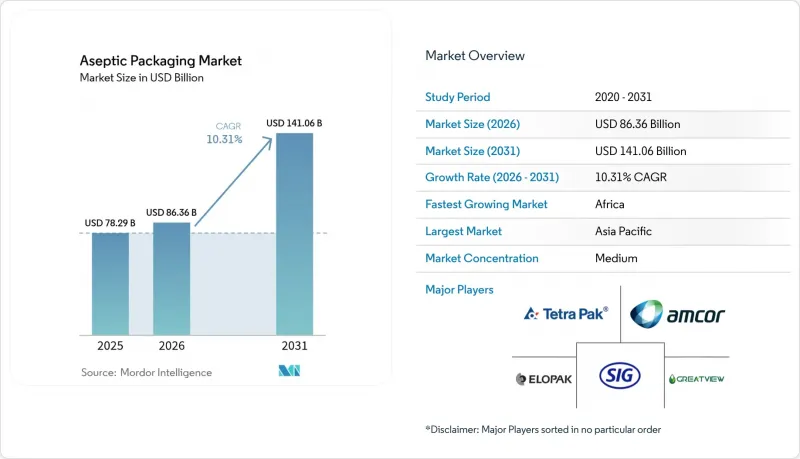
Mordor Intelligence에 의하면, 무균 포장 시장 규모는 2025년 782억 9,000만 달러로 평가되었습니다. 2026년에는 863억 6,000만 달러로 확대되어 2026-2031년에 걸쳐 CAGR 10.31%로 성장을 지속하여, 2031년에는 1,410억 6,000만 달러에 이를 것으로 예측됩니다.
본 보고서는 제품별(카톤, 병, 캔, 봉지·파우치, 기타), 소재 구성별(종이 및 판지, 플라스틱, 유리, 금속, 복합 적층재), 용도별(음료, 식품, 의약품, 기타),충진 기술별(폼-필-씰(FFS), 블로우-필-씰(BFS), 무균 충진(주입 충진), 기타), 지역별로 분류되어 있습니다. 시장 예측은 금액(미 달러) 기준으로 제시되어 있습니다.
세계의 무균 포장 시장 동향 및 인사이트
RTD 기능성 음료의 급속한 성장
즉석 음용(RTD) 유형의 쉐이크, 프로바이오틱스 음료, 영양 강화 식물성 우유는 상온 보관이 가능한 카톤이나 파우치로 전환이 진행되고 있어, 냉장 보관 없이도 전국적인 유통이 가능해졌습니다. 북미의 단백질 음료 등 브랜드 사례에서는 콜드체인에서 무균 포장으로 전환함으로써 물류 비용을 약 4분의 1로 절감했습니다. 설비 투자에도 이러한 변화가 반영되어, 2025년에는 신규 카톤 충전기 도입의 40%를 기능성 음료 제조업체가 차지했습니다. 소규모 신규 진출기업들은 1만-2만 5,000개 단위로 무균 파우치를 제조하는 수탁 제조업체에 의존하고 있으며, 이를 통해 맛 테스트를 신속하게 진행하고 재고 위험을 줄이고 있습니다. 면역력, 장내 환경, 회복력과 관련된 효능 표시에 대해 소비자가 프리미엄 가격을 지불할 의향이 있다는 점이 무균 솔루션의 원자재 가격 급등을 뒷받침하는 요인이 되고 있습니다.
신흥 아시아 지역의 상온 유제품 유통 확대
초고온 살균(UHT) 우유와 요거트는 현재 신뢰할 수 있는 냉장 시설이 없는 농촌 지역 소비자들에게도 공급되고 있습니다. 인도의 협동조합은 2024-2025년에 걸쳐 2·3선 도시로 진출하기 위해 종이팩 제품의 생산 능력을 약 5분의 1 정도 확대했습니다. 상온 보존 제품은 몬순 시즌의 부패를 방지하고 수요를 안정시키며, 생우유에 비해 소폭의 가격 프리미엄을 확보하는 동시에 수입 분유에 비해 합리적인 가격을 유지하고 있습니다. 인도네시아와 베트남에서 무균 충전 설비에 대한 정부의 세제 혜택으로 투자 매력이 높아지면서, 다국적 가공 제조업체들은 상온 유제품 포트폴리오에서 두 자릿수 성장을 기록했습니다.
다층 폴리머 가격 변동
폴리에틸렌과 폴리프로필렌 가격의 급등락으로 인해 가공업체의 이익률은 압박을 받았으며, 브랜드 소유자와 분기별로 가격 재조정을 해야만 했습니다. 아프리카와 라틴아메리카의 소규모 가공업체들은 헤지 수단이 부족하여 비용 충격을 전액 흡수할 수밖에 없었고, 그 결과 수입된 기성 파우치와의 경쟁력이 약화되었습니다. 선견지명이 있는 공급업체들은 원자재를 확보하기 위해 재생 수지 공급원에 대한 투자를 추진하고 있지만, 재생 폴리에틸렌은 현재 버진 등급에 비해 상당한 프리미엄이 붙어 거래되고 있어 단기적인 완화에는 한계가 있습니다.
부문별 분석
가방과 파우치는 2031년까지 연평균 성장률(CAGR) 11.31%를 나타낼 것으로 예측되며, 이는 각 포장 형태 중 가장 높은 성장률입니다. 이는 소비자 직접 판매형 음료 및 소스 브랜드가 디지털 그래픽에 적합한 경량 포장을 필요로 하기 때문입니다. 카톤은 2025년에 매출의 43.56%를 차지했으나, 소매업체들이 파우치에 비해 창고 공간을 20-30% 절약할 수 있다는 점을 높이 평가하고 있어 성장세가 둔화되고 있습니다. 병은 높은 포장 비용을 정당화할 수 있는 프리미엄 커피나 프로바이오틱스 음료용으로 계속 사용되고 있는 반면, 캔은 금속의 차단성과 재활용성을 활용하여 에너지 드링크나 칵테일 등 수요를 충족시키고 있습니다.
비용과 브랜딩 요인이 파우치의 성장 추세를 뒷받침하고 있습니다. 연포장은 동일한 용량의 카톤에 비해 운송 중량을 거의 절반으로 줄일 수 있어, 결과적으로 운송에 따른 배출량 감축으로 이어집니다. 이러한 장점은 지속가능성 스코어카드를 활용하는 소매업체들의 주목을 받고 있습니다. 디지털 인쇄 기술의 발전으로 현재는 5만 개 이하의 소량 생산에서도 풀컬러 아트워크가 가능해졌으며, 기존에는 소량 골판지 상자 생산의 장벽이었던 판 비용을 피할 수 있게 되었습니다. 재밀봉 기능과 품질 평가가 중시되는 카페나 헬스장 등의 유통 채널에서는 여전히 캔이나 병이 주류를 이루고 있지만, 재밀봉이 가능한 주입구가 달린 파우치가 그 기능적 격차를 좁혀가고 있어, 무균 포장 시장에서 연질 포장으로 시장 점유율 전환이 지속되고 있음을 보여줍니다.
2025년에는 종이 및 판지가 매출의 47.13%를 차지하여 유제품 및 주스 부문에서 종이팩의 우위를 반영했지만, 복합 라미네이트 소재는 연평균 성장률(CAGR) 11.39%로 성장할 전망입니다. 이는 변환업체가 폴리에틸렌과 에틸렌-비닐 알코올 층을 적층함으로써 재활용 규정을 충족하면서도 호일 수준의 차단 성능을 실현하고 있기 때문입니다. 플라스틱은 파우치나 병에 폭넓게 활용되고 있는 반면, 유리는 초고급 콜드브루 부문에서 틈새 시장으로만 남아 있으며, 금속은 에너지 드링크에 중점을 두고 있습니다.
라미네이트 구조의 혁신으로 인해 알루미늄 포일에 대한 의존도가 낮아지고 있습니다. 암콜(Amcor)의 폴리에틸렌과 이산화규소 라미네이트는 무게를 20% 줄이면서 산소 투과율 0.5cc 이하를 실현하고 있습니다. 유럽연합(EU)의 2030년 재활용 목표에 따라, 각 컨버터 기업들은 단일 소재, 특히 폴리에틸렌을 사용한 솔루션으로 전환하고 있습니다. 이러한 변화는 무균 포장 시장 전체, 특히 생산자 책임 확대 제도가 적극적으로 도입되고 있는 지역에서 복합 구조가 호일 뒷면 코팅 골판지를 계속해서 대체해 나갈 것임을 시사합니다.
지역별 분석
2025년, 아시아태평양은 전 세계 매출의 35.67%를 차지했으며, 인도의 유제품 수요 증가와 중국의 즉석 음용 차 시장이 성장을 주도했습니다. 인도에서는 신뢰할 수 있는 냉장 시설이 갖춰지지 않은 2선 도시에도 상온 보관이 가능한 포장이 보급됨에 따라 초고온 살균(UHT) 우유가 두 자릿수 성장률을 기록했습니다. 일본과 한국에서는 1인용 요거트 프리미엄 상품에 대한 수요가 증가하는 한편, 동남아시아의 스타트업 기업들은 지방 유통 채널에 진출하기 위해 파우치 포장을 채택하고 있습니다.
2026년부터 2031년에 걸쳐 아프리카에서는 11.34%라는 견실한 연평균 성장률(CAGR)이 예상됩니다. 나이지리아, 케냐, 남아프리카공화국에서는 디젤 연료비와 전기 요금의 급등으로 인해 콜드체인 운영이 경제적으로 어려워지고 있습니다. 그 결과, 이들 국가의 유제품 협동조합과 주스 가공업체들은 상온 보관이 가능한 제품 형태에 주력하기 시작했습니다. 골판지 및 파우치의 현지 생산은 아직 초기 단계에 머물러 있어 수입 원가 부담이 커지고 있지만, 다국적 기업들은 현지 공급망을 강화하기 위해 지역 가공업체와의 제휴를 적극적으로 추진하고 있습니다.
유럽과 북미는 성장 속도가 완만하지만, 지속가능성에 관한 규제를 주도하고 있습니다. EU의 ‘포장 및 포장 폐기물 규정’에 따라 단일 소재 라미네이트 소재의 도입이 가속화되고 있습니다. 북미의 성장은 기능성 음료 및 무균 생물 제제의 충진을 중심으로 전개되고 있는 반면, 라틴아메리카에서는 환율 변동과 상온 보관이 가능한 유제품에 대한 강한 수요 간의 균형을 맞추고 있습니다. 중동에서는 사우디아라비아와 아랍에미리트(UAE)에서 비즈니스 기회가 예상되며, 이 지역들의 고온 기후는 무균 포장 시장에 있어 자연스러운 강점으로 작용하고 있습니다.
기타 혜택
- 엑셀 형식 시장 예측(ME) 시트
- 3개월간의 애널리스트 지원
자주 묻는 질문
목차
제1장 서론
제2장 조사 방법
제3장 주요 요약
제4장 시장 구도
제5장 시장 규모 및 성장 예측
제6장 경쟁 구도
제7장 시장 기회 및 향후 전망
KTH 26.09.04According to Mordor Intelligence, the aseptic packaging market size is expected to grow from USD 78.29 billion in 2025 to USD 86.36 billion in 2026 and is forecast to reach USD 141.06 billion by 2031 at a 10.31% CAGR over 2026-2031.
This report is Segmented by Product (Cartons, Bottles, Cans, Bags and Pouches, and More), Material Composition (Paper and Paperboard, Plastics, Glass, Metal, Composite Laminates), Application (Beverage, Food, Pharmaceuticals, and More), Filling Technology (Form-Fill-Seal (FFS), Blow-Fill-Seal (BFS), Injection Aseptic Filling, and More), and Geography. Market Forecasts are Provided in Terms of Value (USD).
Global Aseptic Packaging Market Trends and Insights
Rapid Growth of RTD Functional Beverages
Ready-to-drink shakes, probiotic drinks, and fortified plant-based milks are switching to ambient cartons and pouches, enabling national distribution without refrigeration. Brand examples such as protein beverages in North America cut logistics bills by roughly one-quarter when they moved from cold-chain to aseptic packaging. Capital spending reflects the shift, with functional beverage producers accounting for 40% of new carton-filler installations in 2025. Smaller entrants lean on co-packers that run aseptic pouches in lots of 10,000-25,000 units, accelerating flavor tests and limiting inventory exposure. Consumer willingness to pay premiums for claims linked to immunity, gut health, and recovery underpins the higher material cost of aseptic solutions.
Expansion of Ambient Dairy Distribution in Emerging Asia
Ultra-high-temperature milk and yogurt now reach rural consumers who lack reliable refrigeration. Indian cooperatives increased carton capacity by roughly one-fifth during 2024-2025 to penetrate tier-2 and tier-3 cities. Ambient formats reduce monsoon-season spoilage, stabilize demand, and earn modest price premiums over fresh milk while remaining affordable relative to imported powders. Government tax incentives for aseptic equipment in Indonesia and Vietnam sharpened the investment case, and multinational processors recorded double-digit growth from ambient dairy portfolios.
Volatility in Multilayer Polymer Prices
Swinging polyethylene and polypropylene prices shaved converter margins and forced quarterly price realignments with brand owners. Small converters in Africa and Latin America, lacking hedging options, absorbed the full cost shock, undermining competitiveness against imported pre-made pouches. Forward-looking suppliers are investing in recycled-resin streams to secure feedstock, yet recycled polyethylene currently trades at a noticeable premium over virgin grades, limiting near-term relief.
Other drivers and restraints analyzed in the detailed report include:
- Stringent Food-Safety Regulations Pushing Sterile Packaging Adoption
- Inflation-Linked Shift from Cold-Chain to Shelf-Stable Logistics
- High Initial CAPEX for Aseptic Filling Lines
For complete list of drivers and restraints, kindly check the Table Of Contents.
Segment Analysis
Bags and pouches are projected to deliver an 11.31% CAGR through 2031, the swiftest among formats, as direct-to-consumer beverage and sauce brands need lightweight packs that suit digital graphics. Cartons retained 43.56% of revenue in 2025, yet their growth rate moderates as retailers reward pouches with 20-30% warehouse cube savings. Bottles continue to serve premium coffees and probiotic drinks that justify higher pack costs, while cans cater to energy cocktails, leveraging metal's barrier and recyclability.
Cost and branding factors underpin the pouch trajectory. Each flexible pack reduces shipping weight by close to half versus a similar-volume carton, translating to lower freight emissions, an advantage spotlighted by retailers with sustainability scorecards. Digital press advances now permit full-color artwork for runs of fewer than 50,000 pieces, avoiding plate fees that historically handicapped small-batch cartons. Cans and bottles still dominate cafe or gym channels where resealability and perceived quality matter, yet resealable spouted pouches are narrowing that functional gap, indicating continued share migration toward flexibles in the aseptic packaging market.
Paper and paperboard accounted for 47.13% of revenue in 2025, reflecting carton dominance in dairy and juice, yet composite laminates are on track for an 11.39% CAGR as converters stack polyethylene and ethylene-vinyl-alcohol layers to achieve foil-barrier performance while meeting recyclability rules. Plastics have broad utility across pouches and bottles, while glass remains niche in ultra-premium cold brews, and metal focuses on energy drinks.
Innovation in laminate structures is reducing reliance on aluminum foil. Amcor's polyethylene plus silicon oxide laminate achieves sub-0.5 cc oxygen transmission with 20% less weight. The European Union's 2030 recyclability targets are steering converters toward mono-material solutions, particularly polyethylene. These shifts suggest composite structures will continue to displace foil-lined cartons across the aseptic packaging market, especially in regions with active extended producer responsibility schemes.
Complete Report Scope:
- By Product
- Cartons
- Bottles
- Cans
- Bags and Pouches
- Vials and Ampoules
- By Material Composition
- Paper and Paperboard
- Plastics (PP, PE, PET)
- Glass
- Metal (Aluminum, Steel)
- Composite Laminates
- By Application
- Beverage
- Ready-to-Drink (RTD) Beverages
- Dairy-Based Beverages
- Food
- Processed Food
- Fruits and Vegetables
- Dairy Food
- Pharmaceuticals
- Personal Care and Cosmetics
- Beverage
- By Filling Technology
- Form-Fill-Seal (FFS)
- Blow-Fill-Seal (BFS)
- Injection Aseptic Filling
- Rotary Aseptic Filling
- By Geography
- North America
- United States
- Canada
- Mexico
- Europe
- United Kingdom
- Germany
- France
- Italy
- Rest of Europe
- Asia Pacific
- China
- Japan
- India
- South Korea
- Rest of Asia Pacific
- Middle East and Africa
- Middle East
- United Arab Emirates
- Saudi Arabia
- Turkey
- Rest of Middle East
- Africa
- South Africa
- Egypt
- Rest of Africa
- Middle East
- South America
- Brazil
- Argentina
- Rest of South America
- North America
Geography Analysis
Asia Pacific accounted for 35.67% of global revenue in 2025, led by expanding dairy demand in India and the growth of ready-to-drink tea in China. Ultra-high-temperature milk in India grew at double-digit rates as ambient packs reached tier-2 cities without reliable refrigeration. Japan and South Korea show premium uptakes in single-serve yogurts, while Southeast Asian startups adopt pouches to penetrate rural channels.
From 2026 to 2031, Africa is projected to witness a robust CAGR of 11.34%. In Nigeria, Kenya, and South Africa, soaring diesel and grid-power expenses are rendering cold chain operations economically unfeasible. As a result, dairy cooperatives and juice processors in these nations are shifting their focus towards shelf-stable product formats. While local production of cartons and pouches is still in its infancy, leading to heightened landed-cost pressures, multinational corporations are proactively forging partnerships with regional converters, aiming to bolster local supply chains.
Europe and North America grow more slowly yet drive sustainability mandates. The EU's Packaging and Packaging Waste Regulation is accelerating the adoption of mono-material laminates. North America's growth clusters around functional drinks and sterile biologic fills, while Latin America balances currency volatility against strong demand for ambient dairy. The Middle East offers opportunities in Saudi Arabia and the United Arab Emirates, where high ambient temperatures naturally favor the aseptic packaging market.
- Tetra Pak International SA
- SIG Combibloc Group
- Amcor PLC
- Elopak ASA
- IPI SRL (Coesia Group)
- DS Smith PLC
- Smurfit Kappa Group
- Mondi PLC
- Uflex Limited
- Schott AG
- Gerresheimer AG
- Toyo Seikan Group
- CDF Corporation
- BIBP Sp. z o.o.
- Nampak Ltd
- Greatview Aseptic Packaging
- OPLATEK Group
- Sealed Air Corporation
- ProAmpac Holdings Inc.
Additional Benefits:
- The market estimate (ME) sheet in Excel format
- 3 months of analyst support
TABLE OF CONTENTS
1 INTRODUCTION
- 1.1 Study Assumptions and Market Definition
- 1.2 Scope of the Study
2 RESEARCH METHODOLOGY
3 EXECUTIVE SUMMARY
4 MARKET LANDSCAPE
- 4.1 Market Overview
- 4.2 Industry Value Chain Analysis
- 4.3 Market Drivers
- 4.3.1 Rapid Growth of RTD Functional Beverages
- 4.3.2 Expansion of Ambient Dairy Distribution in Emerging Asia
- 4.3.3 Stringent Food-Safety Regulations Pushing Sterile Packaging Adoption
- 4.3.4 Inflation-Linked Shift from Cold-Chain to Shelf-Stable Logistics
- 4.3.5 Shift Toward Sustainable, Lightweight Packaging Mandates
- 4.3.6 Rise of Digital-Print-Enabled Short SKUs for D2C Brands
- 4.4 Market Restraints
- 4.4.1 Volatility in Multilayer Polymer Prices
- 4.4.2 High Initial CAPEX for Aseptic Filling Lines
- 4.4.3 Limited Recycling Infrastructure for Aluminum-Foil Laminates
- 4.4.4 Regulatory Uncertainty Around PFAS Barrier Coatings
- 4.5 Impact of Macroeconomic Factors on the Market
- 4.6 Regulatory Landscape
- 4.7 Technological Outlook
- 4.8 Porter's Five Forces Analysis
- 4.8.1 Bargaining Power of Suppliers
- 4.8.2 Bargaining Power of Buyers
- 4.8.3 Threat of New Entrants
- 4.8.4 Threat of Substitutes
- 4.8.5 Intensity of Competitive Rivalry
- 4.9 Pricing Analysis
5 MARKET SIZE AND GROWTH FORECASTS (VALUE)
- 5.1 By Product
- 5.1.1 Cartons
- 5.1.2 Bottles
- 5.1.3 Cans
- 5.1.4 Bags and Pouches
- 5.1.5 Vials and Ampoules
- 5.2 By Material Composition
- 5.2.1 Paper and Paperboard
- 5.2.2 Plastics (PP, PE, PET)
- 5.2.3 Glass
- 5.2.4 Metal (Aluminum, Steel)
- 5.2.5 Composite Laminates
- 5.3 By Application
- 5.3.1 Beverage
- 5.3.1.1 Ready-to-Drink (RTD) Beverages
- 5.3.1.2 Dairy-Based Beverages
- 5.3.2 Food
- 5.3.2.1 Processed Food
- 5.3.2.2 Fruits and Vegetables
- 5.3.2.3 Dairy Food
- 5.3.3 Pharmaceuticals
- 5.3.4 Personal Care and Cosmetics
- 5.3.1 Beverage
- 5.4 By Filling Technology
- 5.4.1 Form-Fill-Seal (FFS)
- 5.4.2 Blow-Fill-Seal (BFS)
- 5.4.3 Injection Aseptic Filling
- 5.4.4 Rotary Aseptic Filling
- 5.5 By Geography
- 5.5.1 North America
- 5.5.1.1 United States
- 5.5.1.2 Canada
- 5.5.1.3 Mexico
- 5.5.2 Europe
- 5.5.2.1 United Kingdom
- 5.5.2.2 Germany
- 5.5.2.3 France
- 5.5.2.4 Italy
- 5.5.2.5 Rest of Europe
- 5.5.3 Asia Pacific
- 5.5.3.1 China
- 5.5.3.2 Japan
- 5.5.3.3 India
- 5.5.3.4 South Korea
- 5.5.3.5 Rest of Asia Pacific
- 5.5.4 Middle East and Africa
- 5.5.4.1 Middle East
- 5.5.4.1.1 United Arab Emirates
- 5.5.4.1.2 Saudi Arabia
- 5.5.4.1.3 Turkey
- 5.5.4.1.4 Rest of Middle East
- 5.5.4.2 Africa
- 5.5.4.2.1 South Africa
- 5.5.4.2.2 Egypt
- 5.5.4.2.3 Rest of Africa
- 5.5.4.1 Middle East
- 5.5.5 South America
- 5.5.5.1 Brazil
- 5.5.5.2 Argentina
- 5.5.5.3 Rest of South America
- 5.5.1 North America
6 COMPETITIVE LANDSCAPE
- 6.1 Market Concentration
- 6.2 Strategic Moves
- 6.3 Market Share Analysis
- 6.4 Company Profiles (includes Global Level Overview, Market Level Overview, Core Segments, Financials as Available, Strategic Information, Market Rank/Share for Key Companies, Products and Services, and Recent Developments)
- 6.4.1 Tetra Pak International SA
- 6.4.2 SIG Combibloc Group
- 6.4.3 Amcor PLC
- 6.4.4 Elopak ASA
- 6.4.5 IPI SRL (Coesia Group)
- 6.4.6 DS Smith PLC
- 6.4.7 Smurfit Kappa Group
- 6.4.8 Mondi PLC
- 6.4.9 Uflex Limited
- 6.4.10 Schott AG
- 6.4.11 Gerresheimer AG
- 6.4.12 Toyo Seikan Group
- 6.4.13 CDF Corporation
- 6.4.14 BIBP Sp. z o.o.
- 6.4.15 Nampak Ltd
- 6.4.16 Greatview Aseptic Packaging
- 6.4.17 OPLATEK Group
- 6.4.18 Sealed Air Corporation
- 6.4.19 ProAmpac Holdings Inc.
7 MARKET OPPORTUNITIES AND FUTURE OUTLOOK
- 7.1 White-Space and Unmet-Need Assessment


