|
시장보고서
상품코드
2120403
자동차 엔진 : 시장 점유율 분석, 업계 동향 및 통계, 성장 예측(2026-2031년)Automotive Engine - Market Share Analysis, Industry Trends & Statistics, Growth Forecasts (2026 - 2031) |
||||||
 Mordor Intelligence
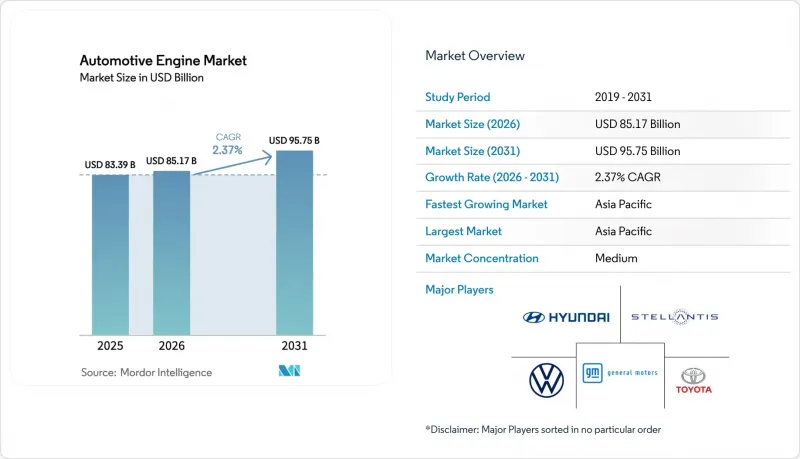
Mordor Intelligence에 의하면, 자동차 엔진 시장 규모는 2025년에 833억 9,000만 달러로 평가되었습니다. 2026년 851억 7,000만 달러에서 2031년까지 957억 5,000만 달러에 이를 것으로 예상되며, 예측 기간(2026-2031년) CAGR은 2.37%를 나타낼 전망입니다.
본 보고서는 배열 유형(인라인, V형, W형, 복서/플랫, 대향 피스톤), 연료 유형(가솔린, 디젤 등), 차종(승용차, 소형 상용차, 중형·대형 상용차 등),배기량(1.5L 미만, 1.5-3L, 3리터 이상) 및 지역별로 분류되어 있습니다. 시장 예측은 금액(달러) 및 수량(대수)으로 제시되어 있습니다.
세계의 자동차 엔진 시장 동향 및 인사이트
아시아태평양 신흥 경제국에서의 자동차 생산 증가
2025년, 인도는 승용차 생산을 대폭 늘렸으며, 구자라트주 및 타밀나두주에서의 생산 능력 확대를 통해 현저한 성장을 달성했습니다. 한편, 중국은 경차의 주요 생산국으로서의 지위를 유지하며, 하이브리드차 및 특히 인프라 문제가 여전히 남아 있는 동남아시아로의 수출에 주력했습니다. 인도네시아와 태국 양국은 유연한 파워트레인 분야에 막대한 투자를 유치하여, 공통 금형을 사용하여 제조되는 가솔린차, 하이브리드차, CNG차 부문에서 아세안(ASEAN) 지역의 주요 허브로서의 입지를 공고히 했습니다. 인건비 우위를 활용하여 인도산 엔진은 유럽산에 비해 대폭 낮은 가격으로 아프리카와 라틴아메리카로 수출되고 있으며, 내연기관(ICE)의 경쟁력을 유지하고 있습니다. 도시 지역의 전동화 정책이 점점 더 엄격해지는 가운데에서도 이러한 생산 증가세가 자동차 엔진 시장을 견인하고 있습니다.
전 세계 배기가스 규제의 강화가 내연기관의 효율 향상을 촉진
유로 7, 중국 VI-b, 그리고 미국 환경보호청(USEPA)의 Tier 4 Final 기준이 맞물려 미세먼지 및 NOx 배출 제한이 강화됨에 따라, 제조업체들은 가솔린 미립자 필터, 차량 진단 시스템의 표준화, 그리고 저온 내구성에 대한 보정 도입을 피할 수 없게 되었습니다. 이러한 하드웨어 추가로 인해 엔진 1대당 비용은 약 300달러 증가하지만, 대량 생산되는 승용차의 규제 준수를 보장하고 있습니다. 선택적 촉매 환원(SCR) 및 고압 직접 분사 기술은 현재 소형 건설 기계와 경차에도 보급되어 공급업체의 대상 시장을 확대시키고 있습니다. 규제가 지속적으로 강화됨에 따라, CO₂ 배출량을 1그램이라도 줄이기 위한 린번(Lean Burn) 전략, 가변 밸브 타이밍, 밀러 사이클 적용을 위한 연구 개발이 추진되고 있습니다. 그 결과, 전기차의 점유율이 확대되는 상황에서도 자동차 엔진 시장의 중요성을 지속적으로 유지할 수 있는 지속 가능한 기술 개발 파이프라인이 형성되고 있습니다.
배터리식 전기차의 급속한 보급이 연구개발 예산의 방향을 전환시키고 있다.
최근 배터리식 전기차(BEV)의 전 세계 판매 대수는 눈에 띄게 증가하며 경차 시장에서 상당한 점유율을 확보하고 있습니다. 이러한 변화로 인해 자동차 제조업체들은 기술 개발의 초점을 배터리 팩과 소프트웨어 아키텍처로 전환할 수밖에 없게 되었습니다. 폭스바겐은 대담한 조치로 향후 10년에 걸친 전동화 이니셔티브에 막대한 예산을 배정했습니다. 이 결정에 따라 내연기관(ICE) 예산은 대폭 삭감되었으며, 내연기관 제품군의 통합이 추진되었습니다. 한편, 제너럴 모터스(GM)는 가까운 시일 내에 새로운 내연기관(ICE) 플랫폼 개발을 중단하고, 향후 지출을 규제 대응 및 마일드 하이브리드 개선에 한정하겠다고 발표했습니다. 업계 상황의 변화를 여실히 보여주는 움직임으로, 보쉬(Bosch) 등 1차 공급업체들이 파워트레인 부문에서 인원 감축을 단행해 화제가 되었습니다. 이러한 움직임은 한때 번성했던 내연기관 분야가 이제는 단순한 유지 기술에 불과하다는 점차 확산되고 있는 공통된 인식을 여실히 드러내고 있습니다. 설비 투자가 감소함에 따라 균질 혼합기 압축 점화나 플라즈마 보조 점화와 같은 분야의 혁신은 둔화되고 있으며, 자동차 엔진 업계는 획기적인 돌파구가 아닌 점진적인 개선으로 나아가고 있습니다.
부문 분석
직렬 엔진은 토요타의 ‘다이나믹 포스’와 폭스바겐의 ‘EA888’ 시리즈에서 보여준 모듈식 확장성과 하이브리드 대응성을 바탕으로, 2025년에는 자동차 엔진 시장의 43.36%를 차지했습니다. 대향 피스톤 엔진은 틈새 시장으로 남아 있지만, 화물 운송 사업자들이 아케츠 파워(Aketz Power)사의 2행정 설계의 유효성을 확인하고 있어 2031년까지 연평균 성장률(CAGR) 2.39%를 나타낼 것으로 예측됩니다. 이 설계는 기존 디젤 엔진에 비해 연비를 3분의 1 향상시켰으며, 선택적 촉매 환원(SCR)을 사용하지 않고도 EPA의 2027년 NOx 규제를 충족합니다.
포드의 3.5리터 ‘에코부스트’ V6 및 GM의 6.2리터 V8은 견인을 주된 목적으로 하는 픽업 트럭에서 V형 엔진의 입지를 유지하고 있는 반면,스바루의 복서형 아키텍처는 낮은 무게 중심 덕분에 제조상의 복잡성 증가를 상쇄할 수 있는 사륜구동 크로스오버 차량에서 여전히 채택되고 있습니다. 규제 당국이 아키텍처보다 출력에 중점을 두고 있기 때문에 자동차 제조업체들은 실린더 소형화를 추진하면서도 익숙한 레이아웃을 유지하도록 권장받고 있지만, 대향 피스톤 엔진의 실증 시험을 통해 얻은 구체적인 효율성 향상으로 인해 예측 기간 동안 장거리 트럭 운송 분야의 조달 동향이 변화할 가능성이 있습니다.
2025년에는 가솔린 엔진이 자동차 엔진 시장의 63.31%를 차지했으나, 마일드 하이브리드,풀 하이브리드, 플러그인 하이브리드를 포함한 하이브리드 내연기관 파워트레인은 2031년까지 연평균 성장률(CAGR) 2.47%로 확대되어, 연료 카테고리 중 가장 빠른 성장률을 보일 전망입니다. 도요타의 2.5리터 ‘다이나믹 포스 하이브리드’는 높은 열효율을 실현하고 있는 반면, 스텔란티스는 지프 및 푸조 각 모델에 1.5리터 직렬 4기통 터보 엔진에 48볼트 시스템을 통합하고 있습니다.
유럽 승용차 시장에서 디젤 차량의 쇠퇴와 대조적으로, 대형 트럭 시장에서는 연료 밀도와 급유 속도가 여전히 결정적인 요인으로 작용하고 있어 디젤 차량의 입지는 유지되고 있습니다. 도시 지역 버스에서는 바이오메탄이 전체 수명 주기 동안 CO₂ 감축을 실현하기 때문에 천연가스를 연료로 사용하는 차량이 증가하고 있습니다. 또한 브라질에서는 플렉스 연료 엔진이 저비용 에탄올이라는 이점을 유지하고 있습니다. 수소와 내연기관(ICE)을 결합한 시범 프로젝트에서는 2025년 내구 레이스에서 300마력의 출력을 발휘하며, 기존의 주조 및 기계 가공 설비를 활용한 탄소 중립으로 가는 길을 제시했습니다.
지역별 분석
아시아태평양은 2025년 전 세계 생산 대수의 38.71%를 차지했으며, 인도의 생산 급증과 유연한 파워트레인 거점으로서 아세안(ASEAN)의 부상으로 인해 2031년까지 연평균 성장률(CAGR) 2.45%로 확대될 것으로 전망됩니다. 중국은 2,680만 대를 생산하며 여전히 세계 최대의 경차 생산국이며, 베이징 정부가 2030년까지 전기차 보급률 향상을 목표로 하고 있음에도 불구하고 하이브리드차 및 수출용 내연기관(ICE) 생산 라인을 유지하고 있습니다. 한편, 일본에서는 2025년 자동차 제조업체들이 생산 능력을 미국·멕시코·캐나다 협정(USMCA) 대상 지역으로 이전함에 따라 국내 엔진 생산 대수가 감소했습니다.
최근 몇 년간 미국의 경차 판매는 견조한 추세를 보이고 있으며, 견인 능력이나 주유 편의성을 중시하는 풀사이즈 트럭에 대한 수요가 높아짐에 따라 내연기관 차량과 하이브리드 차량이 시장을 독점하고 있습니다. 포드의 켄튀르키예 트럭 공장과 GM의 플린트 조립 공장은 EPA Tier 3 기준을 준수하는 V6 및 V8 엔진을 생산하며 계속해서 풀가동 중입니다. 유럽에서는 도시 지역의 제로 배출 구역 도입 확대의 영향으로 승용차 생산이 소폭 감소하고 있습니다. 그러나 독일 잘츠기터 공장에서는 기존 엔진 유닛에 더해 마일드 하이브리드 모듈 생산으로의 전환을 위해 막대한 투자를 단행하고 있으며, 수천 명의 직원 고용을 확보하고 있습니다.
남미, 중동 및 아프리카에서는 자동차 수요가 여전히 견조하지만, 비용 및 인프라 제약으로 인해 배터리 전기자동차(BEV)의 보급에는 과제가 있습니다. 브라질은 휘발유보다 비용 대비 효율이 높은 사탕수수 유래 에탄올이라는 경쟁 우위를 활용하여 플렉스 연료 차량의 생산을 견조하게 유지하고 있습니다. 한편, 사우디아라비아와 아랍에미리트(UAE)는 국내에서 생산된 수소를 활용하여 혹독한 기후 조건 하에서 리튬 이온 배터리가 직면한 과제를 해결하기 위해, 도시 물류용 수소·내연기관(ICE) 시범 프로젝트를 시작했습니다. 남아프리카공화국은 충전 인프라가 아직 초기 단계에 있는 사하라 이남 시장으로의 수출을 위해, 우측 핸들 사양의 내연기관(ICE) 차량 생산에 계속해서 주력하고 있습니다.
기타 혜택 :
- 엑셀 형식 시장 예측(ME) 시트
- 3개월간의 애널리스트 지원
자주 묻는 질문
목차
제1장 서론
제2장 조사 방법
제3장 주요 요약
제4장 시장 구도
제5장 시장 규모 및 성장 예측
제6장 경쟁 구도
제7장 시장 기회 및 향후 전망
KTH 26.09.10According to Mordor Intelligence, the automotive engine market size was valued at USD 83.39 billion in 2025 and estimated to grow from USD 85.17 billion in 2026 to reach USD 95.75 billion by 2031, at a CAGR of 2.37% during the forecast period (2026-2031).
This report is Segmented by Placement Type (In-Line, V-Type, W-Type, Boxer/Flat, and Opposed-Piston), Fuel Type (Gasoline, Diesel, and More), Vehicle Type (Passenger Cars, Light Commercial Vehicles, Medium and Heavy Commercial Vehicles, and More), Engine Capacity (Below 1. 5 L, 1. 5-3 L, and Over 3 L), and Geography. Market Forecasts are Provided in Value (USD) and Volume (Units).
Global Automotive Engine Market Trends and Insights
Rising Vehicle Production in Emerging Asia-Pacific Economies
In 2025, India significantly increased its passenger vehicle production, achieving notable growth due to capacity expansions in Gujarat and Tamil Nadu. Meanwhile, China maintained its position as a leading producer of light vehicles, focusing on hybrids and exports, particularly to Southeast Asia, where infrastructure challenges persist. Both Indonesia and Thailand attracted substantial investments in flexible powertrains, solidifying their roles as key hubs in the ASEAN region for gasoline, hybrid, and CNG variants, all manufactured using shared tooling. Leveraging labor-cost advantages, Indian-manufactured engines are being exported to Africa and Latin America at significantly lower prices compared to their European counterparts, ensuring the continued competitiveness of internal combustion engines (ICE). This production growth is driving the automotive engine market forward, even as urban electrification policies become increasingly stringent .
Stricter Global Emission Regulations Driving Internal Combustion Engine Efficiency Upgrades
Euro 7, China VI-b, and the United States Environmental Protection Agency (USEPA) Tier 4 Final standards converge to tighten particulate and NOx limits, obliging manufacturers to deploy gasoline particulate filters, on-board diagnostics parity, and low-temperature durability calibrations. The incremental hardware raises per-engine cost by roughly USD 300 yet safeguards regulatory compliance for high-volume passenger cars . Selective catalytic reduction and high-pressure direct injection now permeate compact construction machines as well as light vehicles, expanding supplier addressable markets. Continued tightening propels R&D into lean-burn strategies, variable valve timing, and Miller-cycle adaptations that chase every gram of CO2 abatement. The upshot is a sustained engineering pipeline that keeps the automotive engine market relevant even as electric vehicles gain share.
Rapid Battery Electric Vehicle Adoption Diverting R&D Budgets
In recent years, global sales of battery electric vehicles (BEVs) have experienced significant growth, capturing a notable share of the light-vehicle market. This shift has prompted automakers to pivot their engineering focus towards battery packs and software architectures. Volkswagen, in a bold move, allocated a substantial budget for electrification initiatives over the next decade. This decision came with a significant reduction in its internal combustion engine (ICE) budget and a consolidation of its combustion families. Meanwhile, General Motors announced it would halt the development of new ICE platforms in the near future, confining its future expenditures to compliance adjustments and mild-hybrid enhancements. In a clear sign of the industry's evolving landscape, Tier-1 suppliers like Bosch made headlines by reducing their power-train workforce. This move underscores a growing consensus: the once-thriving combustion sector is now merely a sustaining technology. As capital investments dwindle, innovation in areas like homogeneous-charge compression ignition and plasma-assisted ignition has slowed, steering the automotive engine industry towards incremental improvements rather than groundbreaking breakthroughs.
Other drivers and restraints analyzed in the detailed report include:
- E-Commerce Logistics Boosting Light Commercial Vehicle Engine Demand
- Emergence of Synthetic E-Fuels Extending the Internal Combustion Engine Lifecycle
- Zero-Emission Urban Zones Curbing Internal Combustion Engine Sales
For complete list of drivers and restraints, kindly check the Table Of Contents.
Segment Analysis
In-line engines controlled 43.36% of the automotive engine market in 2025 by leveraging modular scalability and hybrid compatibility across Toyota's Dynamic Force and Volkswagen's EA888 families. Opposed-piston units, although niche, are projected to grow at 2.39% CAGR through 2031 as freight operators validate Achates Power's two-stroke design, which posts one-third of fuel-economy gains versus conventional diesels and meets EPA 2027 NOx rules without selective catalytic reduction.
Ford's 3.5-liter EcoBoost V6 and GM's 6.2-liter V8 maintain V-type relevance for towing-oriented pickups, while Subaru's boxer architecture persists in all-wheel-drive crossovers where a low center of gravity offsets added manufacturing complexity. Regulatory focus on output rather than architecture has encouraged automakers to downsize cylinders yet retain familiar layouts, but the tangible efficiency from opposed-piston trials could swing procurement in long-haul trucking over the forecast window.
Gasoline held 63.31% of the automotive engine market in 2025, but hybrid-ICE powertrains spanning mild, full, and plug-in systems will expand at a 2.47% CAGR to 2031, the fastest among fuel categories. Toyota's 2.5-liter Dynamic Force Hybrid achieves thermal efficiency, while Stellantis integrates 48-volt systems on 1.5-liter turbo fours across Jeep and Peugeot models.
Diesel's retreat in European passenger cars contrasts with its endurance in heavy-duty trucks, where fuel density and refueling speed remain decisive. Natural-gas fleets are growing in urban buses as biomethane delivers sustainable lifecycle CO2 reductions, and Brazil's flex-fuel engines preserve the low-cost ethanol advantages. Hydrogen-ICE pilots showcased 300 horsepower outputs in 2025 endurance racing, illustrating a zero-carbon pathway that leverages existing casting and machining assets.
Complete Report Scope:
- By Placement Type
- In-line
- V-type
- W-type
- Boxer / Flat
- Opposed-piston
- By Fuel Type
- Gasoline
- Diesel
- Natural Gas / CNG
- Hybrid-ICE (Mild, Full, Plug-in)
- Alternative Fuels (Ethanol, LPG, e-Fuels)
- Hydrogen Internal Combustion Engine (ICE)
- By Vehicle Type
- Passenger Cars
- Light Commercial Vehicles
- Medium and Heavy Commercial Vehicles
- Two-Wheelers and Powersports
- Off-road / Agricultural / Construction
- By Engine Capacity
- Below 1.5 L
- 1.5 to 3 L
- Over 3 L
- By Geography
- North America
- United States
- Canada
- Rest of North America
- South America
- Brazil
- Argentina
- Rest of South America
- Europe
- Germany
- United Kingdom
- France
- Italy
- Spain
- Rest of Europe
- Asia Pacific
- China
- India
- Japan
- South Korea
- Rest of Asia Pacific
- Middle East and Africa
- United Arab Emirates
- Saudi Arabia
- South Africa
- Turkey
- Rest of Middle East and Africa
- North America
Geography Analysis
Asia Pacific held 38.71% of 2025 global volume and is projected to expand at a 2.45% CAGR through 2031, driven by India's output surge and ASEAN's rise as a flexible power-train hub. China remains the world's largest light-vehicle producer at 26.8 million units, retaining ICE lines for hybrids and exports even as Beijing targets electric vehicle penetration by 2030. Japan's domestic engine production dipped in 2025 as OEMs shifted capacity to the United States-Mexico-Canada Agreement (USMCA) zones.
In recent years, United States light-vehicle sales have shown strong performance, with internal combustion engine (ICE) vehicles and hybrids dominating the market due to the high demand for full-size trucks that emphasize towing and refueling convenience. Ford's Kentucky Truck Plant and GM's Flint Assembly continue to operate at full capacity, producing V6 and V8 engines that comply with EPA Tier 3 standards. In Europe, passenger-car production has experienced a slight decline, influenced by the increasing implementation of urban zero-emission zones. However, Germany's Salzgitter site has made significant investments to transition towards producing mild-hybrid modules alongside traditional engine units, ensuring job security for thousands of workers.
In South America, the Middle East, and Africa, demand for vehicles remains robust, but the adoption of battery electric vehicles (BEVs) faces challenges due to cost and infrastructure limitations. Brazil has leveraged its competitive advantage in sugarcane ethanol, which is more cost-effective than gasoline, to maintain strong production of flex-fuel vehicles. Meanwhile, Saudi Arabia and the UAE have initiated hydrogen-ICE pilot projects for urban logistics, utilizing their domestic hydrogen production and addressing the thermal challenges associated with lithium-ion batteries in extreme climates. South Africa continues to focus on producing right-hand-drive ICE vehicles for export to sub-Saharan markets, where charging infrastructure is still in its early stages of development.
- Toyota Motor Corporation
- Volkswagen AG
- Hyundai Motor Group
- General Motors
- Stellantis N.V.
- Ford Motor Company
- Mercedes-Benz Group AG
- BMW AG
- Honda Motor Co., Ltd.
- Nissan Motor Co., Ltd.
- Cummins Inc.
- Volvo Group
- Tata Motors Limited
- Scania AB
- Caterpillar Inc.
Additional Benefits:
- The market estimate (ME) sheet in Excel format
- 3 months of analyst support
TABLE OF CONTENTS
1 Introduction
- 1.1 Study Assumptions and Market Definition
- 1.2 Scope of the Study
2 Research Methodology
3 Executive Summary
4 Market Landscape
- 4.1 Market Overview
- 4.2 Market Drivers
- 4.2.1 Rising Vehicle Production in Emerging Asia-Pacific Economies
- 4.2.2 Stricter Global Emission Regulations Driving Internal Combustion Engine (ICE) Efficiency Upgrades
- 4.2.3 48-V Micro-Hybrid Systems Reinforcing Internal Combustion Engine (ICE) Relevance
- 4.2.4 E-Commerce Logistics Boosting LCV Engine Demand
- 4.2.5 Emergence of Synthetic E-Fuels Extending Internal Combustion Engine (ICE) Lifecycle
- 4.2.6 Hydrogen-Fueled Internal Combustion Engine (ICE) Pilots for Medium and Heavy Trucks
- 4.3 Market Restraints
- 4.3.1 Rapid Battery Electric Vehicle (BEV) Adoption Diverting R&D Budgets
- 4.3.2 Critical Alloy Shortages Inflating Engine Costs
- 4.3.3 Zero-Emission Urban Zones Curbing Internal Combustion Engine (ICE) Sales
- 4.3.4 OTA-Driven Value Shift Toward Power Electronics
- 4.4 Value / Supply-Chain Analysis
- 4.5 Regulatory Landscape
- 4.6 Technological Outlook
- 4.7 Porter's Five Forces
- 4.7.1 Bargaining Power of Suppliers
- 4.7.2 Bargaining Power of Buyers
- 4.7.3 Threat of New Entrants
- 4.7.4 Threat of Substitutes
- 4.7.5 Competitive Rivalry
5 Market Size and Growth Forecasts (Value (USD) and Volume (Units))
- 5.1 By Placement Type
- 5.1.1 In-line
- 5.1.2 V-type
- 5.1.3 W-type
- 5.1.4 Boxer / Flat
- 5.1.5 Opposed-piston
- 5.2 By Fuel Type
- 5.2.1 Gasoline
- 5.2.2 Diesel
- 5.2.3 Natural Gas / CNG
- 5.2.4 Hybrid-ICE (Mild, Full, Plug-in)
- 5.2.5 Alternative Fuels (Ethanol, LPG, e-Fuels)
- 5.2.6 Hydrogen Internal Combustion Engine (ICE)
- 5.3 By Vehicle Type
- 5.3.1 Passenger Cars
- 5.3.2 Light Commercial Vehicles
- 5.3.3 Medium and Heavy Commercial Vehicles
- 5.3.4 Two-Wheelers and Powersports
- 5.3.5 Off-road / Agricultural / Construction
- 5.4 By Engine Capacity
- 5.4.1 Below 1.5 L
- 5.4.2 1.5 to 3 L
- 5.4.3 Over 3 L
- 5.5 By Geography
- 5.5.1 North America
- 5.5.1.1 United States
- 5.5.1.2 Canada
- 5.5.1.3 Rest of North America
- 5.5.2 South America
- 5.5.2.1 Brazil
- 5.5.2.2 Argentina
- 5.5.2.3 Rest of South America
- 5.5.3 Europe
- 5.5.3.1 Germany
- 5.5.3.2 United Kingdom
- 5.5.3.3 France
- 5.5.3.4 Italy
- 5.5.3.5 Spain
- 5.5.3.6 Rest of Europe
- 5.5.4 Asia Pacific
- 5.5.4.1 China
- 5.5.4.2 India
- 5.5.4.3 Japan
- 5.5.4.4 South Korea
- 5.5.4.5 Rest of Asia Pacific
- 5.5.5 Middle East and Africa
- 5.5.5.1 United Arab Emirates
- 5.5.5.2 Saudi Arabia
- 5.5.5.3 South Africa
- 5.5.5.4 Turkey
- 5.5.5.5 Rest of Middle East and Africa
- 5.5.1 North America
6 Competitive Landscape
- 6.1 Market Concentration
- 6.2 Strategic Moves
- 6.3 Market Share Analysis
- 6.4 Company Profiles (Includes Global Level Overview, Market Level Overview, Core Segments, Financials as Available, Strategic Information, Market Rank/Share for Key Companies, Products and Services, SWOT Analysis, and Recent Developments)
- 6.4.1 Toyota Motor Corporation
- 6.4.2 Volkswagen AG
- 6.4.3 Hyundai Motor Group
- 6.4.4 General Motors
- 6.4.5 Stellantis N.V.
- 6.4.6 Ford Motor Company
- 6.4.7 Mercedes-Benz Group AG
- 6.4.8 BMW AG
- 6.4.9 Honda Motor Co., Ltd.
- 6.4.10 Nissan Motor Co., Ltd.
- 6.4.11 Cummins Inc.
- 6.4.12 Volvo Group
- 6.4.13 Tata Motors Limited
- 6.4.14 Scania AB
- 6.4.15 Caterpillar Inc.
7 Market Opportunities and Future Outlook
- 7.1 White-space and Unmet-need Assessment