

|
시장보고서
상품코드
2121811
OHV(Off-highway Vehicle)용 엔진 : 시장 점유율 분석, 업계 동향과 통계, 성장 예측(2026-2031년)Off Highway Vehicle Engine - Market Share Analysis, Industry Trends & Statistics, Growth Forecasts (2026 - 2031) |
||||||
 Mordor Intelligence
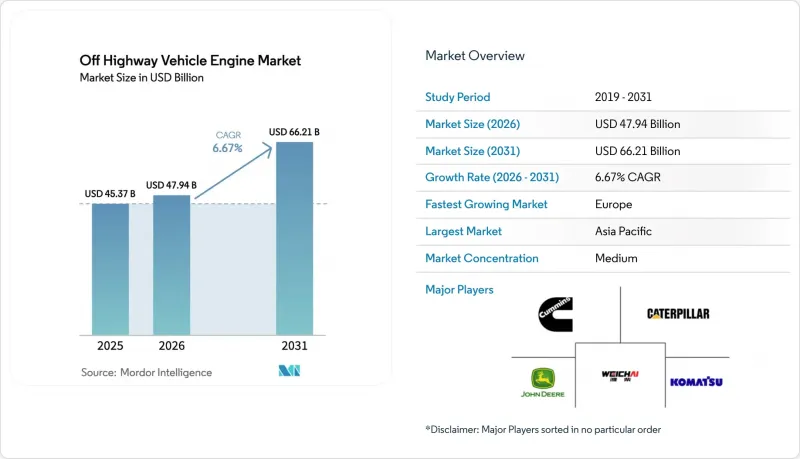
Mordor Intelligence에 의하면, OHV(Off-highway Vehicle)용 엔진 시장 규모는 2025년에 453억 7,000만 달러, 2026년에 479억 4,000만 달러, 2031년까지 662억 1,000만 달러에 이를 것으로 예측되며, 2026-2031년 CAGR 6.67%를 기록할 전망입니다.
본 보고서는 차량 유형(농업 기계, 건설 기계 등), 출력(30 HP 이하 및 그 이상), 연료 유형(디젤, 가솔린 등), 배기량(2L 이하 및 그 이상), 추진 기술(기존 내연기관 등) 및 지역별로 분류되어 있습니다. 시장 전망은 금액(달러) 및 수량(대) 단위로 제시됩니다.
전 세계 오프로드 차량용 엔진 시장 동향 및 인사이트
세계의 대규모 인프라 계획(G7 및 BRI)
G7의 ‘세계 인프라 파트너십’이나 중국의 ‘일대일로(BRI)’와 같은 세계 이니셔티브를 통해 도로, 항만, 에너지 자산에 대한 막대한 투자가 촉진되고 있습니다. 이러한 투자는 인프라 프로젝트에서 중장비에 대한 큰 수요를 창출하고 있습니다. 캐나다의 가까운 미래 연방 예산에서는 교통 및 녹색 에너지 개발에 중점을 두고 있어, 크롤러식 굴삭기나 모터 그레이더와 같은 장비에 대한 수요가 더욱 부각되고 있습니다. 또한, 프로젝트 완료 후 몇 년이 지나면 호스트국에서 EU식 배기가스 규제가 도입되는 경우가 많습니다. 이러한 추세는 모듈식 스테이지 V 대응 제품 라인을 보유한 엔진 제조업체에 유리하게 작용하여, 초기 장비 판매와 그 이후의 개조 및 개량 기회를 모두 확보할 수 있게 해줍니다. 이러한 요건을 충족하도록 전략적으로 부품을 설계하는 공급업체는 엔진 1대당 수명 주기 수익을 높일 수 있는 입장에 있습니다. 과거 동향을 통해 인프라 지출과 건설 기계의 가동률 사이에 강한 상관관계가 있는 것으로 확인되었으며, 이는 비도로용 차량 엔진 시장의 성장 가능성을 뒷받침하고 있습니다.
아시아태평양 및 아프리카의 농업 기계화 진전
2025 회계연도, 인도의 농업 기계 대출 실행액은 신형 트랙터 비용을 대폭 절감해 주는 보조금의 뒷받침을 받아 현저한 증가세를 보였습니다. 유럽에서는 헥타르당 트랙터 보유 밀도가 높은 수준을 유지하고 있는 반면, 사하라 이남 아프리카에서는 여전히 훨씬 낮은 수준에 머물러 있어, 이는 교체 수요에 큰 기회가 있음을 보여줍니다. 2024년, 중국의 농업 기계 생산은 현저한 진전을 보였으며, 국내 제조업체들은 소규모 농가를 위해 설계되고 그들의 요구에 적합한 엔진을 탑재한 트랙터에 주력했습니다. 브라질이나 호주의 대규모 상업 농장에서는 정밀 유도 기능을 갖춘 120-400마력 기종이 선호되는 반면, 아시아와 아프리카의 농가에서는 7년 할부가 가능한 50마력 미만 기종을 원하고 있어, 이에 따라 엔진 제조업체들은 제품 라인을 지역별로 차별화할 수밖에 없는 상황에 놓여 있습니다. 이러한 양극화된 수요 패턴은 소형 디젤 엔진의 판매량 증가를 뒷받침하는 동시에, 이익률이 높은 고마력 모델 수요도 지탱하고 있습니다.
소형 장비의 전기화가 가속화
볼보 CE의 전기식 굴삭기 ‘ECR25 Electric’은 1일 분의 가동 시간을 확보하고 디젤 연료비를 대폭 절감함으로써, 가동률이 높은 건설업체는 합리적인 기간 내에 투자 회수를 실현할 수 있습니다. JCB의 ‘19C-1E’나 캐터필러의 ‘301.9’와 같은 전기식 미니 굴삭기는 제로 배출과 저소음이 필수적인 실내 및 도시 지역 프로젝트에서 동등한 경제적 이점을 제공합니다. 유럽의 6톤 미만 굴삭기 시장에서는 배터리식 모델이 꾸준히 보급되고 있으며, 충전 인프라 확충에 따라 상당한 성장이 예상됩니다. 오일 교환이 필요 없어지고 가동 부품 수가 줄어들어 유지보수 요구 사항이 감소함에 따라, 배터리 구동 소형 굴삭기의 비용 대비 효과는 더욱 높아집니다. 다만, 이러한 변화는 주로 소형 엔진에 영향을 미치고 있으며, 중·고출력 디젤 엔진의 경우 현재로서는 거의 영향을 받지 않고 있습니다.
부문 분석
2025년 매출액 중 건설 기계가 59.04%를 차지하여, 오프로드 차량용 엔진 시장에서 건설 기계가 차지하는 지배적인 위상이 두드러지게 드러나고 있습니다. 아시아 전역의 도시화와 미국 및 EU의 경기 부양책에 힘입은 인프라 갱신으로 인해, 크롤러 굴삭기, 휠 로더, 백호 로더의 가동률은 높은 수준을 유지하고 있습니다. 광산용 장비는 수량은 적지만 가장 빠르게 성장하고 있는 분야입니다. 이 분야의 예상 연평균 성장률(CAGR) 8.33%는 전기차(EV) 공급망에서 구리와 리튬 수요가 급증하는 추세와 일치하며, 여기에는 자율 주행형 운반 트럭과 연간 4,000-5,000시간 가동 가능한 대용량 유압 굴삭기가 필요합니다. 농업 기계는 전체에서 2위를 차지하고 있으며, 아프리카의 트랙터 보급률은 향후 수십 년에 걸쳐 성장을 이어갈 전망입니다. 한편, 임업이나 자재 운반과 같은 틈새 분야에서는 외딴 지역에서의 작업이나 연속 교대 근무 시 디젤 엔진의 높은 에너지 밀도가 필수적입니다.
건설 기계의 경우 7-10년 주기의 정기적인 교체로 인해 엔진 공급업체에게 안정적인 기본 판매량이 확보되고 있지만, 반면 광업의 12-15년 주기에서는 가동 시간이 길기 때문에 애프터마켓 부품을 통한 안정적인 수익원이 더 많이 창출되고 있습니다. 건설 부문은 전 세계 OEM이 지배하고 있지만, 농업 분야에서는 지역별 분산이 진행되고 있어 인도에서는 마힌드라, 북미에서는 디어, 중국에서는 웨이차이가 시장을 주도하고 있습니다. 이러한 모자이크와 같은 상황으로 인해 규모의 경제를 실현하기는 어려워졌지만, 한편으로는 현지 규제 및 연료 품질에 맞추어 엔진을 맞춤 제작하는 전문 제조업체에게는 오히려 보호 요인이 되고 있습니다.
31-70마력의 출력 대역은 2025년 출하 대수의 65.18%를 차지하며, 2031년까지 연평균 성장률(CAGR) 8.12%로 확대될 것으로 예측되어, 오프로드 차량용 엔진 시장에서 그 중요성이 부각되고 있습니다. 이 출력 대역에서는 소형 트랙터, 스키드 스티어 로더, 미니 굴삭기가 주류를 이루고 있으며, 소규모 농가나 도시 지역의 도급업자를 대상으로 한 보조금 제도의 혜택을 받고 있습니다. 쿠보타의 ‘V5009 Stage V’ 시리즈는 플랫폼 개편의 모범적인 사례로, 유지보수가 필요 없는 입자상 물질 필터와 가변 기하학적 터보차저를 통합하여 배기가스 규제와 연비 효율이라는 두 가지 목표를 모두 달성하고 있습니다.
30마력 미만의 엔진은 이미 배터리가 보급되고 있는 다목적 차량에 탑재되어 있습니다. 한편, 71-120마력 엔진군은 중형 휠로더나 백호로더에 채택되고 있습니다. 120마력을 초과하는 엔진은 그 수가 적지만, 광업이나 대규모 인프라 프로젝트에서의 가혹한 가동 주기로 인해 고가 대에서 판매되거나 애프터마켓에서 수익을 창출하고 있습니다. 얀마(Yanmar)나 FPT 인더스트리얼(FPT Industrial) 등 31-120마력에 걸친 유연한 아키텍처를 갖춘 공급업체들은 연간 5만 대가 넘는 판매량으로 연구개발비를 상각하고 있습니다. 이는 400마력 이상의 틈새 시장에서는 달성할 수 없는 규모입니다.
지역별 분석
아시아태평양은 2025년 오프로드 차량용 엔진 시장의 39.12%를 차지하고 있으며, 2031년까지 상당한 연평균 성장률(CAGR)을 보일 것으로 예측됩니다. 중국의 국내 건설 붐과 인도의 농업 기계 대출 대폭 증가는 이 지역의 두 가지 성장 동력을 부각시키고 있습니다. 일본의 출하량은 둔화되었지만, 수출업체들은 ‘일대일로’ 프로젝트가 활발히 진행되고 있는 동남아시아에서 출하량을 회복했습니다. 스테이지 V 엔진을 탑재한 한국의 HX 시리즈 굴삭기는 유럽 및 북미 시장을 겨냥하고 있으며, 이는 아시아의 OEM 업체들이 가치 곡선의 상위권으로 진출하려 하고 있음을 반영합니다.
유럽은 스테이지 V 개조 및 HVO 도입에 힘입어 연평균 성장률(CAGR) 7.23%로 가장 빠르게 성장하고 있는 지역입니다. 독일의 철도 및 재생에너지 프로그램 덕분에 중형 엔진 수요는 견조한 추세를 보이고 있는 반면, 프랑스의 정밀 농업에 대한 우대 조치가 트랙터 보급률을 끌어올리고 있습니다. 브렉시트 이후의 무역 협정으로 인해 퍼킨스(Perkins)와 같은 영국 엔진 제조업체의 수출 경로가 확대되고 있습니다. 서방 국가들의 제재로 인해 러시아의 고성능 엔진 수요는 억제되고 있지만, 그 공백을 중국의 Tier 3 엔진이 메우고 있습니다.
북미는 ‘인프라 투자 및 고용법’에 힘입어 2025년 매출에서 두드러진 점유율을 차지했습니다. 미국에서는 주택 착공 건수가 중요한 이정표에 도달하며 소형 장비 수요 증가를 견인했습니다. 한편, 캐나다의 대규모 그린 인프라 구상은 크롤러와 그레이더 구매를 촉진하고 있습니다. 남미에서는 브라질의 농업 확대, 특히 대두 생산 확대가 시장 성장을 뒷받침하고 있으며, 이로 인해 고마력 트랙터에 대한 수요가 증가하고 있습니다. 중동 및 아프리카에서는 사우디아라비아의 ‘비전 2030’에 기반한 대규모 개발 프로젝트와 남아프리카공화국 광산의 장비 교체 수요가 원동력이 되어 꾸준한 성장이 나타나고 있으나, 시장 규모는 여전히 비교적 작은 임베디드니다.
기타 혜택:
- 엑셀 형식 시장 예측(ME) 시트
- 3개월간의 애널리스트 지원
자주 묻는 질문
목차
제1장 서론
제2장 조사 방법
제3장 주요 요약
제4장 시장 구도
제5장 시장 규모와 성장 예측
제6장 경쟁 구도
제7장 시장 기회와 향후 전망
LSH 26.09.09According to Mordor Intelligence, the off-highway vehicle engine market size is projected to be USD 45.37 billion in 2025, USD 47.94 billion in 2026, and reach USD 66.21 billion by 2031, growing at a CAGR of 6.67% from 2026 to 2031.
This report is Segmented by Vehicle Type (Agricultural Machinery, Construction Equipment, and More), Power Output (Less Than or Equal To 30 HP, and More), Fuel Type (Diesel, Gasoline, and More), Engine Displacement (Less Than or Equal To 2 L, and More), Propulsion Technology (Conventional ICE, and More), and Geography. The Market Forecasts are Provided in Terms of Value (USD) and Volume (Units).
Global Off Highway Vehicle Engine Market Trends and Insights
Massive Global Infrastructure Pipeline (G7 and BRI)
Global initiatives, such as the G7 Partnership for Global Infrastructure and Investment and China's Belt and Road Initiative, are driving significant investments into roads, ports, and energy assets. These investments are creating substantial demand for heavy machinery in infrastructure projects. Canada's federal budget for the near future highlights a strong focus on transport and green-energy development, further underscoring the need for equipment such as crawler excavators and motor graders. Additionally, host nations often implement EU-style emissions regulations a few years after project completion. This trend benefits engine manufacturers with modular Stage V lines, enabling them to secure both initial equipment sales and subsequent retrofitting opportunities. Suppliers who strategically design components to meet these requirements are positioned to achieve higher lifetime revenue per engine. Historical trends confirm a strong correlation between infrastructure spending and construction equipment utilization, reinforcing the growth potential of the off-highway vehicle engine market.
Growing Mechanization of Agriculture in Asia-Pacific and Africa
In fiscal 2025, Indian farm-equipment credit disbursements experienced significant growth, driven by subsidies that substantially reduce the cost of new tractors. While Europe maintains a high density of tractors per hectare, Sub-Saharan Africa continues to operate at a much lower level, highlighting a considerable opportunity for replacement. In 2024, China's agricultural machinery production saw notable progress, with domestic manufacturers focusing on tractors designed for smallholder farms, equipped with engines suitable for their needs. Large commercial farms in Brazil and Australia favor 120-400 horsepower units with precision guidance, whereas Asian and African growers seek sub-50 horsepower designs financed over seven years, forcing engine builders to regionalize product lines. The bifurcated demand pattern sustains volume growth for compact diesels while supporting margin-rich high-horsepower models.
Accelerating Electrification of Compact Equipment
Volvo CE's ECR25 Electric excavator offers a full workday of runtime and significantly reduces diesel costs, enabling high-utilization contractors to achieve a return on investment within a reasonable timeframe. JCB's 19C-1E and Caterpillar's 301.9 electric minis provide comparable economic benefits for indoor or urban projects where zero emissions and low noise are critical. Battery-electric models are steadily gaining traction in Europe's sub-6-ton excavator market, with expectations of substantial growth as charging infrastructure continues to expand. The lower maintenance requirements, which eliminate oil changes and reduce the number of moving parts, further enhance the cost-effectiveness of battery-powered compact excavators. However, this shift primarily impacts smaller engines, while mid- and high-horsepower diesel engines remain largely unaffected for now.
Other drivers and restraints analyzed in the detailed report include:
- Stricter Stage V / Tier 5 Norms Triggering Pre-Buy and Retrofit Cycles
- OEM Shift to Modular Hybrid-Ready Engine Platforms
- Escalating After-Treatment Cost Vs. Price-Sensitive Buyers
For complete list of drivers and restraints, kindly check the Table Of Contents.
Segment Analysis
Construction machinery accounted for 59.04% of 2025 revenue, underscoring its dominance within the off-highway vehicle engine market size. Urbanization across Asia and stimulus-backed infrastructure renewal in the United States and the EU keep crawler excavators, wheel loaders, and backhoe loaders on high utilization schedules. Mining equipment, although smaller in volume, is the fastest riser; its 8.33% forecast CAGR aligns with the soaring demand for copper and lithium in EV supply chains, which require autonomous haul trucks and high-tonnage hydraulic shovels capable of operating for 4,000-5,000 hours per year. Agricultural machinery ranks second overall, with tractor density in Africa poised for multi-decade growth. At the same time, forestry and material-handling niches rely on diesel's high energy density for remote or continuous-shift operations.
Recurring construction replacement every 7-10 years locks in a dependable baseline volume for engine suppliers, whereas the 12-15 year mining cycle produces a richer aftermarket parts annuity due to higher duty hours. Global OEMs dominate the construction sector but face regional fragmentation in agriculture, where Mahindra leads in India, Deere rules North America, and Weichai powers much of China. This mosaic makes scale economies elusive, yet it also protects specialized players that tailor engines to local regulation and fuel quality.
The 31-70 horsepower bracket accounted for 65.18% of unit shipments in 2025 and is projected to expand at an 8.12% CAGR through 2031, underscoring its importance to the off-highway vehicle engine market. Compact tractors, skid-steer loaders, and mini excavators dominate this band, benefiting from subsidy programs that target smallholders and urban contractors. Kubota's V5009 Stage V series exemplifies platform renewal, integrating maintenance-free particulate filters and variable-geometry turbochargers to meet both emissions and fuel-efficiency goals .
Sub-30-horsepower engines power utility vehicles where batteries are already encroaching, while the 71-120-horsepower set serves mid-sized wheel and backhoe loaders. Units above 120 horsepower, although fewer in number, generate premium pricing and aftermarket revenue due to their demanding duty cycles in mining and large infrastructure projects. Suppliers with flexible architectures that span 31-120 horsepower, such as Yanmar and FPT Industrial, amortize R&D costs across volumes exceeding 50,000 units per year, a scale that is unreachable in the 400-horsepower-and-above niche.
Complete Report Scope:
- By Vehicle Type
- Agricultural Machinery
- Construction Equipment
- Mining Equipment
- Forestry and Material-Handling Equipment
- By Power Output
- Less than or equal to 30 HP
- 31-70 HP
- 71-120 HP
- 121-400 HP
- More than 400 HP
- By Fuel Type
- Diesel
- Gasoline
- Natural-/Bio-Gas
- Hybrid-Electric and Fuel-Cell
- By Engine Displacement
- Less than or equal 2 L
- 2.1 to 3.5 L
- 3.6 to 7 L
- More than 7 L
- By Propulsion Technology
- Conventional ICE
- Hybrid
- Battery-Electric
- Fuel-Cell Electric
- By Geography
- North America
- United States
- Canada
- Rest of North America
- South America
- Brazil
- Argentina
- Rest of South America
- Europe
- Germany
- United Kingdom
- France
- Russia
- Spain
- Rest of Europe
- Asia-Pacific
- China
- Japan
- India
- South Korea
- Rest of Asia-Pacific
- Middle East and Africa
- Saudi Arabia
- United Arab Emirates
- Egypt
- Turkey
- South Africa
- Rest of Middle East and Africa
- North America
Geography Analysis
Asia-Pacific controlled 39.12% of the off-highway vehicle engine market in 2025 and is expected to advance at a notable CAGR to 2031. China's domestic construction boom and India's significant jump in farm-equipment credit underscore the region's dual growth engines. Japanese shipments softened, but exporters recouped volume in Southeast Asia, where Belt and Road projects remain active. South Korea's HX Series excavators, fitted with Stage V engines, target Europe and North America, reflecting Asian OEMs' push up the value curve.
Europe is the fastest-growing region, with a 7.23% CAGR, driven by Stage V retrofits and HVO adoption. Germany's rail and renewable program keeps demand steady for mid-sized engines, while France's precision-farming incentives lift tractor penetration. Post-Brexit trade deals widen export lanes for engine builders in the United Kingdom, like Perkins. Western sanctions curtail Russian demand for high-spec engines, allowing Chinese Tier 3 units to backfill the gap.
North America held a notable share of 2025 turnover, underpinned by the Infrastructure Investment and Jobs Act. In the United States, housing starts reached a significant milestone, driving increased demand for compact equipment. Meanwhile, Canada's extensive green-infrastructure initiative has stimulated purchases of crawlers and graders. In South America, market growth is supported by agricultural expansion in Brazil, particularly in soybean production, which boosts the need for high-horsepower tractors. The Middle East and Africa are experiencing steady growth, driven by large-scale development projects under Saudi Vision 2030 and equipment replacements in South African mines, although the market remains relatively smaller in size.
- AGCO Corporation
- Caterpillar Inc.
- Cummins Inc.
- Deere & Company
- Deutz AG
- Komatsu Ltd.
- Mahindra Powerol
- Scania AB
- Volvo Penta
- Yanmar Holdings Co., Ltd.
- Weichai Power Co., Ltd.
- Kubota Corporation
- Perkins Engines Company Limited
- MAN Engines
- Rolls-Royce Power Systems AG
- HD Hyundai Infracore Co., Ltd.
- FPT Industrial S.P.A.
- Rehlko Engines (Kohler Engines)
- Motorenfabrik Hatz GmbH & Co. KG
Additional Benefits:
- The market estimate (ME) sheet in Excel format
- 3 months of analyst support
TABLE OF CONTENTS
1 Introduction
- 1.1 Study Assumptions & Market Definition
- 1.2 Scope of the Study
2 Research Methodology
3 Executive Summary
4 Market Landscape
- 4.1 Market Overview
- 4.2 Market Drivers
- 4.2.1 Massive Global Infrastructure Pipeline (G7 and BRI)
- 4.2.2 Growing Mechanization of Agriculture in Asia-Pacific and Africa
- 4.2.3 Stricter Stage V / Tier 5 Norms Triggering Pre-Buy and Retrofit Cycles
- 4.2.4 OEM Shift to Modular Hybrid-Ready Engine Platforms
- 4.2.5 HVO/Renewable-Diesel Compatibility Extending ICE Relevance
- 4.2.6 Telematics-Driven Predictive Maintenance Shortening Replacement Cycles
- 4.3 Market Restraints
- 4.3.1 Accelerating Electrification of Compact Equipment
- 4.3.2 Escalating After-Treatment Cost Vs. Price-Sensitive Buyers
- 4.3.3 Commodity-Price Volatility Squeezing Engine Margins
- 4.3.4 Rental Fleets Extending Overhaul Intervals
- 4.4 Value/Supply-Chain Analysis
- 4.5 Regulatory Landscape
- 4.6 Technological Outlook
- 4.7 Porter's Five Forces
- 4.7.1 Threat of New Entrants
- 4.7.2 Bargaining Power of Buyers
- 4.7.3 Bargaining Power of Suppliers
- 4.7.4 Threat of Substitutes
- 4.7.5 Intensity of Rivalry
5 Market Size & Growth Forecasts (Value (USD) and Volume (Units))
- 5.1 By Vehicle Type
- 5.1.1 Agricultural Machinery
- 5.1.2 Construction Equipment
- 5.1.3 Mining Equipment
- 5.1.4 Forestry and Material-Handling Equipment
- 5.2 By Power Output
- 5.2.1 Less than or equal to 30 HP
- 5.2.2 31-70 HP
- 5.2.3 71-120 HP
- 5.2.4 121-400 HP
- 5.2.5 More than 400 HP
- 5.3 By Fuel Type
- 5.3.1 Diesel
- 5.3.2 Gasoline
- 5.3.3 Natural-/Bio-Gas
- 5.3.4 Hybrid-Electric and Fuel-Cell
- 5.4 By Engine Displacement
- 5.4.1 Less than or equal 2 L
- 5.4.2 2.1 to 3.5 L
- 5.4.3 3.6 to 7 L
- 5.4.4 More than 7 L
- 5.5 By Propulsion Technology
- 5.5.1 Conventional ICE
- 5.5.2 Hybrid
- 5.5.3 Battery-Electric
- 5.5.4 Fuel-Cell Electric
- 5.6 By Geography
- 5.6.1 North America
- 5.6.1.1 United States
- 5.6.1.2 Canada
- 5.6.1.3 Rest of North America
- 5.6.2 South America
- 5.6.2.1 Brazil
- 5.6.2.2 Argentina
- 5.6.2.3 Rest of South America
- 5.6.3 Europe
- 5.6.3.1 Germany
- 5.6.3.2 United Kingdom
- 5.6.3.3 France
- 5.6.3.4 Russia
- 5.6.3.5 Spain
- 5.6.3.6 Rest of Europe
- 5.6.4 Asia-Pacific
- 5.6.4.1 China
- 5.6.4.2 Japan
- 5.6.4.3 India
- 5.6.4.4 South Korea
- 5.6.4.5 Rest of Asia-Pacific
- 5.6.5 Middle East and Africa
- 5.6.5.1 Saudi Arabia
- 5.6.5.2 United Arab Emirates
- 5.6.5.3 Egypt
- 5.6.5.4 Turkey
- 5.6.5.5 South Africa
- 5.6.5.6 Rest of Middle East and Africa
- 5.6.1 North America
6 Competitive Landscape
- 6.1 Strategic Moves
- 6.2 Market Share Analysis
- 6.3 Company Profiles (Includes Global Level Overview, Market Level Overview, Core Segments, Financials as Available, Strategic Information, Market Rank/Share for Key Companies, Products and Services, SWOT Analysis, and Recent Developments)
- 6.3.1 AGCO Corporation
- 6.3.2 Caterpillar Inc.
- 6.3.3 Cummins Inc.
- 6.3.4 Deere & Company
- 6.3.5 Deutz AG
- 6.3.6 Komatsu Ltd.
- 6.3.7 Mahindra Powerol
- 6.3.8 Scania AB
- 6.3.9 Volvo Penta
- 6.3.10 Yanmar Holdings Co., Ltd.
- 6.3.11 Weichai Power Co., Ltd.
- 6.3.12 Kubota Corporation
- 6.3.13 Perkins Engines Company Limited
- 6.3.14 MAN Engines
- 6.3.15 Rolls-Royce Power Systems AG
- 6.3.16 HD Hyundai Infracore Co., Ltd.
- 6.3.17 FPT Industrial S.P.A.
- 6.3.18 Rehlko Engines (Kohler Engines)
- 6.3.19 Motorenfabrik Hatz GmbH & Co. KG
7 Market Opportunities & Future Outlook
- 7.1 White-space & Unmet-Need Assessment


