

|
시장보고서
상품코드
2120408
형상 기억 폴리머 : 시장 점유율 분석, 업계 동향과 통계, 성장 예측(2026-2031년)Shape Memory Polymer - Market Share Analysis, Industry Trends & Statistics, Growth Forecasts (2026 - 2031) |
||||||
 Mordor Intelligence
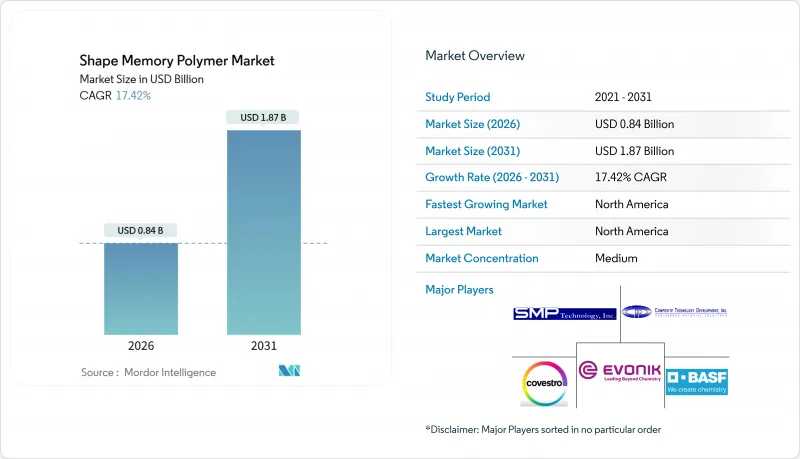
Mordor Intelligence에 따르면 형상 기억 폴리머 시장 규모는 2026년에 8억 4,000만 달러로 추정되며, 예측 기간(2026-2031년) 동안 CAGR 17.42%로 확대되어 2031년까지 18억 7,000만 달러에 달할 것으로 전망됩니다.
본 보고서는 자극 유형(열 반응형, 광 반응형, 전기 반응형, 자기 반응형, 기타 자극), 최종사용자 산업(항공우주, 자동차, 섬유, 전자, 헬스케어, 기타 최종사용자 산업) 및 지역(아시아태평양, 북미, 유럽 등)별로 분류되어 있습니다. 시장 전망은 금액(달러) 기준으로 제시되어 있습니다.
세계 형상 기억 폴리머 시장의 동향 및 인사이트
최소침습 의료기기의 채택 확대
2024년부터 2026년까지 규제 당국이 여러 SMP(형상 기억 폴리머) 기반 색전 시스템을 승인함에 따라, 시술 시간을 단축하고 혈전 형성을 촉진하는 폴리머 폼에 대한 병원의 신뢰가 높아졌습니다. 형상 기억 폼은 X선 불투과성, 낮은 반경 방향 힘, 그리고 낭내 혈전 형성을 촉진하는 다공성 스캐폴드를 제공하여 금속 코일에 비해 임상적 우위를 가지고 있습니다. 2024년에 발표된 시험적 환급 코드로 인해 보험 적용에 대한 주요 장벽이 해소되었으며, ISO 10993 생체적합성 표준 및 FDA 21 CFR 820 품질 시스템 규정을 준수함으로써 장기적인 안전성이 확고해졌습니다.
아시아태평양의 급속한 인프라 확충이 자가복구 콘크리트 수요를 견인
중국과 인도에서 진행 중인 새로운 고속도로, 항만, 철도 프로젝트에서는 균열이 발생하면 파열되어 프리폴리머를 방출하는 폴리머 마이크로캡슐에 대한 시험이 진행되고 있습니다. 이 프리폴리머는 유동하여 경화되고, 공극을 재밀봉함으로써 물의 침투와 철근의 부식을 억제합니다. 초기 현장 시험에서는 압축 강도의 회복과 투수성의 현저한 저하가 보고되었으나, 표준화된 규격의 부재와 특수 캡슐의 높은 비용이 단기적인 보급을 저해하고 있습니다.
금속이나 복합재료에 비해 고무 상태에서의 강성이 비교적 낮은
2024년 실험실 시험에서는 연속 탄소섬유 보강을 통해 비보강 SMP의 굽힘 강성이 향상되었습니다. 그러나 이러한 진전은 재료 비용 증가와 제조 공정의 복잡화를 수반했습니다. 유리 전이 온도를 초과하면 연화되는 비보강 SMP는 알루미늄 합금에 비해 탄성 계수가 현저히 낮습니다. 한편, 하이브리드 구조는 현재 하중 경로를 분리하는 데 탁월하여, 금속이 구조 응력의 주요 부담을 지는 반면 폴리머가 작동할 수 있도록 합니다.
부문 분석
2025년, 열응답성 폴리머는 형상 기억 폴리머 시장의 63.14%를 차지했으며, 이 부문은 2031년까지 연평균 성장률(CAGR) 19.44%로 확대될 것으로 전망됩니다. 이 부문의 장점은 레이저나 자석을 사용하지 않고 기존 가열 소자를 활용하는 유리 전이 및 용융·결정화 스위치에 있습니다. 2021년 MDPI의 연구에서는 50°C에서 99%의 변형 회복률을 보인 용융 방사 폴리카프로락톤-TPU 섬유가 입증되어, 적응형 의류의 내구성이 뒷받침되었습니다.
광응답형 설계는 두꺼운 부분에서 자외선 투과율이 떨어지기 때문에 여전히 얇은 마이크로유체 분야에 국한되어 있습니다. 한편, 전기응답형 등급은 줄 열을 유발하기 위해 탄소나노튜브를 삽입하고 있지만, 이 기법은 취성을 높여 재활용을 어렵게 만듭니다. 자기 반응성 수지에는 나노 규모의 페라이트가 내장되어 있어 교번 자기장에 의한 원격 구동이 가능하지만, 추가 코일로 인해 시스템 비용이 높아져 그 용도는 외과나 항공우주와 같은 틈새 분야로 제한되어 있습니다. 수분 활성화형 및 pH 트리거형 화학 반응이 제품 라인업을 보완하고 있으며, 약물전달용 스캐폴드나 적응형 패키징에 활용되고 있습니다. 전반적으로 활성화 메커니즘이 단순하기 때문에 열반응성 등급은 의료 및 자동차 분야의 대량 생산에서 여전히 선두를 차지하고 있으며, 형상 기억 폴리머 시장에서 그 주도적 지위를 공고히 하고 있습니다.
지역별 분석
북미는 2025년 매출액 기준 형상 기억 폴리머 시장의 47.91%를 차지하며 1위를 차지했으며, 2031년까지 연평균 성장률(CAGR) 57.78%라는 눈부신 성장을 보일 것으로 전망됩니다. 미국에는 벤처 투자자, 적층 제조(AM) 스타트업, 그리고 FDA 승인을 받은 의료기기 제조업체로 구성된 활기찬 생태계가 존재합니다. Carbon사가 2025년에 실시한 6,000만 달러 규모의 자금 조달은 수지 라이브러리 확충과 프린트 팜의 생산능력 확대에 사용되고 있으며, 이는 고성능 SMP 부품에 대한 국내 수요가 공급을 초과하고 있음을 나타냅니다. NASA와 국방부가 변형 구조 프로그램에 공동 투자하고 있어, 이 지역의 선도적 입지를 더욱 공고히 하고 있습니다. 캐나다의 대학들은 고분자 화학 분야에서 획기적인 성과를 내고 있는 반면, 멕시코에서는 전기자동차(EV) 공급망이 성숙해 가고 있으며, 니어쇼어링이 가속화되는 가운데 열 스위치 폼의 새로운 전개 길이 열리고 있습니다.
아시아태평양은 중국의 전기자동차 생산, 일본의 재료 과학 전문 지식, 그리고 인도의 인프라 구축 추진에 힘입어 그 기세를 따라잡고 있습니다. 일본의 대형 화학 제조사인 아사히카세이는 2024년에 경량화와 열 관리를 목적으로 한 자동차용 열가소성 엘라스토머를 발표하며, 향후 SMP 배합의 가능성을 시사했습니다. 에보닉은 2025년 상하이에서 장쇄 폴리아미드 생산량을 두 배로 늘려, 중국 본토 및 동남아시아의 적층 제조(AM) 고객을 겨냥하고 있습니다. 한국의 배터리 대기업인 LG 에너지 솔루션과 삼성SDI는 차세대 배터리 팩을 위한 폴리머 열발포체의 실증 시험을 진행하고 있으나, 공개된 기술 데이터는 여전히 제한적입니다. 인도의 고속도로 정비로 인해 자가 복구형 콘크리트용 마이크로캡슐에 대한 관심이 높아지고 있지만, 표준 위원회는 아직 SMP-시멘트 복합재의 성능 기준을 공표하지 않았습니다.
유럽은 3위를 차지하고 있으며, 견고한 품질 관리 시스템을 갖춘 공급업체를 우대하는 엄격한 MDR 및 REACH 프레임워크에 힘입고 있습니다. 형상 기억형 색전 플러그는 2025년에 EU의 MDR 클래스 III 승인을 획득하여, 27개국으로 구성된 유럽 경제 지역(EEA)에서 폴리머 대체재의 길이 열렸습니다. 에어버스(Airbus)는 연속 섬유 SMP 복합재로 제작된 변형 가능한 후연 패널에 대한 평가를 진행 중이며, 독일의 프라운호퍼 IAP는 2025년 SMP 합성 및 시제품 제조에 관한 위탁 연구개발 서비스를 발표했습니다. 북유럽의 방위 관련 공급업체들은 소형 위성 분산 용도를 위한 저아웃가스성 SMP 힌지를 평가하고 있는 반면, 영국의 캐터펄트 센터에서는 폴리머 전문가와 항공우주 업계의 주요 기업 간의 협력을 도모하고 있습니다.
남미, 중동 및 아프리카는 여전히 발전 단계에 있습니다. 브라질의 엠브라에르사를 중심으로 한 항공우주 클러스터는 SMP 소재 모핑 플랩의 실현 가능성 조사에 자금을 지원하고 있으나, 현지에서 특수 폴리머 생산이 부족하여 원자재 비용이 급등하고 있습니다. 사우디아라비아의 ‘비전 2030’ 메가 프로젝트는 자가 복구형 인프라의 시험장이 될 가능성이 있지만, 수입 의존도와 시험 시설 부족이 시장 출시 속도를 저해하고 있습니다. 두 지역 모두에서 의료기기에 관한 규제 방향이 명확하지 않아, 기업들이 조기 신청을 우선시하는 것을 주저하게 만들고 있습니다.
기타 혜택:
- 엑셀 형식의 시장 예측(ME) 시트
- 3개월간의 애널리스트 지원
자주 묻는 질문
목차
제1장 소개
제2장 조사 방법
제3장 주요 요약
제4장 시장 구도
제5장 시장 규모와 성장 예측
제6장 경쟁 구도
제7장 시장 기회와 향후 전망
KSM 26.09.02According to Mordor Intelligence, the shape memory polymer market size is estimated at USD 0.84 billion in 2026, and is expected to reach USD 1.87 billion by 2031, at a CAGR of 17.42% during the forecast period (2026-2031).
This report is Segmented by Stimulus Type (Thermally Responsive, Photo Responsive, Electrically Responsive, Magnetically Responsive, and Others Stimulus), End-User Industry (Aerospace, Automotive, Textile, Electronics, Healthcare, and Other End-User Industries), and Geography (Asia-Pacific, North America, Europe, and More). The Market Forecasts are Provided in Terms of Value (USD).
Global Shape Memory Polymer Market Trends and Insights
Increasing Minimally Invasive Medical-Device Adoption
Regulators cleared multiple SMP-based embolization systems between 2024 and 2026, bolstering hospital confidence in polymer foams that shorten procedure time and promote clot formation. Shape-memory foams provide radiolucency, low radial force, and porous scaffolds that accelerate sac thrombosis, a clinical edge over metallic coils. Pilot reimbursement codes issued in 2024 eliminated a major coverage barrier, and adherence to ISO 10993 biocompatibility and FDA 21 CFR 820 quality-system rules anchors long-term safety.
Rapid Infrastructure Build-Out in Asia-Pacific Driving Self-Healing Concrete Demand
Emerging highway, port, and rail projects in China and India are testing polymer microcapsules that rupture upon cracking, releasing prepolymers that flow and harden to reseal voids, thereby suppressing water ingress and rebar corrosion. Early field trials report restored compressive strength and a marked decline in permeability, but the absence of standardized codes and the high cost of specialty capsules temper near-term rollouts.
Relatively Low Stiffness in Rubbery State Versus Metals and Composites
In 2024 lab tests, continuous carbon-fiber reinforcement elevated the flexural stiffness of unreinforced SMPs. However, this advancement came at the expense of increased material costs and heightened process complexity. Unreinforced SMPs, which soften above their glass-transition temperature, exhibit elastic moduli significantly lower than those of aluminum alloys. Meanwhile, hybrid architectures are now adept at segregating load paths, enabling polymers to actuate while metals bear the brunt of structural stresses.
Other drivers and restraints analyzed in the detailed report include:
- Lightweight Morphing-Structure Needs in Aerospace and Space Exploration
- 4D Printing Unlocking Complex, Custom SMP Geometries
- High Production and Compounding Costs
For complete list of drivers and restraints, kindly check the Table Of Contents.
Segment Analysis
Thermally responsive polymers captured 63.14% of the shape memory polymer market in 2025, and this cohort is forecast to expand at a 19.44% CAGR through 2031. The segment's advantage lies in glass-transition and melting-crystallization switches that use existing heating elements, avoiding lasers or magnets. A 2021 MDPI study demonstrated melt-spun polycaprolactone-TPU fibers that delivered 99% strain recovery at 50 °C, validating durability for adaptive garments.
Photo-responsive designs remain confined to thin-wall microfluidics because UV penetration fades in thick sections, while electrically responsive grades embed carbon nanotubes to induce Joule heating, a tactic that raises brittleness and complicates recycling. Magnetically responsive resins integrate nanoscale ferrites, enabling remote actuation via alternating fields, yet the extra coils inflate system cost and restrict use to surgical and aerospace niches. Moisture-activated and pH-triggered chemistries round out the portfolio, serving drug-delivery scaffolds and adaptive packaging. Overall, straightforward activation infrastructure keeps thermal grades in pole position for high-volume medical and automotive output, reinforcing their leadership in the shape memory polymer market.
Complete Report Scope:
- By Stimulus Type
- Thermally Responsive
- Photo Responsive
- Electrically Responsive
- Magnetically Responsive
- Others Stimulus
- By End-user Industry
- Aerospace
- Automotive
- Textile
- Electronics
- Healthcare
- Other End-user Industries
- By Geography
- Asia-Pacific
- China
- Japan
- India
- South Korea
- ASEAN Countries
- Rest of Asia-Pacific
- North America
- United States
- Canada
- Mexico
- Europe
- Germany
- United Kingdom
- France
- Italy
- Spain
- Russia
- NORDIC Countries
- Rest of Europe
- South America
- Brazil
- Argentina
- Rest of South America
- Middle-East and Africa
- Saudi Arabia
- South Africa
- Rest of Middle-East and Africa
- Asia-Pacific
Geography Analysis
North America dominated 2025 revenue with a 47.91% slice of the shape memory polymer market and is forecast to escalate at a remarkable 57.78% CAGR through 2031. The United States hosts a vibrant ecosystem of venture investors, additive-manufacturing startups, and FDA-approved device makers. Carbon's USD 60 million capital raise in 2025 is funding the expansion of resin libraries and print-farm capacity, a signal that domestic demand for high-performance SMP parts is outstripping supply. NASA and the Department of Defense co-finance morphing-structure programs, further cementing regional leadership. Canadian universities contribute polymer chemistry breakthroughs, while Mexico's maturing EV supply chain presents an avenue for thermal-switch foams as nearshoring accelerates.
Asia-Pacific trails closely, propelled by China's electric-vehicle output, Japan's material-science expertise, and India's infrastructure push. Japanese chemical major Asahi Kasei introduced an automotive thermoplastic elastomer in 2024 that targets lightweighting and heat management, hinting at future SMP formulations. Evonik doubled production of long-chain polyamides in Shanghai during 2025, eyeing additive-manufacturing customers in mainland China and Southeast Asia. South Korea's battery giants LG Energy Solution and Samsung SDI are piloting polymer thermal foams for next-generation packs, although public technical data remains limited. India's highway build-out fuels interest in self-healing concrete microcapsules, but code committees have yet to publish performance benchmarks for SMP-cement composites.
Europe occupies the third slot, buoyed by stringent MDR and REACH frameworks that favor suppliers with robust quality-management systems. Shape-memory embolization plugs gained EU MDR Class III clearance in 2025, opening the 27-state European Economic Area to polymer alternatives. Airbus is evaluating morphing trailing-edge panels fashioned from continuous-fiber SMP composites, and Germany's Fraunhofer IAP unveiled contract research and development services for SMP synthesis and prototype fabrication in 2025. Nordic defense suppliers are assessing low-outgassing SMP hinges for small-sat dispersion, while the United Kingdom's Catapult centers align polymer experts with aerospace primes.
South America and the Middle-East, and Africa remain nascent contributors. Brazil's aerospace cluster around Embraer is funding feasibility work on SMP morphing flaps, but the lack of local specialty-polymer production inflates raw-material costs. Saudi Arabia's Vision 2030 mega-projects could provide test beds for self-healing infrastructure, yet import reliance and limited testing facilities impede speed-to-market. Across both regions, regulatory pathways for medical devices are less defined, discouraging companies from prioritizing early filings.
- Asahi Kasei Corporation
- BASF SE
- Changchun Foliaplast Bio-Tech
- Composite Technology Development Inc.
- Covestro AG
- Dow
- DYNALLOY, Inc.
- EndoShape Inc.
- Evonik Industries AG
- Guangzhou Manborui Materials
- MedShape Inc.
- Merck KGaA
- Nanoshel LLC
- Shape Memory Medical
- SMP Technologies Inc.
- Spintech Holdings Inc.
Additional Benefits:
- The market estimate (ME) sheet in Excel format
- 3 months of analyst support
TABLE OF CONTENTS
1 Introduction
- 1.1 Study Assumptions and Market Definition
- 1.2 Scope of the Study
2 Research Methodology
3 Executive Summary
4 Market Landscape
- 4.1 Market Overview
- 4.2 Market Drivers
- 4.2.1 Increasing minimally-invasive medical device adoption
- 4.2.2 Rapid infrastructure build-out in Asia-Pacific driving self-healing concrete demand
- 4.2.3 Lightweight morphing-structure needs in aerospace and space exploration
- 4.2.4 4-D printing unlocking complex, custom SMP geometries
- 4.2.5 Thermal-switch foams for EV battery-pack safety and cooling
- 4.3 Market Restraints
- 4.3.1 Relatively low stiffness in rubbery state versus metals and composites
- 4.3.2 High production and compounding costs
- 4.3.3 Water-induced premature actuation in biomedical implants
- 4.4 Value Chain Analysis
- 4.5 Porter's Five Forces
- 4.5.1 Bargaining Power of Suppliers
- 4.5.2 Bargaining Power of Consumers
- 4.5.3 Threat of New Entrants
- 4.5.4 Threat of Substitutes
- 4.5.5 Degree of Competition
5 Market Size and Growth Forecasts (Value)
- 5.1 By Stimulus Type
- 5.1.1 Thermally Responsive
- 5.1.2 Photo Responsive
- 5.1.3 Electrically Responsive
- 5.1.4 Magnetically Responsive
- 5.1.5 Others Stimulus
- 5.2 By End-user Industry
- 5.2.1 Aerospace
- 5.2.2 Automotive
- 5.2.3 Textile
- 5.2.4 Electronics
- 5.2.5 Healthcare
- 5.2.6 Other End-user Industries
- 5.3 By Geography
- 5.3.1 Asia-Pacific
- 5.3.1.1 China
- 5.3.1.2 Japan
- 5.3.1.3 India
- 5.3.1.4 South Korea
- 5.3.1.5 ASEAN Countries
- 5.3.1.6 Rest of Asia-Pacific
- 5.3.2 North America
- 5.3.2.1 United States
- 5.3.2.2 Canada
- 5.3.2.3 Mexico
- 5.3.3 Europe
- 5.3.3.1 Germany
- 5.3.3.2 United Kingdom
- 5.3.3.3 France
- 5.3.3.4 Italy
- 5.3.3.5 Spain
- 5.3.3.6 Russia
- 5.3.3.7 NORDIC Countries
- 5.3.3.8 Rest of Europe
- 5.3.4 South America
- 5.3.4.1 Brazil
- 5.3.4.2 Argentina
- 5.3.4.3 Rest of South America
- 5.3.5 Middle-East and Africa
- 5.3.5.1 Saudi Arabia
- 5.3.5.2 South Africa
- 5.3.5.3 Rest of Middle-East and Africa
- 5.3.1 Asia-Pacific
6 Competitive Landscape
- 6.1 Market Concentration
- 6.2 Strategic Moves
- 6.3 Market Share(%)/Ranking Analysis
- 6.4 Company Profiles {(includes Global level Overview, Market level overview, Core Segments, Financials as available, Strategic Information, Market Rank/Share for key companies, Products and Services, and Recent Developments)}
- 6.4.1 Asahi Kasei Corporation
- 6.4.2 BASF SE
- 6.4.3 Changchun Foliaplast Bio-Tech
- 6.4.4 Composite Technology Development Inc.
- 6.4.5 Covestro AG
- 6.4.6 Dow
- 6.4.7 DYNALLOY, Inc.
- 6.4.8 EndoShape Inc.
- 6.4.9 Evonik Industries AG
- 6.4.10 Guangzhou Manborui Materials
- 6.4.11 MedShape Inc.
- 6.4.12 Merck KGaA
- 6.4.13 Nanoshel LLC
- 6.4.14 Shape Memory Medical
- 6.4.15 SMP Technologies Inc.
- 6.4.16 Spintech Holdings Inc.
7 Market Opportunities and Future Outlook
- 7.1 White-space and Unmet-need Assessment


