|
시장보고서
상품코드
2120445
증강현실(AR) : 시장 점유율 분석, 업계 동향 및 통계, 성장 예측(2026-2031년)Augmented Reality - Market Share Analysis, Industry Trends & Statistics, Growth Forecasts (2026 - 2031) |
||||||
 Mordor Intelligence
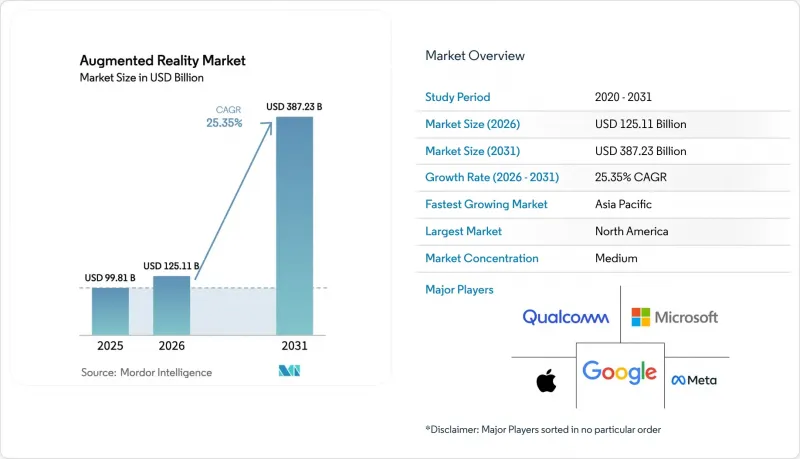
Mordor Intelligence에 의하면, 증강현실(AR) 시장 규모는 2025년 998억 1,000만 달러로 평가되었습니다. 2026년 1,251억 1,000만 달러에서 2031년까지 3,872억 3,000만 달러로 확대되고 2026년부터 2031년까지 연평균 복합 성장률(CAGR)은 25.35%를 나타낼 전망입니다.
5G의 지속적인 확산, 클라우드·엣지 아키텍처의 성숙화, 그리고 실증 실험(PoC) 단계에서 본격적인 생산 단계로 전환하는 기업의 사례가 증가하고 있는 점이 두 자릿수 성장을 뒷받침하고 있습니다.
본 보고서는 제공 형태(하드웨어 및 소프트웨어), 핵심 기술(OLED/마이크로 OLED, 마이크로 LED, 도파관 및 회절 광학 시스템 등), 용도(원격 지원 및 유지보수, 제품 시각화 등), 최종 사용자 산업(게임 및 엔터테인먼트, 교육, 자동차 및 운송 등), 그리고 지역별로 분류되어 있습니다. 시장 전망은 금액(달러) 기준으로 제시되어 있습니다.
세계의 증강현실(AR) 시장 동향 및 인사이트
5G 지원 저지연 모바일 네트워크
현재 독립형 5G 코어는 왕복 지연 시간을 10밀리초 미만으로 억제하고 있으며, 이를 통해 처리 능력에 제약이 있는 헤드셋에서 엣지 서버로 계산 처리를 이전하는 클라우드 렌더링을 통한 오버레이가 가능해졌습니다. 칩셋 제조업체들은 5G 모뎀과 함께 전용 AI 엔진을 탑재하고 있어, 연결이 끊긴 경우에도 실시간 물체 인식을 계속할 수 있습니다. 3GPP 릴리스 18에서는 XR 전용 서비스 품질(QoS) 클래스가 추가되었으며, 네트워크 사업자들은 피크 시간대의 혼잡 상황에서도 프레임 레이트의 안정성을 보장하기 위해 시범 운영을 진행하고 있습니다. 도시 지역의 통신 커버리지는 여전히 고르지 않지만, 공장, 항만, 창고에서는 공공 네트워크를 우회하여 사설 5G 네트워크를 도입함으로써 산업용 디지털 트윈에 대해 확실한 성능을 확보하고 있습니다. 통신 사각지대가 해소됨에 따라, 실외 AR 내비게이션, 관광용 오버레이, 대규모 행사장의 엔터테인먼트 분야에서 증강현실(AR) 시장의 활용이 전환점을 맞이할 것으로 예측됩니다.
기업용 교육 및 현장 서비스의 효율화
헤드 마운트 디스플레이를 도입한 기업에서는 투자 회수 기간을 24개월 미만으로 단축하는 투자 수익률(ROI)이 입증되었습니다. 독립적인 조사에 따르면, 원격 전문가의 지도를 통해 기술자의 출장을 40% 줄일 수 있는 한편, 몰입형 워크플로우를 통해 조립 불량률을 두 자릿수 비율로 줄일 수 있는 것으로 나타났습니다. 항공우주, 자동차, 중장비 제조업체에서는 종이 매뉴얼을 AR 작업 지시서로 대체함으로써 생산 주기가 20%-30% 단축되었다고 보고되고 있습니다. 공장 현장 이외의 경우, 핸즈프리 오버레이를 활용하는 일선 서비스 조직에서 기술자의 기존 방식 복귀율이 5% 미만으로 유지되어, 행동 변화가 정착되었음을 보여주고 있습니다. 거시경제의 불확실성으로 인해 비용 최적화 노력이 추진되는 가운데, AR 도입을 통해 입증된 비용 절감 효과는 증강현실 시장에서 조달 결정을 가속화할 것으로 예측됩니다.
헤드마운트 디스플레이의 배터리 지속 시간과 인체공학
시중에서 판매되는 헤드셋의 대부분은 연속 작동 시간이 2.5시간 미만으로, 종일 작업에 필요한 4시간이라는 기준을 크게 밑돌고 있습니다. 기기의 무게는 여전히 500-600그램 전후로, 많은 사용자에게 1시간 이내에 목의 피로를 유발하기 때문에 게임이나 장시간 산업용도로의 사용 시간이 제한되고 있습니다. 더 밝고 고해상도의 광학 시스템은 몰입감을 높여주지만, 배터리 소모를 가속화합니다. 반면, 배터리 용량을 늘리면 무게가 증가하게 됩니다. 솔리드 스테이트형 프로토타입은 에너지 밀도를 50% 향상시킬 것으로 기대되지만, 2028년까지는 양산 출하될 가능성은 낮을 것입니다. 그때까지는 증강현실 시장에서 인체공학적 제약이 소비자 보급을 방해할 것이며, 기업들은 헤드셋 사용을 전체 업무가 아닌 개별 업무에만 한정할 수밖에 없을 것입니다.
부문 분석
소프트웨어 분야는 2025년에 가장 빠른 매출 성장을 기록했으며, 구독, 인앱 결제, 클라우드 렌더링 서비스의 수익이 헤드셋 단일 제품의 이익을 상회함에 따라 2031년까지 연평균 성장률(CAGR) 28.76%가 예상됩니다. 하드웨어 분야에서는 독립형 및 유선 연결형 헤드마운트 디스플레이, 나아가 스크린리스형 모바일 뷰어가 2025년 지출의 64.66%를 차지했으나, Meta Quest와 같은 가성비형 기기가 설치 기반을 확대하기 위해 원가에 가까운 가격으로 판매됨에 따라 매출 총이익률은 축소되었습니다. Unity의 개발 프레임워크는 모바일 및 헤드셋용 AR 출시의 약 3분의 2를 뒷받침하고 있으며, 전문 크리에이터층이 급증하는 가운데 지속적인 라이선싱 수익의 기반이 되고 있습니다. 언리얼 엔진은 사실적인 시각화 분야에서 계속해서 성장세를 보이고 있는 반면, 기업 사용자들은 기존 자산 관리 시스템과 통합 가능한 로우코드 툴킷에 주목하고 있습니다. 소프트웨어의 비즈니스 기회는 사용자 수 증가에 따라 확대되므로, 부품 원가가 하락하더라도 플랫폼 사업자는 증가하는 라이프타임 가치를 확보할 수 있는 입장에 있습니다. 반면, 하드웨어 로드맵은 더 가벼운 폼 팩터와 에너지 효율이 높은 칩셋에 중점을 두고 있지만, 상품화는 피할 수 없으며, 증강현실(AR) 시장의 수익원은 소프트웨어 및 서비스로 결정적으로 이동하고 있습니다.
과거에는 전문 디자이너가 필요했던 자산 파이프라인도 현재는 온디맨드로 텍스처, 라이팅, 애니메이션을 자동 생성할 수 있게 되었습니다. 이러한 변화로 인해 총 소유 비용(TCO)은 사용량에 따른 과금 모델로 전환되고 있습니다. 규제 및 보험 체계가 확립됨에 따라 의료 및 국방 등 분야에서는 수년에 걸친 플랫폼 구독 계약이 체결될 것으로 예상되며, 이는 소프트웨어 벤더에게 더욱 강력한 선순환 효과를 가져다줄 것입니다. 그 결과, 하드웨어 OEM 업체들은 이미 앱 스토어 수수료율에 연동된 수익 분배 모델을 시범적으로 도입하고 있으며, 이는 AR 시장에서 가치의 중심이 조만간 물리적 단말기에서 디지털 채널로 서서히 이동하고 있음을 여실히 보여주고 있습니다.
OLED 및 마이크로 OLED 디스플레이는 성숙한 공급망과 경쟁력 있는 가격 책정 덕분에 2025년에는 증강현실 시장 매출 점유율의 48.25%를 차지했지만, 고유한 밝기 저하 및 최대 밝기 제한으로 인해 수년에 걸친 내구성에 제약이 있습니다. 주요 디스플레이 공급업체들이 선보인 마이크로 LED 프로토타입은 뛰어난 명암비, 모션 블러 감소 및 에너지 효율을 실현하고 있으며, 폼 팩터를 희생하지 않고도 사용 시간을 연장할 가능성이 있습니다. 그러나 현재의 대량 전사 공정에서는 수율 저하가 보고되고 있으며, 이로 인해 비용이 상승하고 있어 마이크로 LED 생산은 여전히 주로 시범 단계에 머물러 있습니다. 주요 스마트폰 조립 업체와 디스플레이 제조 공장의 투자 발표에 따르면, 이 기술은 2027년부터 2029년 사이에 상업적 실현 가능 단계에 도달할 것으로 예상되며, 그 후 해당 분야의 기존 기업들은 장수명 패널로의 전환을 가속화할 것입니다.
도파판 결합기도 여전히 병목 현상으로 남아 있으며, 주요 공급업체들은 나노 규모의 공차 요건으로 인해 수율이 60% 미만에 머물고 있습니다. 고성능 시스템에서는 유리 파장 가이드가 주류를 이루고 있지만, 폴리머 파장 가이드는 색상 균일성이 향상되어 소비자용 아이웨어에 대한 비용 효율적인 대안이 될 가능성이 있습니다. 실리콘 상 액정(LCOS)은 저조도 조건에서 초고해상도가 필요한 국방 용도에서 틈새 시장을 유지하고 있습니다. MicroLED로의 전환은 궁극적으로 디스플레이 백플레인, 전사 장치 및 도파관 소재의 상호 협력적인 발전에 달려 있습니다. 그러나 이러한 과제가 해결된다면, 그 결과로 가져올 성능 향상은 AR 시장에서 더 가볍고 하루 종일 착용할 수 있는 형식을 중시하는 새로운 제품 주기를 촉진할 것으로 예측됩니다.
지역별 분석
북미는 대도시권 내 5G 보급률이 높고,기존 플랫폼 기업의 집중, 그리고 2024년부터 2025년에 걸쳐 스타트업 기업에 20억 달러 이상을 투자한 탄탄한 벤처 캐피털 생태계에 힘입어, 2025년 증강현실(AR) 시장 매출의 44.42%를 차지했습니다. 항공우주, 물류, 방위 분야 기업들의 도입은 계속 확대되고 있지만, 조기 도입 기업들이 초기 전개 단계에서 최적화 단계로 전환함에 따라 헤드셋 판매 대수의 전년 대비 성장률은 둔화되고 있습니다. 캐나다 토론토의 기술 클러스터는 의료 관련 용도 분야에서 주목을 받고 있는 반면, 멕시코의 자동차 산업 클러스터에서는 조립 교육 및 품질 검사에 AR이 활용되고 있습니다.
AR 시장에서 아시아태평양은 2031년까지 연평균 성장률(CAGR) 25.94%를 기록하며, 지역별로는 가장 빠른 성장세를 보일 것으로 예측됩니다. 중국의 산업 정책은 2030년까지 AR 지원 기기를 1억 대로 늘리는 것을 목표로 하고 있으며, 데이터 현지화 규제와 더불어 국내 OEM 제조업체들이 기기 내 AI 추론 기능을 탑재하도록 장려하고 있습니다. 인도의 소비자 참여는 스마트폰 기반 AR에 크게 의존하고 있으며, 저렴한 5G 데이터 요금제와 현지 언어 컨텐츠 라이브러리 덕분에 매달 수억 명의 필터 사용자가 존재합니다. 로봇을 많이 사용하는 일본의 제조업에서는 숙련된 노동력 부족을 보완하기 위해 핸즈프리 시각화 기술을 도입하고 있는 반면, 한국은 밀집된 도시 경관에 중첩되는 고해상도 게임 체험의 실증 무대가 되고 있습니다. 호주에서는 외딴 지역의 광산 운영이나 대규모 건설 현장에서 AR 시범 운영이 진행되고 있습니다. 하지만 규제 차이와 구매력 격차로 인해 북미에 비해 달러 기준의 절대적 성장은 제한되고 있습니다.
유럽에서는 GDPR(EU 개인정보보호규정)에 따른 엄격한 생체 인증 데이터 규제로 인해 진전이 꾸준한 편이지만, 바로 그 같은 규제 체계 덕분에 퍼블릭 클라우드에 대한 의존을 피하고 개인정보를 보호하는 기업용 도입이 촉진되고 있습니다. 독일, 영국, 프랑스는 자동차 및 항공우주 분야의 활용 사례를 선도하고 있으며, AR을 도입해 조립 오류를 줄이고 교육 기간을 단축하고 있습니다. 이탈리아와 스페인은 관광 및 문화유산 전시 시설에서 이 기술을 활용하여 방문객의 참여도를 높이고 있습니다. EU 차원의 AI 관련 법규에서는 AI로 생성된 AR 컨텐츠에 대한 투명한 공개가 의무화될 예정이며, 이로 인해 규정 준수 비용은 증가할 가능성이 있지만, 소비자로부터의 기본적인 신뢰를 구축하는 데에도 기여할 것입니다. 중동 및 아프리카에서는 시범 프로젝트가 여전히 NEOM과 같은 스마트 시티 구상이나 주요 대도시권의 교육·소매 분야 쇼케이스에 집중되어 있습니다. 남미에서는 전자상거래용 시각화 도구의 시범 도입이 진행되고 있으나, 거시경제의 변동과 수입 관세가 걸림돌이 되고 있습니다.
기타 혜택 :
- 엑셀 형식 시장 예측(ME) 시트
- 3개월간의 애널리스트 지원
자주 묻는 질문
목차
제1장 서론
제2장 조사 방법
제3장 주요 요약
제4장 시장 구도
제5장 시장 규모 및 성장 예측
제6장 경쟁 구도
제7장 시장 기회 및 향후 전망
KTH 26.09.10According to Mordor Intelligence, the augmented reality market size is projected to expand from USD 99.81 billion in 2025 and USD 125.11 billion in 2026 to USD 387.23 billion by 2031, registering a CAGR of 25.35% between 2026 to 2031.Continued 5G roll-outs, maturing cloud-edge architectures, and a growing pipeline of enterprise proofs of concept moving into scaled production are sustaining double-digit growth.
This report is Segmented by Offering (Hardware, and Software), Core Technology (OLED/Micro-OLED, Microled, Waveguide and Diffractive Optics, and More), Application (Remote Assistance and Maintenance, Product Visualization, and More), End-User Vertical (Gaming and Entertainment, Education, Automotive and Transportation, and More), and Geography. The Market Forecasts are Provided in Terms of Value (USD).
Global Augmented Reality Market Trends and Insights
5G-Enabled Low-Latency Mobile Networks
Standalone 5G cores are now delivering round-trip latency under 10 milliseconds, enabling cloud-rendered overlays that move compute off constrained headsets to edge servers. Chipset makers have embedded dedicated AI engines alongside 5G modems, meaning real-time object recognition can continue even when connectivity drops. 3GPP Release 18 adds XR-specific quality-of-service classes that network operators are trialing to guarantee frame-rate stability during peak congestion. Urban coverage remains uneven, yet factories, ports, and warehouses are bypassing the public grid with private 5G networks, ensuring deterministic performance for industrial digital twins. As coverage gaps close, outdoor AR navigation, tourism overlays, and large-venue entertainment are expected to see a usage inflection in the augmented reality market.
Enterprise Training and Field-Service Efficiency Gains
Enterprises deploying head-mounted displays have documented return-on-investment profiles that shorten payback periods to fewer than 24 months. Independent studies show remote-expert guidance can cut technician travel by 40%, while immersive workflows reduce assembly defects by double-digit percentages. Aerospace, automotive, and heavy-equipment manufacturers report 20%-30% shorter production cycles once AR work instructions replace paper manuals. Beyond the factory floor, frontline service organizations using hands-free overlays note technician reversion rates below 5%, indicating sticky behavioral change. As macro uncertainty pushes cost-optimization agendas, the documented savings from AR deployments are expected to accelerate procurement decisions in the augmented reality market.
Battery-Life and Ergonomics of Head-Mounted Displays
Most commercial headsets offer under 2.5 hours of continuous operation, well below the four-hour threshold required for all-day workflows. Device masses still hover around 500-600 grams, generating neck fatigue within an hour for many users, which curtails session length in gaming and prolonged industrial scenarios. Brighter, higher-resolution optics boost immersion but drain batteries faster, while adding battery capacity exacerbates weight. Solid-state prototypes promise 50% energy-density gains but are unlikely to ship in volume before 2028. Until then, for the augmented reality market, ergonomic limits will restrain consumer uptake and compel enterprises to limit headset usage to discrete tasks rather than entire shifts.
Other drivers and restraints analyzed in the detailed report include:
- Generative-AI Tools for Rapid AR Content Creation
- Apple Vision Pro-Led Spatial-Computing Ecosystem Push
- Privacy and Data-Security Concerns
For complete list of drivers and restraints, kindly check the Table Of Contents.
Segment Analysis
The software tier generated the fastest revenue expansion in 2025, tracking a 28.76% CAGR projection through 2031 as subscriptions, in-app purchases, and cloud-rendering services outstrip one-off headset margins. Within hardware, standalone and tethered head-mounted displays plus screenless mobile viewers maintained 64.66% of 2025 spending, yet gross margins narrowed when value-tier devices such as Meta Quest were sold near cost to enlarge the installed base. Unity's development framework underpins roughly two-thirds of mobile and headset AR releases, anchoring recurring license spreads as the cohort of professional creators mushrooms. Unreal Engine continues to gain traction in photorealistic visualization, while enterprise buyers gravitate to low-code toolkits that integrate with existing asset-management systems. The software opportunity scales with every incremental user, positioning platform operators to capture expanding lifetime value even as bill-of-materials costs decline. Meanwhile, hardware roadmaps focus on lighter form factors and energy-efficient chipsets, but commoditization is inevitable, steering profit pools decisively toward software and services in the augmented reality market.
Asset pipelines that once demanded specialized designers can now auto-generate textures, lighting, and animations on demand. This shift tilts total cost of ownership toward usage-based pricing. As regulatory and insurance frameworks solidify, sectors such as healthcare and defense are expected to commit to multi-year platform subscriptions, reinforcing the virtuous flywheel for software vendors. Consequently, hardware OEMs are already experimenting with revenue-sharing models tied to app-store take rates, underscoring the gradual inversion of value from physical units to digital channels in the AR market.
OLED and Micro-OLED displays combined for 48.25% revenue share of the augmented reality market in 2025 owing to mature supply chains and competitive pricing, yet inherent luminance decay and limited peak brightness constrain multiyear durability. MicroLED prototypes showcased by leading display vendors deliver superior contrast, reduced motion blur, and energy efficiency that could elongate session lengths without sacrificing form factor. Current mass-transfer processes, however, report yield losses that inflate costs, keeping MicroLED production largely in the pilot phase. Investment announcements by top smartphone assemblers and display fabs indicate the technology will cross commercial viability between 2027 and 2029, after which category incumbents will accelerate a migration to longer-life panels.
Waveguide combiners remain another chokepoint, with leading suppliers experiencing sub-60% yields due to nanoscale tolerance demands. Glass-based waveguides dominate high-end systems, while polymer variants are progressing in color uniformity and may unlock cost-effective alternatives for consumer eyewear. Liquid-Crystal-on-Silicon retains niche relevance in defense applications requiring ultra-high resolution under low-light conditions. The transition toward MicroLED ultimately depends on coordinated advances in display backplanes, transfer equipment, and waveguide materials. Nonetheless, once solved, the resulting performance uplift is expected to catalyze a new product cycle favoring lighter, all-day wearable formats in the AR market.
Complete Report Scope:
- By Offering
- Hardware
- Stand-Alone HMDs
- Tethered HMDs
- Screenless Viewers
- Software
- Hardware
- By Core Technology
- OLED / Micro-OLED
- MicroLED
- Waveguide and Diffractive Optics
- Liquid-Crystal-on-Silicon (LCOS)
- By Application
- Remote Assistance and Maintenance
- Product Visualisation and Configuration
- Navigation and Mapping
- Social and Communication Filters
- Other Applications
- By End-User Vertical
- Gaming and Entertainment
- Education
- Healthcare
- Retail
- Automotive and Transportation
- Other End-User Verticals
- By Geography
- North America
- United States
- Canada
- Mexico
- Europe
- Germany
- United Kingdom
- France
- Italy
- Spain
- Rest of Europe
- Asia Pacific
- China
- Japan
- India
- South Korea
- Australia
- Rest of Asia Pacific
- South America
- Brazil
- Argentina
- Rest of South America
- Middle East
- Saudi Arabia
- United Arab Emirates
- Turkey
- Rest of Middle East
- Africa
- South Africa
- Egypt
- Nigeria
- Rest of Africa
- North America
Geography Analysis
North America generated 44.42% of 2025 revenues in the augmented reality market, underpinned by high 5G penetration across metro areas, a concentration of platform incumbents, and deep venture-capital ecosystems that bankrolled over USD 2 billion in start-ups across 2024-2025. Enterprise deployments at aerospace, logistics, and defense organizations continue to scale, though year-on-year headset unit growth has moderated as early adopters shift from initial roll-outs to optimization phases. Canada's Toronto tech cluster is gaining visibility in healthcare-related applications, whereas Mexico's automotive corridor is embracing AR for assembly training and quality inspection.
Asia Pacific is projected to post the fastest regional expansion at 25.94% CAGR through 2031 in the AR market. China's industrial policy targets 100 million AR-capable devices by 2030, pairing data-localization rules with incentives for domestic OEMs to incorporate on-device AI inference. India's consumer engagement leans heavily on smartphone-based AR, counting hundreds of millions of monthly filter users thanks to affordable 5G data plans and vernacular content libraries. Japan's robotics-intensive manufacturing sector is integrating hands-free visualization to offset skilled-labor shortages, while South Korea serves as a proving ground for high-fidelity gaming experiences layered onto dense urban landscapes. Australia is piloting AR across remote mining operations and large-scale construction. Regulatory fragmentation and uneven purchasing power nonetheless temper absolute dollar growth relative to North America.
Europe's progress is methodical due to GDPR's stringent biometric-data rules, yet the same framework is catalyzing privacy-preserving enterprise deployments that avoid public-cloud dependencies. Germany, the United Kingdom, and France lead in automotive and aerospace use cases, deploying AR to cut assembly errors and shorten training windows. Italy and Spain harness the technology in tourism and cultural-heritage installations, elevating visitor engagement. EU-level AI legislation will require transparent disclosure of AI-generated AR content, which could raise compliance costs but also build baseline consumer trust. In the Middle East and Africa, pilots remain concentrated in smart-city initiatives such as NEOM and in education and retail showcases within major urban centers. South America is experimenting with e-commerce visualization tools, although macroeconomic variability and import tariffs introduce headwinds.
- Microsoft Corporation
- Google LLC (Alphabet Inc.)
- Meta Platforms Inc.
- Apple Inc.
- Snap Inc.
- Niantic Inc.
- PTC Inc.
- Vuzix Corporation
- Magic Leap Inc.
- Seiko Epson Corporation
- RealWear Inc.
- Lenovo Group Ltd.
- Fujitsu Ltd.
- Kopin Corporation
- Qualcomm Technologies Inc.
- Unity Technologies
- Optinvent SA
- Samsung Electronics Co. Ltd.
- Sony Corporation
Additional Benefits:
- The market estimate (ME) sheet in Excel format
- 3 months of analyst support
TABLE OF CONTENTS
1 INTRODUCTION
- 1.1 Study Assumptions and Market Definition
- 1.2 Scope of the Study
2 RESEARCH METHODOLOGY
3 EXECUTIVE SUMMARY
4 MARKET LANDSCAPE
- 4.1 Market Overview
- 4.2 Market Drivers
- 4.2.1 5G-Enabled Low-Latency Mobile Networks
- 4.2.2 Rising Smartphone Penetration and AR-Ready Apps
- 4.2.3 Enterprise Training and Field-Service Efficiency Gains
- 4.2.4 Generative-AI Tools for Rapid AR Content Creation
- 4.2.5 Industrial Digital-Twin Overlays for Real-Time IoT Data
- 4.2.6 Apple Vision Pro-Led Spatial-Computing Ecosystem Push
- 4.3 Market Restraints
- 4.3.1 Battery-Life and Ergonomics of Head-Mounted Displays
- 4.3.2 Privacy and Data-Security Concerns
- 4.3.3 Optical-Waveguide Glass Supply Bottlenecks
- 4.3.4 Fragmented Developer Standards and Cross-Platform Issues
- 4.4 Industry Value Chain Analysis
- 4.5 Regulatory Landscape
- 4.6 Technological Outlook
- 4.6.1 Cloud Computing
- 4.6.2 Artificial Intelligence
- 4.6.3 Cyber Security
- 4.6.4 Digital Services
- 4.7 Porter's Five Forces Analysis
- 4.7.1 Bargaining Power of Suppliers
- 4.7.2 Bargaining Power of Buyers
- 4.7.3 Threat of New Entrants
- 4.7.4 Threat of Substitutes
- 4.7.5 Intensity of Competitive Rivalry
- 4.8 Impact of Macroeconomic Factors on the Market
5 MARKET SIZE AND GROWTH FORECASTS (VALUE)
- 5.1 By Offering
- 5.1.1 Hardware
- 5.1.1.1 Stand-Alone HMDs
- 5.1.1.2 Tethered HMDs
- 5.1.1.3 Screenless Viewers
- 5.1.2 Software
- 5.1.1 Hardware
- 5.2 By Core Technology
- 5.2.1 OLED / Micro-OLED
- 5.2.2 MicroLED
- 5.2.3 Waveguide and Diffractive Optics
- 5.2.4 Liquid-Crystal-on-Silicon (LCOS)
- 5.3 By Application
- 5.3.1 Remote Assistance and Maintenance
- 5.3.2 Product Visualisation and Configuration
- 5.3.3 Navigation and Mapping
- 5.3.4 Social and Communication Filters
- 5.3.5 Other Applications
- 5.4 By End-User Vertical
- 5.4.1 Gaming and Entertainment
- 5.4.2 Education
- 5.4.3 Healthcare
- 5.4.4 Retail
- 5.4.5 Automotive and Transportation
- 5.4.6 Other End-User Verticals
- 5.5 By Geography
- 5.5.1 North America
- 5.5.1.1 United States
- 5.5.1.2 Canada
- 5.5.1.3 Mexico
- 5.5.2 Europe
- 5.5.2.1 Germany
- 5.5.2.2 United Kingdom
- 5.5.2.3 France
- 5.5.2.4 Italy
- 5.5.2.5 Spain
- 5.5.2.6 Rest of Europe
- 5.5.3 Asia Pacific
- 5.5.3.1 China
- 5.5.3.2 Japan
- 5.5.3.3 India
- 5.5.3.4 South Korea
- 5.5.3.5 Australia
- 5.5.3.6 Rest of Asia Pacific
- 5.5.4 South America
- 5.5.4.1 Brazil
- 5.5.4.2 Argentina
- 5.5.4.3 Rest of South America
- 5.5.5 Middle East
- 5.5.5.1 Saudi Arabia
- 5.5.5.2 United Arab Emirates
- 5.5.5.3 Turkey
- 5.5.5.4 Rest of Middle East
- 5.5.6 Africa
- 5.5.6.1 South Africa
- 5.5.6.2 Egypt
- 5.5.6.3 Nigeria
- 5.5.6.4 Rest of Africa
- 5.5.1 North America
6 COMPETITIVE LANDSCAPE
- 6.1 Market Concentration
- 6.2 Strategic Moves
- 6.3 Market Share Analysis
- 6.4 Company Profiles (includes Global Level Overview, Market Level Overview, Core Segments, Financials as Available, Strategic Information, Market Rank/Share for Key Companies, Products and Services, and Recent Developments)
- 6.4.1 Microsoft Corporation
- 6.4.2 Google LLC (Alphabet Inc.)
- 6.4.3 Meta Platforms Inc.
- 6.4.4 Apple Inc.
- 6.4.5 Snap Inc.
- 6.4.6 Niantic Inc.
- 6.4.7 PTC Inc.
- 6.4.8 Vuzix Corporation
- 6.4.9 Magic Leap Inc.
- 6.4.10 Seiko Epson Corporation
- 6.4.11 RealWear Inc.
- 6.4.12 Lenovo Group Ltd.
- 6.4.13 Fujitsu Ltd.
- 6.4.14 Kopin Corporation
- 6.4.15 Qualcomm Technologies Inc.
- 6.4.16 Unity Technologies
- 6.4.17 Optinvent SA
- 6.4.18 Samsung Electronics Co. Ltd.
- 6.4.19 Sony Corporation
7 MARKET OPPORTUNITIES AND FUTURE OUTLOOK
- 7.1 White-Space and Unmet-Need Assessment