
|
시장보고서
상품코드
2120447
웨어러블 의료기기 : 시장 점유율 분석, 업계 동향 및 통계, 성장 예측(2026-2031년)Wearable Medical Devices - Market Share Analysis, Industry Trends & Statistics, Growth Forecasts (2026 - 2031) |
||||||
 Mordor Intelligence
Mordor Intelligence에 의하면, 2026년 웨어러블 의료기기 시장 규모는 557억 달러로 추정되고 2025년 482억 6,000만 달러에서 확대해, 2031년에는 1,140억 9,000만 달러에 이를 것으로 예측됩니다.
2026년부터 2031년까지의 연평균 성장률(CAGR)은 15.41%가 될 것으로 전망됩니다.
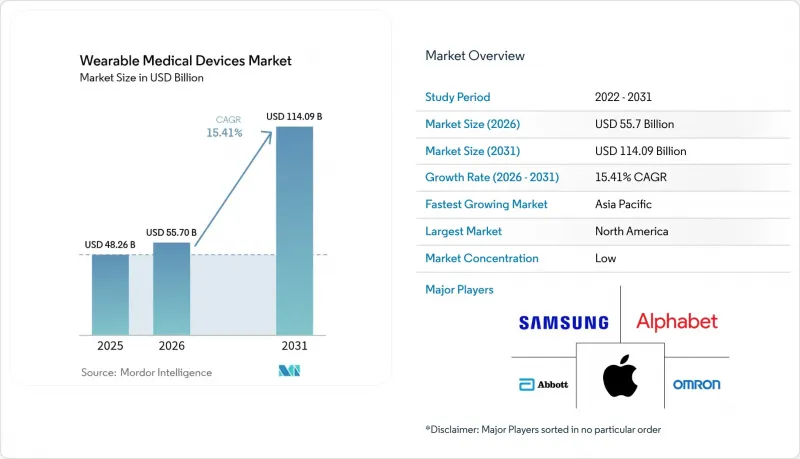
본 보고서는 기기 유형(진단·모니터링 기기(생체 신호 모니터링 기기 등) 및 기타), 연령대(18세 미만 및 기타), 판매 채널(온라인 및 오프라인), 용도(스포츠 및 피트니스 및 기타), 최종 사용자(소비자 및 기타),지역(북미, 유럽, 아시아태평양 및 기타)별로 분류되어 있습니다. 시장 예측은 금액(달러) 기준으로 제시되어 있습니다.
세계의 웨어러블 의료기기 시장 동향 및 인사이트
만성 질환 유병률 증가와 재택치료에 대한 수요
인구 고령화와 가치 기반 의료 보상 제도로 인해, 예기치 않은 입원을 줄이기 위한 지속적인 모니터링에 의존하는 만성 질환 관리 프로그램이 가속화되고 있습니다. 애보트(Abbott)사의 ‘프리스타일 리브레(Freestyle Libre)’와 같은 시판용 연속 혈당 모니터는 당뇨병 환자가 자가 관리를 할 수 있게 해주는 동시에, 임상의에게 실시간 동향 데이터를 제공합니다. 각국 정부는 24시간 체온 및 생체 신호 측정을 위해 검증된 바이오센서가 필요한 ‘재택 병원’ 모델을 추진하고 있으며, 이로 인해 웨어러블 의료기기 시장은 의료비 절감에 필수적인 요소가 되었습니다. 이상 징후에 대한 조기 경고를 통해 치료 성과가 향상되고 응급실 이용이 감소합니다. 고령 인구 증가율이 가장 높은 아시아태평양에서는 낙상 감지 패치와 심장 리듬 패치에 대한 수요가 활발합니다. 이러한 구조적 요인들이 예측되는 연평균 성장률(CAGR)을 장기적으로 약 3.5포인트 끌어올리는 기반이 되고 있습니다.
질환 특이적 모니터링을 위한 AI 탑재 바이오센서의 채택 확대
플렉서블 전자 기기에 통합된 AI 덕분에 웨어러블 기기는 범용 건강 추적기에서 FDA 승인 알고리즘을 사용하여 부정맥을 98%의 민감도로 감지할 수 있는 진단 플랫폼으로 진화하고 있습니다. Nanowear사의 ‘SimpleSense-BP’는 텍스타일 기판 위에서 수십 가지 바이오마커를 포착하여 임상 수준의 혈압 측정값을 제공합니다. 홍콩대학교가 개발한 엣지 컴퓨팅 설계는 데이터를 로컬에서 처리함으로써 개인정보를 보호하고 클라우드 지연 시간을 줄여줍니다. 머신러닝을 통해 광 플레티스모그래피(광맥파 측정법)가 정교화되어, SpO2 및 혈압 측정 정확도가 임상 수준에 근접한 수준에 도달했습니다. 예측 분석을 통해 증상이 나타나기 몇 시간 전에 병세 악화를 감지할 수 있어, 의료 패러다임이 ‘사후 대응형’에서 ‘예방적 접근’으로 전환되고 있습니다. 이러한 기능 덕분에 의사의 신뢰도가 높아지면서, 순환기내과 및 신경과 등 각 진료과에서의 도입이 촉진되고 있습니다.
사이버 보안 및 데이터 개인정보 보호 규정 준수 비용
의료 업계는 랜섬웨어의 표적이 되는 가장 빈번한 분야 중 하나이며, 이에 따라 규제 당국은 요건을 더욱 엄격하게 하고 있습니다. FDA는 현재 시판 전 신청 시 소프트웨어 BOM(부품 명세서) 공개와 수명 주기 전반에 걸친 패치 계획을 의무화하고 있으며, 복잡한 웨어러블 기기의 경우 개발 비용에 최대 100만 달러의 추가 지출이 발생합니다. EU의 GDPR(EU 개인정보보호규정) 규정에서는 명시적인 동의와 ‘잊혀질 권리’에 관한 프로토콜을 요구하고 있어, 공급업체들은 암호화, 키 관리, 감사 추적에 대한 투자를 강요받고 있습니다. 기술적으로 기동성이 뛰어난 소규모 혁신 기업들은 엔터프라이즈급 보안 기준을 충족하는 과정에서 종종 자금 면에서 제약을 겪습니다. 인증 지연은 상용화를 늦추고 경쟁 우위를 훼손할 가능성이 있습니다.
부문 분석
2025년 웨어러블 의료기기 시장 규모 중 진단·모니터링 기기가 63.15%를 차지했습니다. 이는 보험 적용 대상인 만성 질환 관리 경로를 충족하는 심박수, 혈압 및 연속 혈당 모니터의 보급에 힘입은 결과입니다. 이 부문이 주도적인 위치를 차지하고 있는 배경에는 센서 정밀도의 성숙과 광범위한 규제 당국의 승인이 있습니다. 심전도 패치는 여전히 심혈관 병동에서 선호되고 있으며, 야간용 맥박 산소 포화도 측정기 웨어러블 기기는 수면 무호흡증 선별 검사를 지원하고 있습니다. CMS(미국 의료보험서비스센터)가 보험 적용 범위를 확대함에 따라 폐쇄 루프 혈당 관리 시스템의 도입이 급속히 진행되어 내분비과 분야에서 지속적인 성장의 기반이 되고 있습니다.
치료용 웨어러블 기기는 현재 시장 규모는 작지만, 폼 팩터가 수동적인 패치에서 능동적인 약물 전달 기기 및 신경 조절 기기로 진화함에 따라 연평균 성장률(CAGR) 15.72%로 확대될 것으로 예측됩니다. AI 기반 운동 라이브러리를 탑재한 온열 요법 패드는 물리치료와 소비자 편의성의 융합을 구현하고 있습니다. Epiminder사의 ‘Minder’와 같은 이식형 뇌파(EEG) 모니터는 임상 현장 밖에서도 지속적인 발작 추적이 가능하게 하여, 시장이 중재적 치료로 전환되고 있음을 보여줍니다. 이러한 획기적인 발전은 알고리즘이 투여량이나 자극 강도를 실시간으로 개인화함으로써, 치료용 웨어러블 의료기기 시장 규모가 2031년까지 현저히 확대될 것임을 뒷받침하고 있습니다.
2025년에는 18세에서 60세 사이의 성인이 웨어러블 의료기기 시장 점유율의 61.02%를 차지했습니다. 이는 노동 인구에서 만성 질환 발병률 증가와 고용주의 건강 증진 인센티브에 힘입은 결과입니다. 이러한 기기는 라이프스타일에 대한 인사이트력과 FDA 승인 측정 지표를 모두 충족시켜, 예방 의료와 임상 모니터링의 요구를 모두 충족시키고 있습니다. 고령자들은 간단한 사용자 인터페이스와 천연 소재에 모션 센서가 내장된 낙상 감지 기능이 탑재된 스마트웨어를 환영하고 있으며, 기술에 익숙하지 않은 사용자들 사이에서도 치료 순응도가 향상되고 있습니다.
소아 분야에서의 보급 규모는 작지만, 연평균 성장률(CAGR)은 16.18%로 예측됩니다. 12세 이상 소아를 대상으로 한 비약물성 코막힘 치료 기기 ‘Sonu Band’가 FDA 승인을 획득한 것은 소아 특유의 디자인에 대한 규제 당국의 관용을 보여주는 좋은 사례입니다. 보호자들 사이에서는 스마트폰으로 알림을 전송하는 비침습형 생체 신호 측정 패치 키트가 호평을 받고 있으며, 이로 인해 의료기관 방문 횟수가 감소하고 있습니다. 게임과 같은 피드백과 다채로운 디자인이 젊은 사용자를 끌어들이고 있으며, 학교를 대상으로 한 원격의료 시범 사업도 초기 단계에서 성공을 거두고 있습니다. 이를 종합해 보면, 젊은 층에 초점을 맞춘 혁신을 통해 기존 의료 기술의 혜택이 충분히 미치지 못했던 분야에서 웨어러블 의료기기 시장 규모가 확대되고 있습니다.
지역별 분석
북미는 견실한 환급 체계와 상품화를 가속화하는 FDA의 간소화된 승인 절차 덕분에 2025년에는 전 세계 매출의 34.12%를 차지했습니다. CMS(미국 의료보험 및 의료서비스 센터)가 승인한 원격 환자 모니터링 코드의 도입으로, 병원들은 퇴원 시 인증된 센서를 배포하게 되었으며, 이는 1차 진료 네트워크 전반에 걸친 보급을 더욱 촉진하고 있습니다. 미국의 주요 기술 기업들은 타사 용도를 통해 기기의 기능을 강화하는 활기찬 개발자 생태계를 조성하고 있습니다. 캐나다에서는 각 주에서 원격 의료를 의무화함으로써 유사한 모델이 확대되고 있는 반면, 멕시코에서는 국경을 초월한 공급망을 활용하여 인증된 기기를 저렴한 비용으로 이용할 수 있게 하고 있습니다.
유럽은 환자의 신뢰를 높이는 GDPR(EU 개인정보보호규정)을 준수한 개인정보 보호를 기반으로 연평균 성장률(CAGR) 15.08%로 성장세를 유지하고 있습니다. 독일의 DiGA 프로그램에서는 심박 리듬 패치를 포함한 디지털 치료제에 대해 법정 보험을 통해 환급이 이루어지고 있습니다. 프랑스에서는 의료기기 주문을 자동화하는 전국적인 전자 처방전 서비스가 도입되었으며, 이탈리아에서는 노인 요양 시설에 낙상 감지 웨어러블 기기를 통합하기 위한 민관 협력 시범 사업이 진행되고 있습니다. 의료기기 규정(MDR)에 따른 시판 후 조사 의무화로 인해 공급업체의 설명 책임이 강화되면서, 웨어러블 의료기기 시장 전반에서 CE 마크가 부착된 제품의 평판이 향상되고 있습니다.
아시아태평양은 연평균 성장률(CAGR) 16.21%로 가장 빠르게 성장하는 지역이 될 것으로 예측됩니다. 중국의 의료기기 부문 전체는 2025년까지 2,100억 달러 규모에 달했으며, 현지 유력 기업들이 혈당 모니터 및 AI를 활용한 부정맥 패치에 대해 국가약품감독관리국(NMPA)의 승인을 획득했습니다. 일본 후생노동성의 지침에서는 스마트 워치에서 얻은 심전도 데이터를 초기 분류에 활용하는 것이 권장되고 있는 반면, 한국에서는 ‘바이오·헬스케어 2030’ 계획에 따라 스마트웨어 제조 공장에 대한 지원이 이루어지고 있습니다. 인도의 디지털 헬스 미션에서는 지방 진료소에 블루투스 지원 생체 신호 측정 기기 도입을 추진하여 접근성을 높이고 있습니다. 지역 수탁 제조업체들이 세계 브랜드에 제품을 공급하고 있으며, 웨어러블 의료기기 시장의 생산 규모와 비용 측면에서의 우위를 바탕으로 아시아태평양의 영향력을 강화하고 있습니다.
기타 혜택 :
- 엑셀 형식 시장 예측(ME) 시트
- 3개월간의 애널리스트 지원
자주 묻는 질문
목차
제1장 서론
제2장 조사 방법
제3장 주요 요약
제4장 시장 구도
제5장 시장 규모 및 성장 예측
제6장 경쟁 구도
제7장 시장 기회 및 향후 전망
KTH 26.09.10According to Mordor Intelligence, the wearable medical devices market size in 2026 is estimated at USD 55.7 billion, growing from 2025 value of USD 48.26 billion with 2031 projections showing USD 114.09 billion, growing at 15.41% CAGR over 2026-2031.
This report is Segmented by Device Type (Diagnostic & Monitoring Devices [Vital-Sign Monitoring Devices and More] and More), Age Group (Under 18 and More), Distribution Channel (Online and Offline), Application (Sports & Fitness and More), End-User (Consumers and More), and Geography (North America, Europe, Asia-Pacific, and More). The Market Forecasts are Provided in Terms of Value (USD).
Global Wearable Medical Devices Market Trends and Insights
Rising Prevalence of Chronic Diseases & Home-Healthcare Demand
Population aging and value-based care reimbursement accelerate chronic-disease programs that rely on continuous monitoring to reduce unplanned admissions. Commercial continuous glucose monitors such as Abbott's Freestyle Libre allow diabetes patients to self-manage while providing clinicians with real-time trend data. Governments promote "hospital-at-home" models that require validated biosensors for round-the-clock vitals, making the wearable medical devices market essential to cost containment. Early anomaly alerts improve therapeutic outcomes and lower emergency department utilization. Asia-Pacific, where the elderly population rises fastest, demonstrates strong demand for fall-detection and cardiac-rhythm patches. These structural forces underpin a long-run uplift of roughly 3.5 percentage points in projected CAGR.
Increasing Adoption of AI-Enabled Biosensors for Disease-Specific Monitoring
AI embedded in flexible electronics shifts wearables from generic wellness trackers to diagnostic platforms capable of 98% arrhythmia-detection sensitivity in FDA-cleared algorithms. Nanowear's SimpleSense-BP captures dozens of biomarkers on a textile substrate to deliver clinical-grade blood-pressure readings. Edge-computing designs from the University of Hong Kong process data locally, preserving privacy and cutting cloud latency. Machine learning refines photoplethysmography to near-clinical accuracy for SpO2 and blood pressure. Predictive analytics flag exacerbations hours before symptomatic onset, transitioning care paradigms from reactive to proactive. These capabilities raise physician confidence and spur procurement across cardiology and neurology units.
Cyber-Security & Data-Privacy Compliance Costs
Healthcare ranks among the most targeted sectors for ransomware, prompting regulators to tighten requirements. The FDA now mandates software bill-of-materials disclosures and lifecycle patch plans in pre-market submissions, adding as much as USD 1 million in extra development outlays for complex wearables. EU GDPR rules require explicit consent and right-to-forget protocols, forcing vendors to invest in encryption, key management, and audit trails. Smaller innovators, though technically agile, often encounter capital constraints when meeting enterprise-grade security benchmarks. Delays in certification can defer commercialization and erode competitive positioning.
Other drivers and restraints analyzed in the detailed report include:
- Growing Reimbursement for Remote Patient-Monitoring Programs
- Integration with Consumer-Tech Ecosystems Boosting User Engagement
- Fragmented Device-Data Standards Hindering Interoperability
For complete list of drivers and restraints, kindly check the Table Of Contents.
Segment Analysis
Diagnostic and monitoring devices accounted for 63.15% of the wearable medical devices market size in 2025, buoyed by widespread heart-rate, blood-pressure, and continuous glucose monitors that satisfy reimbursable chronic-care pathways. The segment's leadership reflects mature sensor accuracy and broad regulatory clearances. Vital-sign patches remain preferred in cardiology wards, while overnight oximetry wearables support sleep-apnea screening. Closed-loop glucose systems received strong uptake after CMS broadened coverage, anchoring continued growth across endocrinology departments.
Therapeutic wearables, although smaller today, are advancing at a projected 15.72% CAGR as form factors evolve from passive patches to active drug-delivery or neuromodulation devices. Heat-therapy pads equipped with AI-guided exercise libraries illustrate convergence between physiotherapy and consumer convenience. Implantable EEG monitors such as Epiminder's Minder extend continuous seizure tracking outside clinical settings, signalling the market's shift toward intervention. These breakthroughs underscore how the wearable medical devices market size for therapeutics will expand markedly through 2031 as algorithms personalize dosage or stimulus intensity in real time.
Adults aged 18-60 represented 61.02% of the wearable medical devices market share in 2025, driven by chronic-disease incidence in working populations and employer wellness incentives. Devices balance lifestyle insights with FDA-cleared metrics, satisfying both preventive health and clinical monitoring. Seniors embrace simplified user interfaces and fall-detection smart clothing that embed motion sensors in natural fabrics, boosting compliance among less tech-savvy users.
Pediatric adoption, though smaller, carries a 16.18% forecast CAGR. FDA clearance for the Sonu Band, a drug-free nasal-congestion therapy for children over 12, exemplifies regulatory openness to child-specific designs. Parents value non-invasive vitals patch kits that transmit alerts to smartphones, reducing clinic visits. Gaming-style feedback and colorful form factors entice younger users, while school tele-health pilots showcase early success. Taken together, youth-focused innovation enlarges the wearable medical devices market size in segments traditionally underserved by medical technology.
Complete Report Scope:
- By Device Type
- Diagnostic & Monitoring Devices
- Vital-sign Monitoring Devices
- Sleep-monitoring Devices
- Continuous-Glucose Monitors
- Blood-pressure Monitors
- Other Diagnostic & Monitoring Devices
- Therapeutic Devices
- Pain-management Devices
- Rehabilitation Devices
- Respiratory-therapy Devices
- Insulin-delivery Devices
- Other Therapeutic Devices
- Diagnostic & Monitoring Devices
- By Age Group
- Under 18
- 18 - 60
- Above 60
- By Distribution Channel
- Online
- Offline
- By Application
- Sports & Fitness
- Remote Patient Monitoring
- Home Healthcare
- By End-User
- Consumers
- Hospitals & Clinics
- Long-term Care Centres
- Ambulatory Surgical Centres
- Others
- By Geography
- North America
- United States
- Canada
- Mexico
- Europe
- Germany
- United Kingdom
- France
- Italy
- Spain
- Rest of Europe
- Asia-Pacific
- China
- India
- Japan
- Australia
- South Korea
- Rest of Asia-Pacific
- Middle East and Africa
- GCC
- South Africa
- Rest of Middle East and Africa
- South America
- Brazil
- Argentina
- Rest of South America
- North America
Geography Analysis
North America generated 34.12% of global revenue in 2025 owing to robust reimbursement frameworks and streamlined FDA pathways that hasten commercialization. Uptake of CMS-approved remote patient-monitoring codes encourages hospitals to distribute certified sensors at discharge, driving further penetration across primary-care networks. U.S. tech giants foster vibrant developer ecosystems that enrich device functionality with third-party applications. Canada scales similar models through provincial tele-health mandates, while Mexico leverages cross-border supply chains to make certified devices accessible at lower cost.
Europe maintains momentum with a 15.08% CAGR, anchored by GDPR-aligned privacy assurance that elevates patient trust. Germany's DiGA program reimburses digital therapeutics, including cardiac-rhythm patches, through statutory insurance. France adopts nationwide electronic prescription services that automate device ordering, and Italy pilots public-private partnerships to integrate fall-detection wearables in elderly-care homes. The Medical Device Regulation's post-market surveillance obligations heighten vendor accountability, elevating the reputation of CE-marked products across the wearable medical devices market.
Asia-Pacific is forecast to be the fastest-growing territory at 16.21% CAGR. China's broader medical-device sector is trending toward USD 210 billion by 2025 as local champions secure National Medical Products Administration clearance for glucose monitors and AI-aided arrhythmia patches. Japan's health-ministry guidance endorses smartwatch-derived ECG data for preliminary triage, while South Korea subsidizes smart-clothing factories under its Bio-Healthcare 2030 plan. India's digital-health mission promotes Bluetooth-enabled vitals devices in rural clinics, enhancing accessibility. Regional contract manufacturers supply global brands, reinforcing Asia-Pacific's influence on production scale and cost leadership within the wearable medical devices market.
- Abbott Laboratories
- AIQ Smart Clothing Inc.
- Alphabet Inc.
- Apple
- Biobeat Technologies Ltd.
- Dexcom
- Garmin
- Huawei Technologies
- imec
- Intelesens
- Koninklijke Philips
- Lifesense Group
- Masimo
- Medtronic
- MINTTI Health
- OMRON
- Resmed
- Samsung Group
- Withings SA
- Xiaomi Corporation
Additional Benefits:
- The market estimate (ME) sheet in Excel format
- 3 months of analyst support
TABLE OF CONTENTS
1 Introduction
- 1.1 Study Assumptions & Market Definition
- 1.2 Scope of the Study
2 Research Methodology
3 Executive Summary
4 Market Landscape
- 4.1 Market Overview
- 4.2 Market Drivers
- 4.2.1 Rising prevalence of chronic diseases & home-healthcare demand
- 4.2.2 Increasing adoption of AI-enabled biosensors for disease-specific monitoring
- 4.2.3 Growing reimbursement for remote patient-monitoring programs
- 4.2.4 Integration with consumer-tech ecosystems boosting user engagement
- 4.2.5 Miniaturization of battery technology lowering form-factor constraints
- 4.2.6 Regulatory fast-track pathways for digital therapeutics & connected devices
- 4.3 Market Restraints
- 4.3.1 Cyber-security & data-privacy compliance costs
- 4.3.2 Fragmented device-data standards hindering interoperability
- 4.3.3 Low physician trust in consumer-grade data accuracy
- 4.3.4 Battery-longevity and e-waste concerns
- 4.4 Supply Chain Analysis
- 4.5 Regulatory Landscape
- 4.6 Technological Outlook
- 4.7 Porter's Five Forces Analysis
- 4.7.1 Threat of New Entrants
- 4.7.2 Bargaining Power of Buyers/Consumers
- 4.7.3 Bargaining Power of Suppliers
- 4.7.4 Threat of Substitute Products
- 4.7.5 Intensity of Competitive Rivalry
5 Market Size & Growth Forecasts (Value)
- 5.1 By Device Type
- 5.1.1 Diagnostic & Monitoring Devices
- 5.1.1.1 Vital-sign Monitoring Devices
- 5.1.1.2 Sleep-monitoring Devices
- 5.1.1.3 Continuous-Glucose Monitors
- 5.1.1.4 Blood-pressure Monitors
- 5.1.1.5 Other Diagnostic & Monitoring Devices
- 5.1.2 Therapeutic Devices
- 5.1.2.1 Pain-management Devices
- 5.1.2.2 Rehabilitation Devices
- 5.1.2.3 Respiratory-therapy Devices
- 5.1.2.4 Insulin-delivery Devices
- 5.1.2.5 Other Therapeutic Devices
- 5.1.1 Diagnostic & Monitoring Devices
- 5.2 By Age Group
- 5.2.1 Under 18
- 5.2.2 18 - 60
- 5.2.3 Above 60
- 5.3 By Distribution Channel
- 5.3.1 Online
- 5.3.2 Offline
- 5.4 By Application
- 5.4.1 Sports & Fitness
- 5.4.2 Remote Patient Monitoring
- 5.4.3 Home Healthcare
- 5.5 By End-User
- 5.5.1 Consumers
- 5.5.2 Hospitals & Clinics
- 5.5.3 Long-term Care Centres
- 5.5.4 Ambulatory Surgical Centres
- 5.5.5 Others
- 5.6 By Geography
- 5.6.1 North America
- 5.6.1.1 United States
- 5.6.1.2 Canada
- 5.6.1.3 Mexico
- 5.6.2 Europe
- 5.6.2.1 Germany
- 5.6.2.2 United Kingdom
- 5.6.2.3 France
- 5.6.2.4 Italy
- 5.6.2.5 Spain
- 5.6.2.6 Rest of Europe
- 5.6.3 Asia-Pacific
- 5.6.3.1 China
- 5.6.3.2 India
- 5.6.3.3 Japan
- 5.6.3.4 Australia
- 5.6.3.5 South Korea
- 5.6.3.6 Rest of Asia-Pacific
- 5.6.4 Middle East and Africa
- 5.6.4.1 GCC
- 5.6.4.2 South Africa
- 5.6.4.3 Rest of Middle East and Africa
- 5.6.5 South America
- 5.6.5.1 Brazil
- 5.6.5.2 Argentina
- 5.6.5.3 Rest of South America
- 5.6.1 North America
6 Competitive Landscape
- 6.1 Market Concentration
- 6.2 Competitive Benchmarking
- 6.3 Market Share Analysis
- 6.4 Company Profiles (includes Global level Overview, Market level overview, Core Segments, Financials as available, Strategic Information, Market Rank/Share for key companies, Products & Services, and Recent Developments)
- 6.4.1 Abbott Laboratories
- 6.4.2 AIQ Smart Clothing Inc.
- 6.4.3 Alphabet Inc.
- 6.4.4 Apple Inc.
- 6.4.5 Biobeat Technologies Ltd.
- 6.4.6 Dexcom Inc.
- 6.4.7 Garmin Ltd.
- 6.4.8 Huawei Technologies Co., Ltd.
- 6.4.9 imec
- 6.4.10 Intelesens Ltd.
- 6.4.11 Koninklijke Philips N.V.
- 6.4.12 Lifesense Group
- 6.4.13 Masimo Corporation
- 6.4.14 Medtronic plc
- 6.4.15 MINTTI Health
- 6.4.16 Omron Corporation
- 6.4.17 ResMed Inc.
- 6.4.18 Samsung Electronics Co., Ltd.
- 6.4.19 Withings SA
- 6.4.20 Xiaomi Corporation
7 Market Opportunities & Future Outlook
- 7.1 White-space & Unmet-need Assessment