

|
시장보고서
상품코드
2099997
웨어러블 의료기기 소프트웨어 시장 : 시장 점유율 분석, 업계 동향 및 통계, 성장 예측(2026-2031년)Wearable Medical Device Software - Market Share Analysis, Industry Trends & Statistics, Growth Forecasts (2026 - 2031) |
||||||
 Mordor Intelligence
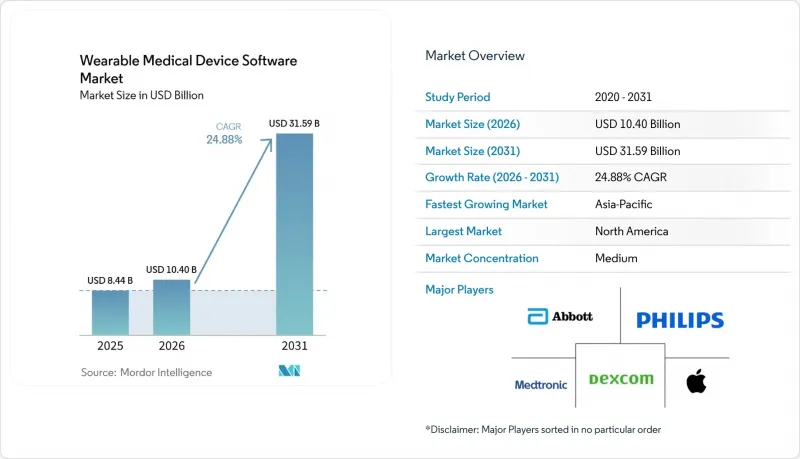
Mordor Intelligence에 의하면, 웨어러블 의료기기 소프트웨어 시장 규모는 2025년에 84억 4,000만 달러로 평가되었고, 2026년 104억 달러에서 2031년까지 315억 9,000만 달러에 이를 것으로 예측되며, 2026-2031년 CAGR 24.88%로 성장할 전망입니다.
본 보고서는 컴포넌트별(소프트웨어, 서비스), 기기 유형별(스마트 워치, 패치, 심전도 모니터, CGM 기기, 히어러블), 용도별(RPM, 만성 질환, 피트니스), 최종 사용자별(병원, 재택 간호, 일반 소비자), 도입 형태별(클라우드, 하이브리드, 온프레미스), 기능별(모니터링, CDS), 연결 방식별(블루투스, 하이브리드), 지역별(북미, 유럽, 아시아태평양, 중동 및 아프리카, 남미)로 분류되어 있습니다.
세계의 웨어러블 의료기기 소프트웨어 시장 동향 및 인사이트
원격 환자 모니터링에 대한 수요 증가가 의료 경제의 패러다임을 재정의하고 있습니다.
웨어러블 의료기기 소프트웨어 시장은 지속적인 모니터링으로 더욱 전환되고 있습니다. 이는 의료 제공업체가 시설 방문 시 수집되는 단편적인 측정값이 아닌, 지속적인 환자 상태 파악을 필요로 하기 때문입니다. 2025년에는 용도 부문의 27.6%를 원격 환자 모니터링이 차지할 것으로 예상되며, 이는 도입 대수가 이미 충분히 많아 일회성 기기 판매가 아닌 지속적인 소프트웨어 수익을 뒷받침하기에 충분한 규모에 도달했음을 보여줍니다. 이러한 변화가 중요한 이유는 치료 전 과정에 걸쳐 데이터 수집, 알림, 보고서 작성, 환자와의 소통을 관리하는 것은 소프트웨어 플랫폼인 반면, 기반이 되는 하드웨어의 차별화는 시간이 지남에 따라 점차 희미해지고 있기 때문입니다. 소비자의 웰니스 수요도 이러한 전환을 뒷받침하고 있지만, 보다 강력한 상업적 신호는 체계화된 임상 워크플로우 내에서 웨어러블 데이터를 활용하는 케어 프로그램에서 나오고 있습니다. 그 결과, 웨어러블 의료기기 소프트웨어 시장에서는 임상의나 환자에게 부담을 주지 않으면서 대규모의 지속적인 케어를 지원할 수 있는 벤더에 대한 평가가 높아지고 있습니다.
만성 질환 관리 프로그램의 확대가 소프트웨어 지출의 지속적인 증가를 견인
웨어러블 의료기기 소프트웨어 시장은 당뇨병, 만성 신장 질환, 심혈관 질환, 근골격계 통증 및 행동 건강에 대한 지속적인 모니터링에서 측정 가능한 가치를 발견하게 된 만성 질환 관리 프로그램의 혜택을 받고 있습니다. CMS ACCESS 모델은 2026년 7월 5일부터 메디케어 수급자 등록을 시작했으며, 이 지불 설계에서는 서비스 양이 아닌 환자의 치료 결과에 따라 상환이 이루어지기 때문에 의료 제공업체가 웨어러블 소프트웨어에 대한 투자를 평가하는 방식에 변화가 생기고 있습니다. 이러한 구조를 통해 소프트웨어는 의료 제공에서 더욱 중심적인 역할을 담당하게 될 것입니다. 왜냐하면 의료 시스템에는 상태 악화를 조기에 감지하고, 개입 시점을 도출하며, 시간 경과에 따른 환자의 경과를 기록할 수 있는 도구가 필요하기 때문입니다. 또한 만성 질환 관리 프로그램에서는 단기적인 사용 주기가 아닌 지속적인 참여, 안정적인 데이터 흐름, 그리고 엄격한 보고 체계가 요구되므로 장기적인 수요도 강화됩니다. 따라서 웨어러블 의료기기 소프트웨어 시장은 소프트웨어를 단순한 지원 도구가 아닌 임상 운영의 기반으로 자리매김하는 케어 모델로부터 혜택을 받게 될 것입니다.
경고 피로와 워크플로우 혼란이 임상 도입을 저해
웨어러블 의료기기 소프트웨어 시장은 여전히 ‘경고 피로’라는 심각한 도입 장벽에 직면해 있습니다. 특히, 임계값 기반 시스템이 가치가 낮은 알림을 과도하게 생성해 버리는 대규모 모니터링 프로그램에서 이 문제는 두드러집니다. 2026년에 실시된 NHS(영국 국민보건서비스)의 원격 환자 모니터링 도입에 관한 조사에 따르면, 위양성 알림 비율이 74%에서 99%에 달했으며, 이로 인해 시간이 지남에 따라 임상 현장의 감각 둔화와 대응 품질 저하를 초래했다고 보고되었습니다. 케어 팀이 합리적으로 분류할 수 있는 양을 초과하는 경보를 수신하면, 불필요한 모니터링 데이터는 가치를 창출하지 못할 뿐만 아니라 법적 및 운영상의 위험을 높일 수도 있습니다. 각 벤더사는 환자별 기준치나 확률 기반 점수 산정 방식을 도입하여 이에 대응하고 있지만, 의료 시스템 측은 어느 정도의 모델 리스크를 수용할지에 대해 여전히 판단을 내려야 하는 상황에 놓여 있습니다. 웨어러블 의료기기 소프트웨어 시장은 임상적으로 중요한 상태 악화 신호를 놓치지 않으면서 노이즈를 줄일 수 있는 소프트웨어가 등장할 때까지 대규모 도입에 있어 계속해서 저항에 직면할 것입니다.
부문 분석
2025년에는 소프트웨어가 이 부문의 78.2%를 차지한 것으로 평가되었으며, 이는 웨어러블 의료기기 소프트웨어 시장이 더 이상 하드웨어뿐만 아니라 용도, 분석, 미들웨어, 데이터 관리를 중심으로 구성되어 있음을 보여줍니다. 이러한 집중 경향은 가치 창출에 있어 광범위한 변화를 반영하고 있으며, 센서나 폼 팩터는 복제가 쉬워진 반면, 임상적 해석이나 워크플로우 통합은 여전히 상품화가 어려운 상태가 지속되고 있습니다. 많은 도입 사례에서 모바일 애플리케이션, 시각화 도구, 기기 관리 계층, 통합 소프트웨어, 데이터 플랫폼은 더 이상 개별적인 포인트 도구로 기능하지 않습니다. 대신 구매자들은 단일 환경에서 데이터를 수집·분석하고, 의료 시스템으로 전송하며, 환자 참여를 지원할 수 있는 통합 스택을 점점 더 선호하고 있습니다. 2025년, 웨어러블 의료기기 소프트웨어 시장에서 소프트웨어가 차지하는 비중은 78.2%로, 이 카테고리의 수익 구조가 더 이상 기기 교체 주기가 아니라 지속적인 디지털 기능에 크게 의존하고 있음을 여실히 보여줍니다.
서비스는 이 부문의 나머지 부분을 차지하고 있으며, 특히 기업의 도입 환경이 여러 EHR(전자건강기록) 및 케어 플랫폼에 걸쳐 있는 경우, 도입의 복잡성으로 인해 계속해서 혜택을 보고 있습니다. 임상 모니터링 프로그램의 경우, 연결 중단, 불안정한 보고서 작성, 진료팀 간 환자 기록의 미비 등이 용납될 수 없기 때문에 지원 및 유지보수는 여전히 중요한 역할을 수행하고 있습니다. 또한, 임상의에 의한 도입의 성패는 기술 그 자체뿐만 아니라 워크플로우 설계, 에스컬레이션 규칙, 명확한 사용자 책임 분담에 좌우되는 경우가 많기 때문에 교육 및 컨설팅도 계속해서 중요하게 여겨지고 있습니다. 웨어러블 의료기기 소프트웨어 업계에서 미들웨어 계층은 특히 중요합니다. 이는 의료 제공업체의 시스템에서 기존 디지털 기록에 통합될 수 있는 표준화된 데이터 교환이 점점 더 요구되고 있기 때문입니다. 2025년 2월 VitalConnect가 1억 달러의 자금을 조달한 것은 바이오센서, 분석 기능, 클라우드 전송을 결합한 소프트웨어 주도형 웨어러블 모니터링 플랫폼에 투자자들이 여전히 지속적인 수익 가능성을 보고 있음을 뒷받침합니다.
2025년 현재, 스마트 워치는 기기 유형별 부문의 31.2%를 차지했으며, 이러한 선두 위상은 대규모 보급 대수와 심전도(ECG), 혈중 산소 농도, 활동량 및 관련 모니터링 기능에 대한 임상 현장의 폭넓은 수용을 모두 반영하고 있습니다. 많은 사용자가 이미 기본적인 디지털 모니터링에 필요한 하드웨어를 보유하고 있기 때문에 이러한 보급 대수는 소프트웨어 공급업체에 광범위한 유통 채널을 제공합니다. 스마트 워치 소프트웨어는 새로운 기능이 소비자와 의료 제공업체 모두에게 동시에 수용될 경우 신속하게 확장될 수 있으므로, 웨어러블 의료기기 소프트웨어 시장은 이러한 추세로부터 계속해서 혜택을 받고 있습니다. 동시에 기기의 신뢰성도 중요하며, 단순한 건강 관리 추적이 아닌 임상적으로 의미 있는 결과를 제공하는 플랫폼이 유리합니다. 스마트 워치는 여전히 가장 큰 카테고리이지만, 지속적인 센서 데이터가 더 높은 임상적 관련성과 더 빈번한 개입을 뒷받침하는 분야에서 가장 강력한 성장이 나타나고 있습니다.
CGM 소프트웨어가 탑재된 기기는 2031년까지 연평균 성장률(CAGR) 26.2%를 나타낼 것으로 예측되며, 이러한 성장세는 데이터 수집, 알고리즘을 통한 해석, 그리고 치료 조치와의 연계가 더욱 강화되고 있음을 반영합니다. 2025년 8월 CE 마크를 획득하고 2025년 12월 FDA 승인을 받은 Diabeloop사의 DBLG2 시스템은 2026년 7월 독일에서 상용 판매가 시작되었으며, Kaleido의 사용자 데이터에 따르면 실제 사용 환경에서 ‘목표 범위 내 체류 시간(Time in Range)’ 이 77%를 초과한 것으로 보고되었습니다. 패치형 기기, 독립형 심전도 모니터, 스마트 밴드, 스마트웨어 및 히어러블은 특히 부정맥 감지, 부담 없는 착용, 전문적인 모니터링 분야에서 여전히 중요한 임상 틈새 시장을 차지하고 있습니다. 2025년 과학 문헌 또한 CGM 주도형 소프트웨어의 강점을 뒷받침하고 있는데, 이는 발표된 AI 탑재 웨어러블 당뇨병 연구의 70%가 주요 감지 기법으로 CGM에 의존했기 때문입니다. 실용적인 관점에서 볼 때, 웨어러블 의료기기 소프트웨어 시장에서는 단순히 측정값을 표시하는 것을 넘어, 소프트웨어가 의사 결정에 영향을 미칠 수 있는 범주로 기기의 주도권이 이동하고 있습니다.
2025년 기준, 원격 환자 모니터링(RPM)은 용도 부문의 27.6%를 차지했으며, 이는 웨어러블 의료기기 소프트웨어 시장에서 현재 가장 큰 이용 사례입니다. 이러한 위상은 불필요한 병원 방문을 줄이고, 진료소 밖에서도 경과 관찰을 가능하게 하며, 위험이 높아졌을 때 조기 대응을 지원할 수 있는 지속적인 저급성 모니터링에 대한 의료 제공업체의 명확한 수요를 반영합니다. 또한 RPM은 이 카테고리의 ‘소프트웨어 우선(software-first)’ 구조에도 잘 부합합니다. 그 가치는 단순히 기기 소유뿐만 아니라 데이터 수집, 알림, 대시보드 및 커뮤니케이션 워크플로우에 의존하기 때문입니다. 2025년, 원격 환자 모니터링은 웨어러블 의료기기 소프트웨어 시장의 27.6%를 차지했으며, 도입의 가장 견고한 기반이 여전히 조직적인 의료 제공과 연결되어 있음이 확인되었습니다. 피트니스 및 웰니스 모니터링도 여전히 상당한 규모를 창출하고 있지만, 그 성과가 검증된 치료 경로나 보험 적용 프로그램과 연계되지 않는다면 임상 분야에서의 수익화 범위는 제한적입니다.
만성 질환 관리는 2031년까지 연평균 성장률(CAGR) 26.1%를 나타낼 것으로 예측되며, 이러한 성장세는 반복적인 측정이 장기적인 치료 계획에 직접적인 영향을 미치는 질환과 밀접하게 연관되어 있습니다. CMS의 ACCESS 모델은 당뇨병, 만성 신장 질환, 심혈관 질환, 근골격계 통증 및 행동 건강을 대상으로 하며, 이는 웨어러블 소프트웨어가 장기적으로 치료 결과에 영향을 미칠 수 있는 환자 여정과 밀접하게 일치합니다. 또한, 의료 시스템이 퇴원 후 재입원을 줄이려는 가운데, 급성기 이후의 케어 모니터링도 주목을 받고 있으며, 복약 순응도 및 수면·스트레스 추적은 행동 의학 현장에서 더 폭넓은 의미를 부여받고 있습니다. AI를 활용한 혈당 예측은 여기에 추가적인 부가가치를 제공합니다. 예측 모델을 통해 소프트웨어가 사후적인 기록에서 미래를 내다보는 개입으로 전환할 수 있기 때문입니다. 따라서 웨어러블 의료기기 소프트웨어 시장에서 모니터링이 단순한 데이터 서비스가 아닌 장기적인 케어 모델의 일부가 되는 분야에서 가장 강력한 용도 성장이 나타나고 있습니다.
지역별 분석
2025년, 북미는 지역별 부문의 39.1%를 차지했으며, 웨어러블 의료기기 소프트웨어 시장에서 가장 규모가 큰 지역 블록이 되었습니다. 미국이 이러한 위치를 주도하고 있는 것은 대규모 보험사 기반, 체계화된 디지털 헬스 분야의 보상 경로, 그리고 원격 모니터링에 대한 의료 제공업체의 폭넓은 수용성이 결합되어 있기 때문입니다. CMS의 ACCESS 모델은 웨어러블 모니터링의 이용 사례와 밀접하게 연계된 만성 질환 관리 분야에서 지불을 치료 성과와 연계함으로써 이러한 환경을 더욱 강화하고 있습니다. 캐나다와 멕시코의 기여도는 여전히 미미하지만, 디지털 케어 기능이 확대됨에 따라 두 국가 모두 병원 기반의 원격 모니터링 도입을 지속적으로 확대되고 있습니다. 2025년, 북미는 웨어러블 의료기기 소프트웨어 시장 규모의 39.1%를 차지하고 있으며, 이러한 규모 덕분에 벤더들은 기업 대상 계약과 사용자 직접 구독 모델 간의 균형을 맞출 여지가 생기고 있습니다.
유럽은 웨어러블 의료기기 소프트웨어 시장에서 지역별 2위를 차지하고 있으며, 독일, 영국, 프랑스가 주요 시장으로 부상하고 있습니다. 독일이 두드러지는 이유는 DiGA(디지털 헬스케어법)의 틀을 통해 디지털 헬스 용도이 보험 적용 대상이 되기까지의 절차가 신속화되어, 상업적 실험과 소프트웨어 보급이 촉진되고 있기 때문입니다. Diabeloop사가 2026년 7월 독일에서 DBLG2 시스템을 상용화한 사례는 임상 데이터가 충실할 경우 규제 준수와 상용화가 어떻게 상호 보완할 수 있는지를 보여줍니다. 영국에서는 신뢰 수준에 기반한 원격 모니터링 프로그램의 확대가 계속되고 있지만, NHS(국민보건서비스) 도입 과정에서 보고된 높은 위양성 경보율은 소프트웨어의 품질이 여전히 조달 결정에 큰 영향을 미치고 있음을 보여줍니다. 유럽 전역에서 기밀성이 높은 건강 데이터에 관한 GDPR(EU 개인정보보호규정)(일반 데이터 보호 규정) 의무는 클라우드 설계, 동의 처리 및 국경을 초월한 운영 모델에 계속해서 영향을 미치고 있습니다.
아시아태평양은 2031년까지 연평균 성장률(CAGR) 26.2%를 나타낼 것으로 예측되며, 웨어러블 의료기기 소프트웨어 시장에서 가장 빠르게 성장하는 지역 부문으로 자리매김하고 있습니다. 이러한 성장은 만성 질환의 큰 부담, 디지털 헬스 투자 확대, 그리고 주요 시장에서 의료 현대화를 위한 정부의 참여 강화에 힘입고 있습니다. 일본에서는 바이오센서 연동 제품에 대한 소프트웨어 검증 요건이 엄격해지는 반면, 한국에서는 디지털 헬스 인프라가 확충되고 있으며, 중국에서는 국제적인 벤더들에게 현지 상황에 더 부합하는 전략의 채택이 요구되고 있습니다. GCC 국가들이 주도하는 중동 및 아프리카과 브라질, 아르헨티나가 주도하는 남미 지역은 여전히 도입이 민간 의료 및 프리미엄 소비자 대상 채널에 집중되어 있는 초기 단계의 지역이지만, 연결성 확대와 웨어러블 하드웨어 가격 하락에 따라 두 지역 모두 혜택을 볼 수 있는 위치에 있습니다.
기타 혜택 :
- 엑셀 형식 시장 예측(ME) 시트
- 3개월간의 애널리스트 지원
자주 묻는 질문
목차
제1장 서론
제2장 조사 방법
제3장 주요 요약
제4장 시장 구도
제5장 시장 규모 및 성장 예측
제6장 경쟁 구도
제7장 시장 기회 및 향후 전망
AJY 26.08.07According to Mordor Intelligence, the wearable medical device software market size is projected to be USD 8.44 billion in 2025, USD 10.40 billion in 2026, and reach USD 31.59 billion by 2031, growing at a CAGR of 24.88% from 2026 to 2031.
This report is Segmented by Component (Software, Services), Device Type (Smartwatches, Patches, ECG Monitors, CGM Devices, Hearables), Application (RPM, Chronic Disease, Fitness), End User (Hospitals, Home Care, Consumers), Deployment (Cloud, Hybrid, On-Prem), Functionality (Monitoring, CDS), Connectivity (Bluetooth, Hybrid), and Geography (North America, Europe, APAC, MEA, South America).
Global Wearable Medical Device Software Market Trends and Insights
Rising Demand For Remote Patient Monitoring Redefines Care Economics
The wearable medical device software market is moving further toward continuous monitoring, because providers now need ongoing patient visibility instead of isolated readings collected during facility visits. Remote patient monitoring accounted for 27.6% of the application segment in 2025, which shows that the installed base is already large enough to support recurring software revenue rather than one-time device sales. This shift matters because software platforms manage data capture, alerts, reporting, and patient communication across episodes of care, while the underlying hardware is becoming less differentiated over time. Consumer wellness demand is also feeding this transition, but the stronger commercial signal comes from care programs that use wearable data inside structured clinical workflows. As a result, the wearable medical device software market is increasingly rewarding vendors that can support continuous care at scale without adding friction for clinicians or patients.
Expansion Of Chronic Disease Management Programs Drives Sustained Software Spend
The wearable medical device software market is benefiting from chronic disease programs that now place measurable value on continuous monitoring for diabetes, chronic kidney disease, cardiovascular disease, musculoskeletal pain, and behavioral health. The CMS ACCESS Model began enrolling Medicare beneficiaries on July 5, 2026, and its payment design ties reimbursement to patient outcomes rather than service volume, which changes how providers evaluate wearable software investments. That structure makes software more central to care delivery, because health systems need tools that can surface deterioration early, guide intervention timing, and document patient progress over time. It also strengthens long-term demand, since chronic disease programs require ongoing engagement, stable data flows, and strong reporting discipline rather than short usage cycles. The wearable medical device software market therefore stands to gain from care models that treat software as a clinical operating layer instead of a support tool.
Alert Fatigue And Workflow Disruption Constrain Clinical Adoption
The wearable medical device software market still faces a serious adoption barrier in the form of alert fatigue, especially in high-volume monitoring programs where threshold-based systems generate too many low-value notifications. A 2026 study of NHS remote patient monitoring deployments reported false positive alert rates of 74% to 99%, which contributed to clinical desensitization and weaker response quality over time. When care teams receive more alerts than they can reasonably triage, extra monitoring data stops creating value and can even raise legal and operational risk. Vendors are responding by introducing patient-specific baselines and probability-based scoring, but health systems still have to decide how much model risk they are willing to accept. The wearable medical device software market will keep facing resistance in large deployments until software can reduce noise without missing clinically important deterioration signals.
Other drivers and restraints analyzed in the detailed report include:
- Integration Of AI-Enabled Alerting And Risk Scoring Unlocks Clinical Utility
- Growth In Reimbursement And Value-Based Care Adoption Accelerates Market Entry
- Data Privacy, Security, And Consent Compliance Burden Introduces Structural Cost
For complete list of drivers and restraints, kindly check the Table Of Contents.
Segment Analysis
Software accounted for 78.2% of the segment in 2025, which shows that the wearable medical device software market is already centered on applications, analytics, middleware, and data management rather than on hardware alone. This concentration reflects a broad shift in value capture, where sensors and form factors are becoming easier to replicate but clinical interpretation and workflow integration remain harder to commoditize. Mobile applications, visualization tools, device management layers, integration software, and data platforms are no longer acting as separate point tools in many deployments. Instead, buyers increasingly prefer integrated stacks that can collect data, analyze it, route it into care systems, and support patient engagement from a single environment. Software held 78.2% of the wearable medical device software market share in 2025, which underlines how much of the category's economics now depend on recurring digital functionality rather than device replacement cycles.
Services made up the remaining portion of the segment and continue to benefit from implementation complexity, especially when enterprise deployments span more than one EHR or care platform. Support and maintenance remain relevant because clinical monitoring programs cannot tolerate interrupted connectivity, unstable reporting, or incomplete patient records across care teams. Training and consulting also remain important, since clinician adoption often depends on workflow design, escalation rules, and clear user responsibilities rather than technology alone. The middleware layer is especially important in the wearable medical device software industry because provider systems increasingly expect standardized data exchange that can fit into existing digital records. VitalConnect's USD 100 million financing in February 2025 reinforced that investors still see durable revenue potential in software-led wearable monitoring platforms that combine biosensors, analytics, and cloud delivery.
Smartwatches held 31.2% of the device type segment in 2025, and their lead reflects both a large installed base and wider clinical acceptance for ECG, blood oxygen, activity, and related monitoring functions. That installed base gives software vendors a broad distribution channel, because many users already carry the hardware needed for basic digital monitoring. The wearable medical device software market continues to benefit from this dynamic because smartwatch software can scale quickly when new features are accepted by consumers and providers at the same time. At the same time, device credibility matters, and that favors platforms with clinically meaningful outputs rather than simple wellness tracking. Smartwatches remain the largest category, but the strongest expansion is occurring where continuous sensor data supports higher clinical relevance and more frequent intervention.
CGM software-enabled devices are projected to grow at a 26.2% CAGR through 2031, and that pace reflects stronger links between data capture, algorithmic interpretation, and treatment action. Diabeloop's DBLG2 system, which received CE marking in August 2025 and FDA clearance in December 2025, launched commercially in Germany in July 2026 and reported real-world Time in Range above 77% in Kaleido user data. Patches, standalone ECG monitors, smart bands, smart clothing, and hearables still serve important clinical niches, particularly in arrhythmia detection, low-burden wear, and specialty monitoring. The 2025 scientific literature also supports the strength of CGM-led software, since 70% of published AI wearable diabetes studies relied on CGM as the primary sensing modality. In practical terms, the wearable medical device software market is seeing device leadership shift toward categories where software can influence decisions, not just display readings.
Remote patient monitoring accounted for 27.6% of the application segment in 2025, which makes it the largest current use case in the wearable medical device software market. That position reflects clear provider demand for continuous low-acuity monitoring that can reduce unnecessary hospital visits, extend oversight beyond clinics, and support earlier escalation when risk rises. RPM also fits well with the software-first structure of the category, because value depends on data capture, alerts, dashboards, and communication workflows rather than only on device ownership. Remote patient monitoring accounted for 27.6% of wearable medical device software market share in 2025, which confirms that the strongest base of adoption remains tied to organized care delivery. Fitness and wellness monitoring still generates meaningful volume, but clinical monetization remains narrower when outputs do not connect to validated care pathways or reimbursable programs.
Chronic disease management is forecast to grow at a 26.1% CAGR through 2031, and that strength is closely tied to conditions where repeated measurements directly influence long-term care plans. The CMS ACCESS Model covers diabetes, chronic kidney disease, cardiovascular disease, musculoskeletal pain, and behavioral health, which aligns closely with the kinds of patient journeys where wearable software can influence outcomes over time. Post-acute care monitoring is also gaining traction as health systems try to reduce readmissions after discharge, while medication adherence and sleep or stress tracking are finding broader relevance in behavioral health settings. AI-enabled glucose forecasting adds another layer of value here, because predictive models can move software from retrospective logging toward prospective intervention. The wearable medical device software market therefore shows its strongest application growth where monitoring becomes part of a longitudinal care model rather than a standalone data service.
Complete Report Scope:
- By Component
- Hardware
- Software
- Services
- By Deployment Mode
- Conventional AI-Enhanced CT
- Spectral CT
- Photon-Counting CT
- Interventional CT
- By Application
- Oncology Diagnosis and Staging
- Tumor Monitoring and Treatment Response
- Radiation Therapy Planning Support
- Research and Clinical Trials
- By End User
- Hospitals
- Diagnostic Imaging Centers
- Cancer Treatment Centers
- Academic and Research Institutes
- By Geography
- North America
- United States
- Canada
- Mexico
- Europe
- Germany
- United Kingdom
- France
- Italy
- Spain
- Asia-Pacific
- China
- India
- Japan
- South Korea
- Australia
- Rest of Asia-Pacific
- Middle East & Africa
- GCC
- South Africa
- Rest of Middle East and Africa
- South America
- Brazil
- Argentina
- Rest of South America
- North America
Geography Analysis
North America held 39.1% of the geographic segment in 2025, which made it the largest regional block in the wearable medical device software market. The United States anchors that position because it combines large payer capacity, structured digital health reimbursement pathways, and broad provider readiness for remote monitoring. The CMS ACCESS Model has strengthened this environment by tying payment to outcomes in chronic care categories that align closely with wearable monitoring use cases. Canada and Mexico remain smaller contributors, but both continue to expand hospital-based remote monitoring adoption as digital care capabilities widen. North America represented 39.1% of the wearable medical device software market size in 2025, and that scale gives vendors room to balance enterprise contracts with direct user subscription models.
Europe holds the second-largest regional position in the wearable medical device software market, with Germany, the United Kingdom, and France acting as the primary country markets. Germany stands out because the DiGA pathway offers a faster route for digital health applications to reach reimbursable use, which supports commercial experimentation and software uptake. Diabeloop's July 2026 commercial launch of the DBLG2 system in Germany illustrates how regulatory compliance and commercialization can reinforce one another when clinical data is strong. The United Kingdom continues to expand trust-level remote monitoring programs, but the high false positive alert rates reported in NHS deployments show that software quality still shapes procurement choices. Across Europe, GDPR obligations for sensitive health data continue to influence cloud design, consent handling, and cross-border operating models.
Asia Pacific is projected to grow at a 26.2% CAGR through 2031, which makes it the fastest-growing regional segment in the wearable medical device software market. Growth is being supported by a large chronic disease burden, rising digital health investment, and stronger government involvement in healthcare modernization across major markets. Japan is tightening expectations around software validation for biosensor-linked products, while South Korea is expanding digital health infrastructure and China is pushing international vendors toward more localized strategies. The Middle East and Africa, led by GCC countries, and South America, led by Brazil and Argentina, remain earlier-stage regions where adoption is more concentrated in private healthcare and premium consumer channels, but both are positioned to benefit as connectivity expands and wearable hardware becomes more affordable.
- Alphabet Inc. (Google Health / DeepMind)
- Microsoft
- NVIDIA
- Siemens Healthineers
- GE HealthCare Technologies Inc.
- Koninklijke Philips
- Roche
- Tempus AI, Inc.
- Aidoc Medical Ltd.
- Qure.ai Technologies Private Limited
- Heartflow
- PathAI, Inc.
- Paige.AI, Inc.
- Ada Health GmbH
- AliveCor
- Butterfly Network, Inc.
- Digital Diagnostics
- Lunit
- Ibex Medical Analytics Ltd.
Additional Benefits:
- The market estimate (ME) sheet in Excel format
- 3 months of analyst support
TABLE OF CONTENTS
1 Introduction
- 1.1 Study Assumptions & Market Definition
- 1.2 Scope of the Study
2 Research Methodology
3 Executive Summary
4 Market Landscape
- 4.1 Market Overview
- 4.2 Market Drivers
- 4.2.1 Rising Oncology Imaging Demand
- 4.2.2 AI Assisted Protocol Optimization
- 4.2.3 Photon Counting and Spectral Precision Gains
- 4.2.4 Radiation Dose Reduction Pressure
- 4.2.5 Oncology Workflow Automation and Triage
- 4.2.6 Reimbursement Support for Quantitative Imaging
- 4.3 Market Restraints
- 4.3.1 High Capital Cost of Premium CT Platforms
- 4.3.2 Integration Burden Across PACS, RIS, and EHR Environments
- 4.3.3 Clinical Validation and Regulatory Friction for AI Features
- 4.3.4 Cybersecurity and Data Governance Concerns
- 4.4 Value / Supply-Chain Analysis
- 4.5 Regulatory Landscape
- 4.6 Technological Outlook
- 4.7 Porters Five Forces
5 Market Size & Growth Forecasts
- 5.1 By Component
- 5.1.1 Hardware
- 5.1.2 Software
- 5.1.3 Services
- 5.2 By Deployment Mode
- 5.2.1 Conventional AI-Enhanced CT
- 5.2.2 Spectral CT
- 5.2.3 Photon-Counting CT
- 5.2.4 Interventional CT
- 5.3 By Application
- 5.3.1 Oncology Diagnosis and Staging
- 5.3.2 Tumor Monitoring and Treatment Response
- 5.3.3 Radiation Therapy Planning Support
- 5.3.4 Research and Clinical Trials
- 5.4 By End User
- 5.4.1 Hospitals
- 5.4.2 Diagnostic Imaging Centers
- 5.4.3 Cancer Treatment Centers
- 5.4.4 Academic and Research Institutes
- 5.5 By Geography
- 5.5.1 North America
- 5.5.1.1 United States
- 5.5.1.2 Canada
- 5.5.1.3 Mexico
- 5.5.2 Europe
- 5.5.2.1 Germany
- 5.5.2.2 United Kingdom
- 5.5.2.3 France
- 5.5.2.4 Italy
- 5.5.2.5 Spain
- 5.5.3 Asia-Pacific
- 5.5.3.1 China
- 5.5.3.2 India
- 5.5.3.3 Japan
- 5.5.3.4 South Korea
- 5.5.3.5 Australia
- 5.5.3.6 Rest of Asia-Pacific
- 5.5.4 Middle East & Africa
- 5.5.4.1 GCC
- 5.5.4.2 South Africa
- 5.5.4.3 Rest of Middle East and Africa
- 5.5.5 South America
- 5.5.5.1 Brazil
- 5.5.5.2 Argentina
- 5.5.5.3 Rest of South America
- 5.5.1 North America
6 Competitive Landscape
- 6.1 Market Concentration
- 6.2 Market Share Analysis
- 6.3 Company Profiles
- 6.3.1 Alphabet Inc. (Google Health / DeepMind)
- 6.3.2 Microsoft Corporation
- 6.3.3 NVIDIA Corporation
- 6.3.4 Siemens Healthineers AG
- 6.3.5 GE HealthCare Technologies Inc.
- 6.3.6 Koninklijke Philips N.V.
- 6.3.7 F. Hoffmann-La Roche Ltd
- 6.3.8 Tempus AI, Inc.
- 6.3.9 Aidoc Medical Ltd.
- 6.3.10 Qure.ai Technologies Private Limited
- 6.3.11 Heartflow, Inc.
- 6.3.12 PathAI, Inc.
- 6.3.13 Paige.AI, Inc.
- 6.3.14 Ada Health GmbH
- 6.3.15 AliveCor, Inc.
- 6.3.16 Butterfly Network, Inc.
- 6.3.17 Digital Diagnostics, Inc.
- 6.3.18 Lunit Inc.
- 6.3.19 Ibex Medical Analytics Ltd.
7 Market Opportunities & Future Outlook
- 7.1 White Space and Unmet Need Assessment


