

|
시장보고서
상품코드
2120479
발 및 발목용 기기 : 시장 점유율 분석, 업계 동향 및 통계, 성장 예측(2026-2031년)Foot And Ankle Devices - Market Share Analysis, Industry Trends & Statistics, Growth Forecasts (2026 - 2031) |
||||||
 Mordor Intelligence
Mordor Intelligence에 의하면, 발 및 발목용 기기 시장 규모는 2025년 54억 8,000만 달러로 평가되었습니다. 2026년에는 54억 8,000만 달러로 답보 상태로 추이해, 2026-2031년에 걸쳐 CAGR 7.09%로 확대되어 2031년에는 82억 7,000만 달러에 이를 것으로 예측됩니다.
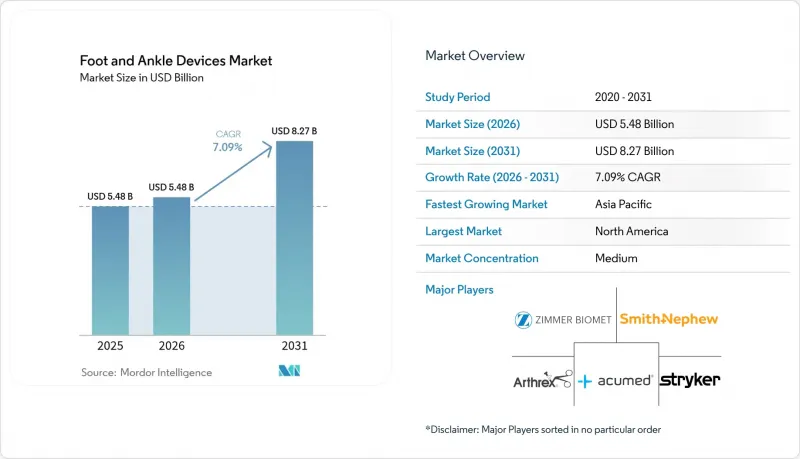
본 보고서는 제품 유형별(정형외과용 고정 기구, 기타),용도별(외상·골절, 기타), 최종 사용자별(병원, 외래수술센터(ASC), 전문 정형외과·족병 클리닉, 재활센터), 지역별(북미, 유럽, 아시아태평양, 중동 및 아프리카, 남미)로 분류되어 있습니다. 시장 예측은 금액(미 달러) 기준으로 제시되어 있습니다.
세계의 발 및 발목용 기기 시장 동향 및 인사이트
외상 및 퇴행성 질환으로 인한 수술 건수 증가
외상과 퇴행성 질환은 합쳐서 전체 의료기기 수요의 절반 이상을 차지하며, 골절 치료만으로도 2025년 적용 사례의 36.8%를 차지했습니다. 자동차 사고, 스포츠 부상, 산업 재해는 젊은 성인층의 고에너지성 발목 골절을 증가시키고 있는 반면, 골다공증을 앓으면서 장수하는 고령자의 경우 뼈가 약해져 골절률이 상승하고 있습니다. 외과의사들은 조기 체중 부하와 신속한 재활을 가능하게 하는 저침습 고정법, 잠금 플레이트, 재수술이 용이한 나사를 점점 더 선호하는 추세입니다. 2025년 레지스트리 데이터에 따르면, 해부학적 플레이트는 기존 고정법과 비교하여 정렬을 개선하고 불유합률을 낮추는 것으로 확인되었습니다. Zimmer Biomet의 ‘Gorilla Pilon Fusion Plating System’과 같은 신제품의 출시는 기업들이 분쇄 골절이나 관절 고정술의 요구 사항에 맞추어 임플란트 형태를 얼마나 정교하게 발전시키고 있는지를 보여줍니다. 관절 보존 치료의 선택지가 꾸준히 늘어나면서 말기 단계의 관절 고정술 시행이 미뤄지고, 장기적인 수술 수요가 확대되고 있습니다.
임플란트 재료 및 디지털 외과 분야의 기술 발전
환자 개개인에 맞춘 임플란트에 대한 규제가 명확해짐에 따라, 환자의 뼈 윤곽을 충실히 재현한 3D 프린팅 방식의 티타늄 및 코발트-크롬 구조물의 채택이 가속화되고 있습니다. 다공성 격자 구조는 골유합을 촉진하고, 일회용 가이드는 수술 시간을 몇 분 단축시킵니다. 2024년에 Paragon 28사의 ‘APEX 3D Total Ankle System’이 승인된 것은 중소규모 기업이 적층 가공 기술을 얼마나 신속하게 상용 제품으로 전환할 수 있는지를 입증한 사례였습니다. 디지털 플랫폼은 외과의사의 시야에 내비게이션 가이드를 중첩시킵니다. 존슨앤드존슨의 ‘VOLT mini’ 플레이트 시스템은 증강현실(AR) 헤드셋과 연동되어 나사 삽입 경로를 최적화합니다. Canary Medical의 ‘Canturio TE’와 같은 센서 탑재 임플란트는 실시간 하중 데이터를 클라우드 대시보드로 전송하여 원격 재활 및 이완에 대한 조기 경고를 지원합니다. 표준화 기관, 특히 ASTM F3001은 미세 다공성을 감지하고 피로 파손을 방지하기 위한 비파괴 검사 절차를 현재 수립 중입니다.
신흥 시장의 고액 치료비 및 제한된 보험 환급
남아시아, 아프리카, 라틴아메리카 일부 지역에서는 1인당 의료비가 600달러 미만이기 때문에 여전히 본인 부담이 주를 이루고 있습니다. 발목 관절 전치환술용 임플란트 한 세트는 시설비와 외과 의사의 보수를 제외하더라도 8,000달러를 초과하는 경우가 있어, 대부분의 가구에게 수술은 감당하기 어려운 비용입니다. 인도의 ‘아유슈만 바라트’ 제도에서는 고액 의료비 보상이 이루어지고 있지만, 임플란트 가격에 상한선이 설정되어 있어 많은 환자가 기본적인 스테인리스 시스템으로 전환할 수밖에 없거나 수술 자체를 포기하고 있습니다. 일부 신흥 경제국에서는 민간 보험 보급률이 5% 이하이기 때문에 고급 인공 관절이나 디지털 수술 기구의 보급이 둔화되고 있습니다. 단계적인 제품 라인업은 공급업체가 비용 압박에 대처하는 데 도움이 되지만, 가격 책정이 하위 세분화되어 있어 수요 예측 및 재고 관리가 복잡해지고 있습니다.
부문별 분석
의족은 2026년 초 매출의 32.9%를 차지했으며, 2031년까지 연평균 성장률(CAGR) 9.5%를 나타낼 것으로 전망되어 발 및 발목용 기기 시장에서 가장 큰 성장 동력이 될 것으로 보입니다. Ossur가 2024년에 출시한 ‘Proprio Foot’과 같은 고급 마이크로프로세서 탑재 발목 의족은 관절 각도를 실시간으로 조정하여 대사 비용을 최대 15% 절감할 뿐만 아니라, 보상성 고관절 진자 운동 없이도 계단을 오르내릴 수 있게 해줍니다. 정형외과용 재건 임플란트는 32.5%의 점유율을 차지하고 있지만, 10년 생존율이 고관절이나 무릎 관절용 동종 제품에 비해 여전히 약 80% 낮다는 점 때문에 외과의들 사이에서 논란이 제기되고 있어 그 성장은 둔화되고 있습니다. 고정용 하드웨어는 복잡한 골절에서 여전히 필수적이며, 가변 각도 플레이트와 경피적 나사는 연조직에 가해지는 부담을 줄여주는 수술법을 가능하게 하여 재활의 조기화를 돕고 있습니다. 발 및 발목용 고정 솔루션 시장 규모는 연평균 성장률(CAGR) 6.2%를 기록하며, 2031년까지 27억 달러에 달할 것으로 예측됩니다. 인대 복구 및 연골 보존에 대한 수요가 증가함에 따라, 보조기, 서포터, 바이오 스캐폴드는 규모는 작지만 성장세가 두드러지는 틈새 시장이 되고 있습니다.
모든 하위 카테고리에서 환자 맞춤형 임플란트로의 전환이 진행되고 있습니다. 전자빔 용융법이나 레이저 분말 베드 용융법을 통해 기계 가공으로는 실현할 수 없는 다공성 형태가 형성되어 골유합이 촉진될 뿐만 아니라, 재건된 관절 전체에 하중이 더 고르게 분산됩니다. 규제 당국의 승인도 확대되고 있으며, FDA는 2025년 한 해 동안만 5개의 환자 맞춤형 발목 임플란트를 승인했습니다. 이는 2023년 승인 건수의 2배에 해당합니다. 현재 각 공급업체들은 QR 코드가 포함된 멸균 기록이 첨부된 일회용 커팅 가이드를 출하하고 있으며, 재처리 부담을 줄여주는 일회용 기구를 선호하는 외래수술센터(ASC)의 요구에 부응하고 있습니다.
지역별 분석
2025년 매출의 43.2%를 북미가 차지했는데, 이는 메디케어의 외래 수술로의 전환과 환자 맞춤형 임플란트의 급속한 보급이 주도했습니다. 2024년에 발표된 FDA 지침에 따라 적층 가공용 파일의 요건이 명확해졌으며, 수술 시간을 20% 단축하는 복잡한 후족부 케이지의 승인이 가속화되었습니다. 미국의 민간 보험사들은 CMS의 동향을 따르며, 2026년 보험 계약에서 발목 관절 치환술에 대한 외래수술센터(ASC)의 보험 적용 범위를 확대했습니다. 캐나다의 각 주는 표준 외상용 플레이트를 공동 조달하여 시스템 비용을 절감했습니다. 한편, 멕시코의 민간 병원은 중미에서 온 의료 관광객을 대상으로 고품질의 재건 수술을 홍보했습니다.
아시아태평양은 2031년까지 연평균 성장률(CAGR) 8.5%를 기록하며, 지역별로는 가장 높은 성장률을 보일 것으로 예측됩니다. 중국의 ‘제14차 5개년 계획’에서는 지역 외상 센터를 우선 과제로 삼았으며, 2026년 각 주에서 실시한 입찰에서는 내비게이션 장치를 포함한 교육 패키지를 제공하는 업체가 우대받았습니다. 인도의 ‘헬스 미션(Health Mission)’은 2025년, 150개 지역 병원에 디지털 X선 촬영실과 내비게이션 모듈에 대한 자금을 지원하여, 그동안 의료 서비스가 미치지 못했던 농촌 지역의 의료 접근성을 확대했습니다. 일본에서는 초고령화 사회의 영향으로 2025년 발목 골절로 인한 입원 환자 수가 전년 대비 11% 증가했으며, 이에 따라 보험사는 관절 고정술의 보험 지급액을 인상했습니다. 호주에서는 종합적인 민간 보험 제도가 스마트 임플란트의 조기 도입을 뒷받침하고 있으며, 한국에서는 정부의 혁신 보조금 지원을 받아 외과의사들이 후족부 고정술에 대한 혼합 현실(MR) 내비게이션의 선구적인 시도를 진행하고 있습니다.
유럽과 남미에서는 5%대 초반의 성장이 나타났습니다. EU 의료기기 규정에 대한 준수 비용으로 인해 일부 중소기업의 제품 출시가 지연되기도 했으나, 환자 안전성이 강화되었고, 실세계 레지스트리 관련 컨소시엄 형성의 기회가 생겨났습니다. 독일과 프랑스는 2025년에 외상용 및 당뇨병성 족부 병변용 임플란트를 세트로 묶은 다년 일괄 입찰을 실시하여 가격을 안정시키는 동시에 공급업체 수를 줄였습니다. 영국에서는 2025년 하반기, 복잡한 재건 수술에 대한 국민보건서비스(NHS) 대기 목록이 12개월을 초과함에 따라 일부 환자들은 고성능 임플란트를 더 빨리 이용할 수 있는 민간 의료 경로로 유입되었습니다. 남미에서는 브라질과 아르헨티나가 수요를 주도했으나, 환율 변동이 조달 리스크를 초래함에 따라 병원 측은 2026년 납품을 확보하기 위해 달러로 표시된 할부 계약을 협상했습니다.
기타 혜택
- 엑셀 형식 시장 예측(ME) 시트
- 3개월간의 애널리스트 지원
자주 묻는 질문
목차
제1장 서론
제2장 조사 방법
제3장 주요 요약
제4장 시장 구도
제5장 시장 규모 및 성장 예측
제6장 경쟁 구도
제7장 시장 기회 및 향후 전망
KTH 26.09.04According to Mordor Intelligence, the foot and ankle devices market size is expected to grow from USD 5.48 billion in 2025 to USD 5.48 billion in 2026 and is forecast to reach USD 8.27 billion by 2031 at 7.09% CAGR over 2026-2031.

This report is Segmented by Product Type (Orthopedic Fixation Devices, and More), Application (Trauma & Fractures, and More), End-User (Hospitals, Ambulatory Surgical Centers, Specialty Orthopedic/Podiatric Clinics, and Rehabilitation Centers), and Geography (North America, Europe, Asia-Pacific, Middle East & Africa, and South America). The Market Forecasts are Provided in Terms of Value (USD).
Global Foot And Ankle Devices Market Trends and Insights
Growing Surgical Volume from Trauma and Degenerative Conditions
Trauma and degenerative pathologies together drive more than half of all device demand, and fracture care alone represented 36.8% of 2025 applications. Vehicle collisions, sports injuries, and workplace accidents fuel high-energy ankle fractures in younger adults, while fragile bones amplify fracture rates in seniors living longer with osteoporosis. Surgeons increasingly favor minimally invasive fixation, locking plates, and revision-friendly nails that permit earlier weight bearing and faster rehabilitation. Registry data from 2025 confirmed that anatomic plating improved alignment and reduced nonunion rates compared with conventional constructs. Launches such as Zimmer Biomet's Gorilla Pilon Fusion Plating System illustrate how companies refine hardware geometry for comminuted injuries and arthrodesis requirements. The steady rise of joint-preserving options delays end-stage arthrodesis, enlarging the long-term procedure pool.
Technological Advancements in Implant Materials and Digital Surgery
Regulatory clarity for patient-matched implants is accelerating adoption of 3D-printed titanium and cobalt-chromium constructs that mirror a patient's bone contours. Porous lattices foster osseointegration, while single-use guides shave minutes off operative time. Clearance of Paragon 28's APEX 3D Total Ankle System in 2024 validated the speed with which smaller firms can translate additive manufacturing into commercial products. Digital platforms overlay navigation cues in surgeons' field of view; Johnson & Johnson's VOLT mini plating system pairs with augmented-reality headsets to perfect screw trajectories. Sensor-enabled implants such as Canary Medical's Canturio TE stream real-time load data to cloud dashboards, supporting tele-rehabilitation and early warning of loosening. Standardization bodies, notably ASTM F3001, now guide non-destructive testing routines that flag micro-porosity and prevent fatigue failure.
High Treatment Cost and Limited Reimbursement in Emerging Markets
Self-payment remains dominant in much of South Asia, Africa, and parts of Latin America, where per capita health outlays are below USD 600. Implant packages for total ankle arthroplasty can exceed USD 8,000 before facility and surgeon fees, pushing procedures out of reach for most households. India's Ayushman Bharat scheme reimburses catastrophic care but caps implant pricing, compelling many patients to downgrade to basic stainless-steel systems or forgo surgery. Private insurance penetration below 5% across several emerging economies slows the uptake of premium prostheses and digital instrumentation. Tiered product families help vendors address cost pressure, but fragmented pricing complicates forecasting and inventory management.
Other drivers and restraints analyzed in the detailed report include:
- Migration of Procedures to Ambulatory Surgery Centers
- Rising Global Geriatric and Obese Population
- Stringent Global Regulatory and Post-Market Surveillance Requirements
For complete list of drivers and restraints, kindly check the Table Of Contents.
Segment Analysis
Prostheses opened 2026 with 32.9% revenue and are projected to post a 9.5% CAGR to 2031, making them the strongest contributor to the foot and ankle devices market. High-end microprocessor ankles, such as Ossur's 2024 Proprio Foot, adjust joint angles in real time, lowering metabolic cost by up to 15% and enabling stair ambulation without compensatory hip swing. Orthopedic reconstruction implants secure a 32.5% share, yet their growth moderates as surgeons debate ten-year survivorship, which still trails hip and knee analogs by roughly 80%. Fixation hardware remains essential for complex fractures, with variable-angle plates and percutaneous nails facilitating soft-tissue-gentle techniques that quicken rehabilitation. The foot and ankle devices market size for fixation solutions is projected to reach USD 2.7 billion by 2031 at a 6.2% CAGR. Bracing, supports, and bio-scaffolds occupy smaller but rising niches as demand for ligament repair and cartilage preservation mounts.
A push toward patient-matched constructs is visible across all subcategories. Electron-beam melting and laser-powder bed fusion create porous geometries that are impossible to achieve with machining, enhancing osteointegration and distributing load more evenly across reconstructed joints. Regulatory acceptance is widening: the FDA cleared five patient-matched ankle constructs in 2025 alone, twice as many as in 2023. Vendors now ship single-use cutting guides with QR-coded sterilization logs, aligning with ambulatory center preferences for disposable instrumentation that curbs reprocessing overhead.
Complete Report Scope:
- By Product Type
- Orthopedic Fixation Devices
- Orthopedic Implants (Joint & Fusion)
- Bracing & Support Devices
- Prostheses
- Soft-Tissue Orthopedic Devices
- By Application
- Trauma & Fractures
- Osteoarthritis & Rheumatoid Arthritis
- Diabetic Foot Disorders
- Neurological & Congenital Disorders
- Sports-Related Injuries & Others
- By End-User
- Hospitals
- Ambulatory Surgical Centers (ASCs)
- Specialty Orthopedic / Podiatric Clinics
- Rehabilitation Centers
- Geography
- North America
- United States
- Canada
- Mexico
- Europe
- Germany
- United Kingdom
- France
- Italy
- Spain
- Rest of Europe
- Asia-Pacific
- China
- Japan
- India
- Australia
- South Korea
- Rest of Asia-Pacific
- Middle East & Africa
- GCC
- South Africa
- Rest of Middle East & Africa
- South America
- Brazil
- Argentina
- Rest of South America
- North America
Geography Analysis
North America accounted for 43.2% of 2025 sales, driven by Medicare-backed outpatient migration and the rapid adoption of patient-matched hardware. FDA guidance issued in 2024 clarified additive manufacturing file requirements, accelerating clearances for complex hindfoot cages that cut operative time by 20%. U.S. private insurers followed CMS's lead, expanding ambulatory surgery center coverage for ankle arthroplasty in their 2026 policies. Canadian provinces pooled procurement for standard trauma plates, slimming system costs, while Mexico's private hospitals marketed premium reconstructions to inbound medical tourists from Central America.
Asia-Pacific is projected to record the fastest regional CAGR at 8.5% through 2031. China's 14th Five-Year Plan prioritizes community trauma centers, and provincial tenders in 2026 favored vendors offering training packages with navigation units. India's Health Mission funded digital radiography suites and navigation modules for 150 district hospitals in 2025, opening rural corridors previously underserved[3]. Japan's super-aged demographic escalated ankle fracture admissions 11% year-on-year in 2025, prompting insurers to raise arthrodesis reimbursement. Australia's robust private coverage underwrites early adoption of smart implants, while Korean surgeons pioneer mixed-reality navigation in hindfoot fusions supported by government innovation grants.
Europe and South America delivered mid-single-digit expansion. EU Medical Device Regulation compliance costs delayed several small-company launches but reinforced patient safety and opened consortium opportunities for real-world registries. Germany and France awarded multi-year bulk tenders in 2025 that bundled trauma and diabetic foot constructs, stabilizing prices but reducing vendor count. In the United Kingdom, National Health Service wait lists for complex reconstructions exceeded 12 months in late 2025, pushing some patients onto private pathways that offer quicker access to high-end implants. Brazil and Argentina led South American demand; fluctuating exchange rates added procurement risk, so hospitals negotiated installment contracts in USD to secure 2026 deliveries.
- Acumed
- Advanced Orthopaedic Solutions
- Arthrex
- Conmed
- Enovis (Formerly DJO)
- Extremity Medical LLC
- Integra LifeSciences
- Johnson & Johnson
- Medartis
- MiRus LLC
- Orthofix
- Ottobock
- Paragon 28
- Smiths Group
- Stryker
- Wright Medical Group
- Zimmer Biomet
Additional Benefits:
- The market estimate (ME) sheet in Excel format
- 3 months of analyst support
TABLE OF CONTENTS
1 Introduction
- 1.1 Study Assumptions & Market Definition
- 1.2 Scope Of The Study
2 Research Methodology
3 Executive Summary
4 Market Landscape
- 4.1 Market Overview
- 4.2 Market Drivers
- 4.2.1 Growing Surgical Volume from Trauma and Degenerative Conditions
- 4.2.2 Technological Advancements in Implant Materials and Digital Surgery
- 4.2.3 Migration of Procedures to Ambulatory Surgery Centers
- 4.2.4 Rising Global Geriatric and Obese Population
- 4.2.5 Emergence of Bio-Scaffold and Regenerative Solutions
- 4.2.6 Integration of Smart Implants and Remote Monitoring
- 4.3 Market Restraints
- 4.3.1 High Treatment Cost and Limited Reimbursement in Emerging Markets
- 4.3.2 Stringent Global Regulatory and Post-Market Surveillance Requirements
- 4.3.3 Clinical Concerns Over Implant Longevity and Revision Risk
- 4.3.4 Manufacturing Quality Challenges in Additive and Customized Implants
- 4.4 Value / Supply-Chain Analysis
- 4.5 Regulatory Landscape
- 4.6 Technological Outlook
- 4.7 Porter's Five Forces Analysis
- 4.7.1 Threat Of New Entrants
- 4.7.2 Bargaining Power Of Buyers
- 4.7.3 Bargaining Power Of Suppliers
- 4.7.4 Threat Of Substitutes
- 4.7.5 Intensity Of Competitive Rivalry
5 Market Size & Growth Forecasts (Value, USD)
- 5.1 By Product Type
- 5.1.1 Orthopedic Fixation Devices
- 5.1.2 Orthopedic Implants (Joint & Fusion)
- 5.1.3 Bracing & Support Devices
- 5.1.4 Prostheses
- 5.1.5 Soft-Tissue Orthopedic Devices
- 5.2 By Application
- 5.2.1 Trauma & Fractures
- 5.2.2 Osteoarthritis & Rheumatoid Arthritis
- 5.2.3 Diabetic Foot Disorders
- 5.2.4 Neurological & Congenital Disorders
- 5.2.5 Sports-Related Injuries & Others
- 5.3 By End-User
- 5.3.1 Hospitals
- 5.3.2 Ambulatory Surgical Centers (ASCs)
- 5.3.3 Specialty Orthopedic / Podiatric Clinics
- 5.3.4 Rehabilitation Centers
- 5.4 Geography
- 5.4.1 North America
- 5.4.1.1 United States
- 5.4.1.2 Canada
- 5.4.1.3 Mexico
- 5.4.2 Europe
- 5.4.2.1 Germany
- 5.4.2.2 United Kingdom
- 5.4.2.3 France
- 5.4.2.4 Italy
- 5.4.2.5 Spain
- 5.4.2.6 Rest of Europe
- 5.4.3 Asia-Pacific
- 5.4.3.1 China
- 5.4.3.2 Japan
- 5.4.3.3 India
- 5.4.3.4 Australia
- 5.4.3.5 South Korea
- 5.4.3.6 Rest of Asia-Pacific
- 5.4.4 Middle East & Africa
- 5.4.4.1 GCC
- 5.4.4.2 South Africa
- 5.4.4.3 Rest of Middle East & Africa
- 5.4.5 South America
- 5.4.5.1 Brazil
- 5.4.5.2 Argentina
- 5.4.5.3 Rest of South America
- 5.4.1 North America
6 Competitive Landscape
- 6.1 Market Concentration
- 6.2 Market Share Analysis
- 6.3 Company Profiles (Includes Global-Level Overview, Market-Level Overview, Core Segments, Financials As Available, Strategic Information, Market Rank/Share For Key Companies, Products & Services, And Recent Developments)
- 6.3.1 Acumed LLC
- 6.3.2 Advanced Orthopaedic Solutions
- 6.3.3 Arthrex Inc.
- 6.3.4 CONMED Corporation
- 6.3.5 Enovis (Formerly DJO)
- 6.3.6 Extremity Medical LLC
- 6.3.7 Integra LifeSciences
- 6.3.8 Johnson & Johnson (DePuy Synthes)
- 6.3.9 Medartis AG
- 6.3.10 MiRus LLC
- 6.3.11 Orthofix Medical Inc.
- 6.3.12 Ottobock SE & Co. KGaA
- 6.3.13 Paragon 28
- 6.3.14 Smith & Nephew PLC
- 6.3.15 Stryker Corporation
- 6.3.16 Wright Medical Group NV
- 6.3.17 Zimmer Biomet
7 Market Opportunities & Future Outlook
- 7.1 White-Space & Unmet-Need Assessment


