

|
시장보고서
상품코드
2120480
투명 세라믹 : 시장 점유율 분석, 업계 동향 및 통계, 성장 예측(2026-2031년)Transparent Ceramics - Market Share Analysis, Industry Trends & Statistics, Growth Forecasts (2026 - 2031) |
||||||
 Mordor Intelligence
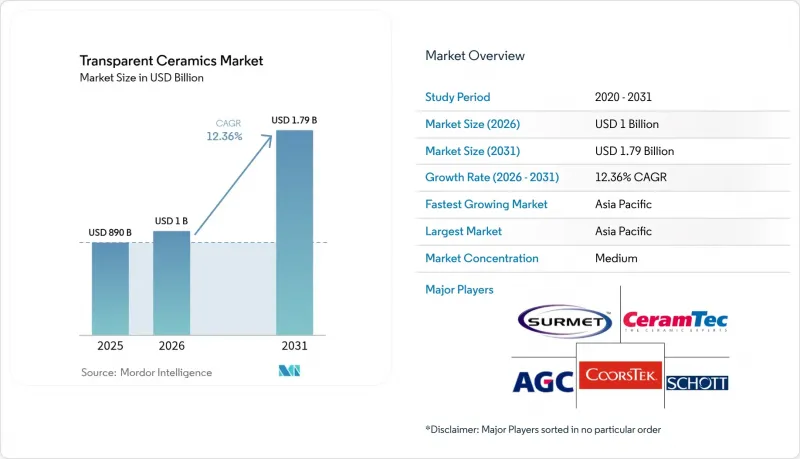
Mordor Intelligence에 의하면, 투명 세라믹 시장 규모는 2025년에 8억 9,000만 달러로 평가되었습니다. 2026년 10억 달러에서 2031년까지 17억 9,000만 달러에 이를 것으로 예상되며, 예측 기간(2026-2031년) CAGR은 12.36%를 나타낼 전망입니다.
본 보고서는 구조별(결정질, 비결정질), 소재별(사파이어, 이트륨 알루미늄 가넷, 알루미늄 질화산화물, 기타),용도별(광학·광전자공학, 항공우주 및 방위, 기계·화학적 처리, 기타), 지역별(아시아태평양, 북미, 유럽, 남미, 중동 및 아프리카)로 분류되어 있습니다. 시장 예측은 금액(달러) 기준으로 제시되어 있습니다.
세계의 투명 세라믹 시장 동향 및 인사이트
광학·광전자 부문에서의 활용 가속화
레이저 구동형 제조, LiDAR, 포토닉 집적 회로가 고순도이며 결함이 적은 투명 세라믹에 대한 사상 최대 수요를 견인하고 있습니다. 티타늄 사파이어 온 인슐레이터(Ti : SaOI) 프로토타입은 시스템 실적를 줄이면서 출력 밀도를 높이는 콤팩트한 레이아웃을 구현하여 웨이퍼 레벨 레이저 어레이의 상업적 실현 가능성을 시사하고 있습니다. 세륨(Ce)을 도핑한 가넷 세라믹은 현재 65W/mm²의 광도 포화 임계값을 보여주고 있으며, LED 백라이트 및 산업용 레이저 분야에서 단결정 이득 매체를 대체할 수 있는 내구성이 높고 열적으로 안정적인 대체 소재로 자리 잡고 있습니다. 따라서 투명 세라믹 시장은 광대역 통신과 밀접하게 연결되어 있으며, 소형화에 대한 압박이 커지는 가운데 강력한 광자 빔과 높은 접합 온도를 견딜 수 있는 소재의 가치가 높아지고 있습니다.
항공우주 및 방위 부문 수요 증가
투명 세라믹는 초음속기, 미사일 시커, 위성 센서 창에 요구되는 ‘광 투과성’과 ‘고온 내성’이라는 이중 요건을 충족합니다. 다공성 Si3N4로 제작된 레이돔은 기계적 무결성을 유지하면서 56%의 다공성을 달성하여 장거리 요격 미사일의 총 중량을 줄이고 있습니다. 극초음속 활공체의 투명 돔은 2,000°C의 표면 온도를 견뎌야 합니다. AlON과 스피넬은 열충격을 견디면서도 이러한 임계값을 상회합니다. 미국 연방 정부의 로드맵에서는 이러한 세라믹이 내성이 있는 에너지 무기용 광학 시스템 및 지향성 에너지 시스템의 기반 소재로 꼽히고 있습니다. 게르마늄 창을 대체하는 움직임이 진행됨에 따라 투명 세라믹 시장은 더욱 확대될 것이며, 센서의 대역폭 요구 사항을 충족하는 칼코겐화물 유리 유도체를 통해 전략적 광물공급 위험이 완화될 것입니다.
높은 생산 비용
투명 세라믹은 고순도 원료와 다단계 소결 공정이 필요하며, 이로 인해 용광로 내 체류 시간과 전력 소비량이 표준 타일이나 구조용 세라믹을 훨씬 초과합니다. 2단계 소결은 밀도를 높여주지만, 정밀한 온도 상승 곡선이 요구됩니다. 또한, 사파이어 부품의 다이아몬드 휠 마무리를 위해서는 고회전 스핀들과 냉각 시스템에 대한 추가 설비 투자가 필요합니다. 산업계의 탄소 발자국에 대한 관심이 높아짐에 따라 그린 수소 가마로의 전환이 가속화되고 있지만, 단기적인 전환 비용은 이익률을 압박하고 있습니다.
부문별 분석
결정계 제품은 2025년 투명 세라믹 시장에서 64.12%의 점유율을 확보했습니다. 이는 0.3-5μm 대역에서 일관되게 높은 투과율과 2GPa를 초과하는 압축 강도에 기인합니다. 미세 입자 사파이어 돔과 YAG 레이저 슬래브는 레이돔 및 고체 레이저 등 이 부문의 폭넓은 범용성을 보여주고 있습니다. 한편, 비결정질 유리 세라믹은 유연성이 높은 용융 주조 라인과 낮은 스크랩률을 활용하여 휴대전화 렌즈 커버 및 스마트 워치 백플레이트 시장을 선점했습니다. 12.58%의 연평균 성장률(CAGR)은 가격에 민감한 소비자 채널에서 수요 탄력성을 뒷받침하고 있습니다.
82.3%의 투과율과 2.6ppm°C-1 이하의 열팽창률을 겸비한 코디에라이트 유리 세라믹은 폴리머 적층이 필요 없는 일체형 모바일 스크린 구현의 길을 열어주고 있습니다. 한편, P2O5 + ZrO2 + TiO2로 구성된 첨단 핵형성제 시스템은 결정화를 재료 내부로 이동시켜 투명도를 저해하지 않으면서 기계적 인장 강도를 향상시킵니다. 스파크 플라즈마 소결을 통해 가공 시간이 수 시간에서 수 분으로 단축되고, 에너지 투입량이 절반으로 줄어들며, 결정립 경계가 미세화되어 산란이 억제됩니다.
지역별 분석
아시아태평양은 후난성의 확립된 사파이어 불 생산과 나고야의 대구경 AlON 플레이트 생산에 힘입어 2025년 매출의 56.12%를 차지했습니다. 현지 반도체 에칭 및 디스플레이 제조 공장에 대한 정부의 지원 정책이 주요 수요 원천이 되고 있는 한편, 중국의 수출 지향형 방위 산업 그룹은 차세대 ISR 드론에 스피넬 돔을 채택하고 있습니다. 2031년까지 이 지역은 연평균 성장률(CAGR) 13.95%로 성장하며 매출이 크게 증가할 것으로 예측됩니다. 한국의 나노 투명 스크린 구상 덕분에인치당 비용이 OLED의 10분의 1로 절감되어, 관련 디스플레이 시장이 확대되고 현지 공급망이 심화되고 있습니다.
북미는 여전히 기술 최전선을 달리고 있으며, DARPA 및 에너지부(DoE)의 보조금을 활용하여 지향성 에너지 레이저 커플러와 핵융합급 광학 소자의 실증을 진행하고 있습니다. LightPath Technologies는 게르마늄 대신 BDNL4 칼코게나이드 유리를 채택하고 있으며, 이를 통해 국방 거점이 지정학적 위험으로부터 격리되고 있습니다. 멕시코의 전자기기 마키라도라(수출가공공장)에서는 유리 세라믹 열 확산기를 파워 모듈에 통합하고 있으며, 이는 첨단 소재가 지역 밖으로 확산되고 있음을 시사합니다.
유럽은 부가가치가 높은 저탄소 생산에 주력하고 있습니다. SCHOTT의 4억 5,000만 유로 규모의 설비 투자 계획에는 수소를 연료로 사용하는 플로트 라인이 포함되어 있으며, 2024년에 최초의 CO2 중립 유리를 생산했습니다. 이를 통해 세라믹 소결로의 실현 가능성이 입증되었습니다. 독일의 세라믹 복합재료 네트워크는 2025년까지 산화물 섬유 생산량을 두 배로 늘리는 것을 목표로 하고 있으며, 이는 항공우주용 터빈의 세라믹 매트릭스 복합재료에 있어 매우 중요합니다. 아프리카와 중동에서는 아직 초기 단계이긴 하지만 전략적인 도입이 진행되고 있습니다. 특히 집광형 태양열 발전 부문에서는 내진성이 뛰어나고 적외선을 투과하는 차폐막이 헬리오스태트의 수명을 연장하고 있습니다.
기타 혜택
- 엑셀 형식 시장 예측(ME) 시트
- 3개월간의 애널리스트 지원
자주 묻는 질문
목차
제1장 서론
제2장 조사 방법
제3장 주요 요약
제4장 시장 구도
제5장 시장 규모 및 성장 예측
제6장 경쟁 구도
제7장 시장 기회 및 향후 전망
KTH 26.09.04According to Mordor Intelligence, the transparent ceramics market size was valued at USD 890 million in 2025 and estimated to grow from USD 1 billion in 2026 to reach USD 1.79 billion by 2031, at a CAGR of 12.36% during the forecast period (2026-2031).
This report is Segmented by Structure (Crystalline, Non-Crystalline), Material (Sapphire, Yttrium Aluminum Garnet, Aluminum Oxynitride, and More), Application (Optics & Optoelectronics, Aerospace & Defense, Mechanical & Chemical Processing, and More), and Geography (Asia Pacific, North America, Europe, South America, Middle East and Africa). The Market Forecasts are Provided in Terms of Value (USD).
Global Transparent Ceramics Market Trends and Insights
Accelerating Usage in Optics & Optoelectronics
Laser-driven manufacturing, lidar, and photonic-integrated circuits are fueling record off-take for high-purity, low-defect transparent ceramics. Titanium:sapphire-on-insulator prototypes have delivered compact layouts that cut system footprints while boosting power density, signaling commercial feasibility for wafer-level laser arrays. Ce-doped garnet ceramics now demonstrate luminance saturation thresholds of 65 W mm-2, offering durable, thermally stable alternatives to single-crystal gain media in LED backlights and industrial lasers. The transparent ceramics market is, therefore, intertwined with broadband communications, where miniaturization pressures amplify the value of materials that can survive intense photon flux and elevated junction temperatures.
Growing Demand from Aerospace & Defense
Transparent ceramics meet the dual mandate of optical transmission and high-temperature resilience imposed by supersonic aircraft, missile seekers, and satellite sensor windows. Porous Si3N4 radomes have reached 56% porosity while preserving mechanical integrity, trimming overall weight for long-range interceptors. Transparent domes on hypersonic glide bodies must tolerate 2,000 °C skin temperatures; AlON and spinel exceed such thresholds while resisting thermal shock. U.S. federal roadmaps name these ceramics as cornerstone materials for resilient energy weapon optics and directed-energy systems. Substitution away from germanium windows further elevates the transparent ceramics market, alleviating strategic mineral supply risk through chalcogenide glass derivatives that match sensor bandwidth needs.
High Production Cost
Transparent ceramics require high-purity feedstocks and multi-stage sintering profiles that push furnace dwell times and electricity usage well above standard tile or structural ceramics. Two-step sintering raises density but demands precision thermal ramps, while diamond-wheel finishing of sapphire parts adds capex for high-RPM spindles and coolant systems. Industry carbon-footprint scrutiny is accelerating shifts to green hydrogen kilns, but near-term conversion expenses weigh on margins.
Other drivers and restraints analyzed in the detailed report include:
- Advanced Ceramics Increasingly Replacing Plastics and Metals
- Fusion-Grade High-Power Ceramic Lasers
- Manufacturing Complexity & Yield Losses
For complete list of drivers and restraints, kindly check the Table Of Contents.
Segment Analysis
Crystalline variants secured 64.12% transparent ceramics market share in 2025, validated by consistently higher transmission in the 0.3-5 μm band and compressive strengths above 2 GPa. Fine-grain sapphire domes and YAG laser slabs illustrate the segment's versatility across radomes and solid-state lasers. Non-crystalline glass-ceramics, conversely, capitalized on agile melt-casting lines and lower scrap rates, capturing handset lens covers and smart-watch backplates. Their 12.58% CAGR underscores demand elasticity in price-sensitive consumer channels.
Cordierite glass-ceramics that combine 82.3% transmittance with sub-2.6 ppm °C-1 thermal expansion pave the way for monolithic mobile screens that forego polymer lamination. Meanwhile, advanced nucleant systems-P2O5 + ZrO2 + TiO2-shift crystallization to the bulk, enhancing mechanical tensile strength without sacrificing clarity. Spark plasma sintering reduces processing windows from hours to minutes, halving energy input and shrinking grain boundaries to suppress scattering.
Complete Report Scope:
- By Structure
- Crystalline
- Non-crystalline (Glass-ceramic)
- By Material
- Sapphire (Al2O3)
- Yttrium Aluminum Garnet (YAG)
- Aluminum Oxynitride (AlON)
- Spinel (MgAl2O4)
- Yttria-stabilized Zirconia (YSZ)
- Other Advanced Materials
- By Application
- Optics and Optoelectronics
- Aerospace and Defense
- Mechanical and Chemical Processing
- Healthcare and Dental
- Consumer Electronics and Goods
- Energy and Power
- Others Applications
- By Geography
- Asia Pacific
- China
- Japan
- India
- South Korea
- Australia and New Zealand
- ASEAN countries
- Rest of Asia Pacific
- North America
- United States
- Canada
- Mexico
- Europe
- Germany
- United Kingdom
- France
- Italy
- NORDIC
- Russia
- Rest of Europe
- South America
- Brazil
- Argentina
- Rest of South America
- Middle East and Africa
- Saudi Arabia
- UAE
- South Africa
- Egypyt
- Nigeria
- Rest of Middle East and Africa
- Asia Pacific
Geography Analysis
Asia Pacific controlled 56.12% of 2025 sales, buoyed by entrenched sapphire boules in Hunan and wide-aperture AlON plates in Nagoya. Government stimulus for local semiconductor etching and display fabs furnishes anchor demand, while export-oriented defense conglomerates in China adopt spinel domes for next-generation ISR drones. By 2031, the region is poised to generate significant incremental revenue, growing at a rate of 13.95% CAGR. South Korea's nano transparent screen initiative cuts per-inch costs to one-tenth of OLED, broadening addressable display footprints and deepening local supply chains.
North America remains the technology vanguard, leveraging DARPA and DoE grants to demonstrate directed-energy laser couplers and fusion-grade optics. LightPath Technologies is substituting BDNL4 chalcogenide glass for germanium, insulating the defense base from geopolitical risk. Mexico's electronics maquiladoras integrate glass-ceramic heat spreaders into power modules, signaling outward regional diffusion of advanced materials.
Europe positions itself on value-added, low-carbon production. SCHOTT's EUR 450 million capital program includes a hydrogen-fired float line that delivered its first CO2-neutral glass in 2024, validating feasibility for ceramic sintering kilns. Germany's Ceramic Composites network targets a doubling of oxide-fiber throughput by 2025, critical for ceramic-matrix composites in aerospace turbines. The Middle East and Africa record nascent but strategic uptake, especially in concentrated solar power fields where dust-resistant, IR-transparent shields elongate heliostat lifetimes.
- AGC Inc.
- CeramTec GmbH
- CILAS
- CoorsTek Inc.
- Deisenroth Engineering GmbH
- Fraunhofer IKTS
- General Electric
- II-VI Optical Systems
- Konoshima Chemical Co. Ltd
- Kyocera Corporation
- Meller Optics Inc
- Murata Manufacturing
- OptoCity Inc.
- Philips Lighting Holdings
- Raytheon Technologies (RTX)
- Saint-Gobain Group
- SCHOTT AG
- Surmet Corporation
Additional Benefits:
- The market estimate (ME) sheet in Excel format
- 3 months of analyst support
TABLE OF CONTENTS
1 Introduction
- 1.1 Study Assumptions and Market Definition
- 1.2 Scope of the Study
2 Research Methodology
3 Executive Summary
4 Market Landscape
- 4.1 Market Overview
- 4.2 Market Drivers
- 4.2.1 Accelerating usage in optics and optoelectronics
- 4.2.2 Growing demand from aerospace and defense
- 4.2.3 Advanced Ceramics Increasingly Replacing Plastics and Metals
- 4.2.4 Fusion-grade high-power ceramic lasers
- 4.2.5 Rising use of transparent ceramics in IR domes for hypersonic vehicles
- 4.3 Market Restraints
- 4.3.1 High production cost
- 4.3.2 Manufacturing complexity and yield losses
- 4.3.3 Sustainability issues in rare-earth mining
- 4.4 Value Chain Analysis
- 4.5 Porter's Five Forces Analysis
- 4.5.1 Bargaining Power of Suppliers
- 4.5.2 Bargaining Power of Buyers
- 4.5.3 Threat of New Entrants
- 4.5.4 Threat of Substitutes
- 4.5.5 Degree of Competition
5 Market Size and Growth Forecasts
- 5.1 By Structure
- 5.1.1 Crystalline
- 5.1.2 Non-crystalline (Glass-ceramic)
- 5.2 By Material
- 5.2.1 Sapphire (Al2O3)
- 5.2.2 Yttrium Aluminum Garnet (YAG)
- 5.2.3 Aluminum Oxynitride (AlON)
- 5.2.4 Spinel (MgAl2O4)
- 5.2.5 Yttria-stabilized Zirconia (YSZ)
- 5.2.6 Other Advanced Materials
- 5.3 By Application
- 5.3.1 Optics and Optoelectronics
- 5.3.2 Aerospace and Defense
- 5.3.3 Mechanical and Chemical Processing
- 5.3.4 Healthcare and Dental
- 5.3.5 Consumer Electronics and Goods
- 5.3.6 Energy and Power
- 5.3.7 Others Applications
- 5.4 By Geography
- 5.4.1 Asia Pacific
- 5.4.1.1 China
- 5.4.1.2 Japan
- 5.4.1.3 India
- 5.4.1.4 South Korea
- 5.4.1.5 Australia and New Zealand
- 5.4.1.6 ASEAN countries
- 5.4.1.7 Rest of Asia Pacific
- 5.4.2 North America
- 5.4.2.1 United States
- 5.4.2.2 Canada
- 5.4.2.3 Mexico
- 5.4.3 Europe
- 5.4.3.1 Germany
- 5.4.3.2 United Kingdom
- 5.4.3.3 France
- 5.4.3.4 Italy
- 5.4.3.5 NORDIC
- 5.4.3.6 Russia
- 5.4.3.7 Rest of Europe
- 5.4.4 South America
- 5.4.4.1 Brazil
- 5.4.4.2 Argentina
- 5.4.4.3 Rest of South America
- 5.4.5 Middle East and Africa
- 5.4.5.1 Saudi Arabia
- 5.4.5.2 UAE
- 5.4.5.3 South Africa
- 5.4.5.4 Egypyt
- 5.4.5.5 Nigeria
- 5.4.5.6 Rest of Middle East and Africa
- 5.4.1 Asia Pacific
6 Competitive Landscape
- 6.1 Market Concentration
- 6.2 Strategic Moves
- 6.3 Market Share Analysis
- 6.4 Company Profiles (includes Global level Overview, Market level overview, Core Segments, Financials as available, Strategic Information, Market Rank/Share for key companies, Products and Services, and Recent Developments)
- 6.4.1 AGC Inc.
- 6.4.2 CeramTec GmbH
- 6.4.3 CILAS
- 6.4.4 CoorsTek Inc.
- 6.4.5 Deisenroth Engineering GmbH
- 6.4.6 Fraunhofer IKTS
- 6.4.7 General Electric
- 6.4.8 II-VI Optical Systems
- 6.4.9 Konoshima Chemical Co. Ltd
- 6.4.10 Kyocera Corporation
- 6.4.11 Meller Optics Inc
- 6.4.12 Murata Manufacturing
- 6.4.13 OptoCity Inc.
- 6.4.14 Philips Lighting Holdings
- 6.4.15 Raytheon Technologies (RTX)
- 6.4.16 Saint-Gobain Group
- 6.4.17 SCHOTT AG
- 6.4.18 Surmet Corporation
7 Market Opportunities and Future Outlook
- 7.1 White-space and Unmet-Need Assessment
- 7.2 Increasing Demand in the Medical Sector


