

|
시장보고서
상품코드
2120482
IoC(Internet Of Cars) : 시장 점유율 분석, 업계 동향 및 통계, 성장 예측(2026-2031년)Internet Of Cars - Market Share Analysis, Industry Trends & Statistics, Growth Forecasts (2026 - 2031) |
||||||
 Mordor Intelligence
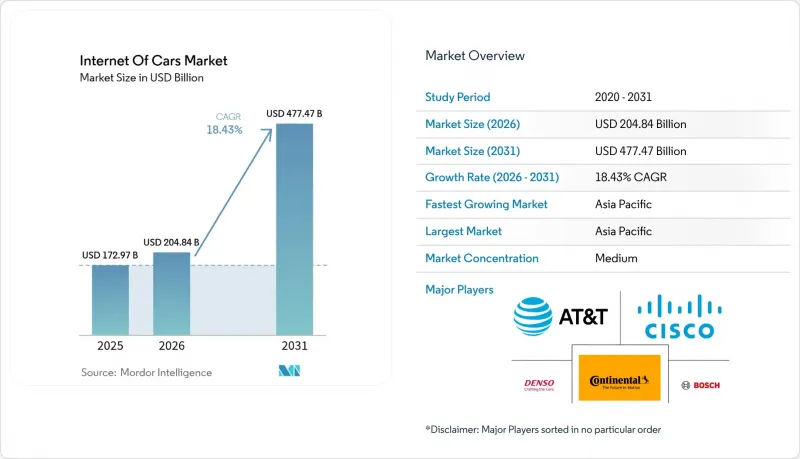
에 의하면, 2026년 ' IoC(Internet Of Cars) ' 시장 규모는 2,048억 4,000만 달러로 추정되며, 2025년 1,729억 7,000만 달러에서 확대해, 2031년에는 4,774억 7,000만 달러에 이를 것으로 예측됩니다.
2026년부터 2031년까지의 연평균 성장률(CAGR)은 18.43%가 될 것으로 전망됩니다.
본 보고서는 소프트웨어 솔루션(실시간 교통 관리 등), 하드웨어 구성 요소(텔레매틱스 제어 장치 등), 연결 기술(셀룰러 V2X 5G 등), 용도(모빌리티 관리 등), 최종 사용자 산업(운송 및 물류 등), 지역(북미 등)별로 분류되어 있습니다. 시장 전망은 금액(달러) 기준으로 제시됩니다.
세계의 IoC(Internet Of Cars) 시장 동향 및 인사이트
V2X 인프라에 대한 정부 자금 지원 증가
각국 및 각 지역의 당국이 도로변 통신 노드의 비용을 부담하고 있어, 이로 인해 민간 투자자의 비용 장벽이 낮아지고 도입이 가속화되고 있습니다. 미국은 2024년에 6,000만 달러를 지원하여 1,200곳의 교차로에 셀룰러 V2X(Vehicle-to-Everything) 하드웨어를 설치했습니다. 중국은 2025년까지 모든 신규 고속도로에 C-V2X를 통합하도록 의무화하여 도입 기간을 18개월 단축했습니다. 유럽연합 집행위원회는 유럽 횡단 회랑을 따라 구축되는 협력형 교통 시스템에 13억 유로(13억 9,000만 달러)를 배정했습니다. 사우디아라비아의 NEOM 프로젝트에서는 5G 지원 모빌리티 그리드에 5,000억 달러를 배정했습니다. 이 자금을 활용하기 위해서는 공급업체가 설계 단계에서 ISO 21434 사이버 보안 준수를 입증해야 합니다.
차량 플랫폼에서의 5G 및 엣지 컴퓨팅 통합
5G와 멀티 액세스 엣지 컴퓨팅의 결합을 통해 지연 시간이 10밀리초 미만으로 단축되어, 안전상 중요한 기능을 구현할 수 있게 되었습니다. 퀄컴의 ‘Snapdragon Ride’는 2024년에 양산 차량에 탑재되었으며, 센서 데이터를 로컬에서 처리하는 통합형 엣지 AI 가속기를 특징으로 합니다. 버라이즌과 닛산은 미국 내 150개 판매점에서 무선 업데이트(OTA) 소요 시간을 5분 미만으로 단축했습니다. 차이나 모바일은 320곳의 엣지 거점을 설치하여 주요 화물 운송 노선을 따라 평균 소요 시간을 12% 단축했습니다. 유럽의 통신 사업자들은 여전히 뒤처져 있으며, 2024년 말 현재 보다폰의 커버리지율은 독일 아우토반 네트워크의 불과 8%에 그치고 있습니다.
전 세계적으로 분열된 셀룰러 V2X 표준
주파수 대역 할당이 통일되지 않아 자동차 제조업체들은 여러 가지 하드웨어 변형을 개발할 수밖에 없으며, 이는 비용 증가와 시장 출시 지연을 초래하고 있습니다. 미국에서는 5.9GHz 대역에서 Wi-Fi 기기 사용이 허용되어 있어 간섭 위험이 높아지고 있습니다. 유럽에서는 회원국이 C-V2X와 DSRC 중 하나를 선택할 수 있기 때문에 서로 다른 기술이 뒤죽박죽으로 혼재된 상태입니다. 중국은 3GPP Release 16을 표준으로 채택하고 있지만, 유럽과 미국은 Release 17로의 전환을 추진하고 있습니다. 콘티넨탈(Continental)에 따르면, 서로 다른 변형을 유지함으로써 2024년 연구개발 예산에 1억 8,000만 유로(1억 9,300만 달러)가 추가로 투입되었다고 합니다.
부문 분석
2024년 7월 UNECE(유엔 유럽 경제 위원회) 규정에 따라 모든 신차에 침입 감지 기능 탑재가 의무화됨에 따라, 보안 소프트웨어 시장은 2031년까지 연평균 성장률(CAGR) 18.92%를 나타낼 것으로 예측됩니다. 2025년에는 차량 관리 부문이 18.12%로 최대 점유율을 유지할 것으로 보이며, 상용차 차량군이 가동 시간과 경로 효율을 중시하고 있음이 부각되었습니다. 로스앤젤레스 메트로가 2,300대의 버스를 연동하여 승객의 대기 시간을 8분 단축한 것을 계기로, 실시간 운송 시스템 도입이 가속화되었습니다. 배터리 상태 진단이 필요한 전기자동차 차량의 경우, 원격 모니터링이 일상화되고 있습니다. 또한, 포드사가 엣지 캐싱 도입에 앞서 2024년에 1억 2,000만 달러를 셀룰러 데이터에 지출함에 따라 대역폭 관리 도구의 인기가 높아지고 있습니다.
보안에 대한 수요가 조달 체계를 재편하고 있습니다. 현재 각 OEM 업체들은 공급업체에게 제3자에 의한 ISO 21434 감사 결과 제출을 의무화하고 있으며, 이로 인해 제품 개발 일정에 최대 9개월의 지연이 발생하고 있습니다. 솔루션 사전 인증을 획득한 벤더들은 설계 채택까지의 기간이 단축되었다고 보고하고 있으며, 사이버 보안이 다음 가격 결정 요인으로 자리 잡고 있습니다. 플릿 플랫폼의 보급률은 여전히 높은 수준이지만, 무선 업데이트(OTA) 오케스트레이션이 부문 간 기회로 부상하고 있으며, 소프트웨어 기업들은 이를 확보하기 위해 경쟁하고 있습니다. 그 결과, 자동차 인터넷(IoC) 시장은 계속해서 ‘소프트웨어 우선’ 수익 구조로 전환되고 있습니다.
텔레매틱스 제어 장치는 2025년 매출의 12.18%를 차지했지만, 내장형 5G 모뎀은 2031년까지 연평균 성장률(CAGR) 19.76%를 나타낼 것으로 예측됩니다. 퀄컴의 싱글 칩 무선 장치는 C-V2X와 셀룰러 광대역을 통합하여 부품 원가를 30% 절감하고 있습니다. 2024년에 출고된 차량에는 평균 17개의 커넥티드 센서가 탑재되어 있으며, 이는 2년 전의 11개에서 증가한 수치입니다. 콘티넨탈의 48인치 OLED 클러스터는 휴먼-머신 인터페이스가 소프트웨어 정의 콕핏으로 융합되고 있음을 보여줍니다.
반도체 공급 부족으로 성장이 제약받고 있으며, 2024년에는 텔레매틱스용 ECU의 리드타임이 26주에 달했습니다. 보쉬, 콘티넨탈, 덴소 3사가 생산량의 60%를 차지하고 있어 집중 위험이 부각되고 있습니다. mm파 5G의 상용화에 따라 안테나 기술 혁신이 가속화되고 있습니다. 앰페놀(Anphenol)의 위상 배열(phased array) 설계는 기가비트급 차량용 스트리밍을 위해 28GHz 및 39GHz 대역을 지원합니다. 이러한 변화는 하드웨어의 표준화가 진행되는 한편, 차별화 요소가 소프트웨어 계층으로 이동하고 있음을 보여주며, 자동차 인터넷 시장의 데이터 중심적 전망을 뒷받침하고 있습니다.
지역별 분석
2025년, 아시아태평양은 33.62%의 점유율로 ‘IoC(Internet Of Cars)’ 시장을 주도했으며, 2031년까지 연평균 성장률(CAGR) 19.02%를 유지할 것으로 예측됩니다. 중국은 우시, 상하이, 충칭의 스마트 도로 인프라에 500억 위안(69억 달러)을 예산으로 편성했습니다. 일본의 5G-V2X 프로그램은 2027년까지 5만 대의 협업형 크루즈 컨트롤 차량을 도입하는 것을 목표로 하고 있습니다. 인도의 150억 달러 규모 ‘스마트 시티 미션’에서는 교차로 대기 시간을 18% 단축하는 시범 사업이 완료되었습니다. 한국은 2025년부터 모든 신규 고속도로에 C-V2X 기술을 도입할 계획입니다. 인도네시아와 베트남은 5G 통신 범위가 제한적이어서 진전이 더딘 편이지만, 라이드셰어 기업들은 이륜차 차량에 텔레매틱스를 도입하고 있습니다.
북미와 유럽은 성숙 단계에 있지만, 그 동향은 엇갈리고 있습니다. 워싱턴주는 주간고속도로 80호선 및 95호선의 V2X 회랑 구축을 위해 12억 달러의 예산을 승인했습니다. EU는 트럭 플래토닝을 통해 10-15%의 연료 절감을 가능하게 하는 23건의 국경을 넘는 화물 운송 프로젝트에 자금을 지원하고 있습니다. 캐나다 온타리오주에서 실시된 시범 사업에서는 신호등이 있는 교차로에서의 추돌 사고가 22% 감소했습니다. 멕시코는 차량 시험을 위한 공장 내 5G 네트워크 구축에 주력하고 있습니다. 유럽의 개인정보 보호 규제가 강화됨에 따라 규정 준수 관련 지출이 증가하여 수익화 일정에 차질이 생겼습니다.
중동 및 아프리카에서는 스마트 시티 메가 프로젝트가 추진되고 있습니다. 사우디아라비아의 5,000억 달러 규모 ‘NEOM’ 프로젝트에서는 2만 6,500제곱킬로미터에 걸쳐 5G 지원 V2X가 도입될 예정입니다. 두바이에서는 1,200대의 버스를 네트워크에 연결하여 지연 시간을 12분 단축했습니다. 남아프리카공화국의 하우텡주는 2027년까지 300곳의 C-V2X 지원 교차로를 구축할 계획입니다. 나이지리아와 케냐는 도난 방지를 목적으로 한 배송용 오토바이 추적에 주력하고 있습니다. 라틴아메리카는 자금 부족으로 인해 뒤처지고 있으며, 브라질의 5G 도로 커버리지 의무화 조치 일정은 불투명한 상황입니다. 이러한 다양한 전개는 지역별 정책과 통신 인프라 구축 현황이 ‘IoC(Internet Of Cars)’ 시장 전망 성장을 어떻게 형성해 나갈지를 보여주고 있습니다.
기타 혜택 :
- 엑셀 형식 시장 예측(ME) 시트
- 3개월간의 애널리스트 지원
자주 묻는 질문
목차
제1장 서론
제2장 조사 방법
제3장 주요 요약
제4장 시장 구도
제5장 시장 규모 및 성장 예측
제6장 경쟁 구도
제7장 시장 기회 및 향후 전망
KTH 26.09.10According to Mordor Intelligence, internet of Cars market size in 2026 is estimated at USD 204.84 billion, growing from 2025 value of USD 172.97 billion with 2031 projections showing USD 477.47 billion, growing at 18.43% CAGR over 2026-2031.
This report is Segmented by Software Solutions (Real-Time Transit Management, and More), Hardware Components (Telematics Control Units, and More), Connectivity Technology (Cellular-V2X 5G, and More), Application (Mobility Management, and More), End-User Industry (Transportation and Logistics, and More), and Geography (North America, and More). Market Forecasts are Provided in Terms of Value (USD).
Global Internet Of Cars Market Trends and Insights
Rising Government Funding for V2X Infrastructure
National and regional authorities are underwriting roadside communication nodes, lowering the cost hurdle for private investors and speeding rollouts. The United States awarded USD 60 million in 2024 to equip 1,200 intersections with cellular Vehicle-to-Everything (V2X) hardware. China mandated that all new highways integrate C-V2X by 2025, trimming deployment timelines by 18 months. The European Commission directed EUR 1.3 billion (USD 1.39 billion) toward cooperative transport systems along trans-European corridors. Saudi Arabia's NEOM project earmarked USD 500 billion for a 5G-enabled mobility grid. To gain access to these funds, suppliers must document ISO 21434 cybersecurity compliance at the design stage.
Integration of 5G and Edge Computing in Vehicle Platforms
5G paired with multi-access edge computing is compressing latency to below 10 milliseconds, enabling safety-critical functions. Qualcomm's Snapdragon Ride was shipped in production cars in 2024, featuring an integrated edge AI accelerator that processes sensor data locally. Verizon and Nissan cut over-the-air update times to less than five minutes at 150 U.S. dealerships. China Mobile established 320 edge sites, which reduced the average travel time by 12% along a major freight corridor. European operators remain behind; Vodafone's coverage reached only 8% of Germany's autobahn network by the end of 2024.
Fragmented Global Cellular-V2X Standards
Inconsistent spectrum allocation is forcing automakers to engineer multiple hardware variants, which inflates costs and slows launches. The U.S. allows Wi-Fi devices in the 5.9 GHz band, which raises the risk of interference. Europe allows member states to choose between C-V2X and DSRC, resulting in a patchwork of different technologies. China has standardized on 3GPP Release 16, while Europe and the United States are moving to Release 17. Continental said maintaining separate variants added EUR 180 million (USD 193 million) to its 2024 R&D budget.
Other drivers and restraints analyzed in the detailed report include:
- OEM Pivot Toward Data-Monetization Business Models
- Insurer Adoption of Usage-Based Policies
- Consumer Privacy Concerns Around In-Car Data Streams
For complete list of drivers and restraints, kindly check the Table Of Contents.
Segment Analysis
Security software is forecast to grow at a 18.92% CAGR through 2031 as July 2024 UNECE rules require intrusion detection on every new model. Fleet management retained the largest share, at 18.12%, in 2025, highlighting the commercial fleets' focus on uptime and route efficiency. Real-time transit systems gained momentum when the Los Angeles Metro reduced passenger wait times by eight minutes by connecting 2,300 buses. Remote monitoring has become routine for electric fleets that need battery health diagnostics. Bandwidth management tools are gaining popularity because Ford spent USD 120 million on cellular data in 2024, prior to deploying edge caching.
Demand for security is reconfiguring procurement. OEMs now insist suppliers show third-party ISO 21434 audits, adding up to nine months to product timelines. Vendors that pre-certified solutions reported faster design wins, positioning cybersecurity as the next pricing lever. Fleet platforms remain sticky, but over-the-air update orchestration is emerging as a cross-segment opportunity that software firms are racing to capture. As a result, the Internet of Cars market continues to migrate toward a software-first revenue profile.
Telematics control units accounted for 12.18% of 2025 revenue; however, embedded 5G modems are projected to grow at a 19.76% CAGR to 2031. Qualcomm's single-chip radio merges C-V2X and cellular broadband, shaving 30% off bill-of-materials costs. Vehicles shipped in 2024 carried an average of 17 connected sensors, up from 11 two years earlier. Continental's 48-inch OLED cluster illustrates how human-machine interfaces are converging into software-defined cockpits.
Growth is constrained by semiconductor supply tightness; lead times for telematics ECUs hit 26 weeks in 2024. Three suppliers-Bosch, Continental, and Denso-controlled 60% of the output, underscoring the concentration risk. Antenna innovation is accelerating as millimeter-wave 5G becomes viable; Amphenol's phased-array design supports 28 GHz and 39 GHz bands for gigabit car streaming. These shifts signal that hardware will increasingly be standardized, while differentiation moves to the software layer, reinforcing the data-centric outlook for the Internet of Cars market.
Complete Report Scope:
- By Software Solutions
- Real-Time Transit Management Systems
- Security Solutions
- Remote Monitoring Systems
- Network Bandwidth Management
- Fleet Management
- By Hardware Components
- Telematics Control Units
- On-Board Sensors
- Embedded Modems
- HMI Displays
- Antennas and Cables
- By Connectivity Technology
- Cellular-V2X (5G)
- Dedicated Short-Range Communications (DSRC)
- Satellite
- Wi-Fi / Bluetooth
- By Application
- Mobility Management
- Vehicle Management
- Integrated Entertainment
- Safety and Driver Assistance
- Other Applications
- By End-user Industry
- Transportation and Logistics
- Automotive OEMs
- Car-Sharing and Ride-Hailing Operators
- Insurance
- Other End-user Industries
- By Geography
- North America
- United States
- Canada
- Mexico
- South America
- Brazil
- Argentina
- Rest of South America
- Europe
- Germany
- United Kingdom
- France
- Italy
- Spain
- Rest of Europe
- Asia Pacific
- China
- Japan
- India
- South Korea
- Rest of Asia Pacific
- Middle East and Africa
- Middle East
- Saudi Arabia
- United Arab Emirates
- Turkey
- Rest of Middle East
- Africa
- South Africa
- Nigeria
- Kenya
- Rest of Africa
- Middle East
- North America
Geography Analysis
The Asia Pacific led the Internet of Cars market in 2025, with a 33.62% share, and is expected to sustain a 19.02% CAGR through 2031. China budgeted RMB 50 billion (USD 6.9 billion) for smart roadside assets in Wuxi, Shanghai, and Chongqing. Japan's 5G-V2X program aims to deploy 50,000 cooperative cruise-control cars by 2027. India's USD 15 billion Smart Cities Mission has completed pilots that reduced wait times by 18% at intersections. South Korea plans to install C-V2X technology on every new expressway starting from 2025. Indonesia and Vietnam are slower due to limited 5G coverage; however, ride-hailing firms are deploying telematics on their two-wheel fleets.
North America and Europe are mature yet divergent. Washington authorized USD 1.2 billion for V2X corridors on Interstates 80 and 95. The EU has financed 23 cross-border freight projects that enable fuel savings of 10-15% through truck platooning. Canada's Ontario pilot cut rear-end collisions by 22% at signalized intersections. Mexico focuses on plant-side 5G networks for vehicle testing. Stricter privacy rules in Europe increased compliance spending and impacted monetization timelines.
The Middle East and Africa are riding the smart-city megaprojects. Saudi Arabia's USD 500 billion NEOM will deploy 5G-ready V2X across 26,500 square kilometers. Dubai connected 1,200 buses and cut delays by 12 minutes. South Africa's Gauteng province plans 300 C-V2X intersections by 2027. Nigeria and Kenya focus on delivery-motorcycle tracking for theft reduction. Latin America lags due to funding gaps; Brazil's 5G road-coverage mandate faces uncertain timelines. These diverse trajectories outline how regional policies and telecom readiness will shape the future growth of the Internet of Cars market.
- AT&T Inc.
- Robert Bosch GmbH
- Cisco Systems Inc.
- Continental AG
- Denso Corporation
- Ford Motor Company
- General Motors Company
- HERE Global B.V.
- Huawei Technologies Co. Ltd.
- International Business Machines Corporation
- Microsoft Corporation
- NXP Semiconductors N.V.
- Oracle Corporation
- Qualcomm Technologies Inc.
- Samsung Electronics Co. Ltd.
- SAP SE
- Tesla Inc.
- Valeo S.A.
- Verizon Communications Inc.
- Volkswagen AG
- Geotab Inc.
- ZF Friedrichshafen AG
Additional Benefits:
- The market estimate (ME) sheet in Excel format
- 3 months of analyst support
TABLE OF CONTENTS
1 INTRODUCTION
- 1.1 Study Assumptions and Market Definition
- 1.2 Scope of the Study
2 RESEARCH METHODOLOGY
3 EXECUTIVE SUMMARY
4 MARKET LANDSCAPE
- 4.1 Market Overview
- 4.2 Market Drivers
- 4.2.1 Rising Government Funding for V2X Infrastructure
- 4.2.2 Integration of 5G and Edge Computing in Vehicle Platforms
- 4.2.3 OEM Pivot Toward Data-Monetization Business Models
- 4.2.4 Insurer Adoption of Usage-Based Policies
- 4.2.5 Real-Time OTA Cybersecurity Frameworks
- 4.2.6 Smart City Mandates in Middle-Income Economies
- 4.3 Market Restraints
- 4.3.1 Fragmented Global Cellular-V2X Standards
- 4.3.2 High Upfront Cost of Telematics ECUs
- 4.3.3 Skill Shortage in Automotive Software Engineering
- 4.3.4 Consumer Privacy Concerns Around In-Car Data Streams
- 4.4 Industry Value Chain Analysis
- 4.5 Regulatory Landscape
- 4.6 Technological Outlook
- 4.7 Impact of Macroeconomic Factors on the Market
- 4.8 Porter's Five Forces Analysis
- 4.8.1 Threat of New Entrants
- 4.8.2 Bargaining Power of Buyers
- 4.8.3 Bargaining Power of Suppliers
- 4.8.4 Threat of Substitutes
- 4.8.5 Intensity of Competitive Rivalry
5 MARKET SIZE AND GROWTH FORECASTS (VALUE)
- 5.1 By Software Solutions
- 5.1.1 Real-Time Transit Management Systems
- 5.1.2 Security Solutions
- 5.1.3 Remote Monitoring Systems
- 5.1.4 Network Bandwidth Management
- 5.1.5 Fleet Management
- 5.2 By Hardware Components
- 5.2.1 Telematics Control Units
- 5.2.2 On-Board Sensors
- 5.2.3 Embedded Modems
- 5.2.4 HMI Displays
- 5.2.5 Antennas and Cables
- 5.3 By Connectivity Technology
- 5.3.1 Cellular-V2X (5G)
- 5.3.2 Dedicated Short-Range Communications (DSRC)
- 5.3.3 Satellite
- 5.3.4 Wi-Fi / Bluetooth
- 5.4 By Application
- 5.4.1 Mobility Management
- 5.4.2 Vehicle Management
- 5.4.3 Integrated Entertainment
- 5.4.4 Safety and Driver Assistance
- 5.4.5 Other Applications
- 5.5 By End-user Industry
- 5.5.1 Transportation and Logistics
- 5.5.2 Automotive OEMs
- 5.5.3 Car-Sharing and Ride-Hailing Operators
- 5.5.4 Insurance
- 5.5.5 Other End-user Industries
- 5.6 By Geography
- 5.6.1 North America
- 5.6.1.1 United States
- 5.6.1.2 Canada
- 5.6.1.3 Mexico
- 5.6.2 South America
- 5.6.2.1 Brazil
- 5.6.2.2 Argentina
- 5.6.2.3 Rest of South America
- 5.6.3 Europe
- 5.6.3.1 Germany
- 5.6.3.2 United Kingdom
- 5.6.3.3 France
- 5.6.3.4 Italy
- 5.6.3.5 Spain
- 5.6.3.6 Rest of Europe
- 5.6.4 Asia Pacific
- 5.6.4.1 China
- 5.6.4.2 Japan
- 5.6.4.3 India
- 5.6.4.4 South Korea
- 5.6.4.5 Rest of Asia Pacific
- 5.6.5 Middle East and Africa
- 5.6.5.1 Middle East
- 5.6.5.1.1 Saudi Arabia
- 5.6.5.1.2 United Arab Emirates
- 5.6.5.1.3 Turkey
- 5.6.5.1.4 Rest of Middle East
- 5.6.5.2 Africa
- 5.6.5.2.1 South Africa
- 5.6.5.2.2 Nigeria
- 5.6.5.2.3 Kenya
- 5.6.5.2.4 Rest of Africa
- 5.6.5.1 Middle East
- 5.6.1 North America
6 COMPETITIVE LANDSCAPE
- 6.1 Market Concentration
- 6.2 Strategic Moves
- 6.3 Market Share Analysis
- 6.4 Company Profiles (includes Global Level Overview, Market Level Overview, Core Segments, Financials as Available, Strategic Information, Market Rank/Share for Key Companies, Products and Services, and Recent Developments)
- 6.4.1 AT&T Inc.
- 6.4.2 Robert Bosch GmbH
- 6.4.3 Cisco Systems Inc.
- 6.4.4 Continental AG
- 6.4.5 Denso Corporation
- 6.4.6 Ford Motor Company
- 6.4.7 General Motors Company
- 6.4.8 HERE Global B.V.
- 6.4.9 Huawei Technologies Co. Ltd.
- 6.4.10 International Business Machines Corporation
- 6.4.11 Microsoft Corporation
- 6.4.12 NXP Semiconductors N.V.
- 6.4.13 Oracle Corporation
- 6.4.14 Qualcomm Technologies Inc.
- 6.4.15 Samsung Electronics Co. Ltd.
- 6.4.16 SAP SE
- 6.4.17 Tesla Inc.
- 6.4.18 Valeo S.A.
- 6.4.19 Verizon Communications Inc.
- 6.4.20 Volkswagen AG
- 6.4.21 Geotab Inc.
- 6.4.22 ZF Friedrichshafen AG
7 MARKET OPPORTUNITIES AND FUTURE OUTLOOK
- 7.1 White-Space and Unmet-Need Assessment


