

|
시장보고서
상품코드
2120495
자동차용 압력 센서 : 시장 점유율 분석, 업계 동향 및 통계, 성장 예측(2026-2031년)Automotive Pressure Sensors - Market Share Analysis, Industry Trends & Statistics, Growth Forecasts (2026 - 2031) |
||||||
 Mordor Intelligence
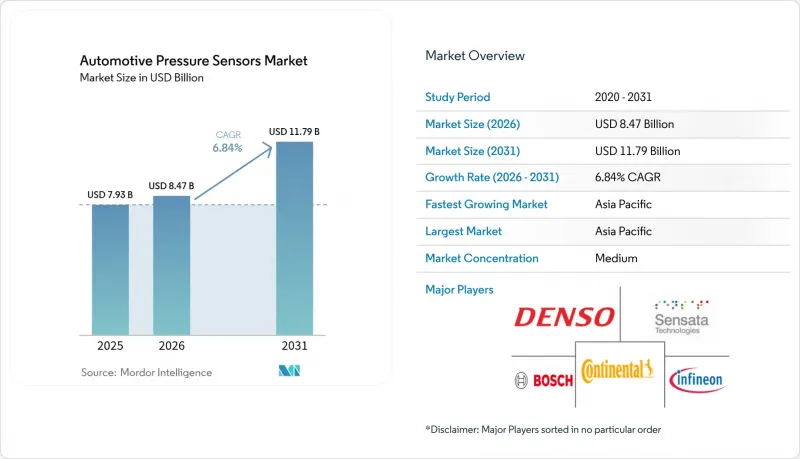
Mordor Intelligence에 의하면, 자동차용 압력 센서 시장 규모는 2025년에 79억 3,000만 달러로 평가되었습니다. 2026년 84억 7,000만 달러에서 2031년까지 117억 9,000만 달러에 이를 것으로 추정되고 예측 기간(2026-2031년) CAGR은 6.84%를 나타낼 전망입니다.
본 보고서는 차종별(승용차, 소형 상용차 등), 용도별(타이어 공기압 모니터링 시스템(TPMS) 등), 압력 유형별(절대압, 차압 등),센서 기술별(피에조 저항형 MEMS 등), 판매 채널별(OEM 순정 장착 및 애프터마켓), 그리고 지역별로 분류되어 있습니다. 시장 전망은 금액(미화) 및 수량(대)의 관점에서 제시되어 있습니다.
세계의 자동차용 압력 센서 시장 동향 및 인사이트
TPMS 장착에 관한 정부 규제
규제 당국은 현재 타이어 공기압 데이터를 최우선 안전 정보로 취급하고 있습니다. 2024년 7월부터 EU의 ‘일반 안전 규정 II’에 따라 모든 신형 승용차, 버스, 트럭 및 트레일러에 TPMS 탑재가 의무화되었습니다. 미국에서는 이미 유사한 규제가 시행 중이며, 남미 및 동남아시아 각국 정부도 유사한 규정을 마련하고 있습니다. 각 OEM 업체들은 의무화된 무선 백본을 활용하여 트레드 마모 분석 및 클라우드 알림 기능을 추가함으로써 센서의 가치를 높이고 있으며, 사이버 보안 감사를 통과한 암호화 프로토콜을 제공하는 공급업체를 우선적으로 선정하고 있습니다.
전동 파워트레인 생산 확대
배터리식 전기차 플랫폼에서는 냉각수 루프, Brake-by-wire 회로, 밀폐형 냉매 시스템에 추가적인 압력 측정 지점이 도입되고 있습니다. 정확한 피드백을 통해 열 폭주를 방지하고, 급속 충전 시의 온도 범위를 최적화합니다. 중국의 조립 제조업체들은 모듈당 여러 개의 저압 MEMS 다이를 통합하고 있는 반면, 유럽의 고급 브랜드들은 더 강력한 전기적 절연이 필요한 800볼트 아키텍처로 전환하고 있습니다. 데이터 포인트 수가 증가함에 따라 자동차용 압력 센서 시장의 생산량과 복잡성이 모두 확대되고 있으며, 견고한 하드웨어와 배터리 팩 건전성 평가 알고리즘을 융합한 공급업체가 우위를 점하고 있습니다.
센서 가격 하락 추세와 이익률 압박
자동차 제조업체들은 기존의 매니폴드 및 TPMS 게이지에 대해 매년 2-3%의 비용 절감을 협상하고 있는 반면, 동남아시아의 수탁 제조업체들은 성숙한 설계를 복제함으로써 이익률을 압박하고 있습니다. 가격 방어책으로 공급업체들은 진단 기능이나 예측 유지보수용 API를 묶어 구독 수익을 창출하고 있습니다. 그러나 가차 없는 비용 절감 목표에 따라 슬림한 패키징, 테스트 외주화, 그리고 적극적인 다이 미세화가 요구되고 있으며, 이는 중소기업에게 과제가 되고, 자동차용 압력 센서 시장의 단기적인 수익성을 억제하는 요인이 되고 있습니다.
부문 분석
승용차가 도입의 대부분을 차지하고 있으며, 이는 전 세계 생산 규모와 전동화로의 급속한 전환을 모두 반영합니다. 2025년에는 승용차 플랫폼이 자동차용 압력 센서 시장의 64.72% 점유율을 차지했으며, 2031년까지 연평균 성장률(CAGR) 7.78%를 기록할 전망입니다. 고급차 브랜드들이 어댑티브 에어 서스펜션, 액티브 에어로다이나믹스, 예측 제동 시스템을 통합함에 따라 도입이 가속화되고 있습니다. 전기 세단의 경우, 배터리 쿨러와 실내 히트 펌프에 저압 노드가 추가되면서 차량당 센서 수가 증가하고 있습니다. 상용 밴과 소형 트럭은 생산 대수 면에서는 뒤처지고 있지만, 적재물 모니터링과 회생 제동 최적화가 요구되는 라스트 마일 배송 차량으로서 주목받고 있습니다. 중형 및 대형 트럭은 신규 승인 차량에 대한 EU의 TPMS(타이어 공기압 모니터링 시스템) 도입 의무에 직면해 있어, 가혹한 가동 사이클에서도 견딜 수 있는 고내압 게이지 수요를 뒷받침하고 있습니다. 자율주행 화물 운송 시범 프로젝트에서는 고장 시에도 운행을 유지해야 한다는 요건을 충족하기 위해 이중화된 압력 회로가 채택되고 있습니다. 그 결과, 차량 등급을 아우르는 다양한 제품 라인업을 통해 공급업체는 개별 부문의 경기 순환적 침체를 헤지할 수 있게 되었으며, 이는 자동차용 압력 센서 시장의 지속적인 성장을 뒷받침하고 있습니다.
두 번째 성장 동력은 특수 오프로드 차량입니다. 이 분야에서는 유압 부하와 장시간 가동으로 인해 고내압 다이어프램에 대한 수요가 증가하고 있습니다. 농업 기계에는 토양 다짐 관리를 위한 디지털 타이어 공기압 제어 기능이 탑재되어 있으며, 건설 기계에서는 실시간 유압 시스템 상태 모니터링이 도입되고 있습니다. 판매 대수는 적지만, 이러한 센서에는 스테인리스 스틸 또는 세라믹 재질의 셀과 밀폐형 커넥터가 채택되어 있어 평균 판매 가격(ASP)이 상승하고 있습니다. 따라서 승용차 분야의 주도적 지위와 대형 차량 용도의 수익성이 높은 틈새 시장이 공존하고 있어, 자동차용 압력 센서 업계 전체의 가치 창출을 풍요롭게 하고 있습니다.
타이어 공기압 모니터링 시스템은 2025년 매출의 38.90%를 차지하며, 새로운 규제의 진입점으로서의 역할을 확고히 했습니다. 각 경차에는 4-6개의 휠웰 센서가 탑재되어 있으며, 고급차 사양에서는 5번째 스페어 타이어용 유닛이 추가됩니다. 센서의 배터리 수명은 최대 10년에 달하며, 연금과 같은 안정적인 수익을 가져다주는 애프터마켓을 형성하고 있습니다. 그러나 유로 7 규제로 인해 추가 지출은 배기가스 재순환(EGR), 입자 포집 장치(DPF), 그리고 SCR 분사 서브시스템으로 이동하고 있으며, 이들에는 현재 지속적인 압력 피드백이 필요합니다. 이러한 배기 모듈은 10.02%라는 가장 높은 연평균 성장률(CAGR)을 기록하고 있으며, 일반 TPMS 유닛의 평균 판매 가격(ASP)의 2배에 달하는 가격대의 고온용 실리콘 카바이드 다이가 필요합니다. 브레이크 및 ABS의 압력 감지는 여전히 안정적인 핵심 분야이지만, Brake-by-wire로의 전환에 따라 더 높은 해상도와 중복성이 도입되면서 장치 수가 증가하고 있습니다. 엔진 매니폴드, 연료 레일, 터보 부스트 감지는 큰 압력 변동 하에서도 고정밀화가 진행되고 있으며, 전동화가 진행되는 가운데서도 기존 수요는 유지되고 있습니다. 모든 대역에서 자동차용 압력 센서 시장은 다양한 용도 수요에 힘입어 성장하고 있으며, 규제 준수를 위한 지출이 단기적인 수요 급증을 뒷받침하고, 소프트웨어를 활용한 차량 상태 모니터링 기능이 장기적인 수익을 창출하고 있습니다.
차량 실내에서는 스마트 에어백 모듈이 기압 정보를 활용하여 탑승자 분류 정확도를 높이고 있습니다. 차세대 공조 제어 시스템은 증기 압축 모니터링을 활용하여 전기차(EV)에 널리 채택되고 있는 히트 펌프의 냉매 충전량을 최적화하고 있습니다. 라이드 컨트롤 시스템에는 10 kHz의 고속 압력 센서가 내장되어 세미액티브 댐퍼를 제어합니다. 센서 수가 증가함에 따라 아날로그 배선을 대신해 다중화된 디지털 버스가 채택되어, 하네스의 경량화와 신뢰성 향상을 도모하고 있습니다. 이처럼 적용 범위가 확대되고 있는 것은 자동차용 압력 센서 시장이 단일 용도의 아날로그 게이지에서 중앙 집중형 도메인 컨트롤러에 정보를 공급하는 네트워크화된 디지털 노드로 지속적으로 전환되고 있음을 여실히 보여줍니다.
지역별 분석
아시아태평양은 자동차용 압력 센서 시장의 판매량 성장 동력으로 계속 자리매김하고 있으며, 2025년에는 49.20%의 점유율로 1위를 유지했습니다. 중국이 전기차 생산을 가속화하고 배터리 안전성을 확보하기 위해 여러 개의 저압 노드를 통합함에 따라, 이 지역은 2031년까지 연평균 성장률(CAGR) 9.21%로 더욱 성장할 것으로 예측됩니다. 현지 제조업체들은 국내 MEMS 조달을 장려하고 수입 의존도를 낮추는 국가 차원의 국산화 의무 조치의 혜택을 받고 있습니다. 인도는 구자라트주와 타밀나두주에서 자동차 조립 클러스터를 확장하고 있으며, 파워트레인용 전자 기기와 병행하여 지역 센서 공급망을 육성하고 있습니다. 일본은 마이크로 머시닝 공구 분야에서 리더십을 유지하며 세계 브랜드를 위한 외주 웨이퍼 제조를 뒷받침하고 있는 반면, 한국은 가전제품용 팹을 활용하여 센서의 소형화를 추진하고 있습니다. 스마트 모빌리티 연구소에 대한 정부의 보조금으로 인해 지역 설계 주기가 단축되고 경쟁력이 강화되고 있습니다.
북미에서는 규제에 따른 수요 창출과 기술 혁신에 의한 추진이 결합되어 있습니다. TPMS에 관한 NHTSA의 규제와 EPA의 배기가스 기준이 기초적인 수요를 확보하는 한편, 실리콘밸리의 소프트웨어 스택이 디지털 압력 프로토콜을 우선시하는 중앙 집중형 도메인으로의 전환을 가속화하고 있습니다. 디트로이트의 각 OEM 업체들은 배터리 팩 조립 및 열 관리 통합을 현지화함으로써 국내산 센서의 채택률을 높이고 있습니다. 캐나다의 대형 트럭 부문에서는 연비 향상을 위해 고정밀 타이어 공기압 제어를 채택하고 있어, 센서 활용이 특수 용도까지 확대되고 있습니다. 멕시코의 Tier 2 공급망은 성형 하우징 및 리드 프레임 프레스 가공품을 공급함으로써, 자동차용 압력 센서 시장 전체의 지역적 비용 최적화를 뒷받침하고 있습니다.
유럽의 정책 환경은 가장 엄격합니다. 유로 7 규제로 인해 실시간 배기가스 모니터링이 의무화되면서 SiC 고온 센서의 채택이 촉진되고 있습니다. 일반 안전 규정(GSR)에 따라 모든 차종 등급에서 TPMS 탑재가 의무화됨에 따라, 트레일러 및 장거리 버스에서 센서 밀도가 높아지고 있습니다. 독일의 각 고급차 제조업체들은 레벨 3 자율주행 인증 획득을 위해 이중 중복화된 브레이크 압력 모듈을 공급업체에 지정하고 있습니다. 프랑스와 이탈리아에서는 첨단 배터리 냉각수 감지 기능을 통합한 전기 버스 프로젝트에 부흥 자금이 투입되고 있습니다. 동유럽의 공장들은 단일 시장 내에 머무르면서도 경쟁력 있는 인력을 활용하여 MEMS 패키징 분야에 대한 새로운 투자를 유치하고 있습니다. 전반적으로 규제 일관성과 수준 높은 최종 사용자의 존재가 자동차용 압력 센서 시장 전체의 장기적인 수요를 안정시키고 있습니다.
기타 혜택 :
- 엑셀 형식 시장 예측(ME) 시트
- 3개월간의 애널리스트 지원
자주 묻는 질문
목차
제1장 서론
제2장 조사 방법
제3장 주요 요약
제4장 시장 구도
제5장 시장 규모 및 성장 예측
제6장 경쟁 구도
제7장 시장 기회 및 향후 전망
KTH 26.09.10According to Mordor Intelligence, the automotive pressure sensors market size was valued at USD 7.93 billion in 2025 and estimated to grow from USD 8.47 billion in 2026 to reach USD 11.79 billion by 2031, at a CAGR of 6.84% during the forecast period (2026-2031).
This report is Segmented by Vehicle Type (Passenger Cars, Light Commercial Vehicles, and More), Application (Tire Pressure Monitoring System (TPMS), and More), Pressure Type (Absolute, Differential, and More), Sensor Technology (Piezoresistive MEMS, and More), Sales Channel (OEM-Fitted and Aftermarket), and Geography. The Market Forecasts are Provided in Terms of Value (USD) and Volume (Units).
Global Automotive Pressure Sensors Market Trends and Insights
Government Mandates for TPMS Fitment
Regulators now treat tire-pressure data as frontline safety information. From July 2024, the EU General Safety Regulation II requires TPMS on every new passenger car, bus, truck, and trailer . Comparable mandates already exist in the United States, while South American and Southeast Asian governments draft matching rules. OEMs exploit the mandatory wireless backbone to layer tread-wear analytics and cloud alerts, increasing sensor value, and they prefer vendors offering encrypted protocols that pass cybersecurity audits.
Escalating Electrified-Powertrain Production
Battery-electric platforms introduce extra pressure nodes in coolant loops, brake-by-wire circuits, and closed refrigerant systems; accurate feedback prevents thermal runaway and optimizes fast-charge temperature windows. Chinese assemblers embed several low-pressure MEMS dice per module, whereas European premium brands migrate to 800-volt architectures needing stronger electrical isolation. The growing datapoint count enlarges both volume and complexity, rewarding suppliers that marry robust hardware with pack-health algorithms inside the automotive pressure sensors market.
Sensor Price-Erosion and Margin Pressure
Automakers negotiate yearly 2-3% cost reductions on legacy manifold and TPMS gauges, while Southeast Asian contract foundries replicate mature designs, compressing margins. To defend pricing, suppliers bundle diagnostics and predictive-maintenance APIs that create subscription revenue. Nonetheless, relentless cost-down targets demand lean packaging, outsourced test, and aggressive die shrinks, challenging smaller firms and tempering short-term profitability inside the automotive pressure sensors market.
Other drivers and restraints analyzed in the detailed report include:
- Rising Integration of ADAS and Autonomous Systems
- Stricter Global Emission and Fuel-Economy Norms
- Semiconductor Supply-Chain Volatility
For complete list of drivers and restraints, kindly check the Table Of Contents.
Segment Analysis
Passenger cars dominate deployments, reflecting both global production scale and the rapid shift toward electric propulsion. In 2025, passenger platforms held 64.72% of the automotive pressure sensors market share and are tracking an 7.78% CAGR to 2031. Adoption accelerates as luxury marques integrate adaptive air suspension, active aerodynamics, and predictive brake servicing. Electric sedans place additional low-pressure nodes in battery chillers and cabin heat pumps, expanding sensor counts per vehicle. Commercial vans and light trucks trail in volume yet attract attention from last-mile delivery fleets that demand load monitoring and regenerative braking optimization. Medium and heavy trucks face EU mandates for TPMS on new approvals, spurring higher-range gauges that thrive in harsher duty cycles. Autonomous freight pilots employ redundant pressure circuits to satisfy fail-operational criteria. Consequently, diversified offerings across vehicle classes allow suppliers to hedge cyclical softness in any single segment, supporting sustainable gains for the automotive pressure sensors market.
Second-tier growth comes from specialized off-highway vehicles where hydraulic workloads and extended duty drive demand for high-proof-pressure diaphragms. Agricultural machinery integrates digital tire inflation control for soil compaction management, while construction equipment adopts real-time hydraulic health tracking. Though unit volumes are modest, ASPs rise because these sensors pack stainless or ceramic cells and sealed connectors. Passenger car leadership therefore coexists with profitable niches in heavy applications, enriching the overall value capture of the automotive pressure sensors industry.
Tire pressure monitoring systems generated 38.90% of 2025 revenue, cementing their role as the entry point for new regulations. Each light vehicle carries four to six wheel-well sensors, and premium fitments add a fifth spare-wheel unit. Sensor batteries last up to 10 years, creating an annuity-like aftermarket. Yet Euro 7 shifts incremental expenditure toward exhaust gas recirculation, particulate trap, and SCR dosing subsystems that now need continuous pressure feedback. These exhaust modules post the fastest 10.02% CAGR and require high-temperature silicon-carbide dies that command double the ASP of common TPMS units. Brake and ABS pressure sensing remains a steady core, though migration to brake-by-wire introduces finer resolution and redundancy that raise device count. Engine manifold, fuel rail, and turbo boost sensing evolve toward higher accuracy at large pressure swings, keeping legacy demand intact even as electrification proceeds. Across every bandwidth, the automotive pressure sensors market benefits from diversified application pull, with compliance spend fueling near-term spikes and software-enabled health features creating longer-cycle revenue.
Inside the cabin, smart airbag modules employ barometric pressure information to improve occupant classification. Next-generation climate control leverages vapor-compression monitoring to optimize refrigerant charge in heat pumps common to EVs. Ride-control systems embed fast 10 kHz pressure pick-ups to regulate semi-active dampers. As sensor counts expand, multiplexed digital buses replace analog lines, simplifying harness weight and boosting reliability. The widening scope underlines how the automotive pressure sensors market continues to migrate from single-purpose analog gauges to networked digital nodes that feed centralized domain controllers.
Complete Report Scope:
- By Vehicle Type
- Passenger Cars
- Light Commercial Vehicles
- Medium and Heavy Commercial Vehicles
- By Application
- Tire Pressure Monitoring System (TPMS)
- Brake Booster and ABS
- Engine and Fuel/Manifold Management
- Exhaust Gas Recirculation/After-treatment
- Airbag and Safety Restraint Systems
- Vehicle Dynamics and ESC
- By Pressure Type
- Absolute
- Gauge (Sealed/Vent)
- Differential
- Vacuum/Low-pressure
- By Sensor Technology
- Piezoresistive MEMS
- Capacitive MEMS
- Resonant/Quartz
- Opto-electronic and Others
- By Sales Channel
- OEM-Fitted
- Aftermarket
- By Geography
- North America
- United States
- Canada
- Rest of North America
- South America
- Brazil
- Argentina
- Rest of South America
- Europe
- Germany
- United Kingdom
- France
- Italy
- Rest of Europe
- Asia-Pacific
- China
- Japan
- India
- South Korea
- Rest of Asia-Pacific
- Middle East and Africa
- United Arab Emirates
- Saudi Arabia
- Egypt
- South Africa
- Rest of Middle East and Africa
- North America
Geography Analysis
Asia-Pacific remains the volume engine for the automotive pressure sensors market, leading with 49.20% share in 2025. The region is further projected to grow with a 9.21% CAGR by 2031, as China accelerates electric-vehicle production and embeds multiple low-pressure nodes for battery safety. Local makers benefit from national content mandates that incentivize domestic MEMS sourcing, reducing import reliance. India scales automotive assembly clusters in Gujarat and Tamil Nadu, fostering regional sensor supply chains alongside powertrain electronics. Japan sustains leadership in micro-machining tools, feeding outsourced wafer fabrication for global brands, while South Korea leverages its consumer-electronics fabs to push sensor miniaturization. Government subsidies for smart mobility labs keep regional design cycles short, enhancing competitiveness.
North America combines regulatory pull with technology push. NHTSA rules on TPMS and EPA emission standards ensure baseline demand, while Silicon Valley software stacks accelerate the shift to centralized domains that favor digital pressure protocols. Detroit OEMs localize battery pack assembly and thermal management integration, increasing domestic sensor content. Canada's heavy-truck sector adopts high-accuracy tire inflation control for fuel-efficiency gains, extending sensor use into vocational applications. Mexico's Tier-2 ecosystem supplies molded housings and lead frame stampings, supporting regional cost optimization across the automotive pressure sensors market.
Europe's policy landscape is the most stringent. Euro 7 legislation forces real-time exhaust monitoring, driving uptake of SiC high-temperature sensors . The General Safety Regulation obliges TPMS on every vehicle class, elevating sensor density in trailers and coaches. Germany's premium OEMs specify dual-redundant brake pressure modules for Level-3 autonomous approval. France and Italy channel recovery funds into electric-bus projects that integrate advanced battery coolant sensing. Eastern European plants attract new MEMS packaging investments, exploiting competitive labor while staying inside the common market. Altogether, synchronized regulations and sophisticated end-users stabilize long-run demand across the automotive pressure sensors market.
- Robert Bosch GmbH
- Continental AG
- Sensata Technologies, Inc.
- DENSO Corporation
- Infineon Technologies AG
- STMicroelectronics N.V.
- NXP Semiconductors N.V.
- Texas Instruments Incorporated
- Autoliv Inc.
- Allegro MicroSystems, LLC
- TE Connectivity Ltd.
- Honeywell International Inc.
- Analog Devices, Inc.
- Melexis NV
- Aptiv PLC
- Amphenol Advanced Sensors
- Alps Alpine Co., Ltd.
- Bourns, Inc.
- Nidec-Copal Electronics
Additional Benefits:
- The market estimate (ME) sheet in Excel format
- 3 months of analyst support
TABLE OF CONTENTS
1 Introduction
- 1.1 Study Assumptions & Market Definition
- 1.2 Scope of the Study
2 Research Methodology
3 Executive Summary
4 Market Landscape
- 4.1 Market Overview
- 4.2 Market Drivers
- 4.2.1 Government mandates for TPMS fitment
- 4.2.2 Escalating electrified-powertrain production
- 4.2.3 Rising integration of ADAS and autonomous systems
- 4.2.4 Stricter global emission and fuel-economy norms
- 4.2.5 SiC-based high-temperature sensors open exhaust-side use-cases
- 4.2.6 OTA prognostics require self-diagnosing smart sensors
- 4.3 Market Restraints
- 4.3.1 Sensor price-erosion and margin pressure
- 4.3.2 Semiconductor supply-chain volatility
- 4.3.3 Cyber-risk of TPMS signal spoofing
- 4.3.4 Complex multi-standard certification burden
- 4.4 Value/Supply-Chain Analysis
- 4.5 Regulatory Landscape
- 4.6 Technological Outlook
- 4.7 Porter's Five Forces
- 4.7.1 Threat of New Entrants
- 4.7.2 Bargaining Power of Buyers
- 4.7.3 Bargaining Power of Suppliers
- 4.7.4 Threat of Substitutes
- 4.7.5 Intensity of Competitive Rivalry
5 Market Size & Growth Forecasts (Value (USD) and Volume (Units))
- 5.1 By Vehicle Type
- 5.1.1 Passenger Cars
- 5.1.2 Light Commercial Vehicles
- 5.1.3 Medium and Heavy Commercial Vehicles
- 5.2 By Application
- 5.2.1 Tire Pressure Monitoring System (TPMS)
- 5.2.2 Brake Booster and ABS
- 5.2.3 Engine and Fuel/Manifold Management
- 5.2.4 Exhaust Gas Recirculation/After-treatment
- 5.2.5 Airbag and Safety Restraint Systems
- 5.2.6 Vehicle Dynamics and ESC
- 5.3 By Pressure Type
- 5.3.1 Absolute
- 5.3.2 Gauge (Sealed/Vent)
- 5.3.3 Differential
- 5.3.4 Vacuum/Low-pressure
- 5.4 By Sensor Technology
- 5.4.1 Piezoresistive MEMS
- 5.4.2 Capacitive MEMS
- 5.4.3 Resonant/Quartz
- 5.4.4 Opto-electronic and Others
- 5.5 By Sales Channel
- 5.5.1 OEM-Fitted
- 5.5.2 Aftermarket
- 5.6 By Geography
- 5.6.1 North America
- 5.6.1.1 United States
- 5.6.1.2 Canada
- 5.6.1.3 Rest of North America
- 5.6.2 South America
- 5.6.2.1 Brazil
- 5.6.2.2 Argentina
- 5.6.2.3 Rest of South America
- 5.6.3 Europe
- 5.6.3.1 Germany
- 5.6.3.2 United Kingdom
- 5.6.3.3 France
- 5.6.3.4 Italy
- 5.6.3.5 Rest of Europe
- 5.6.4 Asia-Pacific
- 5.6.4.1 China
- 5.6.4.2 Japan
- 5.6.4.3 India
- 5.6.4.4 South Korea
- 5.6.4.5 Rest of Asia-Pacific
- 5.6.5 Middle East and Africa
- 5.6.5.1 United Arab Emirates
- 5.6.5.2 Saudi Arabia
- 5.6.5.3 Egypt
- 5.6.5.4 South Africa
- 5.6.5.5 Rest of Middle East and Africa
- 5.6.1 North America
6 Competitive Landscape
- 6.1 Market Concentration
- 6.2 Strategic Moves
- 6.3 Market Share Analysis
- 6.4 Company Profiles (Includes Global Level Overview, Market Level Overview, Core Segments, Financials as Available, Strategic Information, Market Rank/Share for Key Companies, Products and Services, SWOT Analysis, and Recent Developments)
- 6.4.1 Robert Bosch GmbH
- 6.4.2 Continental AG
- 6.4.3 Sensata Technologies, Inc.
- 6.4.4 DENSO Corporation
- 6.4.5 Infineon Technologies AG
- 6.4.6 STMicroelectronics N.V.
- 6.4.7 NXP Semiconductors N.V.
- 6.4.8 Texas Instruments Incorporated
- 6.4.9 Autoliv Inc.
- 6.4.10 Allegro MicroSystems, LLC
- 6.4.11 TE Connectivity Ltd.
- 6.4.12 Honeywell International Inc.
- 6.4.13 Analog Devices, Inc.
- 6.4.14 Melexis NV
- 6.4.15 Aptiv PLC
- 6.4.16 Amphenol Advanced Sensors
- 6.4.17 Alps Alpine Co., Ltd.
- 6.4.18 Bourns, Inc.
- 6.4.19 Nidec-Copal Electronics
7 Market Opportunities & Future Outlook
- 7.1 White-space & Unmet-Need Assessment


