

|
시장보고서
상품코드
2120502
탄산칼슘 : 시장 점유율 분석, 업계 동향 및 통계, 성장 예측(2026-2031년)Calcium Carbonate - Market Share Analysis, Industry Trends & Statistics, Growth Forecasts (2026 - 2031) |
||||||
 Mordor Intelligence
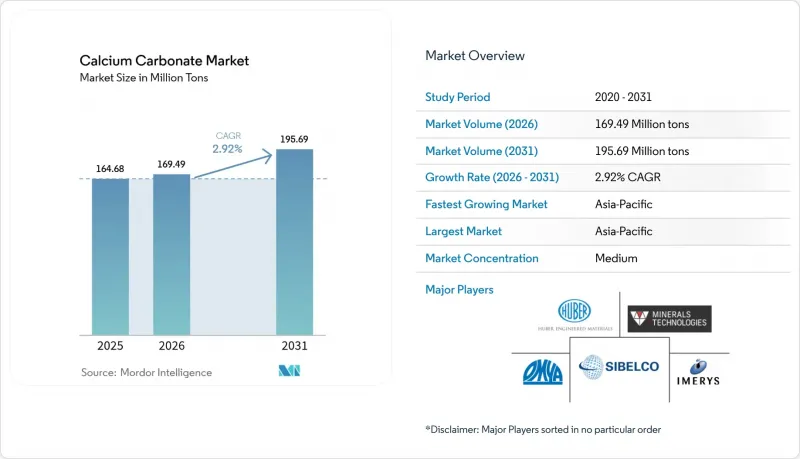
Mordor Intelligence에 의하면, 2026년 탄산칼슘 시장 규모는 1억 6,949만 톤으로 추정되고 2025년 1억 6,468만 톤으로부터 확대해, 2031년에는 1억 9,569만 톤에 이를 것으로 예측됩니다.
2026년부터 2031년에 걸쳐 연평균 성장률(CAGR) 2.92%로 성장할 것으로 전망됩니다.
본 보고서는 유형별(미분쇄 탄산칼슘(GCC), 침전 탄산칼슘(PCC)), 용도별(건축자재용 원료, 영양 보조 식품, 열가소성 플라스틱용 첨가제, 필러·안료, 기타),최종 사용자 산업별(종이, 플라스틱, 접착제 및 실란트, 건설, 기타), 지역별(아시아태평양, 북미, 유럽, 남미, 중동 및 아프리카)로 분류되어 있습니다.
세계의 탄산칼슘 시장 동향 및 인사이트
건설 및 인프라 개발 가속화
아시아태평양 전체에서 유틸리티 지출이 급증하고 있으며, 건설업체들이 시멘트, 폴리머 개질 콘크리트, 건축용 도료, 실란트 용도로 비용 대비 효과가 높은 광물성 충전재를 찾는 가운데, 탄산칼슘 시장을 견인하고 있습니다. 통합형 제조업체들은 이러한 수요에 부응하기 위해 생산 능력을 확대되고 있습니다. 예를 들어, 이메리스(Imerys)는 앨라배마주 사이라코가 공장의 생산량을 두 배로 늘려 건설용 등급의 자재를 공급하는 동시에 북미 고객에 대한 납기 단축을 도모하고 있습니다. 도시 계획 담당자들의 저탄소 건축자재 추진도 ReMined와 같은 제품에 대한 수요를 높이고 있습니다. ReMined는 강도와 내구성 기준을 유지하면서도 내재된 탄소 배출량을 줄이는 100% 생산 전 재활용 탄산칼슘입니다. 이러한 지속가능성과 관련된 틈새 시장 덕분에 판매업체들은 대량 판매가 꾸준히 증가하는 상황에서도 더 높은 이익률을 확보할 수 있게 되었습니다.
플라스틱·폴리머 용도의 확대
나노 규모의 분쇄 기술과 표면 처리 화학의 급속한 발전으로 인해 필름, 마스터배치, 엔지니어링 플라스틱 각 등급의 성능 상한선이 높아졌습니다. 나노 탄산칼슘은 투명성을 유지하면서 포장재의 인장 강도, 차단성, 열안정성을 향상시켜, 가공업체가 중량 기준으로 수지 사용량을 최대 5%까지 줄일 수 있게 해줍니다. 중국 제조업체인 후베이 마이크로크리스탈 뉴머티리얼즈(Hubei Microcrystal New Materials)는 생분해성 폴리머에 분산된 100nm 이하의 입자가 필름의 인성을 높이는 동시에 분해 속도를 미세하게 조절할 수 있음을 입증하여, 순환 경제에서 요구되는 포장 요건을 직접적으로 지원하고 있습니다. 자동차 OEM 및 전자 브랜드들은 경량화, 내열성, 재활용성 목표를 달성하기 위해 이러한 기능성 충전재를 사양으로 채택하는 사례가 늘고 있습니다.
탄산칼슘과 관련된 건강 피해
작업자가 흡입할 수 있는 탄산칼슘 분진에 노출되는 사태가 발생함에 따라 규제 당국의 모니터링이 강화되고 있으며, 공장 및 다운스트림 공정 시설에서는 허용 노출 한계치의 하향 조정과 더욱 엄격한 격리 기준이 요구되고 있습니다. 나노 입자의 독성에 관한 연구는 현재도 진행 중이며, 식품 및 의약품 용도로의 승인을 위해서는 현재 일상적으로 광범위한 위험 평가가 요구되고 있습니다. 이로 인해 상품화까지의 기간이 길어지거나 규정 준수 비용이 증가할 수 있습니다. 자본력이 제한된 소규모 생산자들은 폐쇄형 처리 시스템이나 고효율 여과 장치의 도입에 어려움을 겪는 경우가 많아, 공급의 유연성이 제약받고 있습니다.
부문별 분석
분쇄 탄산칼슘(GCC)은 풍부한 석회석 광상과 저에너지 분쇄 공정 덕분에 2025년 수요의 76.92%를 차지했으며, 계속해서 탄산칼슘 시장의 주류를 이루고 있습니다. 일반 용지, 폴리올레핀 필름, 레디믹스 콘크리트 등 수량 주도형 부문에서는 GCC의 뛰어난 가성비가 여전히 결정적인 요인으로 작용하고 있습니다. 반면, 침전형 탄산칼슘(PCC)은 입자 크기 분포가 좁고, 백도가 높으며, 맞춤형 표면 화학적 특성에 대해 고객이 프리미엄을 지불하기 때문에 2031년까지 연평균 성장률(CAGR) 3.31%로 시장을 주도하고 있습니다. 이러한 변화는 연구진이 대두 우레아제를 이용한 효소 유도 침전에 성공함으로써 더욱 부각되었으며, PCC의 적용 범위를 확대할 가능성이 있는 비용 절감의 길을 시사하고 있습니다.
따라서 성숙한 GCC 제조업체들은 탄산화 반응 장치에 드는 막대한 설비 투자를 하지 않고도 PCC의 성능에 근접하기 위해 분류식 분쇄 시스템과 건식 코팅 장치를 도입하여 공장 설비 현대화를 추진하고 있습니다. 한편, PCC 공급업체들은 다국적 기업 고객들에게 점점 더 중요한 조달 기준이 되고 있는 탄소 발자국을 줄이기 위해, 사내 이산화탄소 포집 및 재생에너지 이용을 확대되고 있습니다. 이러한 전략들이 교차하는 가운데 경쟁은 치열해지고 있지만, 건설, 플라스틱, 생명과학 산업별 수요 특성이 다르다는 점을 고려할 때, 두 하위 부문의 탄산칼슘 시장 규모는 꾸준히 확대될 것으로 전망됩니다.
지역별 분석
아시아태평양은 2025년에 48.25%의 점유율로 탄산칼슘 시장을 독점했으며, 2031년까지 연평균 성장률(CAGR) 3.62%로 확대될 것으로 예측됩니다. 이 지역 수요 대부분을 중국이 차지하고 있으며, 이메리스(Imerys)는 우후, 칭양, 야오양에 시설을 운영하며 포장, 건설, 생명과학 부문의 고객에게 제품을 공급하고 있습니다. 동남아시아 국가들 또한 코팅 보드 및 PVC 파이프의 생산 능력을 강화하고 있어, 이 지역 수요 기반을 확대되고 있습니다.
북미는 기술 등급을 우선시하고 엄격한 품질 관리를 실시하는 첨단 플라스틱 및 제약 공급망을 통해 확고한 입지를 유지하고 있습니다. 앨라배마주와 조지아주에서의 최근 투자는 운송에 따른 배출량을 줄이고 신속한 기술 지원을 확보하기 위한 현지 조달에 대한 해당 지역의 높은 수요를 뒷받침하고 있습니다. 유럽에서는 엄격한 탄소 배출 감축 규제와 채석장 복원 관련 규정에 따라 재생 원료와 에너지 효율이 높은 침전 플랜트가 필수적입니다. 남미에서는 브라질과 아르헨티나의 건설 붐에 더해, 토양 처리용 제품의 소비를 끌어올리는 농업 관련 산업의 성장이 호재로 작용하고 있습니다. 중동에서는 석유화학 단지와 대규모 인프라 프로젝트로부터 안정적인 수요가 나타나고 있습니다. 한편, 아프리카의 채석 잠재력은 여전히 미개발 상태이지만, 특히 이집트, 나이지리아, 남아프리카공화국에서는 미래성이 기대되고 있습니다. 고품질 석회암 광상의 지리적 분산은 앞으로도 무역 흐름과 지역별 가격 형성에 계속 영향을 미칠 것이지만, 현지에 설치된 침전 플랜트와 현대화된 분쇄 거점을 통해 전 세계 탄산칼슘 시장 전체의 운송 부담은 점차 줄어들고 있습니다.
기타 혜택
- 엑셀 형식 시장 예측(ME) 시트
- 3개월간의 애널리스트 지원
자주 묻는 질문
목차
제1장 서론
제2장 조사 방법
제3장 주요 요약
제4장 시장 구도
제5장 시장 규모 및 성장 예측
제6장 경쟁 구도
제7장 시장 기회 및 향후 전망
KTH 26.09.04According to Mordor Intelligence, calcium carbonate market size in 2026 is estimated at 169.49 million tons, growing from 2025 value of 164.68 million tons with 2031 projections showing 195.69 million tons, growing at 2.92% CAGR over 2026-2031.
This report is Segmented by Type (Ground Calcium Carbonate and Precipitated Calcium Carbonate), Application (Raw Substance for Construction Material, Dietary Supplement, Additive for Thermoplastics, Filler and Pigment, and More), End-User Industry (Paper, Plastic, Adhesives and Sealants, Construction, and More), and Geography (Asia-Pacific, North America, Europe, South America, Middle-East, and Africa).
Global Calcium Carbonate Market Trends and Insights
Accelerating Construction and Infrastructure Development
Surging public-works spending across Asia-Pacific is boosting the calcium carbonate market as builders seek cost-effective mineral fillers for cement, polymer-modified concrete, architectural coatings, and sealants. Integrated producers have ramped up capacity to meet this requirement: Imerys doubled output at its Sylacauga, Alabama unit to supply construction-grade material and improve lead times for North American customers. Urban planners' push for low-carbon building materials is also raising demand for products such as ReMined, a 100% pre-consumer recycled calcium carbonate that reduces embodied carbon while maintaining strength and durability benchmarks. These sustainability-linked niches allow sellers to command higher margins even as bulk volumes grow steadily.
Expanding Plastic and Polymer Applications
Rapid advances in nano-scale grinding and surface-treatment chemistries have shifted the performance ceiling for film, masterbatch, and engineered-plastic grades. Nano-calcium carbonate enhances tensile strength, barrier properties, and thermal stability in packaging while preserving clarity, letting converters cut resin intensity by up to 5% on a weight basis. Chinese producer Hubei Micro Crystal New Materials demonstrated how sub-100 nm particles dispersed in biodegradable polymers can both toughen films and fine-tune degradation rates, directly supporting circular-economy packaging mandates. Automotive OEMs and electronics brands are increasingly specifying these functional fillers to meet lightweighting, heat-resistance, and recyclability targets.
Health Hazards Associated with Calcium Carbonate
Worker exposure to respirable calcium carbonate dust has sharpened regulatory oversight, prompting lower permissible exposure limits and more stringent containment norms in mills and downstream plants. Nanoparticle toxicology remains under study, and approvals for food or pharma applications now routinely require extensive risk assessments, which can prolong commercialization timelines and inflate compliance costs. Small producers with limited capital often struggle to install closed-loop handling and high-efficiency filtration, constraining supply flexibility.
Other drivers and restraints analyzed in the detailed report include:
- Growing Demand from the Paper and Packaging Industry
- Rising Healthcare and Pharmaceutical Usage
- Environmental and Mining Regulations
For complete list of drivers and restraints, kindly check the Table Of Contents.
Segment Analysis
Ground calcium carbonate continues to anchor the calcium carbonate market, claiming 76.92% of 2025 demand thanks to abundant limestone deposits and low-energy milling routes. In volume-driven sectors such as basic paper, polyolefin film, and ready-mix concrete, GCC's favorable price-performance ratio remains decisive. Yet precipitated calcium carbonate is setting the pace with a 3.31% CAGR through 2031 as customers pay premiums for narrow particle-size distribution, higher brightness, and customizable surface chemistry. This shift was underscored when researchers achieved enzyme-induced precipitation using soybean urease, signaling cost-reduction paths that could widen PCC's reach.
Mature GCC producers are therefore retooling plants with classified grinding systems and dry-coating units to edge closer to PCC performance without incurring the steep capex of carbonation reactors. Meanwhile, PCC suppliers are scaling captive carbon-dioxide recovery and renewable-energy inputs to shrink their carbon footprint, an increasingly important procurement criterion for multinational customers. As these strategies converge, competitive intensity is rising, but the calcium carbonate market size for both sub-segments is projected to expand steadily, given differentiated demand profiles across construction, plastics, and life-science industries.
Complete Report Scope:
- Type
- Ground Calcium Carbonate (GCC)
- Precipitated Calcium Carbonate (PCC)
- Application
- Raw Substance for Construction Material
- Dietary Supplement
- Additive for Thermoplastics
- Filler and Pigment
- Component of Adhesives
- Desulfurization of Fuel Gas
- Neutralizing Agent in Soil
- Other Applications
- End-user Industry
- Paper
- Plastic
- Adhesives and Sealants
- Construction
- Paints and Coatings
- Pharmaceutical
- Automotive
- Agriculture
- Rubber
- Other End-user Industries
- Geography
- Asia-Pacific
- China
- India
- Japan
- South Korea
- ASEAN Countries
- Australia and New Zealand
- Rest of Asia-Pacific
- North America
- United States
- Canada
- Mexico
- Europe
- Germany
- United Kingdom
- France
- Italy
- Russia
- Rest of Europe
- South America
- Brazil
- Argentina
- Rest of South America
- Middle-East
- Saudi Arabia
- United Arab Emirates
- Iran
- Iraq
- Kuwait
- Qatar
- Rest of the Middle-East
- Africa
- South Africa
- Rest of Africa
- Asia-Pacific
Geography Analysis
Asia-Pacific dominated the calcium carbonate market with a 48.25% share in 2025 and is projected to advance at a 3.62% CAGR through 2031. China accounts for the lion's share of regional demand; Imerys operates facilities in Wuhu, Qingyang, and Yueyang to supply packaging, construction, and life-science customers. Southeast Asian economies are also adding coated-board and PVC-pipe capacity, broadening the regional demand base.
North America maintains a solid foothold owing to advanced plastics and pharmaceutical supply chains that prioritize technical grades and stringent quality control. Recent investments in Alabama and Georgia underscore the region's appetite for localized supply that cuts freight emissions and ensures rapid technical support. Europe's stringent carbon-reduction and quarry-rehabilitation rules make recycled feedstocks and energy-efficient precipitation plants critical. South America is leveraging construction booms in Brazil and Argentina alongside agribusiness growth that lifts soil-treatment consumption. The Middle East sees steady demand from petrochemical complexes and large-scale infrastructure projects, while Africa's quarrying potential remains underdeveloped but promising, particularly in Egypt, Nigeria, and South Africa. Geographic dispersion of high-grade limestone deposits will continue to influence trade flows and regional pricing, but localized precipitation units and upgraded grinding hubs are gradually trimming transport intensity across the global calcium carbonate market.
- ACCM
- GCCP Resources Limited
- Gulshan Polyols Ltd.
- Huber Engineered Materials
- Imerys
- Jordan Carbonate Company
- Manaseer Group
- Minerals Technologies Inc.
- Nigtas
- OKUTAMA KOGYO CO.,LTD.
- Omya International AG
- Provencale SA
- SaudiCarbonate
- SCHAEFER KALK GmbH & Co. KG
- Shiraishi Group
- Sibelco
- SigmaRoc Plc
- VMPC Joint Stock Company.
- Zantat Sdn. Bhd.
Additional Benefits:
- The market estimate (ME) sheet in Excel format
- 3 months of analyst support
TABLE OF CONTENTS
1 Introduction
- 1.1 Study Assumptions and Market Definition
- 1.2 Scope of the Study
2 Research Methodology
3 Executive Summary
4 Market Landscape
- 4.1 Market Overview
- 4.2 Market Drivers
- 4.2.1 Accelerating Construction and Infrastructure Development
- 4.2.2 Expanding Plastic and Polymer Applications
- 4.2.3 Growing Demand from the Paper and Packaging Industry
- 4.2.4 Rising Healthcare and Pharmaceutical Usage
- 4.3 Market Restraints
- 4.3.1 Health Hazards Associated with Calcium Carbonate
- 4.3.2 Environmental and Mining Regulations
- 4.3.3 Logistics and Supply Chain Challenges
- 4.4 Value Chain Analysis
- 4.5 Porter's Five Forces
- 4.5.1 Bargaining Power of Suppliers
- 4.5.2 Bargaining Power of Buyers
- 4.5.3 Threat of New Entrants
- 4.5.4 Threat of Substitute Products and Services
- 4.5.5 Degree of Competition
- 4.6 Import/Export Trade Statistics
5 Market Size and Growth Forecasts (Volume)
- 5.1 Type
- 5.1.1 Ground Calcium Carbonate (GCC)
- 5.1.2 Precipitated Calcium Carbonate (PCC)
- 5.2 Application
- 5.2.1 Raw Substance for Construction Material
- 5.2.2 Dietary Supplement
- 5.2.3 Additive for Thermoplastics
- 5.2.4 Filler and Pigment
- 5.2.5 Component of Adhesives
- 5.2.6 Desulfurization of Fuel Gas
- 5.2.7 Neutralizing Agent in Soil
- 5.2.8 Other Applications
- 5.3 End-user Industry
- 5.3.1 Paper
- 5.3.2 Plastic
- 5.3.3 Adhesives and Sealants
- 5.3.4 Construction
- 5.3.5 Paints and Coatings
- 5.3.6 Pharmaceutical
- 5.3.7 Automotive
- 5.3.8 Agriculture
- 5.3.9 Rubber
- 5.3.10 Other End-user Industries
- 5.4 Geography
- 5.4.1 Asia-Pacific
- 5.4.1.1 China
- 5.4.1.2 India
- 5.4.1.3 Japan
- 5.4.1.4 South Korea
- 5.4.1.5 ASEAN Countries
- 5.4.1.6 Australia and New Zealand
- 5.4.1.7 Rest of Asia-Pacific
- 5.4.2 North America
- 5.4.2.1 United States
- 5.4.2.2 Canada
- 5.4.2.3 Mexico
- 5.4.3 Europe
- 5.4.3.1 Germany
- 5.4.3.2 United Kingdom
- 5.4.3.3 France
- 5.4.3.4 Italy
- 5.4.3.5 Russia
- 5.4.3.6 Rest of Europe
- 5.4.4 South America
- 5.4.4.1 Brazil
- 5.4.4.2 Argentina
- 5.4.4.3 Rest of South America
- 5.4.5 Middle-East
- 5.4.5.1 Saudi Arabia
- 5.4.5.2 United Arab Emirates
- 5.4.5.3 Iran
- 5.4.5.4 Iraq
- 5.4.5.5 Kuwait
- 5.4.5.6 Qatar
- 5.4.5.7 Rest of the Middle-East
- 5.4.6 Africa
- 5.4.6.1 South Africa
- 5.4.6.2 Rest of Africa
- 5.4.1 Asia-Pacific
6 Competitive Landscape
- 6.1 Market Concentration
- 6.2 Strategic Moves
- 6.3 Market Share (%)/Ranking Analysis
- 6.4 Company Profiles (includes Global level Overview, Market level overview, Core Segments, Financials as available, Strategic Information, Market Rank/Share for key companies, Products and Services, and Recent Developments)
- 6.4.1 ACCM
- 6.4.2 GCCP Resources Limited
- 6.4.3 Gulshan Polyols Ltd.
- 6.4.4 Huber Engineered Materials
- 6.4.5 Imerys
- 6.4.6 Jordan Carbonate Company
- 6.4.7 Manaseer Group
- 6.4.8 Minerals Technologies Inc.
- 6.4.9 Nigtas
- 6.4.10 OKUTAMA KOGYO CO.,LTD.
- 6.4.11 Omya International AG
- 6.4.12 Provencale SA
- 6.4.13 SaudiCarbonate
- 6.4.14 SCHAEFER KALK GmbH & Co. KG
- 6.4.15 Shiraishi Group
- 6.4.16 Sibelco
- 6.4.17 SigmaRoc Plc
- 6.4.18 VMPC Joint Stock Company.
- 6.4.19 Zantat Sdn. Bhd.
7 Market Opportunities and Future Outlook
- 7.1 White-space and Unmet-Need Assessment
- 7.2 Emerging Importance of Green Applications
- 7.3 Advancements in High-Performance Plastics and Polymers


