
|
시장보고서
상품코드
2120506
Drug Discovery 분야 실험실 자동화 : 시장 점유율 분석, 업계 동향 및 통계, 성장 예측(2026-2031년)Lab Automation In Drug Discovery - Market Share Analysis, Industry Trends & Statistics, Growth Forecasts (2026 - 2031) |
||||||
 Mordor Intelligence
Mordor Intelligence에 의하면, Drug Discovery 분야 실험실 자동화 시장 규모는 2025년에 56억 6,000만 달러로 평가되었습니다. 2026년 59억 달러에서 2031년까지 72억 7,000만 달러에 이를 것으로 예상되며, 예측 기간(2026-2031년) CAGR은 4.28%를 나타낼 전망입니다.
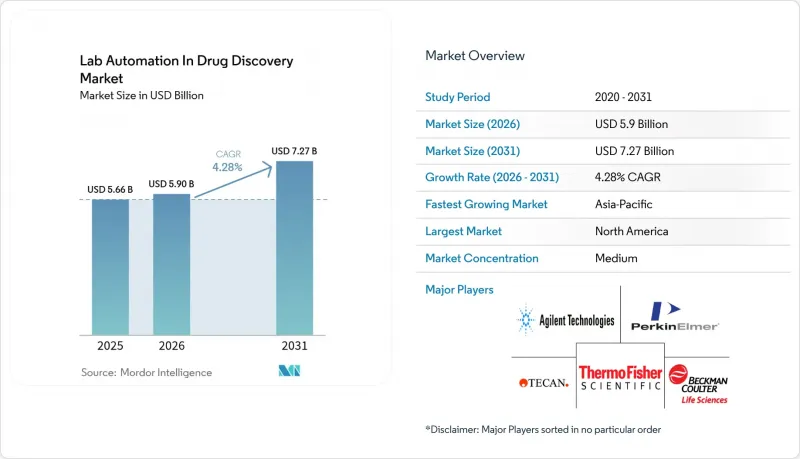
본 보고서는 장비별(자동 액체 핸들러, 자동 플레이트 핸들러, 기타), 용도별(표적 동정·검증, 히트-투-리드, 기타), 최종 사용자별(제약 회사, 생명공학 기업, 기타), 지역별(북미, 남미, 유럽, 아시아태평양, 기타)로 분류되어 있습니다. 시장 전망은 금액(달러) 기준으로 제시되어 있습니다.
세계의 Drug Discovery 분야 실험실 자동화 시장 동향 및 인사이트
급속한 소형화 및 HTS 플랫폼
1,536웰 및 3,456웰의 소형화 플레이트 덕분에, 고성능 스크리닝(HTS)의 일일 처리량은 현재 10만 개 이상의 화합물에 달하며, 데이터의 품질을 저하시키지 않으면서 시약 사용량을 95% 절감하고 있습니다. 음향식 디스펜서는 서브 마이크로리터 단위의 정밀도를 실현하며, 환경 센서가 탑재된 플레이트 핸들러는 엄격한 규제 관리 하에서도 어세이의 무결성을 유지합니다. 이 기술로 인해 분석당 비용이 절감되고 저분자 화합물 라이브러리의 커버리지가 확대됨에 따라, 과거에는 대형 로봇 시스템을 도입할 자금이 부족했던 생명공학 스타트업 기업들 사이에서도 그 도입이 확산되고 있습니다. 통합 시스템을 통해 시료 전처리와 분석 간의 수작업 인계가 줄어들고, 가동 시간이 향상되며, 운영자에 의한 수동 점검의 필요성이 최소화됩니다. 현재 미국과 유럽의 규제 당국은 신청 서류에 첨부된 자료로서 소형화된 분석 결과를 승인하고 있어, 제도상의 마지막 장벽이 제거되었습니다.
AI를 활용한 분석 기능의 통합
인공지능(AI)을 통해 기존 로봇은 프로토콜을 실시간으로 최적화하는 적응형 연구 파트너로 변모합니다. NVIDIA BioNeMo와 같은 플랫폼을 통해 액체 핸들러는 과거 성능을 기반으로 자동으로 조정을 수행할 수 있게 되어, 편차를 최대 40%까지 줄이는 동시에 데이터 검토 전에 이상을 감지하여 경고를 발령합니다. 예지 유지보수 알고리즘 또한 예기치 못한 가동 중단 시간을 단축하고 연간 생산 시간을 연장합니다. 이와 동시에 딥러닝 엔진이 스크리닝 결과를 면밀히 검토하여 히트 항목을 자동으로 순위를 매김으로써, 히트 항목에서 리드로 전환되는 기간을 약 30% 단축합니다.
중소기업의 막대한 설비 투자
종합적인 자동화 라인 도입 비용은 200만 달러 이상에 달하며, 그 투자 효과가 입증되었음에도 불구하고 많은 바이오테크 스타트업 기업에게는 감당하기 어려운 수준입니다. 리스나 RaaS(Robot-as-a-Service)와 같은 제도가 등장하고 있지만, 엄격한 신용 심사 및 수년에 걸친 계약 의무로 인해 여전히 창업 초기 기업의 진입을 가로막고 있습니다. 지역 은행은 대상 기업을 선별하여 대출을 제공하고 있으나, 대출 한도가 제한적이어서 수요를 완전히 충족시키지 못하고 있습니다.
부문별 분석
자동 액체 핸들러는 2025년 지출의 31.05%를 차지하며, 거의 모든 스크리닝 및 분석에서 중심적인 역할을 하고 있음이 부각되었습니다. 음향 디스펜싱 기술의 지속적인 개선으로, 고가의 시약을 보호하면서도 분석 정확도를 유지하는 서브마이크로리터 단위의 이송이 가능해졌습니다. 각 벤더사는 AI 대시보드를 통합하여, 사업자가 과거 오류 동향을 바탕으로 프로토콜을 미세 조정할 수 있게 되었습니다. 실험실 가동 시간이 연장됨에 따라 가동률과 칩의 경제성이 결정적인 구매 요인이 되고 있습니다. 비접촉 세척 기술의 병행적인 혁신으로 교차 오염 위험이 감소하고 소모품 예산도 절감되고 있습니다.
자동 보관·인출 시스템은 규모는 작지만 연평균 성장률(CAGR) 5.45%를 기록하며 가장 빠르게 성장했습니다. 다온도 대응 타워에는 바코드 검증 기능과 FDA의 감사 추적 요건을 충족하는 관리 이력 기록 기능이 통합되어 있습니다. 모듈식 설계 덕분에 기존 시설에서도 워크플로우를 방해하지 않고 용량을 증강할 수 있으며, 클라우드 대시보드에서는 예측 유지보수 알림이 발송되어 비용이 많이 드는 가동 중지 시간을 미연에 방지합니다. 향후, 단일 통로 내에 극저온 랙과 상온 랙을 병설하는 하이브리드 시스템을 통해 가동률의 추가적인 향상이 기대됩니다.
지역별 분석
2025년, 북미는 전 세계 매출의 34.20%를 차지하며, 첨단 플랫폼의 최대 시장으로 자리매김했습니다. 미국은 공유 핵심 시설의 현대화를 추진하는 국립보건원(NIH)의 지속적인 보조금 지원으로 주도적인 위치를 유지하고 있는 반면, 캐나다 온타리오주와 퀘벡주의 연구 클러스터에서는 개조된 실험실에 적합한 모듈형 로봇이 선호되고 있습니다. 멕시코의 제조 회랑에서는 현재 미국과 유럽 공급업체를 위한 하위 조립품이 생산되고 있어 국경을 넘는 공급이 효율화되고 있습니다.
유럽도 이에 뒤이어 독일, 영국, 스위스에서 꾸준한 도입이 진행되고 있습니다. 지속가능성에 관한 규제로 인해 마이크로플루이딕스 카트리지의 급속한 보급이 촉진되고 있으며, 기존 플레이트에 비해 용매 사용량을 90% 줄이고 있습니다. ‘호라이즌 유럽(Horizon Europe)’ 보조금은 여러 기관에 걸친 자동화 프로젝트를 지원하고 있으며, 유럽의약품청(EMA)의 데이터 무결성 지침에서 자동화된 감사 추적이 표준 관행으로 자리 잡았기 때문에 실험실 정보 관리 시스템 업그레이드에 대한 재주문이 촉진되고 있습니다.
아시아태평양은 대규모 공공 투자의 견인력에 힘입어 연평균 성장률(CAGR) 5.62%라는 가장 높은 성장률을 보이고 있습니다. 중국은 ‘중국 제조 2025’ 전략에 따라 자동화 실험실에 막대한 예산을 배정하고 있는 반면, 인도의 CRDMO(의약품 개발·제조 수탁) 부문은 유럽과 미국의 후원사들이 전임상 검사 위탁을 동아시아로 전환함에 따라 두 자릿수 성장률을 기록하고 있습니다. 일본과 한국은 기존 로봇 라인에 AI 기능을 통합함으로써 성장세를 가속화하고 있으며, 품질 면에서 세계 표준을 확보하고 있습니다. 지역 규제 당국은 아세안(ASEAN)의 규제 조화를 통해 기준을 합리화하고 국경 간 도입 절차를 간소화하는 한편, 다국적 기업의 사업 확장 계획을 뒷받침하고 있습니다.
기타 혜택
- 엑셀 형식 시장 예측(ME) 시트
- 3개월간의 애널리스트 지원
자주 묻는 질문
목차
제1장 서론
제2장 조사 방법
제3장 주요 요약
제4장 시장 구도
제5장 시장 규모 및 성장 예측
제6장 경쟁 구도
제7장 시장 기회 및 향후 전망
KTH 26.09.04According to Mordor Intelligence, the lab automation market size in the drug discovery sector was valued at USD 5.66 billion in 2025 and estimated to grow from USD 5.90 billion in 2026 to reach USD 7.27 billion by 2031, at a CAGR of 4.28% during the forecast period (2026-2031).
This report is Segmented by Equipment (Automated Liquid Handlers, Automated Plate Handlers, and More), Application (Target Identification and Validation, Hit-To-Lead, and More), End User (Pharmaceutical Companies, Biotechnology Companies, and More), and Geography (North America, South America, Europe, Asia-Pacific, and More). The Market Forecasts are Provided in Terms of Value (USD).
Global Lab Automation In Drug Discovery Market Trends and Insights
Rapid Miniaturization and HTS Platforms
High-throughput screening now reaches daily volumes of over 100,000 compounds, thanks to miniaturized 1,536- and 3,456-well plates, which cut reagent use by 95% without compromising data quality.Acoustic dispensers deliver sub-microliter precision, and plate handlers equipped with environmental sensors maintain assay integrity under stringent regulatory controls. The technology lowers per-assay cost, broadens library coverage for small molecules, and widens adoption among biotechnology start-ups that once lacked capital for large-footprint robotics. Integrated systems reduce handoffs between sample preparation and analysis, boosting uptime and minimizing the need for manual checks by operators. Regulators in the United States and Europe now accept miniaturized assay results for submission dossiers, removing the last institutional hurdle.
Integration of AI-enabled Analytics
Artificial intelligence converts conventional robots into adaptive research companions that optimize protocols in real time. Platforms such as NVIDIA BioNeMo enable liquid handlers to self-adjust based on historical performance, reducing variance by up to 40% while flagging anomalies before data review. Predictive maintenance algorithms equally shrink unplanned downtime, extending annual productive hours. In parallel, deep-learning engines sift through screening outputs to auto-rank hits, trimming hit-to-lead timelines by roughly 30%.
High CAPEX for SMEs
Comprehensive automation lines cost over USD 2 million, a threshold beyond the reach of many biotech start-ups despite proven paybacks. Leasing and robotics-as-a-service schemes have emerged, yet stiff credit checks and multi-year commitments still deter early-stage firms. Regional banks offer targeted loans, but limited quotas leave demand unmet.
Other drivers and restraints analyzed in the detailed report include:
- Chronic-disease Research and Devlopment Spending Up-cycle
- Demand for Faster Time-to-clinic
- Legacy-software Interoperability Gaps
For complete list of drivers and restraints, kindly check the Table Of Contents.
Segment Analysis
Automated liquid handlers accounted for 31.05% of the 2025 expenditure, underscoring their centrality in nearly every screen and assay. Continuous improvements in acoustic dispensing now enable sub-microliter transfers that safeguard expensive reagents while preserving analytical precision. Vendors embed AI dashboards, allowing operators to fine-tune protocols based on historical error trends. As laboratories extend operating hours, uptime and tip economy become decisive buying factors. Parallel innovation in contactless cleaning lowers cross-contamination risk and reduces consumable budgets.
Automated storage and retrieval systems, although smaller in base, represent the fastest-growing cluster with a 5.45% CAGR. Multi-temperature towers integrate barcode verification and chain-of-custody logging that satisfy FDA audit trails. Modular footprints let mature facilities add capacity without disrupting workflows, and cloud dashboards issue predictive maintenance alerts that prevent costly downtime. Looking ahead, hybrid systems that co-locate cryogenic and ambient racks in a single aisle are expected to yield further utilization gains.
Complete Report Scope:
- By Equipment
- Automated Liquid Handlers
- Automated Plate Handlers
- Robotic Arms
- Automated Storage and Retrieval Systems
- Analyzers
- By Application
- Target Identification and Validation
- Hit-to-Lead
- Lead Optimisation
- High-Throughput Screening
- ADME-Tox Studies
- By End User
- Pharmaceutical Companies
- Biotechnology Companies
- Contract Research Organisations (CROs)
- Academic and Government Labs
- By Geography
- North America
- United States
- Canada
- Mexico
- South America
- Brazil
- Argentina
- Rest of South America
- Europe
- Germany
- United Kingdom
- France
- Italy
- Spain
- Russia
- Rest of Europe
- Asia-Pacific
- China
- Japan
- India
- South Korea
- South-East Asia
- Rest of Asia-Pacific
- Middle East and Africa
- North America
Geography Analysis
North America accounted for 34.20% of global revenue in 2025 and remains the largest market for advanced platforms. The United States leads through sustained National Institutes of Health grants that modernize shared-core facilities, while Canada's research clusters in Ontario and Quebec favor modular robotics that fit in retrofit labs. Mexico's manufacturing corridors now produce subassemblies for U.S. and European vendors, streamlining cross-border supply.
Europe follows with robust adoption in Germany, the United Kingdom, and Switzerland. Sustainability rules drive the rapid uptake of microfluidic cartridges, which slash solvent use by 90% compared with legacy plates. Horizon Europe grants support multi-institutional automation projects, and the European Medicines Agency's data-integrity guidance positions automated audit trails as a standard practice, spurring repeat orders for laboratory information management upgrades.
The Asia-Pacific region grows at the fastest rate of 5.62% CAGR, driven by substantial public investment. China has earmarked a significant portion for automated labs that align with its "Made in China 2025" strategy, while India's CRDMO sector is scaling into double digits as Western sponsors shift preclinical briefs eastward. Japan and South Korea add momentum by integrating AI layers into established robotic lines, ensuring global alignment on quality. Regional regulators streamline standards through ASEAN harmonization, simplifying cross-border deployments and fueling multinational rollout plans.
- Thermo Fisher Scientific Inc.
- Beckman Coulter Life Sciences
- Hudson Robotics Inc.
- Becton, Dickinson and Company
- MolGen B.V.
- Agilent Technologies Inc.
- Siemens Healthineers AG
- Tecan Group AG
- PerkinElmer Inc.
- Bio-Rad Laboratories Inc.
- F. Hoffmann-La Roche AG
- Eppendorf SE
- Shimadzu Corporation
- Aurora Biomed Inc.
- Hamilton Company
- HighRes Biosolutions Inc.
- SPT Labtech Ltd.
- Biosero Inc.
- TTP Labtech Holdings
- Automata Tech
- Opentrons Labworks Inc.
- Analytik Jena GmbH
- Andrew Alliance SA
- Arctoris Ltd.
- Labman Automation Ltd.
Additional Benefits:
- The market estimate (ME) sheet in Excel format
- 3 months of analyst support
TABLE OF CONTENTS
1 INTRODUCTION
- 1.1 Study Assumptions and Market Definition
- 1.2 Scope of the Study
2 RESEARCH METHODOLOGY
3 EXECUTIVE SUMMARY
4 MARKET LANDSCAPE
- 4.1 Market Overview
- 4.2 Market Drivers
- 4.2.1 Rapid miniaturisation and HTS platforms
- 4.2.2 Integration of AI-enabled analytics
- 4.2.3 Chronic-disease RandD spending up-cycle
- 4.2.4 Demand for faster time-to-clinic
- 4.2.5 Open-source lab-automation consortia
- 4.2.6 Sustainability-driven micro-fluidics
- 4.3 Market Restraints
- 4.3.1 High CAPEX for SMEs
- 4.3.2 Legacy-software interoperability gaps
- 4.3.3 Supplier back-orders on precision actuators
- 4.3.4 Post-COVID wet-lab talent crunch
- 4.4 Impact of Macroeconomic Factors
- 4.5 Technological Outlook
- 4.6 Regulatory Landscape
- 4.7 Industry Value Chain Analysis
- 4.8 Porter's Five Forces Analysis
- 4.8.1 Bargaining Power of Suppliers
- 4.8.2 Bargaining Power of Buyers
- 4.8.3 Threat of New Entrants
- 4.8.4 Threat of Substitutes
- 4.8.5 Intensity of Rivalry
5 MARKET SIZE AND GROWTH FORECASTS (VALUE)
- 5.1 By Equipment
- 5.1.1 Automated Liquid Handlers
- 5.1.2 Automated Plate Handlers
- 5.1.3 Robotic Arms
- 5.1.4 Automated Storage and Retrieval Systems
- 5.1.5 Analyzers
- 5.2 By Application
- 5.2.1 Target Identification and Validation
- 5.2.2 Hit-to-Lead
- 5.2.3 Lead Optimisation
- 5.2.4 High-Throughput Screening
- 5.2.5 ADME-Tox Studies
- 5.3 By End User
- 5.3.1 Pharmaceutical Companies
- 5.3.2 Biotechnology Companies
- 5.3.3 Contract Research Organisations (CROs)
- 5.3.4 Academic and Government Labs
- 5.4 By Geography
- 5.4.1 North America
- 5.4.1.1 United States
- 5.4.1.2 Canada
- 5.4.1.3 Mexico
- 5.4.2 South America
- 5.4.2.1 Brazil
- 5.4.2.2 Argentina
- 5.4.2.3 Rest of South America
- 5.4.3 Europe
- 5.4.3.1 Germany
- 5.4.3.2 United Kingdom
- 5.4.3.3 France
- 5.4.3.4 Italy
- 5.4.3.5 Spain
- 5.4.3.6 Russia
- 5.4.3.7 Rest of Europe
- 5.4.4 Asia-Pacific
- 5.4.4.1 China
- 5.4.4.2 Japan
- 5.4.4.3 India
- 5.4.4.4 South Korea
- 5.4.4.5 South-East Asia
- 5.4.4.6 Rest of Asia-Pacific
- 5.4.5 Middle East and Africa
- 5.4.1 North America
6 COMPETITIVE LANDSCAPE
- 6.1 Market Concentration
- 6.2 Strategic Moves
- 6.3 Market Share Analysis
- 6.4 Company Profiles (includes Global level Overview, Market level overview, Core Segments, Financials as available, Strategic Information, Market Rank/Share, Products and Services, Recent Developments)
- 6.4.1 Thermo Fisher Scientific Inc.
- 6.4.2 Beckman Coulter Life Sciences
- 6.4.3 Hudson Robotics Inc.
- 6.4.4 Becton, Dickinson and Company
- 6.4.5 MolGen B.V.
- 6.4.6 Agilent Technologies Inc.
- 6.4.7 Siemens Healthineers AG
- 6.4.8 Tecan Group AG
- 6.4.9 PerkinElmer Inc.
- 6.4.10 Bio-Rad Laboratories Inc.
- 6.4.11 F. Hoffmann-La Roche AG
- 6.4.12 Eppendorf SE
- 6.4.13 Shimadzu Corporation
- 6.4.14 Aurora Biomed Inc.
- 6.4.15 Hamilton Company
- 6.4.16 HighRes Biosolutions Inc.
- 6.4.17 SPT Labtech Ltd.
- 6.4.18 Biosero Inc.
- 6.4.19 TTP Labtech Holdings
- 6.4.20 Automata Tech
- 6.4.21 Opentrons Labworks Inc.
- 6.4.22 Analytik Jena GmbH
- 6.4.23 Andrew Alliance SA
- 6.4.24 Arctoris Ltd.
- 6.4.25 Labman Automation Ltd.
7 MARKET OPPORTUNITIES AND FUTURE OUTLOOK
- 7.1 White-space and Unmet-need Assessment