|
시장보고서
상품코드
2120508
왁스 : 시장 점유율 분석, 업계 동향 및 통계, 성장 예측(2026-2031년)Wax - Market Share Analysis, Industry Trends & Statistics, Growth Forecasts (2026 - 2031) |
||||||
 Mordor Intelligence
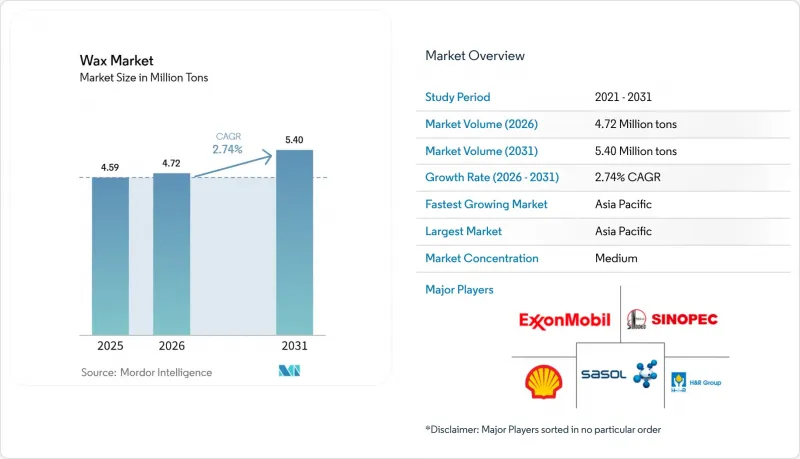
Mordor Intelligence에 의하면, 왁스 시장 규모는 2025년 459만 톤으로 평가되었습니다. 2026년 472만 톤으로부터, 2031년까지 540만 톤으로 확대되고 예측 기간(2026-2031년) CAGR은 2.74%를 나타낼 전망입니다.
본 보고서는 유형별(파라핀·광물 왁스, 합성 왁스, 천연 왁스), 용도별(양초 제조, 포장, 화장품, 기타), 등급별(식품 등급, 산업용 등급, 기타), 형태별(고체, 분말, 에멀젼·액체),지역별(아시아태평양, 북미, 유럽, 남미, 중동 및 아프리카)로 분류되어 있습니다. 시장 예측은 수량(톤) 기준으로 제시되어 있습니다.
세계의 왁스 시장 동향 및 인사이트
아시아태평양의 전자상거래 붐에 따른 핫멜트 포장용 소재 및 FT 왁스 수요 증가
아시아태평양의 급속한 산업화로 인해 해당 지역의 왁스 소비량은 현저히 증가하고 있습니다. 2025년 5월 중국의 파라핀 월간 수출량은 7만 800톤에 달했으며, 이는 포장 가공업체의 하류 수요가 견조함을 보여줍니다. 사솔(SASOL)은 2024년 8월 ‘SASOLWAX LC100’을 출시하여, 해당 제품의 탄소 발자국을 35% 감축함으로써 고급 전자상거래 포장 시장을 공략하고 있습니다. 클라리언트(Clariant)가 2025년 4월에 출시한 쌀겨 유래의 ‘Ceridust 1310’은 지속가능성 지표를 향상시키면서도 인쇄 잉크의 성능을 보장하고 있습니다. 왁스에 특화된 엄격한 규제가 없는 가운데, 현재는 ISO 9001 인증이나 브랜드의 탄소 보고서가 공급업체 선정에 영향을 미치고 있습니다.
유럽의 클린 라벨 화장품 시장에서 식물 유래 및 꿀벌 유래 왁스로의 전환 가속화
유럽의 각 브랜드는 합성 탄화수소를 배제하기 위해 배합을 재검토하고 있으며, 칸데릴라 왁스, 카르나우바 왁스, 쌀겨 왁스, 해바라기 왁스의 대체품에 대한 수요가 확대되고 있습니다. ‘Licocare RBW Vita’는 카르나우바 왁스에 비해 탄소 발자국을 80% 줄이면서도 경도와 광택을 재현하여, 프리미엄 브랜드가 스코프 3 목표를 달성하는 데 일조하고 있습니다. 밀랍은 다기능적인 매력을 유지하고 있지만, 비건 제품 라인이 급증함에 따라 대체재에 대한 수요가 높아지고 있으며, 또한 꿀 생산량의 변동으로 인해 공급 계획 수립이 복잡해지고 있습니다. 2028년 10월에 발효될 EU의 씻어내는 유형 화장품에 대한 미세 플라스틱 금지 조치로 인해, 배합 선택은 천연 텍스처라이저로 기울고 있습니다. EU 규정 1223/2009 및 REACH에 따른 규정 준수 비용은 상승하고 있지만, 바로 이러한 규정들이 인증 등급 제품의 판매 가격 상승을 뒷받침하는 요인이 되고 있습니다.
유럽연합(EU)의 REACH 규정에 따른 장난감 및 화장품에 포함된 파라핀에 대한 PAH 규제 강화
2026년 4월부터 REACH 개정에 따라 클레이 사격용 표적, 장난감, 파라핀이 포함된 화장품의 다환 방향족 탄화수소(PAH) 함량이 50mg/kg으로 제한됩니다. 슬랙 왁스 유래 파라핀은 본래 PAH 함량이 높기 때문에 수소화 처리에 대한 투자가 진행되고 있으며, 이로 인해 톤당 100-200달러의 비용이 증가하고 있습니다. 클라리언트(Clariant)사의 PFAS 무첨가 첨가제 포트폴리오는 이러한 변화에 부합하며, 이 회사는 고급 제품 제조업체들 사이에서 유리한 입지를 확립하고 있습니다. 이 규제는 EU 규정 1935/2004에 따른 식품 접촉용 잉크에도 파급되고 있으며, 현재는 이행 검사가 공급업체 감사의 일부로 포함되고 있습니다. REACH의 적용을 받지 않는 아시아 수출업체들은 여전히 비용 면에서 우위를 유지하고 있지만, 다국적 기업들은 규정 준수를 간소화하기 위해 지역 간 규제 조화를 점점 더 추진하고 있습니다.
부문별 분석
파라핀은 2025년 생산량의 58.12%를 차지하며, 중국의 200만 톤 생산량과 1kg당 1.50-2달러의 비용 우위가 그 기반이 되었습니다. 천연 등급은 연평균 성장률(CAGR) 3.45%로 증가하고 있으며, 이는 각 유형 중 가장 높은 성장률입니다. 이는 유럽 브랜드들이 클린 라벨화를 추진하는 가운데 식물 유래 왁스를 선호하여 채택하고 있기 때문입니다. 합성 FT 왁스와 폴리에틸렌 왁스는 핫멜트 접착제나 코팅제와 같은 고성능 틈새 시장을 점유하고 있습니다. 2024년에 발표된 ‘SASOLWAX LC100’은 탄소 발자국을 35% 줄여, 고급 포장 시장에서의 매력을 높이고 있습니다. 클라리언트(Clariant)사의 쌀겨 유래 ‘Licocare’ 시리즈는 천연 왁스 분야의 저탄소 혁신 사례로, 순수 광물계 등급에서 점진적으로 전환되고 있음을 입증하고 있습니다.
중국의 파라핀 수출 점유율이 왁스 시장의 유동성을 유지하고 있지만, EU의 PAH 규제 강화로 인해 정제된 미세결정성 분획과의 혼합이 촉진되고 있습니다. 뛰어난 향기 확산력 덕분에 양초 제조에서는 여전히 파라핀이 주류를 이루고 있지만, 비건 제품 라인에서는 대두나 코코넛의 혼합이 점차 그 점유율을 잠식하고 있습니다. 미세결정성 분획은 특수 고무나 화장품에 이용되고 있으며, 융점이 55-100℃인 점 때문에 고가에 거래되고 있습니다. 브라질의 카르나우바 생산량 1만 7,844톤은 천연 왁스 공급업체에 가격 협상에서 우위를 점하게 하고 있습니다. 이러한 동향을 종합해 보면, 향후 10년 동안 파라핀의 왁스 시장 점유율이 완만하지만 꾸준히 하락할 것으로 예측됩니다.
2025년 생산량의 60.32%는 양초 제조가 차지했으나, PFAS 프리 및 비건 대응 제품 재처방에 힘입어 화장품 부문이 2031년까지 연평균 성장률(CAGR) 3.68%로 가장 빠르게 확대될 전망입니다. 아시아태평양의 전자상거래에 힘입어 성장하는 포장 부문에서는 왁스가 풍부하게 함유된 핫멜트 시스템이 활용되고 있습니다. 고무 용도의 경우, 오존 균열을 방지하기 위해 타이어 배합에 약 1%의 파라핀이 사용됩니다. 화장품 등급의 밀랍, 카르나우바 왁스, 칸데릴라 왁스는 유화 작용과 광택을 부여하기 때문에 1kg당 8-12달러의 가격 책정이 정당화됩니다.
핫멜트 수요 증가로 인해 분자량 분포가 좁은 폴리에틸렌과 FT 분획에 대한 수요가 증가하고 있습니다. 크레용, 연마제, 전기 절연재는 미세 결정성 등급에 있어 틈새 시장이지만 안정적인 판로를 형성하고 있습니다. 클라리언트(Clariant)사의 ‘Ceridust 1310’은 쌀겨 왁스를 인쇄 잉크에 도입하여, 용도 전반에 걸친 혁신을 두드러지게 하고 있습니다. 웰빙 지향 캔들은 현재 연중 판매되고 있으며, 고융점 파라핀 수요를 견인하고 있어 고체 왁스가 여전히 주류를 차지하고 있습니다. 화장품 부문의 눈부신 성장 궤적은 미용 용도와 관련된 왁스 시장 규모가 향후 더 큰 부가가치를 창출해 나갈 것임을 시사합니다.
지역별 분석
아시아태평양은 2025년 세계 생산량의 45.54%를 차지했으며, 중국의 200만 톤 생산량과 견조한 전자상거래 포장 수요에 힘입어 2031년까지 지역 최고 수준인 연평균 성장률(CAGR) 3.27%로 확대될 것으로 전망됩니다. 중국석유천연가스그룹(CNPC)의 왁스 생산 시설 가동률은 평균 90%에 달하며, 이는 공급의 신뢰성을 뒷받침하고 있습니다. 인도의 국내 양초 및 화장품 산업 클러스터는 수입품 대체를 시작하고 있지만, 여전히 중국 및 중동산 슬랙 왁스에 대한 의존도가 지속되고 있습니다.
북미는 셰일가스에 기반한 비용 우위의 혜택을 누리고 있습니다. 헨리 허브 가격과 동등한 에탄 가격 덕분에 폴리에틸렌 왁스의 경쟁력이 유지되고 있습니다. 고급 양초 판매와 자사 브랜드용 포장 수요가 수요를 뒷받침하는 한편, 멕시코는 미국 내 자동차 및 전자상거래 채널에 대한 공급에서 저비용 가공업체로서의 입지를 확고히 하고 있습니다. 에탄 크래커의 확장이 지속됨에 따라, 해당 지역의 왁스 시장은 구조적인 투입 비용 우위를 계속 누릴 것으로 예측됩니다.
유럽은 역풍에 직면해 있습니다. REACH의 PAH 규제로 인해 공급업체들은 수소화 공정에 대한 투자를 강요받고 있으며, 이로 인해 손익분기점이 톤당 150달러 상승했습니다. 독일과 프랑스의 클린 라벨(Clean Label) 추진으로 천연 왁스 수요는 증가하고 있지만, 쉘(Shell)사의 베셀링(Wesseling) 사업 철수 등 정제소의 철수로 인해 현지 공급이逼迫하고 있습니다. 남미는 수출 수입의 원천으로서 브라질의 1만 7,844톤 카르나우바 수확에 크게 의존하고 있는 반면, 페트로브라스는 하루 185만 1,000배럴 규모의 정제 시스템에서 부산물인 파라핀을 회수하고 있습니다. 중동 및 아프리카는 원유가 풍부함에도 불구하고 여전히 순수입 지역으로 남아 있습니다. 사우디아라비아는 2023년에 2,077톤의 왁스를 수입했는데, 이는 원료의 확보 가능성과 특수 가공 능력 사이에 불일치가 있음을 여실히 보여줍니다.
기타 혜택
- 엑셀 형식 시장 전망(ME) 시트
- 3개월간의 애널리스트 지원
자주 묻는 질문
목차
제1장 서론
제2장 조사 방법
제3장 주요 요약
제4장 시장 구도
제5장 시장 규모 및 성장 예측
제6장 경쟁 구도
제7장 시장 기회 및 향후 전망
KTH 26.09.04According to Mordor Intelligence, the wax market size is projected to expand from 4.59 million tons in 2025 and 4.72 million tons in 2026 to 5.40 million tons by 2031, at a CAGR of 2.74% during the forecast period (2026-2031).
This report is Segmented by Type (Paraffin and Mineral Wax, Synthetic Wax, and Natural Wax), Application (Candle Making, Packaging, Cosmetics, and More), Grade (Food Grade, Industrial Grade, and More), Form (Solid, Powdered, and Emulsions and Liquids), and Geography (Asia-Pacific, North America, Europe, South America, Middle East and Africa). The Market Forecasts are Provided in Terms of Volume (Tons).
Global Wax Market Trends and Insights
Asia-Pacific E-commerce Boom Boosting Hot-Melt Packaging and FT Wax Demand
Asia-Pacific's wax consumption is growing significantly owing to rapid industrialization in the region. Monthly Chinese paraffin exports hit 70,800 tons in May 2025, evidence of strong downstream demand from packaging converters. Sasol introduced SASOLWAX LC100 in August 2024, cutting the product's carbon footprint by 35% to target premium e-commerce packaging. Clariant's rice-bran-based Ceridust 1310, launched in April 2025, secures printing-ink performance with improved sustainability metrics. With no stringent wax-specific regulation, ISO 9001 certification and brand carbon reporting now influence supplier selection.
Clean-Label Cosmetics in Europe Accelerating Plant and Bee-Based Wax Shift
European brands are reformulating to exclude synthetic hydrocarbons, spurring demand for candelilla, carnauba, rice-bran, and sunflower wax alternatives. Licocare RBW Vita reduces the carbon footprint by 80% compared with carnauba yet replicates hardness and gloss, helping premium brands meet Scope-3 goals. Beeswax retains multifunctional appeal but faces substitution as vegan lines proliferate, and fluctuating honey output makes supply planning complex. The EU microplastics ban in rinse-off cosmetics, effective October 2028, tips formulation choices toward natural texturizers. Compliance costs rise under EU Regulation 1223/2009 and REACH, but these same rules underpin higher selling prices for certified grades.
European Union REACH PAH Limits Tightening on Paraffin in Toys and Cosmetics
From April 2026, the REACH amendment caps polycyclic aromatic hydrocarbons in clay targets, toys, and paraffin-bearing cosmetics at 50 mg/kg. Slack-wax-based paraffin carries higher inherent PAH content, prompting investments in hydrotreating that add USD 100-200 per ton to cost. Clariant's PFAS-free additives portfolio dovetails with these changes, positioning the company favorably among premium formulators. The restriction spills into food-contact inks under EU Regulation 1935/2004, where migration testing now forms part of supplier audits. Asian exporters not bound by REACH retain a cost edge, yet multinationals increasingly harmonize across regions to simplify compliance.
Other drivers and restraints analyzed in the detailed report include:
- North America Ethane-Cracker Build-Out Lowering PE-Wax Cost Curve
- Candle Premiumisation and Wellness Trend Expanding Global Paraffin Demand
- Crude and Gas Price Volatility Squeezing Synthetic and Paraffin Margins
For complete list of drivers and restraints, kindly check the Table Of Contents.
Segment Analysis
Paraffin held 58.12% of 2025 volume, anchored by China's 2 million-ton output and a cost advantage of USD 1.50-2.00 per kg. Natural grades are rising at a 3.45% CAGR, the highest among types, as European brands favor plant-derived waxes for cleaner labels. Synthetic FT and polyethylene waxes fill high-performance niches in hot-melt adhesives and coatings. SASOLWAX LC100, unveiled in 2024, lowers carbon footprint by 35%, expanding premium packaging appeal. Clariant's rice-bran Licocare series demonstrates low-carbon innovation in natural waxes, underscoring a steady shift away from pure mineral grades.
China's share of paraffin exports keeps the wax market liquid, but tightening PAH norms in the EU incentivize blends with purified microcrystalline fractions. While paraffin remains king in candle making due to superior scent throw, soy and coconut blends nibble at share in vegan lines. Microcrystalline fractions service specialty rubber and cosmetics, fetching premiums for 55-100 °C melting points. Brazil's 17,844-ton carnauba output gives natural wax suppliers bargaining power in price negotiations. Collectively, these dynamics foreshadow a slow yet steady erosion of paraffin's wax market share over the next decade.
Candle making absorbed 60.32% of 2025 volume, yet cosmetics will expand the fastest at 3.68% CAGR through 2031, driven by PFAS-free and vegan reformulations. Packaging, powered by Asia-Pacific e-commerce, benefits from wax-rich hot-melt systems. Rubber applications rely on paraffin at roughly 1 phr in tire formulas to counter ozone cracking. Cosmetic-grade beeswax, carnauba, and candelilla deliver emulsification and gloss, justifying prices of USD 8-12 per kg.
Hot-melt demand lifts polyethylene and FT fractions with narrow molecular-weight distributions. Crayons, polishes, and electrical insulation represent niche but sticky outlets for microcrystalline grades. Clariant's Ceridust 1310 brings rice-bran wax into printing inks, spotlighting cross-application innovation. Wellness-inspired candles, now sold year-round, pull high-melting-point paraffin, keeping solid waxes dominant. Cosmetics' superior growth trajectory nonetheless signals that the wax market size linked to beauty applications will capture incremental value.
Complete Report Scope:
- By Type
- Paraffin and Mineral Wax
- Synthetic Wax
- Natural Wax
- By Application
- Candle Making
- Packaging
- Cosmetics
- Adhesives
- Rubber
- Other Applications
- By Grade
- Food Grade
- Industrial Grade
- Cosmetic and Pharmaceutical Grade
- By Form
- Solid
- Powdered
- Emulsions and Liquids
- By Geography
- Asia-Pacific
- China
- India
- Japan
- South Korea
- ASEAN
- Rest of Asia-Pacific
- North America
- United States
- Canada
- Mexico
- Europe
- Germany
- United Kingdom
- France
- Italy
- Spain
- Rest of Europe
- South America
- Brazil
- Argentina
- Rest of South America
- Middle East and Africa
- Saudi Arabia
- South Africa
- Rest of Middle East and Africa
- Asia-Pacific
Geography Analysis
Asia-Pacific controlled 45.54% of 2025 global volume and is forecast to expand at a region-leading 3.27% CAGR through 2031, propelled by China's 2 million-ton output and robust e-commerce packaging. Utilization at CNPC's wax units averages 90%, underscoring supply reliability. India's domestic candle and cosmetic clusters start to displace imports, yet still rely on slack wax cargos from China and the Middle East.
North America benefits from a shale-gas-driven cost edge: ethane at Henry Hub parity keeps polyethylene wax competitive. Premium candle sales and private-label packaging bolster demand, while Mexico positions itself as a low-cost converter feeding U.S. auto and e-commerce channels. Continued ethane cracker expansions suggest that the region's wax market will enjoy a structural input-cost advantage.
Europe confronts headwinds: REACH PAH limits push suppliers to invest in hydrotreating, raising break-evens by USD 150 per ton. Clean-label initiatives in Germany and France boost natural wax uptake, but refinery exits-such as Shell's Wesseling pivot-tighten local supply. South America relies heavily on Brazil's 17,844-ton carnauba crop for export revenues, while Petrobras captures byproduct paraffin from its 1.851 million bpd refining system. Middle East and Africa remain net importers despite abundant crude: Saudi Arabia imported 2,077 tons of wax in 2023, highlighting a mismatch between feedstock availability and specialty processing.
- BASF SE
- BP p.l.c.
- Calumet, Inc.
- CALWAX
- China Petrochemical Corporation
- CLARIANT
- Evonik Industries AG
- Exxon Mobil Corporation
- H&R GROUP
- Honeywell International Inc.
- Ilumina Wax d.o.o.
- Koster Keunen
- Moeve
- NIPPON SEIRO CO., LTD.
- Petrobras
- Petro-Canada Lubricants Inc.
- Sasol Ltd.
- Shell plc
- Strahl & Pitsch LLC
- The International Group, Inc.
Additional Benefits:
- The market estimate (ME) sheet in Excel format
- 3 months of analyst support
TABLE OF CONTENTS
1 Introduction
- 1.1 Study Assumptions and Market Definition
- 1.2 Scope of the Study
2 Research Methodology
3 Executive Summary
4 Market Landscape
- 4.1 Market Overview
- 4.2 Market Drivers
- 4.2.1 Asia-Pacific e-commerce boom boosting hot-melt packaging and FT wax demand
- 4.2.2 Clean-label cosmetics in Europe accelerating plant and bee-based wax shift
- 4.2.3 North America ethane-cracker build-out lowering PE-wax cost curve
- 4.2.4 Candle premiumisation and wellness trend expanding global paraffin demand
- 4.2.5 Bio-based oleogels replacing saturated fats with natural waxes
- 4.3 Market Restraints
- 4.3.1 European Union REACH PAH limits tightening on paraffin in toys and cosmetics
- 4.3.2 Crude and gas price volatility squeezing synthetic and paraffin margins
- 4.3.3 Vegan-cosmetic reformulations substituting beeswax with oleochemicals
- 4.4 Value Chain Analysis
- 4.5 Porter's Five Forces
- 4.5.1 Bargaining Power of Suppliers
- 4.5.2 Bargaining Power of Buyers
- 4.5.3 Threat of New Entrants
- 4.5.4 Threat of Substitutes
- 4.5.5 Degree of Competition
5 Market Size and Growth Forecasts (Volume)
- 5.1 By Type
- 5.1.1 Paraffin and Mineral Wax
- 5.1.2 Synthetic Wax
- 5.1.3 Natural Wax
- 5.2 By Application
- 5.2.1 Candle Making
- 5.2.2 Packaging
- 5.2.3 Cosmetics
- 5.2.4 Adhesives
- 5.2.5 Rubber
- 5.2.6 Other Applications
- 5.3 By Grade
- 5.3.1 Food Grade
- 5.3.2 Industrial Grade
- 5.3.3 Cosmetic and Pharmaceutical Grade
- 5.4 By Form
- 5.4.1 Solid
- 5.4.2 Powdered
- 5.4.3 Emulsions and Liquids
- 5.5 By Geography
- 5.5.1 Asia-Pacific
- 5.5.1.1 China
- 5.5.1.2 India
- 5.5.1.3 Japan
- 5.5.1.4 South Korea
- 5.5.1.5 ASEAN
- 5.5.1.6 Rest of Asia-Pacific
- 5.5.2 North America
- 5.5.2.1 United States
- 5.5.2.2 Canada
- 5.5.2.3 Mexico
- 5.5.3 Europe
- 5.5.3.1 Germany
- 5.5.3.2 United Kingdom
- 5.5.3.3 France
- 5.5.3.4 Italy
- 5.5.3.5 Spain
- 5.5.3.6 Rest of Europe
- 5.5.4 South America
- 5.5.4.1 Brazil
- 5.5.4.2 Argentina
- 5.5.4.3 Rest of South America
- 5.5.5 Middle East and Africa
- 5.5.5.1 Saudi Arabia
- 5.5.5.2 South Africa
- 5.5.5.3 Rest of Middle East and Africa
- 5.5.1 Asia-Pacific
6 Competitive Landscape
- 6.1 Market Concentration
- 6.2 Strategic Moves
- 6.3 Market Share/Ranking Analysis
- 6.4 Company Profiles (includes Global-level Overview, Market-level Overview, Core Segments, Financials, Strategic Info, Market Rank/Share, Products and Services, Recent Developments)
- 6.4.1 BASF SE
- 6.4.2 BP p.l.c.
- 6.4.3 Calumet, Inc.
- 6.4.4 CALWAX
- 6.4.5 China Petrochemical Corporation
- 6.4.6 CLARIANT
- 6.4.7 Evonik Industries AG
- 6.4.8 Exxon Mobil Corporation
- 6.4.9 H&R GROUP
- 6.4.10 Honeywell International Inc.
- 6.4.11 Ilumina Wax d.o.o.
- 6.4.12 Koster Keunen
- 6.4.13 Moeve
- 6.4.14 NIPPON SEIRO CO., LTD.
- 6.4.15 Petrobras
- 6.4.16 Petro-Canada Lubricants Inc.
- 6.4.17 Sasol Ltd.
- 6.4.18 Shell plc
- 6.4.19 Strahl & Pitsch LLC
- 6.4.20 The International Group, Inc.
7 Market Opportunities and Future Outlook
- 7.1 White-Space and Unmet-Need Assessment