

|
시장보고서
상품코드
2120550
선형 알킬벤젠(LAB) : 시장 점유율 분석, 업계 동향 및 통계, 성장 예측(2026-2031년)Linear Alkyl Benzene (LAB) - Market Share Analysis, Industry Trends & Statistics, Growth Forecasts (2026 - 2031) |
||||||
 Mordor Intelligence
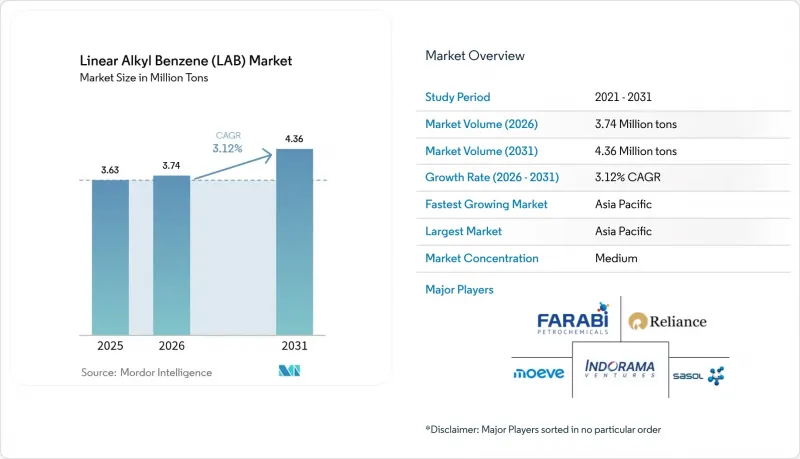
Mordor Intelligence에 의하면, 선형 알킬벤젠(LAB) 시장 규모는 2025년 363만 톤으로 평가되었습니다. 2026년에는 374만 톤으로 확대되어 2031년까지 436만 톤에 이를 것으로 예상되고 2026-2031년에 걸쳐 CAGR 3.12%로 성장할 전망입니다.
본 보고서는 용도별(계면활성제, 기타), 최종 사용자 산업별(세탁 세제, 경질 식기 세제, 산업용 세정제, 가정용 세정제, 기타), 지역별(아시아태평양, 북미, 유럽, 남미, 중동 및 아프리카)로 분류되어 있습니다. 시장 예측은 수량(톤) 단위로 표시됩니다.
세계의 선형 알킬벤젠(LAB) 시장 동향 및 인사이트
신흥국에서의 세제 보급률 상승
인도, 인도네시아, 베트남, 나이지리아에서는 2급 및 3급 도시 지역에서 수요가 급증하고 있으며, 2028년까지 브랜드 세탁 세제의 가정 내 보급률이 크게 증가할 것으로 예측됩니다. 설비 가동률이 중간 수준인 인도의 제조업체들은 인도를 동아프리카와 중동으로의 순수출국으로 자리매김하고 있습니다. 동남아시아 소비자들이 고형 비누에서 분말 및 액체 세제로 전환하고 있는 반면, 사하라 사막 이남의 아프리카도 출발점은 낮지만 비슷한 길을 걷고 있습니다. 이러한 추세는 인구 통계학적 변화에 힘입어 가속화되고 있으며, 2030년까지 상당수의 인구가 전 세계 중산층에 합류할 것으로 예상되어 예측되는 연평균 성장률(CAGR)에 긍정적인 기여를 할 것으로 전망됩니다.
생분해성 LAS 계면활성제에 대한 규제 추진
유럽연합(EU)의 REACH 규정에서는 분지 사슬형 LAS에 비해 직쇄형 LAS가 분해 속도가 빠르다는 점이 강조되고 있으며, 선형 알킬벤젠은 규정 준수에 적합한 원료로 자리 잡고 있습니다. 2023년, 유럽 집행위원회는 계면활성제의 생분해성에 관한 더 엄격한 규제를 제안했으며, 이로 인해 배합의 신속한 변경이 촉진되었습니다. 선형 알킬벤젠(LAB)에서 유래한 선형 알킬벤젠 설폰산염(LAS)은 이미 28일 이내에 생분해성 기준치를 초과하고 있으므로, 분지쇄 유사 물질이나 특정 비이온성 변종에 비해 유리한 입장에 있습니다. 미국 환경보호청(EPA)의 ‘Safer Choice’ 프로그램은 시설용 세정 제품에서 LAS 사용을 권장하고 있는 반면, 일본의 ‘화학물질관리법’은 순도가 더 높은 등급으로 시장 전환을 촉진하고 있습니다. 이러한 규제는 전반적으로 시장 성장에 기여하고 있지만, 한편으로는 ISO 14001 인증을 취득하지 않은 소규모 공장의 경우 규정 준수 비용 증가 요인이 되고 있습니다.
원료(벤젠·파라핀)의 가격 변동
2024년부터 2025년에 걸쳐 벤젠 가격이 변동함에 따라, 비통합형 LAB 생산자의 현금 원가에 변동이 발생했습니다. N-파라핀 가격도 정유시설가 등유 생산을 지속가능한 항공 연료로 전환한 영향으로 유사한 변동을 보였습니다. 2025년 2월에는 세제 제조업체들의 재고 보충 움직임을 배경으로 중국과 유럽의 LABSA 현물 가격이 일시적으로 상승하여, 장기적인 인수 계획에 대한 과제가 부각되었습니다.
부문별 분석
2025년 생산량 중 계면활성제가 96.81%를 차지하여, 선형 알킬벤젠설폰산염(LAB) 생산에서 LABSA의 지배적인 지위가 부각되었습니다. 가정용 세제, 상업용 세정제, 산업용 탈지제에서는 뛰어난 가성비를 이유로 알코올 에톡시스설폰산염보다 LABSA가 선호되고 있습니다. 농약용 유화제, 섬유 보조제, 특수 코팅재용 선형 알킬벤젠 시장은 수성 에멀젼으로의 전환을 배경으로 2031년까지 연평균 성장률(CAGR) 4.55%를 나타낼 것으로 예측됩니다. 농축 세제 부문에서는 고순도이며 분자량 분포가 좁은 LABSA에 대한 수요가 증가하고 있어, 프리미엄 틈새 시장을 개척하고 있습니다. 또한, 농약 산업의 고객들은 LAB 유래의 유화제를 채택하는 경향이 있어, 제초제 농축액에서 탱크 혼합 안정성이 향상되고, 생산자들에게 새로운 수익 기회가 창출되고 있습니다.
이러한 전망을 더욱 강화하고 있는 것은 2차적 효과입니다. 아시아태평양에서는 소비자들이 지속가능성을 점점 더 중요시하게 되어, 탄소 발자국 저감 및 냉수 세척 효과를 중시하고 있습니다. 이러한 추세로 인해 배합 개발자들은 저온 세탁 시 탁도를 줄여주는 고순도 등급의 채택을 요구받고 있습니다. 또한, 산업용 표면 세정제에서는 유효 성분의 함유량이 증가하고 있어, 단위당 LAB 소비량 증가로 이어지고 있습니다. 계면활성제 부문은 사실상 독점 상태에 있지만, 부가가치가 높은 틈새 시장으로의 진출은 상품화가 진행된 시장에서 이익률 개선으로 이어집니다.
지역별 분석
아시아태평양은 2025년 총 생산량의 53.75%를 차지했으며, 2031년까지 연평균 성장률(CAGR) 4.22%를 나타낼 것으로 예측됩니다. 산둥성, 장쑤성, 허베이성, 허난성, 구자라트주에 밀집된 석유화학 클러스터를 기반으로, 중국과 인도는 합쳐서 연간 상당한 양의 LAB를 소비하고 있습니다. 인도의 LAB 생산 능력은 국내 소비량을 상회하여 동아프리카 및 중동으로의 수출을 촉진하고 있습니다. 동남아시아에서는 인도네시아, 베트남, 필리핀의 세제 보급률 향상에 힘입어 견조한 연간 성장률을 유지하고 있습니다. 한편, 수요 정체에 직면한 일본과 한국은 생산 능력 합리화를 추진하는 동시에 중국산 고순도 등급 제품 수입으로 전환하고 있습니다.
세계 수요의 상당 부분을 차지하는 북미와 유럽에서는 성장률이 둔화되고 있습니다. 미국에서는 소비가 주로 상업용 청소 수요에 의해 견인되고 있습니다. 반면 캐나다에서는 주로 자사 브랜드와의 치열한 경쟁으로 인해 수요가 정체되어 있습니다. 유럽의 생산자들은 HF 방식 준수 비용과 저가 LABSA 수입품의 유입이라는 이중의 과제에 직면해 있으며, 그 결과 생산 능력 축소가 가속화되고 있습니다. 그러나 EU의 생분해성 규제는 LAS계 세제의 기준을 정하고 있어, 해당 지역에서는 완만하긴 하지만 안정적인 수요가 확보되고 있습니다.
중동 및 아프리카는 중요한 공급 거점으로서의 위상을 확립해 가고 있습니다. 파라비 페트로케미칼스는 얀부에서 ‘Detal-2’ 공장을 가동하고, 가격 책정을 탄소 강도 지표에 연동하는 인수 계약을 체결했습니다. 알제리는 스키쿠다에 신규 공장을 가동할 예정이며, 그 생산물을 서아프리카 시장에 공급할 방침입니다. 한편, 카타르 에너지(Qatar Energy)는 저비용 에탄을 활용하여 아시아 시장에서 경쟁력 있는 현물 가격을 제공합니다. 브라질과 아르헨티나가 주도하는 남미에서는 운송 비용 및 수입 관세 제약으로 인해 완만한 성장에 그치고 있습니다.
기타 혜택
- 엑셀 형식 시장 예측(ME) 시트
- 3개월간 애널리스트 지원
자주 묻는 질문
목차
제1장 서론
제2장 조사 방법
제3장 주요 요약
제4장 시장 구도
제5장 시장 규모 및 성장 예측
제6장 경쟁 구도
제7장 시장 기회 및 향후 전망
KTH 26.09.04According to Mordor Intelligence, the linear alkyl benzene market size is expected to increase from 3.63 million tons in 2025 to 3.74 million tons in 2026 and reach 4.36 million tons by 2031, growing at a CAGR of 3.12% over 2026-2031.
This report is Segmented by Application (Surfactant and Other Applications), End-User Industry (Laundry Detergents, Light-Duty Dishwashing Liquids, Industrial Cleaners, Household Cleaners, and Other End-User Industries), and Geography (Asia-Pacific, North America, Europe, South America, and Middle-East and Africa). Market Forecasts are Provided in Volume (Tons).
Global Linear Alkyl Benzene (LAB) Market Trends and Insights
Rising Detergent Penetration in Emerging Economies
In India, Indonesia, Vietnam, and Nigeria, tier-2 and tier-3 urban centers are witnessing a surge in demand, with household penetration of branded laundry detergents projected to grow significantly by 2028. Indian manufacturers, operating at moderate capacity on their installations, have positioned the nation as a net exporter to East Africa and the Middle East. While Southeast Asian consumers are transitioning from bar soap to powder and liquid detergents, Sub-Saharan Africa is on a similar path, albeit starting from a lower baseline. This trend is bolstered by a demographic shift, with a substantial number of people expected to join the global middle class by 2030, contributing positively to the forecasted CAGR.
Regulatory Push for Biodegradable LAS Surfactants
The European Union's REACH framework highlights faster breakdown of straight-chain LAS compared with branched analogs, making linear alkyl benzene a compliance-friendly feedstock. In 2023, the European Commission proposed stricter regulations on surfactant biodegradability, prompting swift changes in formulations. Linear Alkylbenzene Sulfonate (LAS), derived from Linear Alkylbenzene (LAB), already surpasses the biodegradability threshold within 28 days, positioning it favorably against branched counterparts and certain nonionic variants. The U.S. EPA's Safer Choice program endorses LAS for institutional cleaning products, while Japan's Chemical Substances Control Law is steering the market towards purer grades. Collectively, these regulations contribute to market growth, yet they also inflate compliance costs for smaller plants without ISO 14001 certification.
Feedstock Price Volatility
In 2024-2025, benzene prices fluctuated, leading to cash cost variations for non-integrated producers of LAB. N-paraffin prices mirrored these fluctuations, influenced by refineries shifting kerosene cuts towards sustainable aviation fuel. In February 2025, LABSA spot prices in China and Europe experienced a brief uptick, driven by detergent manufacturers' restocking efforts, highlighting the challenges in long-term offtake planning.
Other drivers and restraints analyzed in the detailed report include:
- Post-COVID Hygiene and Cleaning Intensity
- Detal-2 Retrofits Cutting LAB Carbon Footprint
- HF-Route Environmental Compliance Costs
For complete list of drivers and restraints, kindly check the Table Of Contents.
Segment Analysis
Surfactants commanded 96.81% of 2025 volume, underscoring LAB's dominant position in the production of linear alkylbenzene sulfonate. Household detergents, institutional cleaners, and industrial degreasers favor LABSA over alcohol ethoxysulfates due to its superior cost-to-performance ratio. The linear alkyl benzene market, catering to agrochemical emulsifiers, textile auxiliaries, and specialty coatings, is projected to grow at a 4.55% CAGR to 2031, driven by a shift towards water-based emulsions. In concentrated detergent formats, there's a rising demand for LABSA with high purity and a narrow molecular-weight distribution, carving out premium niches. Additionally, agrochemical clients are turning to LAB-derived emulsifiers, enhancing tank-mix stability in herbicide concentrates and presenting new revenue opportunities for producers.
Further reinforcing this outlook are second-order effects. In the Asia-Pacific, consumers are increasingly prioritizing sustainability, emphasizing lower carbon footprints and cold-water efficacy. This trend pushes formulators to opt for high-purity grades that reduce haze in low-temperature washes. Moreover, industrial surface cleaners are ramping up active-matter loadings, leading to increased LAB consumption per unit. While the surfactant segment enjoys a near-monopoly, venturing into value-added niches offers margin relief in a predominantly commoditized market.
Complete Report Scope:
- By Application
- Surfactant
- Other Applications
- By End-User Industry
- Laundry Detergents
- Light-Duty Dishwashing Liquids
- Industrial Cleaners
- Household Cleaners
- Other End-user Industries
- By Geography
- Asia-Pacific
- China
- India
- Japan
- South Korea
- Rest of Asia-Pacific
- North America
- United States
- Canada
- Mexico
- Europe
- Germany
- United Kingdom
- France
- Italy
- Russia
- Rest of Europe
- South America
- Brazil
- Argentina
- Rest of South America
- Middle-East and Africa
- Saudi Arabia
- South Africa
- Rest of Middle-East and Africa
- Asia-Pacific
Geography Analysis
Asia-Pacific accounted for 53.75% of the 2025 volume and is forecast to post a 4.22% CAGR through 2031. Anchored by dense petrochemical clusters in Shandong, Jiangsu, Hebei, Henan, and Gujarat, China and India together consume significant quantities annually. India's installed LAB capacity surpasses its domestic consumption, facilitating exports to East Africa and the Middle East. Southeast Asia enjoys robust annual growth, driven by increased detergent penetration in Indonesia, Vietnam, and the Philippines. Meanwhile, Japan and South Korea, facing stagnant demand, are rationalizing their capacity and turning to imports of higher-purity grades from China.
North America and Europe, collectively accounting for a notable share of global demand, are witnessing slow growth rates. In the U.S., consumption is primarily driven by institutional cleaning needs. Canada, on the other hand, faces stagnant demand, largely due to intense competition from private labels. European producers are contending with the dual challenges of HF-route compliance costs and an influx of lower-priced LABSA imports, leading to accelerated capacity attrition. However, the EU's biodegradability regulations set a baseline for LAS-based detergents, ensuring a stable, albeit slow, demand in the region.
The Middle East and Africa are positioning themselves as pivotal supply hubs. Farabi Petrochemicals launched its Detal-2 unit in Yanbu, sealing an offtake agreement that ties pricing to carbon-intensity metrics. Algeria is set to unveil a plant in Skikda, directing its output towards West African markets. Meanwhile, QatarEnergy is capitalizing on low-cost ethane to offer competitive spot prices in Asia. South America, spearheaded by Brazil and Argentina, is witnessing modest growth, constrained by freight economics and import tariffs.
- CNPC (Fushun Petrochemical)
- Egyptian Petrochemicals Holding Company (ECHEM)
- Farabi Petrochemicals Company
- Formosan Union Chemical Corp.
- Indian Oil Corporation Ltd
- Indorama Ventures Public Company Limited
- ISU Chemical
- JINTUNG Petrochemical Co., Ltd
- Kinef
- Moeve
- NIRMA
- PT Unggul Indah Cahaya Tbk
- QatarEnergy
- Reliance industries Limited
- S.B.K HOLDING
- Sasol
- Tamilnadu Petroproducts Limited
- Thai Oil Public Company Limited
Additional Benefits:
- The market estimate (ME) sheet in Excel format
- 3 months of analyst support
TABLE OF CONTENTS
1 Introduction
- 1.1 Study Assumptions and Market Definition
- 1.2 Scope of the Study
2 Research Methodology
3 Executive Summary
4 Market Landscape
- 4.1 Market Overview
- 4.2 Market Drivers
- 4.2.1 Rising detergent penetration in emerging economies
- 4.2.2 Regulatory push for biodegradable LAS surfactants
- 4.2.3 Post-COVID hygiene and cleaning intensity
- 4.2.4 Detal-2 retrofits cutting LAB carbon footprint
- 4.2.5 Predictive-maintenance analytics boosting plant uptime
- 4.3 Market Restraints
- 4.3.1 Feedstock (benzene and paraffin) price volatility
- 4.3.2 HF-route environmental compliance costs
- 4.3.3 SAF kerosene pull tightening n-paraffin supply
- 4.4 Value Chain Analysis
- 4.5 Price Overview
- 4.6 Trade Analysis
- 4.7 Porter's Five Forces
- 4.7.1 Bargaining Power of Suppliers
- 4.7.2 Bargaining Power of Buyers
- 4.7.3 Threat of New Entrants
- 4.7.4 Threat of Substitutes
- 4.7.5 Degree of Competition
5 Market Size and Growth Forecasts (Volume)
- 5.1 By Application
- 5.1.1 Surfactant
- 5.1.2 Other Applications
- 5.2 By End-User Industry
- 5.2.1 Laundry Detergents
- 5.2.2 Light-Duty Dishwashing Liquids
- 5.2.3 Industrial Cleaners
- 5.2.4 Household Cleaners
- 5.2.5 Other End-user Industries
- 5.3 By Geography
- 5.3.1 Asia-Pacific
- 5.3.1.1 China
- 5.3.1.2 India
- 5.3.1.3 Japan
- 5.3.1.4 South Korea
- 5.3.1.5 Rest of Asia-Pacific
- 5.3.2 North America
- 5.3.2.1 United States
- 5.3.2.2 Canada
- 5.3.2.3 Mexico
- 5.3.3 Europe
- 5.3.3.1 Germany
- 5.3.3.2 United Kingdom
- 5.3.3.3 France
- 5.3.3.4 Italy
- 5.3.3.5 Russia
- 5.3.3.6 Rest of Europe
- 5.3.4 South America
- 5.3.4.1 Brazil
- 5.3.4.2 Argentina
- 5.3.4.3 Rest of South America
- 5.3.5 Middle-East and Africa
- 5.3.5.1 Saudi Arabia
- 5.3.5.2 South Africa
- 5.3.5.3 Rest of Middle-East and Africa
- 5.3.1 Asia-Pacific
6 Competitive Landscape
- 6.1 Market Concentration
- 6.2 Strategic Moves
- 6.3 Market Share(%)/Ranking Analysis
- 6.4 Company Profiles (includes Global Overview, Market Overview, Core Segments, Financials, Strategic Information, Products and Services, Recent Developments)
- 6.4.1 CNPC (Fushun Petrochemical)
- 6.4.2 Egyptian Petrochemicals Holding Company (ECHEM)
- 6.4.3 Farabi Petrochemicals Company
- 6.4.4 Formosan Union Chemical Corp.
- 6.4.5 Indian Oil Corporation Ltd
- 6.4.6 Indorama Ventures Public Company Limited
- 6.4.7 ISU Chemical
- 6.4.8 JINTUNG Petrochemical Co., Ltd
- 6.4.9 Kinef
- 6.4.10 Moeve
- 6.4.11 NIRMA
- 6.4.12 PT Unggul Indah Cahaya Tbk
- 6.4.13 QatarEnergy
- 6.4.14 Reliance industries Limited
- 6.4.15 S.B.K HOLDING
- 6.4.16 Sasol
- 6.4.17 Tamilnadu Petroproducts Limited
- 6.4.18 Thai Oil Public Company Limited
7 Market Opportunities and Future Outlook
- 7.1 White-space and Unmet-Need Assessment


