|
시장보고서
상품코드
2120564
기업 애플리케이션 통합 : 시장 점유율 분석, 업계 동향 및 통계, 성장 예측(2026-2031년)Enterprise Application Integration - Market Share Analysis, Industry Trends & Statistics, Growth Forecasts (2026 - 2031) |
||||||
 Mordor Intelligence
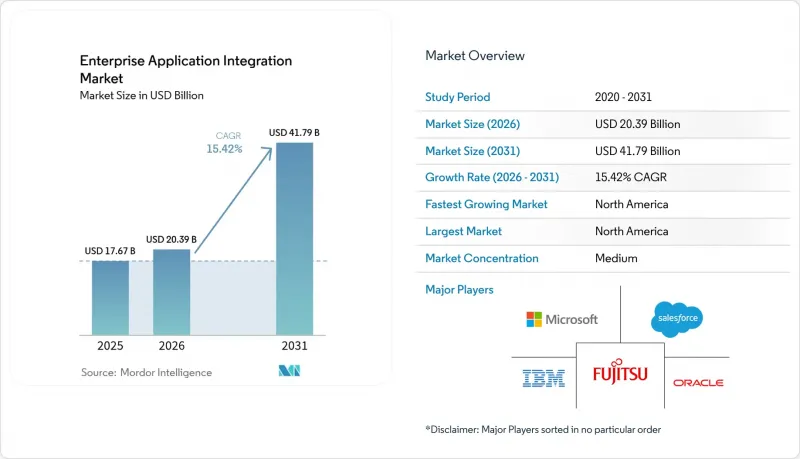
Mordor Intelligence에 의하면, 2026년 기업 애플리케이션 통합 시장 규모는 203억 9,000만 달러로 추정되고 2025년 176억 7,000만 달러에서 확대해, 2031년에는 417억 9,000만 달러에 이를 것으로 예측됩니다.
2026-2031년 동안의 연평균 성장률(CAGR)은 15.42%를 나타낼 전망입니다.
본 보고서는 배포 모델별(On-Premise, 클라우드, 하이브리드), 통합 플랫폼 유형별(엔터프라이즈 서비스 버스(ESB), 기타), 조직 규모별(대기업, 중소기업),용도 부문별(CRM 통합, 기타), 최종 사용자 산업별(은행, 금융서비스 및 보험(BFSI), IT 및 통신, 기타), 지역별로 분류되어 있습니다. 시장 예측은 금액(달러) 기준으로 제시되어 있습니다.
세계의 기업 애플리케이션 통합 시장 동향 및 인사이트
API 주도형 연결성을 통한 SaaS 도입 가속화
재사용 가능한 API 자산은 이제 전략적 구성 요소로 기능하며, 릴리스 주기 단축 및 유지보수 비용 절감에 기여하고 있습니다. 이 모델을 채택한 기업들로부터 통합 기간을 40-60% 단축할 수 있었습니다는 보고가 잇따르고 있으며, 이를 통해 새로운 디지털 서비스에 대한 투자 예산을 확보할 수 있게 되었습니다. Salesforce 포트폴리오 내 MuleSoft의 성장과 Microsoft API 게이트웨이의 확대 전개는 주요 벤더들이 조합 가능한 통합 패브릭으로 무게중심을 옮기고 있음을 보여줍니다.
사실상의 표준 통합 백본으로서의 클라우드 네이티브 iPaaS
컨테이너화된 마이크로서비스, 서버리스 런타임 엔진, 자동화된 확장성을 통해 클라우드 네이티브 iPaaS 플랫폼은 기존 미들웨어에 비해 총 소유 비용(TCO)을 최대 70%까지 절감할 수 있게 되었습니다. 이는 Oracle이 최근 클라우드 수익 관련 공시에서 강조한 점이기도 합니다. 이러한 경제적 이점 외에도, 내장된 가시성 및 정책 적용 기능을 통해 리스크 회피 성향이 강한 기업들조차 멀티클라우드 통합 패브릭으로 이동하고 있습니다.
오픈소스 ESB 대체 솔루션에 의한 라이선스 수익 잠식
Apache Camel, WSO2 및 유사한 프레임워크는 라이선스 비용 없이 견고한 통합 기능을 제공하기 때문에 유능한 사내 엔지니어링 팀을 보유한 조직에게 매력적입니다. 따라서 상용 플랫폼은 프리미엄 플랜의 가치를 정당화하기 위해 차별화된 AI 오케스트레이션, 관리형 서비스, 보안 인증을 강조하고 있습니다.
부문별 분석
하이브리드 환경은 연평균 성장률(CAGR) 17.78%를 기록하며, On-Premise의 제어력과 클라우드의 민첩성 사이에서 아키텍처적으로 최적의 균형을 보여주고 있습니다. 마이그레이션 리스크가 완화되고 클라우드 서비스의 경제성이 지속적으로 개선됨에 따라, 하이브리드 배포와 관련된 기업 애플리케이션 통합 시장 규모는 2027년 이후 On-Premise 지출을 능가할 것으로 예측됩니다. 은행 및 규제 대상 의료 서비스 제공업체는 프라이빗 클라우드에 경량 커넥터를 도입하고, 보안 VPN 또는 SD-WAN 터널을 통해 연결함으로써 메인프레임과 SaaS를 통합하고 있습니다. 정책 기반 라우팅, 암호화, 실시간 가시성을 통합한 도입 툴킷은 운영상의 마찰을 줄여주며, 지속적인 규제 보고 측면에서 하이브리드 통합을 매력적인 선택지로 만들어 줍니다. IBM은 최근 인수한 HashiCorp의 Terraform 모듈을 통합하여 클라우드 간 클러스터 프로비저닝을 자동화했습니다. 이를 통해 세계 기업의 거버넌스가 간소화됩니다.
On-Premise 도입은 여전히 주류를 이루고 있지만, 쇠퇴하기는커녕 계속 진화하고 있습니다. 조직은 기반이 되는 메시지 버스를 사내 Kubernetes 클러스터상의 컨테이너 플랫폼으로 이전하고, 지연 시간이나 주권 요건으로 인해 로컬 처리가 필수적인 경우에만 하드웨어를 업데이트하고 있습니다. 이러한 단계적인 현대화를 통해 시스템을 전면적으로 교체하는 대규모 프로젝트를 피하고, 자본 지출(Capex)에서 예상치 못한 비용을 절감하며, 몇 초를 넘는 다운타임을 허용할 수 없는 미션 크리티컬 워크플로의 연속성을 유지하고 있습니다. 전 세계 제조업체의 경우, 공장 내의 로컬 통합 어플라이언스가 결정적인 지연 시간을 제공하는 반면, 클라우드 이벤트 허브는 예측 분석 모델을 위한 데이터를 집계하고 있습니다.
iPaaS는 2025년에 매출의 33.10%를 차지했으며, 영구 라이선스보다 구독 경제를 우선시하는 기업의 전략 구상 중심에 위치하고 있습니다. 이 부문의 연평균 성장률(CAGR)은 24.95%이며, 커넥터 라이브러리의 지속적인 확충, 관리형 런타임 패치, SLA를 통한 가동률 보장에 의해 뒷받침되고 있어, 이를 통해 고객은 미들웨어 패치 적용이라는 부담에서 해방됩니다. Microsoft, Oracle, SAP, Salesforce는 자사의 클라우드 제품군 내에 iPaaS 기능을 묶어 직접 제공하고 있으며, 이를 통해 조달 프로세스가 간소화되고 용도 계층 전반에 걸쳐 일관된 ID 모델이 실현되고 있습니다.
한편, ESB 플랫폼은 통신 사업자나 방위 관련 기업의 복잡한 허브 앤 스포크형 토폴로지에서 여전히 입지를 유지하고 있습니다. 이러한 환경을 지원하는 벤더들은 현재 쿠버네티스(Kubernetes) 내에서 작동하는 컨테이너화된 런타임을 제공하고 있으며, 데이터센터에서 철수해야 할 경우 프라이빗 클라우드로의 ‘리프트 앤 시프트(lift-and-shift)’를 용이하게 하고 있습니다. 또한, 푸시다운형 ELT 파이프라인을 갖춘 데이터 통합 도구도 높은 처리량의 배치 가져오기가 필요한 레이크하우스 아키텍처에 데이터를 공급함으로써 그 중요성을 입증하고 있습니다.
지역별 분석
북미는 2025년에도 37.60%의 매출 점유율을 유지했습니다. 이는 하이퍼스케일 클라우드 리전, 벤처 캐피털의 자금 지원을 받은 SaaS 생태계, 견고한 API 경제 문화가 융합된 미국이 주도적인 역할을 하고 있기 때문입니다. 연방 및 주 정부 기관들도 조달, 세무, 급여 시스템의 현대화에 자금을 할당하고 있어, 보안이 강화된 통합 게이트웨이에 대한 장기적인 수요를 창출하고 있습니다. 캐나다도 비슷한 성장세를 보이고 있지만, 데이터 리지던시를 더욱 중시하고 있어 로컬 리전의 클라우드 존이나 하이브리드 엣지 어플라이언스의 활용이 확대되고 있습니다. 멕시코는 비교적 초기 단계에 있지만, 기업들이 ERP 및 결제 인프라의 현대화를 추진함에 따라 급속히 성장하고 있으며, 이중 언어를 구사하는 인재 허브에서 통합 서비스를 제공하는 니어쇼어 서비스 제공업체를 활용하는 사례가 많이 보입니다.
유럽은 GDPR(EU 개인정보보호규정), 디지털 운영 복원력 법, 새롭게 부상하고 있는 탄소 발자국 공개가 플랫폼 감사의 지침이 되고 있어 큰 비즈니스 기회를 내포하고 있습니다. 독일의 자동차 및 산업 클러스터에서는 기계의 텔레메트리 데이터를 예측 유지보수 모델로 전송하는 엣지-투-클라우드 커넥터가 도입되고 있습니다. 영국은 API 관리 제품군의 대상 시장을 확대하는 오픈 뱅킹 로드맵에 자금을 지원하고 있습니다. 프랑스는 종합적인 규정 준수 관련 산출물을 묶어 제공하는 유럽 공급업체를 우대하는 소버린 클라우드 이니셔티브를 지원하고 있습니다. 클라우드 도입이 이미 성숙한 북유럽 국가들에서는 통합 엔진이 피크 시간대에 재생에너지를 이용할 수 있는 지역으로 컴퓨팅 리소스를 전환하는 ‘탄소 의식형 라우팅’을 선도적으로 도입하고 있습니다.
아시아태평양은 기업들이 레거시 ESB 세대를 건너뛰고 iPaaS를 직접 이용하게 됨에 따라 2031년 연평균 성장률(CAGR)이 16.05%로 가장 빠른 성장세를 보이고 있습니다. 중국은 방대한 양의 텔레메트리 데이터를 스트리밍하는 대규모 산업용 인터넷 프로젝트와 AI 가속 칩에 투자하고 있으며, 이를 위해서는 높은 처리량을 갖춘 통합 패브릭이 필요합니다. 인도의 디지털 공공 인프라 스택(Aadhaar, Unified Payments Interface 등)은 수백만 명의 시민이 API를 보편적으로 사용하도록 만들었으며, 현지 시스템 통합 업체들이 안전하고 처리량이 높은 커넥터를 전문으로 하도록 촉진하고 있습니다. 일본과 한국은 스마트 팩토리 구상에 자원을 투입하고 있으며, 엣지 브로커가 로봇과 ERP 시스템을 실시간으로 동기화하고 있습니다. 동남아시아 국가들은 클라우드 우선 규제 샌드박스를 활용하여 핀테크 혁신을 가속화하고, 경량 통합 런타임의 틈새 시장을 창출하고 있습니다.
기타 혜택
- 엑셀 형식 시장 예측(ME) 시트
- 3개월간 애널리스트 지원
자주 묻는 질문
목차
제1장 서론
제2장 조사 방법
제3장 주요 요약
제4장 시장 구도
제5장 시장 규모 및 성장 예측
제6장 경쟁 구도
제7장 시장 기회 및 향후 전망
KTH 26.09.04According to Mordor Intelligence, the enterprise application integration market size in 2026 is estimated at USD 20.39 billion, growing from 2025 value of USD 17.67 billion with 2031 projections showing USD 41.79 billion, growing at 15.42% CAGR over 2026-2031.
This report is Segmented by Deployment Model (On-Premise, Cloud, Hybrid), Integration Platform Type (Enterprise Service Bus, and More), Organization Size (Large Enterprises, and Small and Medium-Sized Enterprises), Application Area (CRM Integration, and More), End-User Industry (BFSI, IT and Telecom, and More), and Geography. The Market Forecasts are Provided in Terms of Value (USD).
Global Enterprise Application Integration Market Trends and Insights
API-led Connectivity Accelerating SaaS Adoption
Reusable API assets now serve as strategic building blocks, shortening release cycles and reducing maintenance overhead. Enterprises adopting the model routinely report integration timeline cuts of 40-60%, which frees budget for incremental digital services. MuleSoft's growth inside the Salesforce portfolio, combined with Microsoft's expanding API gateway footprint, illustrates how large vendors are pivoting toward composable integration fabrics.
Cloud-native iPaaS as De-facto Integration Backbone
Containerized microservices, serverless runtime engines, and automated elasticity enable cloud-native iPaaS platforms to deliver up to 70% total cost of ownership (TCO) savings compared to traditional middleware, as highlighted by Oracle in its recent cloud revenue disclosures. These economics, coupled with built-in observability and policy enforcement, are steering even risk-averse enterprises toward multi-cloud integration fabrics.
Open-source ESB Alternatives Eroding License Revenue
Apache Camel, WSO2, and similar frameworks offer robust integration without licensing costs, appealing to organizations with capable internal engineering teams. Commercial platforms, therefore, emphasize differentiated AI orchestration, managed services, and security certifications in order to justify premium tiers.
Other drivers and restraints analyzed in the detailed report include:
- Event-Driven Architectures Enabling Real-time Analytics
- Generative-AI-Assisted Mapping and Testing Tools
- Shortage of Integration-Skill Talent Inflating Project Costs
For complete list of drivers and restraints, kindly check the Table Of Contents.
Segment Analysis
Hybrid environments accounted for 17.78% CAGR, evidencing the architectural sweet spot between on-premise control and cloud agility. The enterprise application integration market size tied to hybrid roll-outs will likely surpass on-premise outlays after 2027, as migration risk is mitigated while cloud services continue to improve their economics. Banks and regulated healthcare providers integrate mainframes with SaaS by dropping lightweight connectors into private clouds and linking them via secure VPN or SD-WAN tunnels. Deployment toolkits that bundle policy-driven routing, encryption, and real-time observability reduce operational friction, making hybrid integration attractive for continuous regulatory reporting. IBM bundled its recently acquired HashiCorp Terraform modules to automate cluster provisioning across clouds, which simplifies governance for global corporations.
Despite ongoing dominance, on-premise implementations are evolving rather than fading. Organizations migrate their foundational message buses toward container platforms on internal Kubernetes clusters, refreshing hardware only where latency or sovereignty requirements necessitate local processing. This incremental modernization prevents wholesale rip-and-replace projects, lowers capex surprises, and maintains continuity for mission-critical workflows that cannot risk outage windows longer than a few seconds. For global manufacturers, local integration appliances in factories offer deterministic latency while cloud event hubs aggregate data for predictive analytics models.
iPaaS generated 33.10% revenue in 2025 and sits at the center of enterprise blueprints that prioritize subscription economics over perpetual licenses. The segment's 24.95% CAGR is underpinned by continuous connector library expansion, managed runtime patches, and SLA-bound uptime commitments that free customers from the burdens of middleware patching. Microsoft, Oracle, SAP, and Salesforce deliver bundled iPaaS capability directly in their cloud suites, reducing procurement steps and providing consistent identity models across application layers.
Conversely, ESB platforms retain hold in complex hub-and-spoke topologies within telecom carriers and defense contractors. Vendors supporting these estates now ship containerized runtimes that run inside Kubernetes, thereby easing the lift-and-shift to private clouds when a data center exit is mandated. Data integration tools with pushdown ELT pipelines also claim relevance by feeding lakehouse architectures that demand high-throughput batch ingestion.
Complete Report Scope:
- By Deployment Model
- On-premise
- Cloud
- Hybrid
- By Integration Platform Type
- Enterprise Service Bus (ESB)
- Integration Platform-as-a-Service (iPaaS)
- API-Gateway / Management Suites
- Data and ETL/ELT Tools
- By Organization Size
- Large Enterprises
- Small and Medium-sized Enterprises
- By Application Area
- CRM Integration
- ERP and Finance Integration
- Supply-Chain / Logistics Integration
- HR and Workforce Integration
- Business Intelligence and Analytics Integration
- By End-user Industry
- BFSI
- IT and Telecom
- Healthcare
- Retail and E-commerce
- Government
- Manufacturing
- Other End-user Industry
- By Geography
- North America
- United States
- Canada
- Mexico
- Europe
- Germany
- United Kingdom
- France
- Spain
- Italy
- Rest of Europe
- Asia-Pacific
- China
- Japan
- India
- South Korea
- Rest of Asia-Pacific
- South America
- Brazil
- Argentina
- Rest of South America
- Middle East and Africa
- Middle East
- Israel
- Saudi Arabia
- United Arab Emirates
- Turkey
- Rest of Middle East
- Africa
- South Africa
- Egypt
- Rest of Africa
- Middle East
- North America
Geography Analysis
North America maintained a 37.60% revenue share in 2025, anchored by the United States, where hyperscale cloud regions, venture capital-funded SaaS ecosystems, and robust API economy cultures converge. Federal and state agencies also allocate funds to modernize procurement, taxation, and benefit systems, generating prolonged demand for secure integration gateways. Canada exhibits similar momentum but places a stronger emphasis on data residency, prompting the usage of local-region cloud zones and hybrid edge appliances. Mexico sits at an earlier stage yet climbs swiftly as enterprises modernize ERP and payment rails, often leveraging near-shore service providers that deliver integration services from bilingual talent hubs.
Europe represents a sizable opportunity, as the GDPR, the Digital Operational Resilience Act, and emerging carbon footprint disclosures guide platform audits. Germany's automotive and industrial clusters deploy edge-to-cloud connectors that transport machine telemetry into predictive maintenance models. The United Kingdom finances open-banking roadmaps that enlarge the addressable pool for API management suites. France backs sovereign-cloud initiatives that favor European vendors bundling comprehensive compliance artefacts. Nordic countries, already mature in cloud adoption, pioneer carbon-aware routing where integration engines shift compute to regions with renewable energy availability during peak windows.
The Asia-Pacific region demonstrates the fastest growth, with a 16.05% CAGR through 2031, as enterprises skip legacy ESB generations and consume iPaaS directly. China invests in large-scale industrial Internet projects and AI acceleration chips that stream vast amounts of telemetry, requiring high-throughput integration fabrics. India's digital-public-infrastructure stack, including Aadhaar and Unified Payments Interface, normalizes API consumption for millions of citizens and drives local SI firms to specialize in secure, high-volume connectors. Japan and South Korea are investing resources in smart factory initiatives, where edge brokers synchronize robots with ERP systems in real-time. Southeast Asian nations utilize cloud-first regulatory sandboxes to jump-start fintech innovation, creating niches for lightweight integration runtimes.
- IBM Corporation
- Microsoft Corporation
- Oracle Corporation
- SAP SE
- Salesforce Inc. (MuleSoft LLC)
- Software AG
- TIBCO Software Inc.
- Fujitsu Ltd.
- iTransition Group
- Dell Boomi LLC
- Informatica LLC
- SnapLogic Inc.
- Workato Inc.
- Celigo Inc.
- Jitterbit Inc.
- Talend S.A.
- Red Hat Inc.
- WSO2 Inc.
- Cleo Communications Inc.
- OpenLegacy Inc.
Additional Benefits:
- The market estimate (ME) sheet in Excel format
- 3 months of analyst support
TABLE OF CONTENTS
1 INTRODUCTION
- 1.1 Study Assumptions and Market Definition
- 1.2 Scope of the Study
2 RESEARCH METHODOLOGY
3 EXECUTIVE SUMMARY
4 MARKET LANDSCAPE
- 4.1 Market Overview
- 4.2 Market Drivers
- 4.2.1 API-Led Connectivity Accelerating Saas Adoption
- 4.2.2 Cloud-Native Ipaas as De-Facto Integration Backbone
- 4.2.3 Event-Driven Architectures Enabling Real-Time Analytics
- 4.2.4 Generative-AI Assisted Mapping and Testing Tools
- 4.2.5 Carbon-Aware Workload Routing Mandates
- 4.2.6 Vendor-Agnostic Integration Marketplaces for Micro-Saas
- 4.3 Market Restraints
- 4.3.1 Open-Source ESB Alternatives Eroding Licence Revenue
- 4.3.2 Shortage of Integration-Skill Talent Inflating Project Costs
- 4.3.3 Hidden Egress-Fee Economics In Hyperscale Clouds
- 4.3.4 Legacy Technical-Debt Penalties on API Security Posture
- 4.4 Industry Value Chain Analysis
- 4.5 Regulatory Landscape
- 4.6 Technological Outlook
- 4.7 Porter's Five Forces Analysis
- 4.7.1 Threat of New Entrants
- 4.7.2 Bargaining Power of Buyers
- 4.7.3 Bargaining Power of Suppliers
- 4.7.4 Threat of Substitutes
- 4.7.5 Degree of Competition
5 MARKET SIZE AND GROWTH FORECASTS (VALUE)
- 5.1 By Deployment Model
- 5.1.1 On-premise
- 5.1.2 Cloud
- 5.1.3 Hybrid
- 5.2 By Integration Platform Type
- 5.2.1 Enterprise Service Bus (ESB)
- 5.2.2 Integration Platform-as-a-Service (iPaaS)
- 5.2.3 API-Gateway / Management Suites
- 5.2.4 Data and ETL/ELT Tools
- 5.3 By Organization Size
- 5.3.1 Large Enterprises
- 5.3.2 Small and Medium-sized Enterprises
- 5.4 By Application Area
- 5.4.1 CRM Integration
- 5.4.2 ERP and Finance Integration
- 5.4.3 Supply-Chain / Logistics Integration
- 5.4.4 HR and Workforce Integration
- 5.4.5 Business Intelligence and Analytics Integration
- 5.5 By End-user Industry
- 5.5.1 BFSI
- 5.5.2 IT and Telecom
- 5.5.3 Healthcare
- 5.5.4 Retail and E-commerce
- 5.5.5 Government
- 5.5.6 Manufacturing
- 5.5.7 Other End-user Industry
- 5.6 By Geography
- 5.6.1 North America
- 5.6.1.1 United States
- 5.6.1.2 Canada
- 5.6.1.3 Mexico
- 5.6.2 Europe
- 5.6.2.1 Germany
- 5.6.2.2 United Kingdom
- 5.6.2.3 France
- 5.6.2.4 Spain
- 5.6.2.5 Italy
- 5.6.2.6 Rest of Europe
- 5.6.3 Asia-Pacific
- 5.6.3.1 China
- 5.6.3.2 Japan
- 5.6.3.3 India
- 5.6.3.4 South Korea
- 5.6.3.5 Rest of Asia-Pacific
- 5.6.4 South America
- 5.6.4.1 Brazil
- 5.6.4.2 Argentina
- 5.6.4.3 Rest of South America
- 5.6.5 Middle East and Africa
- 5.6.5.1 Middle East
- 5.6.5.1.1 Israel
- 5.6.5.1.2 Saudi Arabia
- 5.6.5.1.3 United Arab Emirates
- 5.6.5.1.4 Turkey
- 5.6.5.1.5 Rest of Middle East
- 5.6.5.2 Africa
- 5.6.5.2.1 South Africa
- 5.6.5.2.2 Egypt
- 5.6.5.2.3 Rest of Africa
- 5.6.5.1 Middle East
- 5.6.1 North America
6 COMPETITIVE LANDSCAPE
- 6.1 Market Concentration
- 6.2 Strategic Moves
- 6.3 Market Share Analysis
- 6.4 Company Profiles (includes Global level Overview, Market level overview, Core Segments, Financials as available, Strategic Information, Market Rank/Share for key companies, Products and Services, and Recent Developments)
- 6.4.1 IBM Corporation
- 6.4.2 Microsoft Corporation
- 6.4.3 Oracle Corporation
- 6.4.4 SAP SE
- 6.4.5 Salesforce Inc. (MuleSoft LLC)
- 6.4.6 Software AG
- 6.4.7 TIBCO Software Inc.
- 6.4.8 Fujitsu Ltd.
- 6.4.9 iTransition Group
- 6.4.10 Dell Boomi LLC
- 6.4.11 Informatica LLC
- 6.4.12 SnapLogic Inc.
- 6.4.13 Workato Inc.
- 6.4.14 Celigo Inc.
- 6.4.15 Jitterbit Inc.
- 6.4.16 Talend S.A.
- 6.4.17 Red Hat Inc.
- 6.4.18 WSO2 Inc.
- 6.4.19 Cleo Communications Inc.
- 6.4.20 OpenLegacy Inc.
7 MARKET OPPORTUNITIES AND FUTURE OUTLOOK
- 7.1 White-space and Unmet-need Assessment