

|
시장보고서
상품코드
2120565
아세톤 : 시장 점유율 분석, 업계 동향 및 통계, 성장 예측(2026-2031년)Acetone - Market Share Analysis, Industry Trends & Statistics, Growth Forecasts (2026 - 2031) |
||||||
 Mordor Intelligence
Mordor Intelligence에 의하면, 아세톤 시장 규모는 2025년 72억 3,000만 달러로 평가되었습니다. 2026년에는 77억 1,000만 달러로 확대되어 2026년부터 2031년에 걸쳐 CAGR 6.58%로 성장을 지속하여, 2031년에는 106억 달러에 이를 것으로 예측됩니다.
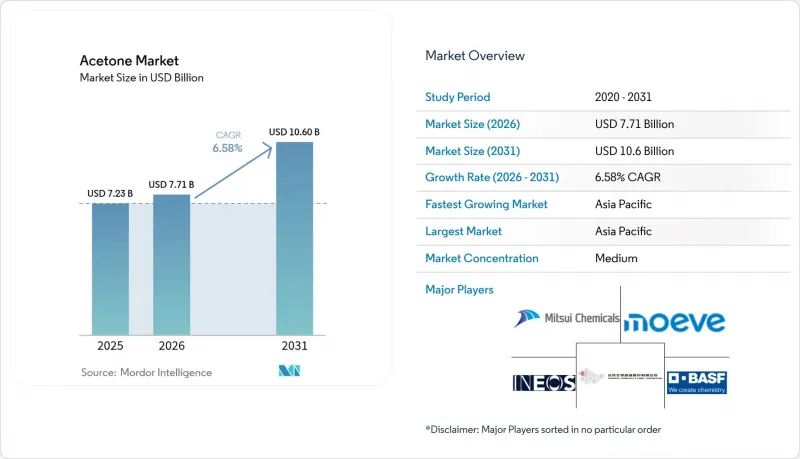
본 보고서는 용도(메틸메타크릴레이트, 비스페놀 A, 용제 등),최종 이용 산업(화장품 및 퍼스널케어, 전자제품 등), 제조 공정(쿠멘법, 이소프로판올 산화법 등), 등급(테크니컬 등급, 의약품 등급 등), 지역(아시아태평양, 북미, 유럽 등)별로 분류되어 있습니다. 시장 예측은 금액(달러) 기준으로 제시되어 있습니다.
세계의 아세톤 시장 동향 및 인사이트
전기차 경량화를 위한 MMA계 아크릴 시트 수요 급증
전기차 제조업체들은 차량 중량을 줄이기 위해 유리나 금속을 MMA 기반 아크릴 시트로 대체하고 있으며, MMA 1파운드 생산 시 약 0.5파운드의 아세톤이 소비되므로 이에 따라 아세톤 수요가 두 배로 증가하고 있습니다. 2023년 기준으로 북미의 자동차 1대당 4,371달러 상당의 화학 물질이 사용되어, 현대 자동차의 높은 소재 집약도가 부각되었습니다. CAFE(기업 평균 연비 기준)의 강화로 인해, 무게가 큰 기판에 비해 아크릴 유리 소재의 매력이 높아지고 있습니다. 미쓰비시 화학 그룹은 마이크로파를 이용한 PMMA 재활용 기술을 개발하여 폐쇄형 재활용 체계를 확립했습니다. 이를 통해 아세톤 시장의 하류 수요가 더욱 강화되고 있습니다.
동남아시아의 퍼스널케어용 용제 수요 증가
동남아시아의 소득 증가와 도시화는 미용 습관을 변화시키고 있으며, 아세톤은 매니큐어 제거제나 화장품 배합에 선호되는 용매가 되고 있습니다. 이 화학 물질의 빠른 증발성과 피부 자극이 적은 특성은 고급 제형에 매우 적합합니다. 현지 생산 업체들은 아세톤이 VOC(휘발성 유기 화합물) 규제 대상에서 제외된다는 점을 활용하여, 대체 용매가 직면한 더 엄격한 배출 부과금을 피함으로써 태국, 베트남, 인도네시아 전역에서 비용 경쟁력을 높이고 있습니다.
EU 및 ECHA의 BPA 규제 강화
EU는 2025년 1월, 식품 접촉 제품에 대해 광범위한 BPA 규제를 시행하여 페놀·아세톤의 공동 생산량을 감축하는 동시에, 유럽 내 아세톤의 주요 판매 경로를 차단했습니다. 생산자들은 수요 격차를 메우기 위해 MMA, 용제 또는 바이오 제조 경로로 전환할 수밖에 없는 상황입니다. 북미 및 아시아 일부 지역에서도 유사한 논의가 진행 중이며, 규제 기준이 비슷해질 가능성이 있어 쿠마렌을 원료로 하는 사업에 대한 압박이 더욱 가중될 우려가 있습니다.
부문별 분석
용제는 2025년 매출의 42.82%를 차지했으며, 아세톤의 빠른 증발성과 특히 도료 및 접착제 분야에서 대부분의 VOC 규제 대상에서 제외된다는 점이 이를 뒷받침하고 있습니다. MMA는 전기차 및 건설 분야에서 아크릴 유리가 일반 유리를 대체함에 따라 연평균 성장률(CAGR) 7.12%로 가장 빠르게 성장하고 있습니다. 비스페놀 A(BPA) 부문은 규제로 인한 제약을 받고 있지만, 폴리카보네이트 사용을 통해 가전제품이 BPA 수요를 어느 정도 지탱하고 있습니다. 메틸이소부틸케톤 및 특수 중간체는 아세톤의 범용성이 높은 반응성을 활용함으로써 틈새 시장의 성장을 이끌고 있습니다.
공급 측면의 변화도 마찬가지로 두드러집니다. 자동차 경량화로 인해 MMA 수요가 확대되는 한편, 미쓰비시 화학 그룹이 마이크로파를 이용한 PMMA 재활용 기술은 순환형 수요 루프를 창출하여 아세톤 시장의 기회 기간을 연장하고 있습니다. 용제 블렌드 제조업체들은 극성의 차이에 관계없이 혼합성이 높은 아세톤을 높이 평가하고 있으며, 이를 통해 비용이 많이 드는 배합 변경 없이도 더욱 엄격한 배출 규제를 충족하는 저VOC 도료의 실현이 가능해졌습니다. 전반적으로 용도 구성의 다양화로 인해 BPA 규제가 강화되는 상황 속에서도 아세톤 시장은 단일 부문의 충격으로부터 보호받고 있습니다.
2025년에는 광범위한 산업 분야에서의 채택으로 인해 도료, 코팅, 접착제가 아세톤 소비량의 37.35%를 차지했지만, 2031년까지 연평균 성장률(CAGR)이 6.95%로 가장 높은 분야는 화장품 및 퍼스널케어 분야입니다. 동남아시아에서 부상하는 중산층이 아세톤의 저자극성이 높이 평가되는 매니큐어 및 스킨케어 제품 수요를 견인하고 있습니다. 전자기기 분야에서는 폴리카보네이트 수지를 통해 아세톤이 사용되고 있어 안정적인 수요가 확보되고 있습니다. 자동차 용도에서는 MMA계 아크릴 패널의 보급으로 수요가 확대되고 있으며, 의약품 분야에서는 아시아 내 새로운 API(원료의약품) 공장 건설에 따라 수요가 증가하고 있습니다.
안정적인 수요의 다양성이 시장의 회복력을 뒷받침하고 있습니다. 퍼스널케어 제품의 제형 개발자들은 아세톤의 ‘수·유 양성’ 특성을 활용하여, 수용성 및 지용성 유효 성분을 단일 제품에 배합함으로써 제형의 유연성을 높이고 있습니다. 북미 및 유럽에서는 전문 미용실 체인들이 시술 시간을 단축하는 아세톤 함량이 높은 리무버를 채택함으로써 재구매 주기를 촉진하고 있습니다. 산업 분야의 최종 사용자들은 속건성이 요구되는 건축용 도료를 통해 수요의 기준선을 유지하고 있습니다.
지역별 분석
아시아태평양은 중국의 방대한 페놀·아세톤 및 BPA 생산 기반과 동남아시아의 틈새 화학제품 클러스터 확장에 힘입어 2025년 판매량의 42.18%를 차지했습니다. 이 지역에서는 현지 수요가 OECD 국가들의 성장률을 상회함에 따라 2031년까지 연평균 성장률(CAGR) 7.25%를 나타낼 것으로 예측됩니다. 정부의 화학 산업 로드맵은 자급자족과 고부가가치 제품 생산을 중시하며, 이익률 변동에 따라 연료와 석유화학제품 생산을 전환할 수 있는 통합 정유시설로 자본을 유도하고 있습니다. 중국은 2023년에 하루 1,480만 배럴의 원유를 정제하고 있으며, 이는 하류 아세톤 생산 설비에 대한 원료 공급이 확보되어 있음을 보여줍니다.
북미에서는 자동차 및 항공우주 분야의 경량화에 대한 수요가 강하지만, 정유시설 폐쇄로 인해 쿠멘용 프로파일렌 공급이 부족해지고 있습니다. 유럽에서는 BPA에 대한 규제 감시가 가장 엄격한 상황이지만, 지속 가능한 생산에 대한 투자를 통해 생산량 감소를 일부 상쇄하고 있습니다. INEOS사의 말(Marl) 시설은 원료 확보와 탄소 배출 감축을 결합하여 장래에 걸쳐 아세톤 공급을 안정화하려는 전략의 좋은 사례입니다.
남미, 특히 브라질의 산업화는 현지 생산 능력이 여전히 제한적이어서 새로운 수입을 초래하고 있습니다. 에탄올을 원료로 하는 화학 산업 단지 건설에 대한 정부의 우대 조치는 예측 기간 동안 발효 프로젝트를 촉진할 가능성이 있습니다. 중동 및 아프리카에서는 저비용 나프타와 LPG가 페놀·아세톤 통합을 포함한 신규 석유화학 단지의 기반이 되어 수출 지향적인 공급을 제공하고 있으나, 국내 수요는 제한적입니다.
기타 혜택 :
- 엑셀 형식 시장 예측(ME) 시트
- 3개월간의 애널리스트 지원
자주 묻는 질문
목차
제1장 서론
제2장 조사 방법
제3장 주요 요약
제4장 시장 구도
제5장 시장 규모 및 성장 예측
제6장 경쟁 구도
제7장 시장 기회 및 향후 전망
KTH 26.09.10According to Mordor Intelligence, the acetone market size is expected to grow from USD 7.23 billion in 2025 to USD 7.71 billion in 2026 and is forecast to reach USD 10.6 billion by 2031 at 6.58% CAGR over 2026-2031.

This report is Segmented by Application (Methyl Methacrylate, Bisphenol A, Solvents, and More), End-Use Industry (Cosmetics and Personal Care, Electronics, and More), Production Process (Cumene Process, Isopropanol Oxidation, and More), Grade (Technical Grade, Pharmaceutical Grade, and More), and Geography (Asia-Pacific, North America, Europe, and More). The Market Forecasts are Provided in Terms of Value (USD).
Global Acetone Market Trends and Insights
Surging Demand for MMA-Based Acrylic Sheets in EV Lightweighting
Electric vehicle makers are replacing glass and metal with MMA-based acrylic sheets to cut curb weight, which multiplies acetone demand because MMA consumes roughly 0.5 pounds of acetone per pound produced. The average North American auto contained USD 4,371 worth of chemistry in 2023, underscoring the material intensity of modern vehicles. Stricter CAFE fuel-economy rules heighten the appeal of acrylic glazing over heavier substrates. Mitsubishi Chemical Group has advanced microwave-assisted PMMA recycling, creating a closed-loop premium that further strengthens downstream pull on the acetone market.
Expansion of Personal-Care Solvent Demand in Southeast Asia
Rising incomes and urbanization in Southeast Asia are reshaping beauty routines, making acetone a preferred solvent for nail polish removers and cosmetic blends. The chemical's rapid evaporation and low dermal irritation suit premium formulations. Local producers capitalize on acetone's VOC-exempt status, avoiding the stricter emission fees faced by alternative solvents and enhancing cost competitiveness across Thailand, Vietnam, and Indonesia.
Tightening BPA Regulations by EU & ECHA
The EU enforced broad BPA restrictions in January 2025 for food-contact articles, reducing phenol-acetone co-production volumes and removing a notable outlet for acetone in Europe. Producers must pivot to MMA, solvents, or bio-routes to cushion the demand gap. Parallel debates in North America and parts of Asia may duplicate regulatory limits, compounding pressure on cumene-based operations.
Other drivers and restraints analyzed in the detailed report include:
- Growing Pharmaceutical API Solvent Requirements Post-COVID
- Bio-Acetone Cost Parity via Waste-Glycerol Fermentation
- Emerging VOC Limits on Solvent Use
For complete list of drivers and restraints, kindly check the Table Of Contents.
Segment Analysis
Solvents held 42.82% of 2025 revenues, supported by acetone's rapid evaporation and exemption from most VOC caps, especially in paints and adhesives. MMA is the fastest riser at 7.12% CAGR as acrylic glazing replaces glass in electric vehicles and construction. The bisphenol A segment faces regulatory drag, yet consumer electronics sustain some BPA volume through polycarbonate use. Methyl isobutyl ketone and specialty intermediates provide niche growth by leveraging acetone's versatile reactivity.
Supply-side changes are equally stark. Automotive lightweighting magnifies MMA pull, whereas microwave PMMA recycling from Mitsubishi Chemical Group creates circular demand loops that lengthen acetone market opportunity windows. Solvent blenders prize acetone for miscibility across polarities, permitting lower VOC coatings that meet tougher emission caps without costly reformulation. Overall, application mix diversification shields the acetone market from single-segment shocks even as BPA curbs unfold.
Paints, coatings, and adhesives consumed 37.35% of acetone in 2025 due to broad industrial adoption, yet cosmetics and personal care post the highest 6.95% CAGR to 2031. Southeast Asia's rising middle class fuels nail polish and skincare volumes, where acetone's low irritation profile is prized. Electronic devices channel acetone through polycarbonate resins, locking in stable demand. Automotive applications grow through MMA-based acrylic panels, while pharmaceuticals expand alongside new API plants in Asia.
Stable demand diversity bolsters resilience. Personal care formulators exploit acetone's dual miscibility to pair water and oil actives in a single product, raising formulation flexibility. In North America and Europe, professional salon chains adopt acetone-rich removers that cut service times, boosting repeat purchase cycles. Industrial end users maintain baseline volume through architectural coatings that need fast dry times.
Complete Report Scope:
- By Application
- Methyl Methacrylate (MMA)
- Bisphenol A (BPA)
- Solvents
- Methyl Isobutyl Ketone (MIBK)
- Other Applications (Chemical Intermediates)
- By End-Use Industry
- Cosmetics and Personal Care
- Electronics
- Automotive
- Pharmaceutical
- Paints, Coatings and Adhesives
- Textile
- Other End-user Industry (Plastics)
- By Production Process
- Cumene Process
- Isopropanol Oxidation
- Direct Propylene Oxidation
- Bio-based Fermentation
- By Grade
- Technical Grade
- Pharmaceutical Grade
- Reagent/Analytical Grade
- By Geography
- Asia-Pacific
- China
- India
- Japan
- South Korea
- ASEAN
- Rest of APAC
- North America
- United States
- Canada
- Mexico
- Europe
- Germany
- United Kingdom
- France
- Italy
- Russia
- Rest of Europe
- South America
- Brazil
- Argentina
- Rest of South America
- Middle East and Africa
- Saudi Arabia
- United Arab Emirates
- South Africa
- Rest of Middle East and Africa
- Asia-Pacific
Geography Analysis
Asia Pacific captured 42.18% of 2025 volume owing to China's vast phenol-acetone and BPA base and Southeast Asia's expanding niche chemicals clusters. The region is projected to post a 7.25% CAGR to 2031 as local demand outstrips OECD growth. Government chemical industry roadmaps emphasize self-sufficiency and higher value products, steering capital into integrated refineries that can toggle between fuels and petrochemicals amid margin swings. China processed 14.8 million b/d of crude in 2023, underscoring feedstock availability for downstream acetone units.
North America enjoys a strong automotive and aerospace lightweighting pull, although refinery closures narrow the propylene supply for cumene. Europe faces the sharpest regulatory scrutiny on BPA but offsets some volume loss through sustainable production investments. INEOS's Marl facility exemplifies strategy that pairs feedstock control with carbon-cuts to future-proof acetone supply.
South America's industrialization, especially in Brazil, invites new imports as local capacity remains limited. State incentives to build chemical parks around ethanol feedstocks could spur fermentation projects over the forecast period. In the Middle East and Africa, low-cost naphtha and LPG underpin greenfield petrochemical complexes that include phenol-acetone integration, providing export-oriented supply but limited domestic pull.
- Altivia
- BASF SE
- Borealis GmbH
- Deepak
- Formosa Chemicals & Fibre Corp.
- Honeywell International Inc.
- INEOS
- Kumho P&B Chemicals
- LG Chem
- Mitsui Chemicals Inc.
- Moeve
- PTT Phenol Co. Ltd.
- SABIC
- Shell plc
- Ufaorgsintez (Bashneft)
Additional Benefits:
- The market estimate (ME) sheet in Excel format
- 3 months of analyst support
TABLE OF CONTENTS
1 Introduction
- 1.1 Study Assumptions and Market Definition
- 1.2 Scope of the Study
2 Research Methodology
3 Executive Summary
4 Market Landscape
- 4.1 Market Overview
- 4.2 Market Drivers
- 4.2.1 Surging demand for MMA-based acrylic sheets in EV light-weighting
- 4.2.2 Rising polycarbonate consumption in consumer electronics
- 4.2.3 Expansion of personal-care solvent demand in Southeast Asia
- 4.2.4 Growing pharmaceutical API solvent requirements post-COVID
- 4.2.5 Bio-acetone cost parity via waste-glycerol fermentation
- 4.3 Market Restraints
- 4.3.1 Tightening BPA regulations by EU and ECHA
- 4.3.2 Refinery closures curbing cumene feedstock supply
- 4.3.3 Emerging VOC limits on solvent use
- 4.4 Value Chain Analysis
- 4.5 Regulatory Landscape
- 4.6 Porter's Five Forces
- 4.6.1 Bargaining Power of Suppliers
- 4.6.2 Bargaining Power of Buyers
- 4.6.3 Threat of New Entrants
- 4.6.4 Threat of Substitutes
- 4.6.5 Degree of Rivalry
- 4.7 Production Capacity Analysis
- 4.8 Trade Analysis
5 Market Size and Growth Forecasts (Value)
- 5.1 By Application
- 5.1.1 Methyl Methacrylate (MMA)
- 5.1.2 Bisphenol A (BPA)
- 5.1.3 Solvents
- 5.1.4 Methyl Isobutyl Ketone (MIBK)
- 5.1.5 Other Applications (Chemical Intermediates)
- 5.2 By End-Use Industry
- 5.2.1 Cosmetics and Personal Care
- 5.2.2 Electronics
- 5.2.3 Automotive
- 5.2.4 Pharmaceutical
- 5.2.5 Paints, Coatings and Adhesives
- 5.2.6 Textile
- 5.2.7 Other End-user Industry (Plastics)
- 5.3 By Production Process
- 5.3.1 Cumene Process
- 5.3.2 Isopropanol Oxidation
- 5.3.3 Direct Propylene Oxidation
- 5.3.4 Bio-based Fermentation
- 5.4 By Grade
- 5.4.1 Technical Grade
- 5.4.2 Pharmaceutical Grade
- 5.4.3 Reagent/Analytical Grade
- 5.5 By Geography
- 5.5.1 Asia-Pacific
- 5.5.1.1 China
- 5.5.1.2 India
- 5.5.1.3 Japan
- 5.5.1.4 South Korea
- 5.5.1.5 ASEAN
- 5.5.1.6 Rest of APAC
- 5.5.2 North America
- 5.5.2.1 United States
- 5.5.2.2 Canada
- 5.5.2.3 Mexico
- 5.5.3 Europe
- 5.5.3.1 Germany
- 5.5.3.2 United Kingdom
- 5.5.3.3 France
- 5.5.3.4 Italy
- 5.5.3.5 Russia
- 5.5.3.6 Rest of Europe
- 5.5.4 South America
- 5.5.4.1 Brazil
- 5.5.4.2 Argentina
- 5.5.4.3 Rest of South America
- 5.5.5 Middle East and Africa
- 5.5.5.1 Saudi Arabia
- 5.5.5.2 United Arab Emirates
- 5.5.5.3 South Africa
- 5.5.5.4 Rest of Middle East and Africa
- 5.5.1 Asia-Pacific
6 Competitive Landscape
- 6.1 Market Concentration
- 6.2 Strategic Moves
- 6.3 Market Share Analysis
- 6.4 Company Profiles {(includes Global level Overview, Market level overview, Core Segments, Financials as available, Strategic Information, Market Rank/Share for key companies, Products and Services, and Recent Developments)}
- 6.4.1 Altivia
- 6.4.2 BASF SE
- 6.4.3 Borealis GmbH
- 6.4.4 Deepak
- 6.4.5 Formosa Chemicals & Fibre Corp.
- 6.4.6 Honeywell International Inc.
- 6.4.7 INEOS
- 6.4.8 Kumho P&B Chemicals
- 6.4.9 LG Chem
- 6.4.10 Mitsui Chemicals Inc.
- 6.4.11 Moeve
- 6.4.12 PTT Phenol Co. Ltd.
- 6.4.13 SABIC
- 6.4.14 Shell plc
- 6.4.15 Ufaorgsintez (Bashneft)
7 Market Opportunities and Future Outlook
- 7.1 White-space and Unmet-Need Assessment


