

|
시장보고서
상품코드
2120578
금융 분석 : 시장 점유율 분석, 업계 동향 및 통계, 성장 예측(2026-2031년)Financial Analytics - Market Share Analysis, Industry Trends & Statistics, Growth Forecasts (2026 - 2031) |
||||||
 Mordor Intelligence
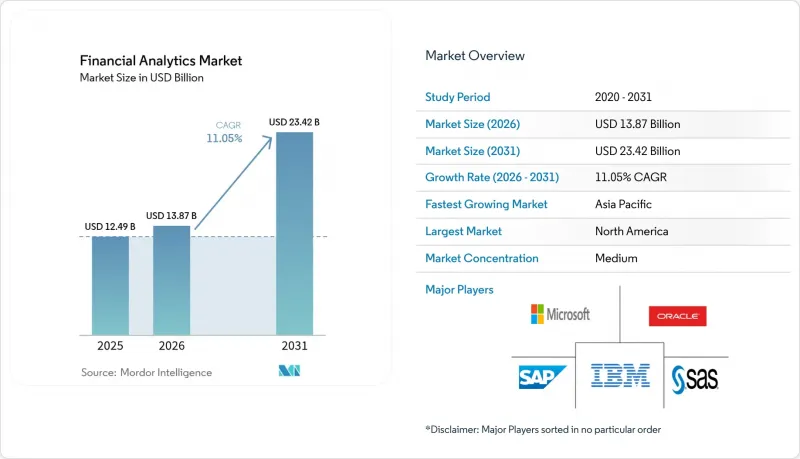
Mordor Intelligence에 의하면, 금융 분석 시장 규모는 2025년에 124억 9,000만 달러로 평가되었습니다. 2026년 138억 7,000만 달러에서 2031년까지 234억 2,000만 달러에 이를 것으로 예상되며, 예측 기간(2026-2031년) CAGR은 11.05%를 나타낼 전망입니다.
본 보고서는 도입 형태(On-Premise 및 클라우드), 솔루션 유형(데이터베이스 관리 및 계획·분석·보고서 작성 등), 용도(리스크 관리, 예산 편성·예측, 기타), 분석 유형(기술적 분석, 기타), 조직 규모(대기업 및 중소기업), 최종 사용자 산업(은행, 금융서비스 및 보험(BFSI), 헬스케어, 기타), 그리고 지역별로 분류되어 있습니다.
세계의 금융 분석 시장 동향 및 인사이트
‘클라우드 퍼스트’에 따른 코어 뱅킹 현대화의 폭발적인 확대
모놀리식 코어 시스템에서 클라우드 네이티브 아키텍처로 전환한 금융 기관에서는 도입 첫해에 업무 효율이 45% 향상되었으며, 최대 40%의 비용 절감을 달성했습니다. 이러한 전환을 통해 기존에는 유지보수에 소요되던 예산이 확보되어, 데이터를 실시간으로 분석 엔진에 스트리밍하는 마이크로서비스 구현이 가능해집니다. 북미의 Tier 1 은행은 하이브리드형으로의 전환을 추진하는 한편, 인도와 인도네시아의 중견 금융 기관은 퍼블릭 클라우드 기반 코어 시스템으로 직접 전환하고 있습니다. 벤더의 로드맵은 현재, 일중 거래량에 따라 탄력적으로 확장 가능한 컨테이너화된 분석 모듈을 중심으로 하고 있습니다. 규제 당국은 클라우드 그리드가 재해 복구를 가속화하고 다운타임을 거의 제로로 만들 수 있다는 점에서 복원력의 이점을 인정하고 있습니다. 이러한 추세에 힘입어 금융 분석 시장의 잠재 수요가 크게 확대되고 있습니다.
금융 스위트에 통합된 AI/ML이 TCO를 절감
재무, 대출, 포트폴리오 관리 도구에 AI 엔진을 통합함으로써 별도의 데이터 사이언스 스택을 마련할 필요가 없어집니다. AI가 통합된 플랫폼을 도입한 금융 기관은 자동화된 대조, 매우 정확한 현금 흐름 예측, 그리고 오감지 알림 감소를 통해 연간 평균 190만 달러의 비용 절감을 실현하고 있습니다. 최신 제품군에는 ERP 및 CRM 파이프라인에서 데이터를 가져오는 예측 모델이 미리 설정되어 있어, 고도의 분석 인력을 충분히 확보하지 못한 지방 은행에서도 도입 주기를 단축할 수 있습니다. AI를 활용한 운전 자본 최적화 등의 용도는 예측 오차를 50% 줄여, 수익을 창출하는 상품으로 재분배 가능한 유동성을 창출합니다. 그 결과, 총 소유 비용(TCO)이 감소함에 따라 비용에 민감한 부문에서 금융 분석 시장의 확산이 가속화됩니다.
심화되는 사이버 침해에 따른 배상 책임
은행 1곳당 사고 1건당 손실액은 평균 608만 달러로, 업계 전반의 평균치를 25% 가까이 상회합니다. 공격의 잠복 기간은 종종 5개월을 초과하며, 인증 정보 및 고객 기록 도난을 조장하고 있습니다. 2024년 미국의 한 대형 의료보험사를 강타한 랜섬웨어 공격은 단 한 건의 사고만으로도 2,200만 달러의 배상금을 초래할 수 있음을 보여주었습니다. 이사회는 현재 분석 시스템 업그레이드에서 보안 강화로 자본을 재편하고 있어 시스템 업데이트 주기가 지연되고 있습니다. 사이버 보험료도 두 자릿수 증가세를 보이며 IT 예산을 더욱 압박하고 있습니다. 따라서 벤더는 구매자의 우려를 해소하고 금융 분석 시장의 성장을 유지하기 위해 분석 플랫폼 내에 제로 트러스트 제어 기능을 통합해야 합니다.
부문 분석
2025년, On-Premise 환경은 금융 분석 시장 점유율의 60.65%를 유지했으며, 이는 데이터 상주지 및 지연 제어에 대한 해당 부문의 신중한 태도를 여실히 드러내고 있습니다. 그러나 퍼블릭 클라우드 및 프라이빗 클라우드로의 도입은 연평균 성장률(CAGR) 13.04%로 진행되고 있으며, 규제 당국이 공동 책임 체계를 공식적으로 확립함에 따라 그 격차는 점차 좁혀질 것입니다. 금융 기관들은 실시간 리스크 관리 엔진을 이전하기 전에, 예산 수립용 샌드박스 등 비핵심 용도부터 단계적으로 이전하는 방안을 검토하고 있습니다. 벤더들이 현지 규정 준수 요건을 충족하기 위해 주권 클라우드 리전을 구축함에 따라, 클라우드 플랫폼에 기인한 금융 분석 시장 규모는 현저히 확대될 것으로 예측됩니다. 은행들은 또한 비용과 지연 시간에 따라 워크로드를 On-Premise와 클라우드 노드 간에 유연하게 전환할 수 있는 컨테이너 오케스트레이션도 도입하고 있습니다. 데이터 이관 비용이나 벤더 락인에 대한 우려는 여전히 남아 있지만, 멀티클라우드 연결 도구와 이식 가능한 라이선싱 제도가 이러한 제약을 완화하고 클라우드의 보다 광범위한 도입을 촉진하고 있습니다.
워크로드가 이전되면 운영 모델도 변화합니다. 하드웨어 팀을 대신해 사이트 신뢰성 엔지니어가 활약하게 되며, 종량제 요금제를 통해 IT 지출이 거래량에 상응하게 됩니다. 중소 금융 기관은 종량제 요금 모델을 활용하여, 이전에는 세계 은행에만 국한되었던 머신러닝 라이브러리를 이용할 수 있게 됩니다. 클라우드 플랫폼에는 테넌트 간 네트워크 트래픽을 모니터링하는 위협 분석 기능이 통합되어 사이버 복원력이 강화됩니다. 확장 가능한 컴퓨팅을 통해 막대한 고정 투자 없이도 포트폴리오 리스크에 대한 몬테카를로 시뮬레이션이 가능해집니다. 그 결과로 얻게 되는 민첩성은 여전히 메인프레임에 의존하고 있는 기존 기업에 추가적인 압박을 가하며, 클라우드 기반 금융 분석 시장 솔루션에 대한 예산 배분을 가속화할 것입니다.
재무 팀이 결산 주기를 단축하기 위해 통합 대시보드를 필요로 함에 따라, 분석 및 보고 작성 제품군은 2025년 시장에서 33.12%의 매출 점유율을 차지하며 시장을 주도했습니다. 다중 법인 기업은 복잡한 IFRS 및 GAAP 요건을 충족하기 위해 ‘단일 진실(Single Version of Truth)’이 되는 원장을 필요로 하기 때문에 재무 통합 제품군은 12.46%의 연평균 성장률(CAGR)을 보이고 있습니다. 이러한 모듈은 외화 환산 및 계열사 간 거래 상계를 자동화하여 수기 분개 입력을 70% 줄여줍니다. 각 벤더는 그룹 결산 과정에서 비정상적인 차이를 감지하고 시정 조치를 제안하는 AI 기능을 통합하여, 이를 통해 보고까지 소요되는 기간을 며칠 단축하고 있습니다. 규제 당국이 기후 변화 및 세무 투명성에 관한 공시 요건을 강화함에 따라, 연결 결산과 관련된 재무 분석 시장 규모는 크게 확대될 것으로 예측됩니다.
데이터베이스 관리 및 계획 수립 도구는 분석 엔진이 작동할 수 있는 기반을 형성하는 한편, 리스크 및 컴플라이언스 모듈은 시나리오 모델링과 규제 분류 체계를 통합하고 있습니다. ESG 점수 분석 및 양자 컴퓨팅을 지원하는 파생상품 플랫폼은 신흥 ‘기타 솔루션’이라는 틈새 시장을 차지하고 있습니다. 기업들이 종단간 재무 혁신을 추구하는 가운데, 각 벤더들은 계정 대조 및 공시 관리와 같은 관련 기능을 더 대규모의 플랫폼에 통합하고 있습니다. 이러한 융합 추세는 각 공급업체가 풀스택 서비스를 제공하기 위해 경쟁하는 가운데 M&A를 촉진하고, 재무 분석 시장의 경쟁을 격화시키고 있습니다.
지역별 분석
2025년에는 자본력이 풍부한 은행들이 AI 코어, 클라우드 내결함성, 통합 컴플라이언스 워크벤치에 조기에 투자한 결과, 북미가 매출 점유율 38.45%로 1위를 차지했습니다. 미국 규제 당국은 모델 리스크 관리에 관한 명확한 지침을 제공하고 있어, 금융 기관들은 명확하게 정의된 프레임워크 내에서 실험을 수행할 수 있게 되었습니다. 캐나다 은행들은 풍부한 거래 데이터를 제3자 분석 레이어로 스트리밍하는 오픈 뱅킹 API의 선구자가 되었습니다. 뉴욕과 토론토의 자본 시장 기업들은 마이크로초 단위로 파생상품 가격 산정을 수행하는 저지연 그리드를 도입하고 있습니다. 하이퍼스케일 클라우드 리전의 존재로 인해 데이터 주권을 둘러싼 마찰이 완화되어, 해당 지역 전체의 금융 분석 시장 우위가 유지되고 있습니다.
아시아태평양은 적극적인 디지털화, 지원적인 정책, 그리고 금융 서비스에 대한 중산층 수요 증가를 배경으로 2031년까지 연평균 성장률(CAGR) 12.32%를 나타낼 것으로 예측됩니다. 중국의 대형 은행들은 수십억 달러 규모의 클라우드 예산을 투자하고 있는 반면, 인도의 공공 부문 은행들은 신용 점수 산정을 위한 새로운 데이터 세트를 활용하는 계좌 통합 네트워크에 참여하고 있습니다. 일본의 주요 금융사들은 금리 변동 위험을 완화하기 위해 양자 컴퓨팅 컨소시엄을 모색하고 있습니다. 동남아시아의 핀테크 기업들은 은행 계좌가 없는 사람들에게 대출 접근성을 제공하고, 실시간 분석 워크로드를 엣지로 이전하고 있습니다. 이 지역의 AI 관련 지출은 2028년까지 1,100억 달러에 달할 것으로 예측되며, 장기적인 성장 모멘텀을 더욱 강화할 것으로 보입니다.
유럽은 선진적인 ESG 보고 기준과 정교한 도매 시장을 바탕으로 여전히 강력한 입지를 유지하고 있습니다. 프랑스 은행들은 탄소 회계를 신용 평가 모델에 통합하고 있는 반면, 독일 보험사들은 기후 리스크를 반영한 보험 수리 엔진을 도입하고 있습니다. EU 데이터법으로 인해 개인정보 보호 규정 준수의 중요성이 높아지면서, 시큐어 엔클레이브(Secure Enclave)와 같은 개인정보 보호형 분석 기술의 보급이 확대되고 있습니다. 한편, 유럽중앙은행이 결제 인프라 보호를 목적으로 포스트 양자암호화를 조사한 데 따라 양자 기술에 대한 대비가 주목받고 있습니다. 남미, 중동 및 아프리카는 현재 시장 점유율이 작지만, 모바일 머니, 디지털 ID, 오픈 뱅킹 관련 노력이 성숙해짐에 따라 두 자릿수 성장률을 기록하고 있습니다.
기타 혜택 :
- 엑셀 형식 시장 예측(ME) 시트
- 3개월간의 애널리스트 지원
자주 묻는 질문
목차
제1장 서론
제2장 조사 방법
제3장 주요 요약
제4장 시장 구도
제5장 시장 규모 및 성장 예측
제6장 경쟁 구도
제7장 시장 기회 및 향후 전망
KTH 26.09.10According to Mordor Intelligence, the financial analytics market size was valued at USD 12.49 billion in 2025 and estimated to grow from USD 13.87 billion in 2026 to reach USD 23.42 billion by 2031, at a CAGR of 11.05% during the forecast period (2026-2031).
This report is Segmented by Deployment Mode (On-Premise and Cloud), Solution Type (Database Management and Planning, Analysis and Reporting, and More), Application (Risk Management, Budgeting and Forecasting, and More), Analytics Type (Descriptive Analytics, and More), Organization Size (Large Enterprises and Small and Medium Enterprises), End-User Industry (BFSI, Healthcare, and More), and Geography.
Global Financial Analytics Market Trends and Insights
Explosion in Cloud-First Core-Banking Modernizations
Financial institutions that migrate from monolithic cores to cloud-native architectures record 45% jumps in operational efficiency and up to 40% cost savings within the first year. The shift frees budgets historically consumed by maintenance and enables microservices that stream data into analytics engines in real time. North American tier-1 banks are executing hybrid moves, while mid-tier lenders in India and Indonesia leap directly to public cloud cores. Vendor roadmaps now center on containerized analytics modules that scale elastically with intraday transaction volumes. Regulators acknowledge the resilience benefit because cloud grids allow faster disaster recovery and near-zero downtime. This momentum greatly enlarges addressable demand in the financial analytics market.
AI/ML Embedded in Finance Suites Lowers TCO
Embedding AI engines inside treasury, lending, and portfolio tools removes the need for separate data science stacks. Institutions deploying AI-infused platforms save an average of USD 1.9 million annually through automated reconciliations, hyper-accurate cash forecasts, and fewer false-positive alerts. Modern suites come pre-configured with predictive models that pull data from ERP and CRM pipes, shrinking implementation cycles for regional banks lacking deep analytics talent. Applications such as AI-guided working capital optimization reduce forecast errors by 50%, unlocking liquidity that can be redeployed into revenue-generating products. The resulting lower total cost of ownership accelerates penetration of the financial analytics market into cost-sensitive segments.
Escalating Cyber-Breach Liabilities
Banks average USD 6.08 million in loss per breach, nearly 25% above cross-sector norms. Attack dwell time often exceeds five months, amplifying theft of credentials and customer records. The 2024 ransomware strike on a leading U.S. health insurer showed how a single breach can trigger USD 22 million in payouts. Boards now divert capital from analytics upgrades to security hardening, slowing refresh cycles. Cyber insurance premiums also rise by double digits, squeezing IT budgets further. Vendors must therefore embed zero-trust controls inside analytics platforms to assuage buyer concerns and sustain growth in the financial analytics market.
Other drivers and restraints analyzed in the detailed report include:
- Regulatory Push for Real-Time Risk and Capital Reporting
- Surge in Data-Driven Financial Planning and Analysis Across SMBs
- Shortage of Advanced Analytics Talent
For complete list of drivers and restraints, kindly check the Table Of Contents.
Segment Analysis
On-premise setups retained 60.65% of the financial analytics market share in 2025, underscoring the sector's cautious stance on data residency and latency control. However, public and private cloud deployments are advancing at 13.04% CAGR and will narrow the gap as regulators formalize shared-responsibility frameworks. Institutions weigh staged migrations beginning with non-core applications, such as budgeting sandboxes, before moving real-time risk engines. The financial analytics market size attributed to cloud platforms is forecast to climb markedly as vendors build sovereign cloud regions to satisfy local compliance. Banks also adopt container orchestration that allows workloads to swing between on-premise and cloud nodes based on cost or latency. Although data-egress fees and vendor lock-in fears linger, multicloud connectivity tools and portable licensing help alleviate these restraints and propel broader cloud adoption.
Once workloads shift, operating models change. Site-reliability engineers replace hardware teams, and consumption pricing aligns IT spend with transaction volumes. Smaller lenders exploit the pay-as-you-go model to access machine-learning libraries previously limited to global banks. Cloud platforms integrate threat analytics that monitor network traffic across tenants, strengthening cyber resilience. Scalable compute further enables Monte Carlo simulations for portfolio risk without large fixed investments. The resulting agility places added pressure on incumbents still anchored to mainframes, encouraging an accelerated reallocation of budgets toward cloud-based financial analytics market solutions.
Analysis and reporting suites led the 2025 landscape with 33.12% revenue share as finance teams demanded unified dashboards for faster close cycles. Financial consolidation suites exhibit 12.46% CAGR because multi-entity corporations require single-version-of-truth ledgers to meet complex IFRS and GAAP obligations. These modules automate currency translation and intercompany eliminations, reducing manual journal entries by 70%. Vendors embed AI that flags anomalous variances during group close and recommends corrective actions, shaving days off reporting timelines. The financial analytics market size associated with consolidation is projected to expand significantly as regulators intensify disclosure demands for climate and tax transparency.
Database management and planning tools form the substrate on which analytical engines run, while risk and compliance modules integrate scenario modeling with regulatory taxonomy. ESG-score analytics and quantum-ready derivatives platforms occupy the emerging "other solutions" niche. As corporations seek end-to-end financial transformation, vendors bundle adjacent capabilities such as account reconciliation and disclosure management into larger platforms. The convergence trend fuels mergers and acquisitions as providers race to offer full-stack coverage, amplifying competition within the financial analytics market.
Complete Report Scope:
- By Deployment Mode
- On-premise
- Cloud
- By Solution Type
- Database Management and Planning
- Analysis and Reporting
- Financial Consolidation
- Risk and Compliance
- Other Solutions
- By Application
- Risk Management
- Budgeting and Forecasting
- Revenue Management
- Fraud Detection
- Cash-flow and Treasury Analytics
- Compliance and Reporting
- Wealth and Portfolio Analytics
- By Analytics Type
- Descriptive Analytics
- Diagnostic Analytics
- Predictive Analytics
- Prescriptive Analytics
- By Organisation Size
- Large Enterprises
- Small and Medium Enterprises
- By End-user Industry
- BFSI
- Healthcare
- Manufacturing
- Government
- IT and Telecom
- Retail and eCommerce
- Others
- By Geography
- North America
- United States
- Canada
- Mexico
- Europe
- Germany
- United Kingdom
- France
- Italy
- Spain
- Russia
- Rest of Europe
- Asia-Pacific
- China
- Japan
- India
- South Korea
- ASEAN
- Australia and New Zealand
- Rest of Asia-Pacific
- South America
- Brazil
- Argentina
- Rest of South America
- Middle East and Africa
- Middle East
- Saudi Arabia
- UAE
- Turkey
- Rest of Middle East
- Africa
- South Africa
- Nigeria
- Rest of Africa
- Middle East
- North America
Geography Analysis
North America led with 38.45% revenue share in 2025 as well-capitalized banks invested early in AI cores, cloud resilience, and integrated compliance workbenches. U.S. regulators provide clear guidance on model risk management, allowing institutions to experiment within well-defined guardrails. Canadian banks pioneer open-banking APIs that stream enriched transaction data into third-party analytics layers. Capital markets firms in New York and Toronto deploy low-latency grids that price derivatives in microseconds. The presence of hyperscale cloud regions reduces data-sovereignty friction, sustaining dominance of the financial analytics market across the region.
Asia-Pacific is expected to post a 12.32% CAGR through 2031 on the back of aggressive digitization, supportive policy, and expanding middle-class demand for financial services. China's megabanks commit multi-billion-dollar cloud budgets, while India's public-sector banks join account-aggregator networks that unleash new data sets for credit scoring. Japan's financial giants explore quantum computing consortiums to mitigate interest-rate volatility. Southeast Asian fintechs unlock credit access for the unbanked, pushing real-time analytics workloads to the edge. Regional AI spend is forecast to hit USD 110 billion by 2028, reinforcing long-term momentum.
Europe maintains a sizeable footprint with advanced ESG reporting norms and sophisticated wholesale markets. French banks integrate carbon accounting into credit models, while German insurers deploy actuarial engines that factor climate risk. The EU Data Act elevates privacy compliance, prompting wider adoption of privacy-preserving analytics such as secure enclaves. Meanwhile, quantum readiness gains traction after the European Central Bank explored post-quantum cryptography to safeguard payment rails. South America, and Middle East, and Africa contribute smaller shares today but register double-digit growth as mobile money, digital ID, and open banking initiatives mature.
- FICO
- Hitachi Vantara
- SAS Institute
- IBM Corporation
- Microsoft Corporation
- Oracle Corporation
- SAP SE
- Teradata Corporation
- Salesforce (Tableau)
- Qlik Tech
- TIBCO Software
- Alteryx
- ThoughtSpot
- Domo
- MicroStrategy
- Sisense
- Anaplan
- Workday Adaptive Planning
- Moody's Analytics
- SandP Global Market Intelligence
- BlackLine
- Infor
- Wolters Kluwer
- Datarails
Additional Benefits:
- The market estimate (ME) sheet in Excel format
- 3 months of analyst support
TABLE OF CONTENTS
1 INTRODUCTION
- 1.1 Study Assumptions and Market Definition
- 1.2 Scope of the Study
2 RESEARCH METHODOLOGY
3 EXECUTIVE SUMMARY
4 MARKET LANDSCAPE
- 4.1 Market Overview
- 4.2 Market Drivers
- 4.2.1 Explosion in cloud-first core-banking modernisations
- 4.2.2 AI/ML embedded in finance suites lowers TCO
- 4.2.3 Regulatory push for real-time risk and capital reporting
- 4.2.4 Surge in data-driven financial planning and analysis across SMBs
- 4.2.5 ESG-score-linked debt issuance analytics
- 4.2.6 Quantum-ready Monte-Carlo engines for VAR
- 4.3 Market Restraints
- 4.3.1 Escalating cyber-breach liabilities
- 4.3.2 Shortage of advanced analytics talent
- 4.3.3 Rising cloud egress fees and vendor lock-in
- 4.3.4 Algorithmic bias compliance investigations
- 4.4 Value Chain Analysis
- 4.5 Regulatory Landscape
- 4.6 Technological Outlook
- 4.7 Porter's Five Forces Analysis
- 4.7.1 Threat of New Entrants
- 4.7.2 Bargaining Power of Buyers
- 4.7.3 Bargaining Power of Suppliers
- 4.7.4 Threat of Substitutes
- 4.7.5 Intensity of Competitive Rivalry
- 4.8 Assessment of the Impact of Macroeconomic Trends on the Market
5 MARKET SIZE AND GROWTH FORECASTS (VALUE)
- 5.1 By Deployment Mode
- 5.1.1 On-premise
- 5.1.2 Cloud
- 5.2 By Solution Type
- 5.2.1 Database Management and Planning
- 5.2.2 Analysis and Reporting
- 5.2.3 Financial Consolidation
- 5.2.4 Risk and Compliance
- 5.2.5 Other Solutions
- 5.3 By Application
- 5.3.1 Risk Management
- 5.3.2 Budgeting and Forecasting
- 5.3.3 Revenue Management
- 5.3.4 Fraud Detection
- 5.3.5 Cash-flow and Treasury Analytics
- 5.3.6 Compliance and Reporting
- 5.3.7 Wealth and Portfolio Analytics
- 5.4 By Analytics Type
- 5.4.1 Descriptive Analytics
- 5.4.2 Diagnostic Analytics
- 5.4.3 Predictive Analytics
- 5.4.4 Prescriptive Analytics
- 5.5 By Organisation Size
- 5.5.1 Large Enterprises
- 5.5.2 Small and Medium Enterprises
- 5.6 By End-user Industry
- 5.6.1 BFSI
- 5.6.2 Healthcare
- 5.6.3 Manufacturing
- 5.6.4 Government
- 5.6.5 IT and Telecom
- 5.6.6 Retail and eCommerce
- 5.6.7 Others
- 5.7 By Geography
- 5.7.1 North America
- 5.7.1.1 United States
- 5.7.1.2 Canada
- 5.7.1.3 Mexico
- 5.7.2 Europe
- 5.7.2.1 Germany
- 5.7.2.2 United Kingdom
- 5.7.2.3 France
- 5.7.2.4 Italy
- 5.7.2.5 Spain
- 5.7.2.6 Russia
- 5.7.2.7 Rest of Europe
- 5.7.3 Asia-Pacific
- 5.7.3.1 China
- 5.7.3.2 Japan
- 5.7.3.3 India
- 5.7.3.4 South Korea
- 5.7.3.5 ASEAN
- 5.7.3.6 Australia and New Zealand
- 5.7.3.7 Rest of Asia-Pacific
- 5.7.4 South America
- 5.7.4.1 Brazil
- 5.7.4.2 Argentina
- 5.7.4.3 Rest of South America
- 5.7.5 Middle East and Africa
- 5.7.5.1 Middle East
- 5.7.5.1.1 Saudi Arabia
- 5.7.5.1.2 UAE
- 5.7.5.1.3 Turkey
- 5.7.5.1.4 Rest of Middle East
- 5.7.5.2 Africa
- 5.7.5.2.1 South Africa
- 5.7.5.2.2 Nigeria
- 5.7.5.2.3 Rest of Africa
- 5.7.5.1 Middle East
- 5.7.1 North America
6 COMPETITIVE LANDSCAPE
- 6.1 Market Concentration
- 6.2 Strategic Moves
- 6.3 Market Share Analysis
- 6.4 Company Profiles (includes Global level Overview, Market level overview, Core Segments, Financials as available, Strategic Information, Market Rank/Share for key companies, Products and Services, and Recent Developments)
- 6.4.1 FICO
- 6.4.2 Hitachi Vantara
- 6.4.3 SAS Institute
- 6.4.4 IBM Corporation
- 6.4.5 Microsoft Corporation
- 6.4.6 Oracle Corporation
- 6.4.7 SAP SE
- 6.4.8 Teradata Corporation
- 6.4.9 Salesforce (Tableau)
- 6.4.10 Qlik Tech
- 6.4.11 TIBCO Software
- 6.4.12 Alteryx
- 6.4.13 ThoughtSpot
- 6.4.14 Domo
- 6.4.15 MicroStrategy
- 6.4.16 Sisense
- 6.4.17 Anaplan
- 6.4.18 Workday Adaptive Planning
- 6.4.19 Moody's Analytics
- 6.4.20 SandP Global Market Intelligence
- 6.4.21 BlackLine
- 6.4.22 Infor
- 6.4.23 Wolters Kluwer
- 6.4.24 Datarails
7 MARKET OPPORTUNITIES AND FUTURE OUTLOOK
- 7.1 White-space and Unmet-need Assessment


