|
시장보고서
상품코드
2120585
마취 기기 : 시장 점유율 분석, 업계 동향 및 통계, 성장 예측(2026-2031년)Anesthesia Devices - Market Share Analysis, Industry Trends & Statistics, Growth Forecasts (2026 - 2031) |
||||||
 Mordor Intelligence
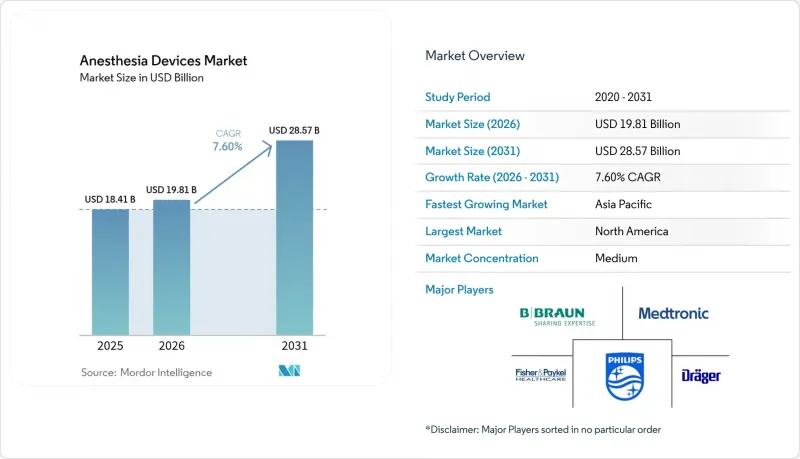
Mordor Intelligence에 의하면, 마취 기기 시장 규모는 2025년에 184억 1,000만 달러로 평가되었습니다. 2026년 198억 1,000만 달러에서 2031년까지 285억 7,000만 달러에 이를 것으로 예상되며, 예측 기간(2026-2031년) CAGR은 7.6%를 나타낼 전망입니다.
본 보고서는 제품 유형별(마취기, 일회용 제품·부속품), 최종 사용자별(병원, 클리닉·요양 시설), 지역별(북미, 유럽, 아시아태평양, 중동 및 아프리카, 남미)로 분류되어 있습니다. 시장 예측은 금액(미 달러) 기준으로 제시되어 있습니다.
세계의 마취 기기 시장 동향 및 인사이트
마취 투여 및 모니터링 분야의 기술 발전
수면제와 흡입 마취제를 실시간으로 조절하는 폐쇄 루프 시스템 덕분에 약물 소비량이 최대 50% 감소하여, 의료 서비스 제공업체에게 측정 가능한 비용 절감이 실현되고 있습니다. 머신러닝 알고리즘을 활용한 FDA 승인 통증 지수를 통해 진통의 깊이가 개인별로 맞춤화되어, 통증 평가 시 인종적 편향이 완화되고 있습니다. 뇌 기능 모니터를 통해 각성 시 기억 잔존률이 64% 감소하여, 고도 모니터링의 가치 제안이 강화되고 있습니다. 각 벤더사는 터치스크린 인터페이스, HL7 호환 데이터 포트, 수술 중 데이터를 전자의무기록과 연동하는 클라우드 게이트웨이를 탑재하고 있습니다. 경쟁사와의 차별화는 회복 속도 향상, 합병증 감소, 총 소유 비용(TCO) 절감을 입증할 수 있는지 여부에 달려 있습니다. 알고리즘을 활용한 의료기기에는 고성능 컴퓨팅 리소스, 임상 데이터 세트, 시판 후 조사 팀이 필수적이기 때문에 중소규모 기업들은 자금 및 규제 측면의 장벽에 직면해 있습니다.
전 세계 수술 건수 증가
외래수술센터(ASC)의 연간 수술 건수는 21% 증가하여 2034년까지 4,400만 건에 달할 것으로 예상되며, 그 중심에는 정형외과, 척추외과, 소화기외과 수술이 있습니다. 아시아태평양에서는 2050년까지 60세 이상 인구가 총 인구의 22.2%를 차지할 것으로 예상되며, 이에 따라 심혈관 질환 및 종양학 중재 치료에 필요한 전신 마취 수요가 가속화될 것으로 보입니다. 저침습 기술로의 전환으로 인해, 기존에는 입원 치료로만 제한되었던 심장 절제술이나 척추 고정술이 외래에서 시행 가능해졌습니다. 병원 수술실의 수용 능력 제약으로 인해, 독립형 수술센터에 수십억 달러 규모의 투자가 촉진되고 있습니다. 의료기기 제조업체들은 일회용 소모품의 회전율 향상과 수술실 간 이동이 용이한 소형 기기에 대한 수요로 혜택을 보고 있지만, 한편으로는 종합적 보상 제도로 인한 비용 압박에도 대처해야 합니다.
첨단 시스템 도입 및 유지 비용의 높음
자원이 제한된 병원의 설비 투자 예산으로는 정가가 20만 달러를 넘는 경우도 있는 고급 워크스테이션을 구입할 여유가 거의 없으며, 서비스 계약에는 구입 가격의 10-15%가 매년 추가되는 경우가 흔합니다. 생체의료 공학 기술자의 훈련 부족과 제조업체의 현장 팀이 광범위한 지역을 담당하고 있다는 점 때문에 고장 시 수리 지연이 널리 관찰됩니다. 자금 조달, 교육, 가동률 보장을 결합한 ‘장비 관리 서비스 계약’이 주목을 받고 있지만, 구매자는 10년에 달하는 계약에 얽매여 재정적 유연성이 저하될 우려가 있습니다. AI 탑재 장비의 경우, 클라우드 이용료나 보안 업데이트에 추가 비용이 발생합니다. 도입 진척도에 편차가 있어, 마취 기기 시장이 첨단 기술 부문과 기초 의료 부문으로 양분될 위험이 있습니다.
부문별 분석
2025년, 마취기는 마취 기기 시장 매출의 41.88%를 차지하며, 모든 수술실의 설비 투자의 핵심으로서의 위상을 확고히 하고 있습니다. 업그레이드 주기에서는 고속 피스톤식 인공호흡기, 용적식 약물 투여, 병원 데이터 인프라와 연동되는 실시간 가스 분석 기능을 갖춘 고급 기기 유형이 선호되고 있습니다. 15인치 정전용량식 터치스크린이나 HL7 상호운용성을 갖춘 모델 등의 차세대 워크스테이션은 완전 디지털화된 수술실을 지향하는 의료 기관에서 지지를 받고 있습니다. 대규모 병원에서는 7년에서 9년마다 업그레이드가 이루어지기 때문에 불규칙적이긴 하지만 대규모 수주가 발생하여 주요 공급업체의 분기별 수익을 좌우하고 있습니다. 환경 보호 요구에 따라 엔지니어들은 온실가스 배출량을 최대 65%까지 줄여주는 휘발성 마취제 회수 모듈의 도입을 추진하고 있습니다.
일회용 제품 및 부속품은 연평균 성장률(CAGR) 9.18%를 나타낼 것으로 예측되며, 이는 마취 기기 시장에서 가장 빠른 성장세입니다. 일회용 호흡 회로, 성문 상부 기도, 마취 깊이 전극은 수술 건수와 밀접하게 연동되어 지속적인 수익을 창출합니다. 팬데믹 이후 감염 예방 프로토콜의 강화와 즉시 사용 가능한 멸균 키트의 편의성으로 인해, 재사용형 제품을 대체하는 추세가 지속되고 있습니다. 마취 기기 시장에서 일회용 제품이 차지하는 시장 규모는 금세기 말까지 기기 매출액을 넘어설 것으로 예상되지만, 지속가능성 노력에 따라 퇴비화 가능하거나 재사용형 회로의 초기 시범 도입이 진행되고 있어, 이것이 수요 패턴을 재구성할 가능성이 있습니다. 독자적인 일회용 제품을 하드웨어 플랫폼과 세트로 판매하는 공급업체는 고객 유지를 강화하고 이익률을 안정화할 수 있습니다.
지역별 분석
북미는 수술 건수가 많고, 외래 수술에 대한 확립된 보험 환급 제도, AI 탑재 플랫폼의 조기 도입에 힘입어 2025년 마취 기기 시장 매출의 39.85%를 차지했습니다. 미국의 보험사는 2023년에 외래수술센터(ASC)에 68억 달러를 지급했으며, 이는 전년 대비 15.4% 증가한 수치로, 수술의 지속적인 전환을 뒷받침하고 있습니다. 상호 운용성을 촉진하는 연방 정부의 이니셔티브도 네트워크 지원 워크스테이션으로의 업그레이드를 가속화하고 있습니다. 캐나다는 단일 지불자 모델을 채택하여 설비 투자를 어느 정도 억제하고 있지만, 시뮬레이션을 통한 마취 교육이 통합형 훈련 솔루션에 대한 수요를 견인하고 있습니다. 멕시코는 의료 관광의 혜택을 받고 있으며, 민간 병원은 비용 대비 효과가 높은 선택적 수술을 원하는 외국인 환자를 유치하기 위해 고급 투여 시스템에 대한 투자를 추진하고 있습니다.
아시아태평양은 연평균 성장률(CAGR) 8.12%로 가장 빠르게 성장하고 있는 지역입니다. 중국과 인도는 공공 예산을 3차 병원 및 비용 경쟁력이 있는 장비를 공급하는 국내 공급업체를 우대하는 대량 조달 계획에 할당하고 있습니다. 인도네시아는 2025년 기업공개(IPO)를 앞두고 IFC로부터 1,200만 달러의 핵심 투자를 확보하여 국내 생산 능력을 확대했습니다. 일본의 원조 기관은 세계 보건 형평성을 위한 이 지역의 대외적 노력을 반영하여, 국경을 초월한 기술 이전에 자금을 지원하고 있습니다. 벤처 자금은 2021년 정점 시기에 비해 감소했으나, 여전히 자원이 부족한 환경을 위한 폐쇄형 솔루션을 맞춤화하는 AI 스타트업을 지원하고 있습니다. 이 지역의 마취 기기 시장 규모는 고령화와 생활 방식의 변화에 따른 심혈관 질환 및 종양학 부문 진료 건수 증가로 인해 호조를 보이고 있습니다.
유럽에서는 데스플루란의 단계적 폐지 및 병원의 탄소 발자국 감축을 요구하는 각국의 정책에 힘입어 여전히 큰 시장 점유율을 유지하고 있습니다. 영국과 스칸디나비아 국가의 병원에서는 저유량 세보플루란 및 정맥 내 투여 프로토콜을 지원하기 위해 파이프라인을 재설계하고 있으며, 기존 워크스테이션에 장착 가능한 휘발성 가스 회수 카트리지에 대한 수요를 불러일으키고 있습니다. 독일과 프랑스에서는 엄격한 시판 후 모니터링이 시행되고 있어, 제조업체들은 실제 환경에서의 성능 모니터링에 자원을 할당해야 하는 상황에 직면해 있습니다. 한편, 중동 및 아프리카에서는 장비, 서비스, 교육을 다년간의 계약으로 묶은 ‘관리형 장비 서비스’ 모델에 따라 도입이 가속화되고 있습니다. 예를 들어, 케냐의 국립 발표 병원에서는 가동 시간과 교육을 보장하는 세계 공급업체와 턴키 계약을 체결하여, 기존 유지보수 방식의 문제점이 완화되고 있습니다.
기타 혜택
- 엑셀 형식 시장 예측(ME) 시트
- 3개월간 애널리스트의 지원
자주 묻는 질문
목차
제1장 서론
제2장 조사 방법
제3장 주요 요약
제4장 시장 구도
제5장 시장 규모 및 성장 예측
제6장 경쟁 구도
제7장 시장 기회 및 향후 전망
KTH 26.09.04According to Mordor Intelligence, the anesthesia devices market size was valued at USD 18.41 billion in 2025 and estimated to grow from USD 19.81 billion in 2026 to reach USD 28.57 billion by 2031, at a CAGR of 7.6% during the forecast period (2026-2031).

This report is Segmented by Product Type (Anesthesia Machines and Disposables & Accessories), End User (Hospitals, Ambulatory Surgery Centers, and Clinics & Nursing Facilities), and Geography (North America, Europe, Asia-Pacific, Middle East & Africa, South America). The Market Forecasts are Provided in Terms of Value (USD).
Global Anesthesia Devices Market Trends and Insights
Technological Advancements in Anesthesia Delivery and Monitoring
Closed-loop systems that titrate hypnotics and inhalational agents in real time are trimming drug consumption by up to 50%, producing measurable cost savings for providers. FDA-cleared nociception indices that harness machine-learning algorithms now personalize analgesic depth and reduce racial bias in pain assessment. Brain-function monitors have cut awareness with recall by 64%, strengthening the value proposition of advanced monitoring. Vendors are embedding touchscreen interfaces, HL7-ready data ports, and cloud gateways that channel intraoperative data into the electronic medical record. Competitive differentiation hinges on demonstrating faster recovery, fewer complications, and lower total cost of ownership. Smaller firms face capital and regulatory hurdles because high-performance compute resources, clinical data sets, and post-market surveillance teams are compulsory for algorithmic devices.
Rising Volume of Surgical Procedures Globally
Ambulatory centers are projected to lift annual case throughput by 21%, reaching 44 million procedures by 2034, with orthopedic, spine, and gastroenterology cases at the forefront. Asia-Pacific's population aged 60+ will represent 22.2% of residents by 2050, accelerating demand for general anesthesia in cardiovascular and oncologic interventions. Migration toward minimally invasive techniques enables outpatient cardiac ablations and spine fusions that traditionally remained inpatient. Capacity constraints in hospital operating rooms are triggering multibillion-dollar investments in standalone surgical hubs. Device makers benefit from higher disposable turnover and the need for compact machines that roll easily between theaters, yet they must also address cost pressures stemming from bundled reimbursement rates.
High Acquisition and Maintenance Costs of Advanced Systems
Capital budgets in low-resource hospitals rarely stretch to premium workstations whose list prices can surpass USD 200,000, and service contracts often add 10-15% of purchase price annually. Break-fix delays are widespread because biomedical engineers lack training and manufacturers' field teams cover large territories. Managed-equipment-service contracts that combine financing, training, and uptime guarantees are gaining traction, yet they lock buyers into decade-long commitments that strain fiscal flexibility. AI-enabled units impose further costs for cloud subscriptions and security updates. An uneven adoption curve risks splitting the anesthesia devices market into high-tech and basic-care tiers.
Other drivers and restraints analyzed in the detailed report include:
- Increasing Burden of Chronic Diseases and Aging Population
- Expansion of Ambulatory and Day-Care Surgery Centers
- Stringent Regulatory and Approval Requirements
For complete list of drivers and restraints, kindly check the Table Of Contents.
Segment Analysis
Anesthesia machines produced 41.88% of the anesthesia devices market revenue in 2025, underscoring their status as the capital cornerstone of every operating suite. Replacement cycles favor premium units with high-speed piston ventilators, volumetric agent delivery, and real-time gas analysis that feed into the hospital data backbone. Next-generation workstations, such as models equipped with 15-inch capacitive touchscreens and HL7 interoperability, appeal to facilities pursuing fully digital operating rooms. Larger hospitals upgrade every seven to nine years, creating lumpy but sizeable orders that shape quarterly earnings for leading vendors. Environmental imperatives are leading engineers to incorporate volatile-agent capture modules that cut greenhouse emissions by up to 65%.
Disposables and accessories are set to grow at a 9.18% CAGR, the fastest pace in the anesthesia devices market. Single-use breathing circuits, supraglottic airways, and depth-of-anesthesia electrodes deliver recurring revenues tightly aligned with procedure counts. Heightened infection-control protocols post-pandemic and the convenience of ready-to-use sterile kits continue to displace reusable equivalents. The anesthesia devices market size attributed to disposables is expected to outpace machine revenues by the end of the decade, though sustainability initiatives are prompting early pilots of compostable or reusable circuits that could reshape demand patterns. Vendors that package proprietary disposables with hardware platforms strengthen lock-in and stabilize margins.
Complete Report Scope:
- By Product Type
- Anesthesia Machines
- Anesthesia Workstations
- Anesthesia Delivery Machines
- Portable
- Stand-Alone
- Anesthesia Ventilators
- Anesthesia Monitors
- Disposables & Accessories
- Anesthesia Circuits
- Anesthesia Masks
- Endotracheal Tubes (ETTs)
- Laryngeal Mask Airways (LMAs)
- Other Disposables And Accessories
- Anesthesia Machines
- By End User
- Hospitals
- Hospitals
- Clinics & Nursing Facilities
- Geography
- North America
- United States
- Canada
- Mexico
- Europe
- Germany
- United Kingdom
- France
- Italy
- Spain
- Rest of Europe
- Asia-Pacific
- China
- Japan
- India
- Australia
- South Korea
- Rest of Asia-Pacific
- Middle East & Africa
- GCC
- South Africa
- Rest of Middle East & Africa
- South America
- Brazil
- Argentina
- Rest of South America
- North America
Geography Analysis
North America generated 39.85% of 2025 revenue in the anesthesia devices market, buoyed by high surgical volumes, established reimbursement for outpatient procedures, and early uptake of AI-enabled platforms. U.S. payers reimbursed ambulatory centers USD 6.8 billion in 2023, a 15.4% year-on-year rise, validating sustained procedural migration. Federal initiatives that encourage interoperability also accelerate upgrades to network-ready workstations. Canada follows a single-payer model that somewhat tempers capital spending, but simulation-based anesthesia education drives demand for integrated training solutions. Mexico benefits from medical tourism, prompting private hospitals to invest in premium delivery systems to attract foreign patients seeking cost-effective elective surgeries.
Asia-Pacific represents the fastest growing territory at an 8.12% CAGR. China and India channel public budgets into tertiary hospitals and mass-procurement schemes that favor domestic vendors offering cost-competitive devices. Indonesia secured a USD 12 million IFC cornerstone investment during a 2025 IPO to enlarge local production capacity. Japanese aid agencies have financed cross-border technology transfers, reflecting the region's outward focus on global health equity. Venture funding dipped relative to 2021 highs, but still underwrites AI start-ups tailoring closed-loop solutions for low-resource settings. The anesthesia devices market size in the region benefits from rising cardiovascular and oncology workloads linked to aging demographics and lifestyle shifts.
Europe retains a significant stake, driven by national mandates to phase out desflurane and cut hospital carbon footprints. Hospitals in the United Kingdom and Scandinavia have re-engineered pipelines to support low-flow sevoflurane and intravenous protocols, spurring demand for volatile capture cartridges that attach to existing workstations. Germany and France impose stringent post-market surveillance, pushing manufacturers to allocate resources for real-world performance monitoring. Meanwhile, the Middle East and Africa see accelerating uptake under managed-equipment-service models that bundle devices, service, and training into multiyear agreements. Kenya's national referral hospitals, for example, run turnkey contracts with global vendors that guarantee uptime and training, easing traditional maintenance hurdles.
- GE Healthcare
- Dragerwerk
- Medtronic
- Koninklijke Philips
- Mindray
- Smiths Group
- B. Braun
- Fisher & Paykel Healthcare
- Ambu
- Teleflex
- Nihon Kohden
- Shenzhen Comen Medical
- Allied Medical
- BPL
- Masimo
- MindChild Medical
- Aeonmed Co. Ltd.
- L-wenstein Medical
- Spacelabs Healthcare
- Penlon Ltd.
Additional Benefits:
- The market estimate (ME) sheet in Excel format
- 3 months of analyst support
TABLE OF CONTENTS
1 Introduction
- 1.1 Study Assumptions & Market Definition
- 1.2 Scope of the Study
2 Research Methodology
3 Executive Summary
4 Market Landscape
- 4.1 Market Overview
- 4.2 Market Drivers
- 4.2.1 Technological Advancements in Anesthesia Delivery and Monitoring
- 4.2.2 Rising Volume of Surgical Procedures Globally
- 4.2.3 Increasing Burden of Chronic Diseases and Aging Population
- 4.2.4 Expansion of Ambulatory and Day-Care Surgery Centers
- 4.2.5 Growing Healthcare Investments in Emerging Economies
- 4.2.6 Integration of Digital Health and Data Analytics in Operating Rooms
- 4.3 Market Restraints
- 4.3.1 High Acquisition and Maintenance Costs of Advanced Systems
- 4.3.2 Stringent Regulatory and Approval Requirements
- 4.3.3 Shortage of Skilled Anesthesiology Professionals
- 4.3.4 Environmental and Sustainability Concerns over Anesthetic Gases
- 4.4 Regulatory Landscape
- 4.5 Porter's Five Forces Analysis
- 4.5.1 Threat Of New Entrants
- 4.5.2 Bargaining Power Of Buyers
- 4.5.3 Bargaining Power Of Suppliers
- 4.5.4 Threat Of Substitutes
- 4.5.5 Intensity Of Competitive Rivalry
5 Market Size & Growth Forecasts (Value, USD)
- 5.1 By Product Type
- 5.1.1 Anesthesia Machines
- 5.1.1.1 Anesthesia Workstations
- 5.1.1.2 Anesthesia Delivery Machines
- 5.1.1.2.1 Portable
- 5.1.1.2.2 Stand-Alone
- 5.1.1.3 Anesthesia Ventilators
- 5.1.1.4 Anesthesia Monitors
- 5.1.2 Disposables & Accessories
- 5.1.2.1 Anesthesia Circuits
- 5.1.2.2 Anesthesia Masks
- 5.1.2.3 Endotracheal Tubes (ETTs)
- 5.1.2.4 Laryngeal Mask Airways (LMAs)
- 5.1.2.5 Other Disposables And Accessories
- 5.1.1 Anesthesia Machines
- 5.2 By End User
- 5.2.1 Hospitals
- 5.2.2 Hospitals
- 5.2.3 Clinics & Nursing Facilities
- 5.3 Geography
- 5.3.1 North America
- 5.3.1.1 United States
- 5.3.1.2 Canada
- 5.3.1.3 Mexico
- 5.3.2 Europe
- 5.3.2.1 Germany
- 5.3.2.2 United Kingdom
- 5.3.2.3 France
- 5.3.2.4 Italy
- 5.3.2.5 Spain
- 5.3.2.6 Rest of Europe
- 5.3.3 Asia-Pacific
- 5.3.3.1 China
- 5.3.3.2 Japan
- 5.3.3.3 India
- 5.3.3.4 Australia
- 5.3.3.5 South Korea
- 5.3.3.6 Rest of Asia-Pacific
- 5.3.4 Middle East & Africa
- 5.3.4.1 GCC
- 5.3.4.2 South Africa
- 5.3.4.3 Rest of Middle East & Africa
- 5.3.5 South America
- 5.3.5.1 Brazil
- 5.3.5.2 Argentina
- 5.3.5.3 Rest of South America
- 5.3.1 North America
6 Competitive Landscape
- 6.1 Market Concentration
- 6.2 Market Share Analysis
- 6.3 Company Profiles (includes Global level Overview, Market level overview, Core Business Segments, Financials, Headcount, Key Information, Market Rank, Market Share, Products and Services, and analysis of Recent Developments)
- 6.3.1 GE Healthcare
- 6.3.2 Draegerwerk AG & Co. KGaA
- 6.3.3 Medtronic PLC
- 6.3.4 Koninklijke Philips NV
- 6.3.5 Mindray Medical International Limited
- 6.3.6 Smiths Medical (ICU Medical)
- 6.3.7 B. Braun SE
- 6.3.8 Fisher & Paykel Healthcare
- 6.3.9 Ambu AS
- 6.3.10 Teleflex Inc.
- 6.3.11 Nihon Kohden Corporation
- 6.3.12 Shenzhen Comen Medical
- 6.3.13 Allied Medical Limited
- 6.3.14 BPL Medical Technologies
- 6.3.15 Masimo Corporation
- 6.3.16 MindChild Medical
- 6.3.17 Aeonmed Co. Ltd.
- 6.3.18 L-wenstein Medical
- 6.3.19 Spacelabs Healthcare
- 6.3.20 Penlon Ltd.
7 Market Opportunities & Future Outlook
- 7.1 White-Space & Unmet-Need Assessment