|
시장보고서
상품코드
2120330
국소 마취제 : 시장 점유율 분석, 업계 동향 및 통계, 성장 예측(2026-2031년)Local Anesthesia Drugs - Market Share Analysis, Industry Trends & Statistics, Growth Forecasts (2026 - 2031) |
||||||
 Mordor Intelligence
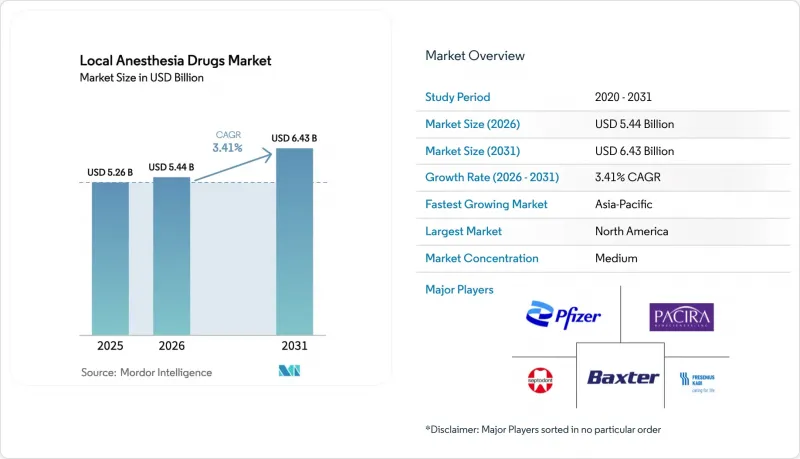
Mordor Intelligence에 의하면, 국소 마취제 시장 규모는 2025년에 52억 6,000만 달러로 평가되었습니다. 2026년 54억 4,000만 달러에서 2031년까지 64억 3,000만 달러에 이를 것으로 추정되고 예측 기간(2026-2031년) CAGR은 3.41%를 나타낼 전망입니다.
본 보고서는 약제 유형(부피바카인, 리도카인 등), 투여 방법(주사제 및 표면 마취제), 용도(수술용 마취 등), 최종 사용자(병원 등), 유통 채널(의료기관 대상 판매 등) 및 지역(북미, 유럽 등)별로 분류되어 있습니다. 시장 예측은 금액(달러) 기준으로 제시되어 있습니다.
세계의 국소 마취제 시장 동향 및 인사이트
전 세계 외과 수술 건수 증가
OECD 국가들의 예정 수술 대기 건수는 2025년 말까지 해소될 것으로 예상되며, 고관절 및 무릎 관절 치환술은 연간 4-5%의 속도로 계속 증가하고 있습니다. 이 모든 것은 말초 신경 차단의 주요 적용 사례이며, 국소 마취제 시장의 성장을 견인하고 있습니다. 중국이 2025년까지 인구 1,000명당 7.5병상이라는 병상 수 목표를 제시했으며, 인도의 ‘아유슈만 바라트’ 계획 확충에 따라 침윤 마취 및 신경축 마취 분야에서 아미드계 마취제의 소비량이 증가했습니다. 2023년에는 메디케어 피보험자 1,000명당 222.1건의 ASC(외래수술센터(ASC)) 시술이 이루어졌으며, 중등도 증례가 국소 마취에 의존하는 시설로 이동하고 있음이 부각되었습니다. 세계은행의 ‘수술 후 조기 회복(ERAS)’ 프로토콜에 따라 대장·직장 외과 및 정형외과 사례에서 1회 투여형 차단 마취가 표준화되어, 예측 가능한 약물 수요가 확고해졌습니다. 이러한 모든 수요 증가 요인이 합쳐져 국소 마취제 시장의 연평균 성장률(CAGR)을 현저히 끌어올리고 있습니다.
신규 국소 마취제의 승인 및 출시 증가
2024년 미국에서 승인된 부피바카인-멜록시캄 폴리머 제제 ‘ZYNRELEF’는 72시간 동안 통증 관리를 가능하게 하여 오피오이드 정제와 직접적으로 경쟁합니다. 장쑤 헝루이(Jiangsu Hengrui)는 2024년 7월, 리포솜형 부피바카인 제네릭 의약품의 승인을 획득하여 단일 공급업체에 의한 공급 병목 현상을 해소하는 동시에, 복잡한 주사제의 바이오시밀러 승인 경로의 유효성을 입증했습니다. 박스터(Baxter)사의 즉시 사용 가능한 로피바카인은 현장에서의 조제 필요성을 없애주어, 오염 경보에 직면한 병원들로부터 높은 평가를 받고 있습니다. 이에 반해, 파실라 바이오사이언스(Pasila Biosciences)는 2024년 12월, EXPAREL에 관한 새로운 제조 공정 특허를 취득하여 독점권을 연장하는 한편, 경쟁사들이 대체 운반체를 모색하도록 촉진했습니다. 파이프라인의 가속화로 인해 출시까지의 지연이 단축되어, 국소 마취제 시장 전체의 제품 갱신률이 향상되고 있습니다.
아미드계 마취제와 관련된 전신 독성 및 이상반응
국소 마취제에 의한 전신 독성은 드물지만, 즉시 지질 에멀젼을 이용한 응급 처치를 실시하지 않을 경우 높은 사망률을 동반하기 때문에 각 수술실에서는 20% 인트라리피드를 상비하고 있으며, 직원에 대한 훈련이 의무화되어 직접 비용이 증가하고 있습니다. FDA의 첨부 문서에서는 점진적 투여와 최대 투여량 제한이 강조되고 있지만, 사례 보고는 끊이지 않고 있으며, 그 대부분은 부주의로 인한 혈관 내 주사와 관련이 있습니다. 벤조카인 스프레이와 관련된 메트헤모글로빈혈증 경고로 인해 이비인후과 전문의들은 리도카인 점성액으로 대체할 수밖에 없게 되었고, 외용약 시장 점유율이 재편되고 있습니다. 로피바카인은 더 안전한 심혈관 프로파일을 가지고 있지만, 부피바카인보다 20-30% 비싸기 때문에 가격에 민감한 지역에서는 구하기 어렵습니다. 휴대용 초음파 장치는 독성 발생률을 낮출 수 있습니다. 그러나 대당 1만-3만 달러의 비용이 들고 조작 훈련도 필요하기 때문에 그렇지 않았다면 국소 마취제 시장을 확대했을 소규모 외래수술센터(ASC)에게는 장벽이 되고 있습니다.
부문 분석
2025년에는 리도카인이 매출의 38.54%를 차지하며, 즉효성 치과용 및 경미한 외과용 차단 마취 분야에서 입지를 유지했습니다. 로피바카인은 산부인과 및 소아과 시설에서 낮은 심장 독성을 우선시하기 때문에 동종 제품 중 가장 빠른 연평균 5.67%의 성장률이 예상됩니다. 부피바카인은 장시간의 척추 및 관절 수술에서 여전히 선호되고 있지만, 고도의 소생 능력을 갖추지 못한 시설에서는 사용 제한에 직면해 있습니다. 벤조카인의 감소는 FDA의 메트헤모글로빈혈증에 대한 경고에 따른 것이며, 수요는 더 안전한 아미드계 대체품으로 이동하고 있습니다.
리포솜 캡슐화 부피바카인은 72시간 동안 지속되는 효과를 발휘하여 여러 범주에 걸쳐, 오피오이드를 사용하지 않는 퇴원을 목표로 하는 의료 기관의 관심을 끌고 있습니다. 클로로프로카인은 효과가 빠르게 소실되기 때문에 ASA의 2024년 지침에 따라 제왕절개 시 척수 마취에 이상적이며, 이로 인해 지방 지역에서의 보급이 확대되고 있습니다. 이러한 변화로 인해 국소 마취제 시장은 다양화되고 있으며, 비용보다 안전성과 지속 시간이 결정적인 구매 기준이 되고 있습니다.
외과, 산부인과, 치과에서는 정확한 투여량이 요구되기 때문에 2025년 매출액 중 주사제가 71.43%를 차지했습니다. 외용제는 고령자의 신경통에 대한 리도카인 패치의 채택 확대와, 저침습 미용 시술에서 피부과가 EMLA 크림을 선호하여 사용하는 것을 배경으로, 2031년까지 연평균 5.87%의 성장이 예상됩니다. 리도카인 함유량 4% 이하의 일반의약품 판매로 소매에서 구하기 쉬워진 반면, 처방전이 필요한 패치는 많은 시장에서 여전히 보험 적용 대상이기 때문에 판매량이 증가하고 있습니다.
즉시 사용 가능한 로피바카인 주사제는 조제에 수반되는 위험을 경감시켜, 오염 경고로 골머리를 앓아온 병원에서는 높은 가격 책정이 정당화되고 있습니다. 외용제는 보다 다양한 공급 기반을 유지하고 있어, 무균 주사제가 겪고 있는 공급 부족의 영향을 유통 경로를 통해 차단하고 있습니다. 이러한 탄력성 덕분에 소비자용 및 외래 진료 현장에서 국소 마취제 시장 규모가 꾸준히 확대되고 있습니다.
지역별 분석
북미는 세계 최고 수준의 수술 건수, 리포솜형 부피바카인 및 폴리머 복합제의 조기 도입, 그리고 비오피오이드 진통을 장려하는 보험 급여 제도의 뒷받침을 받아 2025년 매출의 42.56%를 차지했습니다. 미국 정부감사원(GAO)의 조사에 따르면, 미국에서 현재 발생하고 있는 102건의 의약품 부족 사례 중 71건이 무균 주사제와 관련되어 있어, 이로 인해 병원에서는 리도카인이나 부피바카인을 여러 공급처에서 조달할 수밖에 없으며, 경우에 따라서는 비싼 가격에 구매해야 하는 상황에 처해 있습니다. 캐나다의 공적 의료 제도는 폭넓은 접근성을 뒷받침하고 있는 반면, 멕시코의 의료 관광 회랑은 민간 부문 수요를 촉진하고 있습니다.
아시아태평양에서는 중국과 인도의 병상 수 확대, 그리고 농촌 지역의 외과 수술에 대한 정부의 지원을 배경으로 2026년부터 2031년까지 연평균 성장률(CAGR) 4.56%를 달성할 것으로 예측됩니다. 중국이 제시한 ‘인구 1,000명당 병상 7.5개’라는 목표는 수술 건수를 증가시켜 아미드계 마취제 소비량을 직접적으로 끌어올리고 있습니다. 인도의 ‘아유슈만 바라트’ 계획에서는 국소 차단 마취에 대응할 수 있는 안전한 수술실 구축이 진행되고 있어, 마취과 의사에 대한 의존도를 낮추는 동시에 더 많은 환자에게 의료 서비스를 제공할 수 있게 되었습니다.
유럽에서는 유럽의약품청(EMA)의 엄격한 심사 및 입찰 주도형 가격 책정으로 인해 안정적인 저성장이 예상됩니다. 영국에서 NRFit 커넥터의 의무화는 제품 업데이트를 가속화하여 ISO 규격 인증을 취득한 공급업체에 유리하게 작용하고 있습니다. 중동 및 아프리카의 도시 지역에서는 초음파 유도 하 수술이 도입되고 있는 반면, 라틴아메리카에서는 치과 의료 관광의 활용과 중산층의 소비 확대가 진행되고 있습니다. 다만, 남미의 환율 변동은 국소 마취제 시장에서 사업을 전개하는 세계 제조업체에게 수익 인식의 변동 요인이 되고 있습니다.
기타 혜택 :
- 엑셀 형식 시장 예측(ME) 시트
- 3개월간의 애널리스트 지원
자주 묻는 질문
목차
제1장 서론
제2장 조사 방법
제3장 주요 요약
제4장 시장 구도
제5장 시장 규모 및 성장 예측
제6장 경쟁 구도
제7장 시장 기회 및 향후 전망
KTH 26.09.10According to Mordor Intelligence, the local anesthesia drugs market size was valued at USD 5.26 billion in 2025 and is estimated to grow from USD 5.44 billion in 2026 to reach USD 6.43 billion by 2031, at a CAGR of 3.41% during the forecast period (2026-2031).
This report is Segmented by Drug Type (Bupivacaine, Lidocaine, and More), Mode of Administration (Injectable and Surface Anesthetic), Application (Surgical Anesthesia, and More), End User (Hospitals, and More), Distribution Channel (Institutional Sales, and More), and Geography (North America, Europe, and More). The Market Forecasts are Provided in Terms of Value (USD).
Global Local Anesthesia Drugs Market Trends and Insights
Rising Surgical Procedure Volume Globally
Elective backlogs in OECD economies are expected to be cleared by late 2025, and hip and knee replacements continue climbing at 4-5% per year, both heavy users of peripheral nerve blocks that drive local anesthesia drug market growth. China's hospital-bed target of 7.5 per 1,000 population by 2025 and India's Ayushman Bharat upgrades are lifting amide anesthetic consumption for infiltration and neuraxial techniques. Medicare beneficiaries underwent 222.1 ASC procedures per 1,000 enrollees in 2023, underscoring the shift of intermediate cases to venues that rely on regional blocks. Enhanced Recovery After Surgery protocols from the World Bank standardize single-shot blocks in colorectal and orthopedic cases, cementing predictable drug demand. Collectively, these volume gains contribute a measurable uplift to the CAGR of the local anesthesia drugs market.
Increasing Approvals and Launches of Novel Local Anesthetics
The 2024 U.S. approval of ZYNRELEF, a bupivacaine-meloxicam polymer, delivers 72-hour pain control and directly competes with opioid tablets. Jiangsu Hengrui received a green light for its generic liposomal bupivacaine in July 2024, erasing a single-supplier bottleneck and validating biosimilar pathways for complex injectables. Baxter's ready-to-use ropivacaine eliminates the need for on-site compounding, a proposition valued by hospitals facing contamination alerts. Pacira BioSciences responded with new process patents for EXPAREL in December 2024, extending exclusivity and prompting rivals to seek alternative carriers. Accelerated pipelines shorten adoption lags, lifting product refresh rates across the local anesthesia drugs market.
Systemic Toxicity and Adverse Events Associated with Amide Anesthetics
Local anesthetic systemic toxicity, though rare, carries high mortality without immediate lipid-emulsion rescue, obligating each operating suite to stock 20% Intralipid and train staff, adding direct costs. FDA labeling emphasizes incremental dosing and maximum limits, yet case reports continue, often linked to inadvertent intravascular injections. Benzocaine spray warnings about methemoglobinemia have pushed ENT specialists toward lidocaine viscous alternatives, reshuffling topical shares. Ropivacaine offers a safer cardiac profile but costs 20-30% more than bupivacaine, limiting access in price-sensitive regions. Portable ultrasound can reduce the incidence of toxicity. Yet, units cost USD 10,000-30,000 and require training, creating a hurdle for smaller ambulatory centers that would otherwise expand the local anesthesia drugs market.
Other drivers and restraints analyzed in the detailed report include:
- Growing Adoption in Ambulatory & Day-Care Surgeries
- Shift Toward Ultrasound-Guided Regional Anesthesia
- Stringent Regulatory Requirements for New Anesthetic Molecules
For complete list of drivers and restraints, kindly check the Table Of Contents.
Segment Analysis
In 2025, lidocaine accounted for 38.54% of revenue, maintaining its position in rapid-onset dental and minor surgical blocks. Ropivacaine is forecast to expand at 5.67% annually, the fastest among its peers, as obstetric and pediatric units prioritize its lower cardiotoxicity. Bupivacaine, though still favored for lengthy spine and joint procedures, faces usage caps in settings without advanced resuscitation capabilities. Benzocaine's decline follows FDA methemoglobinemia warnings, steering demand toward safer amide alternatives.
Liposome-encapsulated bupivacaine straddles categories by delivering 72-hour coverage, attracting centers seeking opioid-free discharges. Chloroprocaine's rapid offset makes it ideal for cesarean spinal blocks, as per ASA's 2024 guidance, thereby widening its rural penetration. These shifts diversify the local anesthesia drugs market, with safety and duration rather than cost becoming decisive purchasing criteria.
Injectables accounted for 71.43% of 2025 revenue, as surgery, obstetrics, and dentistry rely on precise dosing. Surface formats are projected to grow at a rate of 5.87% to 2031, driven by the increasing adoption of lidocaine patches for neuralgia among the elderly and dermatology's preference for EMLA cream during minimally invasive aesthetic procedures. Over-the-counter sales of <=4% lidocaine products expand retail access, while prescription-strength patches remain reimbursable in many markets, thereby increasing volumes.
Ready-to-use ropivacaine injectables mitigate compounding risks, justifying premium prices in hospitals that have battled contamination alerts. Topicals maintain a more diverse supplier base, insulating the channel from the shortages plaguing sterile injectables. This resilience supports consistent expansion of the local anesthesia drugs market size within consumer and outpatient settings.
Complete Report Scope:
- By Drug Type
- Bupivacaine
- Lidocaine
- Benzocaine
- Ropivacaine
- Prilocaine
- Chloroprocaine
- Other Drug Types
- By Mode of Administration
- Injectable
- Surface Anesthetic
- By Application
- Surgical Anesthesia
- Post-Operative Pain Management
- Dental Anesthesia
- Labor & Delivery Analgesia
- Chronic Pain Management
- By End User
- Hospitals
- Ambulatory Surgical Centers
- Specialty Clinics
- Dental Clinics
- Home Healthcare Settings
- By Distribution Channel
- Institutional (Direct/Tender) Sales
- Retail Pharmacies
- Online Pharmacies
- Geography
- North America
- United States
- Canada
- Mexico
- Europe
- Germany
- United Kingdom
- France
- Italy
- Spain
- Rest Of Europe
- Asia-Pacific
- China
- Japan
- India
- Australia
- South Korea
- Rest Of Asia-Pacific
- Middle East And Africa
- GCC
- South Africa
- Rest Of Middle East And Africa
- South America
- Brazil
- Argentina
- Rest Of South America
- North America
Geography Analysis
North America generated 42.56% of 2025 revenue, propelled by the highest surgical incidence worldwide, early adoption of liposomal bupivacaine and polymer combinations, and reimbursement structures that reward non-opioid analgesia. The GAO confirmed that 71 of 102 active U.S. shortages involve sterile injectables, leading hospitals to dual-source lidocaine and bupivacaine, sometimes at premium prices. Canada's publicly funded system supports broad access, while Mexico's medical tourism corridor boosts private-sector demand.
The Asia-Pacific region is projected to achieve a 4.56% CAGR from 2026 to 2031, driven by the expansion of hospital beds in China and India, as well as government support for rural surgery. China's 7.5-beds-per-1,000 target elevates procedural throughput, directly increasing amide anesthetic consumption. India's Ayushman Bharat upgrades secure operating rooms equipped for regional blocks, lowering dependency on anesthesiologists and broadening patient reach.
Europe offers stable, low-growth prospects due to rigorous EMA reviews and tender-driven pricing. The United Kingdom's NRFit connector mandate accelerates product refreshes and favors suppliers certified to ISO standards. Urban centers in the Middle East and Africa are adopting ultrasound-guided techniques, while Latin America is leveraging dental tourism and expanding middle-class spending. Currency swings in South America, however, translate into revenue-recognition volatility for global manufacturers active in the local anesthesia drugs market.
- Abbvie
- Aspen Pharmacare
- B. Braun
- Baxter
- Cristalia
- Endo International
- Fresenius
- Glenmark Pharmaceuticals
- Hikma Pharmaceuticals
- Mylan
- Pacira BioSciences Inc.
- Pfizer
- Piramal Critical Care
- Septodont
- Sichuan Kelun Pharmaceutical Co. Ltd.
- Sun Pharmaceuticals Industries
- Teva Pharmaceutical Industries
- Tonghua Dongbao Pharmaceutical Co. Ltd.
- Zydus Lifesciences Ltd.
Additional Benefits:
- The market estimate (ME) sheet in Excel format
- 3 months of analyst support
TABLE OF CONTENTS
1 Introduction
- 1.1 Study Assumptions & Market Definition
- 1.2 Scope of the Study
2 Research Methodology
3 Executive Summary
4 Market Landscape
- 4.1 Market Overview
- 4.2 Market Drivers
- 4.2.1 Rising Surgical Procedure Volume Globally
- 4.2.2 Increasing Approvals and Launches of Novel Local Anesthetics
- 4.2.3 Growing Adoption of Local Anesthesia In Ambulatory & Day-Care Surgeries
- 4.2.4 Shift Toward Ultrasound-Guided Regional Anesthesia Boosting Drug Utilization
- 4.2.5 Development of Long-Acting Liposomal And Polymer-Based Formulations
- 4.2.6 Expansion of Dental Tourism In Emerging Economies Elevating Demand
- 4.3 Market Restraints
- 4.3.1 Systemic Toxicity and Adverse Events Associated with Amide Anesthetics
- 4.3.2 Stringent Regulatory Requirements for New Anesthetic Molecules
- 4.3.3 Supply Shortages of Key Active Pharmaceutical Ingredients
- 4.3.4 Rising Adoption of Non-Pharmacological Analgesia Reducing Drug Use
- 4.4 Value / Supply-Chain Analysis
- 4.5 Regulatory Landscape
- 4.6 Technological Outlook
- 4.7 Porter's Five Forces Analysis
- 4.7.1 Threat of New Entrants
- 4.7.2 Bargaining Power of Buyers/Consumers
- 4.7.3 Bargaining Power of Suppliers
- 4.7.4 Threat of Substitute Products
- 4.7.5 Intensity of Competitive Rivalry
5 Market Size & Growth Forecasts (Value, USD)
- 5.1 By Drug Type
- 5.1.1 Bupivacaine
- 5.1.2 Lidocaine
- 5.1.3 Benzocaine
- 5.1.4 Ropivacaine
- 5.1.5 Prilocaine
- 5.1.6 Chloroprocaine
- 5.1.7 Other Drug Types
- 5.2 By Mode of Administration
- 5.2.1 Injectable
- 5.2.2 Surface Anesthetic
- 5.3 By Application
- 5.3.1 Surgical Anesthesia
- 5.3.2 Post-Operative Pain Management
- 5.3.3 Dental Anesthesia
- 5.3.4 Labor & Delivery Analgesia
- 5.3.5 Chronic Pain Management
- 5.4 By End User
- 5.4.1 Hospitals
- 5.4.2 Ambulatory Surgical Centers
- 5.4.3 Specialty Clinics
- 5.4.4 Dental Clinics
- 5.4.5 Home Healthcare Settings
- 5.5 By Distribution Channel
- 5.5.1 Institutional (Direct/Tender) Sales
- 5.5.2 Retail Pharmacies
- 5.5.3 Online Pharmacies
- 5.6 Geography
- 5.6.1 North America
- 5.6.1.1 United States
- 5.6.1.2 Canada
- 5.6.1.3 Mexico
- 5.6.2 Europe
- 5.6.2.1 Germany
- 5.6.2.2 United Kingdom
- 5.6.2.3 France
- 5.6.2.4 Italy
- 5.6.2.5 Spain
- 5.6.2.6 Rest Of Europe
- 5.6.3 Asia-Pacific
- 5.6.3.1 China
- 5.6.3.2 Japan
- 5.6.3.3 India
- 5.6.3.4 Australia
- 5.6.3.5 South Korea
- 5.6.3.6 Rest Of Asia-Pacific
- 5.6.4 Middle East And Africa
- 5.6.4.1 GCC
- 5.6.4.2 South Africa
- 5.6.4.3 Rest Of Middle East And Africa
- 5.6.5 South America
- 5.6.5.1 Brazil
- 5.6.5.2 Argentina
- 5.6.5.3 Rest Of South America
- 5.6.1 North America
6 Competitive Landscape
- 6.1 Market Concentration
- 6.2 Market Share Analysis
- 6.3 Company Profiles (includes Global Level Overview, Market Level Overview, Core Segments, Financials as Available, Strategic Information, Market Rank/Share for Key Companies, Products & Services, and Recent Developments)
- 6.3.1 AbbVie Inc.
- 6.3.2 Aspen Pharmacare
- 6.3.3 B. Braun Melsungen AG
- 6.3.4 Baxter International Inc.
- 6.3.5 Cristalia
- 6.3.6 Endo Pharmaceuticals
- 6.3.7 Fresenius SE & Co. KGaA
- 6.3.8 Glenmark Pharmaceuticals Ltd.
- 6.3.9 Hikma Pharmaceuticals PLC
- 6.3.10 Mylan NV
- 6.3.11 Pacira BioSciences Inc.
- 6.3.12 Pfizer Inc.
- 6.3.13 Piramal Critical Care
- 6.3.14 Septodont
- 6.3.15 Sichuan Kelun Pharmaceutical Co. Ltd.
- 6.3.16 Sun Pharmaceutical Industries Ltd.
- 6.3.17 Teva Pharmaceutical Industries Ltd.
- 6.3.18 Tonghua Dongbao Pharmaceutical Co. Ltd.
- 6.3.19 Zydus Lifesciences Ltd.
7 Market Opportunities & Future Outlook
- 7.1 White-Space & Unmet-Need Assessment