|
시장보고서
상품코드
2120616
북미의 무인 운반차(AGV) : 시장 점유율 분석, 업계 동향 및 통계, 성장 예측(2026-2031년)North America Automated Guided Vehicle - Market Share Analysis, Industry Trends & Statistics, Growth Forecasts (2026 - 2031) |
||||||
 Mordor Intelligence
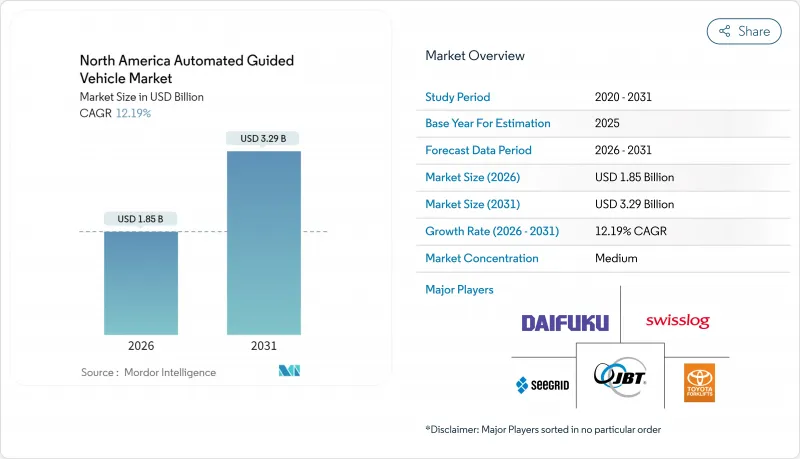
Mordor Intelligence에 의하면, 북미의 무인 운반차(AGV) 시장 규모는 2026년에 18억 5,000만 달러로 평가되고 2031년까지 32억 9,000만 달러에 이르며, CAGR 12.19%로 확대될 것으로 예측됩니다.
본 보고서는 차량 유형(자동 지게차, 견인차/태거, 유닛 로드 캐리어, 조립 라인 등), 내비게이션 방식(레이저, 자기, 비전/SLAM 등),구성 요소(하드웨어, 소프트웨어, 서비스), 배터리(납산, 리튬 이온 등), 최종 사용자(자동차, 식음료 등), 지역별로 분류되어 있습니다. 시장 예측은 금액(미 달러) 기준으로 제시되어 있습니다.
북미의 무인 운반차(AGV) 시장 동향 및 인사이트
전자상거래 주문 처리 붐이 창고 자동화 도입을 가속화하고 있습니다.
당일 배송에 대한 기대감이 높아짐에 따라, 3PL(제3자 물류 업체) 및 소매업체들은 AGV를 활용한 ‘상품에서 사람으로’의 워크플로우를 도입하고 기존 시설을 업그레이드해야 하는 상황에 직면해 있습니다. 아마존은 2024년 말까지 75만 대 이상의 이동형 로봇을 도입하고, 주문 주기 목표를 달성하기 위해 계속해서 로봇 군의 규모를 확대되었습니다. 월마트는 2024년에 42곳의 지역 물류 센터(DC)에 자동 지게차에 2억 달러를 투자하여 부상률을 30% 줄이는 것을 목표로 하고 있습니다. 2025년 미국 온라인 소매 시장 침투율이 총 매출의 16.3%에 달함에 따라, AGV 도입은 텍사스주, 캘리포니아주, 펜실베이니아주, 오하이오주에 집중되었습니다. 이 지역들은 주문 처리 밀도가 높기 때문에 자본 집약적인 투자가 정당화됩니다. 무인 운반차(AGV) 시장은 컨베이어에 의존하던 분류 방식에서 SKU 증가에 유연하게 대응할 수 있는 이동식 시스템으로의 전환이라는 이러한 변화의 혜택을 받고 있습니다. 캐나다와 멕시코도 전자상거래 기반은 낮지만 비슷한 궤적을 따르고 있으며, 이러한 동향이 계속해서 단기적인 수요를 끌어올리는 가장 큰 요인이 되고 있습니다.
물류 허브의 인건비 급등과 인력 부족
2025년, 미국 자재 운반 작업원의 시간당 임금 중앙값은 17.85달러에 달하여 2020년 대비 22% 상승했습니다. 한편, 내륙 물류 회랑의 구인 공석률은 채용 보너스가 지급되고 있음에도 불구하고 8%를 넘어섰습니다. 현재 자동화의 경제성을 고려할 때, 정규직 2명을 자본 비용 8만 달러의 리튬이온 지게차 1대로 대체하는 것이 유리하며, 24개월 이내에 투자 회수가 가능합니다. 이직에 따른 비용도 절감 효과를 더욱 증폭시키고 있습니다. 직원 1명이 이직할 때마다 채용 비용이나 업무 중단으로 인한 손실로 연봉의 50%에서 60%에 달하는 비용이 발생할 가능성이 있기 때문입니다. 그 결과, 무인 운반차(AGV) 시장에서는 자금력이 넉넉한 대형 사업자와 자체 자금으로 운영에 어려움을 겪는 중견 기업 간의 경쟁 격차가 확대되고 있습니다. 캐나다의 온타리오주 골든 호스슈 지역에서도 유사한 임금 상승 추세가 나타나고 있지만, 멕시코에서는 인건비 우위 덕분에 특히 수출 지향적인 공장에서 자동화에 대한 수요가 억제되기는 해도 완전히 사라지지는 않을 것입니다.
중규모 창고에서의 고액 초기 시스템 및 통합 비용
20만 평방피트 규모의 시설에 턴키 방식의 AGV를 도입하는 데는 워크플로우 설계 및 직원 교육을 제외하더라도 150만 달러에서 250만 달러가 소요될 수 있습니다. 통합 업체는 맞춤화 및 안전 검증 비용으로 30%에서 40%의 추가 비용을 청구하는 경우가 많으며, 매출액이 5,000만 달러 미만인 사업자의 경우 투자 회수 기간이 5년 이상으로 늘어납니다. 미국 물류 부동산의 임대 계약 기간이 평균 6년으로 짧은 점도 투자 회수를 더욱 저해하고 있습니다. 그 결과, 자동화 도입은 여전히 대기업에 집중되어 있으며, 중견 기업 부문에서의 무인 운반차(AGV) 시장 확산을 지연시키고 있습니다. 각 벤더가 모듈식이며 인프라 부담을 줄여주는 솔루션을 제공함으로써, 예측 기간 동안 이러한 제약 요인을 완화할 가능성이 있습니다.
부문 분석
자동 지게차는 공장이 OSHA(미국 직업안전보건청)의 대기질 규정을 충족하고 유지보수로 인한 가동 중단 시간을 줄이기 위해 디젤식에서 리튬이온식으로 전환함에 따라, 2025년 매출의 34.49%를 계속 차지했습니다. 이 성숙한 카테고리는 북미의 무인 운반차(AGV) 시장의 기반을 이루고 있지만, 냉장 창고 및 제약 업계의 횡방향 이동 수요에 힘입어 하이브리드형 및 전방향 이동형 운반차가 12.94%의 성장세를 보이며 부상하고 있습니다. 견인차와 태거 트레인은 자동차 산업의 키트 조립 분야에서 여전히 주력을 이루고 있습니다. 한편, 유닛 로드 캐리어는 크로스독에서 입고되는 팔레트의 이송을 자동화하고 있습니다. 리프트 테이블과 비전 센서를 장착한 조립 라인용 차량은 mm 단위의 정밀도로 배터리 팩을 확실하게 고정합니다. 특수 용도 기계는 위험물이나 클린룸과 같은 틈새 시장을 대응하고 있으며, 이를 통해 높은 마진이 정당화되어 공급업체는 가격 주도형 경쟁으로부터 자신을 보호할 수 있습니다.
2025년부터 2026년에 걸쳐 각 제조업체들은 협업 로봇 팔과 이동식 베이스의 조합을 도입하기 시작했으며, 운송 플랫폼을 주행 중에 부품을 꺼내거나 검사할 수 있는 조작 시스템으로 전환했습니다. 도요타가 2025년에 협업 로봇이 탑재된 지게차를 출시한 것은 모빌리티와 조작성의 융합을 시사하는 것으로, 이를 통해 차량 대수를 줄일 수 있을 가능성이 있습니다. 리튬 이온 배터리용 사후 장착 키트가 업그레이드 선택지를 넓히는 한편, 예측 유지보수 소프트웨어 덕분에 가동률이 98%에 근접하면서 북미의 무인 운반차(AGV) 시장에서 장비 구매에서 성과 기반 구독 모델로의 전환이 가속화되고 있습니다.
처리량이 높은 자동차 및 식품 공장에서 검증된 반사 그리드 덕분에 2025년 매출의 58.11%를 레이저 유도 방식이 차지했습니다. 그럼에도 불구하고, 이미지 센서 비용의 하락과 오픈소스 라이브러리의 성숙에 따라 카메라 기반 비전 및 SLAM 플랫폼은 연평균 성장률(CAGR) 12.55%로 확대되고 있습니다. 임대 물류 센터 운영자들은 건물주의 승인이 필요 없는 인프라가 불필요한 내비게이션을 선호하기 때문에 비전 기술의 도입이 가속화되고 있습니다. 자기식 및 유도식 내비게이션은 반사나 분진이 광학식 시스템에 지장을 주는 야외 제철소나 금속이 밀집된 환경에서 여전히 사용되고 있습니다. 자연 내비게이션은 항만 야드 및 컨테이너 터미널을 위해 GPS, IMU, LiDAR를 융합하고 있으며, 실내와 실외 구역을 연결하는 가교 기술로 기능하고 있습니다.
경쟁 심화로 인해 가격 곡선이 재편되고 있습니다. 중국 업체들은 저비용 카메라를 활용해 유럽의 레이저 기반 업체들보다 낮은 가격을 제시하고 있으며, 기존 기업들은 소프트웨어를 통한 차별화를 강조할 수밖에 없는 상황입니다. OTTO Motors사는 카메라와 LiDAR를 융합하여 10mm 미만의 정밀도를 달성했으며, 구조화된 통로에서 레이저와 동등한 성능을 발휘함을 입증했습니다. 멀티 센서 융합 기술이 성숙해짐에 따라, 북미의 무인 운반차(AGV) 시장에서는 반사경 유지보수 예산이 점차 축소되고, 그만큼의 운영 비용(OPEX)을 차량 확충에 할당할 수 있게 될 것입니다.
기타 혜택 :
- 엑셀 형식 시장 예측(ME) 시트
- 3개월간의 애널리스트 지원
자주 묻는 질문
목차
제1장 서론
제2장 조사 방법
제3장 주요 요약
제4장 시장 구도
제5장 시장 규모 및 성장 예측
제6장 경쟁 구도
제7장 시장 기회 및 향후 전망
KTHAccording to Mordor Intelligence, the North America automated guided vehicle market size is valued at USD 1.85 billion in 2026 and is projected to reach USD 3.29 billion by 2031, advancing at a 12.19% CAGR.
This report is Segmented by Vehicle Type (Automated Forklift, Tow/Tugger, Unit Load Carrier, Assembly Line, and More), Navigation (Laser, Magnetic, Vision/SLAM, and More), Component (Hardware, Software, and Service), Battery (Lead-Acid, Lithium-Ion, and More), End-User (Automotive, Food and Beverage, and More), and Geography. The Market Forecasts are Provided in Terms of Value (USD).
North America Automated Guided Vehicle Market Trends and Insights
E-Commerce Fulfilment Boom Accelerating Warehouse Automation Adoption
Rising same-day delivery expectations are pushing 3PLs and retailers to upgrade legacy facilities with goods-to-person workflows powered by AGVs. Amazon deployed more than 750,000 mobile robots by late 2024 and continues to scale fleets to meet order-cycle targets. Walmart invested USD 200 million in automated forklifts across 42 regional DCs in 2024, targeting a 30% drop in injury rates. As U.S. online retail penetration reached 16.3% of total sales in 2025, AGV installations clustered in Texas, California, Pennsylvania, and Ohio, where fulfillment density justifies capital intensity. The automated guided vehicle market benefits from this shift away from conveyor-bound sortation toward mobile systems that flex with SKU proliferation. With Canada and Mexico following similar trajectories, albeit at lower e-commerce baselines, the driver remains the single largest uplift to near-term demand.
Rising Labor Costs and Shortages in Logistics Hubs
Median hourly wages for U.S. material movers climbed to USD 17.85 in 2025, a 22% increase since 2020, while vacancy rates in inland logistics corridors topped 8% despite signing bonuses. Automation economics now favor replacing two full-time positions with one lithium-ion forklift at a capital cost of USD 80,000, yielding payback inside 24 months. Turnover costs compound savings, as each employee exit can cost 50% to 60% of annual salary in recruitment and downtime. Consequently, the automated guided vehicle market is widening the competitive divide between large operators with cheap capital and mid-sized firms struggling to self-finance. Canada shows identical wage inflation patterns in Ontario's Golden Horseshoe region, while Mexico's labor cost advantage tempers but does not negate automation pull, especially for export-oriented factories.
High Up-Front System and Integration Costs for Mid-Sized Warehouses
A turnkey AGV deployment in a 200,000 square-foot facility can require USD 1.5 million to USD 2.5 million before workflow engineering and staff training. Integrators often add 30% to 40% for customization and safety validation, stretching payback beyond five years for operators with revenue below USD 50 million. Short lease terms in U.S. distribution real estate, averaging six years, further hinder amortization. As a result, automation density remains concentrated among large enterprises, slowing penetration of the automated guided vehicle market in the mid-tier segment. Vendors responding with modular, infrastructure-light offerings could soften this drag over the forecast window.
Other drivers and restraints analyzed in the detailed report include:
- Automotive OEM Re-Tooling for EV Platforms Demanding Flexible Material Flow
- AI-Enabled Fleet Orchestration Unlocking Multi-Robot ROI in Brownfield Sites
- Emerging AMR Alternatives Cannibalizing Fixed-Path AGV Spending
For complete list of drivers and restraints, kindly check the Table Of Contents.
Segment Analysis
Automated forklifts retained 34.49% of 2025 revenue as factories replaced diesel units with lithium-ion models to satisfy OSHA air-quality rules and slash maintenance downtime. This mature cohort underpins the North America automated guided vehicle market, yet hybrid and omni-directional carriers are emerging with a 12.94% growth trajectory fueled by cold-storage and pharma demand for lateral motion. Tow and tugger trains remain staples in automotive kitting, whereas unit-load carriers automate inbound pallet transfers in cross-docks. Assembly-line vehicles, fitted with lift tables and vision sensors, secure battery packs with millimeter precision. Special-purpose machines serve hazardous and cleanroom niches, justifying premium margins and buffering vendors against price-led competition.
During 2025-2026, manufacturers began pairing collaborative arms with mobile bases, converting transport platforms into manipulation systems that pick or inspect components on the fly. Toyota's cobot-equipped forklift debuted in 2025, signaling a convergence of mobility and dexterity that could compress fleet sizes. Lithium-ion retrofit kits broaden upgrade options, while predictive-maintenance software pushes uptime toward 98%, reinforcing the North America automated guided vehicle market's shift from capital purchase to performance subscription.
Laser guidance owned 58.11% of 2025 revenue thanks to proven reflector grids in high-throughput automotive and food plants. Still, camera-based vision and SLAM platforms are expanding at a 12.55% CAGR as image-sensor costs fall and open-source libraries mature. Operators in leased distribution centers favour infrastructure-free navigation to avoid landlord approvals, propelling vision adoption. Magnetic and inductive lines linger in outdoor mills and metal-dense environments where reflections or dust confound optics. Natural navigation blends GPS, IMU, and lidar for port yards and container terminals, providing bridge technology between indoor and outdoor zones.
Competitive intensity is reshaping price curves. Chinese vendors use low-cost cameras to undercut European laser players, compelling incumbents to emphasize software differentiation. OTTO Motors achieved sub-10-millimeter precision by fusing cameras with lidar, proving parity with lasers in structured aisles. As multi-sensor fusion matures, the North America automated guided vehicle market may see a gradual phase-out of reflector maintenance budgets, freeing opex for fleet expansion.
Complete Report Scope:
- By Vehicle Type
- Automated Forklift
- Tow/Tugger
- Unit Load Carrier
- Assembly Line Vehicle
- Hybrid / Omni-Directional
- Special Purpose Vehicle
- By Navigation Technology
- Laser Guidance
- Magnetic Guidance
- Vision / SLAM Guidance
- Inductive / Wire Guidance
- Natural Navigation
- By Component
- Hardware
- Software
- Services
- By Battery Type
- Lead-Acid
- Lithium-Ion
- Nickel-Based
- Fuel Cell
- By End-User Industry
- Automotive
- Food and Beverage
- Retail and E-commerce
- Electronics and Electricals
- General Manufacturing
- Healthcare and Pharmaceuticals
- Logistics and Warehousing
- By Country
- United States
- Canada
- Mexico
List of Companies Covered in this Report:
- Amerden Inc.
- Swisslog Holding AG
- SSI Schaefer AG
- Daifuku Co., Ltd.
- Jungheinrich AG
- Murata Machinery, Ltd.
- Dematic Group S.a r.l.
- Toyota Material Handling, Inc.
- Transbotics Corporation
- John Bean Technologies Corporation
- System Logistics S.p.A.
- Seegrid Corporation
- Locus Robotics Corp.
- OTTO Motors, LLC
- Vecna Robotics, Inc.
- Balyo S.A.
- Crown Equipment Corporation
- Hyster-Yale Materials Handling, Inc.
- E&K Automation GmbH
- Bastian Solutions, LLC
Additional Benefits:
- The market estimate (ME) sheet in Excel format
- 3 months of analyst support
TABLE OF CONTENTS
1 INTRODUCTION
- 1.1 Study Assumptions and Market Definition
- 1.2 Scope of the Study
2 RESEARCH METHODOLOGY
3 EXECUTIVE SUMMARY
4 MARKET LANDSCAPE
- 4.1 Market Overview
- 4.2 Market Drivers
- 4.2.1 E-commerce Fulfilment Boom Accelerating Warehouse Automation Adoption
- 4.2.2 Rising Labor Costs and Shortages in U.S. and Canadian Logistics Hubs
- 4.2.3 Automotive OEM Re-tooling for EV Platforms Demanding Flexible Material Flow
- 4.2.4 Stricter Workplace-Safety Regulations Mandating Ergonomic Material Handling
- 4.2.5 Expansion of U.S. On-shoring Incentives Fueling Greenfield Smart-Factory Builds
- 4.2.6 AI-Enabled Fleet Orchestration Unlocking Multi-Robot ROI in Brownfield Sites
- 4.3 Market Restraints
- 4.3.1 High Up-Front System and Integration Costs for Mid-Sized Warehouses
- 4.3.2 Intermittent Wireless Dead-Zones in Large Metal-Dense Facilities
- 4.3.3 Limited Skilled Technicians for AGV Maintenance in Secondary Cities
- 4.3.4 Emerging AMR Alternatives Cannibalising Fixed-Path AGV Spending
- 4.4 Industry Value Chain Analysis
- 4.5 Regulatory Landscape
- 4.6 Technological Outlook
- 4.7 Impact of Macroeconomic Factors on the Market
- 4.8 Porter's Five Forces Analysis
- 4.8.1 Bargaining Power of Buyers
- 4.8.2 Bargaining Power of Suppliers
- 4.8.3 Threat of New Entrants
- 4.8.4 Threat of Substitute Products
- 4.8.5 Intensity of Competitive Rivalry
5 MARKET SIZE AND GROWTH FORECASTS (VALUE)
- 5.1 By Vehicle Type
- 5.1.1 Automated Forklift
- 5.1.2 Tow/Tugger
- 5.1.3 Unit Load Carrier
- 5.1.4 Assembly Line Vehicle
- 5.1.5 Hybrid / Omni-Directional
- 5.1.6 Special Purpose Vehicle
- 5.2 By Navigation Technology
- 5.2.1 Laser Guidance
- 5.2.2 Magnetic Guidance
- 5.2.3 Vision / SLAM Guidance
- 5.2.4 Inductive / Wire Guidance
- 5.2.5 Natural Navigation
- 5.3 By Component
- 5.3.1 Hardware
- 5.3.2 Software
- 5.3.3 Services
- 5.4 By Battery Type
- 5.4.1 Lead-Acid
- 5.4.2 Lithium-Ion
- 5.4.3 Nickel-Based
- 5.4.4 Fuel Cell
- 5.5 By End-User Industry
- 5.5.1 Automotive
- 5.5.2 Food and Beverage
- 5.5.3 Retail and E-commerce
- 5.5.4 Electronics and Electricals
- 5.5.5 General Manufacturing
- 5.5.6 Healthcare and Pharmaceuticals
- 5.5.7 Logistics and Warehousing
- 5.6 By Country
- 5.6.1 United States
- 5.6.2 Canada
- 5.6.3 Mexico
6 COMPETITIVE LANDSCAPE
- 6.1 Market Concentration
- 6.2 Strategic Moves
- 6.3 Market Share Analysis
- 6.4 Company Profiles (includes Global level Overview, Market level overview, Core Segments, Financials as available, Strategic Information, Market Rank/Share for key companies, Products & Services, and Recent Developments)
- 6.4.1 Amerden Inc.
- 6.4.2 Swisslog Holding AG
- 6.4.3 SSI Schaefer AG
- 6.4.4 Daifuku Co., Ltd.
- 6.4.5 Jungheinrich AG
- 6.4.6 Murata Machinery, Ltd.
- 6.4.7 Dematic Group S.a r.l.
- 6.4.8 Toyota Material Handling, Inc.
- 6.4.9 Transbotics Corporation
- 6.4.10 John Bean Technologies Corporation
- 6.4.11 System Logistics S.p.A.
- 6.4.12 Seegrid Corporation
- 6.4.13 Locus Robotics Corp.
- 6.4.14 OTTO Motors, LLC
- 6.4.15 Vecna Robotics, Inc.
- 6.4.16 Balyo S.A.
- 6.4.17 Crown Equipment Corporation
- 6.4.18 Hyster-Yale Materials Handling, Inc.
- 6.4.19 E&K Automation GmbH
- 6.4.20 Bastian Solutions, LLC
7 MARKET OPPORTUNITIES and FUTURE OUTLOOK
- 7.1 White-Space and Unmet-Need Assessment