

|
시장보고서
상품코드
2120641
관성 항법 시스템(INS) : 시장 점유율 분석, 업계 동향과 통계, 성장 예측(2026-2031년)Inertial Navigation System (INS) - Market Share Analysis, Industry Trends & Statistics, Growth Forecasts (2026 - 2031) |
||||||
 Mordor Intelligence
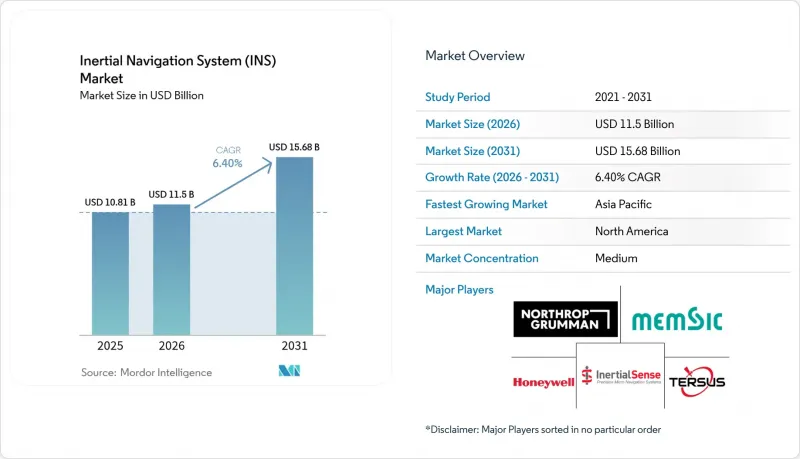
Mordor Intelligence에 의하면, 관성 항법 시스템 시장 규모는 2025년에 108억 1,000만 달러로 평가되었고, 2026년 115억 달러에서 2031년까지 156억 8,000만 달러에 이를 것으로 예측되며, 예측 기간(2026-2031년) CAGR은 6.40%를 기록할 전망입니다.
본 보고서는 구성 부품(가속도계, 자이로스코프 등), 기술(기계식 자이로, 링 레이저 자이로, 광섬유 자이로 등), 성능 등급(항법 등급, 전술 등급, 산업용 등급 등), 최종 사용자 산업(항공우주 및 방위, 해양 등),플랫폼(항공기 탑재형, 지상형 등), 지역별로 분류되어 있습니다. 시장 예측은 금액(달러) 기준으로 제시되어 있습니다.
전 세계 관성 항법 시스템(INS) 시장 동향 및 인사이트
군 및 방위 지출 증가
방위력의 현대화에 따라 관성 항법 시스템 시장에는 전례 없는 규모의 자금이 유입되고 있습니다. 1,410억 달러 규모의 미국 연구개발·시험·평가(RDT&E) 예산 중 15억 달러가 고정밀 INS 페이로드와 원활하게 통합되는 GPS-Enterprise 프로그램에 배정되었습니다. 유럽의 방위 기업들도 이러한 추세를 따르고 있으며, 탈레스(Thales)는 2024년에 253억 유로(275억 달러) 규모의 수주를 기록했습니다. 여기에는 육상 및 해군 플랫폼용 항법 장비가 포함됩니다. AN/WSN-7 링 레이저 자이로 내비게이터와 같은 해군 주도의 노력은 GPS에 의존하지 않는 작전을 향한 전술적 전환을 부각시키고 있습니다. 나토(NATO)가 표준화된 함정용 관성 항법 시스템을 채택한 것은 동맹 전체에서 조화가 진행되고 있음을 보여줍니다. 이러한 프로그램들이 결합되어 방사선 내성 및 전자전에 대한 내성을 갖춘 항법 센서에 대한 수요를 가속화하고 있습니다.
자율주행차에서의 채택 확대
각 자동차 제조업체들은 견고한 INS를 레벨 4-5 자율주행의 필수 조건으로 간주하고 있으며, 이것이 관성 항법 시스템 시장의 상당 부분을 견인하고 있습니다. 약한 결합형 5G-IMU 융합 방식은 가동 시간의 95%에서 14cm의 정확도를 달성하여, 기존의 GPS만을 사용한 방식을 능가하고 있습니다. 이 분야의 연평균 성장률(CAGR) 8.2%는 고급차뿐만 아니라 대중차 모델로의 채택이 진행되고 있음을 반영합니다. 실리콘 카바이드(SiC)를 사용하여 제조된 MEMS 자이로는 80°C에서 460만 Q값을 달성하며, 바이어스 불안정성을 0.5°*h?¹ 미만으로 억제하고 있습니다. 이는 고온이 되는 자동차 실내에 적합한 결과입니다. 언센트 칼만 필터(UKF)를 활용한 센서 퓨전으로 RMS 오차가 5m 미만으로 감소하여 차선 수준의 유도 기능이 강화되었습니다. 규제가 안전 기준으로 수렴됨에 따라, Tier 1 공급업체들은 이중 중복 IMU를 탑재하여 INS를 단순한 옵션 기능이 아닌 설계의 핵심 요소로 전환하고 있습니다.
내비게이션 등급 시스템의 높은 비용
5만-20만 달러 가격대의 내비게이션 등급 어셈블리는 기존에 비용에 민감한 분야에서의 보급을 제한해 왔습니다. MEMS의 수율은 향상되고 있지만, 전술 등급 대체품과 비교해 3배나 되는 가격 차이가 있어 신흥국에서의 채택은 여전히 저해되고 있습니다. Anello Photonics사가 개발한 칩 스케일 광학 자이로스코프는 100km에 달하는 거리 오차를 0.1%로 억제하면서도 부품 비용을 절감할 수 있는 것으로 알려져 있습니다. 이와 병행하여 진행된 조사에서는 마이크로컨트롤러 기반의 저비용 센서 퓨전이 수중에서 1미터 미만의 정확도를 달성했으며, 알고리즘 개선을 통해 하드웨어의 높은 가격을 부분적으로 상쇄할 수 있음이 입증되었습니다. 각 공급업체들은 대당 교정 비용을 절감하기 위해 팹라이트 모델이나 라이선싱 계약을 채택하고 있지만, 합리적인 가격 실현은 여전히 관성 항법 시스템 시장의 중기적 확장을 저해하는 요인으로 작용하고 있습니다.
부문 분석
IMU는 2025년 매출의 42.12%를 차지하며, 관성 항법 시스템 시장의 기반이 되는 구성 요소로서의 역할을 강화하고 있습니다. 3축 가속도계, 자이로스코프 및 옵션인 자력계를 하나의 패키지에 견고하게 통합함으로써 배선, 무게 및 교정 비용을 절감하고 있습니다. 이러한 구성은 단위 경제성의 개선에 따라 유도 무기, 산업용 로봇 및 민수용 드론 분야로 확대되고 있습니다. 이 부문은 웨이퍼 레벨 진공 패키징과 앨런 분산을 두 자릿수 비율로 줄여주는 머신러닝 기반의 오차 모델링에 힘입어 2031년까지 연평균 성장률(CAGR) 7.25%를 나타낼 것으로 예측됩니다.
실내나 나무가 우거진 곳에서는 GNSS 수신 상태가 악화되기 때문에 자율 주행 창고 로봇과 과수원용 로봇이 새로운 수요를 주도하고 있습니다. GRU-Transformer 알고리즘은 기존 EKF에 비해 위치 RMSE를 61.6% 감소시켜, 고급 필터링에 의한 시너지 효과를 부각시켰습니다. 재고 관리용 로봇은 비전 지원형 IMU를 채택함으로써 낮은 선반에서도 95.8%의 품목 감지율을 달성하고 있습니다. 이러한 도입 사례는 IMU가 널리 보급되는 추세에 있음을 뒷받침할 뿐만 아니라, 관성 항법 시스템 시장에서의 점유율 확대를 확실하게 하고 있습니다.
2025년에는 MEMS 디바이스가 매출의 36.65%를 차지할 것으로 예상되며, 이는 파운드리 규모의 확대와 리소그래피 기술의 성숙을 뒷받침하는 것입니다. 저전력 소비와 뛰어난 내충격성을 갖춘 MEMS 자이로는 스마트폰 및 자동차용 ADAS(첨단 운전자 지원 시스템)에 있어 합리적인 선택지가 되고 있습니다. 팹이 200mm 실리콘 카바이드 웨이퍼로 전환을 추진하고, 높은 종횡비 에칭 기술을 도입하여 400만 이상의 Q-팩터를 실현함에 따라, MEMS 출하 대수는 연평균 성장률(CAGR) 8.35%를 나타낼 것으로 예측됩니다.
고정밀 틈새 분야에서는 여전히 링 레이저나 광섬유 자이로가 주류를 이루고 있지만, 실리콘 상의 광도파로(OWoS) 솔루션 덕분에 그 성능 차이는 점차 좁혀지고 있습니다. 한 광학식 자이로 온 칩은 1cm² 미만의 다이 면적임에도 센티미터급의 위치 정확도를 실현하고 있는 것으로 보고되었습니다. 동시에, INFN-피사의 링 레이저 연구진은 줄무늬 콘트라스트의 안정성을 향상시켜 내비게이션 등급 장치의 평균 고장 간격(MTBF)을 연장할 가능성을 보여주었습니다. 이러한 혁신 기술이 상용화됨에 따라, MEMS는 관성 항법 시스템 시장에서 양산 확대의 핵심 요소로 계속 자리매김할 것입니다.
지역별 분석
북미는 2025년, 내결함성이 높은 PNT를 우선시하는 국방 예산 주기의 뒷받침을 받아 관성 항법 시스템 시장의 31.10%를 계속 차지했습니다. 노스롭 그루먼은 2025년 1분기를 915억 달러의 수주 잔고로 마감하며, 항공 전자 장비 및 미사일 항법 시스템 업그레이드에 대한 장기적인 성장 여력을 강조했습니다. 수출관리규정(EAR) 개정 등 규제 합리화로 인해 연간 약 90건의 라이선스 신청이 감소하면서 우주 기술 공급이 가속화되고 있습니다. 자율주행차 실증 실험과 상업 발사 사업자에 대한 민간 부문의 견실한 자금 지원이 기술 갱신 속도를 뒷받침하며, 이 지역의 리더십을 강화하고 있습니다.
아시아태평양은 국방 현대화, 반도체 제조 규모 확대, 무인 항공기의 급속한 보급에 힘입어 2031년까지 연평균 성장률(CAGR) 9.05%를 나타낼 것으로 전망됩니다. 일본과 한국은 ADAS(첨단 운전자 지원 시스템) 및 마이크로모빌리티에 대한 설비 투자를 확대하고 있는 반면, 인도가 독자적으로 개발한 항법 위성 군은 발사 로켓 및 미사일에 국내 관성 항법 시스템(INS)을 통합하는 것을 추진하고 있습니다. 중국의 스마트폰 OEM 기업들은 실내 위치 측정 정확도를 높이기 위해 듀얼 IMU 구성의 통합을 지속하고 있으며, 이는 소비자의 인식을 프리미엄 내비게이션 기능으로 전환하는 데 일조하고 있습니다.
유럽은 수직 통합형 항공우주 대기업과 NATO의 협력 프로그램으로부터 혜택을 받고 있습니다. 하네웰의 시비타나비 인수는 광섬유 자이로스코프의 지역적 공급 기반을 강화하는 것입니다. 탈레스(Thales)사는 신흥 시장에서의 수주가 49% 증가했다고 지적하며, 유럽산 플랫폼 수출의 매력을 강조하고 있습니다(thalesgroup.com). 북해와 지중해의 에너지 탐사 분야에서는 파이프라인 검사를 위한 해저용 INS 키트가 요구되고 있으며, 이것이 수요를 더욱 끌어올리는 요인이 되고 있습니다. 중동 및 아프리카, 남미에서는 규모는 작지만 꾸준히 성장하고 있는 수요 거점이 나타나고 있습니다. 이는 모두 GPS에 의존하지 않는 항법이 필요한 해양 시추, 광업, 국경 경비 프로그램에서 비롯된 것입니다.
기타 혜택:
- 엑셀 형식 시장 전망(ME) 시트
- 3개월간의 애널리스트 지원
자주 묻는 질문
목차
제1장 서론
제2장 조사 방법
제3장 주요 요약
제4장 시장 구도
제5장 시장 규모와 성장 예측
제6장 경쟁 구도
제7장 시장 기회와 향후 전망
LSH 26.09.08According to Mordor Intelligence, the inertial navigation system market size was valued at USD 10.81 billion in 2025 and estimated to grow from USD 11.5 billion in 2026 to reach USD 15.68 billion by 2031, at a CAGR of 6.40% during the forecast period (2026-2031).
This report is Segmented by Component (Accelerometers, Gyroscopes, and More), Technology (Mechanical Gyro, Ring Laser Gyro, Fiber-Optic Gyro, and More), Performance Grade (Navigation Grade, Tactical Grade, Industrial Grade, and More), End-User Industry (Aerospace and Defense, Marine, and More), Platform (Airborne, Land, and More), and Geography. The Market Forecasts are Provided in Terms of Value (USD).
Global Inertial Navigation System (INS) Market Trends and Insights
Increased Military and Defense Spending
Defense modernization is funneling unprecedented capital toward the inertial navigation system market. The USD 141 billion U.S. RDT&E allocation dedicates USD 1.5 billion to GPS-Enterprise programs that integrate seamlessly with high-precision INS payloads. European contractors mirror this momentum; Thales recorded EUR 25.3 billion (USD 27.5 billion) in 2024 orders that included navigation equipment for land and naval platforms. Naval initiatives such as the AN/WSN-7 Ring Laser Gyro Navigator underscore a tactical pivot toward GPS-independent operations. NATO's adoption of standardized Ships Inertial Navigation Systems highlights alliance-wide harmonization. Collectively these programs accelerate demand for navigation-grade sensors with radiation tolerance and electronic-warfare resilience.
Growing Adoption in Autonomous Vehicles
Vehicle OEMs view robust INS as a prerequisite for Level 4-5 autonomy, catalyzing a sizable slice of the inertial navigation system market. Loosely coupled 5G-IMU fusion schemes have demonstrated 14 cm accuracy for 95% of run-time, eclipsing legacy GPS-only methods. The sector's 8.2% CAGR reflects adoption in mass-market models, not merely premium fleets. MEMS gyros fabricated with silicon-carbide achieve Q-factors of 4.6 million at 80 °C, sustaining bias instability below 0.5°*h-1-an outcome well suited to high-temperature automotive cabins. Sensor fusion using Unscented Kalman Filters has cut RMS errors to under 5 m, bolstering lane-level guidance. As regulation converges on safety standards, tier-one suppliers embed dual-redundant IMUs, turning INS into a core design element rather than an optional add-on.
High Cost of Navigation-Grade Systems
Navigation-grade assemblies priced between USD 50,000 and USD 200,000 have historically restricted penetration in cost-sensitive domains. Although MEMS yields are improving, the three-fold price gap versus tactical-grade alternatives still discourages adoption in emerging economies. Chip-scale optical gyros developed by Anello Photonics claim 0.1% distance error over 100 km while compressing bill-of-materials cost. Parallel research shows low-cost microcontroller-based sensor-fusion achieving sub-meter accuracy underwater, proving that algorithmic enhancements can partially offset hardware pricing. Suppliers are adopting fab-lite models and licensing arrangements to lower per-unit calibration overhead, yet affordability remains a mid-term drag on inertial navigation system market expansion.
Other drivers and restraints analyzed in the detailed report include:
- Rising Demand from Unmanned Systems (UAV, UGV, USV)
- Miniaturized INS Enabling Precision-Guided Munitions
- Cumulative Drift Error Versus GNSS
For complete list of drivers and restraints, kindly check the Table Of Contents.
Segment Analysis
IMUs generated 42.12% of 2025 revenue, reinforcing their role as the foundational building block of the inertial navigation system market. Robust single-package integration of tri-axial accelerometers, gyroscopes, and optional magnetometers reduces wiring, weight, and calibration costs. This configuration is scaling into guided weapons, industrial bots, and consumer drones as unit economics improve. The segment is projected to post a 7.25% CAGR through 2031, fueled by wafer-level vacuum packaging and machine-learning-based error modeling that cut Allan variance by double-digit margins.
Autonomous warehouse and orchard robots illustrate emerging demand as GNSS reception degrades indoors or under dense foliage. A GRU-Transformer algorithm trimmed positional RMSE by 61.6% compared with traditional EKF, underscoring the multiplier effect of advanced filtering. Inventory robotics employ vision-aided IMUs to achieve 95.8% item detection on low shelves. These deployments reinforce IMUs' trajectory toward ubiquity and affirm their expanding share within the inertial navigation system market.
MEMS devices owned 36.65% revenue in 2025, a testament to foundry scale and maturing lithography. Lower power draw and shock resilience position MEMS gyros as logical choices for smartphones and automotive ADAS. Forecasts place an 8.35% CAGR on MEMS shipments as fabs switch to 200-mm silicon-carbide and deploy high-aspect ratio etching to realize Q-factors above 4 million.
High-precision niches still rely on ring laser or fiber-optic gyros, yet optical-waveguide-on-silicon solutions are narrowing the performance gap. An optical gyro-on-chip reports centimeter-grade positional accuracy while occupying less than 1 cm2 die area. Concurrently, ring laser researchers at INFN-Pisa improved fringe contrast stability, potentially extending MTBF for navigation-grade units. As these innovations commercialize, MEMS remains the fulcrum for volume growth in the inertial navigation system market.
Complete Report Scope:
- By Component
- Accelerometers
- Gyroscopes
- Magnetometers
- Inertial Measurement Units (IMU)
- Others
- By Technology
- Mechanical Gyro
- Ring Laser Gyro (RLG)
- Fiber-Optic Gyro (FOG)
- Micro-Electro-Mechanical Systems (MEMS)
- Hemispherical Resonator Gyro (HRG)
- Others
- By Performance Grade
- Navigation Grade
- Tactical Grade
- Industrial Grade
- Automotive Grade
- Consumer Grade
- By End-user Industry
- Aerospace and Defense
- Marine
- Automotive
- Industrial and Manufacturing
- Oil and Gas and Energy
- Agriculture, Mining and Construction
- Others
- By Platform
- Airborne
- Land
- Naval
- Space
- By Geography
- North America
- United States
- Canada
- Mexico
- South America
- Brazil
- Argentina
- Rest of South America
- Europe
- Germany
- United Kingdom
- France
- Italy
- Spain
- Russia
- Rest of Europe
- Asia-Pacific
- China
- Japan
- India
- South Korea
- Australia
- ASEAN
- Rest of APAC
- Middle East and Africa
- Saudi Arabia
- United Arab Emirates
- Turkey
- South Africa
- Rest of MEA
- North America
Geography Analysis
North America retained 31.10% of the inertial navigation system market in 2025, energized by a defense budget cycle that prioritizes resilient PNT. Northrop Grumman closed 2025 Q1 with USD 91.5 billion backlog, emphasizing long-term runway for avionics and missile navigation upgrades. Regulatory streamlining, such as the Export Administration Regulations amendment, trims roughly 90 annual license applications and accelerates space technology deliveries. Robust private-sector funding for autonomous-vehicle pilots and commercial launch providers sustains technology refresh rates, reinforcing the region's leadership.
Asia-Pacific is projected to post a 9.05% CAGR through 2031, steered by defense modernization, semiconductor fabrication scale, and rapid adoption of unmanned aerial vehicles. Japan and South Korea are raising capital spend on ADAS and micro-mobility, while India's indigenous navigation constellation drives domestic INS integration in launch vehicles and missiles. Chinese smartphone OEMs continue to integrate dual-IMU set-ups to improve indoor positioning, helping pivot consumer perception toward premium navigation capabilities.
Europe benefits from vertically integrated aerospace champions and concerted NATO programs. Honeywell's purchase of Civitanavi bolsters the regional supply base for fiber-optic gyros. Thales noted a 49% upswing in orders from emerging markets, highlighting export attractiveness of European platforms thalesgroup.com. Energy exploration in the North Sea and Mediterranean demands subsea INS kits for pipeline inspection, offering incremental uplift. Smaller but steadily growing demand pockets in the Middle East, Africa, and South America stem from offshore drilling, mining, and border-security programs that all rely on GPS-independent navigation.
- Honeywell International Inc.
- Northrop Grumman Corp.
- Safran Electronics and Defense
- Thales Group
- Bosch Sensortec GmbH
- KVH Industries Inc.
- Trimble Inc.
- NovAtel Inc. (Hexagon)
- iXblue (Exail)
- VectorNav Technologies LLC
- MEMSIC Inc.
- Parker Hannifin - LORD MicroStrain
- Tersus GNSS Inc.
- Inertial Labs Inc.
- Oxford Technical Solutions Ltd.
- Inertial Sense LLC
- Aeron Systems Pvt. Ltd.
- STMicroelectronics NV
- Analog Devices Inc.
- Raytheon Technologies Corp.
Additional Benefits:
- The market estimate (ME) sheet in Excel format
- 3 months of analyst support
TABLE OF CONTENTS
1 INTRODUCTION
- 1.1 Study Assumptions and Market Definition
- 1.2 Scope of the Study
2 RESEARCH METHODOLOGY
3 EXECUTIVE SUMMARY
4 MARKET LANDSCAPE
- 4.1 Market Overview
- 4.2 Market Drivers
- 4.2.1 Increased military and defense spending
- 4.2.2 Growing adoption in autonomous vehicles
- 4.2.3 Rising demand from unmanned systems (UAV, UGV, USV)
- 4.2.4 Miniaturized INS enabling precision-guided munitions (under-the-radar)
- 4.2.5 Integration with GNSS for field robotics and smart farming (under-the-radar)
- 4.2.6 Commercial spaceflight need for radiation-hardened INS (under-the-radar)
- 4.3 Market Restraints
- 4.3.1 High cost of navigation-grade systems
- 4.3.2 Cumulative drift error versus GNSS
- 4.3.3 Radiation-induced errors in deep-space missions (under-the-radar)
- 4.3.4 ITAR export controls limiting emerging-market adoption (under-the-radar)
- 4.4 Value/Supply-Chain Analysis
- 4.5 Regulatory Landscape
- 4.6 Porter's Five Forces Analysis
- 4.6.1 Bargaining Power of Suppliers
- 4.6.2 Bargaining Power of Buyers/Consumers
- 4.6.3 Threat of New Entrants
- 4.6.4 Threat of Substitute Products
- 4.6.5 Intensity of Competitive Rivalry
5 MARKET SIZE AND GROWTH FORECASTS (VALUE)
- 5.1 By Component
- 5.1.1 Accelerometers
- 5.1.2 Gyroscopes
- 5.1.3 Magnetometers
- 5.1.4 Inertial Measurement Units (IMU)
- 5.1.5 Others
- 5.2 By Technology
- 5.2.1 Mechanical Gyro
- 5.2.2 Ring Laser Gyro (RLG)
- 5.2.3 Fiber-Optic Gyro (FOG)
- 5.2.4 Micro-Electro-Mechanical Systems (MEMS)
- 5.2.5 Hemispherical Resonator Gyro (HRG)
- 5.2.6 Others
- 5.3 By Performance Grade
- 5.3.1 Navigation Grade
- 5.3.2 Tactical Grade
- 5.3.3 Industrial Grade
- 5.3.4 Automotive Grade
- 5.3.5 Consumer Grade
- 5.4 By End-user Industry
- 5.4.1 Aerospace and Defense
- 5.4.2 Marine
- 5.4.3 Automotive
- 5.4.4 Industrial and Manufacturing
- 5.4.5 Oil and Gas and Energy
- 5.4.6 Agriculture, Mining and Construction
- 5.4.7 Others
- 5.5 By Platform
- 5.5.1 Airborne
- 5.5.2 Land
- 5.5.3 Naval
- 5.5.4 Space
- 5.6 By Geography
- 5.6.1 North America
- 5.6.1.1 United States
- 5.6.1.2 Canada
- 5.6.1.3 Mexico
- 5.6.2 South America
- 5.6.2.1 Brazil
- 5.6.2.2 Argentina
- 5.6.2.3 Rest of South America
- 5.6.3 Europe
- 5.6.3.1 Germany
- 5.6.3.2 United Kingdom
- 5.6.3.3 France
- 5.6.3.4 Italy
- 5.6.3.5 Spain
- 5.6.3.6 Russia
- 5.6.3.7 Rest of Europe
- 5.6.4 Asia-Pacific
- 5.6.4.1 China
- 5.6.4.2 Japan
- 5.6.4.3 India
- 5.6.4.4 South Korea
- 5.6.4.5 Australia
- 5.6.4.6 ASEAN
- 5.6.4.7 Rest of APAC
- 5.6.5 Middle East and Africa
- 5.6.5.1 Saudi Arabia
- 5.6.5.2 United Arab Emirates
- 5.6.5.3 Turkey
- 5.6.5.4 South Africa
- 5.6.5.5 Rest of MEA
- 5.6.1 North America
6 COMPETITIVE LANDSCAPE
- 6.1 Market Concentration
- 6.2 Strategic Moves and Developments
- 6.3 Market Share Analysis
- 6.4 Company Profiles (includes Global level Overview, Market level overview, Core Segments, Financials as available, Strategic Information, Market Rank/Share, Products and Services, Recent Developments)
- 6.4.1 Honeywell International Inc.
- 6.4.2 Northrop Grumman Corp.
- 6.4.3 Safran Electronics and Defense
- 6.4.4 Thales Group
- 6.4.5 Bosch Sensortec GmbH
- 6.4.6 KVH Industries Inc.
- 6.4.7 Trimble Inc.
- 6.4.8 NovAtel Inc. (Hexagon)
- 6.4.9 iXblue (Exail)
- 6.4.10 VectorNav Technologies LLC
- 6.4.11 MEMSIC Inc.
- 6.4.12 Parker Hannifin - LORD MicroStrain
- 6.4.13 Tersus GNSS Inc.
- 6.4.14 Inertial Labs Inc.
- 6.4.15 Oxford Technical Solutions Ltd.
- 6.4.16 Inertial Sense LLC
- 6.4.17 Aeron Systems Pvt. Ltd.
- 6.4.18 STMicroelectronics NV
- 6.4.19 Analog Devices Inc.
- 6.4.20 Raytheon Technologies Corp.
7 MARKET OPPORTUNITIES AND FUTURE OUTLOOK
- 7.1 White-space and Unmet-need Assessment


