
|
시장보고서
상품코드
2120650
희귀의약품 : 시장 점유율 분석, 업계 동향 및 통계, 성장 예측(2025-2031년)Orphan Drugs - Market Share Analysis, Industry Trends & Statistics, Growth Forecasts (2025 - 2031) |
||||||
 Mordor Intelligence
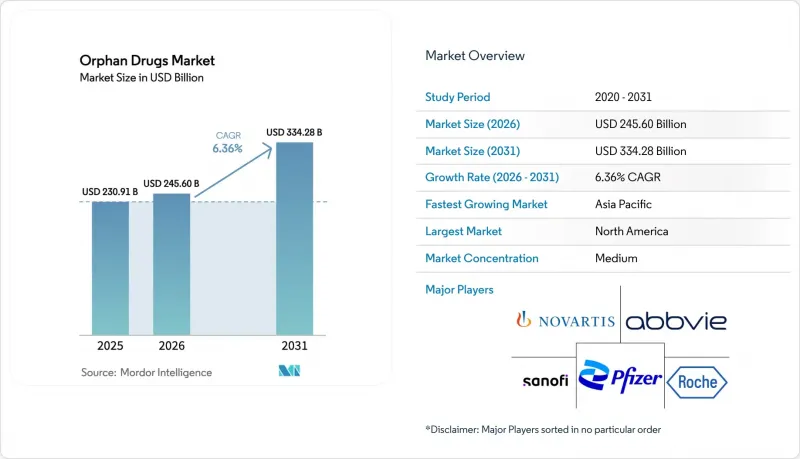
희귀의약품 시장 규모는 2025년 2,309억 1,000만 달러로 평가되었습니다. 2026년 2,456억 달러에서 2031년까지 3,342억 8,000만 달러로 확대되고 2026년부터 2031년까지 연평균 복합 성장률(CAGR)은 6.36%를 나타낼 전망입니다.
본 보고서는 약제 유형(생물학적 제제 및 비생물학적 제제), 질환 분야(종양 질환, 혈액·면역 질환, 신경 질환 등), 투여 경로(비경구, 경구 등), 유통 채널(병원 약국 등), 지역(북미, 유럽, 아시아태평양 등)별로 분류되어 있습니다. 시장 전망은 금액(달러) 기준으로 제시되어 있습니다.
세계의 희귀의약품 시장 동향 및 인사이트
희귀질환 유병률 증가
현재 미국 38개 주에서는 신생아 선별 검사 대상 질환이 60개 이상으로 늘어났으며, 이로 인해 평균 18개월 더 빠른 진단이 가능해져 대사성 질환 및 혈액 질환의 치료 시작이 촉진되고 있습니다. 중국에서는 2024년에 국가 카탈로그에 86개의 질환이 추가되었고, 12개월 이내에 성(省) 차원에서 보험 적용이 의무화됨에 따라 고셰병 및 파브리병의 치료 대상 환자 수가 사실상 2배로 늘어났습니다. 전체 엑솜 시퀀싱 비용은 500달러 미만으로 낮아져 인도나 브라질의 지역 병원에서도 초희귀 변이 검출이 가능해졌으며, 이 지역들의 처방 건수는 연평균 22%의 성장률을 보이고 있습니다. NORD 및 EURORDIS가 관리하는 전 세계 환자 등록부에는 현재 120만 명이 등록되어 있으며, 이로 인해 후원사의 피험자 모집 기간이 40% 단축되었고, 자연 경과 연구에서 위약군이 더 이상 필요하지 않게 되었습니다. 이러한 발전들이 합쳐져 희귀질환 의약품 시장의 예상 연평균 성장률(CAGR)에 1.2%를 추가하고 있습니다.
유리한 정부 인센티브 및 세액 공제
미국 희귀질환 의약품법(Orphan Drug Act)에서는 임상시험에 대한 25%의 세액 공제, 신청 건당 320만 달러의 신청 수수료 면제, 그리고 7년간의 독점권을 제공하며, 이를 통해 일반적인 적응증에 비해 순개발 비용을 40% 가까이 절감하고 있습니다. 일본의 ‘사키가케’ 지정은 심사 기간을 6개월로 절반으로 단축하고, 대상 제품에 대해 10%의 가격 프리미엄을 부여하기 때문에 각 후원사는 FDA에 동시 신청을 추진하고 있습니다. 유럽연합(EU)은 규정 141/2000을 개정하여 병용 요법에도 수수료 감면을 적용함으로써 희귀질환용 의약품의 적격 범위를 15% 확대했습니다. 브라질의 2025년 패스트트랙 제도에서는 현지 임상시험 없이 FDA 또는 EMA의 신청 서류를 접수하게 되어, 승인까지의 기간을 2년에서 8개월로 단축했습니다. 이러한 우대 조치를 종합하면, 희귀질환 의약품 시장의 연평균 성장률(CAGR)을 0.9포인트 끌어올릴 것으로 예측됩니다.
환자 1인당 치료비 부담
Lyfgenia나 Hemgenix와 같은 1회성 유전자 치료는 300만-425만 달러로 가격이 책정되어 있어, 중규모 병원의 예산을 압박하고 재보험 청구를 유발하고 있습니다. 효소 보충 요법의 연간 비용은 50만 달러를 초과하며, 유럽의 보험사들은 출시 후 6개월 이내에 바이오마커 연계형 환급을 요구하고 있습니다. ICER는 2024년부터 2025년에 걸쳐 12개의 희귀의약품가 비용 대비 효과(ICER) 기준치를 초과한다고 지적했으며, 이로 인해 사전 승인 절차가 까다로워져 치료 시작이 42일 지연될 것으로 보입니다. 브라질에서는 환자 1인당 보상 상한선을 5만 달러로 설정하고, 유전자 치료의 80%를 적용 대상에서 제외함에 따라 최대 2년이 소요되는 사법적 이의 제기를 피할 수 없게 되었습니다. 이러한 압박으로 인해 예상되는 연평균 성장률(CAGR)이 0.8포인트 하향 조정되었습니다.
부문별 분석
생물학적 제제는 2025년에 희귀질환 의약품 시장의 65.55% 점유율을 확보했으며, 2031년까지 연평균 성장률(CAGR) 10.85%를 나타낼 것으로 예측됩니다. 따라서 유전자 치료, 단일클론 항체, 세포 유래 제품이 효소 보충 요법을 대체함에 따라, 생물학적 제제의 희귀질환 의약품 시장 규모는 예측 기간 동안 2배 이상으로 증가할 것으로 전망됩니다. 2024년부터 2025년에 걸쳐 15종의 유전자 치료제가 FDA 승인을 획득했으며, 많은 질환에서 평생 치료에서 1회 투여를 통한 완치로 전환되고 있습니다. 단일클론 항체는 이미 바이오의약품 매출의 43%를 차지하고 있으며, Fc 변형 제제의 경우 투여 간격이 28일 이상으로 연장됨에 따라 정맥 주사 빈도가 감소하고 EMA 준수율이 향상되고 있습니다.
비생물학적 제제의 성장은 저분자 약물의 적응증 확대와 경구 제제의 기술 개발이 주도하고 있습니다. Vertex사의 경구용 CFTR 조절제 ‘Trikafta’는 2024년에 98억 달러의 매출을 기록하며, 희귀질환 의약품 시장에서도 환자 수가 많은 유전자형별 하위 부문이 여전히 블록버스터급 수익성을 뒷받침할 수 있음을 입증했습니다. ‘셀델가’와 같은 경구용 기질 감소 요법은 정맥 주사와 비교해 연간 치료비를 30% 절감합니다. 법정 독점 기간이 만료될 때까지는 바이오시밀러에 의한 압박이 제한적이며, 예측 기간의 대부분 동안 생물학적 제제의 가격 결정력은 유지될 전망입니다.
2025년 매출의 37.53%를 종양학 적응증이 차지했습니다. 이는 희귀 혈액 악성 종양을 표적으로 하는 CAR-T 요법과 항체-약물 복합체(ADC)에 힘입은 결과입니다. ‘Columvi’나 ‘Monjuvi’와 같은 이중 특이성 항체는 재발성 혈액암의 대상 환자층을 확대하여 희귀질환용 의약품 시장의 두 자릿수 성장을 견인했습니다. 혈액·면역계 제품은 여전히 2위 규모를 차지하고 있으며, ‘Casgevy’와 ‘Lyfgenia’ 덕분에 평생에 걸친 인자 보충 요법 비용이 최대 50% 절감되었습니다.
신경 질환 분야에서는 알츠하이머병 치료용 항체 ‘레켄비’ 및 ‘키슨라’, 더불어 뒤쉐인형 근이영양증 및 척수성 근위축증에 대한 유전자 치료제의 승인으로 연평균 성장률(CAGR) 12.75%라는 가장 높은 성장률을 기록했습니다(EMA). 헌팅턴병, ALS 및 희귀 간질을 대상으로 하는 18개의 프로그램으로 구성된 후기 개발 파이프라인을 통해 2030년 이후 매출 성장이 더욱 가속화될 전망입니다. 대사성 질환, 감염증 및 기타 초희귀질환 각 부문은 각각 진전이 완만하기는 하지만, 신생아 선별 검사의 확대와 진단 기술의 향상에 따른 혜택을 받고 있습니다.
지역별 분석
북미는 2025년 매출의 45.55%를 차지하는데, 이는 ‘희귀질환 의약품법(Orphan Drug Act)’에 따른 25%의 세액 공제와 7년간의 독점권으로 인해 개발 비용이 약 40% 절감된 데 기인합니다. 2024년부터 2025년에 걸쳐 벤처 투자액은 128억 달러에 달했으며, 단일 IND(신약 임상시험 신청) 하에서 여러 적응증을 다룰 수 있는 CRISPR 및 RNA 플랫폼에 자본이 집중되었습니다. 이 지역의 희귀의약품 시장 점유율은 향후 메디케어 가격 협상이 예정되어 있음에도 불구하고, 각 후원사가 희귀의약품 지정을 유지하기 위해 제품 출시 시기를 조정하고 있기 때문에 40%를 상회하며 유지될 것으로 예측됩니다.
아시아태평양은 중국의 규제 지연 기간 중앙값이 1.4년으로 단축되고, 일본의 ‘SAKIGAKE’ 제도에 따라 6개월 이내에 심사가 완료됨에 따라 연평균 성장률(CAGR) 11.22%를 기록하며 세계에서 가장 빠른 성장률을 보일 것으로 예측됩니다. 중국에서 효소 보충 요법의 보험 적용 의무화로 인해 리소좀 축적증의 치료 대상 환자 수가 2배로 증가했습니다. 한편, 일본에서는 시판 후 2년간 희귀의약품에 대해 원가의 110%를 보험 환급하고 있어, 조기 신청에 대한 인센티브가 되고 있습니다. 호주의 잠정 승인 제도와 한국의 성과 연동형 계약도 해당 지역 내 접근성 확대를 더욱 촉진하고 있습니다.
유럽에서는 중소기업에 대한 신청 수수료 100% 면제 및 EMA에 의한 최대 12년간의 독점권 부여에 힘입어, 2024년 한 해에만 15건의 희귀의약품가 승인되는 등 견실한 파이프라인 활동이 유지되었습니다. 그러나 HTA(의료기술평가) 기관은 현재,시판 후 18개월 이내에 비교 유효성 데이터 제출을 의무화하고 있으며, 또한 매출액이 5,000만 유로를 초과하는 의약품에 대해서는 독점 기간이 8년으로 단축될 가능성이 있는 법안이 제출되어, 이로 인해 유럽의 희귀의약품 시장 규모는 예상 매출의 15-20% 축소될 가능성이 있습니다. 남미, 중동 및 아프리카는 브라질 ANVISA의 패스트트랙 제도와 GCC 국가들의 국내 등록 제도가 새로운 환자층을 창출하고 있어, 시장 점유율은 작지만 증가 추세를 보이고 있습니다.
기타 혜택 :
- 엑셀 형식 시장 예측(ME) 시트
- 3개월간의 애널리스트 지원
자주 묻는 질문
목차
제1장 서론
제2장 조사 방법
제3장 주요 요약
제4장 시장 구도
제5장 시장 규모 및 성장 예측
제6장 경쟁 구도
제7장 시장 기회 및 향후 전망
KTH 26.09.04According to Mordor Intelligence, the orphan drugs market size is projected to expand from USD 230.91 billion in 2025 and USD 245.60 billion in 2026 to USD 334.28 billion by 2031, registering a CAGR of 6.36% between 2026 and 2031.
This report is Segmented by Drug Type (Biologics and Non-Biologics), Disease Area (Oncologic Diseases, Hematologic & Immunologic Diseases, Neurologic Diseases, and More), Route of Administration (Parenteral, Oral, and More), Distribution Channel (Hospital Pharmacies, and More), and Geography (North America, Europe, Asia-Pacific, and More). The Market Forecasts are Provided in Terms of Value (USD).
Global Orphan Drugs Market Trends and Insights
Rising Prevalence of Rare Diseases
Newborn screening now covers more than 60 conditions in 38 U.S. states, enabling diagnosis 18 months earlier on average and lifting treatment initiation across metabolic and hematologic disorders. China added 86 conditions to its national catalog in 2024 and mandated provincial reimbursement within 12 months, effectively doubling the treated population for Gaucher and Fabry diseases. Whole-exome sequencing costs have fallen below USD 500, allowing community hospitals in India and Brazil to detect ultra-rare mutations and driving 22% annual growth in prescriptions in those regions. Global patient registries maintained by NORD and EURORDIS now include 1.2 million individuals, cutting sponsor recruitment timelines by 40% and replacing placebo arms in natural-history studies. These developments collectively add 1.2 percentage points to the forecast CAGR of the orphan drugs market.
Favorable Government Incentives and Tax Credits
The U.S. Orphan Drug Act offers a 25% clinical-testing tax credit, user-fee waivers of USD 3.2 million per filing, and seven-year exclusivity, trimming net development costs by nearly 40% compared with mainstream indications. Japan's SAKIGAKE designation halves review time to six months and grants a 10% price premium for eligible products, leading sponsors to pursue simultaneous filings with the FDA. The European Union updated Regulation 141/2000 to extend fee reductions to combination therapies, broadening orphan eligibility by 15%. Brazil's 2025 fast-track pathway now accepts FDA or EMA dossiers without local trials, cutting approval time from two years to eight months. Collectively, these incentives are projected to lift the orphan drugs market CAGR by 0.9 percentage points.
High Per-Patient Treatment Cost
One-time gene therapies such as Lyfgenia and Hemgenix command price tags of USD 3-4.25 million, overwhelming mid-sized hospital budgets and triggering reinsurance claims. Enzyme-replacement regimens exceed USD 500,000 annually, prompting European payers to demand biomarker-linked reimbursement within six months of launch. ICER flagged 12 orphan drugs as breaching cost-effectiveness thresholds in 2024-2025, leading to prior-authorization hurdles that delay therapy by 42 days. Brazil caps reimbursement at USD 50,000 per patient, excludes 80% of gene therapies, and forces judicial appeals that can take up to 2 years. These pressures shave 0.8 percentage points from the forecast CAGR.
Other drivers and restraints analyzed in the detailed report include:
- Market Exclusivity for Orphan-Designated Drugs
- AI-Driven Adaptive Trials
- Limited Patient Pool for Trials and Launch
For complete list of drivers and restraints, kindly check the Table Of Contents.
Segment Analysis
Biologics secured 65.55% of the orphan drugs market share in 2025 and are projected to grow at a 10.85% CAGR through 2031. The orphan drugs market size for biologics should therefore more than double over the forecast horizon as gene therapies, monoclonal antibodies, and cell-based products replace enzyme-replacement regimens. Fifteen gene therapies gained FDA approval during 2024-2025, shifting many diseases from lifelong treatment to single-dose cures. Monoclonal antibodies already account for 43% of biologic revenue, and Fc-engineered formats now achieve dosing intervals of more than 28 days, reducing infusion frequency and improving adherence to EMA.
Non-biologics growth led by small-molecule repurposing and oral formulation engineering. Vertex's oral CFTR modulator Trikafta delivered USD 9.8 billion in 2024 sales, proving that high-volume genotypic subsegments can still support blockbuster economics in the orphan drugs market. Oral substrate-reduction therapies, such as Cerdelga, lower the annual cost of care by 30% compared with infusions. Biosimilar pressure remains limited until statutory exclusivity expires, preserving biologics' pricing power for most of the forecast period.
Oncologic indications accounted for 37.53% of 2025 revenue, underpinned by CAR-T therapies and antibody-drug conjugates that target rare hematologic malignancies. Bispecific antibodies such as Columvi and Monjuvi expanded the addressable pool of relapsed blood cancers, driving double-digit growth in the orphan drugs market. Hematologic and immunologic products remain the second-largest group, with Casgevy and Lyfgenia reducing lifetime factor-replacement expenses by up to 50%.
Neurologic diseases posted the fastest 12.75% CAGR in approvals for Alzheimer's antibodies Leqembi and Kisunla, plus gene therapies for Duchenne muscular dystrophy and spinal muscular atrophy, EMA. A late-stage pipeline of 18 programs targeting Huntington's disease, ALS, and rare epilepsies is likely to accelerate revenue beyond 2030. Metabolic, infectious, and residual ultra-rare categories each advance more slowly yet still benefit from broader newborn screening and improved diagnostic technologies.
Complete Report Scope:
- By Drug Type
- Biologics
- Non-biologics
- By Disease Area
- Oncologic Diseases
- Hematologic & Immunologic Diseases
- Neurologic Diseases
- Metabolic Diseases
- Infectious Diseases
- Other Rare Diseases
- By Route of Administration
- Parenteral
- Oral
- Inhalation
- Topical
- Implantable
- By Distribution Channel
- Hospital Pharmacies
- Retail Pharmacies
- Online Pharmacies
- Geography
- North America
- United States
- Canada
- Mexico
- Europe
- Germany
- United Kingdom
- France
- Italy
- Spain
- Rest of Europe
- Asia-Pacific
- China
- India
- Japan
- Australia
- South Korea
- Rest of Asia-Pacific
- Middle East and Africa
- GCC
- South Africa
- Rest of Middle East and Africa
- South America
- Brazil
- Argentina
- Rest of South America
- North America
Geography Analysis
North America accounted for 45.55% of 2025 revenue, driven by the Orphan Drug Act's 25% tax credit and 7-year exclusivity, which cut development costs by roughly 40%. Venture investment climbed to USD 12.8 billion in 2024-2025, with capital directed toward CRISPR and RNA platforms that can address multiple indications under a single IND. The orphan drugs market share in the region is expected to stay above 40% despite upcoming Medicare price negotiations, as sponsors sequence launches to maintain orphan status.
Asia-Pacific is projected to grow at an 11.22% CAGR, the fastest worldwide, because China's median regulatory lag has dropped to 1.4 years, and Japan's SAKIGAKE pathway clears reviews within six months. China's reimbursement mandate for enzyme-replacement therapies doubled the treated population for lysosomal storage disorders, while Japan reimburses orphans at 110% of cost for two years post-launch, incentivizing early filing. Australia's provisional pathway and South Korea's outcomes-based contracts further widen regional access.
Europe maintains robust pipeline activity with 15 orphan approvals in 2024 alone, aided by 100% fee waivers for SMEs and up to 12 years of exclusivity EMA. However, HTA bodies now require comparative-effectiveness data within 18 months of launch, and legislative proposals could shorten exclusivity to eight years for drugs exceeding EUR 50 million in sales, potentially compressing the European orphan drugs market size by 15-20% of forecast revenue. South America, the Middle East, and Africa together represent a small but rising share as Brazil's ANVISA fast-track and GCC national registries create new patient pools.
- Abbvie
- Alexion Pharmaceuticals Inc.
- Amgen
- AstraZeneca
- Bayer
- Biomarin Pharmaceutical
- Bristol-Myers Squibb
- CSL Behring
- Roche
- GlaxoSmithKline
- Horizon Therapeutics
- Johnson & Johnson
- Novartis
- Pfizer
- Regeneron Pharmaceuticals
- Sanofi
- Sarepta Therapeutics
- Takeda Pharmaceuticals
- Vertex Pharmaceuticals Inc.
Additional Benefits:
- The market estimate (ME) sheet in Excel format
- 3 months of analyst support
TABLE OF CONTENTS
1 Introduction
- 1.1 Study Assumptions & Market Definition
- 1.2 Scope of the Study
2 Research Methodology
3 Executive Summary
4 Market Landscape
- 4.1 Market Overview
- 4.2 Market Drivers
- 4.2.1 Rising Prevalence of Rare Diseases
- 4.2.2 Favorable Government Incentives & Tax Credits
- 4.2.3 Market Exclusivity for Orphan-Designated Drugs
- 4.2.4 AI-Driven Adaptive Trials Shrinking Development Timelines
- 4.2.5 Repurposing Shelved Phase II Assets for Niche Indications
- 4.2.6 "Orphan-First" Launch Sequencing to Defer Medicare Price Negotiations
- 4.3 Market Restraints
- 4.3.1 High Per-Patient Treatment Cost
- 4.3.2 Limited Patient Pool for Trials & Marketing
- 4.3.3 Payer Scrutiny on Indication Creep & Real-World Value
- 4.3.4 Legislative Proposals to Shorten Exclusivity Windows
- 4.4 Supply-Chain Analysis
- 4.5 Regulatory Landscape
- 4.6 Technological Outlook
- 4.7 Porter's Five Forces
- 4.7.1 Threat of New Entrants
- 4.7.2 Bargaining Power of Buyers/Consumers
- 4.7.3 Bargaining Power of Suppliers
- 4.7.4 Threat of Substitute Products
- 4.7.5 Intensity of Competitive Rivalry
5 Market Size & Growth Forecasts (Value, USD)
- 5.1 By Drug Type
- 5.1.1 Biologics
- 5.1.2 Non-biologics
- 5.2 By Disease Area
- 5.2.1 Oncologic Diseases
- 5.2.2 Hematologic & Immunologic Diseases
- 5.2.3 Neurologic Diseases
- 5.2.4 Metabolic Diseases
- 5.2.5 Infectious Diseases
- 5.2.6 Other Rare Diseases
- 5.3 By Route of Administration
- 5.3.1 Parenteral
- 5.3.2 Oral
- 5.3.3 Inhalation
- 5.3.4 Topical
- 5.3.5 Implantable
- 5.4 By Distribution Channel
- 5.4.1 Hospital Pharmacies
- 5.4.2 Retail Pharmacies
- 5.4.3 Online Pharmacies
- 5.5 Geography
- 5.5.1 North America
- 5.5.1.1 United States
- 5.5.1.2 Canada
- 5.5.1.3 Mexico
- 5.5.2 Europe
- 5.5.2.1 Germany
- 5.5.2.2 United Kingdom
- 5.5.2.3 France
- 5.5.2.4 Italy
- 5.5.2.5 Spain
- 5.5.2.6 Rest of Europe
- 5.5.3 Asia-Pacific
- 5.5.3.1 China
- 5.5.3.2 India
- 5.5.3.3 Japan
- 5.5.3.4 Australia
- 5.5.3.5 South Korea
- 5.5.3.6 Rest of Asia-Pacific
- 5.5.4 Middle East and Africa
- 5.5.4.1 GCC
- 5.5.4.2 South Africa
- 5.5.4.3 Rest of Middle East and Africa
- 5.5.5 South America
- 5.5.5.1 Brazil
- 5.5.5.2 Argentina
- 5.5.5.3 Rest of South America
- 5.5.1 North America
6 Competitive Landscape
- 6.1 Market Concentration
- 6.2 Market Share Analysis
- 6.3 Company Profiles (includes Global level Overview, Market level overview, Core Segments, Financials as available, Strategic Information, Market Rank/Share for key companies, Products & Services, and Recent Developments)
- 6.3.1 AbbVie Inc.
- 6.3.2 Alexion Pharmaceuticals Inc.
- 6.3.3 Amgen Inc.
- 6.3.4 AstraZeneca plc
- 6.3.5 Bayer AG
- 6.3.6 BioMarin Pharmaceutical Inc.
- 6.3.7 Bristol-Myers Squibb Co.
- 6.3.8 CSL Behring
- 6.3.9 F. Hoffmann-La Roche Ltd
- 6.3.10 GSK plc
- 6.3.11 Horizon Therapeutics plc
- 6.3.12 Johnson & Johnson
- 6.3.13 Novartis AG
- 6.3.14 Pfizer Inc.
- 6.3.15 Regeneron Pharmaceuticals Inc.
- 6.3.16 Sanofi S.A.
- 6.3.17 Sarepta Therapeutics Inc.
- 6.3.18 Takeda Pharmaceutical Co. Ltd
- 6.3.19 Vertex Pharmaceuticals Inc.
7 Market Opportunities & Future Outlook
- 7.1 White-space & unmet-need assessment