

|
시장보고서
상품코드
2120670
외래 의료 서비스 : 시장 점유율 분석, 업계 동향과 통계, 성장 예측(2026-2031년)Ambulatory Healthcare Service - Market Share Analysis, Industry Trends & Statistics, Growth Forecasts (2026 - 2031) |
||||||
 Mordor Intelligence
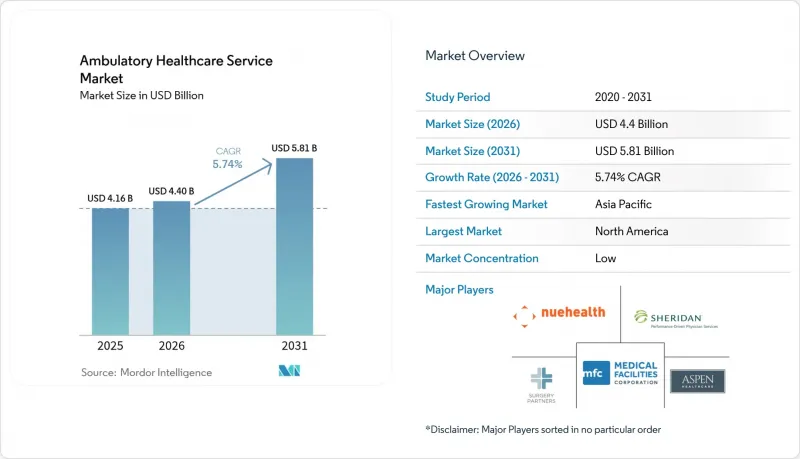
Mordor Intelligence에 의하면, 외래 의료 서비스 시장 규모는 2025년에 41억 6,000만 달러로 평가되었고, 2026년 44억 달러에서 2031년까지 58억 1,000만 달러에 이를 것으로 예측되며, 예측 기간(2026-2031년) CAGR은 5.74%를 기록할 전망입니다.
본 보고서는 서비스 제공 형태(1차 진료 클리닉, 외과 전문 클리닉 등), 전문 분야(안과, 정형외과 등), 소유 형태(의사 소유, 병원/의료 시스템 소유 등), 지역(북미, 유럽, 아시아태평양, 중동 및 아프리카, 남미)별로 분류되어 있습니다. 시장 예측은 금액(달러) 기준으로 제시되어 있습니다.
전 세계 외래 의료 서비스 시장 동향 및 인사이트
만성 질환 부담 증가 및 고령 인구 증가
지역 밀착형 진료를 선호하는 고령층의 다중 질환 병치율 상승에 따라 외래 의료 서비스 시장에 대한 수요는 더욱 높아지고 있습니다. 현재 지급 기관은 재택·지역 진료의 환급액 중 75%를 정부 프로그램과 연계하고 있으며, 외래 의료 제공을 국가 보건 전략에 포함시키고 있습니다. 이에 대응하여 지역 진료소에서는 만성 질환의 진료 범위를 확대하고, 영양 서비스를 통합하며, 의뢰 절차를 단축하는 현장 진단(point-of-care)을 도입하고 있습니다. 집단건강관리 계약에는 외래 환경에서 이루어지는 고혈압, 당뇨병, 만성폐쇄성폐질환(COPD) 관리에 관한 성과 지표가 점점 더 많이 포함되고 있습니다. 이러한 추세는 외래 의료가 단순한 선택적 보조 수단이 아니라 의료 시스템 역량의 구조적 구성 요소로 자리 잡고 있음을 뒷받침합니다.
저침습 수술로의 전환을 가능하게 하는 기술 혁신
로봇 공학, 영상 진단, AI의 발전으로 인해 절개 부위의 크기, 수술실 소요 시간, 회복 기간이 단축되어, 과거에는 병원 수술실로 한정되었던 시술이 외래수술센터(ASC)로 이전될 수 있게 되었습니다. 광자 계수형 CT와 디지털 SPECT 스캐너는 스캔 순서를 단축하고 방사선 피폭량을 줄여, 외래 진료의 처리 능력 목표에 부합하게 되었습니다. 폐색제거술이나 말초 스텐트 삽입술과 같은 심혈관 중재술도 외래 시설에서의 시술에 대한 보험 급여가 확대되면서 시술의 폭이 넓어지고 있습니다. 자동 영상 분석 도구는 스캔 선별 및 이상 부위 표시를 통해 신속한 확인을 가능하게 함으로써, 방사선과 전문의 부족을 보완하고 있습니다. 이러한 기술들이 종합적으로 작용함으로써, 의료기관은 임상 인력을 비례적으로 증원하지 않고도 진료 건수를 늘릴 수 있게 되었습니다.
만성화되는 인력 부족과 임상 의사의 번아웃 증가
2033년까지 최대 13만 9,000명의 의사 부족이 예상되며, 고용이 병원 시스템으로 이동하는 가운데 개업의로 근무하는 의사는 고작 42.2%에 그쳐 인력 공급이逼迫하고 있습니다. 임상의들은 바쁜 진료 업무와 전자의무기록 작성을 병행해야 하는 상황에 몰려 번아웃 비율이 상승하고 있으며, 이는 조기 퇴직이나 근무 시간 단축으로 이어지고 있습니다. 외래 진료 센터에서는 야간이나 주말 진료 인력 확보에 어려움을 겪고 있어, 성수기의 진료 건수가 제한되고 있습니다. 지방에서는 텔레헬스 면허 요건이 주마다 달라 전문의 배치가 지연되면서 인력 부족이 더욱 심각해지고 있습니다. 인력 부족으로 인해 인건비가 상승하여, 병원에 비해 이미 낮은 이익률에 추가적인 압박이 가해지고 있습니다.
부문별 분석
1차 진료 클리닉은 최대 수익원이며, 2025년에는 외래 의료 서비스 시장의 39.74%를 차지할 것으로 예측됩니다. 이러한 클리닉은 질병 예방, 처방전 갱신 및 의뢰의 ‘게이트키퍼’ 역할을 수행하며, 지역 주민 건강 프로그램에서 필수적인 거점으로 자리 잡고 있습니다. 지속적인 관리는 환자와의 견고한 관계를 형성하여 치료 순응도를 높이고 하류 의료비 절감으로 이어집니다. 첨단 분류 도구 및 만성 질환 관리 대시보드에 대한 투자를 통해 진료소는 의사 수의 비례적 증가 없이도 증가하는 다중 질환 병용에 대응할 수 있게 됩니다. 원격의료 및 가상 클리닉은 절대 수로는 소규모이지만, 2031년까지 연평균 성장률(CAGR) 7.62%로 성장할 전망이며, 이는 편의성이 높고 주문형으로 이용할 수 있는 서비스에 대한 소비자의 선호도를 반영합니다.
가상 의료의 급속한 확산은 새로운 경쟁을 불러일으키고 24시간 365일 이용 가능성에 대한 기대를 높이고 있어, 기존 진료소들은 하이브리드 모델 도입을 서둘러야 하는 상황에 놓여 있습니다. 14,000곳 이상에 달하는 응급 치료 센터는 생명에 지장이 없는 증례에 대응함으로써 응급실 혼잡 완화에 지속적으로 기여하고 있습니다. 보험사가 고비용 영상 검사를 병원 영상의학과에서 외부로 이관함에 따라 영상 진단 허브는 번창하고 있습니다. 이와 동시에 재택치료 기관은 원격 생체 징후 모니터링을 활용하여, 특히 급성기 이후의 회복기나 완화 치료 분야에서 임상의의 지원 범위를 확대되고 있습니다. 이러한 다양한 부문의 모자이크는 다양한 의료 제공 거점이 상호 연계함으로써 외래 의료 서비스 시장에서 환자 유입과 수익을 어떻게 강화하고 있는지를 여실히 보여주고 있습니다.
지역별 분석
북미는 2025년 전 세계 외래 의료 수익의 43.12%를 차지했습니다. 이는 보험사의 광범위한 보장 범위, 서비스 제공 장소에 따른 유리한 격차, 그리고 14,000곳이 넘는 응급 치료 센터의 성숙한 공급 체계에 힘입은 결과입니다. 미국에서는 ASC(외래수술센터(ASC))에 대한 메디케어 지급액이 2.9% 인상되어 즉각적인 현금 흐름 개선으로 이어지고 있습니다. 한편, 캐나다에서는 각 주의 개혁을 통해 지역 밀착형 만성 질환 클리닉이 지원을 받고 있습니다. 멕시코의 의료 관광 클러스터는 수술 건수 증가를 이끌어내며 지역 내 점유율을 강화하고 있습니다. 원격의료 도입률은 현재 진료 건수의 23%에 달하며, 디지털 채널이 외래 의료 서비스 시장에 확고히 자리 잡았음을 보여줍니다.
아시아태평양은 공립 병원의 혼잡 완화를 위해 각국 정부가 외래 진료 시설 건설을 급속도로 추진하고 있어, 2031년까지 10.18%라는 업계 최고 수준의 연평균 성장률(CAGR)을 나타낼 전망입니다. 싱가포르의 통합 수술센터는 업계 최고 수준의 처리 능력을 발휘하고 있으며, 중국은 저침습 의료기기의 국내 생산을 우선시하고, 일본은 고령자를 위한 원격 재활에 보조금을 지급하고 있습니다. 인도의 보험 확대 정책과 의료 관광을 통한 자금 유입 또한, 다학제적 분야를 아우르는 외래 의료 허브로의 자본 유입을 뒷받침하고 있습니다. 이 지역의 인구 고령화로 인해 심혈관, 안과, 정형외과 분야의 당일 수술에 대한 지속적인 수요가 확보되고 있습니다.
유럽에서는 각국의 의료 제도가 예산을 긴축하고 ‘시프트 레프트(Shift Left)’ 이니셔티브를 추진하는 가운데, 꾸준한 성장이 나타나고 있습니다. 독일에서는 부인과 수술의 98%가 민간 독립형 시설에서 이루어지고 있으며, EU 전역에 걸친 가치 기반 프레임워크를 통해 외래 시설이 효율적으로 달성할 수 있는 의료 품질 지표에 따라 진료 보수가 결정되고 있습니다. 원격 방사선 진단 도입으로 방사선과 전문의 부족이 완화되는 한편, 국경을 초월한 규제 완화로 인해 EU 역내 환자 이동이 원활해지고 있습니다. 중동 및 아프리카, 남미의 신흥 시장에서는 종종 수용 한계에 다다른 공립 병원을 보완하는 민간 외래 의료 클러스터에 대한 투자가 진행되고 있으며, 이는 전 세계 외래 의료 서비스 시장의 확대에 기여하고 있습니다.
기타 혜택:
- 엑셀 형식 시장 예측(ME) 시트
- 3개월간의 애널리스트 지원
자주 묻는 질문
목차
제1장 서론
제2장 조사 방법
제3장 주요 요약
제4장 시장 구도
제5장 시장 규모와 성장 예측
제6장 경쟁 구도
제7장 시장 기회와 향후 전망
LSH 26.09.08According to Mordor Intelligence, the ambulatory healthcare service market size was valued at USD 4.16 billion in 2025 and estimated to grow from USD 4.40 billion in 2026 to reach USD 5.81 billion by 2031, at a CAGR of 5.74% during the forecast period (2026-2031).
This report is Segmented by Service Setting (Primary Care Clinics, Surgical Specialty Clinics, and More), Specialty (Ophthalmology, Orthopedics, and More), Ownership Model (Physician-Owned, Hospital / Health-System-Owned, and More), and Geography (North America, Europe, Asia-Pacific, Middle East and Africa, South America). The Market Forecasts are Provided in Terms of Value (USD).
Global Ambulatory Healthcare Service Market Trends and Insights
Rising Burden of Chronic Diseases and a Growing Elderly Population
Demand for the ambulatory healthcare service market deepens as multimorbidity rates climb among seniors who prefer community-based care. Payers now tie 75% of home- and community-care reimbursements to government programs, embedding outpatient delivery in national health strategies. Community clinics respond by enlarging chronic-disease panels, integrating nutrition services, and deploying point-of-care diagnostics that shorten referral loops. Population-health contracts increasingly include performance metrics for hypertension, diabetes, and COPD management conducted in ambulatory settings. These patterns confirm that outpatient care is becoming a structural component of health-system capacity rather than a discretionary adjunct.
Technological Innovations Enabling Shift Toward Minimally Invasive Surgeries
Advances in robotics, imaging, and AI reduce incision size, operating-room time, and recuperation periods, allowing procedures once limited to hospital theaters to migrate to ambulatory surgery centers. Photon-counting CT and digital SPECT scanners shrink scan sequences and radiation exposure, aligning with outpatient throughput targets. Cardiovascular interventions such as atherectomy and peripheral stenting are increasingly reimbursed for ambulatory venues, expanding procedure mix. Automated image-analysis tools offset shortages of radiologists by triaging scans and flagging anomalies for rapid review. Collectively, these technologies help facilities boost case volumes without proportional increases in clinical manpower.
Persistent Workforce Shortages and Increasing Clinician Burnout
A projected deficit of up to 139,000 physicians by 2033 tightens labor supply, with only 42.2% of physicians still in private practice as employment shifts toward hospital systems. Burnout rates climb as clinicians juggle high visit counts and electronic documentation, prompting early retirement and reduced hours. Ambulatory centers struggle to staff evening and weekend clinics, limiting throughput during peak periods. Rural areas face compounded shortages because telehealth licensing requirements vary by state, slowing specialist deployment. Workforce gaps elevate salary expenses, pressuring margins that are already thinner than hospital counterparts.
Other drivers and restraints analyzed in the detailed report include:
- Policy Initiatives Promoting Favorable Reimbursement and Site-of-Care Mandates
- Entry of Retail Giants and Big-Tech Players Accelerating Digital Innovation
- Rising Cybersecurity Threats and Fragmented Data Systems
For complete list of drivers and restraints, kindly check the Table Of Contents.
Segment Analysis
Primary care clinics generated the largest revenue stream, accounting for 39.74% of the ambulatory healthcare service market in 2025. They serve as gatekeepers for disease prevention, prescription renewals, and referrals, positioning them as indispensable nodes in population-health programs. Continuity of care fosters strong patient relationships, leading to higher adherence and lower downstream costs. Investment in advanced triage tools and chronic-care dashboards enables clinics to manage rising multimorbidity without proportional physician headcount. Telehealth and virtual clinics, though smaller in absolute terms, are on track for a 7.62% CAGR through 2031, reflecting consumer preference for convenient, on-demand access.
Rapid virtual uptake brings fresh competition and raises expectations for 24/7 availability, pushing traditional practices to adopt hybrid models. Urgent care centers, numbering more than 14,000, continue to relieve emergency-room congestion by handling non-life-threatening episodes. Diagnostic imaging hubs prosper as payers shift high-cost scans out of hospital radiology departments. In parallel, home-health agencies leverage remote vitals monitoring to extend the reach of clinicians, particularly for post-acute recovery and palliative support. The segment mosaic underscores how diversified points of care jointly reinforce the ambulatory healthcare service market flow of patients and revenue.
Complete Report Scope:
- By Service Setting
- Primary Care Clinics
- Surgical Specialty Clinics
- Urgent Care Centers
- Freestanding Emergency Departments
- Diagnostic Imaging Centers
- Specialty Clinics
- Home Healthcare Agencies
- Telehealth & Virtual Clinics
- By Specialty
- Ophthalmology
- Orthopedics
- Gastroenterology
- Cardiovascular
- Pain Management
- Dermatology
- ENT
- Oncology
- Others
- By Ownership Model
- Physician-Owned
- Hospital / Health-System-Owned
- Corporate / Private-Equity-Owned
- Joint-Ventures
- By Geography
- North America
- United States
- Canada
- Mexico
- Europe
- Germany
- United Kingdom
- France
- Italy
- Spain
- Rest of Europe
- Asia-Pacific
- China
- Japan
- India
- Australia
- South Korea
- Rest of Asia-Pacific
- Middle East & Africa
- GCC
- South Africa
- Rest of Middle East & Africa
- South America
- Brazil
- Argentina
- Rest of South America
- North America
Geography Analysis
North America controlled 43.12% of global ambulatory revenues in 2025, underpinned by expansive payer coverage, favorable site-of-service differentials, and a mature supply of more than 14,000 urgent care centers. The United States benefits from a 2.9% Medicare payment bump for ASCs, creating immediate cash-flow lift, while Canada's provincial reforms reward community-based chronic-disease clinics. Mexico's medical-tourism clusters generate incremental procedure volume that fortifies regional share. Telehealth adoption now touches 23% of encounters, a signal that digital pathways are firmly embedded in the ambulatory healthcare service market.
Asia-Pacific posts a leading 10.18% CAGR by 2031 as governments fast-track outpatient construction to relieve public-hospital congestion. Singapore's integrated surgery centers demonstrate best-in-class throughput, China prioritizes domestic production of minimally invasive devices, and Japan subsidizes tele-rehabilitation for seniors. India's insurance-expansion policies and medical-tourism inflows also funnel capital into multispecialty ambulatory hubs. Demographic aging in the region ensures sustainable demand for cardiovascular, ophthalmic, and orthopedic day surgeries.
Europe exhibits steady growth as national health systems tighten budgets and encourage shift-left initiatives. Germany's gynecology procedures now occur 98% in private free-standing units, and EU-wide value-based frameworks tie reimbursement to care-quality metrics that outpatient sites can meet efficiently. Adoption of teleradiology mitigates radiologist shortages, while relaxed cross-border directives ease patient flow within the bloc. Emerging markets in the Middle East, Africa, and South America invest in private outpatient clusters that complement often overstretched public hospitals, extending the global footprint of the ambulatory healthcare service market.
- Aspen Pharmacare
- Healthway Medical Group
- Medical Facilities
- NueHealth
- Envision / Sheridan Healthcare
- Surgery Partners
- SCA Health (Surgical Care Affiliates)
- Terveystalo Healthcare
- United Surgical Partners International (USPI)
- AmSurg
- Tenet Healthcare
- HCA Healthcare
- Community Health Systems
- TeamHealth
- FastMed Urgent Care
- NextCare Urgent Care
- One Medical
- Oak Street Health
- CVS MinuteClinic
- DaVita Kidney Care
- Kaiser Permanente
Additional Benefits:
- The market estimate (ME) sheet in Excel format
- 3 months of analyst support
TABLE OF CONTENTS
1 Introduction
- 1.1 Study Assumptions & Market Definition
- 1.2 Scope of the Study
2 Research Methodology
3 Executive Summary
4 Market Landscape
- 4.1 Market Overview
- 4.2 Market Drivers
- 4.2.1 Rising Burden of Chronic Diseases and a Growing Elderly Population
- 4.2.2 Technological Innovations are Enabling the Shift Toward Minimally Invasive Surgeries
- 4.2.3 Policy Initiatives Promoting Favorable Reimbursement and Site-of-Care Mandates
- 4.2.4 Entry of Retail Giants and Big-Tech Players Accelerating Digital Innovation
- 4.2.5 Hybrid ASC-OBL (Office-Based Lab) Facilities Supporting the Migration of Cardiovascular Procedures
- 4.2.6 Adoption of Value-Based Care and Bundled Payment Models
- 4.3 Market Restraints
- 4.3.1 Persistent Workforce Shortages and Increasing Clinician Burnout
- 4.3.2 Rising Cybersecurity Threats and Fragmented Data Systems
- 4.3.3 High Real Estate Costs in Urban and High-Growth Corridors Pose Barriers to ASC Expansion
- 4.3.4 Operational Complexity from Managing Multispecialty Practices
- 4.4 Porter's Five Forces Analysis
- 4.4.1 Threat of New Entrants
- 4.4.2 Bargaining Power of Buyers
- 4.4.3 Bargaining Power of Suppliers
- 4.4.4 Threat of Substitute Products
- 4.4.5 Intensity of Competitive Rivalry
5 Market Size & Growth Forecasts
- 5.1 By Service Setting
- 5.1.1 Primary Care Clinics
- 5.1.2 Surgical Specialty Clinics
- 5.1.3 Urgent Care Centers
- 5.1.4 Freestanding Emergency Departments
- 5.1.5 Diagnostic Imaging Centers
- 5.1.6 Specialty Clinics
- 5.1.7 Home Healthcare Agencies
- 5.1.8 Telehealth & Virtual Clinics
- 5.2 By Specialty
- 5.2.1 Ophthalmology
- 5.2.2 Orthopedics
- 5.2.3 Gastroenterology
- 5.2.4 Cardiovascular
- 5.2.5 Pain Management
- 5.2.6 Dermatology
- 5.2.7 ENT
- 5.2.8 Oncology
- 5.2.9 Others
- 5.3 By Ownership Model
- 5.3.1 Physician-Owned
- 5.3.2 Hospital / Health-System-Owned
- 5.3.3 Corporate / Private-Equity-Owned
- 5.3.4 Joint-Ventures
- 5.4 By Geography
- 5.4.1 North America
- 5.4.1.1 United States
- 5.4.1.2 Canada
- 5.4.1.3 Mexico
- 5.4.2 Europe
- 5.4.2.1 Germany
- 5.4.2.2 United Kingdom
- 5.4.2.3 France
- 5.4.2.4 Italy
- 5.4.2.5 Spain
- 5.4.2.6 Rest of Europe
- 5.4.3 Asia-Pacific
- 5.4.3.1 China
- 5.4.3.2 Japan
- 5.4.3.3 India
- 5.4.3.4 Australia
- 5.4.3.5 South Korea
- 5.4.3.6 Rest of Asia-Pacific
- 5.4.4 Middle East & Africa
- 5.4.4.1 GCC
- 5.4.4.2 South Africa
- 5.4.4.3 Rest of Middle East & Africa
- 5.4.5 South America
- 5.4.5.1 Brazil
- 5.4.5.2 Argentina
- 5.4.5.3 Rest of South America
- 5.4.1 North America
6 Competitive Landscape
- 6.1 Market Concentration
- 6.2 Market Share Analysis
- 6.3 Company Profiles {(includes Global level Overview, Market level overview, Core Segments, Financials as available, Strategic Information, Market Rank/Share for key companies, Products & Services, and Recent Developments)}
- 6.3.1 Aspen Healthcare
- 6.3.2 Healthway Medical Group
- 6.3.3 Medical Facilities Corporation
- 6.3.4 NueHealth
- 6.3.5 Envision / Sheridan Healthcare
- 6.3.6 Surgery Partners
- 6.3.7 SCA Health (Surgical Care Affiliates)
- 6.3.8 Terveystalo Healthcare
- 6.3.9 United Surgical Partners International (USPI)
- 6.3.10 AmSurg
- 6.3.11 Tenet Healthcare Corporation
- 6.3.12 HCA Healthcare
- 6.3.13 Community Health Systems
- 6.3.14 TeamHealth
- 6.3.15 FastMed Urgent Care
- 6.3.16 NextCare Urgent Care
- 6.3.17 One Medical
- 6.3.18 Oak Street Health
- 6.3.19 CVS MinuteClinic
- 6.3.20 DaVita Kidney Care
- 6.3.21 Kaiser Permanente
7 Market Opportunities & Future Outlook
- 7.1 White-space & Unmet-Need Assessment


