

|
시장보고서
상품코드
2120674
수성 도료 : 시장 점유율 분석, 업계 동향과 통계, 성장 예측(2026-2031년)Waterborne Coatings - Market Share Analysis, Industry Trends & Statistics, Growth Forecasts (2026 - 2031) |
||||||
 Mordor Intelligence
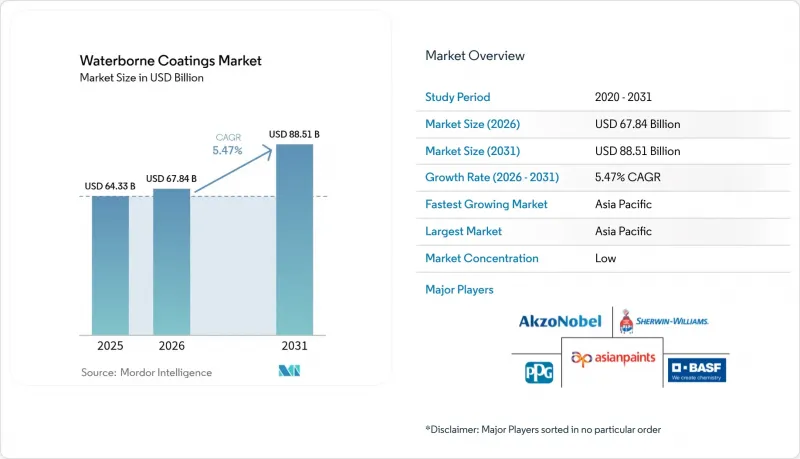
Mordor Intelligence에 의하면, 2026년 수성 도료 시장 규모는 678억 4,000만 달러로 추정되며, 2025년 643억 3,000만 달러에서 2031년에는 885억 1,000만 달러에 달할 것으로 예측됩니다.
또한 2026-2031년 연평균 성장률(CAGR)은 5.47%를 기록할 전망입니다.
본 보고서는 수지 유형(아크릴, 알키드, 에폭시, 폴리우레탄, 폴리에스터, 폴리비닐리덴클로라이드 등), 최종 사용자 산업(건축 및 건설, 자동차, 산업용, 목재, 기타 최종 사용자 산업), 지역(아시아태평양, 북미, 유럽, 남미, 중동 및 아프리카)별로 분류되어 있습니다. 시장 예측은 금액(달러) 기준으로 제시됩니다.
세계 수성 도료 시장 동향 및 인사이트
VOC 규제 및 탈탄소화 규제 강화
캘리포니아주 대기자원국은 산업용 유지보수 분야의 VOC를 50 g/L로 제한하고 있으며, 이는 연방 정부 기준치에 비해 약 10배 더 엄격한 수준입니다. 이에 따라 배합 제조업체들은 접착성, 광택, 내구성 시험을 통과하면서도 초저배출 배합을 개발할 수밖에 없는 상황에 처해 있습니다. 이와 유사한 규제 강화가 캐나다 전역에서도 진행되고 있으며, 2024년 1월 130개 제품 분류에 대한 국가 기준이 발효됨에 따라, 전 세계적으로 통일된 SKU를 보유한 다국적 기업들의 규정 준수 위험이 확대되고 있습니다. 유럽에서는 개정된 REACH 규제 로드맵이 PVC 첨가제 및 오르토프탈산 에스테르를 규제 대상으로 지정함에 따라, PFAS가 포함되지 않은 폴리올의 도입 기간이 단축되고 있습니다. 각 관할 구역이 야심 찬 탈탄소화 지표에 발맞추는 가운데, 대륙을 넘어 단일 수성 사양을 통일할 수 있는 기업은 규정 준수 부담을 줄이고 시장 진입을 가속화할 수 있습니다. 반면, 대응이 늦어진 기업은 파편화된 기존 제품 라인에 얽매이게 될 위험이 있습니다.
아시아 및 아프리카의 급속한 인프라 확충
중국의 경기 부양책에 따른 산업 회복과 인도의 고속도로 및 지하철 확장이 수성 도료 시장 증가분에서 가장 큰 비중을 차지하고 있습니다. GCC(걸프협력회의) 국가들의 건설 프로젝트에는 기후 변화에 대한 배려라는 측면도 더해지고 있습니다. 바레인과 오만에서는 신축 주택의 45% 이상이 속건성이며 저취성인 수성 프라이머로 도장되어 있으며, 지역 건설업체들이 LEED 및 Estidama 인증 획득을 목표로 함에 따라 이 비율은 더욱 확대될 것으로 예측됩니다. 아시아개발은행(ADB)의 ‘2024년 주요 지표’에서는 연간 1조 7,000억 달러에 달하는 인프라 지출에 기후 변화에 대한 내성을 반영할 필요성이 강조되고 있으며, 실내 공기 오염 물질을 최소화한 수성 화학제품이 조달 목록의 최상위로 부상하고 있습니다. 인도네시아에서 케냐에 이르는 회의 논의에 따르면, 기술 컨설턴트들이 병원 및 학교용으로 수성 에폭시 수지를 권장하는 경향이 강해지고 있으며, 장기적인 수요 성장의 하한선을 끌어올리는 확고한 선호도가 확인되고 있습니다.
특수 유변학 첨가제공급 부족과 가격 변동
중량비로 불과 4%에 불과하지만 원자재 비용의 13%를 차지하는 유변학 첨가제는 공급이 부족해지면 전체 생산의 이익률을 크게 좌우합니다. 복잡한 ASE 및 HASE 화학 물질을 둘러싼 제조업체의 통합은 가격 충격을 확대시키고 있습니다. 단일 생산 중단만으로도 전 세계 쿼트톤당 비용이 두 자릿수 비율로 급등할 가능성이 있습니다. 리본형 폴리실리케이트는 저용량에서도 pH 안정성이 높은 유동성을 보장하지만, 광범위한 적합성 시험이 필요하여 혁신 일정을 1년 이상으로 연장하게 됩니다. 당분간 재고 확보가 유일한 헤지 수단이며, 새로운 연구 개발에 투입되어야 할 자금이 묶이게 됩니다.
부문 분석
2025년, 아크릴계 배합 제품은 수성 도료 시장의 80.90%를 차지하고 있으며, 이는 전 세계 건설업체와 DIY 소비자들에게 지지를 받고 있는 자외선 저항성, 색상 유지력, 그리고 비용 효율성이라는 오랜 기간 입증된 특징을 반영한 것입니다. 아크릴 수지를 사용한 수성 도료 시장 규모는 지자체 재도장 프로그램과 DIY 채널의 확대에 힘입어 꾸준히 성장할 것으로 예측됩니다.
폴리우레탄은 시장 규모는 작지만, 자동차 제조업체와 산업용 유지보수 기술자들이 도장 부스에서의 작업 시간을 단축하고 내화학성을 높이기 위해 1액형 수성 화학제품으로 전환하고 있어, 2031년까지 연평균 성장률(CAGR) 5.82%로 성장을 가속화하고 있습니다. 에폭시 수지는 중증 부식 방지 용도에서 여전히 확고한 입지를 유지하고 있지만, PFAS의 단계적 폐지를 위한 노력에 따라, 차단 성능을 유지하기 위해서는 병행된 기술 혁신이 요구되고 있습니다. 알키드 수지는 VOC 과세 압박에 직면해 있지만, 석유계 원료 대신 아젤레인산을 사용한 바이오 유래 대체재 덕분에 숨 돌릴 기회를 얻고 있으며, 익숙한 작업성을 유지하면서 규제 당국의 감시를 완화하고 있습니다.
지역별 분석
아시아태평양은 2025년에 전 세계 매출의 42.40%를 차지할 것으로 예상되며, 2031년까지 시장을 주도하는 5.93%의 연평균 성장률(CAGR)을 유지할 전망으로, 수성 도료 시장의 성장 동력으로서의 입지를 공고히 하고 있습니다. 중국의 경기 부양책으로 산업 생산이 회복되면서 일반 산업용 에나멜 도료의 기초 수요가 확대되고 있는 반면, 인도에서는 콘크리트를 많이 사용하는 스마트 시티 회랑 건설로 인해 엘라스토머계 지붕·교량용 필름 소재에 대한 장기적인 수주가 발생하고 있습니다.
북미에서는 규제 성숙도와 기술적 리더십이 결합되어 있으며, 캘리포니아주의 50g/L 상한 규제로 인해 전미의 SKU가 허용되는 최저 VOC 값을 준수해야만 하는 상황이 발생했고, 이는 유통망 전체로 파급되어 신속한 배합 변경을 촉진하고 있습니다. 캐나다의 전국적인 VOC 규제는 각 주의 제한치를 통일하고 있어, 퀘벡주에서 브리티시컬럼비아주에 이르기까지 규제를 준수하는 수성 제품 라인 시장 진입을 원활하게 하고 있습니다.
유럽은 ‘지속가능성을 위한 화학물질 전략’을 통해 지속가능성 분야의 선도자로 자리매김하고 있으며, 건축, 산업, DIY 각 분야에서 수성 도료의 채택을 가속화하고 있습니다. 영국에서 악소노벨(Akzo Nobel)이 BASF의 기술을 채택한 ‘Dulux Easycare’를 재출시함으로써, 제품 탄소 배출량을 최소 5% 감축하겠다는 공약을 이행하고 있으며, 환경 의식이 높은 소비자들 사이에서 브랜드에 대한 지지를 강화하고 있습니다. 동유럽의 도시화도 판매량 증가를 견인하고 있으며, 특히 EU의 재건 프로그램을 통해 자금을 지원받는 지방 자치단체의 도로 및 철도 개보수 공사에서 두드러지게 나타나고 있습니다.
기타 혜택:
- 엑셀 형식 시장 예측(ME) 시트
- 3개월간의 애널리스트 지원
자주 묻는 질문
목차
제1장 서론
제2장 조사 방법
제3장 주요 요약
제4장 시장 구도
제5장 시장 규모와 성장 예측
제6장 경쟁 구도
제7장 시장 기회와 향후 전망
LSH 26.09.08According to Mordor Intelligence, waterborne coatings market size in 2026 is estimated at USD 67.84 billion, growing from 2025 value of USD 64.33 billion with 2031 projections showing USD 88.51 billion, growing at 5.47% CAGR over 2026-2031.
This report is Segmented by Resin Type (Acrylic, Alkyd, Epoxy, Polyurethane, Polyester, Polyvinylidene Chloride, and More), End-User Industry (Building and Construction, Automotive, Industrial, Wood, and Other End-User Industries), and Geography (Asia-Pacific, North America, Europe, South America, and Middle-East and Africa). The Market Forecasts are Provided in Terms of Value (USD).
Global Waterborne Coatings Market Trends and Insights
Stricter VOC and Decarbonization Mandates
California's Air Resources Board restricts industrial-maintenance VOCs to 50 g/L, nearly a ten-fold tightening against federal thresholds, forcing formulators to engineer ultra-low emission blends that still pass adhesion, gloss, and durability tests. Similar tightening unfolds across Canada, where national limits on 130 product classes took effect in January 2024 and extend compliance risk for multinationals with globally harmonized SKUs. In Europe, the updated REACH Restrictions Roadmap targets PVC additives and ortho-phthalates, compressing the adoption window for PFAS-free polyols. As jurisdictions converge on ambitious decarbonization metrics, companies able to harmonize one waterborne specification across continents will lower compliance overhead and speed market entry, leaving laggards boxed into fragmented legacy lines.
Rapid Infrastructure Buildouts in Asia and Africa
China's stimulus-driven industrial revival and India's highway and metro expansions underpin the largest share of incremental liters for the waterborne coatings market. GCC construction pipelines add a climatic angle: quick-drying, low-odor waterborne primers now coat more than 45% of new residential stock in Bahrain and Oman, a share expected to widen as regional contractors chase LEED and Estidama credentials. The Asian Development Bank's 2024 Key Indicators emphasize that USD 1.7 trillion annual infrastructure spending must integrate climate resilience, thrusting waterborne chemistries with minimal indoor-air pollutants to the top of procurement lists. Conference dialogues from Indonesia to Kenya indicate that technical consultants increasingly recommend water-based epoxies for hospitals and schools, confirming an entrenched preference that raises the floor for long-run demand growth.
Scarcity and Price Volatility of Specialty Rheology Additives
Rheology packages, barely 4% by weight yet 13% of raw-material spend, swing overall production margins when supply tightens. Producer consolidation around complex ASE and HASE chemistries magnifies price shocks; a single outage can inflate global quarti-ton costs by double digits. Ribbon polysilicates promise pH-stable flow at lower dosages but need extensive compatibility trials, stretching innovation timelines to one year or more. Interim stock buffers remain the only hedge, locking capital that could fund new research and development.
Other drivers and restraints analyzed in the detailed report include:
- OEM One-Component Conversion from Solvent to Water Systems
- Bio-Based Resin Breakthroughs
- PFAS-Free Performance Gap for Extreme Anticorrosion
For complete list of drivers and restraints, kindly check the Table Of Contents.
Segment Analysis
Acrylic formulations anchored 80.90% of the waterborne coatings market in 2025, reflecting a time-tested blend of UV resistance, color retention, and cost efficiency that builders and DIY consumers favor worldwide. The waterborne coatings market size for acrylic resins is projected to expand steadily, supported by municipal repaint programs and widening do-it-yourself channels.
Polyurethane, though a smaller base, is accelerating at 5.82% CAGR to 2031 as vehicle makers and industrial-maintenance engineers shift to one-component waterborne chemistries that cut booth times and raise chemical resistance. Epoxies retain their foothold in heavy anticorrosive service, though PFAS exit paths demand parallel innovation to sustain barrier metrics. Alkyds, squeezed by VOC levies, find reprieve in bio-sourced variants that swap azelaic acid for petroleum feedstocks, easing regulatory scrutiny while keeping familiar workability.
Complete Report Scope:
- By Resin Type
- Acrylic
- Alkyd
- Epoxy
- Polyurethane
- Polyester
- Polyvinylidene Chloride (PVDC)
- Polyvinylidene Fluoride (PVDF)
- Other Resin Types
- By End-user Industry
- Building and Construction
- Automotive
- Industrial
- Wood
- Other End-user Industries
- By Geography
- Asia-Pacific
- China
- India
- Japan
- South Korea
- Southeast Asia
- Rest of Asia-Pacific
- North America
- United States
- Canada
- Mexico
- Europe
- Germany
- United Kingdom
- France
- Italy
- Russia
- Rest of Europe
- South America
- Brazil
- Argentina
- Rest of South America
- Middle-East and Africa
- Saudi Arabia
- United Arab Emirates
- South Africa
- Egypt
- Rest of Middle-East and Africa
- Asia-Pacific
Geography Analysis
Asia-Pacific commanded 42.40% of global revenue in 2025 and is on track for a market-leading 5.93% CAGR to 2031, cementing its position as the growth engine for the waterborne coatings market. China's stimulus packages revive industrial output, expanding baseline demand for general-industrial enamels, while India's concrete-intensive smart-city corridors open long-haul orders for elastomeric roof and bridge membranes.
North America reflects regulatory maturity mixed with technology leadership. California's 50 g/L cap forces nationwide SKUs to align at the lowest permissible VOC, rippling through distribution chains and spurring rapid reformulation. Canada's national VOC rulebook harmonizes provincial limits, smoothing market access for compliant waterborne lines from Quebec to British Columbia.
Europe remains a sustainability trend-setter through the Chemicals Strategy for Sustainability, accelerating waterborne adoption across architectural, industrial, and DIY shelves. AkzoNobel's BASF-enabled Dulux Easycare relaunch in the UK advances its pledge to cut product carbon by 5% minimum, strengthening brand pull among eco-conscious shoppers. Eastern-European urbanization also drives incremental liters, especially in municipal road and rail renovations funded by EU recovery programs.
- Akzo Nobel N.V.
- Arkema
- Asian Paints Ltd.
- Axalta Coating Systems, LLC
- BASF
- Benjamin Moore & Co.
- Berger Paints India
- Chokwang Paint
- Dow
- Hempel A/S
- Jotun
- Kansai Paint Co., Ltd.
- KCC Corporation
- Masco Corporation
- Nippon Paint Holdings Co., Ltd.
- PPG Industries, Inc.
- RPM International Inc.
- Sika AG
- Teknos Group
- Tenaris
- The Sherwin-Williams Company
- Tikkurila
Additional Benefits:
- The market estimate (ME) sheet in Excel format
- 3 months of analyst support
TABLE OF CONTENTS
1 Introduction
- 1.1 Study Assumptions and Market Definition
- 1.2 Scope of the Study
2 Research Methodology
3 Executive Summary
4 Market Landscape
- 4.1 Market Overview
- 4.2 Market Drivers
- 4.2.1 Stricter VOC and Decarbonization Mandates
- 4.2.2 Rapid Infrastructure Buildouts in Asia and Africa
- 4.2.3 OEM One-Component Conversion from Solvent to Water Systems
- 4.2.4 Bio-Based Resin Breakthroughs (eg, Lignin, Algae)
- 4.2.5 Smart Factory Demand for Low-Temperature Cure Lines
- 4.3 Market Restraints
- 4.3.1 Scarcity and Price Volatility of Specialty Rheology Additives
- 4.3.2 Humidity-Related Drying Defects in Tropical Regions
- 4.3.3 PFAS-Free Performance Gap for Extreme Anticorrosion
- 4.4 Value Chain Analysis
- 4.5 Porter's Five Forces
- 4.5.1 Bargaining Power of Suppliers
- 4.5.2 Bargaining Power of Buyers
- 4.5.3 Threat of New Entrants
- 4.5.4 Threat of Substitutes
- 4.5.5 Degree of Competition
5 Market Size and Growth Forecasts (Value)
- 5.1 By Resin Type
- 5.1.1 Acrylic
- 5.1.2 Alkyd
- 5.1.3 Epoxy
- 5.1.4 Polyurethane
- 5.1.5 Polyester
- 5.1.6 Polyvinylidene Chloride (PVDC)
- 5.1.7 Polyvinylidene Fluoride (PVDF)
- 5.1.8 Other Resin Types
- 5.2 By End-user Industry
- 5.2.1 Building and Construction
- 5.2.2 Automotive
- 5.2.3 Industrial
- 5.2.4 Wood
- 5.2.5 Other End-user Industries
- 5.3 By Geography
- 5.3.1 Asia-Pacific
- 5.3.1.1 China
- 5.3.1.2 India
- 5.3.1.3 Japan
- 5.3.1.4 South Korea
- 5.3.1.5 Southeast Asia
- 5.3.1.6 Rest of Asia-Pacific
- 5.3.2 North America
- 5.3.2.1 United States
- 5.3.2.2 Canada
- 5.3.2.3 Mexico
- 5.3.3 Europe
- 5.3.3.1 Germany
- 5.3.3.2 United Kingdom
- 5.3.3.3 France
- 5.3.3.4 Italy
- 5.3.3.5 Russia
- 5.3.3.6 Rest of Europe
- 5.3.4 South America
- 5.3.4.1 Brazil
- 5.3.4.2 Argentina
- 5.3.4.3 Rest of South America
- 5.3.5 Middle-East and Africa
- 5.3.5.1 Saudi Arabia
- 5.3.5.2 United Arab Emirates
- 5.3.5.3 South Africa
- 5.3.5.4 Egypt
- 5.3.5.5 Rest of Middle-East and Africa
- 5.3.1 Asia-Pacific
6 Competitive Landscape
- 6.1 Market Concentration
- 6.2 Strategic Moves
- 6.3 Market Share Analysis
- 6.4 Company Profiles (includes Global level Overview, Market level overview, Core Segments, Financials as available, Strategic Information, Market Rank/Share for key companies, Products and Services, and Recent Developments)
- 6.4.1 Akzo Nobel N.V.
- 6.4.2 Arkema
- 6.4.3 Asian Paints Ltd.
- 6.4.4 Axalta Coating Systems, LLC
- 6.4.5 BASF
- 6.4.6 Benjamin Moore & Co.
- 6.4.7 Berger Paints India
- 6.4.8 Chokwang Paint
- 6.4.9 Dow
- 6.4.10 Hempel A/S
- 6.4.11 Jotun
- 6.4.12 Kansai Paint Co., Ltd.
- 6.4.13 KCC Corporation
- 6.4.14 Masco Corporation
- 6.4.15 Nippon Paint Holdings Co., Ltd.
- 6.4.16 PPG Industries, Inc.
- 6.4.17 RPM International Inc.
- 6.4.18 Sika AG
- 6.4.19 Teknos Group
- 6.4.20 Tenaris
- 6.4.21 The Sherwin-Williams Company
- 6.4.22 Tikkurila
7 Market Opportunities and Future Outlook
- 7.1 White-space and Unmet-need Assessment


