
|
시장보고서
상품코드
2120681
자궁암 치료 및 진단 : 시장 점유율 분석, 업계 동향 및 통계, 성장 예측(2026-2031년)Uterine Cancer Therapeutics And Diagnostics - Market Share Analysis, Industry Trends & Statistics, Growth Forecasts (2026 - 2031) |
||||||
 Mordor Intelligence
자궁암 치료 및 진단 시장 규모는 2026년에 259억 9,000만 달러로 추정되고 2025년 244억 6,000만 달러에서 확대해, 2031년에는 351억 9,000만 달러에 이를 것으로 예측됩니다.
2026년부터 2031년까지의 연평균 성장률(CAGR)은 6.26%가 될 것으로 전망됩니다.
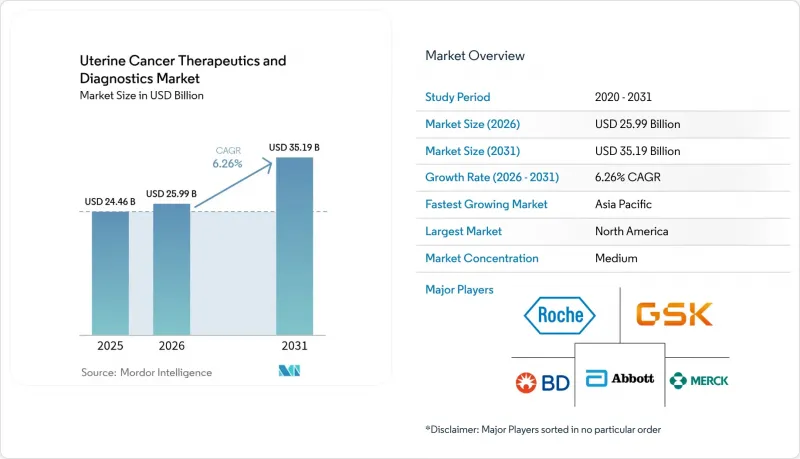
본 보고서는 암의 유형(자궁내막 선암, 선편평상피암, 유두상 장액성 암 등), 제품(치료제(수술 등) 및 진단제), 최종 사용자(병원 및 진료소, 전문 암 센터 등), 지역(북미, 유럽, 아시아태평양 등)별로 분류되어 있습니다. 시장 전망은 금액(달러) 기준으로 제시되어 있습니다.
세계의 자궁암 치료 및 진단 시장 동향 및 인사이트
비만과 관련된 자궁내막 선암 유병률 증가
체질량지수(BMI) 데이터에 따르면, BMI가 5 kg/m² 증가할 때마다 에스트로겐 매개 경로를 통해 자궁내막암의 위험이 높아지는 것으로 밝혀졌습니다. 비알코올성 지방간 질환은 20-39세 여성의 경우 위험을 더욱 높이며, 젊은 층에서의 발병을 가속화하고 있습니다. TMEM205 및 STAT5와 같은 종양 촉진성 세포외 소포 단백질이 이중 바이오마커 및 치료 표적으로 부상하면서, 제약 파이프라인을 대사학 및 종양학의 결합 방향으로 이끌고 있습니다. 이러한 추세에 따라 선암은 대사성 질환으로 재정의되고 있으며, 종양 억제뿐만 아니라 인슐린 저항성까지 다루는 통합적인 치료 요법이 요구되고 있습니다. 그 결과, 자궁암 치료 및 진단 시장은 진단 건수 증가와 치료 기간 연장의 혜택을 누리고 있습니다.
1차 치료법 또는 유지 요법으로서의 면역요법 채택 확대
2024년 미국에서 도스탈리맙의 적응증 확대 승인을 통해 바이오마커에 의존하지 않는 집단에 대한 면역 체크포인트 억제 요법의 유효성이 입증되었으며, 지속적인 생존율의 기준이 확립되었습니다. RUBY 임상시험에서 확인된 44.6개월의 전체 생존 기간 중앙값은 과거 대조군을 능가하는 성과를 보여주었으며, 고가의 치료 요법에 대한 보험사의 수용을 가속화했습니다. 그로부터 몇 주 후, 펨브롤리주맙과 카보플라틴·파클리탁셀 병용 요법도 승인되면서, 규제 당국이 1차 치료법으로서 면역요법으로의 전환을 지지하고 있음이 부각되었습니다. 유지 요법 프로토콜에 따라 투여 주기가 연장되어 환자 1인당 평생 수익이 확대됨과 동시에, PD-1/PD-L1 억제제의 선도 기업들의 경쟁 우위가 더욱 강화되고 있습니다. 신흥 시장의 수입 장벽이 완화됨에 따라 전 세계적인 보급은 급속히 확대될 전망입니다.
ICI와 표적 치료제의 병용 요법 비용 부담
비용-효과 분석에 따르면, 듀르발맙을 포함한 병용 요법의 질 조정 생존년(QALY)당 증분 비율은 15만 달러를 초과하여, 기존 지불 기관이 설정한 기준치를 상회하고 있습니다. 중저소득 국가에서는 발병률이 증가하고 있음에도 불구하고 면역요법의 보급이 더뎌지고 있어 경제적 부담의 격차가 확대되고 있습니다. 전 세계 종양학 분야 지출은 2023년에 2,230억 달러에 달했고, 2028년까지 4,090억 달러로 급증할 것으로 예측되어, 이에 따라 보험사들은 가치 기반 계약을 요구하고 있습니다. 2029년까지 250억 달러 규모에 달할 것으로 예상되는 바이오시밀러 파이프라인은 접근성을 높이는 한편, 이익률을 압박할 가능성이 있습니다. 제약사들은 비용에 민감한 지역에서 시장 침투를 확보하기 위해 단계적 가격 책정 및 위험 분담 계약 도입을 모색하고 있습니다.
부문별 분석
자궁내막선암은 자궁암 치료 및 진단 시장의 2025년 매출의 54.02%를 차지했으며, 이는 높은 발병률과 다각적인 치료에 대한 의존도를 반영합니다. 면역요법과 표적요법을 결합한 병용 요법이 1차 선택 표준 치료법이 되면서 치료 기간이 연장되고, 처방량은 두 자릿수 성장세를 유지하고 있습니다. 비만과 대사증후군으로 인해 환자층이 지속적으로 확대되고 있으며, 이로 인해 선암 시장 점유율 우위가 더욱 강화되고 있습니다. AI를 활용한 조직병리학을 통해 p53abn형 NSMP 선암의 검출이 가능해졌으며, 생존 기간을 연장하는 보다 적극적인 보조 요법 전략이 실현되고 있습니다. 전자 차트에 통합된 유전체 분류 도구는 맞춤형 치료 프로토콜의 선정을 가속화하여, 진단까지 소요되는 시간을 수 주에서 수일로 단축시키고 있습니다.
자궁육종은 환자 수가 적음에도 불구하고 2031년까지 연평균 성장률(CAGR) 9.11%로 해당 부문의 성장을 주도하고 있습니다. 셀리넥솔과 엘리브린의 병용 요법 등 획기적인 발전으로 평활근육종의 신약 파이프라인이 활성화되었으며, 멀티오믹스 바이오마커 패널을 통해 치료 대상이 될 수 있는 TP53 또는 ATRX의 변이가 특정되고 있습니다. FIGO 2023년 병기 분류의 전면적인 재검토를 통해 암 육종의 예후 정확도가 향상되었으며, 환자 계층화가 더욱 정교해졌습니다. 정밀 의학의 도입으로 임상시험 참가자가 확대되었고, 그 결과 규제 승인 절차가 가속화되고 있습니다. 그 결과, 벤처 자금은 기존에 치료 저항성이었던 종양에도 침투할 수 있는 육종 특이적 생물학적 제제나 의약품 및 의료기기 하이브리드 제품으로 이동하고 있습니다.
지역별 분석
2025년, 북미는 자궁암 치료 및 진단 시장에서 매출의 44.85%를 차지하며 시장을 주도했습니다. 이는 종합적인 보험 적용 범위, 견고한 임상시험 인프라, 그리고 체크포인트 억제제의 급속한 보급에 힘입은 결과입니다. 발병률 상승(2050년까지 급증할 것으로 예측됨)에 따라 ‘Cancer Moonshot’과 같은 공중보건 대책이 시행되고 있으며, 해당 프로그램에서는 의료 서비스가 미치지 못하는 지역사회를 위한 선별 검사 프로그램에 자금이 지원되고 있습니다. 흑인 여성의 사망률은 여전히 백인 여성의 약 3배 수준이며, GSK의 인식 제고 캠페인이나 지역 밀착형 임상시험 거점 등 격차 해소를 위한 업계의 노력이 진행되고 있습니다. 학술 기관에서는 AI를 활용한 병리 진단 및 액체 생검 도구를 도입하여 진단까지 걸리는 기간을 단축하고 있습니다. 높은 가격 책정에도 불구하고 보험 환급 상황은 양호하며, 바이오시밀러의 진입에 따른 가격 하락 압력은 현시점에서는 보이지 않습니다.
아시아태평양은 중산층의 확대, 보험 가입률 향상, 의료 인프라 정비를 원동력으로 연평균 성장률(CAGR) 10.42%를 나타낼 것으로 예측됩니다. 중국 내 부인과 암 부담은 현재 선진국 수준에 도달해 있으며, 상당한 규모의 잠재 환자층이 존재합니다. ‘코어 플러스’의 암 관련 자산에 대한 사모펀드 투자로 인해, 선형 가속기 및 면역요법 투여실을 갖춘 3차 의료 센터의 건설이 가속화되고 있습니다. 원격의료 및 재택 병원 프로그램을 통해 인도네시아, 태국, 인도 전역에서 전문 의료에 대한 접근성이 확대되고 있습니다. 이와 동시에 각국의 규제 당국은 ICH 가이드라인 준수를 추진하고 있어, 다국적 기업의 임상시험 승인을 신속히 처리함으로써 신약 시장 출시까지 소요되는 기간을 단축하고 있습니다.
유럽은 혁신과 비용 절감의 균형을 유지하면서 성숙해 가면서도 계속 진화하는 시장입니다. 가치 기반 조달 제도가 보험 적용 의약품 선정에 영향을 미치며, 제약사들은 가격과 치료 성과 지표를 연계하도록 압박받고 있습니다. 2024년에는 유럽 전역에 걸친 의료용 방사성 동위원소 부족으로 인해 근접 방사선 치료 일정에 차질이 발생했습니다. 이에 따라 국내 공급을 확보하기 위해 웨일스에 4억 달러 규모의 악티늄-225 제조 시설을 건설하는 계획 등이 제안되고 있습니다. 정밀 의학의 의무화로 분자진단의 보급이 가속화되고 있으며, 독일과 스칸디나비아 국가의 보험사는 ctDNA에 기반한 미세 잔류 병변 검사 비용을 보상하고 있습니다. 동유럽 국가들은 이를 따라잡는 단계에 있으며, EU의 구조 기금을 활용하여 종양 센터의 현대화를 추진하고 있습니다.
중동 및 아프리카, 남미는 전반적으로 장기적인 성장 잠재력을 지니고 있으나, 보상 제도나 인프라 측면의 과제에 직면해 있습니다. 걸프협력회의(GCC) 회원국들은 해외로 유출되는 의료 관광을 막기 위해 최첨단 방사선 치료 및 로봇 수술 시스템을 도입하고 있습니다. 남아프리카의 보험사는 자궁내막암을 대상으로 한 종합적 지급 프로그램을 시범 도입하고 있는 반면, 브라질의 병원 네트워크에서는 방사선과 의사 부족을 완화하기 위해 AI 초음파 플랫폼을 도입하고 있습니다. 이 지역에서의 도입 진척도는 거시경제의 안정성과 국민건강보험 제도의 확대에 달려 있습니다.
기타 혜택 :
- 엑셀 형식 시장 예측(ME) 시트
- 3개월간의 애널리스트 지원
자주 묻는 질문
목차
제1장 서론
제2장 조사 방법
제3장 주요 요약
제4장 시장 구도
제5장 시장 규모 및 성장 예측
제6장 경쟁 구도
제7장 시장 기회 및 향후 전망
KTH 26.09.04According to Mordor Intelligence, the uterine cancer therapeutics & diagnostics market size in 2026 is estimated at USD 25.99 billion, growing from 2025 value of USD 24.46 billion with 2031 projections showing USD 35.19 billion, growing at 6.26% CAGR over 2026-2031.
This report is Segmented by Cancer Type (Endometrial Adenocarcinoma, Adenosquamous Carcinoma, Papillary Serous Carcinoma, and More), Product (Therapeutics [Surgery and More] and Diagnostics), End User (Hospitals & Clinics, Specialty Cancer Centers, and More), and Geography (North America, Europe, Asia-Pacific, and More). The Market Forecasts are Provided in Terms of Value (USD).
Global Uterine Cancer Therapeutics And Diagnostics Market Trends and Insights
Rising Prevalence of Obesity-Linked Endometrial Adenocarcinoma
Body-mass-index data reveal that every 5 kg/m2 increase raises endometrial cancer risk through estrogen-driven pathways. Non-alcoholic fatty-liver disease further multiplies risk among women aged 20-39, intensifying disease onset in younger cohorts. Tumor-promoting extracellular vesicle proteins such as TMEM205 and STAT5 have emerged as dual biomarkers and therapeutic targets, steering pharmaceutical pipelines toward metabolic-oncology combinations. The trend reframes adenocarcinoma as a metabolic disorder, prompting integrated treatment regimens that tackle insulin resistance alongside tumor suppression. Consequently, the uterine cancer therapeutics & diagnostics market benefits from higher diagnosis volumes and extended treatment durations.
Growing Adoption of Immunotherapy as First-Line or Maintenance Therapy
Dostarlimab's 2024 U.S. label expansion validated immune checkpoint blockade for biomarker-agnostic populations and established durable survival benchmarks. Median overall survival of 44.6 months in the RUBY trial outperformed historical controls, accelerating payer acceptance for premium-priced regimens. Pembrolizumab plus carboplatin-paclitaxel secured approval weeks later, underscoring a regulator-endorsed shift to first-line immunotherapy. Maintenance protocols extend dosing cycles, expanding lifetime revenue per patient and reinforcing the competitive moat for PD-1/PD-L1 innovators. As emerging markets relax import barriers, global uptake is set to scale rapidly.
High Cost of Combination ICI + Targeted-Therapy Regimens
Cost-effectiveness analyses report incremental ratios above USD 150,000 per quality-adjusted life-year for durvalumab combinations, breaching conventional payer thresholds. Affordability gaps widen in low-middle-income countries, where immunotherapy penetration lags despite rising incidence. Global oncology spending reached USD 223 billion in 2023 and is forecast to jump to USD 409 billion by 2028, prompting insurers to demand value-based contracts. Biosimilar pipelines worth USD 25 billion by 2029 could ease access but compress margins. Manufacturers are testing tiered pricing and risk-sharing agreements to safeguard uptake in cost-sensitive regions.
Other drivers and restraints analyzed in the detailed report include:
- Increasing Awareness & Screening Initiatives in High-Risk Populations
- Launch of AI-Enabled Diagnostic Imaging Platforms
- Low Historical Clinical-Trial Success Rates in Uterine Sarcoma
For complete list of drivers and restraints, kindly check the Table Of Contents.
Segment Analysis
Endometrial adenocarcinoma generated 54.02% of 2025 revenue in the uterine cancer therapeutics & diagnostics market, reflecting its high incidence and reliance on multimodal therapy. Combination regimens pairing immunotherapy with targeted agents have become front-line standards, prolonging treatment courses and sustaining double-digit prescription volumes. Obesity and metabolic syndrome continue to enlarge the patient pool, reinforcing adenocarcinoma's share dominance. AI-assisted histopathology now detects p53abn-like NSMP adenocarcinomas, enabling more aggressive adjuvant strategies that lengthen survival windows. Genomic classifiers integrated into electronic health records accelerate personalized protocol selection, trimming diagnostic turnaround times from weeks to days.
Uterine sarcoma, while representing a smaller cohort, leads segment growth at a 9.11% CAGR through 2031. Breakthroughs such as selinexor-eribulin combinations have revitalized drug pipelines for leiomyosarcoma, and multi-omics biomarker panels identify actionable TP53 or ATRX mutations. The FIGO 2023 staging overhaul improves prognostic accuracy for carcinosarcomas, sharpening patient stratification. Precision-therapy roll-outs broaden clinical-trial enrollment, which in turn accelerates regulatory pathways. Consequently, venture funding is shifting toward sarcoma-specific biologics and drug-device hybrids that can penetrate historically refractory tumors.
Complete Report Scope:
- By Cancer Type
- Endometrial Adenocarcinoma
- Adenosquamous Carcinoma
- Papillary Serous Carcinoma
- Uterine Sarcoma
- Clear Cell Carcinoma
- Others
- By Product
- Therapeutics
- Surgery
- Radiation Therapy
- Chemotherapy
- Immunotherapy
- Targeted Therapy
- Hormone Therapy
- Others
- Diagnostics
- Imaging (Ultrasound, CT, MRI, PET)
- Biopsy (Aspiration, Core Needle, D&C)
- Hysteroscopy
- Liquid Biopsy (ctDNA)
- Genomic & Molecular Tests
- Pap Smear / Cytology
- Others
- Therapeutics
- By End User
- Hospitals & Clinics
- Specialty Cancer Centers
- Diagnostic Laboratories
- Research Institutes
- Ambulatory Surgical Centers
- Geography
- North America
- United States
- Canada
- Mexico
- Europe
- Germany
- United Kingdom
- France
- Italy
- Spain
- Rest of Europe
- Asia-Pacific
- China
- Japan
- India
- South Korea
- Australia
- Rest of Asia-Pacific
- Middle East and Africa
- GCC
- South Africa
- Rest of Middle East and Africa
- South America
- Brazil
- Argentina
- Rest of South America
- North America
Geography Analysis
North America led the uterine cancer therapeutics & diagnostics market with 44.85% revenue in 2025, underpinned by sophisticated insurance coverage, robust clinical-trial infrastructure, and rapid adoption of checkpoint inhibitors. Rising incidence-projected to spike by 2050-has prompted public health responses such as the Cancer Moonshot, which funds screening programs for underserved communities. Black women's mortality remains nearly three times that of white women, steering industry initiatives toward disparity mitigation, including GSK's awareness campaign and community-based trial sites. Academic centers deploy AI-powered pathology and liquid-biopsy tools to shorten diagnostic timelines. Despite premium pricing, reimbursement remains favorable, and biosimilar entrants are yet to exert downward pressure.
Asia-Pacific is forecast to advance at a 10.42% CAGR, driven by expanding middle-class populations, improved insurance penetration, and healthcare-infrastructure upgrades. China's gynecologic cancer burden now mirrors that of developed economies, presenting a sizable addressable cohort. Private-equity investment in "core-plus" cancer assets accelerates construction of tertiary-level centers equipped with linear accelerators and immunotherapy infusion suites. Telehealth and hospital-at-home programs widen access to specialist care across Indonesia, Thailand, and India. In parallel, local regulators are aligning with ICH guidelines, expediting multinational trial approvals and enhancing time-to-market for novel agents.
Europe remains a mature yet evolving market that balances innovation with cost containment. Value-based procurement shapes formulary inclusion, pushing manufacturers to link price with outcome metrics. A continental shortage of medical radioisotopes disrupted brachytherapy schedules in 2024, instigating projects such as a proposed USD 400 million actinium-225 facility in Wales to secure domestic supply. Precision-medicine mandates propel uptake of molecular diagnostics, with German and Scandinavian payers reimbursing ctDNA-based minimal-residual-disease tests. Eastern European nations follow a catch-up curve, leveraging EU structural funds to modernize oncology centers.
The Middle East, Africa, and South America collectively offer long-run upside but face reimbursement and infrastructure hurdles. Gulf Cooperation Council states procure leading-edge radiotherapy and robotic-surgery systems, aiming to reverse outbound medical tourism. South African insurers pilot bundled-payment programs for endometrial cancer, whereas Brazilian hospital networks integrate AI-ultrasound platforms to alleviate radiologist shortages. The regions' adoption trajectory depends on macroeconomic stability and expansion of universal health-coverage schemes.
- Merck
- Roche
- GlaxoSmithKline
- Novartis
- Abbott Laboratories
- Beckton Dickinson
- Siemens Healthineers
- Hologic
- Boston Scientific
- Intuitive Surgical
- AstraZeneca
- Pfizer
- Eisai
- Bristol-Myers Squibb
- Regeneron Pharmaceuticals
- Illumina
- Myriad Genetics
- Thermo Fisher Scientific
- Daiichi Sankyo
- Clovis Oncology Inc.
Additional Benefits:
- The market estimate (ME) sheet in Excel format
- 3 months of analyst support
TABLE OF CONTENTS
1 Introduction
- 1.1 Study Assumptions & Market Definition
- 1.2 Scope of the Study
2 Research Methodology
3 Executive Summary
4 Market Landscape
- 4.1 Market Overview
- 4.2 Market Drivers
- 4.2.1 Rising Prevalence Of Obesity-Linked Endometrial Adenocarcinoma
- 4.2.2 Growing Adoption Of Immunotherapy As First-Line Or Maintenance Therapy
- 4.2.3 Increasing Awareness & Screening Initiatives In High-Risk Populations
- 4.2.4 Launch Of AI-Enabled Diagnostic Imaging Platforms
- 4.2.5 Commercialisation Of Ctdna-Based Minimal-Residual-Disease Tests
- 4.2.6 Novel Intratumoural Micro-Injectors Improving Local Drug Delivery
- 4.3 Market Restraints
- 4.3.1 High Cost Of Combination ICI + Targeted-Therapy Regimens
- 4.3.2 Low Historical Clinical-Trial Success Rates In Uterine Sarcoma
- 4.3.3 Limited Reimbursement For Advanced Molecular Diagnostics In Lmics
- 4.3.4 Supply-Chain Bottlenecks For Radio-Isotopes Used In Brachytherapy
- 4.4 Technological Outlook
- 4.5 Porter's Five Forces
- 4.5.1 Threat of New Entrants
- 4.5.2 Bargaining Power of Buyers
- 4.5.3 Bargaining Power of Suppliers
- 4.5.4 Threat of Substitutes
- 4.5.5 Intensity of Competitive Rivalry
5 Market Size & Growth Forecasts (Value, USD)
- 5.1 By Cancer Type
- 5.1.1 Endometrial Adenocarcinoma
- 5.1.2 Adenosquamous Carcinoma
- 5.1.3 Papillary Serous Carcinoma
- 5.1.4 Uterine Sarcoma
- 5.1.5 Clear Cell Carcinoma
- 5.1.6 Others
- 5.2 By Product
- 5.2.1 Therapeutics
- 5.2.1.1 Surgery
- 5.2.1.2 Radiation Therapy
- 5.2.1.3 Chemotherapy
- 5.2.1.4 Immunotherapy
- 5.2.1.5 Targeted Therapy
- 5.2.1.6 Hormone Therapy
- 5.2.1.7 Others
- 5.2.2 Diagnostics
- 5.2.2.1 Imaging (Ultrasound, CT, MRI, PET)
- 5.2.2.2 Biopsy (Aspiration, Core Needle, D&C)
- 5.2.2.3 Hysteroscopy
- 5.2.2.4 Liquid Biopsy (ctDNA)
- 5.2.2.5 Genomic & Molecular Tests
- 5.2.2.6 Pap Smear / Cytology
- 5.2.2.7 Others
- 5.2.1 Therapeutics
- 5.3 By End User
- 5.3.1 Hospitals & Clinics
- 5.3.2 Specialty Cancer Centers
- 5.3.3 Diagnostic Laboratories
- 5.3.4 Research Institutes
- 5.3.5 Ambulatory Surgical Centers
- 5.4 Geography
- 5.4.1 North America
- 5.4.1.1 United States
- 5.4.1.2 Canada
- 5.4.1.3 Mexico
- 5.4.2 Europe
- 5.4.2.1 Germany
- 5.4.2.2 United Kingdom
- 5.4.2.3 France
- 5.4.2.4 Italy
- 5.4.2.5 Spain
- 5.4.2.6 Rest of Europe
- 5.4.3 Asia-Pacific
- 5.4.3.1 China
- 5.4.3.2 Japan
- 5.4.3.3 India
- 5.4.3.4 South Korea
- 5.4.3.5 Australia
- 5.4.3.6 Rest of Asia-Pacific
- 5.4.4 Middle East and Africa
- 5.4.4.1 GCC
- 5.4.4.2 South Africa
- 5.4.4.3 Rest of Middle East and Africa
- 5.4.5 South America
- 5.4.5.1 Brazil
- 5.4.5.2 Argentina
- 5.4.5.3 Rest of South America
- 5.4.1 North America
6 Competitive Landscape
- 6.1 Market Concentration
- 6.2 Market Share Analysis
- 6.3 Company Profiles (includes Global level Overview, Market level overview, Core Segments, Financials as available, Strategic Information, Market Rank/Share for key companies, Products & Services, and Recent Developments)
- 6.3.1 Merck & Co., Inc.
- 6.3.2 F. Hoffmann-La Roche AG
- 6.3.3 GSK plc
- 6.3.4 Novartis AG
- 6.3.5 Abbott Laboratories
- 6.3.6 Becton, Dickinson and Company
- 6.3.7 Siemens Healthineers AG
- 6.3.8 Hologic Inc.
- 6.3.9 Boston Scientific Corporation
- 6.3.10 Intuitive Surgical Inc.
- 6.3.11 AstraZeneca plc
- 6.3.12 Pfizer Inc.
- 6.3.13 Eisai Co., Ltd.
- 6.3.14 Bristol-Myers Squibb Company
- 6.3.15 Regeneron Pharmaceuticals Inc.
- 6.3.16 Illumina Inc.
- 6.3.17 Myriad Genetics Inc.
- 6.3.18 Thermo Fisher Scientific Inc.
- 6.3.19 Daiichi Sankyo Company Ltd.
- 6.3.20 Clovis Oncology Inc.
7 Market Opportunities & Future Outlook
- 7.1 White-space & Unmet-Need Assessment