|
시장보고서
상품코드
2120716
위조 방지 포장 : 시장 점유율 분석, 업계 동향과 통계, 성장 예측(2026-2031년)Anti-Counterfeit Packaging - Market Share Analysis, Industry Trends & Statistics, Growth Forecasts (2026 - 2031) |
||||||
 Mordor Intelligence
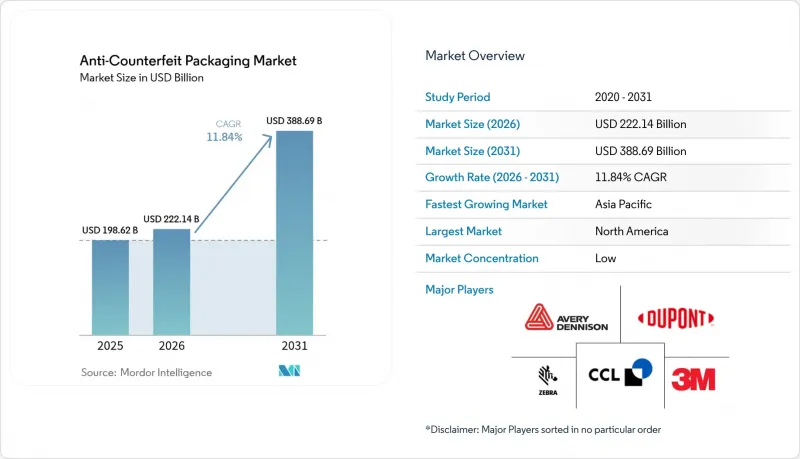
Mordor Intelligence에 의하면, 2026년 위조 방지 포장 시장 규모는 2,221억 4,000만 달러로 추정되며, 2025년 1,986억 2,000만 달러에서 2031년에는 3,886억 9,000만 달러에 달할 것으로 예측됩니다.
또한 2026-2031년 연평균 성장률(CAGR) 11.84%를 기록하며 성장할 것으로 전망됩니다.
본 보고서는 기술별(추적·추적 기능 등), 용도별(일련번호 코드 등), 포장 부품별(라벨·태그, 보안 잉크·코팅 등), 포장 형태별(블리스터 팩 등), 최종 사용자 산업별(식품 및 음료, 헬스케어 및 의약품 등), 지역별로 분류되어 있습니다. 시장 전망은 금액(달러) 기준으로 제시되어 있습니다.
세계 위조 방지 포장 시장 동향 및 인사이트
전자상거래의 급속한 확장에 따른 일련번호 부여 수요의 급증
온라인 판매의 급증으로 유통망이 단축되고 물리적 검사 지점이 제거됨에 따라, 각 브랜드는 모든 소포에 개별 수준의 디지털 식별자를 포함시켜야만 하는 상황에 처해 있습니다. Avery Dennison과 미국의 식료품 체인점에서 실시한 RFID 시범 테스트에서는 99% 이상의 정확도로 스캔이 이루어졌으며, 일련번호가 부여된 데이터 흐름이 재고 회전율과 위조품 감지 모두를 개선한다는 것이 확인되었습니다. 클라우드 대시보드는 현재 주문 이행 앱에 통합되어 있으므로, 소매업체는 라스트 마일 배송 전에 위조 의심 상품을 차단하여 소비자의 신뢰를 유지할 수 있습니다. 이러한 추세에 따라 설비 투자 우선순위가 장식적 마감 처리에서 주문형 인쇄 지원 코더로 이동하고 있으며, 위조 방지 포장 시장에서 소프트웨어 지원 컨버터의 전략적 가치가 높아지고 있습니다.
각국에서의 추적 및トレ?サビリティ 규제 확대
2024년 말 미국이 DSCSA에 기반한 단위 수준의 추적성을 시행한 이후, 제약 수출업체들은 이중 재고를 방지하기 위해 전 세계 공장에 EPCIS 지원 코딩 플랫폼을 도입했습니다. 유럽연합(EU)의 FMD에서는 병행 일련번호 부여 및 위조 방지에 관한 규정이 도입되었으며, 이를 모델로 삼아 브라질, 사우디아라비아, 태국이 도입을 검토하고 있습니다. 규제가 통일됨에 따라 위조 방지 포장 시장공급업체들은 다자간 서비스 계약을 수주하고, 연구개발비를 더 신속하게 상각할 수 있게 되어 규모의 경제가 더욱 강화될 것입니다.
전 라인의 일련번호 부여 개조에는 막대한 설비 투자가 필요
기존의 충전기나 카트너에는 비전 카메라나 불량품 배출 스테이션을 설치할 공간이 부족한 경우가 많기 때문에 기업들은 사후 장착 모듈이 아닌 새로운 턴키 라인을 구매해야 합니다. TraceLink사의 노코드 OPUS 플랫폼 덕분에 데이터 계층 통합은 쉬워졌지만, 하드웨어에 대한 지출은 여전히 병조선 1개당 평균 100만 달러에 달할 전망입니다. 인도 및 베트남의 중소 제네릭 의약품 제조업체와 위탁 포장업체들은 자금 조달 상황이 개선될 때까지 업그레이드를 미루고 있으며, 그 결과 위조 방지 포장 시장에서 확보할 수 있는 점유율이 축소되고 있습니다.
부문 분석
2025년, 추적 및 트레이싱(Trace and Track) 솔루션은 위조 방지 포장 시장의 32.12%를 차지할 것으로 예상되며, 이는 위조 방지 포장 시장 규모가 약 638억 달러에 해당합니다. 한편, 포렌식 마커는 2031년까지 연평균 성장률(CAGR) 15.1%라는 견조한 성장세를 보일 것으로 예측됩니다. 일련번호 부여 하드웨어, 비전 검사, 클라우드 저장소는 제약 업계가 피할 수 없는 규정 준수 기반을 형성하고 있습니다. 위조업자들이 AI 제어 인쇄기를 이용해 육안으로 보이는 홀로그램을 모방하는 가운데, 각 브랜드 기업들은 실험실 수준의 판독기가 필요한 보이지 않는 DNA 잉크나 포렌식 태거로 전환하고 있으며, 이로 인해 위조 방지 포장 시장의 솔루션 다양화가 진행되고 있습니다.
현재, 생성형 AI를 활용한 인쇄 도구는 기요셰 무늬나 동적인 미세 문자를 놀라울 정도로 충실하게 재현할 수 있게 되었으며, 시각적으로 확인할 수 있는 마크만으로는 위조 억제 효과가 떨어지고 있습니다. MIT의 테라헤르츠파 ID 태그에 관한 연구는 패키지를 고유한 스펙트럼 시그니처에 연결하는 변조 방지형 물리적 지문 시스템에 대한 기대를 열어주고 있습니다. 그 결과, 하이브리드 추적성 및 포렌식 기능을 결합한 솔루션을 제공하는 벤더들은 더 높은 이익률과 장기 서비스 계약을 확보하고 있습니다.
2025년, 일련번호 코드는 위조 방지 포장 시장의 35.95% 점유율을 차지하며, DSCSA 및 FMD 준수를 뒷받침하는 핵심을 이루고 있습니다. 한편, RFID/NFC는 16.28%의 연평균 성장률(CAGR)을 기록하며, 스마트폰의 보급으로 비접촉식 판독이 보편화됨에 따라 다른 모든 기능을 능가하고 있습니다. 패키지 수준의 GS1 디지털 링크 형식에서는 EPC 코드가 웹에서 해결 가능한 URL에 연결되도록 되어, 소비자는 쇼핑 앱 내에서 상품을 확인할 수 있게 되었습니다.
홀로그램 씰은 시각적 매력이 브랜드의 미학을 돋보이게 하기 때문에 여전히 증류주나 고급 화장품에 사용되고 있습니다. 한편, 아트워크에 눈에 보이지 않는 형태로 삽입된 디지털 워터마크를 통해 생산 라인 전환 시에도 잉크를 사용하지 않고 변경을 가할 수 있게 되었습니다. Digimarc사가 이러한 마크를 C2PA 2.1 규격에 통합한 것은 패키지와 온라인 이미지가 단일 검증 프로토콜을 공유하고 있음을 보여줍니다. 이러한 융합으로 인해 위조 방지 패키지 시장에서 구독 기반 수익원이 확대되고 있습니다.
지역별 분석
북미는 2025년에 38.64%의 매출을 유지했습니다. 이는 DSCSA의 완전한 시행과 턴키 방식의 코딩, 검사, 데이터 교환 스택을 필요로 하는 CMO(수탁 제조업체)의 긴밀한 네트워크에 힘입은 결과입니다. 또한, 캐나다의 ‘플라스틱 협정’은 컨버터들에게 보안과 재활용성을 동시에 충족하도록 촉구하고 있어, 자동 선별이 가능한 보이지 않는 워터마크 추적기를 갖춘 섬유 기반 포장이 선호되고 있습니다. 미국공급망과 밀접하게 연결된 멕시코에서는 시장 접근성을 확보하기 위해 의료기기 및 테킬라 수출 분야에서 위조 방지 대책 도입이 가속화되고 있습니다.
아시아태평양은 중국의 새로운 사전 포장 표시법, 인도의 QR 코드가 부착된 의약품 목록, 그리고 일본의 식품 접촉용 수지에 관한 포지티브 리스트에 힘입어 15.72%라는 가장 높은 연평균 성장률(CAGR)을 기록하고 있습니다. 광둥성과 호치민시 전역의 수탁 제조업체들은 다국적 기업의 감사 요건을 충족하기 위해 저비용 잉크젯 코더 및 블록체인의 시범 도입을 추진하고 있습니다. 인도네시아의 연포장 인쇄업체들은 초기 ROI 조사에서 위조품으로 인한 반품이 1년 이내에 절반으로 줄어든 것으로 밝혀짐에 따라 나노 안료 스테이션을 도입하고 있으며, 기존 제약 거점 이외의 영역에서도 위조 방지 포장 시장의 잠재력이 입증되고 있습니다.
유럽은 성숙한 시장임에도 여전히 큰 점유율을 차지하고 있으며, ‘FMD(식품의약품법)’와 향후 시행될 ‘포장 및 포장 폐기물 규정’에 따라 지속가능성과 보안이 밀접하게 연결되어 있습니다. 각 브랜드는 자동 분류기가 오염이나 반사를 극복하고 신호를 판독할 수 있도록, Digimarc의 워터마크와 결합된 섬유 기반 배리어 팩을 모색하고 있습니다. 러시아의 PET 사용 금지 및 EU의 BPA 금지 조치가 수지 전환을 촉진하고 있으며, 이는 새로운 보안 인쇄 시도로 이어지고 있습니다. 중동 및 아프리카은 여전히 발전 단계에 있지만, 걸프 연안 국가들의 고급 자동차 부품 공급업체들은 전 세계 바이어들에게 신뢰감을 주기 위해 2D 코드 볼트에 투자하고 있으며, 지역 관세 동맹이 공통 코딩 방식을 확정하면 위조 방지 포장 시장이 더욱 크게 도약할 조짐이 보입니다.
기타 혜택:
- 엑셀 형식 시장 예측(ME) 시트
- 3개월간의 애널리스트 지원
자주 묻는 질문
목차
제1장 서론
제2장 조사 방법
제3장 주요 요약
제4장 시장 구도
제5장 시장 규모와 성장 예측
제6장 경쟁 구도
제7장 시장 기회와 향후 전망
LSH 26.09.08According to Mordor Intelligence, anti-Counterfeit packaging market size in 2026 is estimated at USD 222.14 billion, growing from 2025 value of USD 198.62 billion with 2031 projections showing USD 388.69 billion, growing at 11.84% CAGR over 2026-2031.
This report is Segmented by Technology (Trace and Track, and More), Usage Feature (Serialization Codes, and More), Packaging Component (Labels and Tags, Security Inks and Coatings, and More), Packaging Format (Blister Packs, and More), End-User Industry (Food and Beverage, Healthcare and Pharmaceuticals, and More), and Geography. The Market Forecasts are Provided in Terms of Value (USD).
Global Anti-Counterfeit Packaging Market Trends and Insights
Rapid e-commerce-driven serialization demand
Surging online sales shorten distribution chains and remove physical inspection points, forcing brands to embed unit-level digital identifiers that travel with every parcel. RFID pilots between Avery Dennison and US grocery chains show scan rates above 99% accuracy, confirming that serialized data flow improves both inventory turns and counterfeit detection. Cloud dashboards now fit into fulfilment apps, so retailers block suspected fakes before last-mile dispatch, preserving shopper trust. The trend shifts cap-ex priority toward print-on-demand coders and away from decorative embellishments, raising the strategic value of software-ready converters in the Anti-Counterfeit Packaging market.
Proliferation of national track-and-trace mandates
After the United States enforced DSCSA unit-level traceability in late-2024, pharmaceutical exporters equipped plants worldwide with EPCIS-ready coding platforms to avoid dual inventories. The European Union's FMD introduced parallel serialization and tamper-evident rules, prompting a template that Brazil, Saudi Arabia, and Thailand study for rollout. When regulations converge, vendors in the Anti-Counterfeit Packaging market win multi-country service contracts and amortize R&D faster, reinforcing scale advantages.
High capex for full-line serialization retro-fits
Legacy fillers and cartoners often lack space for vision cameras and reject stations, so firms must buy new turnkey lines rather than bolt-on modules. Although TraceLink's no-code OPUS platform eases integration of data layers, hardware outlays still average USD 1 million per bottle line. Small generics players and contract packers in India and Vietnam defer upgrades, shrinking their accessible share of the Anti-Counterfeit Packaging market until financing improves.
Other drivers and restraints analyzed in the detailed report include:
- Expansion of QR/NFC-enabled connected packaging
- Nano-pigment security inks enabling low-cost authentication
- Inter-operability gaps between global coding standards
For complete list of drivers and restraints, kindly check the Table Of Contents.
Segment Analysis
In 2025, Trace and Track solutions captured 32.12% of the Anti-Counterfeit Packaging market, equal to an Anti-Counterfeit Packaging market size of roughly USD 63.8 billion, while Forensic Markers are projected to post a brisk 15.1% CAGR to 2031. Serialization hardware, vision inspection, and cloud vaults form a compliance backbone that pharmaceutical lines cannot sidestep. As counterfeiters mimic overt holograms with AI-guided presses, brands pivot to covert DNA inks and forensic taggants that require lab-grade readers, pushing solution diversity within the Anti-Counterfeit Packaging market.
Generative-AI printing tools now replicate guilloche patterns and kinetic micro-text with startling fidelity, cutting the deterrent value of purely visible marks. Research at MIT on terahertz-wave ID tags opens hope for tamper-proof physical-fingerprint systems that link packages to a unique spectral signature. Vendors selling hybrid traceability plus forensic stacks, therefore, command higher margins and lengthier service contracts.
Serialization Codes owned 35.95% of Anti-Counterfeit Packaging market share in 2025, supplying the backbone for DSCSA and FMD compliance; RFID/NFC, at a 16.28% CAGR, outpaces all other features as smartphone adoption universalizes contactless reading. Pack-level GS1 Digital Link formats now bind EPC codes to web-resolvable URLs, so consumers verify goods inside shopping apps.
Holographic seals still appear on spirits and luxury cosmetics because visual flair complements brand aesthetics. Yet digital watermarks, embedded invisibly in artwork, allow zero-ink alterations during line changeovers. Digimarc's integration of such marks into the C2PA 2.1 standard shows how packaging and online imagery share one verification protocol. This convergence increases subscription revenue pools inside the Anti-Counterfeit Packaging market.
Complete Report Scope:
- By Technology
- Trace and Track
- Tamper-Evident
- Covert
- Overt
- Forensic Markers
- By Usage Feature
- Serialization Codes
- RFID / NFC Tags
- Holographic Seals
- Digital Watermarks
- By Packaging Component
- Labels and Tags
- Security Inks and Coatings
- Films and Pouches
- Holograms
- Other Packaging Component
- By Packaging Format
- Blister Packs
- Bottles
- Cartons
- Flexible Packs
- Other Packaging Format
- By End-User Industry
- Food and Beverage
- Healthcare and Pharmaceuticals
- Industrial and Automotive
- Consumer Electronics
- Other End-User Industry
- By Geography
- North America
- United States
- Canada
- Mexico
- Europe
- Germany
- United Kingdom
- France
- Italy
- Spain
- Russia
- Rest of Europe
- Asia-Pacific
- China
- India
- Japan
- South Korea
- Australia and New Zealand
- Rest of Asia-Pacific
- Middle East and Africa
- Middle East
- United Arab Emirates
- Saudi Arabia
- Turkey
- Rest of Middle East
- Africa
- South Africa
- Nigeria
- Egypt
- Rest of Africa
- Middle East
- South America
- Brazil
- Argentina
- Rest of South America
- North America
Geography Analysis
North America retained 38.64% revenue in 2025, buoyed by full DSCSA enforcement and a dense network of CMOs that need turnkey coding, inspection, and data-exchange stacks. Canada's Plastics Pact also nudges converters to blend security and recyclability, favoring fiber-based packs that carry invisible watermark tracers enabling automated sortation. Mexico, intertwined with US supply chains, ramps anti-counterfeit adoption in medical devices and tequila exports to safeguard market access.
Asia-Pacific registers the swiftest 15.72% CAGR, driven by China's new pre-packaged labeling law, India's QR-code drug lists, and Japan's Positive List for food-contact resins. Contract manufacturers across Guangdong and Ho Chi Minh City deploy low-cost inkjet coders and blockchain pilots to satisfy multinational audits. Flexible-pack printers in Indonesia install nano-pigment stations after early ROI studies show counterfeit returns fall by half within one year, proving the Anti-Counterfeit Packaging market's potential beyond legacy pharma hubs.
Europe holds a mature but sizable share, with FMD and the upcoming Packaging and Packaging Waste Regulation intertwining sustainability and security. Brands explore fibre-based barrier packs paired with Digimarc watermarks so automated sorters read signals through dirt and glare. Russia's PET bans and the EU's BPA prohibition push resin switchovers, which in turn invite fresh security print trials. The Middle East and Africa remain nascent, yet luxury auto-parts suppliers in the Gulf invest in 2D code vaults to reassure global buyers, hinting at a wider Anti-Counterfeit Packaging market take-off once regional customs unions finalize common coding laws.
- Avery Dennison Corporation
- CCL Industries Inc.
- 3M Company
- DuPont de Nemours Inc.
- Zebra Technologies Corporation
- SICPA Holding SA
- AlpVision SA
- Applied DNA Sciences Inc.
- Uflex Limited
- Authentix Inc.
- Ampacet Corporation
- PharmaSecure Inc.
- Sun Chemical Corporation
- Alien Technology LLC
- Honeywell International Inc.
- TraceLink Inc.
- OPTEL Group
- Prooftag SAS
- Giesecke + Devrient GmbH
- SATO Holdings Corp.
Additional Benefits:
- The market estimate (ME) sheet in Excel format
- 3 months of analyst support
TABLE OF CONTENTS
1 INTRODUCTION
- 1.1 Study Assumptions and Market Definition
- 1.2 Scope of the Study
2 RESEARCH METHODOLOGY
3 EXECUTIVE SUMMARY
4 MARKET LANDSCAPE
- 4.1 Market Overview
- 4.2 Market Drivers
- 4.2.1 Rapid e-commerce-driven serialization demand
- 4.2.2 Proliferation of national track-and-trace mandates
- 4.2.3 Expansion of QR / NFC-enabled "connected packaging" for brand engagement
- 4.2.4 Nano-pigment security inks enabling low-cost authentication
- 4.2.5 Blockchain-based provenance pilots maturing into roll-outs
- 4.2.6 AI image-forensics integrated into consumer apps
- 4.3 Market Restraints
- 4.3.1 High capex for full-line serialization retro-fits
- 4.3.2 Inter-operability gaps between global coding standards
- 4.3.3 Data-privacy and cybersecurity liabilities in cloud TandT
- 4.3.4 Counterfeiters' rapid adoption of generative printing
- 4.4 Supply-Chain Analysis
- 4.5 Regulatory Landscape
- 4.6 Technological Outlook
- 4.7 Porter's Five Forces Analysis
- 4.7.1 Bargaining Power of Suppliers
- 4.7.2 Bargaining Power of Buyers
- 4.7.3 Threat of New Entrants
- 4.7.4 Threat of Substitute Products
- 4.7.5 Intensity of Competitive Rivalry
5 MARKET SIZE AND GROWTH FORECASTS (VALUE)
- 5.1 By Technology
- 5.1.1 Trace and Track
- 5.1.2 Tamper-Evident
- 5.1.3 Covert
- 5.1.4 Overt
- 5.1.5 Forensic Markers
- 5.2 By Usage Feature
- 5.2.1 Serialization Codes
- 5.2.2 RFID / NFC Tags
- 5.2.3 Holographic Seals
- 5.2.4 Digital Watermarks
- 5.3 By Packaging Component
- 5.3.1 Labels and Tags
- 5.3.2 Security Inks and Coatings
- 5.3.3 Films and Pouches
- 5.3.4 Holograms
- 5.3.5 Other Packaging Component
- 5.4 By Packaging Format
- 5.4.1 Blister Packs
- 5.4.2 Bottles
- 5.4.3 Cartons
- 5.4.4 Flexible Packs
- 5.4.5 Other Packaging Format
- 5.5 By End-User Industry
- 5.5.1 Food and Beverage
- 5.5.2 Healthcare and Pharmaceuticals
- 5.5.3 Industrial and Automotive
- 5.5.4 Consumer Electronics
- 5.5.5 Other End-User Industry
- 5.6 By Geography
- 5.6.1 North America
- 5.6.1.1 United States
- 5.6.1.2 Canada
- 5.6.1.3 Mexico
- 5.6.2 Europe
- 5.6.2.1 Germany
- 5.6.2.2 United Kingdom
- 5.6.2.3 France
- 5.6.2.4 Italy
- 5.6.2.5 Spain
- 5.6.2.6 Russia
- 5.6.2.7 Rest of Europe
- 5.6.3 Asia-Pacific
- 5.6.3.1 China
- 5.6.3.2 India
- 5.6.3.3 Japan
- 5.6.3.4 South Korea
- 5.6.3.5 Australia and New Zealand
- 5.6.3.6 Rest of Asia-Pacific
- 5.6.4 Middle East and Africa
- 5.6.4.1 Middle East
- 5.6.4.1.1 United Arab Emirates
- 5.6.4.1.2 Saudi Arabia
- 5.6.4.1.3 Turkey
- 5.6.4.1.4 Rest of Middle East
- 5.6.4.2 Africa
- 5.6.4.2.1 South Africa
- 5.6.4.2.2 Nigeria
- 5.6.4.2.3 Egypt
- 5.6.4.2.4 Rest of Africa
- 5.6.4.1 Middle East
- 5.6.5 South America
- 5.6.5.1 Brazil
- 5.6.5.2 Argentina
- 5.6.5.3 Rest of South America
- 5.6.1 North America
6 COMPETITIVE LANDSCAPE
- 6.1 Market Concentration
- 6.2 Strategic Moves
- 6.3 Market Share Analysis
- 6.4 Company Profiles (includes Global level Overview, Market level overview, Core Segments, Financials as available, Strategic Information, Market Rank/Share for key companies, Products and Services, and Recent Developments)
- 6.4.1 Avery Dennison Corporation
- 6.4.2 CCL Industries Inc.
- 6.4.3 3M Company
- 6.4.4 DuPont de Nemours Inc.
- 6.4.5 Zebra Technologies Corporation
- 6.4.6 SICPA Holding SA
- 6.4.7 AlpVision SA
- 6.4.8 Applied DNA Sciences Inc.
- 6.4.9 Uflex Limited
- 6.4.10 Authentix Inc.
- 6.4.11 Ampacet Corporation
- 6.4.12 PharmaSecure Inc.
- 6.4.13 Sun Chemical Corporation
- 6.4.14 Alien Technology LLC
- 6.4.15 Honeywell International Inc.
- 6.4.16 TraceLink Inc.
- 6.4.17 OPTEL Group
- 6.4.18 Prooftag SAS
- 6.4.19 Giesecke + Devrient GmbH
- 6.4.20 SATO Holdings Corp.
7 MARKET OPPORTUNITIES AND FUTURE OUTLOOK
- 7.1 White-space and Unmet-Need Assessment