

|
시장보고서
상품코드
2120750
진동 센서 : 시장 점유율 분석, 업계 동향과 통계, 성장 예측(2026-2031년)Vibration Sensor - Market Share Analysis, Industry Trends & Statistics, Growth Forecasts (2026 - 2031) |
||||||
 Mordor Intelligence
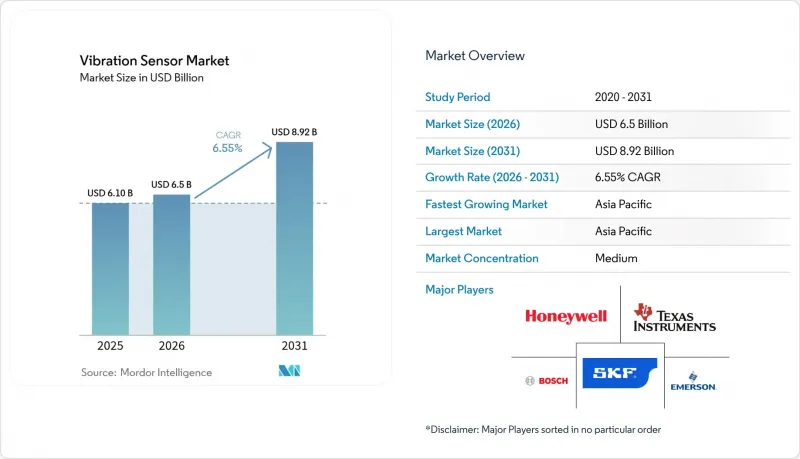
Mordor Intelligence에 의하면, 진동 센서 시장 규모는 2025년 61억 달러에서 2026년에는 65억 달러에 이르고, 2026-2031년 CAGR 6.55%로 성장을 지속하여 2031년에는 89억 2,000만 달러에 달할 것으로 예측됩니다.
본 보고서는 제품 유형(가속도계, 속도 센서, 변위 센서 등), 기술(압전식, 피에조 저항식, 정전용량식, 스트레인 게이지, MEMS), 소재(석영, 압전 세라믹, 도핑 실리콘, 기타),최종 이용 산업(자동차, 항공우주 및 방위 등), 지역(북미, 유럽, 아시아태평양, 남미, 중동 및 아프리카)별로 분류되어 있습니다.
세계 진동 센서 시장 동향 및 인사이트
연속 공정 산업에서의 예측 유지보수 프로그램 확산
아시아태평양의 플랜트 운영자들은 고주파수 데이터를 분석 엔진으로 스트리밍하는 고밀도 센서 그리드를 활용하여, 예측 정비를 통해 계획되지 않은 가동 중단 비용을 최대 50%까지 절감했습니다. Nordic Sugar사의 증기 건조기 개조와 같은 초기 프로젝트에서는 13일간의 고장 예측 기간을 실현함으로써, 대규모 화학 및 철강 플랜트에서의 투자 회수 효과가 입증되었습니다. 지속적인 모니터링이 정기 순회 점검을 대체했으며, 노드에 내장된 엣지 컴퓨팅 칩 덕분에 지연 시간은 밀리초 수준으로 단축되었습니다. 중국의 ‘인더스트리 4.0’으로의 업그레이드를 뒷받침하는 정책 덕분에 시설당 수천 대의 장치가 도입되는 추세가 유지되었습니다. 그 결과, 진동 센서 시장은 설비 투자 주기가 아닌 유지보수 예산을 통해 장기적이고 지속적인 수요를 확보하게 되었습니다.
위험한 석유 및 가스 현장에서의 무선 MEMS 센서의 부상
해상 플랫폼과 정유시설에서는 ATEX 구역 내의 고비용 케이블 설치를 불필요하게 만드는 인증된 무선 노드가 채택되었습니다. 배터리 수명은 3년을 초과하며, 압전식 에너지 하베스터 덕분에 점검 주기는 더욱 연장되었습니다. 사업자 입장에서는 시간당 5만 달러의 비용이 발생할 수 있는 가동 중단을 수반하지 않고도 기존 설비에 사후 설치가 가능하다는 점이 높이 평가되었습니다. 각 센서에 내장된 FFT 처리를 통해 구체적인 행동 지침이 되는 베어링 마모 지표가 생성되어, 현장에서 진동 분석 담당자의 필요성이 감소했습니다. 이러한 장점 덕분에 대상 시장이 확대되었으며, 그동안 디지털 유지보수 도입이 지연되었던 탄화수소 생산국의 진동 센서 시장이 활성화되었습니다.
극한 온도 조건 하에서 압전 센서의 교정 드리프트
압전 소자는 110°C를 초과하면 출력 편차가 발생하며, 적당한 가열 속도에서도 오차가 1.06%에 달했습니다. 열 사이클이 일상적으로 발생하는 터빈이나 항공우주용 엔진의 경우, 빈번한 재교정이 수명 주기 비용을 상승시켰습니다. 고온용 단결정 센서는 600°C를 넘어도 높은 신뢰성으로 작동했으나, 가격은 급등했습니다. 개발자들은 보상 회로나 듀얼 센서 구성을 검토했으나, 설계가 복잡하여 대중 시장에서의 매력은 제한적이었습니다. 그 결과 발생한 성능과 가격의 상충 관계로 인해, 진동 센서 시장의 가혹한 사용 환경 내 틈새 분야에서의 도입이 주춤했습니다.
부문 분석
가속도계는 2025년 매출의 53.85%를 차지했으며, 자동차, 스마트폰, 공장용 모터에서 3축 대응의 범용성을 통해 61억 달러에 달하는 진동 센서 시장 규모를 지탱했습니다. 무선식 속도 센서는 매출 규모는 작았지만, 정유시설 및 파이프라인 엔지니어들이 속도와 베어링의 건전성 간의 직접적인 상관관계를 중시함에 따라 2031년까지 연평균 성장률(CAGR) 8.75%로 성장을 주도했습니다.
소형화 노력에 힘입어 Bosch Sensortec사의 BMA580과 같은 차세대 가속도계의 개발이 촉진되었습니다. 이 제품은 웨어러블 기기의 감도 목표를 충족하면서 패키지 부피를 76% 줄였습니다. 이 칩에 탑재된 엣지 필터링 기능은 이상 데이터만 전송함으로써 전송 데이터를 줄이고, 메시 네트워크의 대역폭을 절약합니다. 에너지 수확 기술의 병행적인 발전으로 노드의 수명이 연장되어, 원격지의 자산에 대해 5년마다 한 번씩만 유지보수를 실시할 수 있게 되었습니다. 이러한 개선 사항들이 결합되면서, 진동 센서 시장은 그동안 전력 및 크기 제약에 시달리던 웨어러블 기기와 상태 감지형 윤활 시스템으로 확대되었습니다.
압전 소자는 저주파 감도 덕분에 2025년에도 46.05%의 점유율을 유지했지만, 반도체 팹을 통한 웨이퍼 수준의 규모의 경제 효과로 인해 MEMS 출하량은 연평균 성장률(CAGR) 9.85%로 성장할 전망입니다. 진동 센서 시장은 개별 아날로그 프런트엔드를 소형 시스템 온 칩(SoC) 패키지에 집적하는 싱글 다이 통합의 혜택을 받았습니다.
텍사스 기기(Texas Instruments)의 초음파 렌즈 세척 시연에서는 프로그래밍 가능한 진동을 이용하여 자동차용 카메라에서 오염 물질을 제거함으로써 MEMS의 범용성을 부각시켰습니다. 파운드리 기술의 발전으로 구조 건전성 모니터링에 적합한 서브 g 레벨의 진동을 측정하는 다축 어레이의 구현이 가능해졌습니다. 한편, 압전 저항형 및 정전용량형 설계는 듀티 사이클이 드문 초저전력 웨어러블 기기에 활용되었습니다. 이러한 다양한 제품 라인업 덕분에 OEM 업체들은 대역폭, 비용, 전력 소비를 기준으로 아키텍처를 선택할 수 있게 되었으며, 진동 센서 시장 전반의 보급이 확대되었습니다.
지역별 분석
2025년에는 중국의 풍력 터빈 도입 확대와 인도의 반도체 설계 센터 설립으로 인해 지역 수요가 증가하여, 아시아태평양이 33.90%의 점유율로 1위를 차지했습니다. 이 지역의 연평균 성장률(CAGR) 8.05%도 세계 평균을 상회하며, 2031년까지 그 주도적 지위를 유지할 전망입니다. 일본의 정밀 기계 제조업체들은 로봇 공학용 고해상도 센서를 발주하여 이 지역의 진동 센서 시장을 더욱 확대시켰습니다.
그 뒤를 이어 북미가 뒤를 이었으며, 화학 플랜트의 ISO 준수 및 방사선 내성 장치가 필요한 항공우주 프로그램이 성장의 견인차 역할을 했습니다. 미국의 국방 분야 개조 사업에서는 사이버 보안 위험을 완화하기 위해 엣지 처리가 적용되고 에어 갭이 유지된 장치가 선호되었습니다. 캐나다의 광산 기업들은 유선 배선이 현실적으로 어려운 외딴 지역의 채굴 현장에 내환경성이 뛰어난 무선 메쉬 네트워크를 도입하여 진동 센서 시장에 틈새 수요를 창출했습니다.
유럽에서는 BMW가 엔진 공장을 순찰하는 센서 탑재 로봇견을 도입한 사례에서 볼 수 있듯이, 시장은 높은 성숙도를 보였습니다. 북유럽의 해상 풍력 발전소에서는 15MW 터빈에 다채널 시스템을 설치하여 요각과 블레이드의 고조파를 모니터링했습니다. 엄격한 근로자 안전 지침에 따라 꾸준한 업그레이드가 보장되어, 거시경제의 역풍에도 불구하고 진동 센서 시장은 견조한 모습을 유지했습니다.
남미 및 중동 및 아프리카은 여전히 신흥 시장이지만 활기를 띠고 있습니다. 브라질의 광산 업체와 농업 관련 가공 업체들은 MEMS 비용 하락을 발판으로 상태 모니터링 키트 도입을 시작했습니다. 걸프 지역의 국영 석유 회사(NOC)는 플레어 스택 및 압축기용으로 ATEX 인증 무선 센서를 채택하여, 위험 구역 내 도입을 통해 진동 센서 시장 점유율을 급속히 확대했습니다.
기타 혜택:
- 엑셀 형식 시장 예측(ME) 시트
- 3개월간의 애널리스트 지원
자주 묻는 질문
목차
제1장 서론
제2장 조사 방법
제3장 주요 요약
제4장 시장 구도
제5장 시장 규모와 성장 예측
제6장 경쟁 구도
제7장 시장 기회와 향후 전망
LSH 26.09.08According to Mordor Intelligence, the vibration sensor market size is expected to grow from USD 6.10 billion in 2025 to USD 6.5 billion in 2026 and is forecast to reach USD 8.92 billion by 2031 at 6.55% CAGR over 2026-2031.
This report is Segmented by Product Type (Accelerometers, Velocity Sensors, Displacement Sensors, and More), Technology (Piezoelectric, Piezoresistive, Capacitive, Strain-Gauge, and MEMS), Material (Quartz, Piezoelectric Ceramics, Doped Silicon, and Others), End-Use Industry (Automotive, Aerospace and Defense, and More), and Geography (North America, Europe, Asia-Pacific, South America, and Middle East and Africa).
Global Vibration Sensor Market Trends and Insights
Proliferation of Predictive Maintenance Programs in Continuous Process Industries
Asia-Pacific plant operators used predictive maintenance to reduce unplanned downtime costs by up to 50%, relying on dense sensor grids that stream high-frequency data to analytics engines. Early projects such as the Nordic Sugar steam-dryer retrofit demonstrated 13-day fault-prediction windows, validating payback for large chemical and steel sites. Continuous monitoring displaced periodic walk-by inspections, and edge-computing chips embedded in nodes lowered latency to millisecond levels. Chinese stimulus for Industry 4.0 upgrades-maintained momentum, embedding thousands of devices per facility. Consequently, the vibration sensor market gained long-run recurring demand from maintenance budgets rather than capital expenditure cycles.
Rise of Wireless MEMS Sensors for Hazardous Oil and Gas Sites
Offshore platforms and refineries adopted certified wireless nodes that eliminated costly cable runs through ATEX zones. Battery lives exceeded three years, and piezoelectric energy harvesters further prolonged service intervals. Operators valued retrofit capability without shutting down throughput that could otherwise cost USD 50,000 per hour. Embedded FFT processing in each sensor produced actionable bearing-wear metrics, reducing the need for on-site vibration analysts. These benefits widened the addressable base and lifted the vibration sensor market in hydrocarbon economies that historically lagged digital-maintenance adoption.
Calibration Drift of Piezoelectric Sensors at Extreme Temperatures
Piezoelectric elements experienced output deviations above 110 °C, with errors hitting 1.06% at moderate heating rates. Frequent recalibration raised lifecycle costs in turbines and aerospace engines where thermal cycling was routine. High-temperature single-crystal alternatives operated reliably beyond 600 °C but commanded premium pricing. Developers explored compensation circuits and dual-sensor configurations, yet complex designs limited mass-market appeal. The resulting performance-price trade-off slowed deployments in harsh-duty niches of the vibration sensor market.
Other drivers and restraints analyzed in the detailed report include:
- Edge-AI Enabled Diagnostics in Automotive Assembly
- Mandatory ISO 20816 Compliance in EU and North America
- Data-Security Concerns in Cloud-based Analytics (Defense)
For complete list of drivers and restraints, kindly check the Table Of Contents.
Segment Analysis
Accelerometers generated 53.85% revenue in 2025, underpinning the vibration sensor market size of USD 6.10 billion through their tri-axial versatility in vehicles, smartphones, and factory motors. Wireless velocity devices, though smaller in value, led growth at 8.75% CAGR to 2031 as refinery and pipeline engineers valued velocity's direct correlation with bearing health.
The miniaturization push spurred next-generation accelerometers such as Bosch Sensortec's BMA580, which reduced package volume by 76% while meeting sensitivity targets for hearables. Edge filtering in these chips cuts outbound data by transmitting only anomalies, conserving bandwidth in mesh networks. Parallel advances in energy harvesting prolonged node life, enabling five-year maintenance intervals on remote assets. Together, these enhancements allowed the vibration sensor market to broaden into wearables and condition-based lubrication systems previously constrained by power or size limits.
Piezoelectric elements retained a 46.05% share in 2025 thanks to low-frequency sensitivity, but MEMS shipments expanded at a 9.85% CAGR as semiconductor fabs delivered wafer-level economies. The vibration sensor market benefited from single-die integration that collapsed discrete analog front-ends into compact system-on-chip packages.
Texas Instruments' ultrasonic lens-cleaning demo highlighted MEMS versatility, using programmable vibrations to remove contaminants from automotive cameras. Foundry advances enabled multi-axis arrays measuring sub-g vibrations suitable for structural-health monitoring. Meanwhile, piezoresistive and capacitive designs served ultra-low-power wearables where duty cycles were sparse. This diversified portfolio allowed OEMs to choose architectures based on bandwidth, cost, and power, expanding overall penetration of the vibration sensor market.
Complete Report Scope:
- By Product Type
- Accelerometers
- Velocity Sensors
- Displacement Sensors
- Gyroscopes (Vibration-Grade)
- By Technology
- Piezoelectric
- Piezoresistive
- Capacitive
- Strain-Gauge
- MEMS
- By Material
- Quartz
- Piezoelectric Ceramics
- Doped Silicon
- Others
- By End-Use Industry
- Automotive
- Aerospace and Defense
- Oil and Gas
- Industrial Manufacturing
- Power Generation (incl. Wind)
- Healthcare
- Consumer Electronics and Wearables
- Others
- By Geography
- North America
- United States
- Canada
- Europe
- Germany
- United Kingdom
- France
- Italy
- Spain
- Rest of Europe
- Asia-Pacific
- China
- Taiwan
- Japan
- South Korea
- India
- ASEAN
- Rest of Asia-Pacific
- South America
- Mexico
- Brazil
- Argentina
- Rest of South America
- Middle East and Africa
- Middle East
- Saudi Arabia
- United Arab Emirates
- Turkey
- Rest of Middle East
- Africa
- South Africa
- Rest of Africa
- Middle East
- North America
Geography Analysis
Asia-Pacific led with a 33.90% share in 2025 as China's wind-turbine roll-outs and India's semiconductor design centers lifted local demand. The region's 8.05% CAGR also out-paced global averages, preserving its leadership through 2031. Japanese precision-machinery firms ordered high-resolution sensors for robotics, further enlarging the vibration sensor market in the bloc.
North America followed, driven by ISO compliance in chemical plants and aerospace programs requiring radiation-tolerant devices. US defense retrofits favored edge-processed units that remained air-gapped, mitigating cybersecurity exposure. Canadian miners installed ruggedized wireless mesh networks across remote pits where wired runs were impractical, adding niche demand to the vibration sensor market.
Europe exhibited advanced maturity, exemplified by BMW's sensor-equipped robo-dogs patrolling engine plants. Nordic offshore wind farms fitted high-channel-count systems on 15 MW turbines to monitor yaw and blade harmonics. Strict worker-safety directives assured steady upgrades, keeping the vibration sensor market resilient despite macroeconomic headwinds.
South America and the Middle East/Africa remained emerging but dynamic. Brazilian miners and agribusiness processors began installing condition-monitoring kits, aided by falling MEMS costs. Gulf-region NOCs embraced ATEX-rated wireless sensors for flare stacks and compressors, quickly expanding the vibration sensor market footprint in hazardous-area deployments.
- Emerson Electric Co.
- SKF AB
- Honeywell International Inc.
- Analog Devices Inc.
- TE Connectivity Ltd
- Bosch Sensortec GmbH
- Texas Instruments Inc.
- National Instruments Corp.
- Rockwell Automation Inc.
- NXP Semiconductors N.V.
- Parker Hannifin Corp.
- Baker Hughes (Bently Nevada)
- Wilcoxon Sensing Technologies
- PCB Piezotronics Inc.
- Meggitt PLC (Sensing Systems)
- IMI Sensors
- ifm electronic GmbH
- Siemens AG
- Omron Corporation
- Hansford Sensors Ltd
Additional Benefits:
- The market estimate (ME) sheet in Excel format
- 3 months of analyst support
TABLE OF CONTENTS
1 INTRODUCTION
- 1.1 Study Assumptions and Market Definition
- 1.2 Scope of the Study
2 RESEARCH METHODOLOGY
3 EXECUTIVE SUMMARY
4 MARKET LANDSCAPE
- 4.1 Market Overview
- 4.2 Market Drivers
- 4.2.1 Proliferation of Predictive Maintenance Programs in Continuous Process Industries (Asia Pacific)
- 4.2.2 Rise of Wireless MEMS Sensors for Hazardous Oil and Gas Sites (Middle East)
- 4.2.3 Edge-AI Enabled Diagnostics in Automotive Assembly (Europe)
- 4.2.4 Mandatory ISO 20816 Compliance in EU and North America
- 4.2.5 Expansion of Wind Turbine Installations (Nordics and China)
- 4.2.6 Miniaturization Demand from Wearables and Hearables
- 4.3 Market Restraints
- 4.3.1 Calibration Drift of Piezoelectric Sensors at Extreme Temperatures
- 4.3.2 Data-Security Concerns in Cloud-based Analytics (Defense)
- 4.3.3 Shortage of Specialty Piezo-ceramic Materials (China Export Quotas)
- 4.4 Value Chain Analysis
- 4.5 Technological Outlook
- 4.6 Porter's Five Forces Analysis
- 4.6.1 Threat of New Entrants
- 4.6.2 Bargaining Power of Suppliers
- 4.6.3 Bargaining Power of Buyers
- 4.6.4 Threat of Substitutes
- 4.6.5 Intensity of Competitive Rivalry
- 4.7 Investment Analysis
- 4.8 Assessment of Macroeconomic Factors on the Market
5 MARKET SIZE AND GROWTH FORECASTS (VALUE)
- 5.1 By Product Type
- 5.1.1 Accelerometers
- 5.1.2 Velocity Sensors
- 5.1.3 Displacement Sensors
- 5.1.4 Gyroscopes (Vibration-Grade)
- 5.2 By Technology
- 5.2.1 Piezoelectric
- 5.2.2 Piezoresistive
- 5.2.3 Capacitive
- 5.2.4 Strain-Gauge
- 5.2.5 MEMS
- 5.3 By Material
- 5.3.1 Quartz
- 5.3.2 Piezoelectric Ceramics
- 5.3.3 Doped Silicon
- 5.3.4 Others
- 5.4 By End-Use Industry
- 5.4.1 Automotive
- 5.4.2 Aerospace and Defense
- 5.4.3 Oil and Gas
- 5.4.4 Industrial Manufacturing
- 5.4.5 Power Generation (incl. Wind)
- 5.4.6 Healthcare
- 5.4.7 Consumer Electronics and Wearables
- 5.4.8 Others
- 5.5 By Geography
- 5.5.1 North America
- 5.5.1.1 United States
- 5.5.1.2 Canada
- 5.5.2 Europe
- 5.5.2.1 Germany
- 5.5.2.2 United Kingdom
- 5.5.2.3 France
- 5.5.2.4 Italy
- 5.5.2.5 Spain
- 5.5.2.6 Rest of Europe
- 5.5.3 Asia-Pacific
- 5.5.3.1 China
- 5.5.3.2 Taiwan
- 5.5.3.3 Japan
- 5.5.3.4 South Korea
- 5.5.3.5 India
- 5.5.3.6 ASEAN
- 5.5.3.7 Rest of Asia-Pacific
- 5.5.4 South America
- 5.5.4.1 Mexico
- 5.5.4.2 Brazil
- 5.5.4.3 Argentina
- 5.5.4.4 Rest of South America
- 5.5.5 Middle East and Africa
- 5.5.5.1 Middle East
- 5.5.5.1.1 Saudi Arabia
- 5.5.5.1.2 United Arab Emirates
- 5.5.5.1.3 Turkey
- 5.5.5.1.4 Rest of Middle East
- 5.5.5.2 Africa
- 5.5.5.2.1 South Africa
- 5.5.5.2.2 Rest of Africa
- 5.5.5.1 Middle East
- 5.5.1 North America
6 COMPETITIVE LANDSCAPE
- 6.1 Market Concentration
- 6.2 Strategic Moves (M&A, Partnerships, Funding)
- 6.3 Market Share Analysis
- 6.4 Company Profiles (includes Global-level Overview, Market-level Overview, Core Segments, Financials, Strategic Information, Market Rank/Share, Products and Services, Recent Developments)
- 6.4.1 Emerson Electric Co.
- 6.4.2 SKF AB
- 6.4.3 Honeywell International Inc.
- 6.4.4 Analog Devices Inc.
- 6.4.5 TE Connectivity Ltd
- 6.4.6 Bosch Sensortec GmbH
- 6.4.7 Texas Instruments Inc.
- 6.4.8 National Instruments Corp.
- 6.4.9 Rockwell Automation Inc.
- 6.4.10 NXP Semiconductors N.V.
- 6.4.11 Parker Hannifin Corp.
- 6.4.12 Baker Hughes (Bently Nevada)
- 6.4.13 Wilcoxon Sensing Technologies
- 6.4.14 PCB Piezotronics Inc.
- 6.4.15 Meggitt PLC (Sensing Systems)
- 6.4.16 IMI Sensors
- 6.4.17 ifm electronic GmbH
- 6.4.18 Siemens AG
- 6.4.19 Omron Corporation
- 6.4.20 Hansford Sensors Ltd
7 MARKET OPPORTUNITIES AND FUTURE OUTLOOK
- 7.1 White-space and Unmet-Need Assessment


