

|
시장보고서
상품코드
2120773
임상시험 관리 시스템 : 시장 점유율 분석, 업계 동향과 통계, 성장 예측(2026-2031년)Clinical Trial Management Systems - Market Share Analysis, Industry Trends & Statistics, Growth Forecasts (2026 - 2031) |
||||||
 Mordor Intelligence
Mordor Intelligence에 따르면 임상시험 관리 시스템(CTMS) 시장 규모는 2025년 23억 5,000만 달러, 2026년 26억 5,000만 달러에서 2031년까지 50억 2,000만 달러로 확대될 것으로 예측되며, 2026년부터 2031년까지 연평균 성장률(CAGR)은 13.62%가 될 전망입니다.
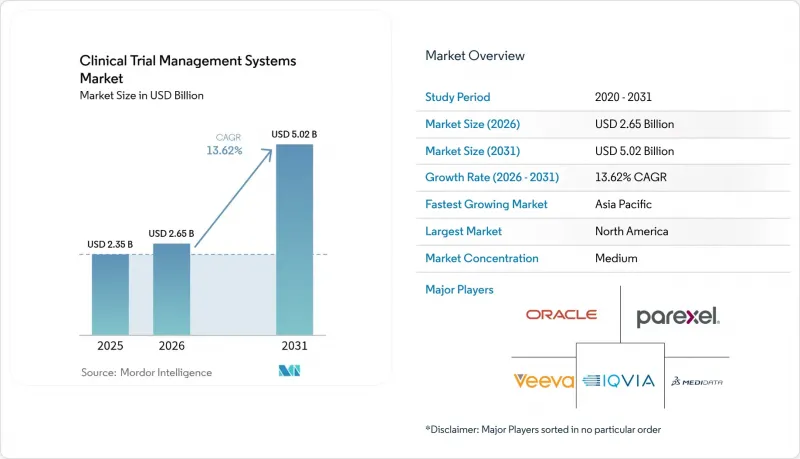
본 보고서는 시스템 유형(엔터프라이즈형 CTMS, 사이트형 CTMS), 제공 형태(웹 기반 호스팅형 CTMS, 클라우드 기반 SaaS형 CTMS, 온프레미스형 CTMS), 구성요소(소프트웨어, 서비스), 최종사용자(제약·바이오기술 기업 등), 및 지역(북미 등)별로 분류되어 있습니다. 시장 예측은 금액(달러) 기준으로 제시되어 있습니다.
세계 임상시험 관리 시스템 시장의 동향 및 인사이트
분산형 임상시험에서 클라우드형 CTMS 도입 급증
분산형 임상시험 설계는 원격의료를 통한 진료, 재택 간호, 웨어러블 센서에 의존하고 있어, 온프레미스형 시스템으로는 처리 능력 확장이 따라잡지 못할 정도의 지속적인 데이터 스트림이 생성됩니다. Veeva와 같은 벤더들은 스폰서가 원격 간호 및 전자 동의 워크플로우를 조정함에 따라, 2025 회계연도 Vault CTMS 바이오테크놀러지용 구독이 전년 대비 28% 증가했다고 보고하고 있습니다. 2024년에 최종 확정된 FDA 지침에서는 오프사이트 활동에 대해 감사 가능한 전자 워크플로우를 요구하고 있으며, 이 요건을 가장 적절하게 충족하는 것은 21 CFR Part 11을 준수하여 검증된 버전 관리 기능이 있는 모듈을 제공하는 멀티테넌트형 SaaS입니다. 대상 환자가 지리적으로 분산되어 있는 종양학 및 희귀질환 임상시험에서는 스크리닝 실패율을 억제하고 피험자 등록 기간을 단축하기 위해 현재 클라우드형 CTMS가 표준으로 자리 잡고 있습니다. 이러한 기능이야말로 임상시험 관리 시스템 시장 전체에서 클라우드 인프라에 대한 지지가 확대되고 있는 배경이 되고 있습니다.
세계 임상시험 건수 및 복잡성의 증가
ClinicalTrials.gov에 등록된 중재 임상시험 건수는 2025년 12월 기준 48만 건을 넘어, 2024년 12월 대비 9% 증가했습니다. 바스켓 프로토콜이나 엄브렐라 프로토콜에서는 여러 질환 코호트가 단일 마스터 프로토콜로 통합되기 때문에 작업 알림, 프로토콜 수정 및 각국 고유의 윤리 심사 워크플로가 기하급수적으로 증가하고 있습니다. 2024년부터 완전히 시행되는 유럽 임상시험 정보 시스템(CTIS)에서는 검증 오류를 방지하기 위해 구조화된 XML 형식의 업로드가 의무화되어 있습니다. 이 프로세스는 최신 CTMS 템플릿을 통해 자동화되어 있습니다. 각 스폰서사가 3상 임상시험 1건당 15개국 이상을 동시에 관리하는 상황에서, 다국어 동의서 문서 라이브러리와 지역별 수입 허가 추적 기능을 통합한 모듈식 CTMS 인터페이스가 필수적이며, 이는 임상시험 관리 시스템 시장 전체의 수요를 뒷받침하고 있습니다.
중소기업(SME) 스폰서에게 부담되는 높은 도입 및 검증 비용
CTMS를 전면 도입하려면 중소기업의 경우 주로 인프라, 소프트웨어 라이선스, 그리고 21 CFR Part 11 및 EMA Annex 11을 준수하는 컴퓨터 시스템의 검증 비용으로 초기 비용만 0.5-200만 달러가 소요됩니다. 검증에는 보통 6-12개월이 소요되며, 그 기간 동안 후원사는 종이 기반의 워크플로우를 병행하여 운영해야 하므로, 결과적으로 첫 피험자 등록일이 지연됩니다. SaaS 구독은 자본 지출(Capex)을 미룰 수 있지만, 사용자 수가 증가함에 따라 운영 비용(OpEx)이 불어나기 때문에 단일 임상시험을 수행하는 바이오테크 기업이나 연구자 주도 임상시험의 경우 비용 부담이 커집니다. 이러한 비용 부담이 임상시험 관리 시스템 시장의 단기적인 보급을 저해하고 있습니다.
부문 분석
2025년 매출액 중 엔터프라이즈 플랫폼이 61.58%를 차지하고 있어, 대형 제약사들이 통합된 포트폴리오에 의존하고 있음을 여실히 보여주고 있습니다. 이러한 도입 사례에서는 재무 모듈과 품질 관리 시스템이 통합되어 200건 이상의 동시 진행 중인 임상시험을 관리하고 있습니다. 한편, 분산형 설계로 인해 임상시험 수행 기관에 더 많은 자율성이 부여됨에 따라, 기관 기반 제품은 2031년까지 연평균 성장률(CAGR) 15.89%로 성장할 것으로 예상됩니다. 종양학 네트워크에서는 지역 정맥 주사 치료 클리닉들이 전자 차트 워크플로우와 원활하게 연동되는 경량 CTMS를 선호하여 도입하고 있으며, 이로 인해 이전 조달 주기를 주도하던 최상위 학술 기관 외에도 공급업체의 영향력이 확대되고 있습니다. 규제 당국의 지침에 따라 후원사의 읽기 전용 접근이 허용되고 감사 장벽이 낮아짐에 따라, 시설 기반 도구를 활용한 임상시험 관리 시스템 시장의 규모는 크게 확대될 것으로 예측됩니다. 향후 상호 운용성의 표준화를 통해 두 도입 모델이 단일 데이터 패브릭으로 통합되어 데이터 중복 입력이 최소화될 전망입니다.
엔터프라이즈 플랫폼은 여러 대륙에 걸쳐 거점을 두고 있으며, 통합된 데이터 가시성이 요구되는 3상 등록 임상시험에서 계속해서 예산상의 우선순위를 차지할 것입니다. 반면, 예산이 제한적인 생명공학 기업들은 첫 인체 임상시험을 시범적으로 실시할 때, 몇 주 이내에 가동을 시작할 수 있고 엔터프라이즈 수준의 변경 관리 프로세스를 피할 수 있는 모듈식 시설 중심 애플리케이션에 대한 지출을 점점 더 늘리고 있습니다. 따라서 예측 기간 동안 임상시험 관리 시스템 시장은 이중 플랫폼의 공존이 특징이 될 것이며, 구매 결정은 시험의 복잡성, 시설의 분산 상황 및 후원사의 인력 규모에 따라 좌우될 것입니다.
웹 호스팅형 도입은 초기 브라우저 기반 전환의 여파로 2025년 매출의 54.66%를 차지했습니다. 그러나 멀티테넌트 아키텍처를 통해 사용자 측에서 패치를 적용할 필요 없이 분기별 기능 업데이트가 제공되므로, 클라우드 SaaS는 2031년까지 연평균 성장률(CAGR) 17.48%로 급성장할 것으로 예측됩니다. SaaS 모델에 기반한 임상시험 관리 시스템 시장의 규모는 전담 IT 인력을 보유하지 않은 중규모 후원사들 사이에서 가장 빠르게 확대되고 있습니다. 2024년에 발표된 규제 지침에서는 암호화, 감사 로그 및 연례 SOC 2 감사가 실시된다면 논리적으로 분리된 멀티테넌트형 클라우드에서도 Part 11의 검증 요건을 충족할 수 있음이 명확히 밝혀져, 오랫동안 존재해 온 도입 장벽이 해소되었습니다.
이러한 추세에도 불구하고, 일부 후원사는 클라우드 리전 선택을 제한하는 국내 데이터 보호법을 준수하기 위해 웹 호스팅형 테넌트를 유지하고 있습니다. 이러한 하이브리드 형태는 특히 각국 규제 당국이 외국 클라우드 제공업체를 엄격하게 감시하고 있는 지역에서 앞으로도 지속될 것입니다. 그럼에도 총소유비용(TCO) 측면에서는 SaaS가 압도적으로 유리하며, 임상시험 관리 시스템 시장 전체에서 제공 형태별 매출 구성이 궁극적으로 역전될 것으로 예상됩니다.
지역별 분석
북미는 보스턴, 샌프란시스코 베이 에어리어, 리서치 트라이앵글 파크에 집중된 생명공학 클러스터를 기반으로 2025년 매출의 49.68%를 차지했습니다. FDA의 2024년 분산형 임상시험에 관한 지침에 따라,원격 대응이 가능한 CTMS에 대한 수요가 가속화되었으며, 더불어 미국 국립보건원(NIH)의 15억 달러 규모의 ‘임상시험 혁신 이니셔티브(CTTI)’가 학술 기관의 기술 현대화에 자금을 지원함에 따라 임상시험 관리 시스템 시장은 더욱 확대되었습니다. 캐나다에서는 15% 이상의 환급 가능한 연구개발 세액 공제가 제공되어 국경을 초월한 임상시험 배치를 촉진하고 있습니다. 한편, 멕시코에서는 2024년 윤리 개혁으로 임상시험 기관의 승인 기간이 단축되었으나, 지방 지역의 광대역 환경 격차로 인해 기관내 도입이 지연되고 있습니다.
유럽에서는 독일, 프랑스, 영국 3개국이 EU의 3상 임상시험 활동의 절반을 차지하고 있습니다. 유럽의약품청(EMA)이 2024년부터 모든 신청을 CTIS를 통해 제출하도록 의무화함에 따라, CTMS의 자동 입력 기능의 중요성이 더욱 높아졌습니다. 이탈리아와 스페인을 포함한 중·남유럽 국가들은 복수 기관의 승인 절차를 효율화함으로써 시장 점유율을 확대하고, 임상시험 관리 시스템 시장에서의 지역적 확산을 뒷받침했습니다.
아시아태평양은 2031년까지 15.24%라는 지역별 최고 연평균 성장률(CAGR)을 기록할 것으로 예측됩니다. 중국의 ‘약사법’ 개정 및 전 세계 혁신 의약품 신청의 50%를 국내에서 처리하겠다는 전략적 목표가 주요 촉진요인으로 작용하고 있습니다. 일본은 2024년에 영어로 제공되는 컨설팅 서비스를 확충하여 국경을 초월한 협력을 원활하게 했습니다. 한편, 인도의 디지털 임상시험 승인 포털은 COVID-19 사태 이후 시험 시설의 재가동을 다시 가속화했습니다. 한국의 세포 치료 클러스터와 호주의 43.5% 환급 가능한 세액 공제 제도가 해당 지역으로의 초기 단계 이전을 뒷받침하고 있으며, 아시아태평양은 임상시험 관리 시스템 시장의 장기적인 성장 동력으로서의 입지를 확고히 하고 있습니다.
기타 혜택:
- 엑셀 형식의 시장 예측(ME) 시트
- 3개월간의 애널리스트 지원
자주 묻는 질문
목차
제1장 소개
제2장 조사 방법
제3장 주요 요약
제4장 시장 구도
제5장 시장 규모와 성장 예측
제6장 경쟁 구도
제7장 시장 기회와 향후 전망
KSM 26.09.02According to Mordor Intelligence, the clinical trial management systems market size is projected to expand from USD 2.35 billion in 2025 and USD 2.65 billion in 2026 to USD 5.02 billion by 2031, registering a CAGR of 13.62% between 2026 to 2031.
This report is Segmented by System Type (Enterprise-Based CTMS, Site-Based CTMS), Delivery Mode (Web-Based Hosted CTMS, Cloud-Based SaaS CTMS, On-Premise CTMS), Component (Software, Services), End User (Pharmaceutical & Biotechnology Companies, and More), and Geography (North America, and More). The Market Forecasts are Provided in Terms of Value (USD).
Global Clinical Trial Management Systems Market Trends and Insights
Surge in Cloud-Based CTMS Adoption for Decentralized Trials
Decentralized designs rely on telehealth visits, home nursing, and wearable sensors, creating continuous data streams that on-premise systems cannot scale to ingest. Vendors such as Veeva report 28% year-over-year growth in Vault CTMS biotech subscriptions for fiscal 2025 as sponsors coordinate remote nursing and electronic consent workflows. FDA guidance finalized in 2024 requires auditable electronic workflows for off-site activities, a criterion best met by multi-tenant SaaS that ships version-controlled modules validated against 21 CFR Part 11. Oncology and rare-disease trials where eligible patients are geographically dispersed now default to cloud CTMS to curb screen-failure rates and compress enrollment timelines. These capabilities underpin the widening preference for cloud infrastructure across the clinical trial management system market.
Rising Volume and Complexity of Global Clinical Trials
Interventional registrations on ClinicalTrials.gov exceeded 480,000 by December 2025, up 9% from December 2024. Basket and umbrella protocols layer multiple disease cohorts into a single master protocol, driving exponential increases in task notifications, protocol amendments, and country-specific ethics workflows. Europe's Clinical Trials Information System, fully enforced from 2024 onward, mandates structured XML uploads, a process automated by modern CTMS templates, to avoid validation errors. As sponsors juggle 15-plus countries per phase-3 study, modular CTMS interfaces that embed multilingual informed-consent libraries and region-specific import-permit trackers have become indispensable, reinforcing demand across the clinical trial management system market.
High Implementation and Validation Costs for SME Sponsors
Full-scope CTMS rollouts cost SMEs USD 0.5-2 million upfront, primarily for infrastructure, software licenses, and computer-system validation tied to 21 CFR Part 11 and EMA Annex 11. Validation commonly extends six to twelve months, during which sponsors must run duplicate paper workflows, delaying first-patient-in dates. SaaS subscriptions defer capex but escalate opex as user seats grow, limiting affordability for single-study biotechs and investigator-initiated trials. This cost drag tempers near-term penetration in the clinical trial management system market.
Other drivers and restraints analyzed in the detailed report include:
- Regulatory Mandates for Real-Time Oversight (ICH-GCP E6-R3)
- CRO Outsourcing Boom Among Mid-Size Biopharma
- Persistent Data-Privacy and Cross-Border Restrictions
For complete list of drivers and restraints, kindly check the Table Of Contents.
Segment Analysis
Enterprise platforms accounted for 61.58% of 2025 revenue, underscoring big-pharma reliance on consolidated portfolios. These deployments integrate financial modules and quality systems to govern more than 200 concurrent trials. Conversely, site-based products are set to grow at a 15.89% CAGR through 2031 as decentralized designs hand greater autonomy to investigator sites. In oncology networks, community infusion clinics prefer lightweight CTMS that dovetail with electronic medical-record workflows, boosting vendor reach beyond the top-tier academic centers that dominated earlier procurement cycles. The clinical trial management system market size for site-based tools is projected to expand significantly as regulatory guidance now permits read-only sponsor access, lowering audit barriers. Over time, interoperability standards are likely to weave both deployment models into a single data fabric that minimizes duplicate entry.
Enterprise platforms will keep commanding budget priority for phase-3 registrational studies that involve multi-continent footprints and require uniform data visibility. Yet budget-constrained biotechs piloting first-in-human studies increasingly funnel spend toward modular, site-centric applications that go live within weeks and avoid enterprise change-control processes. As such, dual-platform coexistence will characterize the clinical trial management system market through the forecast window, with purchasing decisions hinging on trial complexity, site dispersion, and sponsor head-count scale.
Web-hosted deployments held 54.66% of 2025 sales, a residual from early browser-based migrations. Cloud SaaS, however, is forecast to surge at 17.48% CAGR to 2031 as multitenant architectures roll out quarterly feature updates without user-side patching. The clinical trial management system market size attributed to SaaS models is expanding fastest among mid-size sponsors that lack dedicated IT staff. Regulatory guidance issued in 2024 clarified that logically segregated multitenant clouds can meet Part 11 validation if encryption, audit logging, and annual SOC 2 audits are in place, eliminating a lingering adoption barrier.
Despite the momentum, certain sponsors retain web-hosted tenants to comply with sovereign data laws that restrict cloud region choices. These hybrid patterns will persist, particularly where national regulators scrutinize foreign cloud providers. Even so, total cost-of-ownership math overwhelmingly favors SaaS, suggesting an eventual inversion in the delivery-mode revenue mix across the clinical trial management system market.
Complete Report Scope:
- By System Type
- Enterprise-based CTMS
- Site-based CTMS
- By Delivery Mode
- Web-based (Hosted) CTMS
- Cloud-based (SaaS) CTMS
- On-premise CTMS
- By Component
- Software
- Services
- By End User
- Pharmaceutical & Biotechnology Companies
- Contract Research Organizations
- Medical Device Manufacturers
- Academic & Research Institutes
- By Geography
- North America
- United States
- Canada
- Mexico
- Europe
- Germany
- France
- United Kingdom
- Italy
- Spain
- Rest of Europe
- Asia-Pacific
- China
- Japan
- India
- South Korea
- Australia
- Rest of Asia-Pacific
- Middle East & Africa
- GCC
- South Africa
- Rest of Middle East & Africa
- South America
- Brazil
- Argentina
- Rest of South America
- North America
Geography Analysis
North America retained 49.68% of 2025 revenue, anchored by dense biotech clusters in Boston, the San Francisco Bay Area, and Research Triangle Park. The FDA's 2024 decentralized-trial guidance accelerated demand for remote-ready CTMS, and the National Institutes of Health's USD 1.5 billion Clinical Trials Transformation Initiative funds technology modernization at academic centers, further boosting the clinical trial management system market. Canada offers 15%-plus refundable R&D tax credits, spurring cross-border study placements, while Mexico's 2024 ethics reforms shortened site approvals, though rural broadband gaps slow site adoption.
In Europe, Germany, France, and the United Kingdom collectively host half of EU phase-3 activity. The EMA's requirement that all submissions flow through CTIS from 2024 onward amplified CTMS auto-population features. Central and Southern European countries, including Italy and Spain, gained share by streamlining multi-site approvals, nudging wider regional uptake within the clinical trial management system market.
Asia-Pacific is projected to post the highest regional CAGR at 15.24% through 2031. China's Drug Administration Law amendments and strategic goal to fulfil 50% of global innovative drug filings domestically are central catalysts. Japan expanded English-language consultation services in 2024, easing cross-border collaboration, while India's digital trial-approval portal reaccelerated site activations post-COVID. South Korea's cell-therapy clusters and Australia's 43.5% refundable tax offset sustain early-phase migration into the region, positioning Asia-Pacific as the long-term volume engine of the clinical trial management system market.
- Aris Global
- Bio-Optronics (Advarra)
- Calyx
- Castor EDC
- Clario
- Dassault Systemes
- DATATRAK International
- eClinical Solutions
- Forte Research Systems
- IBM
- IQVIA Technologies
- LabCorp
- MasterControl
- MedNet Solutions
- OpenClinica
- Oracle
- Parexel International
- RealTime Software Solutions
- Signant Health
- Veeva Systems
Additional Benefits:
- The market estimate (ME) sheet in Excel format
- 3 months of analyst support
TABLE OF CONTENTS
1 Introduction
- 1.1 Study Assumptions & Market Definition
- 1.2 Scope of the Study
2 Research Methodology
3 Executive Summary
4 Market Landscape
- 4.1 Market Overview
- 4.2 Market Drivers
- 4.2.1 Surge In Cloud-Based CTMS Adoption for Decentralized Trials
- 4.2.2 Rising Volume & Complexity of Global Clinical Trials
- 4.2.3 Regulatory Mandates for Real-Time Oversight (ICH-GCP E6-R3)
- 4.2.4 CRO Outsourcing Boom Among Mid-Size Biopharma
- 4.2.5 AI-Enabled Predictive Analytics Improves Enrolment Velocity
- 4.2.6 U.S.-China Tech Trade Barriers Pushing Regional CTMS Hosting
- 4.3 Market Restraints
- 4.3.1 High Implementation & Validation Costs for SME Sponsors
- 4.3.2 Persistent Data-Privacy / Cross-Border-Transfer Restrictions
- 4.3.3 Shortage of CTMS-Literate Clinical-Ops Talent in Emerging Regions
- 4.3.4 Fragmented Legacy IT Stacks Slowing Interoperability
- 4.4 Value / Supply-Chain Analysis
- 4.5 Regulatory Landscape
- 4.6 Technological Outlook
- 4.7 Porter's Five Forces Analysis
- 4.7.1 Bargaining Power of Suppliers
- 4.7.2 Bargaining Power of Buyers
- 4.7.3 Threat of New Entrants
- 4.7.4 Threat of Substitutes
- 4.7.5 Intensity of Competitive Rivalry
5 Market Size & Growth Forecasts (Value in USD)
- 5.1 By System Type
- 5.1.1 Enterprise-based CTMS
- 5.1.2 Site-based CTMS
- 5.2 By Delivery Mode
- 5.2.1 Web-based (Hosted) CTMS
- 5.2.2 Cloud-based (SaaS) CTMS
- 5.2.3 On-premise CTMS
- 5.3 By Component
- 5.3.1 Software
- 5.3.2 Services
- 5.4 By End User
- 5.4.1 Pharmaceutical & Biotechnology Companies
- 5.4.2 Contract Research Organizations
- 5.4.3 Medical Device Manufacturers
- 5.4.4 Academic & Research Institutes
- 5.5 By Geography
- 5.5.1 North America
- 5.5.1.1 United States
- 5.5.1.2 Canada
- 5.5.1.3 Mexico
- 5.5.2 Europe
- 5.5.2.1 Germany
- 5.5.2.2 France
- 5.5.2.3 United Kingdom
- 5.5.2.4 Italy
- 5.5.2.5 Spain
- 5.5.2.6 Rest of Europe
- 5.5.3 Asia-Pacific
- 5.5.3.1 China
- 5.5.3.2 Japan
- 5.5.3.3 India
- 5.5.3.4 South Korea
- 5.5.3.5 Australia
- 5.5.3.6 Rest of Asia-Pacific
- 5.5.4 Middle East & Africa
- 5.5.4.1 GCC
- 5.5.4.2 South Africa
- 5.5.4.3 Rest of Middle East & Africa
- 5.5.5 South America
- 5.5.5.1 Brazil
- 5.5.5.2 Argentina
- 5.5.5.3 Rest of South America
- 5.5.1 North America
6 Competitive Landscape
- 6.1 Market Concentration
- 6.2 Market Share Analysis
- 6.3 Company Profiles (includes Global level Overview, Market level overview, Core Segments, Financials as available, Strategic Information, Market Rank/Share for key companies, Products and Services, and Recent Developments)
- 6.3.1 ArisGlobal
- 6.3.2 Bio-Optronics (Advarra)
- 6.3.3 Calyx
- 6.3.4 Castor EDC
- 6.3.5 Clario
- 6.3.6 Dassault Systemes
- 6.3.7 DATATRAK International
- 6.3.8 eClinical Solutions
- 6.3.9 Forte Research Systems
- 6.3.10 IBM Watson Health
- 6.3.11 IQVIA Technologies
- 6.3.12 Labcorp
- 6.3.13 MasterControl
- 6.3.14 MedNet Solutions
- 6.3.15 OpenClinica
- 6.3.16 Oracle
- 6.3.17 Parexel International
- 6.3.18 RealTime Software Solutions
- 6.3.19 Signant Health
- 6.3.20 Veeva Systems
7 Market Opportunities & Future Outlook
- 7.1 White-space & Unmet-need Assessment


