|
시장보고서
상품코드
2120785
연료 첨가제 : 시장 점유율 분석, 업계 동향과 통계, 성장 예측(2026-2031년)Fuel Additives - Market Share Analysis, Industry Trends & Statistics, Growth Forecasts (2026 - 2031) |
||||||
 Mordor Intelligence
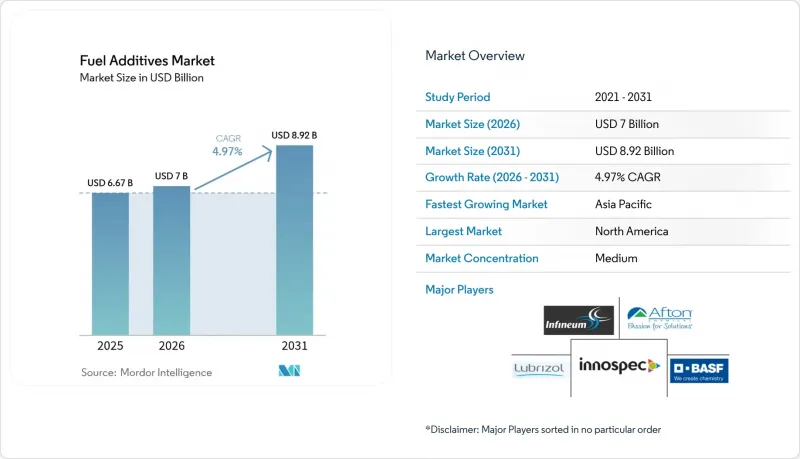
Mordor Intelligence에 따르면 연료 첨가제 시장 규모는 2025년에 66억 7,000만 달러, 2026년에 70억 달러에 달하고, 2031년까지 89억 2,000만 달러에 달할 것으로 예측되며, 2026년부터 2031년까지 CAGR 4.97%로 성장할 것으로 전망됩니다.
본 보고서는 제품 유형(침전물 억제제, 세탄가 향상제, 윤활성 첨가제, 산화 방지제, 방청제, 저온 유동성 향상제, 노킹 방지제 및 기타 제품 유형), 용도(디젤, 가솔린,제트 연료 및 기타 용도), 지역(아시아태평양, 북미, 유럽, 남미, 중동 및 아프리카)별로 분류되어 있습니다. 시장 전망은 금액(달러) 기준으로 제시되어 있습니다.
세계 연료 첨가제 시장의 동향 및 인사이트
엄격한 환경 규제 시행
유럽연합(EU)의 유로 VI, 미국의 휘발유 황 함량에 관한 Tier 3 규제, 그리고 중국 VI의 전면 시행에 따라 전 세계 황 함량 상한선은 10 ppm으로 통일되었습니다. 이로 인해 연료의 천연 윤활성이 저하되어 세정제, 세탄가 향상제, 연소 개량제의 첨가가 의무화되었습니다. 또한, 북미의 ‘탑 티어(Top Tier)’ 휘발유 인증 등 병행되는 자발적 프로그램으로 인해, 브랜드 소매 연료의 침전물 억제를 위한 기준 첨가율이 더욱 상향 조정되고 있습니다. 자동차 제조사들은 보증 조항에서 이러한 기준을 참조하고 있으며, 이로 인해 자발적인 라벨이 사실상 준강제적인 벤치마크로 전환되고 있습니다. 전반적으로 이러한 규제의 수렴은 완제품 연료 1리터당 첨가제 사용량의 구조적 증가를 뒷받침하고 있습니다. 또한, 황, 입자상 물질, 옥탄가 요건을 동시에 충족할 수 있는 다기능 첨가제 패키지의 제품 개발 주기를 가속화하고 있습니다.
원유 품질 저하가 침전물 문제를 심화
세계 생산은 캐나다의 오일샌드와 베네수엘라의 초중질 원유에서 유래한, 더 중질이고 금속 함량이 높은 원유 스트림으로 편중되어 있으며, 이들은 고온에서 침전물 형성을 촉진하는 바나듐과 니켈을 포함하고 있습니다. 이러한 원유에 직면한 정유업체들은 보다 적극적인 수소 처리를 수행하는 경우가 많으며, 미량의 윤활유나 방향족 화합물을 제거하기 위해 다운스트림 공정에서 저온 유동성 개질제나 윤활성 개질제에 대한 의존도가 높아지고 있습니다. 저장 단계에서는 분산제가 존재하지 않는 한, 불안정한 아스팔텐이 슬러지로 침전되어 정유소의 게이트에서 소매 주유소에 이르기까지 첨가제의 밸류체인이 길어지게 됩니다. 중요한 점은, 아시아태평양의 정유사들이 저렴한 러시아산 우랄 원유를 블렌딩하고 있어, 그 결과 왁스 함량이 높고 저온에서 작동성이 떨어지는 디젤 연료가 생산되고 있다는 것입니다. 이 문제는 주유점 강하제 투여량을 늘리는 것만으로만 시정될 수 있습니다.
다기능 첨가제 패키지의 높은 연구개발 비용
침전물을 줄이고, 세탄가를 높이며, 윤활성을 향상시키고, 유동점을 낮추는 다기능 윤활유를 개발하려면 장기간에 걸친 고비용의 공정이 필요하며, 그 결과 소규모 전문 제조업체들은 사실상 시장에서 배제되고 있습니다. GM의 ‘dexos’나 포드의 ‘WSS-M2C936-A’와 같은 주요 OEM 규격에서는 엄격한 노화 시험이 의무화되어 있어, 개발 기간이 길어지고 예산이 증가하는 결과를 초래하고 있습니다. 이러한 비용 증가는 제품 가격 상승으로 이어져, 명백한 성능상의 이점이 있음에도 불구하고 가격에 민감한 시장에서 시장 침투를 저해하고 있습니다. 기존 주요 기업들은 전 세계적인 판매량을 바탕으로 이러한 비용을 분산시키고 있어, 신규 진입자들에게는 큰 장벽이 되고 있습니다. 이러한 상황은 업계 내 합병을 촉진할 뿐만 아니라, 지적 재산의 집중화도 가속화하고 있습니다.
부문 분석
2025년에는 인젝터 끝단의 연소 잔류물을 증가시키는 GDI(직분사 가솔린 엔진) 차량의 증가에 힘입어, 침전물 억제용 화학 약품이 매출의 28.81%를 차지했습니다. 비록 가격이 비싸긴 하지만, 폴리에테르아민(PEA)계 세정제는 고온 연소 환경에서의 내구성과 입자 수를 유로 VI 기준 이내로 유지하는 능력 덕분에 프리미엄 가솔린 분야를 선도하고 있습니다. 이러한 우위는 프리미엄 무연 연료 1리터당 첨가율이 규정되어 있다는 점에서도 분명하며, 연료 첨가제 시장에서 이러한 첨가제가 수행하는 매우 중요한 역할을 부각시키고 있습니다.
저온 유동성 개질제는 판매량이 적긴 하지만, 2031년까지 연평균 성장률(CAGR) 5.51%로 성장할 것으로 예측됩니다. 이러한 성장은 비전통적인 셰일 원유 및 오일샌드 원유의 보급으로 인해 디젤 연료 내 왁스 함량이 증가하고 있는 것이 주요 요인입니다. 에틸렌-비닐아세테이트 공중합체 및 폴리메타크릴레이트는 왁스의 결정 구조를 개질하여 탁점을 5-10°C 낮추고, 극한의 추위 속에서도 여과성을 확보합니다. 유럽과 캐나다에서는 CFPP의 임계값이 -20°C 이하로 설정되어 있어, 이러한 첨가제는 필수적인 요소로 자리 잡고 있습니다. 성숙한 세정제 시장과 급성장하는 저온 유동성 개질제 시장에 힘입어 확대되는 시장은 그 양과 가치 측면에서 다양한 동향을 부각시키고 있습니다.
세탄가 향상제, 주로 2-에틸헥실질산염(2-EHN)은 수소 처리를 통해 탈황된 ULSD(초저유황 디젤)의 점화 품질을 향상시키고, 특정 첨가량에서 세탄가를 높입니다. 윤활성 첨가제는 지방산 메틸 에스터이든 합성계이든, 황 함량 10 ppm의 디젤 연료 배치에 필수적이며,ISO 12156-1에 따라 HFRR(고속 회전 마모 시험)에 의한 마모 흔적이 허용 범위 내에 머물도록 보장합니다. 이러한 필요성으로 인해 기초적인 수요가 확립되어, 연료 첨가제 시장의 상당 부분을 차지하고 있습니다. 또한, 산화 방지제, 방청제, 노킹 방지제, 유화 방지제, 살균제는 전략적 석유 비축에서 바이오디젤 혼합 연료에 이르기까지 특수한 요구 사항을 충족시키며, 상품 규모의 시장과 틈새 시장의 수익률을 융합한 균형 잡힌 포트폴리오를 형성하고 있습니다.
지역별 분석
2025년, 북미는 매출의 35.57%를 차지했습니다. 이는 세정제를 중시하는 엄격한 휘발유 규격, 신형 경차 판매에서 휘발유 직접 분사(GDI)의 높은 보급률, 그리고 세계 최대의 항공 등유 시장이라는 지위에 힘입은 결과입니다. 캐나다에서는 혹독한 겨울 추위로 인해 디젤 연료 풀에서 저온 유동성 개선제의 사용률이 상승하고 있습니다. 한편, 미국에서는 일반 항공기 기단이 존재하기 때문에 정전기 제거제 및 결빙 방지제에 대한 수요가 다른 지역과는 다른 형태로 증가하고 있습니다. 멕시코에서는 2024년 도스 보카스(Dos Bocas) 콤플렉스의 가동 개시가 주목받고 있으며, 정유소의 현대화가 진행되고 있습니다. 이러한 현대화에 따라 전국적으로 초저유황 디젤(ULSD) 및 10ppm 휘발유가 도입되고 있으며, 그 결과 세탄가 향상제 및 윤활성 향상제에 대한 초기 수요가 증가하고 있습니다.
아시아태평양은 2031년까지 연평균 성장률(CAGR) 5.56%를 기록하며 가장 빠르게 성장하는 지역이 될 것으로 예측됩니다. 인도의 ‘바랏 스테이지 VI’ 이니셔티브에서는 도로용 디젤 1리터당 황 함량을 10 ppm 이하로 제한하도록 의무화하고 있으며, 이에 따라 윤활성 화학제품 시장은 수십억 리터 규모로 확대될 것으로 전망됩니다. 2023년 중반까지 중국도 이 움직임에 동참하여, 중국석유화공그룹(Sinopec)과 중국석유(PetroChina)는 도로용 연료에 첨가제를 주입할 수 있는 첨가제 주입 매니폴드를 구축했습니다. 2028년까지 유로 IV에 상응하는 연료 도입을 목표로 하는 동남아시아 국가들, 특히 태국, 인도네시아, 베트남에서는 세탄가 및 저온 유동성에 대한 수요가 크게 증가할 것으로 전망됩니다. 한편, 일본이나 한국 등 성숙한 시장에서는 하이브리드 차량용으로 설계된 프리미엄 첨가제 팩에 초점이 맞춰져 있습니다. 엔진 가동 주기가 불규칙한 이러한 차량의 경우, 장시간 공회전 중에도 높은 산화 안정성이 요구됩니다.
유럽 시장의 성장은 안정화되고 있지만, 여전히 기술 혁신의 최전선에 서 있습니다. ‘재생에너지 지침’에 따라 주요 국가에서는 B10에서 B15의 바이오디젤 혼합 연료 사용이 의무화되어 있습니다. 이 규제로 인해 미생물 증식을 억제하고 산화에 의한 점도 상승을 방지하는 데 필수적인 항산화제 및 안정제의 수요가 증가하고 있습니다. 독일과 프랑스에서는 E20 가솔린의 시범 도입이 진행되고 있으며, 구형 차량에 탑재된 아연 및 황동 부품 보호를 위한 부식 방지제가 필요해지고 있습니다. 남미에서는 브라질이 2026년까지 바이오디젤 혼합 비율을 B12에서 B15로 높일 예정이며, 이에 따라 산화 안정성 솔루션 시장이 확대될 전망입니다. 동시에 아르헨티나의 바카 무에르타 셰일 유전 확장에 따라 경질 저유황 원유가 생산되고 있습니다. 그러나 이러한 원유를 칠레 고지대 시장으로 수출할 때는 저온 유동성 개선이 필요합니다.
중동 및 아프리카의 전망은 양극화되어 있습니다. 걸프협력회의(GCC)의 정유사들은 이미 첨가제를 최소화한 고품질의 저유황 연료를 생산하고 있지만, 사하라 이남 지역의 수입업자들은 규격에 미달하는 휘발유나 디젤을 수령하는 경우가 많습니다. 이러한 연료는 해당 지역의 고온 다습한 저장 환경에서 미생물 오염에 취약하기 때문에 살균제 및 산화 방지제에 대한 안정적인 수요를 창출하고 있습니다. 또한, 사우디아라비아와 쿠웨이트의 합작 정유소에서 처리되는 중질 고황 원유로 인해 아시아 수출용 연료에 대한 침전 억제 첨가제 수요가 증가하고 있습니다. 이러한 추세는 국내 기준이 비교적 완화된 지역에서도 첨가제 공급망이 지속되고 있음을 보여줍니다.
기타 혜택:
- 엑셀 형식의 시장 예측(ME) 시트
- 3개월간의 애널리스트 지원
자주 묻는 질문
목차
제1장 소개
제2장 조사 방법
제3장 주요 요약
제4장 시장 구도
제5장 시장 규모와 성장 예측
제6장 경쟁 구도
제7장 시장 기회와 향후 전망
KSM 26.09.02According to Mordor Intelligence, the fuel additives market size is projected to be USD 6.67 billion in 2025, USD 7 billion in 2026, and reach USD 8.92 billion by 2031, growing at a CAGR of 4.97% from 2026 to 2031.
This report is Segmented by Product Type (Deposit Control, Cetane Improvers, Lubricity Additives, Antioxidants, Anticorrosion, Cold Flow Improvers, Antiknock Agents, and Other Product Types), Application (Diesel, Gasoline, Jet Fuel, and Other Applications), and Geography (Asia-Pacific, North America, Europe, South America, and Middle-East and Africa). The Market Forecasts are Provided in Terms of Value (USD).
Global Fuel Additives Market Trends and Insights
Enactment Of Stringent Environmental Regulations
Implementation of Euro VI in the European Union, Tier 3 gasoline sulfur rules in the United States, and full enforcement of China VI have synchronized global sulfur ceilings at 10 ppm, lowering natural lubricity and driving compulsory dosing of detergents, cetane boosters, and combustion modifiers. Parallel voluntary programs such as the North American "Top Tier" gasoline certification further lift baseline treat rates for deposit control in branded retail fuels. Automakers reference these standards in warranty language, effectively converting a voluntary label into a quasi-mandatory benchmark. Collectively, these converging regulations underpin a structural rise in additive intensity across every liter of finished fuel. They also accelerate product-development cycles for multifunctional packages capable of meeting sulfur, particulate, and octane needs simultaneously.
Degrading Crude-Oil Quality Raising Deposit Issues
Global production is skewing toward heavier, high-metal crude streams from Canadian oil sands and Venezuelan extra-heavy grades, which introduce vanadium and nickel that catalyze high-temperature deposit formation. Refiners facing these slates often hydrotreat more aggressively, stripping trace lubricants and aromatics and raising downstream reliance on cold-flow and lubricity improvers. In storage, unstable asphaltenes precipitate sludge unless dispersants are present, lengthening the additive value chain from refinery gate to retail rack. Importantly, refiners in Asia-Pacific are blending discounted Russian Urals barrels, resulting in diesel cuts with elevated wax content and poor low-temperature operability, an issue corrected only by higher pour-point-depressant treat rates.
High Research And Development Costs For Multifunctional Additive Packages
Developing a multifunctional fluid that reduces deposits, enhances cetane levels, boosts lubricity, and decreases pour point demands a lengthy and costly process, effectively sidelining smaller specialty firms. Major OEM protocols, like GM's dexos and Ford's WSS-M2C936-A, mandate rigorous aging tests, extending timelines and inflating budgets. These heightened expenses translate to elevated product prices, curtailing market penetration in price-sensitive areas, despite evident performance benefits. Established players, leveraging global volumes, spread these costs, creating a significant barrier for new entrants. This dynamic not only fosters industry mergers but also intensifies the concentration of intellectual property.
Other drivers and restraints analyzed in the detailed report include:
- Tight ULSD Specifications In Emerging Economies
- Rising Global Aviation Traffic And Jet-Fuel Demand
- Metal-Containing Additive Bans (e.g., MMT Limits)
For complete list of drivers and restraints, kindly check the Table Of Contents.
Segment Analysis
In 2025, deposit-control chemistries accounted for 28.81% of the revenue, driven by the growing GDI fleet that intensifies combustion residues on injector tips. While pricier, polyether amine (PEA) detergents lead the premium gasoline sector due to their resilience at elevated combustion temperatures and their ability to maintain particulate counts within Euro VI standards. This dominance is evident, with a treat rate integrated into every liter of premium unleaded fuel, highlighting the pivotal role these additives play in the fuel additives landscape.
Cold-flow improvers, despite their smaller sales volume, are projected to grow at a 5.51% CAGR through 2031. This growth is fueled by unconventional shale and oil-sands crudes, introducing elevated wax content into diesel pools. Ethylene-vinyl-acetate copolymers and polymethacrylates modify wax-crystal structure, reducing the cloud point by 5-10 °C and ensuring filterability even in arctic conditions. With Europe and Canada enforcing CFPP thresholds below -20 °C, these additives have become essential. The market's expansion-driven by mature detergents and rapidly growing cold-flow modifiers-highlights the diverse volume and value dynamics at play.
Cetane improvers, chiefly 2-ethylhexyl nitrate (2-EHN), enhance ignition quality in ULSD pools stripped via hydrotreating, boosting cetane numbers with a specific dose. Lubricity additives, whether fatty-acid methyl esters or synthetic variants, are crucial for every 10 ppm sulfur diesel batch, ensuring HFRR wear scars remain within acceptable limits as per ISO 12156-1. This necessity establishes a foundational demand, capturing a significant portion of the fuel additives market. Additionally, antioxidants, anticorrosion agents, antiknock compounds, demulsifiers, and biocides cater to specialized needs, from strategic petroleum reserves to biodiesel blends, creating a balanced portfolio that merges commodity scale with niche margins.
Complete Report Scope:
- By Product Type
- Deposit Control
- Cetane Improvers
- Lubricity Additives
- Antioxidants
- Anticorrosion
- Cold Flow Improvers
- Antiknock Agents
- Other Product Types
- By Application
- Diesel
- Gasoline
- Jet Fuel
- Other Applications
- By Geography
- Asia-Pacific
- China
- India
- Japan
- South Korea
- Rest of Asia-Pacific
- North America
- United States
- Canada
- Mexico
- Europe
- Germany
- United Kingdom
- France
- Italy
- Rest of Europe
- South America
- Brazil
- Argentina
- Rest of South America
- Middle-East and Africa
- Saudi Arabia
- South Africa
- Rest of Middle-East and Africa
- Asia-Pacific
Geography Analysis
In 2025, North America captured a 35.57% share of the revenue, bolstered by stringent detergent-centric gasoline standards, high penetration of Gasoline Direct Injection (GDI) in new light-vehicle sales, and its status as the globe's busiest aviation kerosene market. In Canada, frigid winter temperatures elevate cold-flow treat rates in diesel pools. Meanwhile, the U.S. boasts a unique consumption boost for static dissipators and icing inhibitors, thanks to its general-aviation fleet. Mexico, highlighted by the commissioning of the Dos Bocas complex in 2024, is modernizing its refineries. This modernization introduces Ultra-Low Sulfur Diesel (ULSD) and 10 ppm gasoline nationwide, subsequently driving up the initial demand for cetane and lubricity packages.
Asia-Pacific is projected to be the fastest-growing region at a 5.56% CAGR to 2031. India's Bharat Stage VI initiative mandates a 10 ppm sulfur limit on every liter of on-road diesel, unveiling a multi-billion-liter market for lubricity chemistry. By mid-2023, China mirrored this initiative, with Sinopec and PetroChina establishing additive injection manifolds capable of dosing road fuels. Southeast Asian countries, aiming for Euro IV-equivalent fuel adoption by 2028, are poised for significant surges in cetane and cold-flow demand, especially in Thailand, Indonesia, and Vietnam. Meanwhile, mature markets like Japan and South Korea are focusing on premium additive packs designed for hybrid vehicles. These vehicles, with engines that intermittently run, have heightened oxidation-stability needs during prolonged idle times.
While Europe's market growth has stabilized, it remains at the forefront of technological advancements. Under the Renewable Energy Directive, biodiesel mandates in key countries require B10 to B15 blends. This regulation bolsters the demand for antioxidant and stability chemistries, essential for curbing microbial growth and preventing oxidative thickening. Germany and France are testing E20 gasoline, necessitating corrosion inhibitors to protect zinc and brass components in older vehicle fleets. In South America, Brazil is set to elevate its biodiesel blend from B12 to B15 by 2026, expanding the market for oxidative-stability solutions. Concurrently, Argentina's Vaca Muerta shale expansion is producing light-sweet barrels. However, these barrels require cold-flow modifications when exported to the high-altitude markets of Chile.
The outlook for the Middle East and Africa is divided. While refiners in the Gulf Cooperation Council (GCC) are already producing high-quality, low-sulfur fuels with minimal additives, importers in sub-Saharan regions often receive off-spec gasoline and diesel. These fuels, susceptible to microbial contamination in the region's hot and humid storage, create a consistent demand for biocides and antioxidant solutions. Additionally, heavy-sour crudes processed in joint-venture refineries in Saudi Arabia and Kuwait are raising the demand for deposit-control additives in export fuels heading to Asia. This trend underscores the sustained supply linkages for additives, even in areas with more lenient domestic standards.
- AFTON CHEMICAL
- Baker Hughes Company
- BASF
- Cargill Incorporated
- Chevron Corporation
- Clariant
- Dorf Ketal Chemicals
- Evonik Industries AG
- Exxon Mobil Corporation
- Infineum International Limited
- Innospec
- Lanxess
- The Lubrizol Corporation
- TotalEnergies
Additional Benefits:
- The market estimate (ME) sheet in Excel format
- 3 months of analyst support
TABLE OF CONTENTS
1 Introduction
- 1.1 Study Assumptions and Market Definition
- 1.2 Scope of the Study
2 Research Methodology
3 Executive Summary
4 Market Landscape
- 4.1 Market Overview
- 4.2 Market Drivers
- 4.2.1 Enactment of stringent environmental regulations
- 4.2.2 Degrading crude-oil quality raising deposit issues
- 4.2.3 Tight ULSD specifications in emerging economies
- 4.2.4 Rising global aviation traffic and jet-fuel demand
- 4.2.5 Surge in demand for VLSFO post-IMO 2020 (marine)
- 4.3 Market Restraints
- 4.3.1 High research and development costs for multifunctional additive packages
- 4.3.2 Metal-containing additive bans (e.g., MMT limits)
- 4.3.3 Advanced engine efficiencies reducing fuel-bound detergency needs
- 4.4 Value Chain Analysis
- 4.5 Porter's Five Forces Analysis
- 4.5.1 Bargaining Power of Suppliers
- 4.5.2 Bargaining Power of Buyers
- 4.5.3 Threat of New Entrants
- 4.5.4 Threat of Substitutes
- 4.5.5 Degree of Competition
5 Market Size and Growth Forecasts (Value)
- 5.1 By Product Type
- 5.1.1 Deposit Control
- 5.1.2 Cetane Improvers
- 5.1.3 Lubricity Additives
- 5.1.4 Antioxidants
- 5.1.5 Anticorrosion
- 5.1.6 Cold Flow Improvers
- 5.1.7 Antiknock Agents
- 5.1.8 Other Product Types
- 5.2 By Application
- 5.2.1 Diesel
- 5.2.2 Gasoline
- 5.2.3 Jet Fuel
- 5.2.4 Other Applications
- 5.3 By Geography
- 5.3.1 Asia-Pacific
- 5.3.1.1 China
- 5.3.1.2 India
- 5.3.1.3 Japan
- 5.3.1.4 South Korea
- 5.3.1.5 Rest of Asia-Pacific
- 5.3.2 North America
- 5.3.2.1 United States
- 5.3.2.2 Canada
- 5.3.2.3 Mexico
- 5.3.3 Europe
- 5.3.3.1 Germany
- 5.3.3.2 United Kingdom
- 5.3.3.3 France
- 5.3.3.4 Italy
- 5.3.3.5 Rest of Europe
- 5.3.4 South America
- 5.3.4.1 Brazil
- 5.3.4.2 Argentina
- 5.3.4.3 Rest of South America
- 5.3.5 Middle-East and Africa
- 5.3.5.1 Saudi Arabia
- 5.3.5.2 South Africa
- 5.3.5.3 Rest of Middle-East and Africa
- 5.3.1 Asia-Pacific
6 Competitive Landscape
- 6.1 Market Concentration
- 6.2 Strategic Moves
- 6.3 Market Share(%)/Ranking Analysis
- 6.4 Company Profiles (includes Global Overview, Market Overview, Core Segments, Financials, Strategic Information, Products and Services, Recent Developments)
- 6.4.1 AFTON CHEMICAL
- 6.4.2 Baker Hughes Company
- 6.4.3 BASF
- 6.4.4 Cargill Incorporated
- 6.4.5 Chevron Corporation
- 6.4.6 Clariant
- 6.4.7 Dorf Ketal Chemicals
- 6.4.8 Evonik Industries AG
- 6.4.9 Exxon Mobil Corporation
- 6.4.10 Infineum International Limited
- 6.4.11 Innospec
- 6.4.12 Lanxess
- 6.4.13 The Lubrizol Corporation
- 6.4.14 TotalEnergies
7 Market Opportunities and Future Outlook
- 7.1 White-space and unmet-need assessment