

|
시장보고서
상품코드
2120791
아크릴로니트릴 : 시장 점유율 분석, 업계 동향과 통계, 성장 예측(2026-2031년)Acrylonitrile - Market Share Analysis, Industry Trends & Statistics, Growth Forecasts (2026 - 2031) |
||||||
 Mordor Intelligence
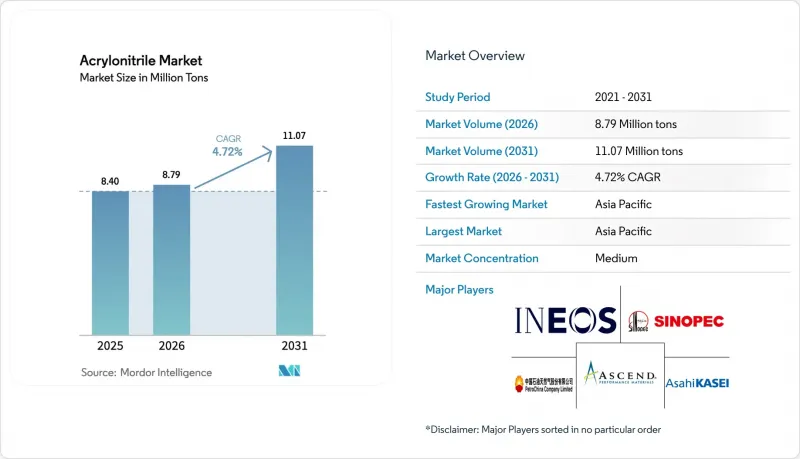
Mordor Intelligence에 의하면, 아크릴로니트릴 시장 규모는 2025년에 840만 톤으로 평가되었고, 2026년 879만 톤에서 2031년까지 1,107만 톤에 이를 것으로 예측되며, 예측 기간(2026-2031년) CAGR은 4.72%를 기록할 전망입니다.
본 보고서는 공정 기술(아목시데이션법 및 기타 제조 공정), 용도(아크릴 섬유, ABS/SAN 수지, 아크릴아미드 등), 최종 이용 산업(자동차 및 운송, 건설 및 인프라 등), 지역(아시아태평양, 북미, 유럽, 남미, 중동 및 아프리카)별로 분류되어 있습니다. 시장 전망은 수량(톤) 기준으로 제시되어 있습니다.
전 세계 아크릴로니트릴 시장 동향 및 인사이트
EU의 바이오화학 분야에 대한 인센티브가 재생 가능 ACN의 시범 사업을 가속화하고 있습니다.
2025년 7월에 발표된 유럽연합 집행위원회의 ‘화학 산업 행동 계획’에서는 대량 생산되는 중간체에 대한 재생 가능 경로에 대한 자금 지원 우선순위가 명확하게 정해져 있습니다. OCI는 현재 AnQore사의 Econitrile 라인에 바이오 암모니아를 공급하고 있으며, 이를 통해 기존의 아모크시데이션에 비해 수명 주기 배출량을 약 60% 감축할 수 있음이 입증되었습니다. NREL 연구진은 3-하이드록시프로피온산으로부터 98%의 전환 수율을 추가로 입증했습니다. 이는 화석 유래 경로와 재생 가능 경로의 비용 격차를 좁히는 획기적인 성과입니다. 스코프 3 대시보드를 공개하고 있는 자동차 OEM 각사는 ABS 컴파운드에 재생 가능 아크릴로니트릴 사용을 지정하기 시작했으며, 바이오 암모니아 공급량이 현재 연간 50만 톤 미만이라는 상한선을 넘어 확대된다면 이러한 변화가 프리미엄 등급 수요를 끌어올릴 가능성이 있습니다. 현재 도입 속도는 그린 수소 프로젝트 일정에 따라 제약을 받고 있지만, EU의 인센티브 제도가 저탄소 중간체를 우대하고 있어 중기적인 성장세는 여전히 양호합니다.
5G 하드웨어 케이스용 전자 등급 SAN 수요 급증
네트워크 장비 제조업체들은 낮은 유전 손실, 난연성 및 자외선 안정성을 겸비한 케이스를 필요로 합니다. 아크릴로니트릴을 28-32% 함유한 전자기기용 SAN은 이러한 요건을 충족하며, 에릭슨과 화웨이가 공급하는 실외 설치형 5G 무선 장치에서 폴리카보네이트 블렌드를 대체하고 있습니다. 모노머 함량이 높기 때문에 범용 SAN 등급에 비해 유닛당 아크릴로니트릴 사용량이 약 15-20% 직접 증가합니다. 한국과 일본의 통합형 제조업체는 컴파운딩 후 첨가제를 추가하지 않고도 UL 94 V-0 규격을 충족하도록 배합을 조정할 수 있으므로, 지역 공급망의 중복성이 향상됩니다. 제품 수명 주기 분석에 따르면, 가혹한 실외 환경에서 SAN 재질의 인클로저는 폴리올레핀 재질의 대체품보다 수명이 길어, 이를 통해 통신 사업자의 교체 비용을 절감할 수 있습니다. 기지국 밀도가 높아짐에 따라, 아크릴로니트릴 시장 수요에 대한 파급 효과는 아시아태평양의 인구 밀집 지역에서 가장 두드러질 것입니다.
프로파일렌 가격 변동은 스팀 크래커 가동 중단과 관련이 있습니다.
프로파일렌 원료는 표준 아목시데이션 공정에서 현금 비용의 약 65%를 차지합니다. 2025년 미국 멕시코만 연안에서 발생한 예기치 못한 크래커 가동 중단으로 인해, 해당 지역의 의도적인 프로파일렌 생산량이 감소했고, 현물 가격은 분기 계약 최저가를 상회했습니다. 한편, 유럽의 정유사들은 금수 조치 대상인 러시아산 원료의 대체재로 미국산 나프타 수입에 의존함에 따라 대서양 횡단 프로파일렌 수급 균형이 타이트해졌고, 중소 아크릴로니트릴 생산자들이 헤지 전략 수립에 어려움을 겪을 정도의 급격한 가격 급등을 초래했습니다. 이러한 동향으로 인해 하류 ABS 및 아크릴 섬유 가공업체의 구매력이 약화되어, 재고를 늘릴 수밖에 없거나 수요 침체기에 수익성을 저해하는 변동 지수에 대한 노출을 감수해야 하는 상황에 처해 있습니다. 스팀 크래커의 가동률이 개선되고, 지역 병목 현상 해소 프로젝트가 2027년 후반에 기계적 준공을 맞이할 때까지 아크릴로니트릴 시장은 주기적인 원가 상승 압력에 직면하게 될 것입니다.
부문 분석
2025년 현재, 아목시데이션 공법은 아크릴로니트릴 시장 점유율의 83.15%를 차지하고 있으며, 기존 플랜트의 지속적인 개조를 통해 2031년까지 연평균 성장률(CAGR) 5.12%로 꾸준한 성장이 예상됩니다. 기존의 소히오(Sohio) 공정에서는 비스무트 몰리브덴산염 촉매를 사용하여 프로파일렌과 암모니아를 반응시켜 싱글 패스 수율이 85%에 육박하지만, 이는 새로운 프로판 공정이나 바이오프로세스에서는 아직 달성되지 않은 벤치마크입니다. INEOS는 2024년에 실 샌즈 공장의 에너지 효율 개선 개조를 완료하고, 열 통합의 단계적 강화 및 촉매 냉각의 미세 조정을 통해 해당 공장의 수율을 최대 3% 향상시킬 수 있음을 확인했습니다. OCI가 공급하는 바이오 암모니아를 사용하는 AnQore의 Econitrile 라인이 주도하는 재생에너지를 활용한 파일럿 프로젝트에서는 라이프사이클 배출량을 약 60% 감축하는 데 성공했으며, 이러한 특성을 통해 자동차 OEM 각사는 스코프 3 배출량 감축으로 이어갈 수 있습니다. 하지만 바이오 암모니아공급량은 여전히 연간 50만 톤 미만에 그치고 있으며, 프로판을 이용한 암모크시데이션은 산화물에 내성이 있는 금속 재료를 사용해야 하기 때문에 여전히 높은 설비 투자가 필요합니다. 그 결과, 바이오 원료의 물류 체계가 개선될 때까지는 절대적인 생산량 증가 측면에서 기존 공정이 주류를 이룰 것입니다.
한편, 반응기 온도를 주기적으로 변화시켜 촉매의 소결을 억제하는 ‘강제 동적 운전’ 기술도 병행하여 발전하고 있으며, 실험실 수준에서는 수율 향상이 확인되었으나 실제 규모에서의 실증은 여전히 필요합니다. 촉매 공급업체들은 동시에 선택성을 높이는 몰리브덴·텔루르 배합 개발을 추진하고 있지만, 430°C 이상에서 운전할 경우 휘발성에 대한 우려가 제기됩니다. 자체적으로 프로파일렌을 보유한 통합형 생산자는 이러한 혁신에 자금을 투입하는 데 있어 가장 유리한 입장에 있으며, 이로 인해 주요 기업이 공급 증가분의 대부분을 차지하는 구조가 더욱 강화될 것입니다.
지역별 분석
아시아태평양은 2025년에 아크릴로니트릴 시장 점유율의 69.81%를 차지할 것이며, 2031년까지 연평균 성장률(CAGR) 5.53%를 나타낼 것으로 예측됩니다. 중국에서만 2025년에 연간 131만 톤의 생산 능력이 추가되어, 중국의 명목 생산 능력은 연간 570만 톤을 넘어섰습니다. 주요 신규 가동 시설로는 절강석유화학의 연산 66만 톤 규모인 다산 제2 플랜트와 중국석유천연가스(페트로차이나)의 연산 26만 톤 규모인 지린 플랜트가 있으며, 이들 모두 다운스트림 공정인 ABS, 아크릴 섬유, 탄소섬유 생산 지역과 통합되어 있습니다. 인도에서는 여전히 구조적인 공급 부족이 지속되고 있으며, 구자라트주 하지라에 연간 생산 능력 4만 1,000톤 규모의 플랜트 1기만이 가동되고 있습니다. 이러한 수급 불균형에 더해 정부의 생산 연동형 인센티브(PLI) 제도가 맞물리면서, 2027년 이후 최소 연간 20만 톤 규모의 신규 생산 능력 증설 계획이 잇따르고 있습니다. 일본과 한국은 촉매 설계 및 특수 SAN 등급 분야에서 계속해서 주도적인 입지를 유지하고 있지만, 자동차 및 가전 분야가 성숙기에 접어들면서 국내 수요는 정체 상태입니다. 이 지역의 성장은 전기차 보급, 5G 인프라 구축, 그리고 남아시아에서의 섬유 제품 수출 확대에 달려 있습니다.
북미와 유럽을 합쳐도 전 세계 소비량의 5분의 1을 조금 넘는 수준에 불과합니다. 미국 멕시코만 연안의 프로파일렌 가격 변동은 정유시설의 정기 정비로 인해 더욱 악화되어, 2025년 아크릴로니트릴의 가동률을 억제했습니다. INEOS는 텍사스주 그린레이크의 연간 45만 톤, 독일 쾰른의 연간 30만 톤 생산 능력을 통해 전략적 유연성을 유지하고 있으며, 이는 수직적 원료 통합의 중요성을 부각시키고 있습니다. 유럽의 생산 기업들은 REACH 규정에 따른 2026년 4월 직업적 노출 한계치 1.0 mg/m³의 시행에 대비하고 있습니다. 이 규정 준수 비용으로 인해 소규모 가공업체들이 시장에서 철수하거나 통합을 강요받을 가능성이 있습니다. 한편, EU의 화학 산업 행동 계획에서는 재생 가능 아크릴로니트릴 시범 사업에 대한 보조금이 동시에 투입되고 있으며, 이러한 동향은 막대한 설비 투자가 필요 없이 바이오 암모니아로 전환이 가능한 기존 기업들에게 유리하게 작용할 것입니다.
중동 및 아프리카, 남미는 이 지역들을 합산했을 때 평균을 상회하는 성장이 예상됩니다. SABIC의 알주바이르 공장(연산 42만 톤)은 프로판이 풍부한 저비용 원료를 활용하고 있으며, 다운스트림 공정에서의 탄소섬유 전구체 사업 전개를 검토하고 있습니다. 튀르키예의 Petkim은 유럽 및 중동의 고객에게 제품을 공급하고 있지만, 가동률은 지역적 정치적 리스크의 영향을 받기 쉬운 상황입니다. 브라질에서는 자동차 생산 회복이 내장 트림용 ABS 수요를 뒷받침하고 있으며, 현지 포장용 가공업체들은 가전제품 케이스용으로 난연성 ABS로의 전환을 추진하고 있습니다. 아프리카는 아직 기반이 소규모이기 때문에 수처리용 아크릴아미드의 중점 시장으로 자리 잡고 있으며, 특히 광업이 활발한 경제권에서는 현재 더 엄격한 폐수 배출 규제가 적용되고 있습니다.
기타 혜택:
- 엑셀 형식 시장 예측(ME) 시트
- 3개월간의 애널리스트 지원
자주 묻는 질문
목차
제1장 서론
제2장 조사 방법
제3장 주요 요약
제4장 시장 구도
제5장 시장 규모와 성장 예측
제6장 경쟁 구도
제7장 시장 기회와 향후 전망
LSH 26.09.08According to Mordor Intelligence, the acrylonitrile market size was valued at 8.40 Million tons in 2025 and is estimated to grow from 8.79 Million tons in 2026 to reach 11.07 Million tons by 2031, at a CAGR of 4.72% during the forecast period (2026-2031).
This report is Segmented by Process Technology (Ammoxidation Process and Other Production Processes), Application (Acrylic Fiber, ABS/SAN Resin, Acrylamide, and More), End-Use Industry (Automotive and Transportation, Construction and Infrastructure, and More), and Geography (Asia-Pacific, North America, Europe, South America, and Middle East and Africa). Market Forecasts are Provided in Terms of Volume (tons).
Global Acrylonitrile Market Trends and Insights
EU Bio-Chemical Incentives Accelerating Renewable ACN Pilots
The European Commission's Chemical Industry Action Plan, published in July 2025, sets explicit funding priorities for renewable pathways in high-volume intermediates. OCI now ships bio-ammonia to AnQore's Econitrile line, enabling a documented ~60% lifecycle-emissions cut compared with conventional ammoxidation. NREL researchers further validated a 98% conversion yield from 3-hydroxypropionic acid, a milestone that narrows the cost gap between fossil and renewable routes. Automotive OEMs that publish Scope 3 dashboards are beginning to specify renewable acrylonitrile in ABS compounds, a shift that could boost premium-grade demand once bio-ammonia availability scales beyond the current sub-500,000 t/y ceiling. Implementation speed is now constrained by green-hydrogen project timing, but medium-term momentum remains favorable as EU incentive structures reward low-carbon intermediates.
Surge in Electronics-Grade SAN for 5G Hardware Casings
Network-equipment manufacturers require housings that combine low dielectric loss, flame retardancy, and UV stability. Electronics-grade SAN, formulated with 28-32% acrylonitrile, meets these criteria and is displacing polycarbonate blends in outdoor 5G radio units supplied by Ericsson and Huawei. The higher monomer content directly lifts acrylonitrile uptake by roughly 15-20% per unit compared with general-purpose SAN grades. Regional supply chains gain redundancy because integrated players in South Korea and Japan can tailor recipes to meet UL 94 V-0 without post-compounding additives. Product life-cycle analyses show that SAN casings outlast polyolefin alternatives in demanding outdoor conditions, thereby lowering replacement costs for telecom operators. As base-station density rises, the associated pull-through effect on acrylonitrile market volumes will be most pronounced in Asia-Pacific's high-population corridors.
Propylene Price Volatility Linked to Steam-Cracker Outages
Propylene feedstock accounts for roughly 65% of cash costs in standard ammoxidation. Unplanned cracker shutdowns in the US Gulf Coast during 2025 cut regional on-purpose propylene output and lifted spot prices above quarterly contract floors. European refiners simultaneously leaned on U.S. naphtha imports to replace embargoed Russian feed, tightening trans-Atlantic propylene balances and creating abrupt price spikes that smaller acrylonitrile producers struggle to hedge. These dynamics weaken the purchasing power of downstream ABS and acrylic-fiber converters, which are forced to carry higher inventories or accept exposure to floating indices that erode profitability during demand troughs. Until steam-cracker reliability improves and regional de-bottlenecking projects reach mechanical completion in late 2027, the acrylonitrile market will face periodic cost-push pressure.
Other drivers and restraints analyzed in the detailed report include:
- Emerging Sodium-Ion Battery Precursor Demand
- Rising ABS Demand in Automotive and Construction
- Engineering Plastics Substitution by Polyolefin Alloys
For complete list of drivers and restraints, kindly check the Table Of Contents.
Segment Analysis
Ammoxidation accounted for 83.15% of the acrylonitrile market share in 2025, and continued brownfield upgrades place the pathway on a steady 5.12% CAGR through 2031. The legacy Sohio process converts propylene and ammonia over bismuth-molybdate catalysts at single-pass yields near 85%, a benchmark that newer propane or bio-routes have yet to match. INEOS completed an energy-efficiency revamp at its Seal Sands unit in 2024, confirming that incremental heat-integration and catalyst-cooling tweaks can lift site-specific yields by up to 3%. Renewable pilots, led by AnQore's Econitrile line using OCI-supplied bio-ammonia, achieve roughly 60% lower lifecycle emissions, an attribute that automotive OEMs can translate into Scope 3 reductions. That said, bio-ammonia availability remains under 500,000 t/y, and propane ammoxidation still requires higher capex owing to oxygenate-resistant metallurgy. As a result, the conventional process will dominate absolute volume additions until bio-feedstock logistics improve.
Parallel advances in forced dynamic operation, in which reactor temperatures cycle to mitigate catalyst sintering, show laboratory yield bumps but need field validation at scale. Catalyst suppliers are simultaneously pursuing molybdenum-tellurium formulations that boost selectivity yet introduce volatility concerns when operating above 430°C. Integrated producers with captive propylene are best positioned to fund these innovations, reinforcing the structure where top-tier players command the lion's share of incremental supply.
Complete Report Scope:
- By Process Technology
- Ammoxidation Process
- Other Production Processes
- By Application
- Acrylic Fiber
- Acrylonitrile Butadiene Styrene (ABS)/Styrene-Acrylonitrile Resin (SAN)
- Acrylamide
- Nitrile-Butadiene Rubber
- Other Applications
- By End-use Industry
- Automotive and Transportation
- Construction and Infrastructure
- Electrical and Electronics
- Textiles and Apparel
- Other End-user Industries (Water and Waste-water Treatment, Packaging and Consumer Goods, etc.)
- By Geography
- Asia-Pacific
- China
- India
- Japan
- South Korea
- Rest of Asia-Pacific
- North America
- United States
- Canada
- Mexico
- Europe
- Germany
- United Kingdom
- France
- Italy
- Russia
- Rest of Europe
- South America
- Brazil
- Argentina
- Rest of South America
- Middle East and Africa
- Saudi Arabia
- South Africa
- Rest of Middle East and Africa
- Asia-Pacific
Geography Analysis
Asia-Pacific held 69.81% acrylonitrile market share in 2025 and is projected to post a 5.53% CAGR through 2031. China alone added 1.31 million t/y of capacity during 2025, bringing national nameplate capacity above 5.7 million t/y. Major start-ups include Zhejiang Petrochemical's 660,000 t/y Daishan Plant 2 and PetroChina's 260,000 t/y Jilin unit, both integrated with downstream ABS, acrylic fiber, and carbon-fiber precincts. India remains structurally short, operating a single 41,000 t/y plant at Hazira, Gujarat; that imbalance, coupled with government Production-Linked Incentives, is spurring proposals for at least 200,000 t/y of new capacity post-2027. Japan and South Korea continue to lead in catalyst design and specialty SAN grades, though domestic demand is flat due to mature automotive and appliance sectors. Regional growth hinges on electric-vehicle penetration, 5G equipment build-out, and expanding textile exports from South Asia.
North America and Europe jointly account for just over one-fifth of global consumption. US Gulf Coast propylene volatility, aggravated by refinery turnarounds, constrained acrylonitrile operating rates in 2025. INEOS maintains strategic flexibility with 450,000 t/y at Green Lake, Texas, and 300,000 t/y in Cologne, Germany, underscoring the importance of vertical feedstock integration. European producers brace for the April 2026 occupational exposure limit of 1.0 mg/m3 under REACH, a compliance cost that could prompt smaller converters to exit or consolidate. The EU Chemical Industry Action Plan simultaneously funnels grants toward renewable acrylonitrile pilots, a dynamic that favors incumbents able to retrofit bio-ammonia inputs without massive capex.
The Middle East, Africa, and South America together are positioned for above-average growth. SABIC's 420,000 t/y Al-Jubail unit leverages low-cost propane-rich feed and is evaluating downstream carbon-fiber precursor ventures. Turkey's Petkim serves both European and Middle Eastern customers, although utilization is sensitive to regional political risk. Brazil's vehicle production rebound supports ABS demand for interior trims, and local packaging converters are shifting toward flame-retardant ABS for appliance housings. Africa's modest base makes it a focus for water-treatment acrylamide, particularly in mining-intensive economies where stricter discharge laws now apply.
- AnQore
- Asahi Kasei Corporation
- Ascend Performance Materials
- China Petrochemical Corporation
- Cornerstone Chemical
- Formosa Plastics Corporation
- INEOS
- Jiangsu Sailboat Petrochemical
- Jiangsu Shenghong Petrochemical
- LG Chem
- Mitsubishi Chemical Group Corporation.
- PetroChina
- Reliance Industries Limited.
- SABIC
- SGL Carbon
- Shanghai SECCO
- SOCAR (Petkim)
- Sumitomo Chemical Co., Ltd.
- Taekwang Industrial
- TONGSUH PETROCHEMICAL CORPORATION,LTD.
- Toray Industries
Additional Benefits:
- The market estimate (ME) sheet in Excel format
- 3 months of analyst support
TABLE OF CONTENTS
1 Introduction
- 1.1 Study Assumptions & Market Definition
- 1.2 Scope of the Study
2 Research Methodology
3 Executive Summary
4 Market Landscape
- 4.1 Market Overview
- 4.2 Market Drivers
- 4.2.1 Rising ABS demand in automotive and construction (mainstream)
- 4.2.2 Growing acrylic-fiber consumption in textiles (mainstream)
- 4.2.3 Expansion of acrylamide for industrial water treatment (mainstream)
- 4.2.4 EU bio-chemical incentives accelerating renewable ACN pilots (under-reported)
- 4.2.5 Surge in electronics-grade SAN for 5G hardware casings (under-reported)
- 4.2.6 Emerging sodium-ion battery precursor demand (under-reported)
- 4.3 Market Restraints
- 4.3.1 Stringent toxicity regulations and REACH compliance costs (mainstream)
- 4.3.2 Propylene price volatility linked to steam-cracker outages (mainstream)
- 4.3.3 Engineering plastics substitution by polyolefin alloys (under-reported)
- 4.3.4 Limited skilled workforce for high-pressure ammoxidation units (under-reported)
- 4.4 Value Chain Analysis
- 4.5 Supply Overview
- 4.6 Regulatory Outlook
- 4.7 Technological Outlook
- 4.8 Porter's Five Forces
- 4.8.1 Bargaining Power of Suppliers
- 4.8.2 Bargaining Power of Buyers
- 4.8.3 Threat of New Entrants
- 4.8.4 Threat of Substitutes
- 4.8.5 Degree of Competition
- 4.9 Production Overview
- 4.10 Production Cost Overview
- 4.11 Pricing Overview
- 4.11.1 Pricing Overview (Acrylonitrile)
- 4.11.2 Raw Material Pricing
5 Market Size & Growth Forecasts (Volume)
- 5.1 By Process Technology
- 5.1.1 Ammoxidation Process
- 5.1.2 Other Production Processes
- 5.2 By Application
- 5.2.1 Acrylic Fiber
- 5.2.2 Acrylonitrile Butadiene Styrene (ABS)/Styrene-Acrylonitrile Resin (SAN)
- 5.2.3 Acrylamide
- 5.2.4 Nitrile-Butadiene Rubber
- 5.2.5 Other Applications
- 5.3 By End-use Industry
- 5.3.1 Automotive and Transportation
- 5.3.2 Construction and Infrastructure
- 5.3.3 Electrical and Electronics
- 5.3.4 Textiles and Apparel
- 5.3.5 Other End-user Industries (Water and Waste-water Treatment, Packaging and Consumer Goods, etc.)
- 5.4 By Geography
- 5.4.1 Asia-Pacific
- 5.4.1.1 China
- 5.4.1.2 India
- 5.4.1.3 Japan
- 5.4.1.4 South Korea
- 5.4.1.5 Rest of Asia-Pacific
- 5.4.2 North America
- 5.4.2.1 United States
- 5.4.2.2 Canada
- 5.4.2.3 Mexico
- 5.4.3 Europe
- 5.4.3.1 Germany
- 5.4.3.2 United Kingdom
- 5.4.3.3 France
- 5.4.3.4 Italy
- 5.4.3.5 Russia
- 5.4.3.6 Rest of Europe
- 5.4.4 South America
- 5.4.4.1 Brazil
- 5.4.4.2 Argentina
- 5.4.4.3 Rest of South America
- 5.4.5 Middle East and Africa
- 5.4.5.1 Saudi Arabia
- 5.4.5.2 South Africa
- 5.4.5.3 Rest of Middle East and Africa
- 5.4.1 Asia-Pacific
6 Competitive Landscape
- 6.1 Market Concentration
- 6.2 Strategic Moves
- 6.3 Market Share/Ranking Analysis
- 6.4 Company Profiles (includes Global level Overview, Market level overview, Core Segments, Financials as available, Strategic Information, Products & Services, Recent Developments)
- 6.4.1 AnQore
- 6.4.2 Asahi Kasei Corporation
- 6.4.3 Ascend Performance Materials
- 6.4.4 China Petrochemical Corporation
- 6.4.5 Cornerstone Chemical
- 6.4.6 Formosa Plastics Corporation
- 6.4.7 INEOS
- 6.4.8 Jiangsu Sailboat Petrochemical
- 6.4.9 Jiangsu Shenghong Petrochemical
- 6.4.10 LG Chem
- 6.4.11 Mitsubishi Chemical Group Corporation.
- 6.4.12 PetroChina
- 6.4.13 Reliance Industries Limited.
- 6.4.14 SABIC
- 6.4.15 SGL Carbon
- 6.4.16 Shanghai SECCO
- 6.4.17 SOCAR (Petkim)
- 6.4.18 Sumitomo Chemical Co., Ltd.
- 6.4.19 Taekwang Industrial
- 6.4.20 TONGSUH PETROCHEMICAL CORPORATION,LTD.
- 6.4.21 Toray Industries
7 Market Opportunities & Future Outlook
- 7.1 White-Space & Unmet-Need Assessment
- 7.2 Development of Bio-Based Acrylonitrile


