|
시장보고서
상품코드
2120829
인간 마이크로바이옴 시장 : 시장 점유율 분석, 업계 동향 및 통계, 성장 예측(2026-2031년)Human Microbiome - Market Share Analysis, Industry Trends & Statistics, Growth Forecasts (2026 - 2031) |
||||||
 Mordor Intelligence
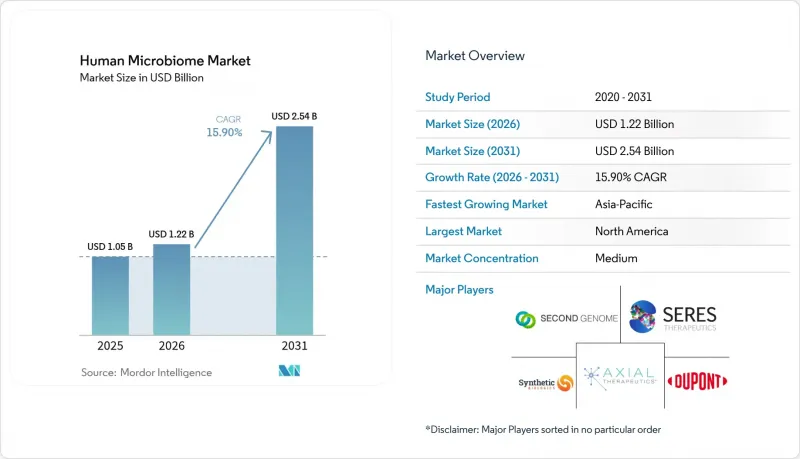
Mordor Intelligence에 의하면, 인간 마이크로바이옴 시장 규모는 2025년 10억 5,000만 달러로 평가되었고, 2026년에는 12억 2,000만 달러로 추정되고, 2026-2031년 CAGR 15.9%로 성장을 지속할 전망이며, 2031년까지 25억 4,000만 달러에 이를 것으로 예측됩니다.
본 보고서는 제품별(의약품, 건강기능식품, 진단 검사, 기타 제품), 용도별(치료, 진단), 질환 분야별(위장 질환, 암 등), 최종 사용자별(병원 및 진료소 등), 지역별(북미, 유럽, 아시아태평양, 중동 및 아프리카, 남미)로 분류되어 있습니다. 시장 예측은 금액(달러) 기준으로 제시되어 있습니다.
세계의 인간 마이크로바이옴 시장 동향 및 인사이트
차세대 시퀀싱 기술의 발전으로 미생물군집 분석 비용 감소
MinION 및 PromethION과 같은 실시간 나노포어 시퀀싱 장치를 통해 샘플당 비용이 약 70% 절감되어, 과거에는 중앙 집중식 연구소가 필요했던 프로파일링을 일상적으로 수행할 수 있게 되었습니다. 휴대용 플랫폼을 통해 장내 미생물 군집의 현장 진단(Point-of-Care) 분석이 가능해져, 진단까지 걸리는 시간을 단축하고 경과에 따른 모니터링을 지원하고 있습니다. PacBio 시스템이 제공하는 전체 길이의 16S rRNA 워크플로는 바이오마커 발견에 필요한 분류학적 해상도를 한층 더 높이고 있습니다. 시퀀싱 비용은 100달러 수준으로 하락하는 추세에 있어, 만성 질환 관리 과정에 마이크로바이옴 검사를 통합하는 것이 현실화되고 있습니다. 병원에서는 이미 염증성 장 질환 환자를 대상으로 한 정기적인 미생물 서베이런스가 시범적으로 도입되고 있으며, 합리적인 가격의 시퀀싱이 갖는 임상적 중요성이 입증되고 있습니다. 이러한 발전들이 결합되면서 진단 및 치료 두 분야 모두에서 인간 마이크로바이옴 시장의 잠재적 적용 범위가 확대되고 있습니다.
마이크로바이옴 기반 치료제에 대한 벤처 자금 조달 증가
2025년에는 이 분야에 특화된 벤처 펀드와 전략적 기업 투자자들이 사상 최대 규모의 자금을 투입하여, 유럽, 북미, 동아시아에서 수십 건의 시드 라운드 및 시리즈 A 라운드가 촉진되었습니다. Abolis Biotechnologies와 같은 유럽의 개발 기업들은 바이오 제조 역량 확대를 위해 3,500만 유로를 확보한 반면, CARB-X와 같은 민관 협력 이니셔티브는 항생제 내성 대책 적용을 목적으로 수백만 달러 규모의 보조금을 지급했습니다. 얀센 산하의 휴먼 마이크로바이옴 인스티튜트(Human Microbiome Institute)는 스타트업이 대형 제약사와 공동으로 병용 요법용 자산을 개발할 수 있도록 하는 유연한 파트너십 체제를 구축했습니다. 제약 기업과 마이크로바이옴 분야의 제휴에는 미리 정해진 마일스톤에 연동된 출자가 포함되는 경우가 많으며, 이를 통해 신생 기업은 자금 조달의 확실성과 멘토에 대한 접근성을 확보할 수 있습니다. 그 결과 발생하는 자금 유입은 개발 기간 단축, 인재 확보, 규제 당국에 대한 신청 절차 가속화로 이어져, 인간 마이크로바이옴 시장의 성장세를 더욱 강화하고 있습니다.
표준화 및 규제 지침의 부재
미생물군집 치료제는 의약품 규제와 이식 규제의 경계에 위치해 있어 정책상의 모호성이 발생하고 있습니다. 이로 인해 국경을 넘는 임상시험 및 시장 출시가 지연되고 있습니다. FDA, EMA 및 일본의 PMDA 간에 생체 치료용 제품의 정의에 차이가 있어, 신청 서류 작성이 복잡해지고 상호 승인 노력이 저해되고 있습니다. 각 연구소가 DNA 추출, 라이브러리 조제, 생물정보학 워크플로우를 각각 다르게 채택하고 있어 분석 결과의 불일치가 여전히 지속되고 있으며, 일관성 없는 측정 결과가 임상의의 신뢰를 떨어뜨리고 있습니다. 인간 유래 물질을 규제하는 유럽연합(EU)의 새로운 규정에 따라 향후 규제 조화가 예상되지만, 2026년까지는 완전히 시행되지 않을 것입니다. 세계적인 기준이 통일될 때까지 각 기업은 지역별 검증 시험에 예산을 할당해야 하며, 이로 인해 비용이 증가하고 인간 마이크로바이옴 시장에서 수익 창출이 지연될 것입니다.
부문 분석
건강기능식품은 2025년에도 매출 점유율 39.35%를 유지했으며, 이는 오랜 기간에 걸친 소비자 정착과 간소화된 규제 절차를 반영한 것입니다. 한편, 의약품 부문은 재발성 C. 디피실 감염증에 대해 임상적으로 입증된 효과를 보이는 VOWST 및 REBYOTA와 같은 획기적인 승인에 힘입어 2031년까지 연평균 성장률(CAGR) 17.9%를 기록할 전망입니다. VOWST의 초기 출시로 2023년 4분기에는 1,040만 달러의 매출이 기록되었으며, 이는 시장 수요가 입증되었음을 보여줄 뿐만 아니라 추가 신청을 촉진하는 계기가 되었습니다. 프로바이오틱스 보충제의 경우, 당국이 식품과 생물학적 제제를 명확히 구분하려는 움직임이 강화되면서 규제가 엄격해지고 있으며, 각 제조업체는 무작위 대조 시험에 투자할 수밖에 없는 상황입니다.
진단 분석은 여전히 수익 기여도가 가장 낮은 분야이지만, 종양학 및 대사 질환 임상시험에서 환자 계층화를 위한 동반 진단 검사가 필수적으로 요구됨에 따라 투자가 활발해지고 있습니다. 포스트바이오틱스와 유전자 변형 균주는 뉴트라슈티컬과 의약품 영역을 연결할 가능성을 지닌 신흥 틈새 시장입니다. 소비자용 제품과 처방전이 필요한 제품의 양분화는 더 광범위한 인간 마이크로바이옴 시장에서 다양한 수익원을 뒷받침하고 있습니다.
2025년에는 매출의 69.35%를 치료 용도가 차지했으나, 시퀀싱 비용의 급격한 하락과 분석 소프트웨어의 성숙에 따라 진단 분야는 2031년까지 연평균 성장률(CAGR) 18.8%를 나타낼 것으로 예측됩니다. 병원 네트워크에서는 면역종양학 약물에 대한 반응을 예측하는 대변 검사 패널의 실증 시험이 진행되고 있으며, 이를 통해 치료법 선택 및 보험 환급 결과가 개선되고 있습니다. 대변 미생물군 이식은 여전히 대표적인 치료 모델이지만, 현재 개발 파이프라인에는 대사성 질환, 자가면역 질환, 신경 질환을 표적으로 하는 경구용 캡슐, 외용제, 그리고 유전자 변형 균주가 포함되어 있습니다.
샘플링 키트, 시퀀싱 서비스, AI 분석 및 표적화된 중재를 결합한 엔드투엔드 플랫폼의 융합을 통해 통합적인 치료 경로가 실현될 전망입니다. 검증된 진단법과 독자적으로 개발한 치료법을 결합할 수 있는 개발자는 인간 마이크로바이옴 시장 전체에서 매우 큰 가치를 창출할 가능성이 있습니다.
지역별 분석
북미는 2025년 전 세계 매출의 41.75%를 차지했습니다. 이는 FDA 지침, 경험이 풍부한 벤처 네트워크, 그리고 일정 규모의 GMP 제조 시설에 힘입은 결과입니다. 조기 도입 병원에서는 재발성 C. 디피실 감염증에 대해 분변 미생물군 이식을 일상적으로 시행하고 있으며, 종양학용 진단 패널의 시범 운영도 진행하고 있습니다. 상환 기준이 명확해짐에 따라 더 광범위한 보급이 촉진되고 있으며, 인간 마이크로바이옴 시장 시장 역학에서 이 지역의 영향력은 확고해지고 있습니다.
유럽은 밀집된 학술 클러스터와 조율된 자금 조달 체계의 혜택을 받고 있습니다. 유럽연합 집행위원회의 2025년 생명공학 로드맵에서는 건강과 지속가능성을 위한 미생수처리제가 우선 과제로 자리 잡고 있습니다. 그러나 국가마다 다른 규제 체제가 여러 국가에 걸친 임상시험을 지연시키고 있어, 제조업체들은 여전히 비용이 많이 드는 병행 신청에 의존할 수밖에 없는 상황입니다. 프랑스나 네덜란드에서 볼 수 있는 민관 파트너십은 경쟁력을 유지하기 위한 중개 연구 자금을 제공합니다.
아시아태평양에서는 규제 당국이 통일된 기준에 부합하도록 노력하고 있으며, 현지 기업들이 발효 및 충전·완성 능력에 자본을 투자하고 있어 연평균 성장률(CAGR) 18.35%를 나타낼 것으로 예측됩니다. 2025년 일본에서 가동을 예정하고 있는 JSR-Metagen의 공장은 이 지역이 국내 생산 능력 육성에 주력하고 있음을 보여주는 좋은 예입니다. 줄리그 파마(Zulig Pharma)가 동남아시아 전역에서 OMNi-BiOTiC 프로바이오틱스를 판매하는 10년간의 계약과 같은 제휴는 대상 시장을 더욱 확대되고 있습니다. 중국과 한국은 마이크로바이옴 관련 프로젝트를 국가의 정밀의료 정책과 연계함으로써 상용화를 가속화하고 있습니다. 이러한 동향들이 맞물리면서, 전 세계적으로 인간 마이크로바이옴 시장에 대한 진출이 확대되고 있습니다.
기타 혜택 :
- 엑셀 형식 시장 예측(ME) 시트
- 3개월간의 애널리스트 지원
자주 묻는 질문
목차
제1장 서론
제2장 조사 방법
제3장 주요 요약
제4장 시장 구도
제5장 시장 규모 및 성장 예측
제6장 경쟁 구도
제7장 시장 기회 및 향후 전망
AJY 26.09.09According to Mordor Intelligence, the human microbiome market size is expected to grow from USD 1.05 billion in 2025 to USD 1.22 billion in 2026 and is forecast to reach USD 2.54 billion by 2031 at 15.9% CAGR over 2026-2031.
This report is Segmented by Product (Drugs, Supplements, Diagnostic Tests, Other Products), Application (Therapeutics, Diagnostics), Disease Area (Gastrointestinal Disorder, Cancer, and More), End-User (Hospitals and Clinics, and More), and Geography (North America, Europe, Asia-Pacific, Middle East and Africa, South America). Market Forecasts are Provided in Terms of Value (USD).
Global Human Microbiome Market Trends and Insights
Advancements in Next-Generation Sequencing Lowering Microbiome Analysis Costs
Real-time nanopore sequencing devices such as MinION and PromethION have cut per-sample costs by roughly 70%, enabling routine profiling that once required centralized laboratories . Portable platforms permit point-of-care analysis of gut microflora, accelerating diagnostic turnaround and supporting longitudinal monitoring. Full-length 16S rRNA workflows delivered by PacBio systems further increase taxonomic resolution needed for biomarker discovery. Sequencing expenditures are trending toward the USD 100 threshold, elevating the feasibility of incorporating microbiome checks into chronic-disease management pathways . Hospitals are already piloting regular microbial surveillance for inflammatory bowel disease patients, confirming the clinical relevance of affordable sequencing. Combined, these advances are widening the addressable base of the human microbiome market across both diagnostics and therapeutics.
Rising Venture Funding for Microbiome-Based Therapeutics
Dedicated venture funds and strategic corporate investors allotted record capital to the sector in 2025, catalyzing dozens of seed and Series A rounds in Europe, North America, and East Asia. European developers such as Abolis Biotechnologies secured EUR 35 million to scale biomanufacturing capacity, while public-private initiatives like CARB-X handed out multimillion-dollar grants targeting antimicrobial-resistance applications. Janssen's Human Microbiome Institute cemented flexible partnership vehicles that enable start-ups to co-develop co-therapy assets with large-scale drug manufacturers . Pharma-microbiome alliances frequently include equity investments tied to predefined milestones, giving young companies funding certainty and mentor access. The resultant capital inflows shorten development timelines, drive talent acquisition, and speed regulatory submissions, reinforcing the upward momentum of the human microbiome market.
Lack of Standardization and Regulatory Guidelines
Microbiome therapeutics straddle medicinal-product and transplant regulations, generating policy ambiguity that slows cross-border trials and market launches. Divergent definitions of live biotherapeutic products across the FDA, EMA, and Japan's PMDA complicate dossier preparation and compromise mutual-recognition ambitions. Analytical discord persists as laboratories deploy varied DNA-extraction, library-prep, and bioinformatics workflows, producing inconsistent readouts that dampen clinician trust. Upcoming European Union rules governing substances of human origin promise eventual harmonization but will not take full effect before 2026. Until global norms converge, companies must budget for region-specific validation studies, raising costs and delaying revenue capture in the human microbiome market.
Other drivers and restraints analyzed in the detailed report include:
- Expanding Applications in Personalized Medicine
- Expansion of Direct-to-Consumer Microbiome Testing
- GMP Scale-Up Challenges for Live Biotherapeutics
For complete list of drivers and restraints, kindly check the Table Of Contents.
Segment Analysis
Supplements maintained a 39.35% revenue share in 2025, reflecting longstanding consumer adoption and streamlined regulatory routes. Drugs, however, are on track to register an 17.9% CAGR through 2031, buoyed by landmark approvals such as VOWST and REBYOTA, which showcase clinically proven benefits against recurrent C. difficile infections. Initial roll-out of VOWST generated USD 10.4 million in Q4 2023, validating commercial appetite and emboldening additional filings. Probiotic supplements face mounting scrutiny as authorities delineate dietary products from live biotherapeutic drugs, prompting manufacturers to invest in randomized controlled trials.
Diagnostic assays remain the smallest contributor but attract intensified investment as companion tests become essential for patient stratification in oncology and metabolic trials. Postbiotics and engineered bacterial strains represent emerging niches that may bridge nutraceutical and pharmaceutical spaces. The bifurcation of consumer-grade and prescription-grade offerings underpins diversified revenue streams within the broader human microbiome market.
Therapeutic use cases accounted for 69.35% of revenue in 2025, yet diagnostics enjoy a forecast 18.8% CAGR to 2031 as sequencing costs plummet and analytical software matures. Hospital networks are piloting stool-based panels that predict response to immuno-oncology agents, improving treatment selection and reimbursement outcomes. Fecal microbiota transplantation remains the archetypal therapeutic model, but pipeline assets now encompass oral capsules, topical formulations, and engineered strains targeting metabolic, autoimmune, and neurologic diseases.
The convergence of end-to-end platforms that combine sampling kits, sequencing services, AI analytics, and targeted interventions promises integrated care pathways. Developers able to link a validated diagnostic to a proprietary therapeutic could capture outsized value across the human microbiome market size.
Complete Report Scope:
- By Product
- Drugs
- Supplements
- Probiotics
- Prebiotics
- Synbiotics
- Diagnostic Tests
- Other Products
- By Application
- Therapeutics
- Diagnostics
- By Disease Area
- Gastrointestinal Disorders
- Metabolic Disorders
- Cancer
- Autoimmune & Inflammatory Diseases
- Central Nervous System Disorders
- Other Applications
- By End-user
- Hospitals and Clinics
- Pharmaceutical & Biotechnology Companies
- Research & Academic Institutes
- Others
- By Geography
- North America
- United States
- Canada
- Mexico
- Europe
- Germany
- United Kingdom
- France
- Italy
- Spain
- Rest of Europe
- Asia-Pacific
- China
- Japan
- India
- Australia
- South Korea
- Rest of Asia
- Middle East and Africa
- GCC
- South Africa
- Rest of Middle East and Africa
- South America
- Brazil
- Argentina
- Rest of South America
- North America
Geography Analysis
North America commanded 41.75% of global revenue in 2025, underpinned by FDA guidance, seasoned venture networks, and a critical mass of GMP plants. Early adopter hospitals routinely implement fecal microbiota transplantation for recurrent C. difficile and are piloting diagnostic panels for oncology. Increasing reimbursement clarity supports broader uptake, solidifying the region's influence on human microbiome market dynamics.
Europe benefits from dense academic clusters and coordinated funding frameworks; the European Commission's 2025 biotechnology roadmap prioritizes microbial therapeutics for health and sustainability. Yet divergent national oversight regimes slow multicountry trials, keeping manufacturers reliant on expensive parallel submissions. Public-private partnerships such as those in France and the Netherlands supply translational funding that sustains competitiveness.
Asia-Pacific is projected to record an 18.35% CAGR as regulators converge on harmonized standards and local companies pour capital into fermentation and fill-finish capabilities. The JSR-Metagen plant scheduled for 2025 in Japan exemplifies the region's resolve to nurture domestic production capacity. Partnerships like Zuellig Pharma's decade-long deal to distribute OMNi-BiOTiC probiotics across Southeast Asia further enlarge the addressable base. China and South Korea expedite commercialization by bundling microbiome projects with national precision-medicine policies. Collectively, these developments broaden global participation in the human microbiome market.
- Seres Therapeutics Inc.
- International Flavors & Fragrances Inc. (IFF Health)
- OptiBiotix Health PLC
- Biomebank
- Pendulum
- Axial Biotherapeutics Inc.
- Finch Therapeutics Group
- 4D Pharma PLC
- Enterome SA
- Evelo Biosciences Inc.
- Microba Life Sciences Ltd.
- Osel
- Second Genome
- Vedanta Biosciences Inc.
- BiomX Inc.
- Synlogic
- Chr. Hansen Holding
- Probi AB
- Assembly Biosciences Inc.
- Kaleido Biosciences Inc.
Additional Benefits:
- The market estimate (ME) sheet in Excel format
- 3 months of analyst support
TABLE OF CONTENTS
1 Introduction
- 1.1 Study Assumptions & Market Definition
- 1.2 Scope of the Study
2 Research Methodology
3 Executive Summary
4 Market Landscape
- 4.1 Market Overview
- 4.2 Market Drivers
- 4.2.1 Advancements in next-generation sequencing lowering microbiome analysis costs
- 4.2.2 Rising venture funding for microbiome-based therapeutics
- 4.2.3 Expanding Applications in Personalized Medicine
- 4.2.4 Expansion of Direct to Consumer microbiome testing
- 4.2.5 Pharma-microbiome co-therapy alliances
- 4.2.6 Growing awareness about the advantages of microbiome-based products
- 4.3 Market Restraints
- 4.3.1 Lack of Standardization and Regulatory Guidelines
- 4.3.2 GMP scale-up challenges for live biotherapeutics
- 4.3.3 Limited Understanding of Complex Microbiome Interactions
- 4.3.4 Slow patient adoption
- 4.4 Value / Supply-Chain Analysis
- 4.5 Regulatory Landscape
- 4.6 Porter's Five Forces Analysis
- 4.6.1 Threat of New Entrants
- 4.6.2 Bargaining Power of Buyers
- 4.6.3 Bargaining Power of Suppliers
- 4.6.4 Threat of Substitutes
- 4.6.5 Intensity of Competitive Rivalry
5 Market Size & Growth Forecasts (Value, USD)
- 5.1 By Product
- 5.1.1 Drugs
- 5.1.2 Supplements
- 5.1.2.1 Probiotics
- 5.1.2.2 Prebiotics
- 5.1.2.3 Synbiotics
- 5.1.3 Diagnostic Tests
- 5.1.4 Other Products
- 5.2 By Application
- 5.2.1 Therapeutics
- 5.2.2 Diagnostics
- 5.3 By Disease Area
- 5.3.1 Gastrointestinal Disorders
- 5.3.2 Metabolic Disorders
- 5.3.3 Cancer
- 5.3.4 Autoimmune & Inflammatory Diseases
- 5.3.5 Central Nervous System Disorders
- 5.3.6 Other Applications
- 5.4 By End-user
- 5.4.1 Hospitals and Clinics
- 5.4.2 Pharmaceutical & Biotechnology Companies
- 5.4.3 Research & Academic Institutes
- 5.4.4 Others
- 5.5 By Geography
- 5.5.1 North America
- 5.5.1.1 United States
- 5.5.1.2 Canada
- 5.5.1.3 Mexico
- 5.5.2 Europe
- 5.5.2.1 Germany
- 5.5.2.2 United Kingdom
- 5.5.2.3 France
- 5.5.2.4 Italy
- 5.5.2.5 Spain
- 5.5.2.6 Rest of Europe
- 5.5.3 Asia-Pacific
- 5.5.3.1 China
- 5.5.3.2 Japan
- 5.5.3.3 India
- 5.5.3.4 Australia
- 5.5.3.5 South Korea
- 5.5.3.6 Rest of Asia
- 5.5.4 Middle East and Africa
- 5.5.4.1 GCC
- 5.5.4.2 South Africa
- 5.5.4.3 Rest of Middle East and Africa
- 5.5.5 South America
- 5.5.5.1 Brazil
- 5.5.5.2 Argentina
- 5.5.5.3 Rest of South America
- 5.5.1 North America
6 Competitive Landscape
- 6.1 Market Concentration
- 6.2 Market Share Analysis
- 6.3 Company Profiles (includes Global level Overview, Market level Overview, Core Business Segments, Financials, Headcount, Key Information, Market Rank, Market Share, Products and Services, and Analysis of Recent Developments)
- 6.3.1 Seres Therapeutics Inc.
- 6.3.2 International Flavors & Fragrances Inc. (IFF Health)
- 6.3.3 OptiBiotix Health PLC
- 6.3.4 Biomebank
- 6.3.5 Pendulum
- 6.3.6 Axial Biotherapeutics Inc.
- 6.3.7 Finch Therapeutics Group Inc.
- 6.3.8 4D Pharma PLC
- 6.3.9 Enterome SA
- 6.3.10 Evelo Biosciences Inc.
- 6.3.11 Microba Life Sciences Ltd.
- 6.3.12 Osel Inc.
- 6.3.13 Second Genome Inc.
- 6.3.14 Vedanta Biosciences Inc.
- 6.3.15 BiomX Inc.
- 6.3.16 Synlogic Inc.
- 6.3.17 Chr. Hansen Holding A/S
- 6.3.18 Probi AB
- 6.3.19 Assembly Biosciences Inc.
- 6.3.20 Kaleido Biosciences Inc.
7 Market Opportunities & Future Outlook
- 7.1 White-space & Unmet-need Assessment