|
시장보고서
상품코드
2121201
클라우드 보안 소프트웨어 : 시장 점유율 분석, 업계 동향과 통계, 성장 예측(2026-2031년)Cloud Security Software - Market Share Analysis, Industry Trends & Statistics, Growth Forecasts (2026 - 2031) |
||||||
 Mordor Intelligence
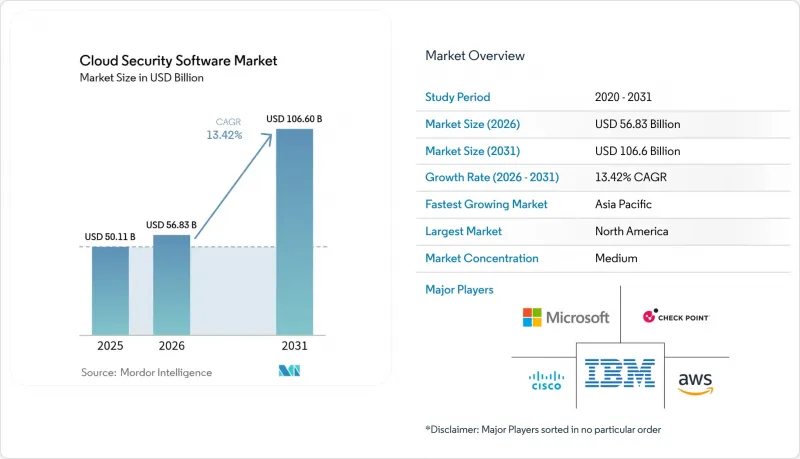
Mordor Intelligence에 의하면, 클라우드 보안 소프트웨어 시장 규모는 2025년에 501억 1,000만 달러로 평가되었고, 2026년 568억 3,000만 달러에서 2031년까지 1,066억 달러에 이를 것으로 예측되며, 예측 기간(2026-2031년) CAGR은 13.42%를 기록할 전망입니다.
본 보고서는 소프트웨어별(클라우드 IAM, CASB, CNAPP/CWPP 등),도입 형태별(퍼블릭 클라우드, 프라이빗 클라우드, 하이브리드/멀티 클라우드), 조직 규모별(대기업 및 중소기업(SME)), 최종 사용자 산업별(은행, 금융서비스 및 보험(BFSI), IT 및 통신, 헬스케어 및 생명과학 등), 그리고 지역별로 분류되어 있습니다.
전 세계 클라우드 보안 소프트웨어 시장 동향 및 인사이트
규제 대상 산업에서의 퍼블릭 클라우드 도입 급속한 확대
규제 대상 기업들은 감독 기관의 클라우드 지침 업데이트에 따라 레거시 아키텍처 개편을 추진하고 있습니다. 연방금융기관검사위원회(FFIEC)는 현재 실시간 제3자 위험 모니터링을 중시하고 있으며, 이에 따라 은행 및 보험사는 규정 준수 증거를 지속적으로 검증하는 자동화된 관리 조치 도입을 추진하고 있습니다. 마찬가지로 의료 서비스 제공업체들도 단순한 규제 요건의 형식적 충족에 그치지 않고, 경쟁 우위를 가져다주는 보안 인증에 맞추어 현대화 계획을 수립하고 있습니다. 연방 위험 및 승인 관리 프로그램(FedRAMP)의 개혁으로 클라우드 전환의 정당성이 더욱 높아지면서, 그 도입 기대감이 계약업체와 공급업체로도 확산되고 있습니다. 벤더들은 이에 대응하여 도입 기간을 단축하고, 정책을 멀티클라우드 환경 전반에 걸친 프로그램화된 보안 조치로 전환하는 사전 패키지화된 컴플라이언스 템플릿을 제공합니다.
멀티클라우드 및 하이브리드 클라우드의 복잡성 급증
기업은 일반적으로 3.2개의 클라우드 공급자에서 워크로드를 실행하고 있으며, 이로 인해 정책의 사일로화와 통합 부채가 증가하고 있습니다. 서로 다른 API와 다양한 보안 모델은 기반 인프라에 의존하지 않고 제어를 표준화할 수 있는 중앙 집중식 오케스트레이션에 대한 수요를 높이고 있습니다. 그 결과, 컨테이너 및 서버리스 함수 전반에 걸친 구성 오류나 실행 시 이상 현상을 감지하는 클라우드 네이티브 애플리케이션 보호 플랫폼이 주목받고 있습니다. 당초 기업들은 리스크 분산을 목적으로 멀티클라우드를 도입했으나, 현재는 비용, 성능 및 법적 규제 요건의 차이에 따라 운영상의 지속가능성을 유지하기 위해 오케스트레이션에 의존하게 되었습니다.
레거시 보안 스택에 수반되는 통합 부채
클라우드 제어가 On-Premise 투자와 겹치면서, 보안 담당자들은 도구 중복과 정책 불일치로 골머리를 앓고 있습니다. 병행되는 환경은 공격 경로를 불분명하게 만들고 운영 비용을 부풀립니다. 특히 조직이 허브 앤 스포크형 네트워크에 제로 트러스트 모델을 사후에 도입하는 경우, 이러한 경향은 더욱 두드러집니다. 통합된 텔레메트리가 없다면 위협 인텔리전스는 사일로화된 상태로 남아, 시정 주기가 장기화되어 보안 투자의 ROI가 저하됩니다.
부문 분석
2025년, 클라우드 ID 및 액세스 관리(IAM)는 클라우드 보안 소프트웨어 시장 점유율의 34.42%를 차지하며, 제로 트러스트 도입에 있어 그 기초적인 역할을 반영하고 있습니다. 조직이 횡방향 이동 위험을 완화하기 위해 최소 권한 정책을 우선시함에 따라, 이 부문의 확고한 입지가 클라우드 보안 소프트웨어 시장 전체를 뒷받침하고 있습니다. 동시에, 클라우드 네이티브 애플리케이션 보호 플랫폼 및 클라우드 워크로드 보호 플랫폼은 2031년까지 연평균 성장률(CAGR) 14.12%를 달성할 전망이며, 이는 실행 시 보호가 필요한 컨테이너화된 워크로드의 보급을 반영합니다. 이러한 부상은 DevSecOps 파이프라인에 통합되어 개발부터 프로덕션 환경에 이르기까지 지속적인 평가를 제공하는 클라우드 액세스 보안 브로커(CASB) 및 취약점 스캐너의 동향과 맞물려 진행되고 있습니다.
통합 로깅에 대한 수요는 보안 정보 및 이벤트 관리(SIEM)의 현대화를 촉진하고 있으며, 각 플랫폼은 머신 러닝을 활용하여 클라우드 규모의 텔레메트리 데이터를 분석함으로써 감지까지의 평균 시간(MTD)을 단축하고 있습니다. 또한 SEALSQ의 ‘Crystal Kyber’ 및 ‘Crystal Dilithium’ 시연이 보여주듯이, 각 벤더는 양자 내성 알고리즘에 대한 실험을 더욱 진행하고 있으며, 이는 암호화 분야의 장기적인 진화를 시사합니다. 이러한 혁신들은 전반적으로 카테고리의 경계를 재정의하며, 플랫폼 벤더들이 조달 및 운영을 간소화하기 위해 인접 기능을 통합 제품군에 포함하도록 촉진하고 있습니다.
2025년, 퍼블릭 클라우드는 클라우드 보안 소프트웨어 시장 규모의 64.85% 점유율을 유지했습니다. 이는 2025년에 2150억 달러에 달한 하이퍼스케일러의 투자에 힘입은 결과입니다. 아마존만 해도 750억 달러 이상을 투자하여 네이티브 보안 서비스와 지리적 중복성을 강화했습니다. 퍼블릭 클라우드의 규모의 경제가 있음에도 불구하고, 기업들이 워크로드 이식성, 데이터 거주지 보장 및 비용 최적화를 추구하는 가운데, 하이브리드 및 멀티 클라우드 환경은 14.76%라는 가장 높은 연평균 성장률(CAGR)을 기록하고 있습니다.
하이브리드 환경의 복잡성이 증가함에 따라 정책 추상화에 대한 수요가 높아지고 있으며, 보안 제공업체들은 쿠버네티스 클러스터, SaaS 용도, On-Premise 자산 전반에 걸쳐 통일된 규칙을 적용하는 중앙 대시보드 제공을 추진하고 있습니다. 기밀성이 높은 지적 재산이나 지연 시간이 중요한 워크로드를 보유한 업계에서는 프라이빗 클라우드 도입이 지속되고 있지만, 많은 기업은 규정 준수상의 장벽이 완화되는 대로 보다 광범위한 퍼블릭 클라우드로의 전환을 위한 과도기적 단계로 프라이빗 환경을位置づけて 있습니다.
지역별 분석
북미는 2025년에도 40.95%의 매출 점유율을 유지하며, 클라우드 보안 소프트웨어 시장에서 가장 규모가 큰 지역 점유율을 차지하고 있습니다. 연방 위험 및 승인 관리 프로그램(FedRAMP)의 현대화로 인해 민간 기관, 계약업체 및 규제가 엄격한 산업 전반에 걸쳐 클라우드 통제에 대한 신뢰가 높아지고 있습니다. 동시에, 미국 법무부의 데이터 보안 프로그램은 해외 데이터 트래픽을 처리하는 통신 사업자에 대해 새로운 규정 준수 요건을 도입하고 있어, 중복되는 규칙 세트를 조화시키는 자동화된 정책 매핑 도구에 대한 수요를 창출하고 있습니다.
아시아태평양은 주권 클라우드 관련 지침, 5G 구축 및 광범위한 디지털화에 힘입어 2031년까지 연평균 성장률(CAGR)이 14.32%를 나타낼 것으로 예측되는 가장 빠르게 성장하는 지역입니다. 그러나 심각한 인력 부족이 실행 일정을 위협하고 있습니다. 일본의 기술 인력 부족은 인재 양성의 시급성을 부각시키고 있으며, 인증 자격에 대한 접근성을 확대하기 위해 대학, 클라우드 제공업체, 보안 벤더간의 제휴가 촉진되고 있습니다. 중국은 주권 요건을 충족하기 위해 국내에서 개발된 보안 스택을 추진하고 있는 반면, 인도는 다양한 기업 기반에 대응하기 위해 저비용이며 확장성이 뛰어난 솔루션을 중시하고 있습니다. 호주, 뉴질랜드, 한국은 첨단 네트워크 인프라를 활용하여 금융 거래 및 스마트 팩토리 환경에서 저지연 보호를 보장하는 실시간 위협 감지 플랫폼을 도입하고 있습니다.
유럽은 혁신과 주권 사이의 미묘한 균형을 모색하고 있습니다. ‘일반 데이터 보호 규정(GDPR(EU 개인정보보호규정))’ 및 지속적으로 발전하고 있는 ‘네트워크 및 정보 보안 지침’이 조달 기준을 형성하고 있으며, 데이터 현지 저장 옵션이나 투명성이 높은 감사 추적을 제공하는 공급업체가 우선적으로 선정되고 있습니다. 독일은 제조업 분야의 도입을 주도하는 한편, 프랑스는 중요한 인프라 프로젝트를 지원하기 위해 국내에서 호스팅되는 클라우드 영역에 투자하고 있습니다. 브렉시트 이후, 영국은 독자적인 데이터 보안 정책을 수립하고 있지만, 국경을 넘는 데이터 전송을 원활하게 하기 위해 충분한 일관성을 유지하고 있습니다. 지역적 조화를 위한 노력으로 벤더 시장 진입은 간소화되었으나, 지침을 국내법으로 전환하기 위한 각국의 일정에 차이가 있어 통일된 전개 전략 수립은 여전히 복잡한 상황입니다.
기타 혜택:
- 엑셀 형식 시장 예측(ME) 시트
- 3개월간의 애널리스트 지원
자주 묻는 질문
목차
제1장 서론
제2장 조사 방법
제3장 주요 요약
제4장 시장 구도
제5장 시장 규모와 성장 예측
제6장 경쟁 구도
제7장 시장 기회와 향후 전망
LSH 26.09.08According to Mordor Intelligence, the cloud security software market size was valued at USD 50.11 billion in 2025 and estimated to grow from USD 56.83 billion in 2026 to reach USD 106.6 billion by 2031, at a CAGR of 13.42% during the forecast period (2026-2031).
This report is Segmented by Software (Cloud IAM, CASB, CNAPP / CWPP, and More), Deployment Mode (Public Cloud, Private Cloud, and Hybrid / Multi-Cloud), Organization Size (Large Enterprises and Small and Medium Enterprises (SMEs)), End-User Industry (BFSI, IT and Telecom, Healthcare and Life-Sciences, and More), and Geography.
Global Cloud Security Software Market Trends and Insights
Fast-growing Public-cloud Adoption Among Regulated Industries
Regulated enterprises are re-tooling legacy architectures as supervisory bodies update cloud guidance. The Federal Financial Institutions Examination Council now stresses real-time third-party risk monitoring, prompting banks and insurers to adopt automated controls that verify compliance evidence continuously. Healthcare providers likewise align modernization plans with security certifications that deliver competitive benefit rather than mere regulatory box-ticking. Federal Risk and Authorization Management Program reforms further legitimize cloud migrations, cascading adoption expectations across contractors and suppliers. Vendors respond with pre-packaged compliance templates that shorten onboarding times and translate policy into programmatic guardrails across multi-cloud estates.
Surge in Multi-cloud and Hybrid-cloud Complexity
Enterprises typically run workloads on 3.2 cloud providers, multiplying policy silos and integration debt. Disparate APIs and variable security models fuel demand for centralized orchestration able to normalize controls independent of underlying infrastructure. Cloud-native application protection platforms thus gain favor by detecting misconfigurations and runtime anomalies across containers and serverless functions. Organizations originally pursued multi-cloud for diversification but now rely on orchestration to maintain operational viability as cost, performance, and jurisdictional requirements diverge.
Integration Debt with Legacy Security Stacks
Security leaders grapple with duplicated tooling and inconsistent policies as cloud controls overlay on-premises investments. Parallel environments obscure attack paths and inflate operating costs, especially when organizations retrofit zero-trust models onto hub-and-spoke networks. Without unified telemetry, threat intelligence remains siloed, and remediation cycles extend, undermining return on security spend.
Other drivers and restraints analyzed in the detailed report include:
- Zero-trust Architecture Mandates
- Generative-AI-driven Threat Vectors
- Cloud-native Skills Shortage
For complete list of drivers and restraints, kindly check the Table Of Contents.
Segment Analysis
Cloud Identity and Access Management accounted for a 34.42% cloud security software market share in 2025, reflecting its cornerstone role in zero-trust rollouts. The segment's entrenched status underpins the broader cloud security software market as organizations prioritize least-privilege policies to mitigate lateral movement risks. Simultaneously, Cloud-Native Application Protection Platforms and Cloud Workload Protection Platforms achieve a 14.12% CAGR through 2031, mirroring the proliferation of containerized workloads that require runtime safeguards. Their ascent joins Cloud Access Security Brokers and vulnerability scanners that integrate within DevSecOps pipelines, offering continuous assessment across development and production.
Demand for unified logging drives Security Information and Event Management modernization, with platforms leveraging machine learning to parse cloud-scale telemetry and accelerate mean-time-to-detect. Vendors further experiment with quantum-resistant algorithms, as demonstrated by SEALSQ's Crystal Kyber and Crystal Dilithium showcase, signaling the long-term evolution of encryption boundaries. These innovations collectively reshape category borders, encouraging platform vendors to fold adjacent capabilities into consolidated suites for simplified procurement and operations.
Public cloud retained 64.85% share of the cloud security software market size in 2025, buoyed by hyperscaler investments that reached USD 215 billion in 2025. Amazon alone allocated more than USD 75 billion, augmenting native security services and geographic redundancy. Despite public cloud scale advantages, hybrid and multi-cloud environments post the fastest 14.76% CAGR as enterprises seek workload portability, data residency assurance, and cost optimization.
Hybrid complexity magnifies the need for policy abstraction, prompting security providers to offer central dashboards that push uniform rules across Kubernetes clusters, SaaS applications, and on-premises assets. Private cloud adoption persists among industries with sensitive intellectual property or latency-critical workloads, though many treat private environments as transitional waypoints toward broader public adoption once compliance hurdles ease.
Complete Report Scope:
- By Software
- Cloud IAM
- CASB
- CNAPP / CWPP
- Vulnerability and Risk Management
- Web, Email and DNS Security
- SIEM and Log Management
- By Deployment Mode
- Public Cloud
- Private Cloud
- Hybrid / Multi-Cloud
- By Organization Size
- Large Enterprises
- Small and Medium Enterprises (SMEs)
- By End-User Industry
- BFSI
- IT and Telecom
- Healthcare and Life-Sciences
- Retail and Consumer Goods
- Manufacturing
- Others
- By Geography
- North America
- United States
- Canada
- Mexico
- Europe
- Germany
- United Kingdom
- France
- Italy
- Spain
- Russia
- Rest of Europe
- Asia-Pacific
- China
- Japan
- India
- South Korea
- Australia and New Zealand
- Rest of Asia-Pacific
- South America
- Brazil
- Argentina
- Rest of South America
- Middle East and Africa
- Middle East
- Saudi Arabia
- United Arab Emirates
- Turkey
- Rest of Middle East
- Africa
- South Africa
- Nigeria
- Rest of Africa
- Middle East
- North America
Geography Analysis
North America retained a 40.95% revenue share in 2025, signifying the largest regional slice of the cloud security software market. Federal Risk and Authorization Management Program modernization boosts confidence in cloud controls across civilian agencies, contractors, and heavily regulated industries. Concurrently, the U.S. Department of Justice Data Security Program introduces fresh compliance layers for telecommunications firms handling foreign data traffic, generating opportunities for automated policy-mapping tools that reconcile overlapping rule sets.
Asia-Pacific is the fastest-growing territory with a 14.32% CAGR through 2031, underpinned by sovereign-cloud directives, 5G rollout, and broad-scale digitization. Yet acute talent shortages threaten execution timelines. Japan's skills deficit underscores the training imperative, spurring partnerships between universities, cloud providers, and security vendors to expand certification access. China advances domestically sourced security stacks to meet sovereignty mandates, whereas India emphasizes low-cost, scalable solutions to service a diverse enterprise base. Australia, New Zealand, and South Korea leverage advanced network infrastructure to adopt real-time threat detection platforms that ensure low-latency protection for financial trading and smart-factory environments.
Europe navigates the delicate balance between innovation and sovereignty. General Data Protection Regulation and the evolving Network and Information Security Directive shape procurement criteria that favor providers offering data-localization options and transparent audit trails. Germany leads adoption in manufacturing, while France invests in nationally hosted cloud zones to underpin critical infrastructure projects. Post-Brexit, the United Kingdom crafts its own data security stance yet aligns closely enough to facilitate cross-border transfers. Regional harmonization efforts simplify vendor entry, although divergent national timelines for directive transposition continue to complicate uniform rollout strategies.
- Palo Alto Networks
- Cisco Systems
- Fortinet
- Zscaler
- Check Point Software
- IBM
- Broadcom (CA Technologies)
- Microsoft
- Trend Micro
- Okta
- CrowdStrike
- Rapid7
- Amazon Web Services (Security services)
- Google Cloud Security
- HPE (Aruba)
- Proofpoint
- Sophos
- Imperva
- Netskope
- Qualys
- F5 Networks
Additional Benefits:
- The market estimate (ME) sheet in Excel format
- 3 months of analyst support
TABLE OF CONTENTS
1 INTRODUCTION
- 1.1 Study Assumptions and Market Definition
- 1.2 Scope of the Study
2 RESEARCH METHODOLOGY
3 EXECUTIVE SUMMARY
4 MARKET LANDSCAPE
- 4.1 Market Overview
- 4.2 Market Drivers
- 4.2.1 Fast-growing public-cloud adoption among regulated industries
- 4.2.2 Surge in multi-cloud and hybrid-cloud complexity
- 4.2.3 Zero-trust architecture mandates
- 4.2.4 Generative-AI-driven threat vectors
- 4.2.5 Cyber-insurance premium incentives
- 4.2.6 Sovereign-cloud initiatives in EU and APAC
- 4.3 Market Restraints
- 4.3.1 Integration debt with legacy security stacks
- 4.3.2 Cloud-native skills shortage
- 4.3.3 Compliance conflicts across jurisdictions
- 4.3.4 Persistent shadow-IT and BYOD behaviour
- 4.4 Value Chain Analysis
- 4.5 Regulatory and Compliance Landscape
- 4.6 Technological Outlook
- 4.7 Porter's Five Forces Analysis
- 4.7.1 Bargaining Power of Suppliers
- 4.7.2 Bargaining Power of Buyers
- 4.7.3 Threat of New Entrants
- 4.7.4 Threat of Substitutes
- 4.7.5 Intensity of Competitive Rivalry
5 MARKET SIZE AND GROWTH FORECASTS (VALUE)
- 5.1 By Software
- 5.1.1 Cloud IAM
- 5.1.2 CASB
- 5.1.3 CNAPP / CWPP
- 5.1.4 Vulnerability and Risk Management
- 5.1.5 Web, Email and DNS Security
- 5.1.6 SIEM and Log Management
- 5.2 By Deployment Mode
- 5.2.1 Public Cloud
- 5.2.2 Private Cloud
- 5.2.3 Hybrid / Multi-Cloud
- 5.3 By Organization Size
- 5.3.1 Large Enterprises
- 5.3.2 Small and Medium Enterprises (SMEs)
- 5.4 By End-User Industry
- 5.4.1 BFSI
- 5.4.2 IT and Telecom
- 5.4.3 Healthcare and Life-Sciences
- 5.4.4 Retail and Consumer Goods
- 5.4.5 Manufacturing
- 5.4.6 Others
- 5.5 By Geography
- 5.5.1 North America
- 5.5.1.1 United States
- 5.5.1.2 Canada
- 5.5.1.3 Mexico
- 5.5.2 Europe
- 5.5.2.1 Germany
- 5.5.2.2 United Kingdom
- 5.5.2.3 France
- 5.5.2.4 Italy
- 5.5.2.5 Spain
- 5.5.2.6 Russia
- 5.5.2.7 Rest of Europe
- 5.5.3 Asia-Pacific
- 5.5.3.1 China
- 5.5.3.2 Japan
- 5.5.3.3 India
- 5.5.3.4 South Korea
- 5.5.3.5 Australia and New Zealand
- 5.5.3.6 Rest of Asia-Pacific
- 5.5.4 South America
- 5.5.4.1 Brazil
- 5.5.4.2 Argentina
- 5.5.4.3 Rest of South America
- 5.5.5 Middle East and Africa
- 5.5.5.1 Middle East
- 5.5.5.1.1 Saudi Arabia
- 5.5.5.1.2 United Arab Emirates
- 5.5.5.1.3 Turkey
- 5.5.5.1.4 Rest of Middle East
- 5.5.5.2 Africa
- 5.5.5.2.1 South Africa
- 5.5.5.2.2 Nigeria
- 5.5.5.2.3 Rest of Africa
- 5.5.5.1 Middle East
- 5.5.1 North America
6 COMPETITIVE LANDSCAPE
- 6.1 Market Concentration
- 6.2 Strategic Moves
- 6.3 Market Share Analysis
- 6.4 Company Profiles (includes Global level Overview, Market level overview, Core Segments, Financials as available, Strategic Information, Market Rank/Share for key companies, Products and Services, and Recent Developments)
- 6.4.1 Palo Alto Networks
- 6.4.2 Cisco Systems
- 6.4.3 Fortinet
- 6.4.4 Zscaler
- 6.4.5 Check Point Software
- 6.4.6 IBM
- 6.4.7 Broadcom (CA Technologies)
- 6.4.8 Microsoft
- 6.4.9 Trend Micro
- 6.4.10 Okta
- 6.4.11 CrowdStrike
- 6.4.12 Rapid7
- 6.4.13 Amazon Web Services (Security services)
- 6.4.14 Google Cloud Security
- 6.4.15 HPE (Aruba)
- 6.4.16 Proofpoint
- 6.4.17 Sophos
- 6.4.18 Imperva
- 6.4.19 Netskope
- 6.4.20 Qualys
- 6.4.21 F5 Networks
7 MARKET OPPORTUNITIES AND FUTURE OUTLOOK
- 7.1 White-space and Unmet-need Assessment