|
시장보고서
상품코드
2121244
헬스케어 처방적 분석 : 시장 점유율 분석, 업계 동향과 통계, 성장 예측(2026-2031년)Healthcare Prescriptive Analytics - Market Share Analysis, Industry Trends & Statistics, Growth Forecasts (2026 - 2031) |
||||||
 Mordor Intelligence
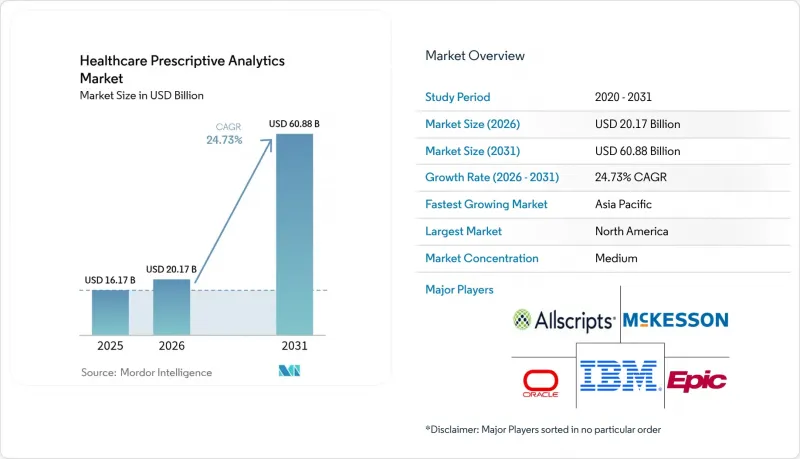
Mordor Intelligence에 따르면 2026년 헬스케어 처방적 분석 시장 규모는 201억 7,000만 달러로 추정되며, 2025년 161억 7,000만 달러에서 확대되어 2031년에는 608억 8,000만 달러에 달할 것으로 예측됩니다.
2026-2031년 동안의 연평균 성장률(CAGR)은 24.73%가 될 전망입니다.
본 보고서는 용도(임상 의사결정 지원, 재무 분석, 기타), 제품(하드웨어, 소프트웨어, 서비스), 전개 모델(온프레미스, 기타), 최종사용자(헬스케어 제공자, 기타), 지역(북미, 유럽, 아시아태평양, 중동 및 아프리카, 남미)별로 분류되어 있습니다. 시장 예측은 금액(달러)으로 표시되어 있습니다.
세계 헬스케어 처방적 분석 시장의 동향 및 인사이트
의료 분야의 빅데이터와 AI 통합
의료 시스템에서는 기존 분석 기법으로는 유전체 데이터, 지속적인 모니터링 데이터, 비정형 임상 기록의 처리 속도와 복잡성을 감당할 수 없다는 점이 인식되고 있습니다. 대규모 데이터 파이프라인과 인공지능을 융합한 플랫폼을 통해 현재는 처방적 분석을 통한 권장 사항이 실시간으로 제공되고 있습니다. Epic Systems가 2024년에 출시한 ‘AI Trust and Assurance Suite’는 임상 도입 전에 알고리즘의 성능을 테스트하고 모니터링하기 위한 도구를 병원에 제공하고 있습니다. 이러한 기능이 성숙해짐에 따라, 임상의들은 사후 보고에서 벗어나 환자 고유의 위험 신호를 기반으로 치료를 개인화하는 진료 현장 개입으로 전환하고 있습니다. 데이터 품질 및 워크플로우 통합의 과제가 해결되면, 조기 도입 기관들로부터 진단 정확도 향상과 표적 치료법 선택이 가능해졌다는 보고가 접수되고 있습니다.
비용 절감과 업무 효율화에 대한 수요 증가
인건비는 병원 총 경비의 50%에 육박하는 반면, 환자 수는 여전히 큰 변동을 보이고 있습니다. 처방적 분석 모델은 수익 주기를 단축하고, 인력 배치를 최적화하며, 공급망의 낭비를 줄여줍니다. 미국병원협회(AHA)의 추정에 따르면, 미국 의료비의 25%가 관리상의 비효율성으로 인해 낭비되고 있다고 합니다. 실시간 위치추적 시스템과 분석 대시보드를 결합함으로써 병상, 의료진, 고가의 의료기기의 위치 정보를 파악하고, 동적인 자원 배분을 실현합니다. 이를 통해 운영비를 절감하고, 중증도가 높은 사례에 대응할 수 있는 여력을 확보할 수 있습니다.
데이터 보안 및 규정 준수 과제
유럽연합(EU)의 ‘인공지능법’에서는 임상용 AI가 고위험으로 분류되어 투명성과 감독이 의무화되어 있습니다. 동시에, 2025년 3월에 승인된 ‘유럽 헬스 데이터 스페이스’ 규정에서는 환자의 프라이버시를 보호하면서 국경을 넘는 데이터 공유 규칙이 도입되었습니다. 이러한 규제 체계로 인해 규정 준수 장벽이 높아지면서, 공급업체는 감사 추적, 동의 획득 기능, 익명화 모듈을 분석 플랫폼에 통합해야만 합니다. 견고한 개인정보 관리 체제가 갖춰지지 않은 병원의 경우, 도입이 지연되거나 제재 대상이 될 가능성이 있습니다.
부문 분석
2025년에는 임상 의사결정 지원 용도가 가장 큰 수익을 창출하여 헬스케어 처방적 분석 시장의 45.72%를 차지했습니다. 병원은 투약 오류를 줄이고 증거 기반 프로토콜을 표준화하기 위해 의사결정 지원을 우선시하고 있는 반면, 미국의 실시간 처방 급여 프로그램과 같은 자금 지원 이니셔티브가 진료 현장에서의 도입을 촉진하고 있습니다. ‘조사 및 인구 건강 분석’은 가장 빠르게 성장하는 용도로, 보험사 및 의료 제공자가 예방적 및 지역사회 차원의 개입으로 전환함에 따라 연평균 성장률(CAGR) 26.31%로 확대되고 있습니다. 2억 4,600만 명 이상의 개인에 대한 익명화된 기록을 보유한 Epic Cosmos와 같은 집단 규모의 데이터셋은 질병 패턴을 모델링하고 공중보건 대책을 수립하는 데 필요한 규모를 여실히 보여주고 있습니다.
개인 수준의 의사결정 지원과 인구 분석의 융합을 통해 조직은 거시적 및 미시적 관점 모두에서 인사이트를 얻을 수 있게 됩니다. 개별 환자부터 전체 코호트에 이르는 치료 경로를 시각화하는 통합 플랫폼이 점점 더 많은 지지를 얻고 있으며, 이는 치료의 개인화와 지역 수준의 건강 계획 이니셔티브를 모두 지원하고 있습니다.
2025년 헬스케어 처방적 분석 시장 규모 중 서비스가 63.77%를 차지하며, 2031년까지 연평균 성장률(CAGR) 26.03%를 기록할 것으로 예측됩니다. 복잡한 규제 체계, 구식 전자건강기록(EHR) 환경, 임상의들의 도입 장벽으로 인해, 기반이 되는 소프트웨어 자체보다 도입에 관한 노하우가 더 가치 있는 요소로 대두되고 있습니다. 소프트웨어 라이선싱은 여전히 필수적이지만, 많은 경우 장기적인 자문 계약이나 관리형 서비스 계약과 함께 제공되고 있습니다. 하드웨어 지출은 훈련 및 추론 워크로드를 지원하는 고성능 스토리지와 GPU에 중점을 두고 있습니다.
듀크 헬스(Duke Health)와 같은 의료 시스템은 전문적인 노하우를 활용하면서도 내부 부담을 줄이기 위해 분석 벤더와 다년간의 파트너십을 체결하고 있습니다. 이러한 서비스 지향적 모델을 통해 병원은 모델 거버넌스, 워크플로우 재설계, 변경 관리에 대해 지속적인 지도를 받을 수 있습니다.
지역별 분석
2025년, 북미는 전 세계 매출의 40.45%를 차지했습니다. 미국은 2027년까지 전면 도입이 예정된 처방 혜택의 실시간 적용 의무화로 인해 이 부문을 주도하고 있습니다. 이를 통해 분석 규칙이 전자 조제 워크플로우에 직접 통합됩니다. 이미 62만 명 이상의 미국 조제 의사가 실시간 처방 급여 도구를 이용하고 있습니다. 캐나다의 주립 의료 프로그램은 데이터 상호 운용성에 투자하고 있으며, 멕시코의 민간 병원 체인은 증가하는 운영 비용을 상쇄하기 위해 분석 기능을 갖춘 수익 사이클 플랫폼을 도입하고 있습니다.
유럽에서는 데이터 개인정보 보호와 모델의 투명성이 우선시되고 있습니다. ‘유럽 헬스 데이터 스페이스(European Health Data Space)’는 2차 사용을 위한 안전한 환경을 구축하기 위해 8억 1,000만 유로를 배정했으며, 이를 통해 연구자와 임상의가 국경을 넘어 익명화된 데이터세트를 교환할 수 있게 됩니다. 독일, 영국, 프랑스는 병원의 디지털화와 AI 시범 사업에 국가 자금을 투입하고 있습니다. EU 인공지능법 준수에 따라 알고리즘에 의한 모든 권장 사항을 기록하는, 감사에 대응 가능한 플랫폼에 대한 수요가 높아지고 있습니다.
아시아태평양은 가장 빠르게 성장하는 지역으로, 연평균 성장률(CAGR)은 29.70%를 기록하고 있습니다. 중국 지방 정부는 AI를 활용한 병원 시스템에 보조금을 지급하고 있으며, 일본에서는 고령화가 진행됨에 따라 원격의료 및 분석에 대한 투자가 확대되고 있습니다. 또한 인도의 ‘국가 디지털 헬스 미션’은 데이터 교환 인프라 구축을 지원하고 있습니다. 호주와 한국은 종단적 데이터세트를 활용한 정밀 의료 프로젝트에 자금을 지원하고 있는 반면, 싱가포르는 지역적 AI 거버넌스 프레임워크의 시험대 역할을 수행하고 있습니다. 브라질의 2024년 임상연구법은 디지털 헬스 연구 승인을 가속화하여 분석 업체들을 라틴아메리카로 유치하고 있습니다.
기타 혜택
- 엑셀 형식의 시장 예측(ME) 시트
- 3개월간의 애널리스트 지원
자주 묻는 질문
목차
제1장 소개
제2장 조사 방법
제3장 주요 요약
제4장 시장 구도
제5장 시장 규모와 성장 예측
제6장 경쟁 구도
제7장 시장 기회와 향후 전망
KSM 26.09.03According to Mordor Intelligence, healthcare prescriptive analytics market size in 2026 is estimated at USD 20.17 billion, growing from 2025 value of USD 16.17 billion with 2031 projections showing USD 60.88 billion, growing at 24.73% CAGR over 2026-2031.
This report is Segmented by Application (Clinical Decision Support, Financial Analytics, and More), Product (Hardware, Software, and Services), Deployment Model (On-Premise, and More), End User (Healthcare Providers, and More), and Geography (North America, Europe, Asia-Pacific, Middle East and Africa, South America). The Market Forecasts are Provided in Terms of Value (USD).
Global Healthcare Prescriptive Analytics Market Trends and Insights
Integration of Big Data and AI in Healthcare
Health systems recognize that traditional analytics cannot process the velocity and complexity of genomic data, continuous monitoring feeds, and unstructured clinical notes. Platforms that fuse large-scale data pipelines with artificial intelligence now deliver prescriptive recommendations in real time. Epic Systems' 2024 release of its AI Trust and Assurance Suite gives hospitals tools to test and monitor algorithm performance before clinical deployment. As these capabilities mature, clinicians transition from retrospective reporting to point-of-care interventions that personalize treatment based on patient-specific risk signals. Early adopters report higher diagnostic accuracy and targeted therapeutic selection, provided data quality and workflow integration hurdles are addressed.
Growing Need for Cost Containment and Operational Efficiency
Labor costs approach 50% of total hospital expenses while patient volumes remain volatile. Prescriptive analytics models shorten revenue-cycle timelines, optimize staffing rosters, and reduce supply chain waste. The American Hospital Association estimates that 25% of U.S. healthcare spending is lost to administrative inefficiencies. Real-time location systems coupled with analytics dashboards keep track of beds, clinicians, and high-value equipment, enabling dynamic resource allocation that lowers operational expenses and frees capacity for higher-acuity cases.
Data Security and Compliance Challenges
The European Union's Artificial Intelligence Act now classifies clinical AI as high-risk, mandating transparency and oversight. Simultaneously, the European Health Data Space regulation approved in March 2025 introduces cross-border sharing rules while preserving patient privacy. These frameworks raise compliance hurdles, forcing vendors to hard-wire audit trails, consent engines, and de-identification modules into analytics platforms. Hospitals that lack robust privacy controls face implementation delays and potential penalties.
Other drivers and restraints analyzed in the detailed report include:
- Incentives for Value-Based Care and Outcome-Focused Reimbursement
- Rise of Patient Digital Twins for Therapy Optimization
- Shortage of Analytics Talent in Clinical Settings
For complete list of drivers and restraints, kindly check the Table Of Contents.
Segment Analysis
Clinical Decision Support applications generated the most significant revenue in 2025, capturing 45.72% of the healthcare prescriptive analytics market. Hospitals prioritize decision support to reduce medication errors and standardize evidence-based protocols, while funding initiatives such as the U.S. real-time prescription benefit program stimulate adoption at the point of care. Research & Population Health Analytics is the fastest-growing application, expanding at a 26.31% CAGR as payers and providers shift toward proactive, community-level interventions. Population-scale datasets such as Epic Cosmos, which holds de-identified records for more than 246 million individuals, illustrate the scale required to model disease patterns and inform public-health actions.
The convergence of individual-level decision support with population analytics lets organizations derive insights across macro and micro lenses. Integrated platforms that map care pathways for single patients and entire cohorts are increasingly favored, supporting both treatment personalization and regional health-planning efforts.
Services accounted for 63.77% of the healthcare prescriptive analytics market size in 2025 and are forecast to post a 26.03% CAGR through 2031. Complex regulatory frameworks, legacy EHR environments, and clinician adoption hurdles make implementation know-how more valuable than the underlying software. Software licenses remain essential yet are frequently bundled with long-term advisory and managed services agreements. Hardware spending focuses on high-performance storage and GPUs that support training and inference workloads.
Health systems such as Duke Health have entered multi-year partnerships with analytics vendors to access specialized expertise while reducing internal burdens. These service-oriented models provide hospitals with sustained guidance on model governance, workflow redesign, and change management.
Complete Report Scope:
- By Application
- Clinical Decision Support
- Financial Analytics
- Administrative / Operational Analytics
- Research & Population Health Analytics
- By Product
- Hardware
- Software
- Services
- By Deployment Model
- On-Premise
- Cloud-Based
- Hybrid
- By End User
- Healthcare Providers
- Healthcare Payers
- Pharmaceutical & Life-Sciences Companies
- Government & Public-Health Agencies
- By Geography
- North America
- United States
- Canada
- Mexico
- Europe
- Germany
- United Kingdom
- France
- Italy
- Spain
- Rest of Europe
- Asia-Pacific
- China
- Japan
- India
- Australia
- South Korea
- Rest of Asia-Pacific
- Middle East & Africa
- GCC
- South Africa
- Rest of Middle East & Africa
- South America
- Brazil
- Argentina
- Rest of South America
- North America
Geography Analysis
North America generated 40.45% of global sales in 2025. The United States sets the pace with mandatory real-time prescription benefit implementation scheduled for full rollout by 2027, which embeds analytic rules directly into e-prescribing workflows. Over 620,000 U.S. prescribers already use real-time prescription benefit tools. Canada's provincial health programs invest in data interoperability, and Mexico's private hospital chains deploy analytics-enabled revenue cycle platforms to counterbalance rising operating expenses.
Europe prioritizes data privacy and model transparency. The European Health Data Space allocates EUR 810 million to create a secure environment for secondary data use, enabling researchers and clinicians to exchange anonymized datasets across borders. Germany, the United Kingdom, and France devote national funding to hospital digitalization and AI pilots. Compliance with the EU Artificial Intelligence Act spurs demand for audit-ready platforms that log every algorithmic recommendation.
Asia-Pacific is the quickest-expanding region, advancing at a 29.70% CAGR. China's local governments subsidize AI-enhanced hospital systems, Japan's aging population drives telemedicine and analytics investment, and India's National Digital Health Mission underwrites data-exchange infrastructure. Australia and South Korea fund precision-medicine projects that rely on longitudinal datasets, while Singapore acts as a test-bed for regional AI governance frameworks. Brazil's 2024 Clinical Research Law accelerates approvals for digital health studies, drawing analytics vendors into Latin America.
- Allscripts
- Oracle
- IBM (Merative)
- Mckesson
- MedeAnalytics
- Optum
- SAS Institute
- Verisk Analytics
- Epic Systems
- Health Catalyst
- Dimensional Insight
- Innovaccer
- Arcadia
- Clarify Health Solutions
- Change Healthcare
- Koninklijke Philips
- Siemens Healthineers
- GE Healthcare
- Qlik
- Teradata
Additional Benefits:
- The market estimate (ME) sheet in Excel format
- 3 months of analyst support
TABLE OF CONTENTS
1 Introduction
- 1.1 Study Assumptions & Market Definition
- 1.2 Scope of the Study
2 Research Methodology
3 Executive Summary
4 Market Landscape
- 4.1 Market Overview
- 4.2 Market Drivers
- 4.2.1 Integration of Big Data & AI in Healthcare
- 4.2.2 Growing Need for Cost Containment & Operational Efficiency
- 4.2.3 Incentives for Value-Based Care & Outcome-Based Reimbursement
- 4.2.4 Rise of Patient Digital Twins for Therapy Optimization
- 4.2.5 Real-time Prescription Benefit (RTPB) Mandate Fuelling Point-of-Care Analytics
- 4.2.6 Surge in Chronic Disease Burden
- 4.3 Market Restraints
- 4.3.1 Data Security & HIPAA/GDPR Compliance Challenges
- 4.3.2 Shortage of Analytics Talent in Clinical Settings
- 4.3.3 Model Explainability Limitations Hindering Physician Trust
- 4.3.4 High Initial Investment Costs
- 4.4 Porter's Five Forces Analysis
- 4.4.1 Threat of New Entrants
- 4.4.2 Bargaining Power of Buyers
- 4.4.3 Bargaining Power of Suppliers
- 4.4.4 Threat of Substitute Products
- 4.4.5 Intensity of Competitive Rivalry
5 Market Size & Growth Forecasts (Value in USD)
- 5.1 By Application
- 5.1.1 Clinical Decision Support
- 5.1.2 Financial Analytics
- 5.1.3 Administrative / Operational Analytics
- 5.1.4 Research & Population Health Analytics
- 5.2 By Product
- 5.2.1 Hardware
- 5.2.2 Software
- 5.2.3 Services
- 5.3 By Deployment Model
- 5.3.1 On-Premise
- 5.3.2 Cloud-Based
- 5.3.3 Hybrid
- 5.4 By End User
- 5.4.1 Healthcare Providers
- 5.4.2 Healthcare Payers
- 5.4.3 Pharmaceutical & Life-Sciences Companies
- 5.4.4 Government & Public-Health Agencies
- 5.5 By Geography
- 5.5.1 North America
- 5.5.1.1 United States
- 5.5.1.2 Canada
- 5.5.1.3 Mexico
- 5.5.2 Europe
- 5.5.2.1 Germany
- 5.5.2.2 United Kingdom
- 5.5.2.3 France
- 5.5.2.4 Italy
- 5.5.2.5 Spain
- 5.5.2.6 Rest of Europe
- 5.5.3 Asia-Pacific
- 5.5.3.1 China
- 5.5.3.2 Japan
- 5.5.3.3 India
- 5.5.3.4 Australia
- 5.5.3.5 South Korea
- 5.5.3.6 Rest of Asia-Pacific
- 5.5.4 Middle East & Africa
- 5.5.4.1 GCC
- 5.5.4.2 South Africa
- 5.5.4.3 Rest of Middle East & Africa
- 5.5.5 South America
- 5.5.5.1 Brazil
- 5.5.5.2 Argentina
- 5.5.5.3 Rest of South America
- 5.5.1 North America
6 Competitive Landscape
- 6.1 Market Concentration
- 6.2 Market Share Analysis
- 6.3 Company Profiles (includes Global level Overview, Market level overview, Core Segments, Financials as available, Strategic Information, Market Rank/Share for key companies, Products & Services, and Recent Developments)
- 6.3.1 Allscripts Healthcare Solutions
- 6.3.2 Oracle Corporation (Cerner Corporation)
- 6.3.3 IBM (Merative)
- 6.3.4 McKesson Corporation
- 6.3.5 MedeAnalytics Inc.
- 6.3.6 Optum Inc.
- 6.3.7 SAS Institute Inc.
- 6.3.8 Verisk Analytics Inc.
- 6.3.9 Epic Systems Corporation
- 6.3.10 Health Catalyst
- 6.3.11 Dimensional Insight
- 6.3.12 Innovaccer
- 6.3.13 Arcadia
- 6.3.14 Clarify Health Solutions
- 6.3.15 Change Healthcare
- 6.3.16 Philips Healthcare
- 6.3.17 Siemens Healthineers
- 6.3.18 GE Healthcare
- 6.3.19 Qlik
- 6.3.20 Teradata
7 Market Opportunities & Future Outlook
- 7.1 White-space & Unmet-Need Assessment