

|
시장보고서
상품코드
2121246
표면 탄성파 센서 : 시장 점유율 분석, 업계 동향과 통계, 성장 예측(2026-2031년)Surface Acoustic Wave Sensors - Market Share Analysis, Industry Trends & Statistics, Growth Forecasts (2026 - 2031) |
||||||
 Mordor Intelligence
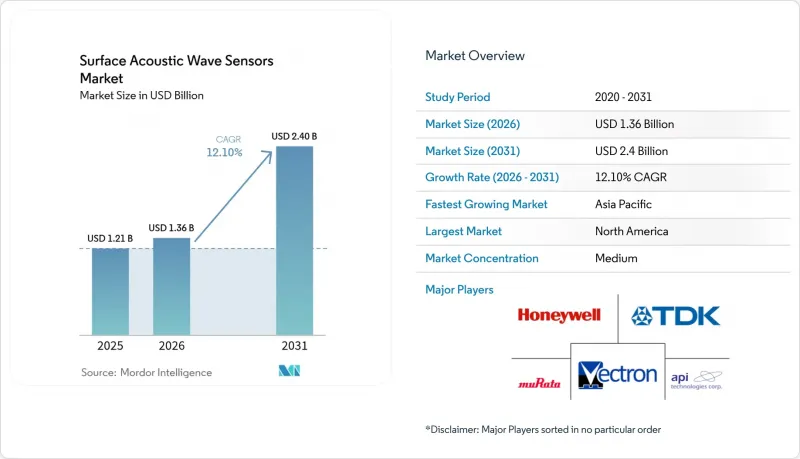
Mordor Intelligence에 의하면, 표면 탄성파 센서 시장 규모는 2025년에 12억 1,000만 달러로 평가되었고, 2026년 13억 6,000만 달러에서 2031년까지 24억 달러에 이를 것으로 예측되며, 예측 기간(2026년-2031년) CAGR은 12.10%를 기록할 전망입니다.
본 보고서는 감지 유형(압력 센서, 토크 센서 등), 최종 사용자 산업(자동차, 항공우주 및 방위, 소비자용 전자기기 등), 장치 유형(공진기 및 지연선), 기판 재료(석영, 탄탈산 리튬 등), 그리고 지역별로 분류되어 있습니다. 시장 예측은 입수 가능한 데이터를 바탕으로 금액(달러) 단위로 제시되어 있습니다.
세계 표면탄성파(SAW) 센서 시장 동향 및 인사이트
배터리 없는 구동이 가능한 무선 및 패시브 센서 아키텍처
패시브형 SAW 태그는 쿼리 신호로부터 에너지를 회수하기 때문에 수명을 제한하고 무게를 늘리는 배터리가 필요하지 않습니다. 이 기능 덕분에 정기적인 셀 교체나 위험 구역 진입이 필요 없어져, 산업 사용자의 총 소유 비용을 최대 60%까지 절감할 수 있습니다. 회전하는 터빈 디스크, 항공기 엔진의 블레이드, 고전압 버스바에도 전원 공급 중단 없이 수십년동안 작동하는 내장형 센서를 설치할 수 있게 되었습니다. 수 미터에 달하는 무선 판독 범위로 인해 데이터 수집이 간소화되고, 기존 설비에 대한 사후 설치 시 배선 비용도 절감됩니다. 센서가 지속적으로 전파를 방출하지 않기 때문에 주파수 대역 혼잡이나 전자기 호환성(EMC) 문제가 최소화되며, 대규모 IoT 네트워크의 규제 준수 승인도 용이해집니다.
확립된 압전 기판 공급망을 통한 낮은 제조 비용
주파수 제어 분야에서 성숙한 석영, 리튬 탄탈레이트, 리튬 니오베이트의 결정 성장 기술을 통해, 두께 공차 1µm의 150mm 웨이퍼는 대량 공급 계약을 통해 현재 2달러 미만으로 구입할 수 있습니다. 스마트폰용 SAW 필터에 이미 최적화되어 있는 프런트엔드 생산 라인은 막대한 설비 투자 없이도 센서 패턴을 추가할 수 있도록 재조정할 수 있으며, 이를 통해 수직 통합형 제조업체의 매출 총이익률 향상에 기여합니다. 일본의 파운드리에서는 완전 자동화가 도입되어 수율을 95% 이상으로 높이고 있습니다. 이는 매년 수백만 대를 출하하는 가격 민감도가 높은 자동차용 프로그램에서 결정적인 요인이 됩니다. 그 결과, SAW 센서는 기존에 디스크리트 MEMS 부품에 의존하던 중급 소비자용 기기에도 점차 보급되고 있습니다.
기존 산업용 네트워크에서의 호환성 및 도입상의 과제
레거시 필드버스나 독자적인 사양의 RF 프로토콜을 기반으로 구축된 공장 제어 시스템에는 SAW 태그의 변조 방식을 인식하는 게이트웨이가 갖추어지지 않은 경우가 많습니다. 생산 라인 개조에는 하루에 수백만 단위의 비용이 드는 가동 중단이 필요한 경우가 있어, 이것이 공장 관리자의 도입을 주저하게 만드는 요인이 되고 있습니다. RFID와의 주파수 중복은 인증상의 장벽이 되어 시운전 일정을 장기화시킵니다. 통합 업체는 센서 ID를 PLC 코드로 변환하는 Honeywell의 브리지를 추가하기도 하지만, 이 추가 하드웨어로 인해 프로젝트 예산이 25-30% 증가하게 됩니다. 무선 네트워크 계획 수립에 필요한 기술 인력 부족은 이러한 주저함을 더욱 심화시켜, 본래라면 도입 가능성이 높은 브라운필드 공장에서의 도입을 지연시키고 있습니다.
부문 분석
온도 측정 장치는 2025년 표면탄성파(SAW) 센서 시장 규모의 36.25%를 차지하고 있으며, 이는 공정 플랜트 및 HVAC 설비에서 정밀한 온도 추적에 대한 광범위한 수요를 반영합니다. 드리프트가 없는 광범위한 측정 능력 덕분에 EV 배터리 모듈,산업용 용광로, 데이터센터의 냉각 루프를 위한 설계가 확고해졌습니다. 압력 센서는 전 세계적인 TPMS(타이어 공기압 모니터링 시스템) 규제와, 무선 타이어·브레이크 센싱을 통한 경량화를 추구하는 항공우주 업계 동향에 힘입어 더 빠른 속도로 성장하고 있습니다. SAW 기상 화학 센서는 ppm 수준의 배출물을 감지해야 하는 환경 관측소에서 초기 수주를 확보하고 있습니다. 습도 및 질량 센서는 스마트 빌딩 제어 시스템과 반도체 증착 라인에 활용되고 있으며, 견실하지만 규모는 작은 수익원을 형성하고 있습니다.
온도 센서는 재료 혁신의 벤치마크 역할을 하고 있습니다. 석영은 주변 온도 변동에도 불구하고 안정적으로 공진하는 반면, 랑가사이트로 제작된 제품은 터빈 배기구에도 설치할 수 있습니다. 경쟁사와의 차별화를 이끄는 핵심은 수증기나 부식성 물질로부터 수십 년간 보호해 주는 금속·세라믹 재질의 기밀 씰을 갖춘 패키징 기술입니다. 압력 센서의 다양한 모델은 동일한 웨이퍼 제조 공정을 활용하면서도 견고한 캐비티와 다이어프램을 채택하고 있어, 파운드리 업체는 제품군 전체에 걸쳐 금형 비용을 상각할 수 있습니다. 자동차 시장의 생산 대수가 증가함에 따라, 가격 하락은 규모가 작은 신규 진출기업들에게는 시련이 될 것입니다. 그렇지만 규제 흐름에 힘입어 이 부문은 두 자릿수 성장 곡선을 유지하고 있으며, 현재 온도 센서가 차지하고 있는 선두 위상은 점차 축소되고 있습니다.
소비자 가전제품은 스마트폰, 태블릿, 웨어러블 기기에서 프런트엔드 필터로서 확고한 역할을 수행한 덕분에 2025년 표면탄성파(SAW) 센서 시장 점유율의 32.15%를 차지했습니다. 현재 주요 휴대폰 제조업체들은 배터리 수명을 유지하면서 5G의 서브 6GHz 대역을 분리하기 위해 기기당 25개 이상의 SAW 또는 SAW 하이브리드 필터를 탑재하고 있습니다. 한편, 자동차 분야는 전동화, TPMS(타이어 공기압 모니터링 시스템)의 직접 도입 의무화, 그리고 디스크리트형 수동 센서를 선호하는 중복 안전 아키텍처로의 전환에 힘입어 연평균 성장률(CAGR) 13.65%로 확대되고 있습니다. 항공우주 및 방위 분야의 구매자들은 초음속 추진 시험에서 1,000°C 이상에서도 작동을 유지할 수 있는 내방사선성 랑가사이트 부품에 높은 가격을 지불하고 있습니다.
의료 분야에서는 현장 진단(Point-of-Care)이 중앙 집중형 검사실에서 진료소로 전환됨에 따라 이에 대한 관심이 높아지고 있습니다. SAW 바이오센서는 수 분 이내에 라벨이 필요 없는 검출이 가능하여, 팬데믹 대응 훈련 시에도 주목을 받고 있습니다. 산업 분야의 사용자들은 인더스트리 4.0 로드맵에 따른 예측 유지보수 프로그램에 SAW 방식의 토크 및 진동 태그를 채택하고 있습니다. 업계를 아우르는 다양성은 수익 주기를 안정화시키지만, Tier 1 공급업체는 자동차 분야의 ISO 26262부터 항공 분야의 FAA FAR-25에 이르기까지 각 수직 시장의 인증 표준에 맞추어 인증 계획을 조정해야 합니다.
지역별 분석
2025년, 북미는 표면 탄성파 센서 시장에서 36.95%의 점유율을 유지했습니다. 이는 항공 전자 기기 및 미사일 유도 시스템에서 내방사선성과 배터리 없이 작동하는 기능을 중시하는 국방 지출에 힘입은 결과입니다. SBIR(중소기업 기술 혁신 연구 프로그램)에 기반한 연방 정부의 연구 보조금은 기술의 성숙을 촉진하는 한편, FAA의 인증 주기가 장기화됨에 따라 형식 승인을 획득한 기존 기업들은 보호받고 있습니다. 주로 애리조나주와 텍사스주에 위치한 이 지역의 성숙한 반도체 산업 기반 덕분에 신속한 설계 반복과 엄격한 품질 관리 주기가 가능해졌습니다. 보잉(Boeing)과 같은 주요 주계약업체들은 회전 어셈블리 내부의 슬립 링을 제거할 수 있다는 점 때문에 엔진 코어의 계측 장비용으로 패시브 SAW 태그를 점점 더 많이 지정하고 있습니다.
아시아태평양은 5G의 전개와 자동차용 전자기기 생산 라인의 중국 및 한국으로의 이전으로 인해 연평균 성장률(CAGR) 13.24%로 성장하고 있습니다. 베이징 정부의 ‘중국 제조 2025’ 구상에 따라 현지 웨이퍼 공장에 보조금이 투입되고 있으며, 현재는 품질 면에서 일본에 필적하는 석영 블랭크가 출하되고 있습니다. 한국은 휴대전화 생태계를 활용하여 모든 프리미엄 스마트폰에 SAW 필터를 채택하고 있습니다. 일본의 대기업들은 기판 연구개발 분야에서 우위를 유지하고 있으며, 토요타 등 Tier 1 자동차 제조업체에서의 채택 실적도 확보하고 있지만, 중국 기업들의 가격 압박으로 인해 이익률은 축소되고 있습니다. 인도에서는 도시 지역의 유틸리티 분야에서 SAW 방식의 스마트 계량기 도입이 시작되었으나, 그 도입 규모는 아직 낮은 수준에 머물러 있습니다.
유럽에서는 자동차 및 산업용 자동화 클러스터를 기반으로 수요가 안정된 한 자릿수 중반의 속도로 성장하고 있습니다. 독일의 전기차(EV) 생산 확대에 따라 150°C를 초과하는 정격의 팩 레벨 온도 센서가 필요해지고 있는 반면, 프랑스의 원자력 발전소군에서는 원자로 감시를 위한 내방사선성 장치가 발주되고 있습니다. UNECE R141 및 EU 배터리 지침과 같은 규제 프레임워크는 안전 규격을 강화함으로써 간접적으로 SAW의 채택을 뒷받침하고 있습니다. 에어버스와 롤스로이스의 항공우주 프로그램에서는 블레이드 끝단의 간극 측정을 위한 랑가사이트 센서의 평가가 진행되고 있으며, 이 지역 특유의 신중한 인증 태도에도 불구하고 향후 비즈니스 기회가 열리고 있습니다.
기타 혜택:
- 엑셀 형식 시장 예측(ME) 시트
- 3개월간의 애널리스트 지원
자주 묻는 질문
목차
제1장 서론
제2장 조사 방법
제3장 주요 요약
제4장 시장 구도
제5장 시장 규모와 성장 예측
제6장 경쟁 구도
제7장 시장 기회와 향후 전망
LSH 26.09.08According to Mordor Intelligence, the surface acoustic wave sensors market size was valued at USD 1.21 billion in 2025 and estimated to grow from USD 1.36 billion in 2026 to reach USD 2.4 billion by 2031, at a CAGR of 12.10% during the forecast period (2026-2031).
This report is Segmented by Sensing Type (Pressure Sensors, Torque Sensors, and More), End-User Industry (Automotive, Aerospace and Defense, Consumer Electronics, and More), Device Type (Resonators and Delay Lines), Material Substrate (Quartz, Lithium Tantalate, and More), and Geography. The Market Forecasts are Provided in Terms of Value (USD), Based On Availability.
Global Surface Acoustic Wave Sensors Market Trends and Insights
Wireless and Passive Sensor Architecture Enabling Battery-less Deployment
Passive SAW tags harvest interrogation energy, eliminating the need for batteries that constrain lifetime and add weight. This feature slashes the total cost of ownership for industrial users by up to 60% as scheduled cell replacement and hazardous-area access are no longer required. Rotating turbine disks, aircraft engine blades, and high-voltage busbars can now host embedded sensors that operate for decades without power interruptions. Radio read ranges approaching several meters simplify data acquisition and cut cabling costs in retrofits. Because the sensor does not radiate continuously, spectrum congestion and electromagnetic compatibility issues are minimal, which eases compliance approvals for large IoT networks.
Low Manufacturing Cost Through Established Piezoelectric Substrate Supply Chains
Quartz, lithium tantalate, and lithium niobate crystal growth matured in the frequency-control sector, so 150 mm wafers with 1 µm thickness tolerance now cost below USD 2 in high-volume supply agreements. Front-end lines already optimized for SAW filters in smartphones can be retooled to add sensor patterns without incurring heavy capital expenditures, thereby pushing gross margins higher for vertically integrated producers. Japanese foundries deploy full automation, which lifts yields above 95%, a decisive factor for price-sensitive automotive programs shipping millions of units each year. As a result, SAW sensors penetrate mid-tier consumer devices that previously relied on discrete MEMS parts.
Compatibility and Installation Challenges in Existing Industrial Networks
Factory control systems built on legacy fieldbus or proprietary RF protocols often lack gateways that recognize SAW tag modulation schemes. Retrofitting lines can require shutdowns costing millions per day, which dissuades plant managers. Frequency overlaps with RFID create certification hurdles that lengthen commissioning schedules. Integrators sometimes add Honeywell-branded bridges that translate sensor IDs to PLC codes, but the extra hardware raises project budgets by 25-30%. Skills shortages in radio network planning compound the hesitation, stalling adoption in otherwise attractive brownfield plants.
Other drivers and restraints analyzed in the detailed report include:
- Automotive TPMS and EV Thermal Management Demand for High-Temperature SAW Sensors
- Expansion of 5G and IoT Infrastructure Requiring Miniaturized, High-Frequency Sensing Solutions
- Performance Limitations of SAW Devices in Liquid-Phase Sensing Environments
For complete list of drivers and restraints, kindly check the Table Of Contents.
Segment Analysis
Temperature devices generated 36.25% of the 2025 surface acoustic wave sensors market size, reflecting the widespread need for precise thermal tracking in process plants and HVAC installations. Their ability to measure wide ranges without drift secures designs for EV battery modules, industrial furnaces, and data center cooling loops. Pressure sensors are growing at a faster rate, benefiting from global TPMS legislation and the aerospace trend toward weight reduction through wireless tire and brake sensing. SAW gas-phase chemical sensors capture early contracts in environmental stations that must detect ppm-level emissions. Humidity and mass devices serve smart-building controls and semiconductor deposition lines, forming steady but smaller revenue pools.
Temperature sensors serve as the benchmark for material innovation; quartz resonates stably across ambient temperature swings, while langasite versions enable turbine exhaust placement. Competitive differentiation hinges on packaging metal-ceramic hermetic seals that provide decades of protection against steam or corrosives. Pressure variants leverage identical wafer processes but adopt rugged cavities and diaphragms, letting foundries amortize tooling across product families. As automotive volumes climb, price erosion will test newcomers lacking scale. Nevertheless, the mandate wave keeps the segment on a double-digit growth curve, narrowing the lead that temperature devices currently hold.
Consumer electronics accounted for 32.15% of the 2025 surface acoustic wave sensors market share thanks to their entrenched role as front-end filters in smartphones, tablets, and wearables. Flagship handset vendors now integrate over 25 SAW or SAW-hybrid filters per device to isolate 5G sub-6 GHz bands while conserving battery life. Yet, the automotive segment advances at a 13.65% CAGR, driven by electrification, direct TPMS mandates, and the shift to redundant safety architectures that favor discrete passive sensors. Aerospace and defense buyers pay premiums for radiation-tolerant langasite parts that stay operational above 1000 °C in hypersonic propulsion tests.
Healthcare interest is growing as point-of-care diagnostics transition from centralized labs to clinics. SAW biosensors offer label-free detection within minutes, capturing attention during pandemic-preparedness drills. Industrial users adopt SAW torque and vibration tags for predictive maintenance programs that align with Industry 4.0 roadmaps. Cross-industry diversity smooths revenue cycles, but tier-one suppliers must tailor qualification plans to each vertical's certification code, from ISO 26262 in vehicles to FAA FAR-25 in aviation.
Complete Report Scope:
- By Sensing Type
- Pressure Sensors
- Torque Sensors
- Temperature Sensors
- Humidity Sensors
- Chemical Sensors
- Mass Sensors
- Other Sensors
- By End-User Industry
- Automotive
- Aerospace and Defense
- Consumer Electronics
- Healthcare
- Industrial
- Other End-User Industries
- By Device Type
- Resonators
- Delay Lines
- By Material Substrate
- Quartz
- Lithium Tantalate
- Lithium Niobate
- Langasite
- Other Materials
- By Geography
- North America
- United States
- Canada
- Mexico
- South America
- Brazil
- Argentina
- Rest of South America
- Europe
- Germany
- United Kingdom
- France
- Italy
- Spain
- Rest of Europe
- Asia Pacific
- China
- Japan
- India
- South Korea
- South-East Asia
- Rest of Asia Pacific
- Middle East
- Saudi Arabia
- United Arab Emirates
- Turkey
- Rest of Middle East
- Africa
- South Africa
- Nigeria
- Rest of Africa
- North America
Geography Analysis
North America retained a 36.95% share of the surface acoustic wave sensors market in 2025, anchored by defense spending that values radiation resistance and battery-free operation in avionics and missile guidance. Federal research grants under SBIR streamline technology maturation, while long FAA certification cycles protect incumbents once type approval is reached. The region's mature semiconductor base, primarily located in Arizona and Texas, enables rapid design iterations and tight quality control loops. Leading primes such as Boeing increasingly specify passive SAW tags for engine-core instrumentation because they eliminate slip rings inside rotating assemblies.
The Asia Pacific is advancing at a 13.24% CAGR due to 5G rollouts and the relocation of automotive electronics lines to China and South Korea. Beijing's "Made in China 2025" drive channels subsidies into local wafer fabs that now ship quartz blanks rivaling those of Japan in quality. South Korea leverages its handset ecosystem to absorb SAW filters in every premium smartphone. Japanese majors maintain an edge in substrate R&D and hold design-in positions at tier-one automakers, such as Toyota, but price pressures from Chinese firms narrow their margins. India begins installing SAW-based smart meters in urban utilities, albeit from a low base.
Europe relies on its auto and industrial automation clusters to grow demand at a steady mid-single-digit pace. Germany's EV build-out needs pack-level temperature sensors rated beyond 150 °C, while France's nuclear fleet orders radiation-tolerant devices for reactor monitoring. Regulatory frameworks such as UNECE R141 and EU battery directives indirectly boost SAW uptake by tightening safety specifications. Aerospace programs at Airbus and Rolls-Royce evaluate langasite sensors for blade-tip clearance measurement, opening future opportunities despite the region's cautious qualification ethos.
- TDK Electronics AG
- Murata Manufacturing Co., Ltd.
- Honeywell International Inc.
- API Technologies Corp.
- Vectron International (Microchip Technology Inc.)
- CTS Corporation
- CeramTec GmbH
- Teledyne Microwave Solutions
- AVX Corporation
- Boston Piezo-Optics Inc.
- SENSeOR SAS
- Transense Technologies plc
- Sensor Technology Ltd.
- NanoTemper Technologies GmbH
- pro-micron GmbH & Co. KG
- Infineon Technologies AG
- Skyworks Solutions Inc.
- Taiyo Yuden Co., Ltd.
- Qorvo Inc.
- Kyocera Corporation
Additional Benefits:
- The market estimate (ME) sheet in Excel format
- 3 months of analyst support
TABLE OF CONTENTS
1 INTRODUCTION
- 1.1 Study Assumptions and Market Definition
- 1.2 Scope of the Study
2 RESEARCH METHODOLOGY
3 EXECUTIVE SUMMARY
4 MARKET LANDSCAPE
- 4.1 Market Overview
- 4.2 Market Drivers
- 4.2.1 Wireless and Passive Sensor Architecture Enabling Battery-less Deployment
- 4.2.2 Low Manufacturing Cost Through Established Piezoelectric Substrate Supply Chains
- 4.2.3 Automotive TPMS and EV Thermal Management Demand for High-Temperature SAW Sensors
- 4.2.4 Expansion of 5G and IoT Infrastructure Requiring Miniaturized, High-Frequency Sensing Solutions
- 4.2.5 Adoption of Ultra-High-Temperature (>1000 °C) Langasite SAW Sensors in Aerospace Turbine Monitoring
- 4.2.6 Emergence of Portable SAW Biosensors for Rapid Point-of-Care Diagnostics
- 4.3 Market Restraints
- 4.3.1 Compatibility and Installation Challenges in Existing Industrial Networks
- 4.3.2 Performance Limitations of SAW Devices in Liquid-Phase Sensing Environments
- 4.3.3 Intensifying Competition from Bulk Acoustic Wave and MEMS Sensors at >3 GHz Bands
- 4.3.4 Supply Risk of Specialty Piezoelectric Materials amid Geopolitical Constraints
- 4.4 Impact of Macroeconomic Factors
- 4.5 Industry Value Chain Analysis
- 4.6 Regulatory Landscape
- 4.7 Technological Outlook
- 4.8 Porter's Five Forces Analysis
- 4.8.1 Threat of New Entrants
- 4.8.2 Bargaining Power of Buyers
- 4.8.3 Bargaining Power of Suppliers
- 4.8.4 Threat of Substitute Products
- 4.8.5 Intensity of Competitive Rivalry
5 MARKET SIZE AND GROWTH FORECASTS (VALUE)
- 5.1 By Sensing Type
- 5.1.1 Pressure Sensors
- 5.1.2 Torque Sensors
- 5.1.3 Temperature Sensors
- 5.1.4 Humidity Sensors
- 5.1.5 Chemical Sensors
- 5.1.6 Mass Sensors
- 5.1.7 Other Sensors
- 5.2 By End-User Industry
- 5.2.1 Automotive
- 5.2.2 Aerospace and Defense
- 5.2.3 Consumer Electronics
- 5.2.4 Healthcare
- 5.2.5 Industrial
- 5.2.6 Other End-User Industries
- 5.3 By Device Type
- 5.3.1 Resonators
- 5.3.2 Delay Lines
- 5.4 By Material Substrate
- 5.4.1 Quartz
- 5.4.2 Lithium Tantalate
- 5.4.3 Lithium Niobate
- 5.4.4 Langasite
- 5.4.5 Other Materials
- 5.5 By Geography
- 5.5.1 North America
- 5.5.1.1 United States
- 5.5.1.2 Canada
- 5.5.1.3 Mexico
- 5.5.2 South America
- 5.5.2.1 Brazil
- 5.5.2.2 Argentina
- 5.5.2.3 Rest of South America
- 5.5.3 Europe
- 5.5.3.1 Germany
- 5.5.3.2 United Kingdom
- 5.5.3.3 France
- 5.5.3.4 Italy
- 5.5.3.5 Spain
- 5.5.3.6 Rest of Europe
- 5.5.4 Asia Pacific
- 5.5.4.1 China
- 5.5.4.2 Japan
- 5.5.4.3 India
- 5.5.4.4 South Korea
- 5.5.4.5 South-East Asia
- 5.5.4.6 Rest of Asia Pacific
- 5.5.5 Middle East
- 5.5.5.1 Saudi Arabia
- 5.5.5.2 United Arab Emirates
- 5.5.5.3 Turkey
- 5.5.5.4 Rest of Middle East
- 5.5.6 Africa
- 5.5.6.1 South Africa
- 5.5.6.2 Nigeria
- 5.5.6.3 Rest of Africa
- 5.5.1 North America
6 COMPETITIVE LANDSCAPE
- 6.1 Market Concentration
- 6.2 Strategic Moves
- 6.3 Market Share Analysis
- 6.4 Company Profiles (includes Global level Overview, Market level overview, Core Segments, Financials as available, Strategic Information, Market Rank/Share for key companies, Products and Services, and Recent Developments)
- 6.4.1 TDK Electronics AG
- 6.4.2 Murata Manufacturing Co., Ltd.
- 6.4.3 Honeywell International Inc.
- 6.4.4 API Technologies Corp.
- 6.4.5 Vectron International (Microchip Technology Inc.)
- 6.4.6 CTS Corporation
- 6.4.7 CeramTec GmbH
- 6.4.8 Teledyne Microwave Solutions
- 6.4.9 AVX Corporation
- 6.4.10 Boston Piezo-Optics Inc.
- 6.4.11 SENSeOR SAS
- 6.4.12 Transense Technologies plc
- 6.4.13 Sensor Technology Ltd.
- 6.4.14 NanoTemper Technologies GmbH
- 6.4.15 pro-micron GmbH & Co. KG
- 6.4.16 Infineon Technologies AG
- 6.4.17 Skyworks Solutions Inc.
- 6.4.18 Taiyo Yuden Co., Ltd.
- 6.4.19 Qorvo Inc.
- 6.4.20 Kyocera Corporation
7 MARKET OPPORTUNITIES AND FUTURE OUTLOOK
- 7.1 White-space and Unmet-Need Assessment


