

|
시장보고서
상품코드
2121251
대장암 진단 및 치료 : 시장 점유율 분석, 업계 동향과 통계, 성장 예측(2026-2031년)Colorectal Cancer Diagnostics And Therapeutics - Market Share Analysis, Industry Trends & Statistics, Growth Forecasts (2026 - 2031) |
||||||
 Mordor Intelligence
Mordor Intelligence에 따르면 대장암 진단 및 치료 시장 규모는 2025년에 298억 9,000만 달러로 평가되며, 2026년 313억 5,000만 달러에서 2031년까지 397억 9,000만 달러에 달할 것으로 예측되며, 예측 기간(2026-2031년) 동안 CAGR은 4.89%가 될 전망입니다.
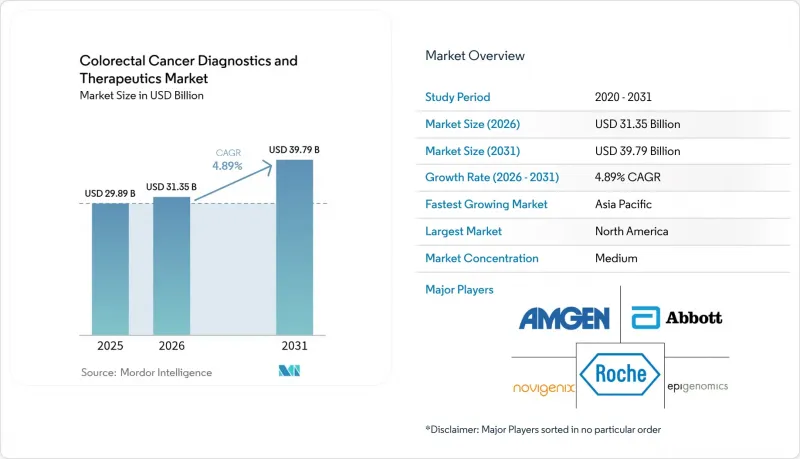
본 보고서는 진단 방식(진단 기술[대변 검사, 혈액 바이오마커 검사, 내시경 영상, 방사선 진단학·분자 내시경 검사 등] 및 치료법[화학요법, 표적 치료, 면역요법 등])과 지역(북미, 유럽, 아시아태평양, 기타)별로 분류되어 있습니다. 시장 규모 및 전망은 금액(달러) 기준으로 제시되어 있습니다.
세계 대장암 진단 및 치료 시장의 동향과 인사이트
대장암 발병률 및 유병률의 증가
1990년부터 2021년까지 젊은 층의 발병률은 10만 명당 5.43에서 6.13으로 상승했으며, 모델 예측에 따르면 2030년까지 그 증가 속도가 계속 가속화될 것으로 보입니다. 고소득 국가에서는 생활 방식의 동질화가 진행되어 젊은 층의 위험이 높아지고 있는 반면, 아시아태평양에서는 남성의 경우 10만 명당 7.51명, 여성의 경우 6.22명의 발병률이 기록되고 있습니다. 생존 기간의 연장으로 인해 평생에 걸친 선별 검사 및 추적 관찰에 대한 수요가 증가함에 따라, 대장암 진단 및 치료 시장의 지속적인 수익 전망이 확고해지고 있습니다.
차세대 분변 DNA 및 혈액 기반 선별 검사의 급속한 보급
2024년에 ‘Shield’(민감도 83.1%), ‘Cologuard Plus’(93.9%), ‘ColoSense’(94.4%)가 FDA 승인을 받으면서 비침습적 검사 옵션이 확대되었습니다. 이러한 검사법은 기존에 대장내시경 검사를 기피해 온 성인 대상자의 40%를 대상으로 하며, 미국에서 연간 선별검사 대상자 수를 1,500만-2,000만 명 증가시킬 가능성이 있습니다. 2025년 1월 Geneoscopy가 1억 500만 달러 규모의 시리즈 C 자금 조달에 성공함에 따라 투자자들의 신뢰는 더욱 공고해졌습니다.
고액의 약제비와 치료에 따른 부작용
표적 치료의 연간 평균 비용은 15만-20만 달러에 달하며, 본인 부담금이 총 의료비의 60%를 초과하는 경우, 이러한 부담이 치료의 보급을 저해하는 요인이 되고 있습니다. 병용 면역요법의 경우, 3/4등급 이상반응 발생률이 81%에 달할 가능성이 있어 치밀한 안전성 모니터링이 필요하며, 이로 인해 대장암 진단 및 치료 산업에서 종양학 관련 예산과 의료 인프라에 부담이 가중되고 있습니다.
부문 분석
치료 부문은 강력한 호재를 타고 선별 검사 활동을 웃도는 연평균 성장률(CAGR) 13.33%를 기록했습니다. ‘옵디보’와 ‘야보이’의 병용요법은 MSI-H/dMMR 질환에 대한 1차 치료법으로서의 입지를 확립하며, 고가 부문에서 수익 전망을 재설정했습니다. KRAS, EGFR, HER2를 표적으로 하는 치료법으로 인해 대상 환자층이 확대되면서, 맞춤형 치료 요법을 위한 대장암 진단 및 치료 시장의 규모를 끌어올리고 있습니다. 진단 부문은 2025년 대장암 진단 및 치료 시장의 28.55% 점유율을 유지했습니다. 이는 선별 검사를 더욱 편리하게 만드는 다중 표적 분변 DNA 검사, 혈액 바이오마커, AI 대장내시경 검사에 힘입은 결과입니다. 메드트로닉(Medtronic)의 ‘GI Genius’는 선종 검출률을 14.4% 향상시켰으며, 약 100대 분량의 3년간 VA(재향군인부) 계약을 추가로 수주했습니다. Shield와 ColoSense는 혈액 및 RNA 기반 검사 기술을 발전시켰으나, 보험사 측은 여전히 검사 1회당 비용이 높다는 이유로 급여 범위를 조정하고 있습니다.
진단 부문의 수익 창출은 검사 건수의 확대에서 다양화로 초점을 옮기고 있습니다. 엑사크트 사이언시스(Exact Sciences)는 민감도 93.9%를 자랑하는 ‘Cologuard Plus’를 출시하여 위양성을 줄이는 동시에 업계 내 리더십을 강화했습니다. 혈액 검사는 침습적인 내시경 검사보다 채혈을 선호하는 젊은 세대 사이에서 급속히 보급되고 있으며, 이러한 추세는 치료 순응도 향상으로 이어지고 있습니다. 분자 잔류 병변(MRD) 검사는 수술 후 미세한 병변을 검출함으로써 치료 전 과정에 걸쳐 가치를 확대하고, 추적 검사를 통해 대장암 진단 및 치료 시장의 규모를 더욱 확대할 기회를 창출하고 있습니다.
지역별 분석
북미의 선도적 지위는 광범위한 보험 적용 범위와 빠른 혁신 속도에 힘입고 있습니다. 2025년에 CT 대장조영술이 메디케어 적용 대상이 됨에 따라 검사 비용이라는 장벽이 제거되고, 예방 의료 코드 하에서 이미 보험 적용을 받고 있는 혈액 검사 및 대변 검사를 보완하게 될 것입니다. 대장암 치료제의 임상시험 중 60%는 미국과 캐나다의 기관에서 진행되고 있으며, FDA 승인이 가속화되면서 그 영향은 전 세계로 확산되고 있습니다. VA(재향군인부)가 100대의 ‘GI Genius’ 장비를 도입한 것은 의료 기관에서 AI 진단으로의 전환을 뒷받침하고 있습니다. ‘획기적인 의료기기(Breakthrough Device)’나 ‘우선 심사(Priority Review)’와 같은 규제 승인 절차는 승인까지 걸리는 기간을 단축시키지만, 치료비에 대한 모니터링 강화로 인해 최근 출시된 제품의 수익화까지 걸리는 기간에 대한 장벽이 높아지고 있습니다.
아시아태평양은 연평균 성장률(CAGR) 7.62%를 기록하며 다른 모든 지역을 앞지르고 있습니다. 정부 프로그램을 통해 중국 농촌 지역의 검진이 확대되고 있으며, 일본에서는 AI 대장내시경 검사에 대한 보조금이 지급되고 있어, 이로 인해 기술이 기존의 병목 현상을 극복할 수 있게 되었습니다. 남성 10만 명당 7.51명, 여성 10만 명당 6.22명이라는 발병률은 정책 입안자들에게 조치를 취하도록 촉구하고 있습니다. 제조 클러스터를 통해 장비 비용이 절감되는 한편, 의료 관광으로 인해 지역 환자들이 태국이나 인도의 기술 허브로 모여들면서 대장암 진단 및 치료 시장의 수요가 확대되고 있습니다.
유럽의 동향은 확립된 국가 프로그램에 힘입어 안정적입니다. 이용률은 여전히 국가별로 편차가 있어, 덴마크에서는 75%인 반면, 저소득 회원국에서는 10% 이하에 그치고 있습니다. EMA(유럽의약품청)의 일원화된 승인 절차는 FDA(미국 식품의약국)에 비해 파이프라인 소요 기간을 길게 만들지만, 일단 승인이 나면 보편적인 보험 제도에 따라 환급 대상이 됨으로써 시장에 빠르게 침투하게 됩니다. 중동 및 아프리카는 향후 성장이 기대되며, 특히 GCC(걸프협력회의) 회원국에서는 석유 수입을 재원으로 AI 영상 진단 및 면역요법을 갖춘 암 센터가 구축되고 있습니다.
기타 혜택
- 엑셀 형식의 시장 예측(ME) 시트
- 3개월간의 애널리스트 지원
자주 묻는 질문
목차
제1장 소개
제2장 조사 방법
제3장 주요 요약
제4장 시장 구도
제5장 시장 규모와 성장 예측
제6장 경쟁 구도
제7장 시장 기회와 향후 전망
KSM 26.09.03According to Mordor Intelligence, the colorectal cancer diagnostics and therapeutics market size was valued at USD 29.89 billion in 2025 and estimated to grow from USD 31.35 billion in 2026 to reach USD 39.79 billion by 2031, at a CAGR of 4.89% during the forecast period (2026-2031).
This report is Segmented by Modality (Diagnostic Techniques {Stool-Based Tests, Blood-Based Biomarker Tests, Endoscopy-Based Imaging, Radiology & Molecular Endoscopy, and More} and Therapeutics {Chemotherapy, Targeted Therapy, Immunotherapy, and More}), and Geography (North America, Europe, Asia Pacific, and More). The Market Sizes and Forecasts are Provided in Terms of Value (USD).
Global Colorectal Cancer Diagnostics And Therapeutics Market Trends and Insights
Rising Incidence of Colorectal Cancer
Early-onset incidence climbed from 5.43 to 6.13 per 100,000 between 1990 and 2021, and modeling signals continued acceleration through 2030. High-income settings see lifestyle convergence that elevates risk at younger ages, while Asia Pacific records incidence rates of 7.51 per 100,000 for males and 6.22 for females. Longer survivorship boosts lifetime screening and follow-up demand, anchoring sustained revenue visibility in the colorectal cancer diagnostics and therapeutics market.
Rapid Adoption of Next-Generation Stool-DNA and Blood-Based Screening Tests
FDA approvals for Shield (83.1% sensitivity), Cologuard Plus (93.9%), and ColoSense (94.4%) in 2024 expanded the non-invasive testing toolkit. These modalities address the 40% of eligible adults who have historically skipped colonoscopy, potentially adding 15-20 million U.S. lives to the annual screening pool. Investor confidence solidified with Geneoscopy's USD 105 million Series C round in January 2025.
High Drug Cost and Treatment-Related Toxicities
Targeted therapy regimens average USD 150,000-200,000 per year, a burden that curtails uptake where out-of-pocket spending exceeds 60% of total healthcare costs. Combination immunotherapy requires intensive safety monitoring as grade 3/4 adverse events can reach 81%, stretching oncology budgets and care infrastructure in the colorectal cancer diagnostics and therapeutics industry.
Other drivers and restraints analyzed in the detailed report include:
- Technological Leaps in Targeted Therapies and Immunotherapy Pipelines
- Expansion of Guideline-Based Screening to 45-Year-Olds in Key Markets
- Sub-Optimal Screening Adherence in Low-Resource Settings
For complete list of drivers and restraints, kindly check the Table Of Contents.
Segment Analysis
Therapeutics generated strong tailwinds, posting a 13.33% CAGR that outpaced screening activity. Opdivo + Yervoy secured first-line status for MSI-H/dMMR disease and reset revenue expectations at premium price points. KRAS, EGFR, and HER2 targets widen addressable pools, boosting the colorectal cancer diagnostics and therapeutics market size for personalized regimens. Diagnostics retained 28.55% of colorectal cancer diagnostics and therapeutics market share in 2025, underwritten by multitarget stool DNA, blood biomarkers, and AI colonoscopy that make screening more convenient. Medtronic's GI Genius raised adenoma detection by 14.4% and secured a three-year VA contract for nearly 100 additional units. Shield and ColoSense advanced blood and RNA-based testing, yet payers still calibrate coverage for their higher per-test costs.
Diagnostics monetization pivots from volume to diversification. Exact Sciences rolled out Cologuard Plus with 93.9% sensitivity, reducing false positives and reinforcing its leadership. Blood-based assays grow fast among younger cohorts who prefer needle sticks to invasive scopes, an alignment that improves adherence. Molecular residual-disease tests extend value across the treatment continuum by flagging minimal disease after surgery, further enlarging colorectal cancer diagnostics and therapeutics market size opportunities through follow-up testing.
Complete Report Scope:
- By Modality
- Diagnostics Techniques
- Stool-Based Tests
- Fecal Immunochemical Test (FIT)
- guaiac-FOBT
- Multi-target Stool-DNA (mt-sDNA)
- Blood-Based Biomarker Tests
- ctDNA assays
- Epigenetic methylation panels
- Endoscopy-Based Imaging
- Colonoscopy
- AI-assisted Colonoscopy
- Flexible Sigmoidoscopy
- Radiology & Molecular Endoscopy
- Histopathology / Digital Pathology
- Stool-Based Tests
- Therapeutics
- Chemotherapy
- Fluoropyrimidines (5-FU, Capecitabine)
- Oxaliplatin-based regimens (FOLFOX)
- Irinotecan-based regimens (FOLFIRI)
- Targeted Therapy
- Anti-EGFR (Cetuximab, Panitumumab)
- Anti-VEGF (Bevacizumab, Aflibercept)
- BRAF / HER2 / KRAS G12C inhibitors
- Immunotherapy
- PD-1 / PD-L1 inhibitors
- CTLA-4 combos
- CAR-T / Oncolytic Viruses
- Other Therapeutics (Radioembolization, Vaccines)
- Chemotherapy
- Diagnostics Techniques
- Geography
- North America
- United States
- Canada
- Mexico
- Europe
- Germany
- United Kingdom
- France
- Italy
- Spain
- Rest of Europe
- Asia Pacific
- China
- Japan
- India
- South Korea
- Australia
- Rest of Asia Pacific
- Middle East & Africa
- GCC
- South Africa
- Rest of Middle East & Africa
- South America
- Brazil
- Argentina
- Rest of South America
- North America
Geography Analysis
North America's leadership is anchored in reimbursement breadth and innovation velocity. Medicare coverage for CT colonography in 2025 removes a procedural cost hurdle, complementing blood and stool tests already reimbursed under preventive codes. Sixty percent of colorectal cancer drug trials run in U.S. and Canadian centers, accelerating FDA clearances that ripple worldwide. VA deployment of 100 GI Genius units underscores institutional migration to AI diagnostics. Regulatory pathways such as Breakthrough Device and Priority Review condense timelines, yet rising scrutiny on therapy cost inflates time-to-profit hurdles for recent launches.
Asia Pacific outruns all regions at 7.62% CAGR. Government programs extend screening to rural China and subsidize AI colonoscopy in Japan, helping technology leapfrog traditional bottlenecks. Incidence rates of 7.51 per 100,000 for males and 6.22 for females press policymakers to act. Manufacturing clusters reduce equipment costs while medical tourism funnels regional patients to technology hubs in Thailand and India, amplifying demand inside the colorectal cancer diagnostics and therapeutics market.
Europe's trajectory is stable, fueled by well-established national programs. Utilization still varies: 75% in Denmark yet under 10% in lower-income members. EMA centralized approvals elongate pipeline timelines compared with the FDA; however, once clearance is granted, reimbursement coverage through universal systems leads to rapid penetration. Middle East & Africa promise future upside, especially in GCC states where oil revenues finance cancer centers equipped with AI imaging and immunotherapies.
- Abbott Laboratories
- Amgen
- Roche
- Exact Sciences Corp.
- Quest Diagnostics
- Labcorp Holdings Inc.
- Siemens Healthineers
- Guardant Health
- Medtronic plc (GI Genius)
- Merck
- Bristol-Myers Squibb
- Sanofi
- Bayer
- Pfizer
- Johnson & Johnson
- BGI Genomics Co. Ltd.
- Epigenomics
- VolitionRx Ltd.
- Clinical Genomics Technologies
- EDP Biotech Corp.
- Novigenix
- Taiho Pharmaceutical Co.
- Regeneron Pharmaceuticals
- Eli Lilly and Company
- Onyx/Biotechne (example mCRC assets)
Additional Benefits:
- The market estimate (ME) sheet in Excel format
- 3 months of analyst support
TABLE OF CONTENTS
1 Introduction
- 1.1 Study Assumptions & Market Definition
- 1.2 Scope of the Study
2 Research Methodology
3 Executive Summary
4 Market Landscape
- 4.1 Market Overview
- 4.2 Market Drivers
- 4.2.1 Rising Incidence and Prevalence Of Colorectal Cancer
- 4.2.2 Rapid Adoption Of Next-Generation Stool-DNA And Blood-Based Screening Tests
- 4.2.3 Technological Leaps In Targeted Therapies & Immunotherapy Pipelines
- 4.2.4 Expansion Of Guideline-Based Screening To 45-Year-Olds In Key Markets
- 4.2.5 Molecular Residual-Disease (MRD) Tests Reshaping Adjuvant-Therapy Decisions
- 4.2.6 Value-Based Reimbursement That Rewards Early Detection
- 4.3 Market Restraints
- 4.3.1 High Drug Cost & Treatment-Related Toxicities
- 4.3.2 Sub-Optimal Screening Adherence In Low-Resource Settings
- 4.3.3 Limited Immunotherapy Efficacy In MSS Tumors Causing High Trial Attrition
- 4.3.4 Data-Integration & Privacy Hurdles For AI-Driven Diagnostics Platforms
- 4.4 Supply-Chain Analysis
- 4.5 Regulatory Landscape
- 4.6 Technological Outlook
- 4.7 Porter's Five Forces Analysis
- 4.7.1 Threat of New Entrants
- 4.7.2 Bargaining Power of Buyers
- 4.7.3 Bargaining Power of Suppliers
- 4.7.4 Threat of Substitutes
- 4.7.5 Intensity of Competitive Rivalry
5 Market Size & Growth Forecasts (Value)
- 5.1 By Modality
- 5.1.1 Diagnostics Techniques
- 5.1.1.1 Stool-Based Tests
- 5.1.1.1.1 Fecal Immunochemical Test (FIT)
- 5.1.1.1.2 guaiac-FOBT
- 5.1.1.1.3 Multi-target Stool-DNA (mt-sDNA)
- 5.1.1.2 Blood-Based Biomarker Tests
- 5.1.1.2.1 ctDNA assays
- 5.1.1.2.2 Epigenetic methylation panels
- 5.1.1.3 Endoscopy-Based Imaging
- 5.1.1.3.1 Colonoscopy
- 5.1.1.3.2 AI-assisted Colonoscopy
- 5.1.1.3.3 Flexible Sigmoidoscopy
- 5.1.1.4 Radiology & Molecular Endoscopy
- 5.1.1.5 Histopathology / Digital Pathology
- 5.1.1.1 Stool-Based Tests
- 5.1.2 Therapeutics
- 5.1.2.1 Chemotherapy
- 5.1.2.1.1 Fluoropyrimidines (5-FU, Capecitabine)
- 5.1.2.1.2 Oxaliplatin-based regimens (FOLFOX)
- 5.1.2.1.3 Irinotecan-based regimens (FOLFIRI)
- 5.1.2.2 Targeted Therapy
- 5.1.2.2.1 Anti-EGFR (Cetuximab, Panitumumab)
- 5.1.2.2.2 Anti-VEGF (Bevacizumab, Aflibercept)
- 5.1.2.2.3 BRAF / HER2 / KRAS G12C inhibitors
- 5.1.2.3 Immunotherapy
- 5.1.2.3.1 PD-1 / PD-L1 inhibitors
- 5.1.2.3.2 CTLA-4 combos
- 5.1.2.3.3 CAR-T / Oncolytic Viruses
- 5.1.2.4 Other Therapeutics (Radioembolization, Vaccines)
- 5.1.2.1 Chemotherapy
- 5.1.1 Diagnostics Techniques
- 5.2 Geography
- 5.2.1 North America
- 5.2.1.1 United States
- 5.2.1.2 Canada
- 5.2.1.3 Mexico
- 5.2.2 Europe
- 5.2.2.1 Germany
- 5.2.2.2 United Kingdom
- 5.2.2.3 France
- 5.2.2.4 Italy
- 5.2.2.5 Spain
- 5.2.2.6 Rest of Europe
- 5.2.3 Asia Pacific
- 5.2.3.1 China
- 5.2.3.2 Japan
- 5.2.3.3 India
- 5.2.3.4 South Korea
- 5.2.3.5 Australia
- 5.2.3.6 Rest of Asia Pacific
- 5.2.4 Middle East & Africa
- 5.2.4.1 GCC
- 5.2.4.2 South Africa
- 5.2.4.3 Rest of Middle East & Africa
- 5.2.5 South America
- 5.2.5.1 Brazil
- 5.2.5.2 Argentina
- 5.2.5.3 Rest of South America
- 5.2.1 North America
6 Competitive Landscape
- 6.1 Market Concentration
- 6.2 Market Share Analysis
- 6.3 Company Profiles (includes Global Overview, Market-Level Overview, Core Segments, Financials, Strategic Info, Market Rank/Share, Products & Services, Recent Developments)
- 6.3.1 Abbott Laboratories
- 6.3.2 Amgen Inc.
- 6.3.3 F. Hoffmann-La Roche AG
- 6.3.4 Exact Sciences Corp.
- 6.3.5 Quest Diagnostics Inc.
- 6.3.6 Labcorp Holdings Inc.
- 6.3.7 Siemens Healthineers AG
- 6.3.8 Guardant Health Inc.
- 6.3.9 Medtronic plc (GI Genius)
- 6.3.10 Merck & Co., Inc.
- 6.3.11 Bristol Myers Squibb Co.
- 6.3.12 Sanofi SA
- 6.3.13 Bayer AG
- 6.3.14 Pfizer Inc.
- 6.3.15 Johnson & Johnson (Janssen)
- 6.3.16 BGI Genomics Co. Ltd.
- 6.3.17 Epigenomics AG
- 6.3.18 VolitionRx Ltd.
- 6.3.19 Clinical Genomics Technologies
- 6.3.20 EDP Biotech Corp.
- 6.3.21 Novigenix SA
- 6.3.22 Taiho Pharmaceutical Co.
- 6.3.23 Regeneron Pharmaceuticals Inc.
- 6.3.24 Eli Lilly & Co.
- 6.3.25 Onyx/Biotechne (example mCRC assets)
7 Market Opportunities & Future Outlook
- 7.1 White-space & Unmet-Need Assessment


