

|
시장보고서
상품코드
2121256
북미의 재생의료 : 시장 점유율 분석, 업계 동향과 통계, 성장 예측(2026-2031년)North America Regenerative Medicines - Market Share Analysis, Industry Trends & Statistics, Growth Forecasts (2026 - 2031) |
||||||
 Mordor Intelligence
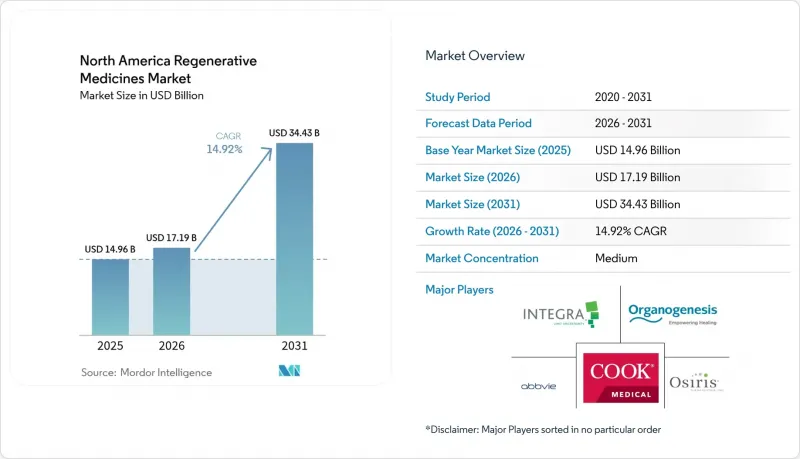
Mordor Intelligence에 의하면, 2026년 북미의 재생의료 시장 규모는 171억 9,000만 달러로 추정되며, 2025년 149억 6,000만 달러에서 성장하여 2031년에는 344억 3,000만 달러에 달할 것으로 예측됩니다.
또한 2026-2031년 연평균 성장률(CAGR)은 14.92%를 기록할 전망입니다.
본 보고서는 제품 유형(세포 치료, 유전자 치료 등), 세포 유래(자가 유래 등), 공급원(성체 줄기세포 등), 용도(정형외과·근골격계 등), 최종 사용자(병원·외과 센터 등), 지역(북미, 유럽, 아시아태평양 등)별로 분류되어 있습니다. 시장 전망은 금액(달러) 기준으로 제시되어 있습니다.
북미의 재생의료 시장 동향 및 인사이트
만성 퇴행성 질환 및 노화 관련 질환 유병률 증가
고령 인구 증가에 따라 재생의학 솔루션에 대한 임상적 시급성이 높아지고 있습니다. 5,400만 명 이상의 미국인이 관절염을 앓고 있으며, 2040년까지 그 수는 7,800만 명에 달할 것으로 예측됩니다. 이것이 북미 재생의학 시장의 정형외과 분야 수요를 견인하고 있습니다. 이와 더불어 심혈관 질환 및 신경퇴행성 질환 환자 수도 급증하고 있으며, 치료 수요가 누적됨에 따라 각 스폰서 기업들은 노화에 따른 적응증에 대해 FDA의 ‘재생의료 첨단 요법(RMAT)’ 지정을 추진 중입니다. 생산성 저하와 직접적인 의료비로 측정되는 누적된 경제적 부담으로 인해, 지불 주체들은 평생 비용을 상쇄할 수 있는 근원적인 치료법의 비용 부담에 대한 의지를 높이고 있습니다. 이러한 역학적 요인들이 맞물려 세포, 유전자, 조직 공학 각 치료법 분야의 파이프라인 활동에 큰 탄력을 주고 있습니다.
첨단 치료법에 대한 정부 및 민간 부문의 견실한 자금 지원
자금 조달의 모멘텀은 혁신 주기의 성숙을 여실히 보여주고 있습니다. 미국 국립보건원(NIH)은 2024 회계연도에 재생의학 프로젝트에 28억 달러를 배정했는데, 이는 2023 회계연도 대비 23% 증가한 예산입니다. 동시에, 캐나다 전략적 혁신 기금은 3개의 첨단 치료 제조 허브 건설에 12억 캐나다 달러(8억 9,000만 달러)를 지원했습니다. 이는 국내 생산 능력을 구축하고 기술 이전 계약을 유치하기 위한 조치입니다. 벤처 투자자들도 이러한 추세를 따라 규제적 경로가 명확한 후기 단계 자산에 우선적으로 자본을 투입하고 있으며, 이는 북미 재생의학 시장에서 단기적인 수익 실현에 대한 자신감을 보여줍니다.
고비용이며 복잡한 GMP 제조 인프라
전문적인 클린룸 건설 비용은 1제곱피트당 평균 2,000달러로, 이는 기존 생물제제 시설의 4배에 해당합니다. 또한 숙련된 인력 부족도 지속되고 있어, 2024년에는 재생의학 기업의 3분의 2가 인재 채용의 어려움을 지적하고 있습니다. 수작업 공정은 배치 간 편차를 확대시키고 있으며, 업계 조사에 따르면 제조 로트의 15%가 출시 사양을 충족하지 못하는 것으로 밝혀졌는데, 이는 단일클론 항체에서 관찰되는 불합격률의 5배에 해당합니다. 자동화는 진전되고 있지만, 자본 집약성은 여전히 큰 장벽으로 남아 있어 북미 재생의학 시장 전체로의 보다 광범위한 확장을 가로막고 있습니다.
부문 분석
2025년에는 암 치료 및 정형외과 분야에서 보험 환급 체계가 확립됨에 따라, 세포 치료가 북미 재생의학 시장에서 42.13%의 점유율을 차지하며 매출 순위 1위를 기록했습니다. 한편, 유전자 치료는 2023년 이후 바이러스 벡터 비용을 35% 절감한 제조 효율성 향상에 힘입어 연평균 성장률(CAGR) 23.82%를 나타낼 것으로 전망됩니다.
2024년 전체 파이프라인을 살펴보면, 후보 제품의 43%가 여러 재생의학 치료법을 결합하고 있으며, 이는 복합 요법으로의 전략적 전환을 반영합니다. 2025년 초, 이러한 하이브리드 제품 3개가 FDA 승인을 획득하며, 카테고리 경계를 모호하게 만드는 솔루션에 대한 규제 당국의 수용성이 확인되었습니다. 이에 따라 북미 재생의학 시장은 더욱 확대될 전망입니다.
2025년, 북미 재생의학 시장 규모의 55.22%를 동종 요법이 차지했습니다. 이는 기성 제품의 확장성과 확립된 유통망에 힘입은 결과입니다. 자가 유래 요법은 공정 최적화를 통해 ‘정맥에서 정맥까지’ 소요 기간이 2023년 28일에서 2025년 초 14일로 단축됨에 따라 연평균 성장률(CAGR) 20.61%로 확대되며 그 격차를 좁혀가고 있습니다.
유효성의 차이는 여전히 적응증마다 다릅니다. 자가 CAR-T는 혈액 악성 종양에서 임상적 우위를 유지하고 있는 반면, 동종 이식 제제는 심혈관계 응급 상황에서 신속한 도입이 가능합니다. 자가 유래 표적 선정과 동종 제조를 결합한 하이브리드 조달 모델은 2025년 3월에 첫 승인을 획득하며, 북미의 재생의료 시장의 다양화를 한층 더 촉진했습니다.
기타 혜택:
- 엑셀 형식 시장 예측(ME) 시트
- 3개월간의 애널리스트 지원
자주 묻는 질문
목차
제1장 서론
제2장 조사 방법
제3장 주요 요약
제4장 시장 구도
제5장 시장 규모와 성장 예측
제6장 경쟁 구도
제7장 시장 기회와 향후 전망
LSH 26.09.08According to Mordor Intelligence, North America regenerative medicines market size in 2026 is estimated at USD 17.19 billion, growing from 2025 value of USD 14.96 billion with 2031 projections showing USD 34.43 billion, growing at 14.92% CAGR over 2026-2031.
This report is Segmented by Product Type (Cell Therapies, Gene Therapies, and More), Origin of Cells (Autologous, and More), Source (Adult Stem Cells, and More), Application (Orthopedics & Musculoskeletal, and More), End User (Hospitals & Surgical Centers, and More), and Geography (North America, Europe, Asia-Pacific, and More). The Market Forecasts are Provided in Terms of Value (USD).
North America Regenerative Medicines Market Trends and Insights
Growing Prevalence of Chronic Degenerative & Age-Related Disorders
An expanding cohort of older adults is amplifying the clinical urgency behind regenerative solutions. More than 54 million Americans live with arthritis, and projections place the figure at 78 million by 2040, driving orthopedic demand within the North America regenerative medicine market. Parallel surges in cardiovascular and neurodegenerative conditions add to the therapeutic backlog, prompting sponsors to pursue FDA's Regenerative Medicine Advanced Therapy (RMAT) designation for age-related indications. The cumulative economic burden, measured in lost productivity and direct medical expenditure, intensifies payer willingness to underwrite curative options that offset lifetime costs. Collectively, these epidemiological factors add substantial momentum to pipeline activity across cell, gene and tissue-engineered modalities.
Robust Government & Private Funding for Advanced Therapies
Funding velocity underscores the maturing innovation cycle. The National Institutes of Health allocated USD 2.8 billion to regenerative-medicine projects for fiscal-year 2024, a 23% budgetary rise over 2023. Simultaneously, Canada's Strategic Innovation Fund committed CAD 1.2 billion (USD 890 million) to construct three advanced-therapy manufacturing hubs, a move designed to anchor domestic capacity and attract technology transfer agreements. Venture investors are mirroring the trend by preferentially channeling capital toward late-stage assets with defined regulatory pathways, signaling confidence in near-term revenue realization within the North America regenerative medicine market.
High Cost & Complex GMP Manufacturing Infrastructure
Specialized clean-room construction averages USD 2,000 per square foot, quadruple that of conventional biologics facilities, and skilled-labor shortages persist, with two-thirds of regenerative-medicine firms citing hiring difficulties in 2024. Manual processing steps amplify batch variability; industry surveys place 15% of runs outside release specifications, five-times the failure rate observed for monoclonal antibodies. While automation is advancing, capital intensity remains a formidable hurdle stifling wider roll-out across the North America regenerative medicine market.
Other drivers and restraints analyzed in the detailed report include:
- Expanded FDA Expedited Pathways Fueling Pipeline
- Big-Pharma-Biotech Alliances Accelerating Commercialization
- Stringent & Evolving Regulatory Compliance for ATMPs
For complete list of drivers and restraints, kindly check the Table Of Contents.
Segment Analysis
Cell therapies led the revenue tables in 2025 with 42.13% North America regenerative medicine market share, benefitting from established reimbursement in oncology and orthopedics. Gene therapies, however, post a 23.82% CAGR outlook, propelled by manufacturing efficiencies that have trimmed viral-vector costs by 35% since 2023.
Across 2024 pipelines, 43% of candidates now blend multiple regenerative modalities, reflecting a strategic pivot toward combination constructs. Three such hybrid products gained FDA clearance in early 2025, confirming regulatory openness to category-blurring solutions that will likely enlarge the North America regenerative medicine market.
Allogeneic therapies commanded 55.22% of the North America regenerative medicine market size in 2025, aided by off-the-shelf scalability and established distribution chains. Autologous approaches are closing the gap, advancing at 20.61% CAGR as process optimization compresses vein-to-vein timelines from 28 days in 2023 to 14 days in early 2025.
Efficacy differentials remain indication-specific: autologous CAR-T retains a clinical edge in hematologic malignancies, whereas allogeneic constructs offer rapid deployment in cardiovascular emergencies. Hybrid sourcing models, marrying autologous targeting with allogeneic manufacturing, received their first approval in March 2025, further diversifying the North American regenerative medicine market.
Complete Report Scope:
- By Product Type
- Cell Therapies
- Gene Therapies
- Tissue-Engineered Products
- Biomaterials
- Acellular Regenerative Products
- By Origin of Cells
- Autologous
- Allogeneic
- Xenogeneic
- By Source
- Adult Stem Cells
- Induced Pluripotent Stem Cells
- Embryonic Stem Cells
- Hematopoietic Stem Cells
- By Application
- Orthopedics & Musculoskeletal
- Dermatology & Wound Care
- Cardiovascular
- Neurology
- Oncology
- Ophthalmology
- Others (Endocrine, Renal etc.)
- By End User
- Hospitals & Surgical Centers
- Specialty Clinics
- Academic & Research Institutes
- Biobanks & Cell Banks
- By Country
- United States
- Canada
- Mexico
List of Companies Covered in this Report:
- AbbVie Inc (Allergan Aesthetics)
- Smiths Group
- Organogenesis
- Medtronic
- Thermo Fisher Scientific
- Merck
- Cook Group
- MiMedx Group Inc.
- Vericel
- Integra LifeSciences
- Mesoblast Limited
- Novartis
- Bristol Myers Squibb (Celgene)
- Gilead Sciences
- bluebird bio Inc.
- Spark Therapeutics Inc. (Roche)
- CRISPR Therapeutics AG
- Sangamo Therapeutics
- Takeda Pharmaceuticals
- 3-D Systems Corp. (Allevi)
Additional Benefits:
- The market estimate (ME) sheet in Excel format
- 3 months of analyst support
TABLE OF CONTENTS
1 Introduction
- 1.1 Study Assumptions & Market Definition
- 1.2 Scope of the Study
2 Research Methodology
3 Executive Summary
4 Market Landscape
- 4.1 Market Overview
- 4.2 Market Drivers
- 4.2.1 Growing Prevalence of Chronic Degenerative & Age-Related Disorders
- 4.2.2 Robust Government & Private Funding for Advanced Therapies
- 4.2.3 Expanded FDA Expedited Pathways Fueling Pipeline
- 4.2.4 Big-Pharma-Biotech Alliances Accelerating Commercialization Roadmaps
- 4.2.5 Increasing Adoption of Stem Cell Technology
- 4.2.6 Advancements in 3D Bioprinting and Tissue Engineering Technologies
- 4.3 Market Restraints
- 4.3.1 High Cost & Complex GMP Manufacturing Infrastructure
- 4.3.2 Stringent & Evolving Regulatory Compliance for ATMPs
- 4.3.3 Limited Long-Term Clinical Evidence and Outcome Data
- 4.3.4 Ethical and Public Perception Challenges Around Cell-Based Therapies
- 4.4 Regulatory Outlook
- 4.5 Porter's Five Forces Analysis
- 4.5.1 Threat of New Entrants
- 4.5.2 Bargaining Power of Buyers
- 4.5.3 Bargaining Power of Suppliers
- 4.5.4 Threat of Substitutes
- 4.5.5 Competitive Rivalry
5 Market Size & Growth Forecasts (Value in USD)
- 5.1 By Product Type
- 5.1.1 Cell Therapies
- 5.1.2 Gene Therapies
- 5.1.3 Tissue-Engineered Products
- 5.1.4 Biomaterials
- 5.1.5 Acellular Regenerative Products
- 5.2 By Origin of Cells
- 5.2.1 Autologous
- 5.2.2 Allogeneic
- 5.2.3 Xenogeneic
- 5.3 By Source
- 5.3.1 Adult Stem Cells
- 5.3.2 Induced Pluripotent Stem Cells
- 5.3.3 Embryonic Stem Cells
- 5.3.4 Hematopoietic Stem Cells
- 5.4 By Application
- 5.4.1 Orthopedics & Musculoskeletal
- 5.4.2 Dermatology & Wound Care
- 5.4.3 Cardiovascular
- 5.4.4 Neurology
- 5.4.5 Oncology
- 5.4.6 Ophthalmology
- 5.4.7 Others (Endocrine, Renal etc.)
- 5.5 By End User
- 5.5.1 Hospitals & Surgical Centers
- 5.5.2 Specialty Clinics
- 5.5.3 Academic & Research Institutes
- 5.5.4 Biobanks & Cell Banks
- 5.6 By Country
- 5.6.1 United States
- 5.6.2 Canada
- 5.6.3 Mexico
6 Competitive Landscape
- 6.1 Market Concentration
- 6.2 Market Share Analysis
- 6.3 Company Profiles (includes Global level Overview, Market level overview, Core Segments, Financials as available, Strategic Information, Market Rank/Share for key companies, Products & Services, and Recent Developments)
- 6.3.1 AbbVie Inc (Allergan Aesthetics)
- 6.3.2 Smith & Nephew plc (Osiris Therapeutics)
- 6.3.3 Organogenesis Holdings Inc.
- 6.3.4 Medtronic
- 6.3.5 Thermo Fisher Scientific Inc.
- 6.3.6 Merck KGaA (Sigma-Aldrich)
- 6.3.7 Cook Medical (Cook Biotech Incorporated)
- 6.3.8 MiMedx Group Inc.
- 6.3.9 Vericel Corporation
- 6.3.10 Integra Lifesciences
- 6.3.11 Mesoblast Limited
- 6.3.12 Novartis AG
- 6.3.13 Bristol Myers Squibb (Celgene)
- 6.3.14 Gilead Sciences Inc. (Kite Pharma)
- 6.3.15 bluebird bio Inc.
- 6.3.16 Spark Therapeutics Inc. (Roche)
- 6.3.17 CRISPR Therapeutics AG
- 6.3.18 Sangamo Therapeutics Inc.
- 6.3.19 Takeda Pharmaceutical Co. Ltd.
- 6.3.20 3-D Systems Corp. (Allevi)
7 Market Opportunities & Future Outlook
- 7.1 White-space & Unmet-Need Assessment


