
|
시장보고서
상품코드
2121271
미국의 자동차용 센서 : 시장 점유율 분석, 업계 동향과 통계, 성장 예측(2026-2031년)US Automotive Sensors - Market Share Analysis, Industry Trends & Statistics, Growth Forecasts (2026 - 2031) |
||||||
 Mordor Intelligence
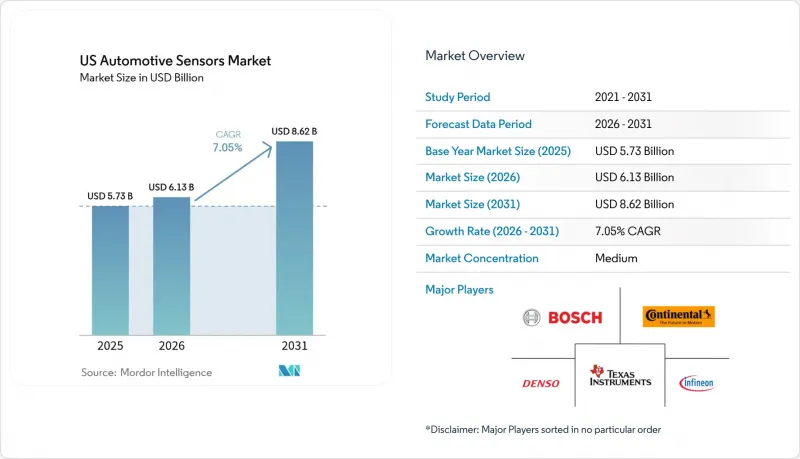
Mordor Intelligence에 따르면 미국의 자동차용 센서 시장 규모는 2025년 57억 3,000만 달러에서 2026년에는 61억 3,000만 달러로 확대되고, 2026년부터 2031년까지 CAGR 7.05%를 기록하며 2031년에는 86억 2,000만 달러에 달할 것으로 예측됩니다.
본 보고서는 센서 유형(온도 센서, 기타), 용도(파워트레인, 기타), 차종(이륜차, 기타), 유통 채널(OEM, 기타), 추진 방식(내연기관 차량, 기타), 센서 기술(MEMS, 기타)별로 분류되어 있습니다. 시장 예측은 금액(달러)과 수량(대)으로 제시되어 있습니다.
미국 자동차용 센서 시장의 동향 및 인사이트
CHIPS법이 국내 MEMS 팹 건설을 촉진
390억 달러 상당의 새로운 연방 보조금을 통해 웨이퍼 제조 공장 프로젝트가 애리조나주, 텍사스주, 뉴욕주 북부로 유치되고 있으며, 엔진, 배터리, 섀시 제어의 기반이 되는 MEMS 압력 센서, 관성 센서, 자기 센서의 현지 공급 체계가 확보되고 있습니다. Rogue Valley Microdevices는 자동차용 MEMS 생산능력을 약 3배로 확대할 플로리다주 공장을 위해 이미 670만 달러의 보조금을 확보했으며, 이는 이 프로그램 하에서 소규모 파운드리 업체가 어떻게 규모를 확장할 수 있는지를 보여줍니다. 생산능력 확대를 통해 리드 타임이 단축되고 운송 위험이 감소할 뿐만 아니라, 디트로이트 및 해안 지역의 조립 공장에 대한 적시 납품이 지원됩니다. 이 대학은 차세대 마이크로머시닝 공정 개발의 토대가 될 연구 보조금을 확보하여, 이를 통해 미국 자동차용 센서 시장의 혁신이 더욱 공고해질 것입니다. 이러한 노력들이 결합되어 공급망의 회복력이 향상되고, 향후 생산이 해외 팹에서 국내로 되돌아오게 될 것입니다.
전기자동차(EV)의 보급이 차량당 센서 탑재 수를 증가시킵니다
전기자동차(EV) 모델에는 내연기관(ICE) 차량에 비해 2-3배 많은 반도체가 탑재되어 있으며, 2030년까지 센서가 차지하는 비중이 더욱 높아질 것으로 예상됩니다. 배터리 관리 시스템만 해도 열 폭주를 방지하기 위해 여러 개의 온도, 전류, 전압 측정 지점이 필요합니다. 위치 센서와 자기 센서는 전기 모터의 회전수를 모니터링하며, 고전압 절연 소자가 안전성을 확보합니다. 정부의 세액 공제 및 전국적인 충전 인프라 구축에 대한 보조금으로 인해 납품 대수가 가속화되고 있어, 각 공급업체들은 더욱 가혹한 엔진룸 환경에 대응하기 위해 SiC(실리콘 카바이드) 기반의 압력·온도용 다이 규모 확대를 추진하고 있습니다. 그 결과, 자동차 총 생산 대수가 정체 상태임에도 불구하고, 미국의 자동차용 센서 시장은 평균 판매 가격 상승이라는 혜택을 누리고 있습니다.
실리콘 공급에 대한 물 부족으로 인한 제약
애리조나주에 건설될 차세대 팹은 각 시설에서 하루에 상당한 양의 물을 소비할 가능성이 있어, 이미 가뭄의 영향을 받고 있는 대수층에 추가적인 부담을 줄 우려가 있습니다. 지역 사회의 반대나 인허가 지연으로 인해 현지 웨이퍼 생산량이 제한될 가능성이 있으며, 그 결과 자동차용 압력 및 관성 센서용 다이의 공급이 부족해질 우려가 있습니다. 위험을 완화하기 위해 각 제조사는 공정 용수의 70% 이상을 회수하는 폐쇄형 순환 재활용 시스템을 도입하고 있으나, 설비 투자로 인해 투자 회수 기간이 길어지고 있습니다. 추가 거점이 승인되지 않을 경우, 장기적인 공급 부족은 미국 자동차용 센서 시장의 성장을 둔화시킬 가능성이 있습니다.
부문별 분석
압력 센서는 2025년 매출의 29.02%를 차지하며, 연료 분사, 브레이크 부스터, 의무화된 타이어 공기압 모니터링 시스템 등의 용도를 뒷받침하고 있습니다. 미국 자동차용 센서 시장에서 압력 센서의 시장 규모는 연비 효율 및 배기가스 규제 목표에 따라 꾸준히 확대될 전망입니다. 레이더 모듈은 현재 규모는 작지만, 77GHz 칩셋의 가격 하락과 NCAP에 의한 사각지대·전방 충돌·횡단 교통 경보 기능 추가 압박으로 인해 2031년까지 연평균 성장률(CAGR) 8.02%로 성장할 전망입니다. Tier 1 공급업체들은 현재 주류 SUV에 4코너 4D 레이더를 기본 사양으로 탑재하고 있으며, 이는 센서 퓨전이 프리미엄 부문에서 양산 부문으로 이동하고 있음을 보여줍니다.
2세대 밀리파 아키텍처에서는 디지털 빔 포밍과 AI 강화형 물체 분류가 단일 CMOS 다이 위에 통합되어 있습니다. 이를 통해 부품 비용이 절감되고 열 설계가 간소화되어, 레이더가 카메라만 사용하는 ADAS의 시장 점유율을 잠식하는 데 기여할 것입니다. 레이더와 관성 항법 장치를 결합한 공급업체들은 GPS를 사용할 수 없는 상황에서도 고정밀 주행 거리 측정을 실현하여, 미국 자동차용 센서 산업에 새로운 가치 창출의 원천을 제공하고 있습니다.
파워트레인 시스템은 2025년 지출의 35.98%를 차지하며, 기류, 노킹, 냉각수 온도, 배터리 팩용 센서 등을 포괄합니다. Tier 3 배기가스 규제를 준수함에 따라 파워트레인에 대한 비중은 높은 수준을 유지하고 있습니다. 한편, ADAS 및 자율주행 기능은 2031년까지 연평균 성장률(CAGR) 8.36%로 확대되어, 미국 자동차용 센서 시장 규모에서 차지하는 비중을 대폭 높일 전망입니다. 초음파, 카메라, 레이더, 라이다(LiDAR)의 조합을 통해 레벨 2+ 기능이 구현되는 한편, NHTSA(미국 도로교통안전국)의 새로운 자동 긴급 제동 의무화로 인해 기본 수요가 확보되고 있습니다.
이중화 목표를 달성하기 위해 각 OEM 업체들은 횡방향 및 종방향 제어를 위해 2개의 독립적인 감지 채널을 규정하고 있습니다. 이에 따라 2029년까지 차량 1대당 반도체 총 개수는 1,000개를 넘어설 것으로 보이며, ADAS는 센서 부문에서 가장 빠르게 성장하는 예산 항목으로서의 입지를 공고히 할 것으로 예상됩니다. 지속적인 무선(OTA)을 통한 기능 업그레이드는 차량 판매 후 수년이 지나도 미사용 연산 여력을 수익화할 수 있으므로, 라이프사이클 수익을 더욱 확대시킬 것입니다.
기타 혜택
- 엑셀 형식의 시장 예측(ME) 시트
- 3개월간의 애널리스트 지원
자주 묻는 질문
목차
제1장 소개
제2장 조사 방법
제3장 주요 요약
제4장 시장 구도
제5장 시장 규모와 성장 예측
제6장 경쟁 구도
제7장 시장 기회와 향후 전망
KSM 26.09.03According to Mordor Intelligence, the US automotive sensors market size is expected to grow from USD 5.73 billion in 2025 to USD 6.13 billion in 2026 and is forecast to reach USD 8.62 billion by 2031 at 7.05% CAGR over 2026-2031.
This report is Segmented by Sensor Type (Temperature Sensors and More), Application (Powertrain and More), Vehicle Type (Motorcycles and More), Sales Channel (OEM and More), Propulsion (Internal Combustion Vehicles and More), and Sensor Technology (MEMS and More). The Market Forecasts are Provided in Terms of Value (USD) and Volume (Units).
US Automotive Sensors Market Trends and Insights
CHIPS Act Incentivises On-Shore MEMS Fabs
New federal grants worth USD 39 billion are steering wafer-fab projects to Arizona, Texas and upstate New York, ensuring a local pipeline of MEMS pressure, inertial and magnetic sensors that underpin engine, battery and chassis controls. Rogue Valley Microdevices has already secured USD 6.7 million for a Florida plant that will nearly triple its automotive MEMS capacity, illustrating how smaller foundries can scale under the program. The added capacity reduces lead-times, cuts shipping risk and supports just-in-time delivery for Detroit and coastal assembly plants. Universities gain research grants that seed next-gen micromachining processes, further anchoring innovation inside the United States automotive sensors market. Combined, these actions lift resilience and pull future production back from overseas fabs.
EV Adoption Pushes Sensor Content per Vehicle
Electric models integrate two to three times more semiconductors than ICE cars, pushing sensor value toward a greater share by 2030. Battery-management systems alone require multiple temperature, current and voltage nodes to prevent thermal runaway. Position and magnetic sensors monitor e-motor speed, while high-voltage isolation devices maintain safety. Government tax credits and coast-to-coast charging grants accelerate delivery volumes, so suppliers are scaling SiC-based pressure and temperature dies to meet harsher under-hood environments. As a result, the United States automotive sensors market is benefiting from higher average selling prices even when overall vehicle production remains flat.
Silicon-Supply Water-Stress Constraints
Next-generation fabs in Arizona may each draw significant liters of water daily, straining aquifers already under drought pressure. Community opposition or permitting delays could cap local wafer output, tightening the flow of automotive pressure and inertial dies. To mitigate risk, manufacturers are installing closed-loop recycling that recovers more than 70% of process water, yet capital outlays lengthen payback. Prolonged shortages could temper growth for the United States automotive sensors market if additional sites are not approved.
Other drivers and restraints analyzed in the detailed report include:
- Connected-Insurance Telematics Retrofits
- Software-Defined Vehicle Architectures
- Cost & Price-Erosion Squeeze Tier-1 Margins
For complete list of drivers and restraints, kindly check the Table Of Contents.
Segment Analysis
Pressure devices delivered 29.02% of 2025 revenue, anchoring applications such as fuel injection, brake boost and mandated tire-pressure monitoring. The United States automotive sensors market size for pressure units is set to expand steadily in line with fuel-efficiency and emissions targets. Radar modules, although smaller today, will grow at a 8.02% CAGR through 2031 thanks to falling 77 GHz chipset prices and NCAP pressure to add blind-spot, front-collision and cross-traffic alerts. Tier-1s now bundle four-corner 4D radar into mainstream SUVs, signalling that sensor fusion is shifting from premium to volume segments.
Second-generation millimetre-wave architectures integrate digital beam-forming and AI-enhanced object classification on a single CMOS die. This reduces bill-of-materials and simplifies thermal design, helping radar to erode camera-only ADAS share. Suppliers that combine radar with inertial reference units promise high-accuracy odometry even when GPS is blocked, creating new value pools within the United States automotive sensors industry.
Powertrain systems accounted for 35.98% of 2025 spend, covering air-flow, knock, coolant-temperature and battery pack sensors. Compliance with Tier 3 emissions rules keeps powertrain allocations high. At the same time, ADAS and autonomous functions will expand at an 8.36% CAGR to 2031, raising their portion of the United States automotive sensors market size considerably. Ultrasonic, camera, radar and lidar combinations enable Level-2+ functions, while NHTSA's new automatic emergency-braking mandate locks in baseline volumes.
To meet redundancy targets, OEMs specify dual independent sensing paths for lateral and longitudinal control. This pushes total semiconductor count per vehicle past thousand mark by 2029, cementing ADAS as the fastest-growing budget line for sensors. Continuous over-the-air feature upgrades further stretch lifecycle revenue because dormant compute headroom can be monetised years after vehicle sale.
Complete Report Scope:
- By Sensor Type
- Temperature Sensors
- Pressure Sensors
- Speed / Velocity Sensors
- Level / Position Sensors
- Magnetic Sensors
- Gas / Chemical Sensors
- Inertial Sensors (Accel/Gyro)
- LiDAR Sensors
- Radar Sensors
- Ultrasonic Sensors
- Image / Camera Sensors
- Current Sensors
- By Application
- Powertrain
- Body Electronics & Comfort
- Vehicle Security & Safety
- ADAS & Autonomous Systems
- Telematics & Connectivity
- Battery-Management (EV)
- By Vehicle Type
- Motorcycles
- Passenger Cars
- Light Commercial Vehicles
- Heavy Commercial Vehicles
- By Sales Channel
- OEM
- Aftermarket
- By Propulsion
- Internal-Combustion Vehicles
- Hybrid Electric Vehicles
- Battery Electric Vehicles
- Fuel-Cell Electric Vehicles
- By Sensor Technology
- MEMS
- Non-MEMS / Macro Sensors
List of Companies Covered in this Report:
- Robert Bosch GmbH
- DENSO Corporation
- Continental AG
- HELLA GmbH & Co. KGaA
- Valeo SA
- Texas Instruments Inc.
- Infineon Technologies AG
- NXP Semiconductors NV
- Analog Devices Inc.
- Hitachi Astemo Americas Inc.
- Sensata Technologies
- TE Connectivity
- Aptiv PLC
- STMicroelectronics NV
- onsemi
- BorgWarner Inc.
- Renesas Electronics Corp.
- Honeywell International Inc.
- Allegro MicroSystems LLC
- Microchip Technology Inc.
Additional Benefits:
- The market estimate (ME) sheet in Excel format
- 3 months of analyst support
TABLE OF CONTENTS
1 Introduction
- 1.1 Study Assumptions & Market Definition
- 1.2 Scope of the Study
2 Research Methodology
3 Executive Summary
4 Market Landscape
- 4.1 Market Overview
- 4.2 Market Drivers
- 4.2.1 CHIPS Act Incentivizes On-Shore MEMS Fabs
- 4.2.2 EV Adoption Pushes Sensor Content per Vehicle
- 4.2.3 Federal TPMS, ESC & NCAP Upgrades
- 4.2.4 Connected-Insurance Telematics Retrofits
- 4.2.5 Software-Defined Vehicle Architectures
- 4.2.6 Fleet Decarbonisation Targets (Corporate)
- 4.3 Market Restraints
- 4.3.1 Silicon-Supply Water-Stress Constraints
- 4.3.2 Cost & Price-Erosion Squeeze Tier-1 Margins
- 4.3.3 Harsh-Duty Reliability & Calibration Issues
- 4.3.4 Sensor-Level Cyber-Security Liabilities
- 4.4 Value / Supply-Chain Analysis
- 4.5 Regulatory Landscape
- 4.6 Technological Outlook
- 4.7 Sustainability & Energy-Footprint Analysis
- 4.8 Porter's Five Forces
- 4.8.1 Threat of New Entrants
- 4.8.2 Bargaining Power of Buyers/Consumers
- 4.8.3 Bargaining Power of Suppliers
- 4.8.4 Threat of Substitute Products
- 4.8.5 Intensity of Competitive Rivalry
5 Market Size & Growth Forecasts (Value (USD) and Volume (Units))
- 5.1 By Sensor Type
- 5.1.1 Temperature Sensors
- 5.1.2 Pressure Sensors
- 5.1.3 Speed / Velocity Sensors
- 5.1.4 Level / Position Sensors
- 5.1.5 Magnetic Sensors
- 5.1.6 Gas / Chemical Sensors
- 5.1.7 Inertial Sensors (Accel/Gyro)
- 5.1.8 LiDAR Sensors
- 5.1.9 Radar Sensors
- 5.1.10 Ultrasonic Sensors
- 5.1.11 Image / Camera Sensors
- 5.1.12 Current Sensors
- 5.2 By Application
- 5.2.1 Powertrain
- 5.2.2 Body Electronics & Comfort
- 5.2.3 Vehicle Security & Safety
- 5.2.4 ADAS & Autonomous Systems
- 5.2.5 Telematics & Connectivity
- 5.2.6 Battery-Management (EV)
- 5.3 By Vehicle Type
- 5.3.1 Motorcycles
- 5.3.2 Passenger Cars
- 5.3.3 Light Commercial Vehicles
- 5.3.4 Heavy Commercial Vehicles
- 5.4 By Sales Channel
- 5.4.1 OEM
- 5.4.2 Aftermarket
- 5.5 By Propulsion
- 5.5.1 Internal-Combustion Vehicles
- 5.5.2 Hybrid Electric Vehicles
- 5.5.3 Battery Electric Vehicles
- 5.5.4 Fuel-Cell Electric Vehicles
- 5.6 By Sensor Technology
- 5.6.1 MEMS
- 5.6.2 Non-MEMS / Macro Sensors
6 Competitive Landscape
- 6.1 Market Concentration
- 6.2 Strategic Moves
- 6.3 Market Share Analysis
- 6.4 Company Profiles (Includes Global Level Overview, Market Level Overview, Core Segments, Financials as Available, Strategic Information, Market Rank/Share for Key Companies, Products and Services, SWOT Analysis, and Recent Developments)
- 6.4.1 Robert Bosch GmbH
- 6.4.2 DENSO Corporation
- 6.4.3 Continental AG
- 6.4.4 HELLA GmbH & Co. KGaA
- 6.4.5 Valeo SA
- 6.4.6 Texas Instruments Inc.
- 6.4.7 Infineon Technologies AG
- 6.4.8 NXP Semiconductors NV
- 6.4.9 Analog Devices Inc.
- 6.4.10 Hitachi Astemo Americas Inc.
- 6.4.11 Sensata Technologies
- 6.4.12 TE Connectivity
- 6.4.13 Aptiv PLC
- 6.4.14 STMicroelectronics NV
- 6.4.15 onsemi
- 6.4.16 BorgWarner Inc.
- 6.4.17 Renesas Electronics Corp.
- 6.4.18 Honeywell International Inc.
- 6.4.19 Allegro MicroSystems LLC
- 6.4.20 Microchip Technology Inc.
7 Market Opportunities & Future Outlook
- 7.1 White-space & Unmet-Need Assessment