|
시장보고서
상품코드
2121276
멸균 포장 : 시장 점유율 분석, 업계 동향과 통계, 성장 예측(2026-2031년)Sterilized Packaging - Market Share Analysis, Industry Trends & Statistics, Growth Forecasts (2026 - 2031) |
||||||
 Mordor Intelligence
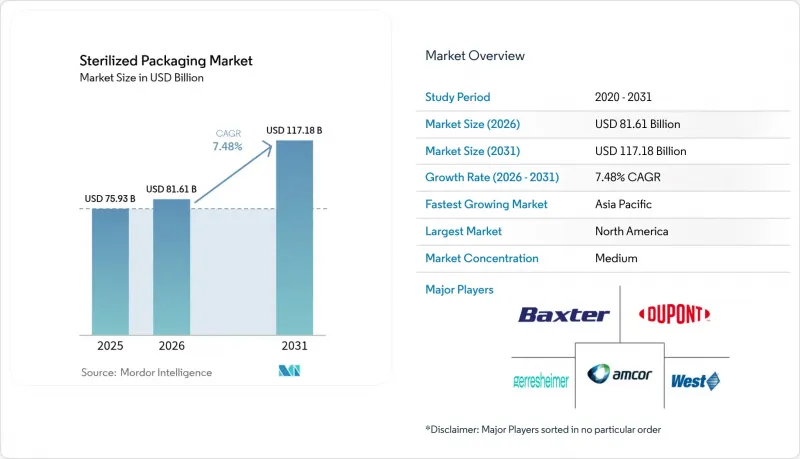
Mordor Intelligence에 의하면, 2026년 멸균 포장 시장 규모는 816억 1,000만 달러로 추정되며, 2025년 759억 3,000만 달러에서 2031년에는 1,171억 8,000만 달러에 달할 것으로 예측됩니다.
또한 2026-2031년 연평균 성장률(CAGR) 7.48%를 기록할 전망입니다.
본 보고서는 제품별(클램쉘, 파우치, 병, 블리스터 및 앰플, 바이알 등), 소재별(플라스틱, 유리, 금속 등),멸균 방법별(화학적, 방사선 등), 최종 사용자 산업별(의료·외과용 기구, 의약품·생물학적 제제, 체외진단용 의약품 등), 지역별로 분류되어 있습니다. 시장 예측은 금액(미 달러) 기준으로 제시되어 있습니다.
세계 멸균 포장 시장 동향 및 인사이트
병원 내 감염 발생률 증가
의료 관련 감염은 미국 입원 환자 31명 중 1명이 매일 걸리고 있으며, 의료 시스템에 연간 284억 달러의 비용을 발생시키고 있습니다. 따라서 병원에서는 중요한 기구에 대해 더 높은 차단 성능을 가진 트레이나 멸균 랩의 사용을 의무화하고 있으며, 많은 시설에서는 법적 책임을 경감하기 위해 재사용 가능한 세트에서 일회용 세트로 전환하고 있습니다. 항생제 내성균의 출현으로 인해 기존의 세척 방법만으로는 불충분해짐에 따라, 일회용 멸균 포장 시장 수요는 더욱 높아지고 있습니다. 포장 가공업체에 따르면, 10-6의 무균 보증 수준을 유지하면서 여러 번의 에틸렌옥사이드(EtO) 사이클을 견딜 수 있는 통기성 타이벡(Tyvek) 뚜껑에 대한 주문이 증가하고 있다고 합니다.
생물학적 제제 및 주사제 시장의 성장
세계 바이오의약품 매출액은 2030년까지 8,560억 달러에 달할 것으로 예상되며, 주사제 형태에 대한 수요가 증가함에 따라 미립자를 방출하지 않는 초고순도 용기가 요구되고 있습니다. 프리필드 주사기 수요가 급증함에 따라 공급업체들은 더욱 엄격한 용기 및 밀봉 시험 인증을 받아야 하는 반면, 세포 치료제 제조업체들에게는 -196°C에서도 무결성을 유지할 수 있는 포장이 요구되고 있습니다. SCHOTT Pharma가 3억 7,100만 달러를 투자하여 미국에 건설한 주사기 공장은 이러한 치료법을 대상으로 하고 있으며, 지역별 생산 능력 확대가 더욱 엄격해진 Annex 1 규정을 어떻게 준수하고 있는지를 보여주고 있습니다.
변동이 심한 의료용 등급 폴리머 가격
의료용 등급 수지에는 특수 첨가제와 장기간에 걸친 검증 과정이 필요하기 때문에 공급업체를 대체하기가 제한적입니다. 지정학적 혼란과 정제소 가동 중단으로 인해 가격이 급등하면서, 이미 고비용의 에틸렌옥사이드(EtO) 제거 프로젝트를 진행 중인 각 컨버터 기업들의 부담이 더욱 가중되고 있습니다. 여러 지역에 걸친 공급 계약과 사내 재활용 능력을 갖춘 기업은 이익 마진이 충분하지만, 단일 공급업체로부터의 구매에 의존하는 기업은 공급 부족이나 긴급 운송비 위험에 노출되어 있습니다.
부문 분석
트레이 및 열성형 포장은 복잡한 기구 세트를 수납할 수 있고 즉시 육안 확인이 가능하다는 장점 덕분에 2025년 멸균 포장 시장에서 26.21%의 점유율을 유지했습니다. 병원에서는 입고 및 출고 절차를 신속하게 처리하고 수술실 지연을 줄여주는 투명 뚜껑이 중요시되고 있습니다. 맞춤형 캐비티를 통해 제품의 이동을 억제하여 운송 중 천공 위험을 줄입니다. 블리스터 및 앰플은 오염으로 인해 고가의 투여량이 훼손될 우려가 있는 1회 투여용 바이오의약품에 힘입어, 2031년까지 연평균 성장률(CAGR) 9.02%로 가장 빠르게 성장하는 제품군입니다.
블리스터 내 고급 배리어 필름으로의 전환은 프리미엄화 추세를 보여줍니다. 열성형 라인에 탑재된 AI 카메라가 최고 속도로 밀봉 상태를 검사하여 배치 수율과 문서화를 개선하고 있습니다. 파우치, 병,점적 용기, 클램쉘은 특정 제형이나 재사용 가능한 기구에서 여전히 중요한 역할을 하고 있지만, 1회 투여 형식이 보급됨에 따라 성장은 둔화되고 있습니다. 온도나 방사선 노출을 기록하는 스마트 라벨은 시험 단계에서 본격적인 도입 단계로 전환되고 있으며, 디지털화의 확산을 반영하고 있습니다.
플라스틱은 강도, 투명성, 비용의 균형이 뛰어나 2025년에도 멸균 포장 시장 규모의 61.58%를 차지하고 있습니다. 폴리에틸렌, 폴리프로필렌 및 고리형 올레핀 공중합체는 에틸렌옥사이드(EtO), 감마선, 전자빔에 내성이 있지만, 지속가능성에 관한 규제 강화와 버진 수지 가격의 급등으로 인해 대체 소재로의 전환이 진행되고 있습니다. 부직포 및 타이벡(Tyvek) 기질은 통기성과 섬유 강도 덕분에 잔류물이 적은 멸균제와 함께 사용할 수 있어, 2031년까지 연평균 성장률(CAGR) 9.11%로 증가할 것으로 예측됩니다.
유리 바이알은 의약품과 용기 간의 상호작용을 거의 제로 수준으로 억제해야 하는 경우, 특히 콜드체인 운송 거리가 긴 바이오의약품 분야에서 여전히 필수적인 존재입니다. 금속 트레이는 견고한 고정력과 차폐 운송이 요구되는 정형외과용 임플란트 키트 등, 보다 틈새적인 분야에서 이용되고 있습니다. 판지는 생분해성이 중시되는 2차 포장용 카톤에서 점유율을 확대하고 있지만, 1차 포장의 무균성에 대해서는 여전히 높은 차단성이 요구되고 있습니다. PFAS 사용 금지 시한이 다가옴에 따라 각 공급업체들은 불소계 폴리머의 대체재로 플라즈마 코팅 및 이산화규소 코팅의 생산을 확대되고 있습니다.
지역별 분석
2025년, 북미는 멸균 포장 시장의 32.84% 점유율을 차지하고 있으며, 그 배경으로는 FDA의 감독 체계와 복잡한 의약품의 출시 비율이 높다는 점을 들 수 있습니다. 대규모 위탁 멸균 네트워크와 주요 수지 제조업체들이 공급 안정성을 뒷받침하고 있으며, 투자는 에틸렌옥사이드(EtO) 감축 및 새로운 전자선 멸균실에 집중되고 있습니다. 벡톤 디킨슨(Becton Dickinson)의 생물학적 제제 전달 사업부는 2024년에 10억 달러를 돌파하며, 이 지역이 고부가가치 의료기기로 기울고 있음을 여실히 보여주고 있습니다.
유럽은 Annex 1 준수 강화 및 PFAS 프리 소재의 조기 도입에 힘입어 성숙한 수요를 보이고 있습니다. 독일과 아일랜드에는 전 세계 바이오의약품 공급망을 뒷받침하는 다수의 충전·마감 공장이 위치해 있습니다. EU가 2026년에 도입할 불소수지 사용 제한에 따라 대체 코팅에 대한 신속한 인증이 진행되고 있으며, 유럽의 컨버터들은 선구자로서의 입지를 확고히 하고 있습니다. 또한, 지속가능성 목표 역시 재사용 가능한 2차 포장을 위한 순환형 경제 시범 사업을 뒷받침하고 있습니다.
아시아태평양은 중국과 인도가 국내 및 수출 시장을 대상으로 생물학적 제제 및 저분자 의약품 생산을 확대하고 있어, 2031년까지 8.95%라는 가장 높은 연평균 성장률(CAGR)을 보일 것으로 전망됩니다. 각 지역의 규제 당국은 ICH 지침과의 조화를 추진하고 있으며, 이에 따라 더 높은 수준의 클린룸 및 방사선 처리 능력에 대한 투자가 촉진되고 있습니다. 일본에서는 고령화에 따라 재택치료용 주사기 수요가 증가하는 한편, 한국과 호주에서는 스마트 라벨이 부착된 콜드체인 포장의 시험장 역할을 수행하고 있습니다. 멸균 포장 시장의 생산 능력을 현지화함으로써 리드 타임을 단축하고 환율 리스크를 완화할 수 있습니다.
기타 혜택:
- 엑셀 형식 시장 예측(ME) 시트
- 3개월간의 애널리스트 지원
자주 묻는 질문
목차
제1장 서론
제2장 조사 방법
제3장 주요 요약
제4장 시장 구도
제5장 시장 규모와 성장 예측
제6장 경쟁 구도
제7장 시장 기회와 향후 동향
LSH 26.09.08According to Mordor Intelligence, sterilized packaging market size in 2026 is estimated at USD 81.61 billion, growing from 2025 value of USD 75.93 billion with 2031 projections showing USD 117.18 billion, growing at 7.48% CAGR over 2026-2031.
This report is Segmented by Product (Clamshells, Pouches, Bottles, Blisters and Ampoules, Vials, and More), Material (Plastics, Glass, Metals, and More), Sterilization Method (Chemical, Radiation, and More), End-User Industry (Medical and Surgical Instruments, Pharmaceutical and Biological, In-Vitro Diagnostics, and More), and Geography. The Market Forecasts are Provided in Terms of Value (USD).
Global Sterilized Packaging Market Trends and Insights
Rising Incidence of Hospital-Acquired Infections
Healthcare-associated infections affect 1 in 31 U.S. hospital patients on any day, costing the system USD 28.4 billion annually. Hospitals are therefore mandating higher barrier trays and sterile wraps for critical instruments, and many facilities are shifting reusable sets to single-use formats to mitigate liability. Single-use sterilized packaging market demand rises further as antibiotic-resistant organisms render legacy cleaning inadequate. Packaging converters report growing orders for breathable Tyvek lids that withstand multiple EtO cycles while maintaining a sterility assurance level of 10-6.
Growth in Biologics and Injectable Drugs
Global biologics revenue is moving toward USD 856 billion by 2030, and demand for injectable formats requires ultra-clean containers that do not shed particulates. The prefilled syringe boom is compelling suppliers to certify tougher container-closure tests, while cell-therapy producers need packs that hold integrity at -196 °C. SCHOTT Pharma's USD 371 million U.S. syringe plant targets these therapies and shows how regional capacity expansion aligns with tighter Annex 1 rules.
Volatile Medical-Grade Polymer Prices
Medical-grade resins require specialty additives and lengthy validation, limiting supplier substitution. Geopolitical disruptions and refinery outages have spiked prices, squeezing converters that already face costly EtO abatement projects. Firms with multi-region supply contracts and in-house recycling capacity have more margin cover, whereas single-source buyers risk shortages and expedited-freight expenses.
Other drivers and restraints analyzed in the detailed report include:
- Stringent Global Sterilization Regulations
- Expansion of Outpatient and Home-Care Settings
- Cost of Ethylene Oxide Emission Compliance
For complete list of drivers and restraints, kindly check the Table Of Contents.
Segment Analysis
Trays and thermoform packs retained a 26.21% share of the sterilized packaging market in 2025 thanks to their ability to nest complex instrument sets and provide instant visual confirmation. Hospitals value clear lids that speed count-in and count-out procedures, reducing operating-room delays. Custom cavities lower product movement, cutting puncture risk in transit. Blisters and ampoules represent the fastest-rising product at a 9.02% CAGR through 2031, supported by unit-dose biologics where contamination can destroy high-value doses.
The push toward advanced barrier films within blisters illustrates premiumization. AI-equipped cameras on thermoform lines inspect seal integrity at full speed, improving batch yield and documentation. Pouches, bottles, IV containers, and clamshells remain relevant for specific dosage forms and reusable instruments, but growth is slower as unit-dose formats gain traction. Smart labels that log temperature or radiation exposure are migrating from trial to scale, reflecting broader digitization.
Plastics still accounted for 61.58% of sterilized packaging market size in 2025 because they balance strength, clarity, and cost. Polyethylene, polypropylene, and cyclic-olefin copolymers withstand EtO, gamma, and e-beam, yet rising sustainability rules and virgin-resin inflation encourage substitution. Non-woven and Tyvek substrates are forecast to rise 9.11% CAGR to 2031 as breathability and fiber strength help them pair with lower-residue sterilants.
Glass vials remain indispensable where drug-product interaction must approach zero, notably for biologics with long cold-chain legs. Metal trays occupy smaller niches such as orthopedic implant kits requiring rigid retention and shielded transport. Paperboard is gaining for secondary cartons where biodegradability is prized, though primary sterility still relies on higher barriers. As PFAS sunset dates approach, suppliers scale up plasma and silicon-oxide coatings to replace fluoropolymers.
Complete Report Scope:
- By Product
- Clamshells
- Pouches
- Bottles
- Blisters and Ampoules
- Vials
- Trays and Thermoform Packs
- IV Containers and Bags
- Others
- By Material
- Plastics (HDPE, PP, PET, PVC, Others)
- Glass
- Metals (Aluminum Foil, Stainless Steel)
- Paper and Paperboard
- Non-woven and Tyvek
- By Sterilization Method
- Chemical (EtO, Ozone)
- Radiation (Gamma, e-Beam, X-Ray)
- High Temperature / Steam
- Aseptic Fill-Finish
- By End-user Industry
- Medical and Surgical Instruments
- Pharmaceutical and Biological
- In-Vitro Diagnostics
- Food and Beverage
- Veterinary and Animal Health
- Other Industrial
- By Geography
- North America
- United States
- Canada
- Mexico
- South America
- Brazil
- Argentina
- Rest of South America
- Europe
- Germany
- United Kingdom
- France
- Italy
- Spain
- Russia
- Rest of Europe
- Asia-Pacific
- China
- Japan
- India
- South Korea
- Australia and New Zealand
- Rest of Asia-Pacific
- Middle East and Africa
- Middle East
- Saudi Arabia
- United Arab Emirates
- Turkey
- Rest of Middle East
- Africa
- South Africa
- Nigeria
- Egypt
- Rest of Africa
- Middle East
- North America
Geography Analysis
North America held 32.84% of sterilized packaging market share in 2025, anchored by FDA oversight and a high proportion of complex drug launches. Large contract sterilization networks and leading resin producers underpin supply security, while investment focuses on EtO abatement and new e-beam vaults. Becton Dickinson's biologic-delivery segment surpassed USD 1 billion in 2024, highlighting the region's tilt toward higher-value devices .
Europe follows with mature demand, driven by Annex 1 upgrades and early adoption of PFAS-free materials. Germany and Ireland host numerous fill-finish plants that feed global biologic supply chains. The EU's 2026 fluoropolymer limits spur rapid qualification of alternative coatings, positioning European converters as first movers. Sustainability targets also push circular-economy pilots for reusable secondary packs.
Asia-Pacific posts the fastest 8.95% CAGR to 2031 as China and India scale biologic and small-molecule output for domestic and export markets. Regional regulators are harmonizing with ICH guidelines, prompting investment in higher-grade cleanrooms and radiation capacity. Japan's aging population drives home-care syringe demand, while South Korea and Australia serve as test beds for smart-label cold-chain packs. Localizing sterilized packaging market capacity cuts lead times and cushions currency risk.
- Amcor plc
- DuPont de Nemours, Inc.
- Baxter International Inc.
- Gerresheimer AG
- SCHOTT AG
- West Pharmaceutical Services, Inc.
- AptarGroup, Inc.
- Tekni-Plex, Inc.
- Sealed Air Corporation
- Sonoco Products Company
- SteriPack Group
- Wipak Group
- Placon Corporation, Inc.
- SGD Pharma
- Becton, Dickinson and Company
- 3M Company
- Berry Global Group, Inc.
- Huhtamaki Oyj
- Sabert Corporation
- Winpak Ltd.
Additional Benefits:
- The market estimate (ME) sheet in Excel format
- 3 months of analyst support
TABLE OF CONTENTS
1 INTRODUCTION
- 1.1 Market Definition and Study Assumptions
- 1.2 Scope of the Study
2 RESEARCH METHODOLOGY
3 EXECUTIVE SUMMARY
4 MARKET LANDSCAPE
- 4.1 Market Overview
- 4.2 Market Drivers
- 4.2.1 Rising incidence of hospital-acquired infections
- 4.2.2 Growth in biologics and injectable drugs
- 4.2.3 Stringent global sterilization regulations
- 4.2.4 Expansion of outpatient and home-care settings
- 4.2.5 AI-enabled inline sterile-pack inspection
- 4.2.6 Cell and gene-therapy cold-chain needs
- 4.3 Market Restraints
- 4.3.1 Volatile medical-grade polymer prices
- 4.3.2 Cost of ethylene oxide (EtO) emission compliance
- 4.3.3 Limited pharma-grade gamma irradiation capacity
- 4.3.4 PFAS scrutiny in fluoropolymer barrier films
- 4.4 Value / Supply-Chain Analysis
- 4.5 Evaluation of Critical Regulatory Framework
- 4.6 Impact Assessment of Key Stakeholders
- 4.7 Technological Outlook
- 4.8 Porter's Five Forces Analysis
- 4.8.1 Bargaining Power of Suppliers
- 4.8.2 Bargaining Power of Consumers
- 4.8.3 Threat of New Entrants
- 4.8.4 Threat of Substitutes
- 4.8.5 Intensity of Competitive Rivalry
- 4.9 Impact of Macro-economic Factors
5 MARKET SIZE AND GROWTH FORECASTS (VALUE)
- 5.1 By Product
- 5.1.1 Clamshells
- 5.1.2 Pouches
- 5.1.3 Bottles
- 5.1.4 Blisters and Ampoules
- 5.1.5 Vials
- 5.1.6 Trays and Thermoform Packs
- 5.1.7 IV Containers and Bags
- 5.1.8 Others
- 5.2 By Material
- 5.2.1 Plastics (HDPE, PP, PET, PVC, Others)
- 5.2.2 Glass
- 5.2.3 Metals (Aluminum Foil, Stainless Steel)
- 5.2.4 Paper and Paperboard
- 5.2.5 Non-woven and Tyvek
- 5.3 By Sterilization Method
- 5.3.1 Chemical (EtO, Ozone)
- 5.3.2 Radiation (Gamma, e-Beam, X-Ray)
- 5.3.3 High Temperature / Steam
- 5.3.4 Aseptic Fill-Finish
- 5.4 By End-user Industry
- 5.4.1 Medical and Surgical Instruments
- 5.4.2 Pharmaceutical and Biological
- 5.4.3 In-Vitro Diagnostics
- 5.4.4 Food and Beverage
- 5.4.5 Veterinary and Animal Health
- 5.4.6 Other Industrial
- 5.5 By Geography
- 5.5.1 North America
- 5.5.1.1 United States
- 5.5.1.2 Canada
- 5.5.1.3 Mexico
- 5.5.2 South America
- 5.5.2.1 Brazil
- 5.5.2.2 Argentina
- 5.5.2.3 Rest of South America
- 5.5.3 Europe
- 5.5.3.1 Germany
- 5.5.3.2 United Kingdom
- 5.5.3.3 France
- 5.5.3.4 Italy
- 5.5.3.5 Spain
- 5.5.3.6 Russia
- 5.5.3.7 Rest of Europe
- 5.5.4 Asia-Pacific
- 5.5.4.1 China
- 5.5.4.2 Japan
- 5.5.4.3 India
- 5.5.4.4 South Korea
- 5.5.4.5 Australia and New Zealand
- 5.5.4.6 Rest of Asia-Pacific
- 5.5.5 Middle East and Africa
- 5.5.5.1 Middle East
- 5.5.5.1.1 Saudi Arabia
- 5.5.5.1.2 United Arab Emirates
- 5.5.5.1.3 Turkey
- 5.5.5.1.4 Rest of Middle East
- 5.5.5.2 Africa
- 5.5.5.2.1 South Africa
- 5.5.5.2.2 Nigeria
- 5.5.5.2.3 Egypt
- 5.5.5.2.4 Rest of Africa
- 5.5.5.1 Middle East
- 5.5.1 North America
6 COMPETITIVE LANDSCAPE
- 6.1 Market Concentration
- 6.2 Strategic Moves
- 6.3 Market Share Analysis
- 6.4 Company Profiles (includes Global level Overview, Market level overview, Core Segments, Financials as available, Strategic Information, Market Rank/Share for key companies, Products and Services, and Recent Developments)
- 6.4.1 Amcor plc
- 6.4.2 DuPont de Nemours, Inc.
- 6.4.3 Baxter International Inc.
- 6.4.4 Gerresheimer AG
- 6.4.5 SCHOTT AG
- 6.4.6 West Pharmaceutical Services, Inc.
- 6.4.7 AptarGroup, Inc.
- 6.4.8 Tekni-Plex, Inc.
- 6.4.9 Sealed Air Corporation
- 6.4.10 Sonoco Products Company
- 6.4.11 SteriPack Group
- 6.4.12 Wipak Group
- 6.4.13 Placon Corporation, Inc.
- 6.4.14 SGD Pharma
- 6.4.15 Becton, Dickinson and Company
- 6.4.16 3M Company
- 6.4.17 Berry Global Group, Inc.
- 6.4.18 Huhtamaki Oyj
- 6.4.19 Sabert Corporation
- 6.4.20 Winpak Ltd.
7 MARKET OPPORTUNITIES AND FUTURE TRENDS
- 7.1 White-space and Unmet-need Assessment