

|
시장보고서
상품코드
2121280
근접 센서 : 시장 점유율 분석, 업계 동향과 통계, 성장 예측(2026-2031년)Proximity Sensor - Market Share Analysis, Industry Trends & Statistics, Growth Forecasts (2026 - 2031) |
||||||
 Mordor Intelligence
Mordor Intelligence에 의하면, 근접 센서 시장 규모는 2025년 56억 1,000만 달러에서 2026년에는 59억 3,000만 달러에 이르고, 2026-2031년 CAGR 5.66%로 성장을 지속하여, 2031년까지 78억 1,000만 달러에 달할 것으로 예측됩니다.
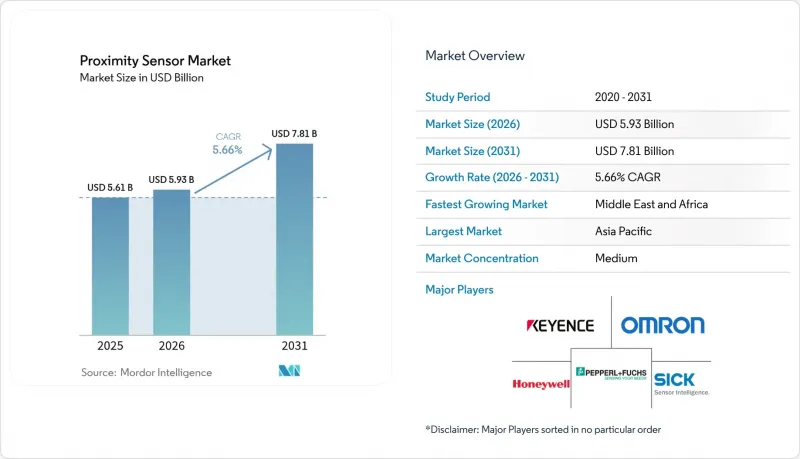
본 보고서는 기술별(유도식, 정전용량식 등), 제품 유형별(고정 거리형, 거리 조절 가능형), 감지 범위별(0-20mm, 20-40m, M, 40mm 초과), 외형(원통형, 기타), 출력 유형(디지털, 아날로그, IO-Link), 배선 방식(2선식, 기타), 최종 사용자 산업(자동차, 기타) 및 지역별로 분류되어 있습니다. 시장 예측은 금액(달러) 기준으로 제시되어 있습니다.
전 세계 근접 센서 시장 동향 및 인사이트
아시아 기존 공장에서 ‘인더스트리 4.0’ 주도의 개조 수요
중국, 베트남, 인도네시아의 제조업체들은 신규 공장 건설보다는 IO-Link 지원 근접 센서를 사용하여 기존 생산 라인을 업그레이드하는 것을 선호하며, 5G를 활용한 모니터링을 통해 15-20%의 효율 향상과 30%의 비용 절감을 실현하고 있습니다(gsma.com). PLC와의 호환성이 높은 핀 배치를 갖추면서도 클라우드 기반 진단 기능을 탑재한 드롭인형 원통형 장치를 제공하는 공급업체들이 개조 입찰을 주도하고 있습니다. 레거시 제어 시스템과의 호환성 덕분에 구매자는 장기간의 가동 중단을 피할 수 있으므로, 근접 센서 시장은 적어도 2028년까지 호황을 유지할 전망입니다.
자동차 OEM의 ISO 26262 인증 비접촉식 위치 감지 의무화
현재 유럽 및 미국의 자동차 프로그램에서는 ASIL C/D를 준수하는 유도형 선형 및 회전 센서가 지정되어 있으며, 미주 자기장에 민감한 홀 효과 디바이스는 점차 대체되고 있습니다. Melexis가 도입한 듀얼 다이 아키텍처는 12mm의 스트로크 범위에서 ±0.85%의 정확도를 실현하며, 브레이크, 페달, 스티어링 모듈을 위한 내장형 이중화 기능을 제공합니다(melexis.com). 인증 비용으로 인해 양극화된 공급 구조가 형성되면서, 중소기업은 지적 재산권(IP) 라이선싱을 받거나 시장에서 철수할 수밖에 없게 되어 근접 센서 시장의 통합이 더욱 가속화되고 있습니다.
유럽 내 유도형 센서의 BOM에 미치는 코일용 구리 가격 변동의 영향
구리 현물 가격이 3년 만에 최고치를 기록함에 따라 코일 비용이 최대 25% 상승하여, 이미 전기 요금 급등으로 어려움을 겪고 있는 독일과 이탈리아의 센서 제조업체들의 이익률을 압박하고 있습니다. 대형 벤더들은 헤지나 구리 공급의 수직 통합을 추진하고 있지만, 중소기업들은 분기별 가격표 개정에 직면하여 경쟁력이 저하되고 있습니다.
부문 분석
유도식 유닛은 2025년 매출의 34.60%를 차지하며, 근접 센서 시장 전체에 통합된 프레스 라인 및 CNC 기계의 금속 감지를 위한 사실상 표준 선택지로서의 입지를 공고히 하고 있습니다. 견고한 페라이트 코어 코일은 오일, 절삭 부스러기, 진동에 강하기 때문에 아시아태평양 공장의 사후 개조에 가장 적합합니다. 연평균 성장률(CAGR) 9.35%로 성장하고 있는 정전용량식 장치는 유도식 장치로는 감지할 수 없는 제약 업계 클린룸 내의 플라스틱 케이스나 액면 레벨을 현재 감지하고 있습니다. 각도 감지에는 홀 효과를, 존재 감지에는 정전용량식을 결합하는 하이브리드화 추세에 따라, 공급업체들은 설치를 간소화하고 SKU 수를 줄일 수 있는 다중 물리 ASIC 개발을 추진하고 있습니다.
정전용량식 센서의 채택이 가속화되고 있는 이유는 하나의 센서로 기계적 접촉 없이 유리, 수지, 또는 곡물의 레벨을 감지할 수 있으며, 식품 안전 규정을 준수하기 때문입니다. 광전식 SKU는 분진이 많은 컨베이어 위에서 10m의 감지 거리가 필요한 틈새 시장을 유지하고 있는 반면, 초음파식은 광학식으로는 감지할 수 없는 화학 약품 탱크에 대응하고 있습니다. 자기식 xMR 센서는 자기장 방향 제어에 밀리 단위 정밀도가 필요한 EV 트랙션 모터 분야에서 점유율을 확대되고 있습니다. 이러한 변화들이 맞물려 근접 센서 시장은 다양성과 탄력성을 유지하고 있습니다.
비용 효율을 중시하는 추세로 인해, 2025년 출하 대수의 59.30%를 고정 거리형 실린더가 차지했습니다. 연중 동일한 도어 패널을 생산하는 자동차 프레스 공장에서는 잘못된 재보정을 방지하기 위해 고정 임계값이 선호됩니다. 한편, 전자기기 조립 분야의 소량 생산으로 인해 IO-Link를 통한 파라미터 설정 기능을 갖춘 가변 거리형 모델의 연평균 성장률(CAGR)은 8.12%에 달했습니다. 생산 엔지니어들은 하드웨어를 교체하는 대신 온보드 펌웨어를 미세 조정함으로써 전환 시간을 대폭 단축하고 있습니다. 무인화(라이트 아웃) 운영으로 전환하는 공장에서는 스마트 가변 거리형 장치가 EQ 타임스탬프 및 사이클 카운트를 MES 대시보드로 전송하여 디지털 트윈을 심화시키는 동시에 근접 센서 시장의 인지도를 높이고 있습니다.
유지보수 팀은 하나의 조정 가능한 센서로 여러 지그 거리를 커버할 수 있어 예비 부품을 줄일 수 있으며, 이를 통해 높은 정가를 상쇄할 수 있다고 지적하고 있습니다. 각 공급업체들은 LED 가이드가 포함된 티칭 모드나 NFC를 통한 스마트폰 설정 기능으로 경쟁을 펼치며 사용 편의성을 한층 더 강화하고 있습니다. 장기적으로는 펌웨어를 통한 측정 범위 조정이 유연성이 높은 공장에서 표준 사양이 될 것으로 예측됩니다.
스마트폰용 픽 앤 플레이스 스테이지, 전기 모터 정류, 스냅핏 품질 검사를 통해 2025년에는 0-20mm 센서가 근접 센서 시장 규모의 44.40%를 계속 차지할 것으로 예측됩니다. 솔리드 스테이트 구조로 인한 견고성은 기계식 리미트 스위치를 능가하며, 오거절률을 낮춥니다. 그러나 창고 자동화, AMR(자율 이동 로봇), 팔레트 셔틀 시스템에서는 2미터 이상의 거리에서 직선 시야 내의 안전성이 요구되고 있어, 40mm를 초과하는 장치 시장은 연평균 성장률(CAGR) 6.95%로 확대되고 있습니다. 공급업체들은 안개 속에서도 4미터 거리까지 감지 가능한 증폭형 트랜시버와 빔 포밍 광학 시스템을 통해 이에 대응하고 있으며, LiDAR 및 레이더를 보완하여 로봇의 360° 인지 기능을 실현하고 있습니다.
인트라로지스틱스 분야에서는 장거리 근접 감지를 통해 고해상도 비전 시스템에 드는 비용을 부담하지 않고도 사각지대에서의 충돌을 피할 수 있습니다. 초음파와 광전식을 결합한 하이브리드형 센서가 시장에 등장하고 있으며, 거리 및 존재 감지를 하나의 SKU로 통합함으로써 고층 랙에서 발생하는 고장 지점이나 배선 작업의 부담을 경감시키고 있습니다.
지역별 분석
아시아태평양은 중국의 공장 디지털화 보조금, 일본의 로봇 수출 주도적 입지, 그리고 한국의 반도체 투자에 힘입어 2025년에도 근접 센서 시장 점유율 35.70%를 유지했습니다. 기존 설비(브라운필드) 라인에 IO-Link 센서를 사후 장착함으로써 신축 공사를 하지 않고도 생산량을 향상시킬 수 있으며, 지역의 설비 투자(CapEx) 제한에도 대응하고 있습니다. 부품 제조업체는 스마트폰 생산 거점 근처에 센서 조립 거점을 집약하여, 제품 수명 주기가 짧은 상황에서도 리드타임을 단축하고 있습니다. 각국 정부는 5G 프라이빗 네트워크에 대한 지원을 통해 실시간 품질 관리 루프를 뒷받침하는 센서 데이터의 백본을 구축하고 있습니다.
유럽은 여전히 프리미엄 고객 기반을 형성하고 있습니다. 독일의 Tier 1 공급업체는 스티어 바이 와이어(Steer-by-Wire)용으로 ASIL-D를 준수하는 유도형 엔코더를 요구하고 있으며, 프랑스의 항공우주 통합업체는 가혹한 터빈 베이 환경을 위해 ELDEC 사의 센서를 지정하고 있습니다. 구리 가격 변동이 지속되고 전기 요금도 높은 수준을 유지하고 있어 유럽의 부품 원가(BOM)가 상승하고 있으며, 일부 코일 권선 공정은 중부 유럽으로 이전되고 있는 반면, 연구 개발(R&D) 센터는 OEM 제조업체 근처에 유지되고 있습니다. 유럽 대륙의 ‘넷 제로 공장’ 추진은 스크랩 및 에너지 낭비를 줄이는 IO-Link 진단을 촉진하고 있으며, 근접 센서 시장 전반에 걸쳐 선진적인 이용 사례의 보급을 뒷받침하고 있습니다.
북미에서는 항공우주, 에너지, 그리고 급성장 중인 전기차(EV) 공급망에 집중된 견조하지만 성숙한 수요가 나타나고 있습니다. 미국의 전력망 현대화 프로그램은 차단기 위치나 밸브 상태를 모니터링하는 근접 센서의 새로운 틈새 시장을 개척하고 있습니다. 슈나이더 일렉트릭의 7억 달러 규모의 설비 투자는 공장에서 교정된 센서가 내장된 디지털화된 개폐 장치 및 배전반에 대한 국내 수요가 높음을 보여줍니다. 캐나다의 광업 자동화 및 멕시코의 자동차 조립 수출이 이 지역 수요를 더욱 심화시키고 있습니다.
중동은 7.18%라는 가장 높은 연평균 성장률(CAGR)을 보이고 있으며, 사우디아라비아의 석유화학 플랜트 및 유틸리티 플랜트에서는 사이트당 수백 개의 IO-Link 근접 노드를 갖춘 예측 유지보수 시스템이 도입되고 있습니다. 아프리카와 남미는 자동화 도입이 초기 단계에 있지만, 물류 및 식품 가공 플랜트를 통해 기반을 다지고 있어 전 세계 근접 센서 시장에 장기적인 성장 여지를 제공합니다.
기타 혜택:
- 엑셀 형식 시장 예측(ME) 시트
- 3개월간의 애널리스트 지원
자주 묻는 질문
목차
제1장 서론
제2장 조사 방법
제3장 주요 요약
제4장 시장 구도
제5장 시장 규모와 성장 예측
제6장 경쟁 구도
제7장 시장 기회와 향후 전망
LSH 26.09.08According to Mordor Intelligence, the proximity sensors market size is expected to grow from USD 5.61 billion in 2025 to USD 5.93 billion in 2026 and is forecast to reach USD 7.81 billion by 2031 at 5.66% CAGR over 2026-2031.
This report is Segmented by Technology (Inductive, Capacitive, and More), Product Type (Fixed-Distance, Adjustable-Distance), Sensing Range (0-20mm, 20-40m, M, Greater Than 40mm), Housing (Cylindrical, and More), Output Type (Digital, Analog, IO-Link), Channel Wiring (2-Wire, and More), End-User Industry (Automotive, and More), and Geography. The Market Forecasts are Provided in Terms of Value (USD).
Global Proximity Sensor Market Trends and Insights
Industry 4.0-led Retro-Fit Demand in Brownfield Asian Factories
Manufacturers across China, Vietnam, and Indonesia prefer upgrading existing lines with IO-Link-ready proximity sensors rather than building new plants, unlocking 15-20% efficiency gains and 30% cost cuts through 5G-enabled monitoring [gsma.com]. Suppliers offering drop-in cylindrical devices with PLC-friendly pinouts yet cloud-ready diagnostics dominate retro-fit tenders. Compatibility with legacy controls shields buyers from lengthy downtime, keeping the proximity sensors market buoyant until at least 2028.
Automotive OEM Mandates for ISO 26262-Certified Contactless Positioning
European and U.S. vehicle programs now specify inductive linear and rotary sensors qualified to ASIL C/D, displacing Hall-effect devices sensitive to stray fields. Dual-die architectures introduced by Melexis achieve +-0.85% accuracy over 12 mm strokes and offer built-in redundancy for brake, pedal, and steering modules [melexis.com]. Certification costs create a two-tier supply landscape, pushing smaller firms to license IP or exit, and further consolidating the proximity sensors market.
Coil-Copper Cost Volatility Impacting Inductive BOM in Europe
Three-year highs in copper spot prices raise coil costs by up to 25%, squeezing margins for German and Italian sensor producers already burdened by elevated electricity tariffs. Larger vendors hedge or vertically integrate copper supply, but smaller firms confront price-list resets quarterly, hampering competitiveness.
Other drivers and restraints analyzed in the detailed report include:
- Mini-LED/µLED Back-Light Integration in Smartphones (APAC)
- FAA & EASA Transition to Solid-State Landing-Gear Proximity Sensors
- EMC Compliance Failures in High-Power EV Inverters (US)
For complete list of drivers and restraints, kindly check the Table Of Contents.
Segment Analysis
Inductive units delivered 34.60% of 2025 revenue, validating their status as the de-facto choice for metal detection on press lines and CNC machines embedded across the proximity sensors market. Rugged ferrite-core coils endure oil, chips, and vibration, ideal for retro-fits in APAC factories. Capacitive devices, advancing at 9.35% CAGR, now sense plastic housings and fluid levels in pharmaceutical clean rooms where inductive devices fail. The hybridization trend-combining Hall-effect for angle and capacitive for presence-pushes suppliers toward multi-physics ASICs that simplify installation and reduce SKU count.
Capacitive adoption accelerates because one sensor can cover glass, resin, or grain level without mechanical contact, aligning with food-safety mandates. Photoelectric SKUs retain niches requiring 10 m targeting over dusty conveyors, while ultrasonic variants serve chemical vats impervious to optical methods. Magnetic xMR sensors gain share within EV traction motors needing millidegree precision for field-oriented control. Collectively, these transitions keep the proximity sensors market varied and resilient.
Skewing to cost efficiency, fixed-distance cylinders amassed 59.30% of 2025 shipments. Automotive stamping plants, running identical door panels year-round, favor fixed thresholds to avoid accidental recalibration. However, short batch runs in electronics assembly spark an 8.12% CAGR for adjustable-distance models equipped with IO-Link parameterization. Production engineers tweak on-board firmware rather than swapping hardware, slashing changeover times. In plants moving toward lights-out operation, smart adjustable devices feed EQ timestamps and cycle counts to MES dashboards, deepening digital twins and elevating the proximity sensors market profile.
Maintenance teams cite reduced spares when one adjustable sensor covers multiple jig distances, offsetting its higher list price. Suppliers compete on LED-guided teach modes and NFC smartphone setup, reinforcing ease of use. Long term, firmware-driven range tuning is expected to become the default in flexible factories.
Smartphone pick-and-place stages, electric-motor commutation, and snap-fit quality checks keep 0-20 mm sensors at 44.40% of proximity sensors market size in 2025. Their solid-state ruggedness beats mechanical limit switches and reduces false rejects. Yet warehouse automation, AMRs, and pallet-shuttle systems require line-of-sight safety at two-meter plus distances, lifting>40 mm devices at a 6.95% CAGR. Suppliers respond with amplified transceivers and beam-forming optics capable of 4 m detection even in fog, complementing LiDAR and radar for 360° robot perception.
In intralogistics, longer-range proximity avoids blind-spot collisions without the cost of high-resolution vision. Hybrid ultrasonic-photoelectric stacks enter this space, integrating distance and presence into one SKU, reducing points of failure and wiring labor in high-bay racking.
Complete Report Scope:
- By Technology
- Inductive
- Capacitive
- Photoelectric
- Magnetic (Hall-Effect and Reed)
- Ultrasonic
- Infra-Red and Others
- By Product Type
- Fixed-Distance Sensors
- Adjustable-Distance Sensors
- By Sensing Range
- 0 - 20 mm
- 20 - 40 mm
- Greater than 40 mm
- By Housing / Form Factor
- Cylindrical
- Rectangular
- Slot / Channel
- Miniature / PCB-Mount
- Ring and Through-Beam
- By Output Type
- Digital (NPN / PNP)
- Analog (0-10 V / 4-20 mA)
- IO-Link and Other Smart Interfaces
- By Channel Wiring
- 2-Wire AC/DC
- 3-Wire DC
- 4-Wire Complementary
- By End-user Industry
- Aerospace and Defense
- Automotive
- Industrial Automation and Robotics
- Consumer Electronics and Wearables
- Food and Beverage Processing
- Healthcare and Medical Devices
- Building Automation and Smart Infrastructure
- Other Industries (Mining, Agriculture, Marine)
- By Geography
- North America
- United States
- Canada
- Mexico
- Europe
- United Kingdom
- Germany
- France
- Italy
- Rest of Europe
- Asia-Pacific
- China
- Japan
- India
- South Korea
- Rest of Asia-Pacific
- Middle East
- Israel
- Saudi Arabia
- United Arab Emirates
- Turkey
- Rest of Middle East
- Africa
- South Africa
- Egypt
- Rest of Africa
- South America
- Brazil
- Argentina
- Rest of South America
- North America
Geography Analysis
Asia-Pacific retained 35.70% proximity sensors market share in 2025, buoyed by China's factory digitalization grants, Japan's robotics export leadership, and South Korea's semiconductor investments. Retro-fitting brownfield lines with IO-Link sensors boosts output without new buildings, aligning with local CapEx restrictions. Component makers co-locate sensor assembly near smartphone clusters, shrinking lead times amid tight product cycles. Governments subsidize 5G private networks, anchoring sensor data backbones that support real-time quality loops.
Europe remains a premium buyer base. German Tier-1s demand ASIL-D inductive encoders for steer-by-wire, while French aerospace integrators specify ELDEC sensors for harsh turbine bays. Continual copper price waves and high electricity tariffs raise European BOMs, nudging some coil-winding to Central Europe yet retaining R&D centers near OEMs. The continent's push for net-zero factories incentivizes IO-Link diagnostics that trim scrap and energy waste, reinforcing advanced use-case uptake across the proximity sensors market.
North America records steady but mature consumption, concentrated in aerospace, energy, and a burgeoning EV supply chain. U.S. energy grid modernization programs open niches for proximity sensors monitoring breaker position and valve status. Schneider Electric's USD 700 million cap-ex illustrates domestic appetite for digitized switchgear and panelboards that embed factory-calibrated sensors. Canada's mining automation and Mexico's auto assembly exports deepen regional demand.
The Middle East delivers the quickest 7.18% CAGR, with Saudi Arabia's petrochemical and utility plants installing predictive-maintenance suites featuring hundreds of IO-Link proximity nodes per site. Africa and South America, while early in automation adoption, lay groundwork through logistics and food-processing plants, offering long-tail upside to the global proximity sensors market.
- Keyence Corporation
- Omron Corporation
- Pepperl+Fuchs GmbH
- Sick AG
- Panasonic Holdings Corp.
- Honeywell International Inc.
- STMicroelectronics N.V.
- Schneider Electric SE
- Rockwell Automation Inc.
- IFM Electronic GmbH
- Turck Holding GmbH
- Datalogic SpA
- Delta Electronics Inc.
- Autonics Corporation
- Balluff GmbH
- Banner Engineering Corp.
- Texas Instruments Inc.
- Broadcom Inc.
- Littelfuse Inc.
- Baumer Group
- Vishay Intertechnology
- BorgWarner Inc.
- Allegro MicroSystems
- Leuze electronic GmbH
Additional Benefits:
- The market estimate (ME) sheet in Excel format
- 3 months of analyst support
TABLE OF CONTENTS
1 INTRODUCTION
- 1.1 Study Assumptions and Market Definition
- 1.2 Scope of the Study
2 RESEARCH METHODOLOGY
3 EXECUTIVE SUMMARY
4 MARKET LANDSCAPE
- 4.1 Market Overview
- 4.2 Market Drivers
- 4.2.1 Industry 4.0-led Retro-Fit Demand in Brownfield Asian Factories
- 4.2.2 Automotive OEM Mandates for ISO 26262-Certified Contactless Positioning
- 4.2.3 Mini-LED/LED Back-Light Integration in Smartphones (Asia-Pacific)
- 4.2.4 FAA and EASA Transition to Solid-State Landing-Gear Proximity Sensors
- 4.2.5 Building Automation and Smart Infrastructure IoT Integration
- 4.2.6 IO-Link Adoption in European Discrete Manufacturing Lines
- 4.3 Market Restraints
- 4.3.1 Coil-Copper Cost Volatility Impacting Inductive BOM in Europe
- 4.3.2 EMC Compliance Failures in High-Power EV Inverters (US)
- 4.3.3 Condensation-Driven False Trips in Food-Grade Photoelectric Sensors
- 4.3.4 ATEX-Zone Certification Lead-Times Delaying Middle-East Projects
- 4.4 Value / Supply-Chain Analysis
- 4.5 Regulatory Outlook (IEC 60947-5-2, ISO 13849)
- 4.6 Technological Outlook (Chip-level Hall, BAW, MEMS Hybrids)
- 4.7 Porter's Five Forces Analysis
- 4.7.1 Threat of New Entrants
- 4.7.2 Bargaining Power of Buyers
- 4.7.3 Bargaining Power of Suppliers
- 4.7.4 Threat of Substitute Products
- 4.7.5 Intensity of Competitive Rivalry
- 4.8 Investment and Funding Analysis
5 MARKET SIZE AND GROWTH FORECASTS (VALUE)
- 5.1 By Technology
- 5.1.1 Inductive
- 5.1.2 Capacitive
- 5.1.3 Photoelectric
- 5.1.4 Magnetic (Hall-Effect and Reed)
- 5.1.5 Ultrasonic
- 5.1.6 Infra-Red and Others
- 5.2 By Product Type
- 5.2.1 Fixed-Distance Sensors
- 5.2.2 Adjustable-Distance Sensors
- 5.3 By Sensing Range
- 5.3.1 0 - 20 mm
- 5.3.2 20 - 40 mm
- 5.3.3 Greater than 40 mm
- 5.4 By Housing / Form Factor
- 5.4.1 Cylindrical
- 5.4.2 Rectangular
- 5.4.3 Slot / Channel
- 5.4.4 Miniature / PCB-Mount
- 5.4.5 Ring and Through-Beam
- 5.5 By Output Type
- 5.5.1 Digital (NPN / PNP)
- 5.5.2 Analog (0-10 V / 4-20 mA)
- 5.5.3 IO-Link and Other Smart Interfaces
- 5.6 By Channel Wiring
- 5.6.1 2-Wire AC/DC
- 5.6.2 3-Wire DC
- 5.6.3 4-Wire Complementary
- 5.7 By End-user Industry
- 5.7.1 Aerospace and Defense
- 5.7.2 Automotive
- 5.7.3 Industrial Automation and Robotics
- 5.7.4 Consumer Electronics and Wearables
- 5.7.5 Food and Beverage Processing
- 5.7.6 Healthcare and Medical Devices
- 5.7.7 Building Automation and Smart Infrastructure
- 5.7.8 Other Industries (Mining, Agriculture, Marine)
- 5.8 By Geography
- 5.8.1 North America
- 5.8.1.1 United States
- 5.8.1.2 Canada
- 5.8.1.3 Mexico
- 5.8.2 Europe
- 5.8.2.1 United Kingdom
- 5.8.2.2 Germany
- 5.8.2.3 France
- 5.8.2.4 Italy
- 5.8.2.5 Rest of Europe
- 5.8.3 Asia-Pacific
- 5.8.3.1 China
- 5.8.3.2 Japan
- 5.8.3.3 India
- 5.8.3.4 South Korea
- 5.8.3.5 Rest of Asia-Pacific
- 5.8.4 Middle East
- 5.8.4.1 Israel
- 5.8.4.2 Saudi Arabia
- 5.8.4.3 United Arab Emirates
- 5.8.4.4 Turkey
- 5.8.4.5 Rest of Middle East
- 5.8.5 Africa
- 5.8.5.1 South Africa
- 5.8.5.2 Egypt
- 5.8.5.3 Rest of Africa
- 5.8.6 South America
- 5.8.6.1 Brazil
- 5.8.6.2 Argentina
- 5.8.6.3 Rest of South America
- 5.8.1 North America
6 COMPETITIVE LANDSCAPE
- 6.1 Market Concentration
- 6.2 Strategic Moves
- 6.3 Market Share Analysis
- 6.4 Company Profiles {(includes Global level Overview, Market level overview, Core Segments, Financials as available, Strategic Information, Market Rank/Share for key companies, Products and Services, and Recent Developments)}
- 6.4.1 Keyence Corporation
- 6.4.2 Omron Corporation
- 6.4.3 Pepperl+Fuchs GmbH
- 6.4.4 Sick AG
- 6.4.5 Panasonic Holdings Corp.
- 6.4.6 Honeywell International Inc.
- 6.4.7 STMicroelectronics N.V.
- 6.4.8 Schneider Electric SE
- 6.4.9 Rockwell Automation Inc.
- 6.4.10 IFM Electronic GmbH
- 6.4.11 Turck Holding GmbH
- 6.4.12 Datalogic SpA
- 6.4.13 Delta Electronics Inc.
- 6.4.14 Autonics Corporation
- 6.4.15 Balluff GmbH
- 6.4.16 Banner Engineering Corp.
- 6.4.17 Texas Instruments Inc.
- 6.4.18 Broadcom Inc.
- 6.4.19 Littelfuse Inc.
- 6.4.20 Baumer Group
- 6.4.21 Vishay Intertechnology
- 6.4.22 BorgWarner Inc.
- 6.4.23 Allegro MicroSystems
- 6.4.24 Leuze electronic GmbH
7 MARKET OPPORTUNITIES AND FUTURE OUTLOOK
- 7.1 White-Space and Unmet-Need Assessment


