|
시장보고서
상품코드
2121282
포름산 : 시장 점유율 분석, 업계 동향과 통계, 성장 예측(2026-2031년)Formic Acid - Market Share Analysis, Industry Trends & Statistics, Growth Forecasts (2026 - 2031) |
||||||
 Mordor Intelligence
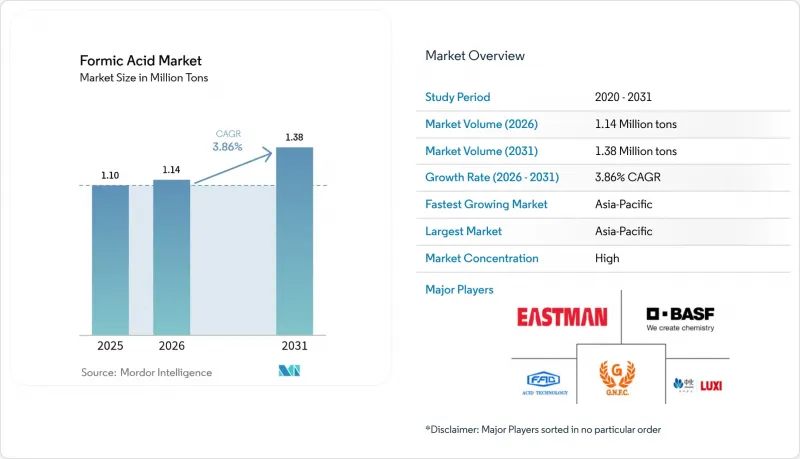
Mordor Intelligence에 따르면 포름산 시장 규모는 2025년 110만 톤에서 2026년에는 114만 톤으로 확대되고, 2026년부터 2031년까지 CAGR 3.86%를 기록하며 2031년에는 138만 톤에 달할 것으로 예측됩니다.
본 보고서는 용도별(사료·저장 목초용 첨가제, 가죽 무두질, 기타), 제조 방법별(메틸포름산염 가수분해, 카르보닐화 기술, 기타 제조 방법), 최종 이용 산업별(농업, 가죽·신발, 기타), 지역별(아시아태평양, 북미, 기타)로 분류되어 있습니다. 시장 예측은 톤 기준으로 제시되어 있습니다.
세계 포름산 시장의 동향 및 인사이트
사료 및 저장용 목초 첨가제에 대한 수요 증가
항생제를 사용하지 않는 축산에 대한 수요가 증가함에 따라, 포름산은 바람직한 보존제 및 항균제로서의 입지를 확립하고 있습니다. 가금류 사료에 4kg/t을 첨가함으로써, 포름산은 살모넬라균의 수를 검출 한계 이하로 감소시켜 식품 안전성을 확보함과 동시에 규제 준수를 강화할 수 있습니다. 유럽식품안전청(EFSA)은 돼지 사료에 최대 12,000mg/kg, 가금류 사료에 최대 10,000mg/kg까지 첨가를 허용하고 있으며, 이러한 법적 확실성이 도입을 가속화하고 있습니다. 이러한 요인들이 복합적으로 작용하여 사료 부문의 소비량은 포름산 시장 전체의 성장률을 상회하는 수준에 도달했습니다.
가죽·무두질 산업의 활발한 수요
고급 가죽 생산에서는 욕액의 pH를 3.8-4.2로 조정하기 위해 포름산이 사용되며, 이를 통해 크롬의 고정이 촉진되는 동시에 무기산에 비해 염분 부하를 줄일 수 있습니다. 세계 가죽 공급량의 상당 부분을 차지하는 중국과 인도의 제혁 공장에서는 순도 85% 이상의 포름산을 지정하는 사례가 늘어나고 있으며, 품질의 일관성을 보장할 수 있는 공급업체에게는 가격 프리미엄을 얻을 기회가 확대되고 있습니다.
메탄올 원료 가격 변동
메탄올은 포름산메틸의 가수분해 과정에서 생산 비용의 60-70%를 차지하기 때문에 천연가스에 연동된 가격 변동이 이익률을 압박하여 장기 공급 계약 체결을 어렵게 만들고 있습니다. 생산자들은 재생 가능 전력 가격이 계속 하락할 경우 원료 의존에서 벗어날 가능성이 있는 CO₂ 전기 환원 공정의 실증 시험을 실시하며, 리스크 헤지를 도모하고 있습니다.
부문별 분석
2025년에는 사료 및 저장용 목초 첨가제가 전 세계 물량의 36.62%를 차지하며, 이 부문이 포름산 시장 규모에서 가장 큰 점유율을 기록했습니다. 항생제 계열 성장 촉진제에 대한 규제로 인한 억제 효과에 힘입어, 이 점유율은 연평균 성장률(CAGR) 4.12%로 확대될 것으로 예측됩니다. 가금류 사료의 경우, 4kg/t의 배합 비율로 검출 가능한 살모넬라균을 제거할 수 있어 농업 종사자들의 신뢰와 소매업자의 수용도가 높아지고 있습니다. 가죽 무두질은 pH 조절 및 크롬 침투 촉진과 같은 포름산의 장점을 활용하여 여전히 2위 용도로 자리 잡고 있습니다. 한편, 섬유 공장에서는 염색욕의 완충 능력이 높이 평가되고 있습니다. 의약품 및 특수 화학제품에 대한 용도도 부상하고 있으며, 고순도가 요구되는 부문에서는 프리미엄 가격이 형성되고 있습니다.
성장 전망은 천연 고무 가공 분야로도 확대되고 있으며, 응고 속도 향상과 응집체의 인장 강도 향상을 목적으로 포름산이 채택되고 있습니다. 세척 및 스케일 제거는 더 강력한 무기산에 비해 환경에 미치는 영향이 적고, 광물 스케일을 용해하는 능력을 활용하고 있기 때문에 규모는 작지만 꾸준한 틈새 시장을 점유하고 있습니다. ‘SoftAcid’와 같이 안전성을 고려하여 설계된 제제를 통해 소규모 사업자로의 보급이 진행되고 있으며, 예측 기간 동안 수요가 더욱 증가할 가능성이 있습니다.
지역별 분석
2025년, 아시아태평양은 전 세계 소비량의 52.88%를 차지하며 포름산 시장 점유율에서 가장 큰 비중을 차지했습니다. 중국은 메탄올과 다운스트림 화학제품의 통합 생산 거점을 활용하여 비용 경쟁력을 확보하고, 해당 지역의 공급을 주도하고 있습니다. 인도의 생산자들은 수출 장려 정책과 국내 가죽 생산량 증가에 힘입어, 지역의 자급률을 높이기 위한 신규 공장을 건설하고 있습니다. 일본과 한국은 전자기기 및 의약품 합성을 위해 고순도 포름산을 조달하고 있는 반면, 인도네시아는 고무 산업의 수요 확대를 통해 추가 성장을 주도하고 있습니다.
북미는 2위 지역으로, 거대한 동물성 단백질 산업과 이산화탄소 활용에 관한 연구 개발에 대한 정부 자금 지원에 힘입어 성장하고 있습니다. 미국은 전기화학적 생산 설비의 시범 도입을 주도하고 있으며, 향후 10년 말까지 상업적 규모의 운영을 목표로 하고 있습니다. 캐나다의 수요는 주로 곡물 및 축산과 관련되어 있는 반면, 멕시코에서는 가죽 및 섬유 부문에서의 사용이 증가하고 있습니다.
유럽에서는 사료 및 화학제품에 대한 엄격한 규제와 적극적인 탈탄소화 목표가 맞물려 바이오 기반 공정에 대한 투자가 촉진되고 있습니다. EU의 수입 화학제품에 대한 반덤핑 조치는 경쟁을 심화시키는 동시에 현지 생산능력 확대를 촉진하고 있습니다. 남미의 성장은 브라질의 확대되는 축산 부문을 중심으로 전개되고 있으며, 중동에서는 특수 화학제품에 대한 투자를 촉진하는 경제 다각화 조치의 혜택을 받고 있습니다. 아시아가 수출을 확대하고 서방 국가들이 저탄소 공급망으로의 전환을 추진하는 가운데, 지역 간 무역 흐름은 유동적인 상태가 지속될 것으로 보입니다.
기타 혜택
- 엑셀 형식의 시장 예측(ME) 시트
- 3개월간 애널리스트의 지원
자주 묻는 질문
목차
제1장 소개
제2장 조사 방법
제3장 주요 요약
제4장 시장 구도
제5장 시장 규모와 성장 예측
제6장 경쟁 구도
제7장 시장 기회와 향후 전망
KSM 26.09.03According to Mordor Intelligence, the formic acid market size is expected to grow from 1.10 Million tons in 2025 to 1.14 Million tons in 2026 and is forecast to reach 1.38 Million tons by 2031 at 3.86% CAGR over 2026-2031.
This report is Segmented by Application (Animal Feed and Silage Additives, Leather Tanning, and More), Production Method (Methyl Formate Hydrolysis, Carbonylation Technology, and Other Production Methods), End-Use Industry (Agriculture, Leather and Footwear, and More) and Geography (Asia-Pacific, North America, and More). The Market Forecasts are Provided in Terms of Volume (tons).
Global Formic Acid Market Trends and Insights
Growing Demand for Animal Feed and Silage Additives
Demand for antibiotic-free livestock production has positioned formic acid as a preferred preservative and antimicrobial. At 4 kg/ton in poultry diets, the acid can drive Salmonella counts to undetectable levels, safeguarding food safety and reinforcing regulatory compliance. The European Food Safety Authority allows inclusion rates up to 12,000 mg/kg for pigs and 10,000 mg/kg for poultry, providing legal certainty that accelerates adoption. These factors collectively lift feed-segment consumption above overall formic acid market growth.
Substantial Demand from Leather and Tanning Industry
Premium leather production relies on formic acid to adjust bath pH to 3.8-4.2, accelerating chrome fixation while lowering salt loads compared with mineral acids. Chinese and Indian tanneries, which supply a sizable portion of global hides, increasingly specify >= 85% purity, opening price-premium opportunities for suppliers able to guarantee consistency.
Methanol Feedstock Price Volatility
Because methanol represents 60-70% of production costs in methyl formate hydrolysis, natural-gas-linked price swings compress margins and complicate long-term supply contracts. Producers are hedging by piloting CO2 electro-reduction routes that could break feedstock dependence if renewable power prices keep falling.
Other drivers and restraints analyzed in the detailed report include:
- Increasing Demand for Rubber Products
- Growing Adoption in Pharmaceutical Industry for Antibacterial Properties
- Risks Related to Corrosion and Handling
For complete list of drivers and restraints, kindly check the Table Of Contents.
Segment Analysis
Animal feed & silage additives controlled 36.62% of global volume in 2025, giving the segment the largest slice of formic acid market size. Supported by regulatory curbs on antibiotic growth promoters, this share is projected to widen at a 4.12% CAGR. In poultry rations, inclusion rates of 4 kg/ton eliminate detectable Salmonella, boosting farmer confidence and retailer acceptance. Leather tanning remains the second-largest application, capitalizing on the acid's pH control and chrome-penetration benefits, while textile mills value its dye-bath buffering capability. Pharmaceutical and specialty chemical uses are emerging, where high-purity requirements yield premium prices.
Growth prospects extend to natural rubber processing, which adopts formic acid for faster coagulation kinetics and higher aggregate tensile strength. Cleaning and descaling occupy a steady but smaller niche, leveraging the acid's mineral-scale dissolving power at lower environmental impact than stronger inorganic acids. Safety-engineered formulations such as SoftAcid broaden access among smaller operations, suggesting incremental demand upside over the forecast period.
Complete Report Scope:
- By Application
- Animal Feed and Silage Additives
- Leather Tanning
- Textile Dyeing and Finishing
- Intermediary in Pharmaceuticals and Chemicals
- Other Applications (Rubber and Latex Coagulation, Cleaning and Descaling Agents, etc.)
- By Production Method
- Methyl Formate Hydrolysis
- Carbonylation Technology
- Other Production Methods (Oxalic-acid Route, Fermentation/Bio-based Route)
- By End-use Industry
- Agriculture
- Leather and Footwear
- Textile
- Chemicals and Solvents
- Pharmaceuticals
- Rubber
- Others End User Industries (Oil and Gas, Food and Beverage, etc.)
- By Geography
- Asia-Pacific
- China
- India
- Japan
- South Korea
- Rest of Asia-Pacific
- North America
- United States
- Canada
- Mexico
- Europe
- Germany
- United Kingdom
- France
- Italy
- Rest of Europe
- South America
- Brazil
- Argentina
- Rest of South America
- Middle East and Africa
- Saudi Arabia
- South Africa
- Rest of Middle-East and Africa
- Asia-Pacific
Geography Analysis
Asia-Pacific held 52.88% of global consumption in 2025, giving the region the largest slice of formic acid market share. China dominates regional supply, leveraging integrated methanol and downstream chemical complexes to ensure cost competitiveness. India's producers, supported by export incentives and growing domestic leather output, are building new plants that lift regional self-sufficiency. Japan and South Korea source high-purity material for electronics and pharmaceutical synthesis, while Indonesia drives incremental growth through rubber-sector uptake.
North America is the second-largest region, propelled by a vast animal-protein sector and government funding for CO2-utilization R&D. The United States leads pilot deployment of electrochemical production units, eyeing commercial scale by decade-end. Canada's demand is tied mainly to grain and livestock production, whereas Mexico sees rising leather and textile usage.
Europe combines strict feed and chemical regulations with aggressive decarbonization targets, spurring investment in bio-based processes. EU anti-dumping measures on imported chemicals intensify competition and encourage local capacity expansion. South America's growth centers on Brazil's expanding livestock sector, while the Middle East benefits from diversification agendas that encourage specialty-chemical investments. Cross-regional trade flows will likely stay fluid as Asia grows exports and western regions pivot to low-carbon supply chains.
- BASF
- Eastman Chemical Company
- Gujarat Narmada Valley Fertilizers and Chemicals Ltd
- Luxi Chemical Group Co.,Ltd.
- Perstorp
- POLIOLI SpA
- Sintas Kurama Perdana
- Rashtriya Chemicals and Fertilizers Ltd
- Shandong Acid Technology Co., Ltd.
- Shandong Rongyue Chemical Co. Ltd
- Wuhan Ruisunny Chemical Co. Ltd
Additional Benefits:
- The market estimate (ME) sheet in Excel format
- 3 months of analyst support
TABLE OF CONTENTS
1 Introduction
- 1.1 Study Assumptions and Market Definition
- 1.2 Scope of the Study
2 Research Methodology
3 Executive Summary
4 Market Landscape
- 4.1 Market Overview
- 4.2 Market Drivers
- 4.2.1 Growing Demand for Animal Feed and Silage Additives
- 4.2.2 Substantial Demand from Leather and Tanning Industry
- 4.2.3 Increasing Demand for Rubber Products
- 4.2.4 Growing Adoption in Pharmaceutical Industry for Antibacterial Properties
- 4.2.5 Growing Advancements in its Bio-based Production Technologies
- 4.3 Market Restraints
- 4.3.1 Methanol feedstock price volatility
- 4.3.2 Risks Related to Corrosion and Handling
- 4.3.3 Rising Usage of bio-propionic acid as alternative
- 4.4 Value Chain Analysis
- 4.5 Porter's Five Forces
- 4.5.1 Bargaining Power of Suppliers
- 4.5.2 Bargaining Power of Buyers
- 4.5.3 Threat of New Entrants
- 4.5.4 Threat of Substitutes
- 4.5.5 Degree of Competition
- 4.6 Price Analysis
5 Market Size and Growth Forecasts (Volume)
- 5.1 By Application
- 5.1.1 Animal Feed and Silage Additives
- 5.1.2 Leather Tanning
- 5.1.3 Textile Dyeing and Finishing
- 5.1.4 Intermediary in Pharmaceuticals and Chemicals
- 5.1.5 Other Applications (Rubber and Latex Coagulation, Cleaning and Descaling Agents, etc.)
- 5.2 By Production Method
- 5.2.1 Methyl Formate Hydrolysis
- 5.2.2 Carbonylation Technology
- 5.2.3 Other Production Methods (Oxalic-acid Route, Fermentation/Bio-based Route)
- 5.3 By End-use Industry
- 5.3.1 Agriculture
- 5.3.2 Leather and Footwear
- 5.3.3 Textile
- 5.3.4 Chemicals and Solvents
- 5.3.5 Pharmaceuticals
- 5.3.6 Rubber
- 5.3.7 Others End User Industries (Oil and Gas, Food and Beverage, etc.)
- 5.4 By Geography
- 5.4.1 Asia-Pacific
- 5.4.1.1 China
- 5.4.1.2 India
- 5.4.1.3 Japan
- 5.4.1.4 South Korea
- 5.4.1.5 Rest of Asia-Pacific
- 5.4.2 North America
- 5.4.2.1 United States
- 5.4.2.2 Canada
- 5.4.2.3 Mexico
- 5.4.3 Europe
- 5.4.3.1 Germany
- 5.4.3.2 United Kingdom
- 5.4.3.3 France
- 5.4.3.4 Italy
- 5.4.3.5 Rest of Europe
- 5.4.4 South America
- 5.4.4.1 Brazil
- 5.4.4.2 Argentina
- 5.4.4.3 Rest of South America
- 5.4.5 Middle East and Africa
- 5.4.5.1 Saudi Arabia
- 5.4.5.2 South Africa
- 5.4.5.3 Rest of Middle-East and Africa
- 5.4.1 Asia-Pacific
6 Competitive Landscape
- 6.1 Market Concentration
- 6.2 Strategic Moves
- 6.3 Market Share (%)/Ranking Analysis
- 6.4 Company Profiles (includes Global level Overview, Market level overview, Core Segments, Financials as available, Strategic Information, Market Rank/Share for key companies, Products and Services, and Recent Developments)
- 6.4.1 BASF
- 6.4.2 Eastman Chemical Company
- 6.4.3 Gujarat Narmada Valley Fertilizers and Chemicals Ltd
- 6.4.4 Luxi Chemical Group Co.,Ltd.
- 6.4.5 Perstorp
- 6.4.6 POLIOLI SpA
- 6.4.7 Sintas Kurama Perdana
- 6.4.8 Rashtriya Chemicals and Fertilizers Ltd
- 6.4.9 Shandong Acid Technology Co., Ltd.
- 6.4.10 Shandong Rongyue Chemical Co. Ltd
- 6.4.11 Wuhan Ruisunny Chemical Co. Ltd
7 Market Opportunities and Future Outlook
- 7.1 White-space and Unmet-need Assessment
- 7.2 Sustainable Use of Formic Acid in Fuel Cell